Problem-based
  learning
       ed 675
   Michelle Greer
Vocabulary


• Inquiry
• Problem-based Learning (PBL)
• Web 2.0
• Scaffolding (hard and soft)
Purpose

• The purpose of this investigation is to examine a
  sixth grade science classroom at Clark Middle
  School, in Anchorage, Alaska, during a Problem-
  based Learning unit and more specifically, student
  collaboration using Web 2.0 tools. This study
  focuses on whether Problem-based Learning is
  beneficial at the middle school level and
  determines whether Web 2.0 tools can be used as a
  method of scaffolding for collaboration among
  students.
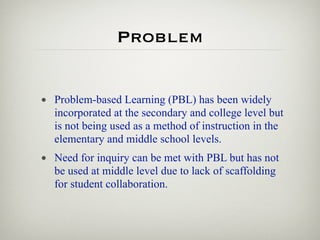
Problem


• Problem-based Learning (PBL) has been widely
  incorporated at the secondary and college level but
  is not being used as a method of instruction in the
  elementary and middle school levels.
• Need for inquiry can be met with PBL but has not
  be used at middle level due to lack of scaffolding
  for student collaboration.
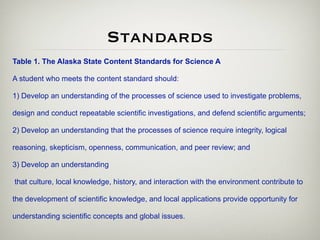
Standards
Table 1. The Alaska State Content Standards for Science A

A student who meets the content standard should:

1) Develop an understanding of the processes of science used to investigate problems,

design and conduct repeatable scientific investigations, and defend scientific arguments;

2) Develop an understanding that the processes of science require integrity, logical

reasoning, skepticism, openness, communication, and peer review; and

3) Develop an understanding

that culture, local knowledge, history, and interaction with the environment contribute to

the development of scientific knowledge, and local applications provide opportunity for

understanding scientific concepts and global issues.
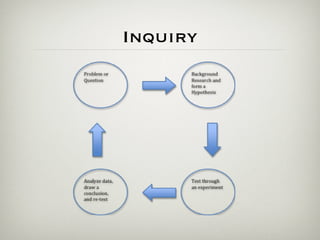
Inquiry
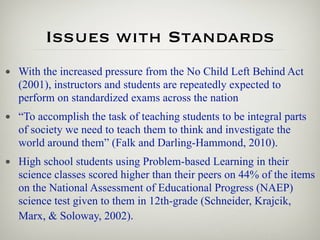
Issues with Standards
• With the increased pressure from the No Child Left Behind Act
  (2001), instructors and students are repeatedly expected to
  perform on standardized exams across the nation
• “To accomplish the task of teaching students to be integral parts
  of society we need to teach them to think and investigate the
  world around them” (Falk and Darling-Hammond, 2010).
• High school students using Problem-based Learning in their
  science classes scored higher than their peers on 44% of the items
  on the National Assessment of Educational Progress (NAEP)
  science test given to them in 12th-grade (Schneider, Krajcik,
  Marx, & Soloway, 2002).
Constructivism
• “A constructivist mode of teaching incorporates either students’
  prior knowledge and experiences or a class’ shared experience
  allowing the student to build scientific concepts upon that
  foundation” (Ashcraft, 2006)
• “Students today learn more effectively in pedagogical practices
  that emphasize holistic thinking, active learning, visual media and
  problem-solving “ (Lee and Breitenberg, 2010).
• “From a very early age, children interact with their environment,
  ask questions, and seek ways to answer those questions.” (NSTA
  2004)
PBL
Table 2. Project-based Learning Can Enable Students

1) To construct an extensive and flexible knowledge base

2) To develop effective problem-solving skills

3) To develop self-directed, lifelong learning skills

4) To become effective collaborators

5) To become intrinsically motivated to learn
Collaboration
• Scaffolding in PBL “support collaborative knowledge
  construction, and can change how students interact with each
  other through transformation of the process and students’
  articulation of thoughts” (Bell, 2010)
• Belland (2009) found that using hard scaffolds helped middle
  school students when deciding whether an argument was good or
  bad.
• Clark and Sampson (2007) also found that hard scaffolding is
  helpful when teaching students how to problem solve.
Web 2.0
• Web 2.0 technology such as blogs, wikis, Google
  applications, and podcasts are known as social software
  because they allow users to collaborate while designing
  content that is open to the public (Chao, 2007)
• The first wiki was created in 1994 for making the exchange
  of ideas between programmers easier (Chao, 2007).
• Ching, Carter and Yasmin concluded from their study on
  fourth and fifth grade students (n=63) benefited from
  collaboration during inquiry using technology for 10 weeks.
Conclusion

• There is a need for Inquiry
• There are standards for Inquiry
• Inquiry is not being met, but could with
  PBL.
• Further research (aka mine) should be
  done to examine if hard scaffolds can
  aid in student collaboration during

Problem-based Learning

  • 1.
    Problem-based learning ed 675 Michelle Greer
  • 2.
    Vocabulary • Inquiry • Problem-basedLearning (PBL) • Web 2.0 • Scaffolding (hard and soft)
  • 3.
    Purpose • The purposeof this investigation is to examine a sixth grade science classroom at Clark Middle School, in Anchorage, Alaska, during a Problem- based Learning unit and more specifically, student collaboration using Web 2.0 tools. This study focuses on whether Problem-based Learning is beneficial at the middle school level and determines whether Web 2.0 tools can be used as a method of scaffolding for collaboration among students.
  • 4.
    Problem • Problem-based Learning(PBL) has been widely incorporated at the secondary and college level but is not being used as a method of instruction in the elementary and middle school levels. • Need for inquiry can be met with PBL but has not be used at middle level due to lack of scaffolding for student collaboration.
  • 5.
    Standards Table 1. TheAlaska State Content Standards for Science A A student who meets the content standard should: 1) Develop an understanding of the processes of science used to investigate problems, design and conduct repeatable scientific investigations, and defend scientific arguments; 2) Develop an understanding that the processes of science require integrity, logical reasoning, skepticism, openness, communication, and peer review; and 3) Develop an understanding that culture, local knowledge, history, and interaction with the environment contribute to the development of scientific knowledge, and local applications provide opportunity for understanding scientific concepts and global issues.
  • 6.
  • 7.
    Issues with Standards •With the increased pressure from the No Child Left Behind Act (2001), instructors and students are repeatedly expected to perform on standardized exams across the nation • “To accomplish the task of teaching students to be integral parts of society we need to teach them to think and investigate the world around them” (Falk and Darling-Hammond, 2010). • High school students using Problem-based Learning in their science classes scored higher than their peers on 44% of the items on the National Assessment of Educational Progress (NAEP) science test given to them in 12th-grade (Schneider, Krajcik, Marx, & Soloway, 2002).
  • 8.
    Constructivism • “A constructivistmode of teaching incorporates either students’ prior knowledge and experiences or a class’ shared experience allowing the student to build scientific concepts upon that foundation” (Ashcraft, 2006) • “Students today learn more effectively in pedagogical practices that emphasize holistic thinking, active learning, visual media and problem-solving “ (Lee and Breitenberg, 2010). • “From a very early age, children interact with their environment, ask questions, and seek ways to answer those questions.” (NSTA 2004)
  • 9.
    PBL Table 2. Project-basedLearning Can Enable Students 1) To construct an extensive and flexible knowledge base 2) To develop effective problem-solving skills 3) To develop self-directed, lifelong learning skills 4) To become effective collaborators 5) To become intrinsically motivated to learn
  • 10.
    Collaboration • Scaffolding inPBL “support collaborative knowledge construction, and can change how students interact with each other through transformation of the process and students’ articulation of thoughts” (Bell, 2010) • Belland (2009) found that using hard scaffolds helped middle school students when deciding whether an argument was good or bad. • Clark and Sampson (2007) also found that hard scaffolding is helpful when teaching students how to problem solve.
  • 11.
    Web 2.0 • Web2.0 technology such as blogs, wikis, Google applications, and podcasts are known as social software because they allow users to collaborate while designing content that is open to the public (Chao, 2007) • The first wiki was created in 1994 for making the exchange of ideas between programmers easier (Chao, 2007). • Ching, Carter and Yasmin concluded from their study on fourth and fifth grade students (n=63) benefited from collaboration during inquiry using technology for 10 weeks.
  • 12.
    Conclusion • There isa need for Inquiry • There are standards for Inquiry • Inquiry is not being met, but could with PBL. • Further research (aka mine) should be done to examine if hard scaffolds can aid in student collaboration during

Editor's Notes