• The Student
• What is Educational
Technology?
• The Roles of Educational Technology
In Learning
• The Student after Educational
Technology
I am Claire
Antonette D. Peras, 19
years old. Currently
studying at Cebu
Technological University
– Moalboal Campus
taking up Bachelor in
Elementary Education
Major in Content
Education.
 It is the art or craft of responding to our
educational needs.
Educational Technology consists of the
designs and environments that engage
learners… and reliable techniques or method for
engaging learning such as cognitive learning
strategies and critical thinking skills.(David H.
Jonassen)
Educational Technology is a field study which is concerned with the practice of
using educational methods and resources for the ultimate goal of facilitating the learning
process. As a field, it operated within the total field of education. (Lucido and Borabo,
1977
Educatioanl Technology is a profession like teaching. It is made up of organized
effort to implement the theory, intellectual technique and practical application of
educational technology. (David H. Jonassen, 1999)
Educational Technology is a “complex, integrated process involving people,
procedures, ideas, devices, and organization for analyzing problems and devising,
implementing, evaluating and managing solutions to those problems involved in
all aspects of human learning”. (Association for Educational Communications and
Technology)
•Technology serves as source and presenter of knowledge.
•It is assumed that “knowledge is embedded in the technology and the
technology presents that knowledge to a students”.
•Technology like computers is seen as productivity tool.
•The learner learns from the technology and the technology serves
as a TEACHER.
•Educational Technology serves as learning
tools to learn with.
•It engages learners in active, constructive,
intentional, authentic and cooperative learning.
•It provides opportunities for technology and
learner interaction for meaningful learning.
• TRADITIONAL WAY
i.e. as delivery vehicles for
instructional lessons
• CONSTRUCTIVIST WAY
i.e. as partner in the
learning process
1.Technology as tools to support
knowledge construction:
For representing learner‘s ideas,
understanding, and beliefs
For producing organized, multimedia
knowledge bases by learners.
For representing and simulating meaningful real-
world problems and
situations and contexts
For representing beliefs, perspectives,
arguments and stories of others
For defining a safe, controllable problem space
for student thinking
2. Technology as context to
support learning-by-doing:
3. Technology as information
vehicles for exploring knowledge to
support learning-by-constructing:
For accessing needed information
For comparing perspectives, beliefs
and world views
4.Technology as a social
medium to support learning by
conversing:
For collaborating with others
For discussing, arguing and building consensus
among members of a community
For supporting discourse among knowledge-
building communities
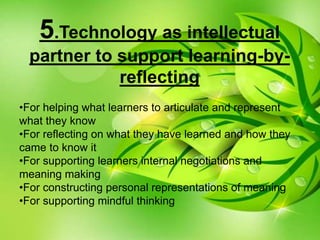
5.Technology as intellectual
partner to support learning-by-
reflecting
•For helping what learners to articulate and represent
what they know
•For reflecting on what they have learned and how they
came to know it
•For supporting learners internal negotiations and
meaning making
•For constructing personal representations of meaning
•For supporting mindful thinking
With Educational Technology, one could learn more
about computers – not only merely about computer
itself but with how this thing could be very useful in our
daily lives. It will serve as an eye opener and mind
booster on making things work more effectively.
Technology could be a very effective and convenient
tool in letting younger students gain and received the
ideas and knowledge we want to impart to them since
the younger generations today belong to the 21st
century learners. They are more engaged with the
modern life as well as the latest gadgets invented by
the experts. We should help them realize that these
valuable things are not just for fun but could also be a
great help in their learning and development.
portfolio in educational technology 1 & 2

portfolio in educational technology 1 & 2

  • 2.
    • The Student •What is Educational Technology? • The Roles of Educational Technology In Learning • The Student after Educational Technology
  • 3.
    I am Claire AntonetteD. Peras, 19 years old. Currently studying at Cebu Technological University – Moalboal Campus taking up Bachelor in Elementary Education Major in Content Education.
  • 4.
     It isthe art or craft of responding to our educational needs. Educational Technology consists of the designs and environments that engage learners… and reliable techniques or method for engaging learning such as cognitive learning strategies and critical thinking skills.(David H. Jonassen)
  • 5.
    Educational Technology isa field study which is concerned with the practice of using educational methods and resources for the ultimate goal of facilitating the learning process. As a field, it operated within the total field of education. (Lucido and Borabo, 1977 Educatioanl Technology is a profession like teaching. It is made up of organized effort to implement the theory, intellectual technique and practical application of educational technology. (David H. Jonassen, 1999) Educational Technology is a “complex, integrated process involving people, procedures, ideas, devices, and organization for analyzing problems and devising, implementing, evaluating and managing solutions to those problems involved in all aspects of human learning”. (Association for Educational Communications and Technology)
  • 7.
    •Technology serves assource and presenter of knowledge. •It is assumed that “knowledge is embedded in the technology and the technology presents that knowledge to a students”. •Technology like computers is seen as productivity tool. •The learner learns from the technology and the technology serves as a TEACHER.
  • 8.
    •Educational Technology servesas learning tools to learn with. •It engages learners in active, constructive, intentional, authentic and cooperative learning. •It provides opportunities for technology and learner interaction for meaningful learning.
  • 9.
    • TRADITIONAL WAY i.e.as delivery vehicles for instructional lessons • CONSTRUCTIVIST WAY i.e. as partner in the learning process
  • 11.
    1.Technology as toolsto support knowledge construction: For representing learner‘s ideas, understanding, and beliefs For producing organized, multimedia knowledge bases by learners.
  • 12.
    For representing andsimulating meaningful real- world problems and situations and contexts For representing beliefs, perspectives, arguments and stories of others For defining a safe, controllable problem space for student thinking 2. Technology as context to support learning-by-doing:
  • 13.
    3. Technology asinformation vehicles for exploring knowledge to support learning-by-constructing: For accessing needed information For comparing perspectives, beliefs and world views
  • 14.
    4.Technology as asocial medium to support learning by conversing: For collaborating with others For discussing, arguing and building consensus among members of a community For supporting discourse among knowledge- building communities
  • 15.
    5.Technology as intellectual partnerto support learning-by- reflecting •For helping what learners to articulate and represent what they know •For reflecting on what they have learned and how they came to know it •For supporting learners internal negotiations and meaning making •For constructing personal representations of meaning •For supporting mindful thinking
  • 17.
    With Educational Technology,one could learn more about computers – not only merely about computer itself but with how this thing could be very useful in our daily lives. It will serve as an eye opener and mind booster on making things work more effectively. Technology could be a very effective and convenient tool in letting younger students gain and received the ideas and knowledge we want to impart to them since the younger generations today belong to the 21st century learners. They are more engaged with the modern life as well as the latest gadgets invented by the experts. We should help them realize that these valuable things are not just for fun but could also be a great help in their learning and development.
Editor's Notes