Overview
 API vs Excipients difference
 Tablet manufacturing process
 Tablet excipients name
 Flow chart of Syrup preparation
 Excipients of Syrup
 The Ophthalmic production
 Common API use in Ophthalmic product
 Excipient uses in Ophthalmic
 Tablet Coating
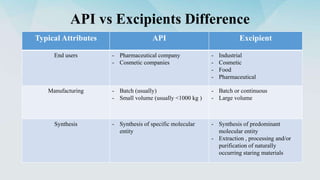
API vs Excipients Difference
Typical Attributes API Excipient
End users - Pharmaceutical company
- Cosmetic companies
- Industrial
- Cosmetic
- Food
- Pharmaceutical
Manufacturing - Batch (usually)
- Small volume (usually <1000 kg )
- Batch or continuous
- Large volume
Synthesis - Synthesis of specific molecular
entity
- Synthesis of predominant
molecular entity
- Extraction , processing and/or
purification of naturally
occurring staring materials
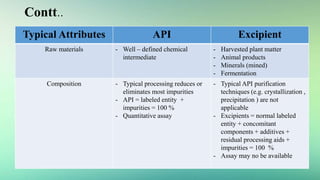
Contt..
Typical Attributes API Excipient
Raw materials - Well – defined chemical
intermediate
- Harvested plant matter
- Animal products
- Minerals (mined)
- Fermentation
Composition - Typical processing reduces or
eliminates most impurities
- API = labeled entity +
impurities = 100 %
- Quantitative assay
- Typical API purification
techniques (e.g. crystallization ,
precipitation ) are not
applicable
- Excipients = normal labeled
entity + concomitant
components + additives +
residual processing aids +
impurities = 100 %
- Assay may no be available
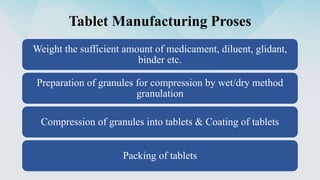
Tablet Manufacturing Proses
Weight the sufficient amount of medicament, diluent, glidant,
binder etc.
Preparation of granules for compression by wet/dry method
granulation
Compression of granules into tablets & Coating of tablets
Packing of tablets
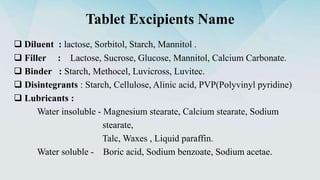
Tablet Excipients Name
 Diluent : lactose, Sorbitol, Starch, Mannitol .
 Filler : Lactose, Sucrose, Glucose, Mannitol, Calcium Carbonate.
 Binder : Starch, Methocel, Luvicross, Luvitec.
 Disintegrants : Starch, Cellulose, Alinic acid, PVP(Polyvinyl pyridine)
 Lubricants :
Water insoluble - Magnesium stearate, Calcium stearate, Sodium
stearate,
Talc, Waxes , Liquid paraffin.
Water soluble - Boric acid, Sodium benzoate, Sodium acetae.
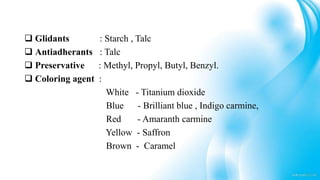
 Glidants : Starch , Talc
 Antiadherants : Talc
 Preservative : Methyl, Propyl, Butyl, Benzyl.
 Coloring agent :
White - Titanium dioxide
Blue - Brilliant blue , Indigo carmine,
Red - Amaranth carmine
Yellow - Saffron
Brown - Caramel
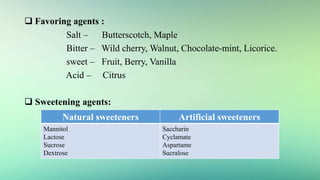
 Favoring agents :
Salt – Butterscotch, Maple
Bitter – Wild cherry, Walnut, Chocolate-mint, Licorice.
sweet – Fruit, Berry, Vanilla
Acid – Citrus
 Sweetening agents:
Natural sweeteners Artificial sweeteners
Mannitol
Lactose
Sucrose
Dextrose
Saccharin
Cyclamate
Aspartame
Sucralose
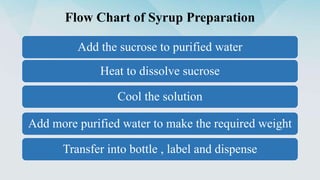
Flow Chart of Syrup Preparation
Add the sucrose to purified water
Heat to dissolve sucrose
Cool the solution
Add more purified water to make the required weight
Transfer into bottle , label and dispense
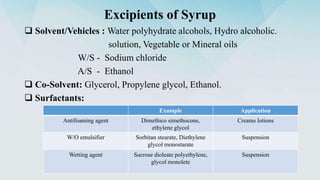
Excipients of Syrup
 Solvent/Vehicles : Water polyhydrate alcohols, Hydro alcoholic.
solution, Vegetable or Mineral oils
W/S - Sodium chloride
A/S - Ethanol
 Co-Solvent: Glycerol, Propylene glycol, Ethanol.
 Surfactants:
Example Application
Antifoaming agent Dimethico simethocone,
ethylene glycol
Creams lotions
W/O emulsifier Sorbitan stearate, Diethylene
glycol monostarate
Suspension
Wetting agent Sucrose dioleate polyethylene,
glycol monolete
Suspension
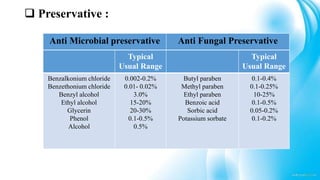
 Preservative :
Anti Microbial preservative Anti Fungal Preservative
Typical
Usual Range
Typical
Usual Range
Benzalkonium chloride
Benzethonium chloride
Benzyl alcohol
Ethyl alcohol
Glycerin
Phenol
Alcohol
0.002-0.2%
0.01- 0.02%
3.0%
15-20%
20-30%
0.1-0.5%
0.5%
Butyl paraben
Methyl paraben
Ethyl paraben
Benzoic acid
Sorbic acid
Potassium sorbate
0.1-0.4%
0.1-0.25%
10-25%
0.1-0.5%
0.05-0.2%
0.1-0.2%
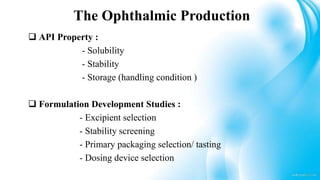
The Ophthalmic Production
 API Property :
- Solubility
- Stability
- Storage (handling condition )
 Formulation Development Studies :
- Excipient selection
- Stability screening
- Primary packaging selection/ tasting
- Dosing device selection
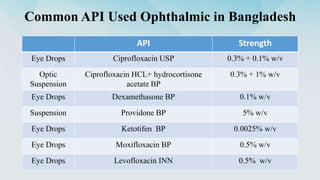
Common API Used Ophthalmic in Bangladesh
API Strength
Eye Drops Ciprofloxacin USP 0.3% + 0.1% w/v
Optic
Suspension
Ciprofloxacin HCL+ hydrocortisone
acetate BP
0.3% + 1% w/v
Eye Drops Dexamethasone BP 0.1% w/v
Suspension Providone BP 5% w/v
Eye Drops Ketotifen BP 0.0025% w/v
Eye Drops Moxifloxacin BP 0.5% w/v
Eye Drops Levofloxacin INN 0.5% w/v
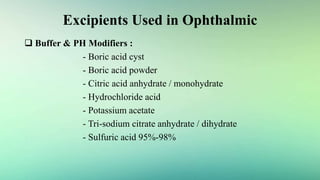
Excipients Used in Ophthalmic
 Buffer & PH Modifiers :
- Boric acid cyst
- Boric acid powder
- Citric acid anhydrate / monohydrate
- Hydrochloride acid
- Potassium acetate
- Tri-sodium citrate anhydrate / dihydrate
- Sulfuric acid 95%-98%
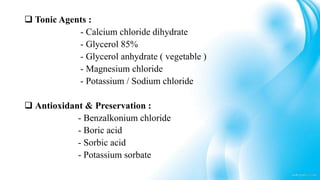
 Tonic Agents :
- Calcium chloride dihydrate
- Glycerol 85%
- Glycerol anhydrate ( vegetable )
- Magnesium chloride
- Potassium / Sodium chloride
 Antioxidant & Preservation :
- Benzalkonium chloride
- Boric acid
- Sorbic acid
- Potassium sorbate
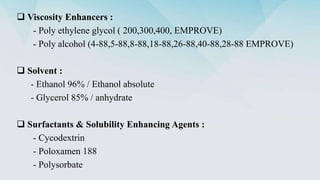
 Viscosity Enhancers :
- Poly ethylene glycol ( 200,300,400, EMPROVE)
- Poly alcohol (4-88,5-88,8-88,18-88,26-88,40-88,28-88 EMPROVE)
 Solvent :
- Ethanol 96% / Ethanol absolute
- Glycerol 85% / anhydrate
 Surfactants & Solubility Enhancing Agents :
- Cycodextrin
- Poloxamen 188
- Polysorbate
Tablet Coating
A tablet coating is a covering over a tablet , used to mask the task,
make it easier to swallow or protect the active medication inside .
Tablet coating with mixture of various substances such as resins ,
gums , inactive and insoluble fillers, sugars, waxes etc.
 Types of Coating
- Sugar costing
- Film coating
- Enteric coating
- Controlled release coating
- Specialized coating
 Sugar Coating
Sugar coating is the most conventional multistep coating
process.
As the name suggests this process involves application of
sugar (sucrose) based coating solution to the tablets.
 Raw Material for Sugar Coating :
- Sugar & its Substituents – Glucose , lactose , isomalt,
sugar, sugar alcohol.
- Binder – Acacia , gelatin, PVP( polyvinyl pyrolidone)
- Coloring Agents – Water soluble ( dyes)
Water insoluble ( lakes)
- Anti Adherents – Talcum , colloidal silica.
- Fillers – CaCO3 ( calcium carbonate ),
CaSO4 ( Calcium sulfate ) ,
starch , talcum ,
TiO2 ( titanium dioxide)
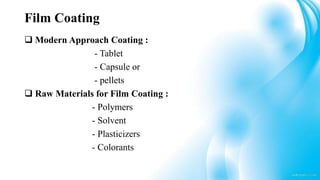
Film Coating
 Modern Approach Coating :
- Tablet
- Capsule or
- pellets
 Raw Materials for Film Coating :
- Polymers
- Solvent
- Plasticizers
- Colorants
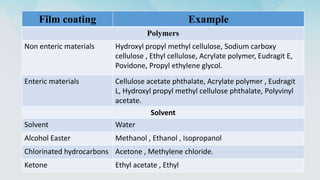
Film coating Example
Polymers
Non enteric materials Hydroxyl propyl methyl cellulose, Sodium carboxy
cellulose , Ethyl cellulose, Acrylate polymer, Eudragit E,
Povidone, Propyl ethylene glycol.
Enteric materials Cellulose acetate phthalate, Acrylate polymer , Eudragit
L, Hydroxyl propyl methyl cellulose phthalate, Polyvinyl
acetate.
Solvent
Solvent Water
Alcohol Easter Methanol , Ethanol , Isopropanol
Chlorinated hydrocarbons Acetone , Methylene chloride.
Ketone Ethyl acetate , Ethyl
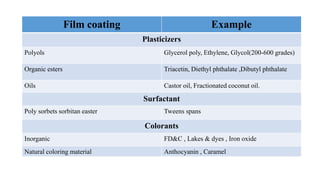
Film coating Example
Plasticizers
Polyols Glycerol poly, Ethylene, Glycol(200-600 grades)
Organic esters Triacetin, Diethyl phthalate ,Dibutyl phthalate
Oils Castor oil, Fractionated coconut oil.
Surfactant
Poly sorbets sorbitan easter Tweens spans
Colorants
Inorganic FD&C , Lakes & dyes , Iron oxide
Natural coloring material Anthocyanin , Caramel
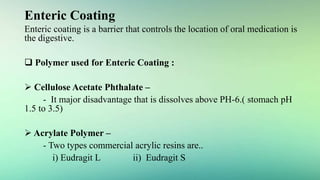
Enteric Coating
Enteric coating is a barrier that controls the location of oral medication is
the digestive.
 Polymer used for Enteric Coating :
 Cellulose Acetate Phthalate –
- It major disadvantage that is dissolves above PH-6.( stomach pH
1.5 to 3.5)
 Acrylate Polymer –
- Two types commercial acrylic resins are..
i) Eudragit L ii) Eudragit S
• Eudragit L is available as an organic solution ( isopropanol) , solid or
aqueous dispersion .
• Eudragit S is available only as organic solution and solid.
 Hydroxyproyl Methylcellous Phthalate (HPMCP)
- HPMCP – 55 (HP 55)
- HPMCP – 55s
- HPMCP 50 ( HP-50)
 Polyvinyl Acetate Phthalate ( PVAP)
THANK YOU

API & Excipients.pptx

  • 1.
    Overview  API vsExcipients difference  Tablet manufacturing process  Tablet excipients name  Flow chart of Syrup preparation  Excipients of Syrup  The Ophthalmic production  Common API use in Ophthalmic product  Excipient uses in Ophthalmic  Tablet Coating
  • 2.
    API vs ExcipientsDifference Typical Attributes API Excipient End users - Pharmaceutical company - Cosmetic companies - Industrial - Cosmetic - Food - Pharmaceutical Manufacturing - Batch (usually) - Small volume (usually <1000 kg ) - Batch or continuous - Large volume Synthesis - Synthesis of specific molecular entity - Synthesis of predominant molecular entity - Extraction , processing and/or purification of naturally occurring staring materials
  • 3.
    Contt.. Typical Attributes APIExcipient Raw materials - Well – defined chemical intermediate - Harvested plant matter - Animal products - Minerals (mined) - Fermentation Composition - Typical processing reduces or eliminates most impurities - API = labeled entity + impurities = 100 % - Quantitative assay - Typical API purification techniques (e.g. crystallization , precipitation ) are not applicable - Excipients = normal labeled entity + concomitant components + additives + residual processing aids + impurities = 100 % - Assay may no be available
  • 4.
    Tablet Manufacturing Proses Weightthe sufficient amount of medicament, diluent, glidant, binder etc. Preparation of granules for compression by wet/dry method granulation Compression of granules into tablets & Coating of tablets Packing of tablets
  • 5.
    Tablet Excipients Name Diluent : lactose, Sorbitol, Starch, Mannitol .  Filler : Lactose, Sucrose, Glucose, Mannitol, Calcium Carbonate.  Binder : Starch, Methocel, Luvicross, Luvitec.  Disintegrants : Starch, Cellulose, Alinic acid, PVP(Polyvinyl pyridine)  Lubricants : Water insoluble - Magnesium stearate, Calcium stearate, Sodium stearate, Talc, Waxes , Liquid paraffin. Water soluble - Boric acid, Sodium benzoate, Sodium acetae.
  • 6.
     Glidants :Starch , Talc  Antiadherants : Talc  Preservative : Methyl, Propyl, Butyl, Benzyl.  Coloring agent : White - Titanium dioxide Blue - Brilliant blue , Indigo carmine, Red - Amaranth carmine Yellow - Saffron Brown - Caramel
  • 7.
     Favoring agents: Salt – Butterscotch, Maple Bitter – Wild cherry, Walnut, Chocolate-mint, Licorice. sweet – Fruit, Berry, Vanilla Acid – Citrus  Sweetening agents: Natural sweeteners Artificial sweeteners Mannitol Lactose Sucrose Dextrose Saccharin Cyclamate Aspartame Sucralose
  • 8.
    Flow Chart ofSyrup Preparation Add the sucrose to purified water Heat to dissolve sucrose Cool the solution Add more purified water to make the required weight Transfer into bottle , label and dispense
  • 9.
    Excipients of Syrup Solvent/Vehicles : Water polyhydrate alcohols, Hydro alcoholic. solution, Vegetable or Mineral oils W/S - Sodium chloride A/S - Ethanol  Co-Solvent: Glycerol, Propylene glycol, Ethanol.  Surfactants: Example Application Antifoaming agent Dimethico simethocone, ethylene glycol Creams lotions W/O emulsifier Sorbitan stearate, Diethylene glycol monostarate Suspension Wetting agent Sucrose dioleate polyethylene, glycol monolete Suspension
  • 10.
     Preservative : AntiMicrobial preservative Anti Fungal Preservative Typical Usual Range Typical Usual Range Benzalkonium chloride Benzethonium chloride Benzyl alcohol Ethyl alcohol Glycerin Phenol Alcohol 0.002-0.2% 0.01- 0.02% 3.0% 15-20% 20-30% 0.1-0.5% 0.5% Butyl paraben Methyl paraben Ethyl paraben Benzoic acid Sorbic acid Potassium sorbate 0.1-0.4% 0.1-0.25% 10-25% 0.1-0.5% 0.05-0.2% 0.1-0.2%
  • 11.
    The Ophthalmic Production API Property : - Solubility - Stability - Storage (handling condition )  Formulation Development Studies : - Excipient selection - Stability screening - Primary packaging selection/ tasting - Dosing device selection
  • 12.
    Common API UsedOphthalmic in Bangladesh API Strength Eye Drops Ciprofloxacin USP 0.3% + 0.1% w/v Optic Suspension Ciprofloxacin HCL+ hydrocortisone acetate BP 0.3% + 1% w/v Eye Drops Dexamethasone BP 0.1% w/v Suspension Providone BP 5% w/v Eye Drops Ketotifen BP 0.0025% w/v Eye Drops Moxifloxacin BP 0.5% w/v Eye Drops Levofloxacin INN 0.5% w/v
  • 13.
    Excipients Used inOphthalmic  Buffer & PH Modifiers : - Boric acid cyst - Boric acid powder - Citric acid anhydrate / monohydrate - Hydrochloride acid - Potassium acetate - Tri-sodium citrate anhydrate / dihydrate - Sulfuric acid 95%-98%
  • 14.
     Tonic Agents: - Calcium chloride dihydrate - Glycerol 85% - Glycerol anhydrate ( vegetable ) - Magnesium chloride - Potassium / Sodium chloride  Antioxidant & Preservation : - Benzalkonium chloride - Boric acid - Sorbic acid - Potassium sorbate
  • 15.
     Viscosity Enhancers: - Poly ethylene glycol ( 200,300,400, EMPROVE) - Poly alcohol (4-88,5-88,8-88,18-88,26-88,40-88,28-88 EMPROVE)  Solvent : - Ethanol 96% / Ethanol absolute - Glycerol 85% / anhydrate  Surfactants & Solubility Enhancing Agents : - Cycodextrin - Poloxamen 188 - Polysorbate
  • 16.
    Tablet Coating A tabletcoating is a covering over a tablet , used to mask the task, make it easier to swallow or protect the active medication inside . Tablet coating with mixture of various substances such as resins , gums , inactive and insoluble fillers, sugars, waxes etc.
  • 17.
     Types ofCoating - Sugar costing - Film coating - Enteric coating - Controlled release coating - Specialized coating
  • 18.
     Sugar Coating Sugarcoating is the most conventional multistep coating process. As the name suggests this process involves application of sugar (sucrose) based coating solution to the tablets.  Raw Material for Sugar Coating : - Sugar & its Substituents – Glucose , lactose , isomalt, sugar, sugar alcohol. - Binder – Acacia , gelatin, PVP( polyvinyl pyrolidone)
  • 19.
    - Coloring Agents– Water soluble ( dyes) Water insoluble ( lakes) - Anti Adherents – Talcum , colloidal silica. - Fillers – CaCO3 ( calcium carbonate ), CaSO4 ( Calcium sulfate ) , starch , talcum , TiO2 ( titanium dioxide)
  • 20.
    Film Coating  ModernApproach Coating : - Tablet - Capsule or - pellets  Raw Materials for Film Coating : - Polymers - Solvent - Plasticizers - Colorants
  • 21.
    Film coating Example Polymers Nonenteric materials Hydroxyl propyl methyl cellulose, Sodium carboxy cellulose , Ethyl cellulose, Acrylate polymer, Eudragit E, Povidone, Propyl ethylene glycol. Enteric materials Cellulose acetate phthalate, Acrylate polymer , Eudragit L, Hydroxyl propyl methyl cellulose phthalate, Polyvinyl acetate. Solvent Solvent Water Alcohol Easter Methanol , Ethanol , Isopropanol Chlorinated hydrocarbons Acetone , Methylene chloride. Ketone Ethyl acetate , Ethyl
  • 22.
    Film coating Example Plasticizers PolyolsGlycerol poly, Ethylene, Glycol(200-600 grades) Organic esters Triacetin, Diethyl phthalate ,Dibutyl phthalate Oils Castor oil, Fractionated coconut oil. Surfactant Poly sorbets sorbitan easter Tweens spans Colorants Inorganic FD&C , Lakes & dyes , Iron oxide Natural coloring material Anthocyanin , Caramel
  • 23.
    Enteric Coating Enteric coatingis a barrier that controls the location of oral medication is the digestive.  Polymer used for Enteric Coating :  Cellulose Acetate Phthalate – - It major disadvantage that is dissolves above PH-6.( stomach pH 1.5 to 3.5)  Acrylate Polymer – - Two types commercial acrylic resins are.. i) Eudragit L ii) Eudragit S
  • 24.
    • Eudragit Lis available as an organic solution ( isopropanol) , solid or aqueous dispersion . • Eudragit S is available only as organic solution and solid.  Hydroxyproyl Methylcellous Phthalate (HPMCP) - HPMCP – 55 (HP 55) - HPMCP – 55s - HPMCP 50 ( HP-50)  Polyvinyl Acetate Phthalate ( PVAP)
  • 25.