Web Services, Orchestration
    and Apache Ode


     Alex Boisvert, Intalio Inc.
      ApacheCon EU 2008
Outline
•   Overview of BPEL
•   Apache Ode
•   Best Practices
•   What's Coming
SOA in 3 Minutes

• Key design principles
  – Standardized service contract
  – Service abstraction
  – Loose-coupling
  – Reusability
  – Autonomy
  – Statelessness
  – Composability
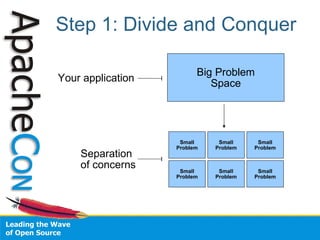
Step 1: Divide and Conquer

                         Big Problem
Your application            Space


                    Small     Small     Small
                   Problem   Problem   Problem
    Separation
    of concerns     Small     Small     Small
                   Problem   Problem   Problem
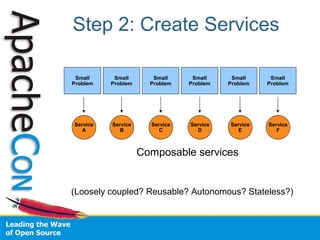
Step 2: Create Services

 Small     Small       Small     Small     Small     Small
Problem   Problem     Problem   Problem   Problem   Problem


Service   Service     Service   Service   Service   Service
   A        B           C         D          E         F


                    Composable services


(Loosely coupled? Reusable? Autonomous? Stateless?)
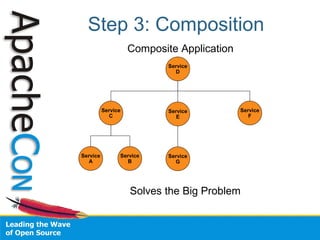
Step 3: Composition
                    Composite Application
                            Service
                              D


          Service           Service         Service
            C                  E               F


Service         Service     Service
   A              B           G


                    Solves the Big Problem
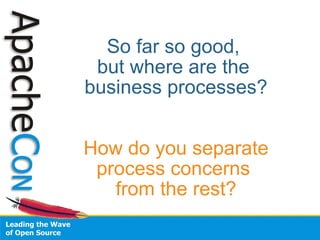
So far so good,
 but where are the
business processes?


How do you separate
 process concerns
   from the rest?
Enter BPEL
• What is BPEL?
   – A programming language for specifying
     business process within a service-oriented
     architecture... as a separate concern
• Benefits
   – Quickly compose services into new applications
   – Easily extend applications from the outside
   – Agile adaptation to your changing business
   – Clearer view of processes helps manage
     processes at the business level
BPEL Goals
• Specifying business process behavior
  – Executable Processes
  – Abstract Processes
• Programming in the large
  – Long-running processes
  – Transactions and compensation
  – Message and instance correlation
  – Leverage web services
What is it based on?
• Web service description
  – WSDL 1.1
• Data Model
  – XML Schema 1.0, Infoset
  – XPath 1.0, XSLT 1.0
• Flow Control
  – Hierarchical structure
  – Graph-based flows
Overview of BPEL Activities
• Message exchange
     <invoke>
     <receive> ... <reply>
• Data manipulation
     <assign>
• Control flow
     <if> ... <else>
     <while>
     <repeatUntil>
Overview BPEL Activities
• Parallel and graph-based processing
   <forEach>, <flow> with <link>'s
• Event processing and timers
   <pick>, <onEvent>, <onMessage>, <onAlarm>
• Exception and error handling
   <throw>, <catch>, <rethrow>, <compensate>
• Miscelaneous
   <wait>, <empty>, <validate>, ...
BPEL is not
• Not a general-purpose programming language
  – But a great complement to your existing
    general-purpose programming language(s)
• Not a human workflow language
  – But it can support human workflow via
    extensions (BPEL4People) or integration with
    workflow web services
• Not a graphical notation
  – But there's a great standard notation (BPMN)
    and many great tools for graphical modeling
BPEL is not
• Not limited to business processes
  – Used in grid computing, SOA testing,
    automation, etc.
• Not limited to WSDL or XML
  – Extensible type and expression system
  – Connect to legacy systems, REST services,
    invoke Java objects, send files via FTP,
    JMS publish/subscribe, ...
  – Whatever your ESB can do
BPEL is not
• Not meant to be hand-written
  – XML syntax chosen for interoperability*
    between tools (import/export)
  – You should use tools
  – Seriously.


           * and because XML was still “hip” back in 2003
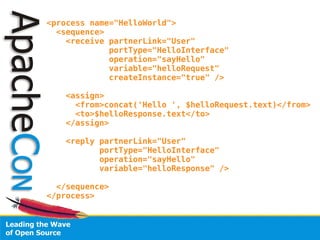
<process name="HelloWorld">
  <sequence>
    <receive partnerLink="User"
             portType="HelloInterface"
             operation="sayHello"
             variable="helloRequest"
             createInstance="true" />

   <assign>
     <from>concat('Hello ', $helloRequest.text)</from>
     <to>$helloResponse.text</to>
   </assign>

   <reply partnerLink="User"
          portType="HelloInterface"
          operation="sayHello"
          variable="helloResponse" />

  </sequence>
</process>
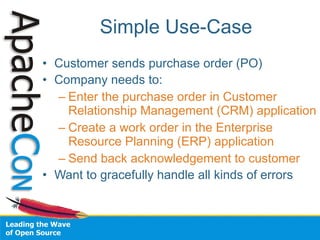
Simple Use-Case
• Customer sends purchase order (PO)
• Company needs to:
  – Enter the purchase order in Customer
    Relationship Management (CRM) application
  – Create a work order in the Enterprise
    Resource Planning (ERP) application
  – Send back acknowledgement to customer
• Want to gracefully handle all kinds of errors
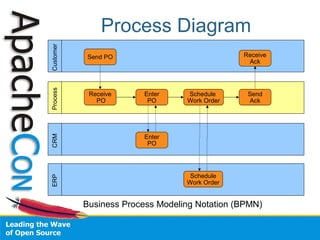
Process Diagram
Customer    Send PO                            Receive
                                                Ack
Process


            Receive      Enter    Schedule      Send
              PO          PO      Work Order    Ack


                         Enter
CRM


                          PO


                                   Schedule
ERP


                                  Work Order


           Business Process Modeling Notation (BPMN)
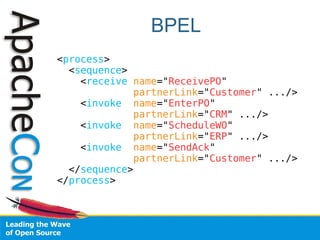
BPEL
<process>
  <sequence>
    <receive name="ReceivePO"
             partnerLink="Customer" .../>
    <invoke name="EnterPO"
             partnerLink="CRM" .../>
    <invoke name="ScheduleWO"
             partnerLink="ERP" .../>
    <invoke name="SendAck"
             partnerLink="Customer" .../>
  </sequence>
</process>
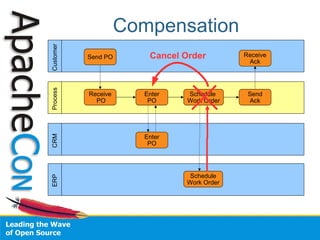
Compensation
Customer   Send PO      Cancel Order         Receive
                                              Ack
Process


           Receive     Enter    Schedule      Send
             PO         PO      Work Order    Ack


                       Enter
CRM


                        PO


                                Schedule
ERP


                               Work Order
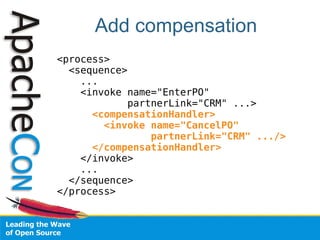
Add compensation
<process>
  <sequence>
    ...
    <invoke name="EnterPO"
            partnerLink="CRM" ...>
      <compensationHandler>
        <invoke name="CancelPO"
                partnerLink="CRM" .../>
      </compensationHandler>
    </invoke>
    ...
  </sequence>
</process>
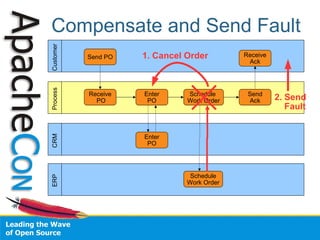
Compensate and Send Fault
Customer   Send PO   1. Cancel Order        Receive
                                             Ack
Process


           Receive   Enter     Schedule      Send
             PO       PO       Work Order    Ack      2. Send
                                                         Fault


                     Enter
CRM


                      PO


                                Schedule
ERP


                               Work Order
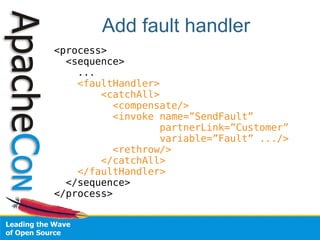
Add fault handler
<process>
  <sequence>
    ...
    <faultHandler>
        <catchAll>
          <compensate/>
          <invoke name=”SendFault”
                  partnerLink=”Customer”
                  variable=”Fault” .../>
          <rethrow/>
        </catchAll>
    </faultHandler>
  </sequence>
</process>
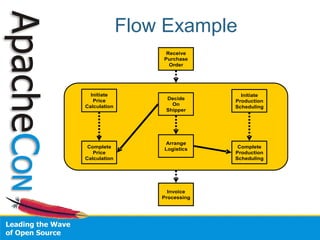
Flow Example
                   Receive
                  Purchase
                    Order


  Initiate                       Initiate
   Price           Decide
                               Production
Calculation          On
                               Scheduling
                   Shipper


                  Arrange
 Complete         Logistics     Complete
   Price                       Production
Calculation                    Scheduling


                    Invoice
                  Processing
Apache Ode
• Great Software
  – A high-performance process engine
    supporting the BPEL 1.1 and 2.0
    specifications
  – Many innovative features
• Cool People
  – A rich and diverse community of users and
    developers that are participating in SOA
    projects worldwide
Project History
• March 2006
   – Started in incubator
   – Code donations from Intalio and Sybase
   – Merge with Apache Agila
• July 2007
   – Graduated as top-level project (TLP)
• August 2007
   – Release 1.1: Bug fixes, performance, BPEL
• January 2008
   – Release 1.1.1: Bug fixes
Project Statistics
• Today
   – 10 committers
   – 150 emails/month
     (ode-user and ode-dev combined)
   – 300 unique visitors per day
BPEL Compliance
• Support for both BPEL 1.1 and 2.0
  – Interoperable with existing tools
  – Many migration success stories
  – Details of compliance can be found
    on web site
Deployment Architectures
• Webapp/Servlet (Axis2)
   – Deploy as a .war on any servlet container
     (e.g. Apache Tomcat)
• Java Business Integration (JBI)
   – Deploy as a service engine on JBI 1.0
     container (e.g. Apache ServiceMix)
• Scalable Component Architecture (SCA)
   – Deploy on Apache Tuscany (experimental)
Build Your Own
• Embed Apache Ode into your application(s)
• Pluggable Dependencies
   – Scheduler
   – Transaction manager
   – DataSource / Data Access Object(s)
   – Message bus
   – Deployment strategy
   – Event listeners, ...
Engine Features
• Robustness
  – Automatic process suspension
    upon transient failure, automatic retries, etc.
  – Everything executed within transaction (XA)
    internally; option to detach
• Deployment
  – Hot-deployment
  – Process versioning
Engine Features
• Implicit message correlation
  – Based on stateful protocol exchange
    (WS-Addressing or HTTP)
• Protocols
  – SOAP/HTTP
  – Plain-Old XML (HTTP binding)
  – JMS
  – ...
Scalability
• Process definitions
  – Activation/passivation of process definitions
  – Tested 100,000+ definitions on single JVM
• Process instances
  – In-Memory: Limited only by available RAM
  – Persistent: Limited by database storage
Performance
• Varies depending on choices
   – Message bus (Axis2 / JBI / SCA / ...)
   – Process design
   – Process persistence
   – Event persistence
   – Hardware/software configuration
• My experience: Database is always the bottleneck
   – Invest in a good disk subsystem and tune your
     database server
   – Partition services over multiple server instances
Management Features
• Process Management API
   – Rich querying
   – Suspend, resume instances
   – Deploy, undeploy, activate, retire
• Debugging API
   – Step through process execution
   – Watch variables, etc.
• Configurable event/audit trail
   – Record to file, database, JMS, ...
BPEL Extensions (1)
• XPath 2.0 and XSLT 2.0
  – More expressive assignments, expressions
    and transformations
• Atomic Scopes
  – All-or-nothing units of work;
    mapped unto XA transactions
• JavaScript E4X
  – More concise assignments/expressions
BPEL Extensions (2)
• External variables
  – Data lives beyond instance lifespan
  – Map to database table row
  – Map to REST resource (not available yet)
• Read/write message headers
  – SOAP, HTTP, ...
• XPath extension functions
  – It's easy to write your own
Best Practices (1)
• Use tooling!
  – Eclipse BPEL Designer
  – NetBeans BPEL Designer
  – SOAPUI
  – Eclipse STP BPMN Modeler
  – Many commercial offerings
• Get trained
  – XML, XSD, XPath, XSLT, WSDL, WS-*,
    BPEL, BPMN, ...
Best Practices (2)
• Web-Services
  – Coarse-grained services
  – Follow standards (WS-I BasicProfile)
  – Everything you already know about WS

• Use BPEL 2.0 standard
  – More interoperable
  – Better defined semantics
Best Practices (3)
• Process lifespan
  – Use process composition to control
    instance lifespan
  – Typically a fraction of the rate of change

• Avoid modeling entities as processes
  – An order is not a process
Best Practices (4)
• Abstract out business rules
  – Use XPath function extensions or WS
  – Consider rule engine for complex
    or large number of rules
• Keep processes protocol-independent
  – Avoid SOAP header manipulation
  – Avoid authentication/authorization in process
What's Coming
• Simple BPEL (SimPEL)
   – Programmer-friendly syntax similar to JavaScript
   – More dynamic typing
• RESTful BPEL
   – Invoke REST services natively
   – Expose process a set of resources
• Event multicasting
   – Signaling between processes
• Event feeds
   – Scalable event listening model based on Atom
What's Coming
• Administration console (Google SoC)
   – Manage processes, instances, querying, ...
• Human workflow (Singleshot)
   – BPEL4People extensions
   – Workflow services
   – Task list webapp
• Better support for WS-* standards
   – WS-Security, WS-ReliableMessaging, ...
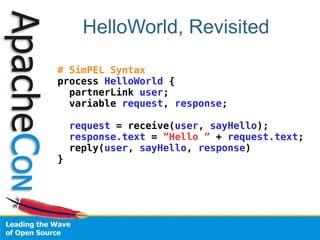
HelloWorld, Revisited

# SimPEL Syntax
process HelloWorld {
  partnerLink user;
  variable request, response;

    request = receive(user, sayHello);
    response.text = ”Hello ” + request.text;
    reply(user, sayHello, response)
}
# Loan approval process (BPEL 2.0 Spec; Section 15.3)
process LoanApproval {
  partnerLink customer, assessor, approver;
  try {
    parallel {
      request = receive(customer, request);
      signal(receive-to-assess, [$request.amount < 10000]);
      signal(receive-to-approval, [$request.amount >= 10000]);
    } and {
      join(receive-to-assess);
      risk = invoke(assessor, check);
      signal(assess-to-setMessage, [$risk.level = 'low']);
      signal(assess-to-approval, [$risk.level != 'low']);
    } and {
      join(assess-to-setMessage);
      approval.accept = "yes";
      signal(setMessage-to-reply);
    } and {
      join(receive-to-approval, assess-to-approval);
      invoke(approver, approve);
      signal(approval-to-reply);
    } and {
      join(approval-to-reply, setMessage-to-reply);
      reply(customer, request, approval);
    }
  } catch(loanProcessFault) { |error|
    reply(customer, request, error);
  }
}
Remember One Thing
• Greenspun's Tenth Rule of Programming
  – Any sufficiently complicated program contains
    an ad-hoc, informally-specified, bug-ridden,
    slow implementation of half of Lisp BPEL
  – Don't write your own business process engine


                Join us! :)
Questions?


Thank You!

Apache O D E Apache Con E U2008

  • 1.
    Web Services, Orchestration and Apache Ode Alex Boisvert, Intalio Inc. ApacheCon EU 2008
  • 2.
    Outline • Overview of BPEL • Apache Ode • Best Practices • What's Coming
  • 3.
    SOA in 3Minutes • Key design principles – Standardized service contract – Service abstraction – Loose-coupling – Reusability – Autonomy – Statelessness – Composability
  • 4.
    Step 1: Divideand Conquer Big Problem Your application Space Small Small Small Problem Problem Problem Separation of concerns Small Small Small Problem Problem Problem
  • 5.
    Step 2: CreateServices Small Small Small Small Small Small Problem Problem Problem Problem Problem Problem Service Service Service Service Service Service A B C D E F Composable services (Loosely coupled? Reusable? Autonomous? Stateless?)
  • 6.
    Step 3: Composition Composite Application Service D Service Service Service C E F Service Service Service A B G Solves the Big Problem
  • 7.
    So far sogood, but where are the business processes? How do you separate process concerns from the rest?
  • 8.
    Enter BPEL • Whatis BPEL? – A programming language for specifying business process within a service-oriented architecture... as a separate concern • Benefits – Quickly compose services into new applications – Easily extend applications from the outside – Agile adaptation to your changing business – Clearer view of processes helps manage processes at the business level
  • 9.
    BPEL Goals • Specifyingbusiness process behavior – Executable Processes – Abstract Processes • Programming in the large – Long-running processes – Transactions and compensation – Message and instance correlation – Leverage web services
  • 10.
    What is itbased on? • Web service description – WSDL 1.1 • Data Model – XML Schema 1.0, Infoset – XPath 1.0, XSLT 1.0 • Flow Control – Hierarchical structure – Graph-based flows
  • 11.
    Overview of BPELActivities • Message exchange <invoke> <receive> ... <reply> • Data manipulation <assign> • Control flow <if> ... <else> <while> <repeatUntil>
  • 12.
    Overview BPEL Activities •Parallel and graph-based processing <forEach>, <flow> with <link>'s • Event processing and timers <pick>, <onEvent>, <onMessage>, <onAlarm> • Exception and error handling <throw>, <catch>, <rethrow>, <compensate> • Miscelaneous <wait>, <empty>, <validate>, ...
  • 13.
    BPEL is not •Not a general-purpose programming language – But a great complement to your existing general-purpose programming language(s) • Not a human workflow language – But it can support human workflow via extensions (BPEL4People) or integration with workflow web services • Not a graphical notation – But there's a great standard notation (BPMN) and many great tools for graphical modeling
  • 14.
    BPEL is not •Not limited to business processes – Used in grid computing, SOA testing, automation, etc. • Not limited to WSDL or XML – Extensible type and expression system – Connect to legacy systems, REST services, invoke Java objects, send files via FTP, JMS publish/subscribe, ... – Whatever your ESB can do
  • 15.
    BPEL is not •Not meant to be hand-written – XML syntax chosen for interoperability* between tools (import/export) – You should use tools – Seriously. * and because XML was still “hip” back in 2003
  • 16.
    <process name="HelloWorld"> <sequence> <receive partnerLink="User" portType="HelloInterface" operation="sayHello" variable="helloRequest" createInstance="true" /> <assign> <from>concat('Hello ', $helloRequest.text)</from> <to>$helloResponse.text</to> </assign> <reply partnerLink="User" portType="HelloInterface" operation="sayHello" variable="helloResponse" /> </sequence> </process>
  • 17.
    Simple Use-Case • Customersends purchase order (PO) • Company needs to: – Enter the purchase order in Customer Relationship Management (CRM) application – Create a work order in the Enterprise Resource Planning (ERP) application – Send back acknowledgement to customer • Want to gracefully handle all kinds of errors
  • 18.
    Process Diagram Customer Send PO Receive Ack Process Receive Enter Schedule Send PO PO Work Order Ack Enter CRM PO Schedule ERP Work Order Business Process Modeling Notation (BPMN)
  • 19.
    BPEL <process> <sequence> <receive name="ReceivePO" partnerLink="Customer" .../> <invoke name="EnterPO" partnerLink="CRM" .../> <invoke name="ScheduleWO" partnerLink="ERP" .../> <invoke name="SendAck" partnerLink="Customer" .../> </sequence> </process>
  • 20.
    Compensation Customer Send PO Cancel Order Receive Ack Process Receive Enter Schedule Send PO PO Work Order Ack Enter CRM PO Schedule ERP Work Order
  • 21.
    Add compensation <process> <sequence> ... <invoke name="EnterPO" partnerLink="CRM" ...> <compensationHandler> <invoke name="CancelPO" partnerLink="CRM" .../> </compensationHandler> </invoke> ... </sequence> </process>
  • 22.
    Compensate and SendFault Customer Send PO 1. Cancel Order Receive Ack Process Receive Enter Schedule Send PO PO Work Order Ack 2. Send Fault Enter CRM PO Schedule ERP Work Order
  • 23.
    Add fault handler <process> <sequence> ... <faultHandler> <catchAll> <compensate/> <invoke name=”SendFault” partnerLink=”Customer” variable=”Fault” .../> <rethrow/> </catchAll> </faultHandler> </sequence> </process>
  • 24.
    Flow Example Receive Purchase Order Initiate Initiate Price Decide Production Calculation On Scheduling Shipper Arrange Complete Logistics Complete Price Production Calculation Scheduling Invoice Processing
  • 25.
    Apache Ode • GreatSoftware – A high-performance process engine supporting the BPEL 1.1 and 2.0 specifications – Many innovative features • Cool People – A rich and diverse community of users and developers that are participating in SOA projects worldwide
  • 26.
    Project History • March2006 – Started in incubator – Code donations from Intalio and Sybase – Merge with Apache Agila • July 2007 – Graduated as top-level project (TLP) • August 2007 – Release 1.1: Bug fixes, performance, BPEL • January 2008 – Release 1.1.1: Bug fixes
  • 27.
    Project Statistics • Today – 10 committers – 150 emails/month (ode-user and ode-dev combined) – 300 unique visitors per day
  • 28.
    BPEL Compliance • Supportfor both BPEL 1.1 and 2.0 – Interoperable with existing tools – Many migration success stories – Details of compliance can be found on web site
  • 29.
    Deployment Architectures • Webapp/Servlet(Axis2) – Deploy as a .war on any servlet container (e.g. Apache Tomcat) • Java Business Integration (JBI) – Deploy as a service engine on JBI 1.0 container (e.g. Apache ServiceMix) • Scalable Component Architecture (SCA) – Deploy on Apache Tuscany (experimental)
  • 30.
    Build Your Own •Embed Apache Ode into your application(s) • Pluggable Dependencies – Scheduler – Transaction manager – DataSource / Data Access Object(s) – Message bus – Deployment strategy – Event listeners, ...
  • 31.
    Engine Features • Robustness – Automatic process suspension upon transient failure, automatic retries, etc. – Everything executed within transaction (XA) internally; option to detach • Deployment – Hot-deployment – Process versioning
  • 32.
    Engine Features • Implicitmessage correlation – Based on stateful protocol exchange (WS-Addressing or HTTP) • Protocols – SOAP/HTTP – Plain-Old XML (HTTP binding) – JMS – ...
  • 33.
    Scalability • Process definitions – Activation/passivation of process definitions – Tested 100,000+ definitions on single JVM • Process instances – In-Memory: Limited only by available RAM – Persistent: Limited by database storage
  • 34.
    Performance • Varies dependingon choices – Message bus (Axis2 / JBI / SCA / ...) – Process design – Process persistence – Event persistence – Hardware/software configuration • My experience: Database is always the bottleneck – Invest in a good disk subsystem and tune your database server – Partition services over multiple server instances
  • 35.
    Management Features • ProcessManagement API – Rich querying – Suspend, resume instances – Deploy, undeploy, activate, retire • Debugging API – Step through process execution – Watch variables, etc. • Configurable event/audit trail – Record to file, database, JMS, ...
  • 36.
    BPEL Extensions (1) •XPath 2.0 and XSLT 2.0 – More expressive assignments, expressions and transformations • Atomic Scopes – All-or-nothing units of work; mapped unto XA transactions • JavaScript E4X – More concise assignments/expressions
  • 37.
    BPEL Extensions (2) •External variables – Data lives beyond instance lifespan – Map to database table row – Map to REST resource (not available yet) • Read/write message headers – SOAP, HTTP, ... • XPath extension functions – It's easy to write your own
  • 38.
    Best Practices (1) •Use tooling! – Eclipse BPEL Designer – NetBeans BPEL Designer – SOAPUI – Eclipse STP BPMN Modeler – Many commercial offerings • Get trained – XML, XSD, XPath, XSLT, WSDL, WS-*, BPEL, BPMN, ...
  • 39.
    Best Practices (2) •Web-Services – Coarse-grained services – Follow standards (WS-I BasicProfile) – Everything you already know about WS • Use BPEL 2.0 standard – More interoperable – Better defined semantics
  • 40.
    Best Practices (3) •Process lifespan – Use process composition to control instance lifespan – Typically a fraction of the rate of change • Avoid modeling entities as processes – An order is not a process
  • 41.
    Best Practices (4) •Abstract out business rules – Use XPath function extensions or WS – Consider rule engine for complex or large number of rules • Keep processes protocol-independent – Avoid SOAP header manipulation – Avoid authentication/authorization in process
  • 42.
    What's Coming • SimpleBPEL (SimPEL) – Programmer-friendly syntax similar to JavaScript – More dynamic typing • RESTful BPEL – Invoke REST services natively – Expose process a set of resources • Event multicasting – Signaling between processes • Event feeds – Scalable event listening model based on Atom
  • 43.
    What's Coming • Administrationconsole (Google SoC) – Manage processes, instances, querying, ... • Human workflow (Singleshot) – BPEL4People extensions – Workflow services – Task list webapp • Better support for WS-* standards – WS-Security, WS-ReliableMessaging, ...
  • 44.
    HelloWorld, Revisited # SimPELSyntax process HelloWorld { partnerLink user; variable request, response; request = receive(user, sayHello); response.text = ”Hello ” + request.text; reply(user, sayHello, response) }
  • 45.
    # Loan approvalprocess (BPEL 2.0 Spec; Section 15.3) process LoanApproval { partnerLink customer, assessor, approver; try { parallel { request = receive(customer, request); signal(receive-to-assess, [$request.amount < 10000]); signal(receive-to-approval, [$request.amount >= 10000]); } and { join(receive-to-assess); risk = invoke(assessor, check); signal(assess-to-setMessage, [$risk.level = 'low']); signal(assess-to-approval, [$risk.level != 'low']); } and { join(assess-to-setMessage); approval.accept = "yes"; signal(setMessage-to-reply); } and { join(receive-to-approval, assess-to-approval); invoke(approver, approve); signal(approval-to-reply); } and { join(approval-to-reply, setMessage-to-reply); reply(customer, request, approval); } } catch(loanProcessFault) { |error| reply(customer, request, error); } }
  • 46.
    Remember One Thing •Greenspun's Tenth Rule of Programming – Any sufficiently complicated program contains an ad-hoc, informally-specified, bug-ridden, slow implementation of half of Lisp BPEL – Don't write your own business process engine Join us! :)
  • 47.