Using APA Style in a college paper
 Anytime

you write a paper, give a speech or
complete a project for class, you are going to
do some research

 Find

statistics, quotes, definitions, case
studies, business reports, etc.

 Find

research and ideas about a topic

 These

are the sources you must cite!
 Helps

the reader understand the basis for
information presented in your paper

 Readers

of your paper might want further
information on your topic…your references
will lead your reader to that information

 You

should give credit to the person who
conducted the original research

 Protect

yourself from plagiarism
 Plagiarism:

"To present the ideas or words of
another as one's own" -- Merriam-Webster's
Dictionary & Thesaurus 2007

 Plagiarism

can be intentional or unintentional

 It

occurs anytime you quote, reference or use
someone else’s work (article, book, photo,
information on a website, etc.) and you don’t
cite your source

 Or

if you paraphrase but use too much of the
original source.
 Citation

styles were created to provide a
guide for authors/writers to properly
reference another person’s work

 Citation

styles have a very specific set of

RULES
 Punctuation,

Italics, Underlining,
capitalization, parentheses – IT ALL PLAYS A
ROLE


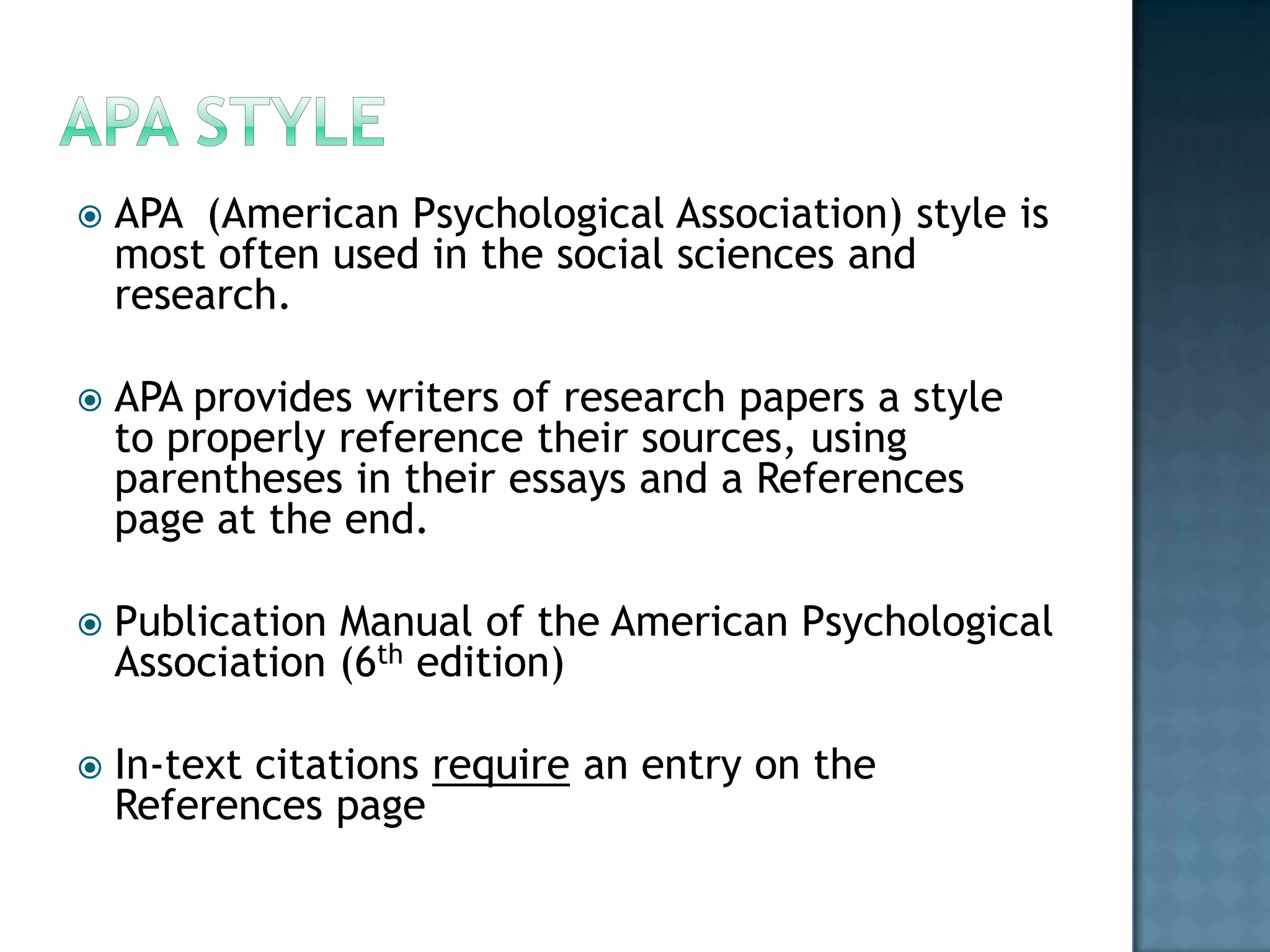
APA (American Psychological Association) style is
most often used in the social sciences and
research.



APA provides writers of research papers a style
to properly reference their sources, using
parentheses in their essays and a References
page at the end.



Publication Manual of the American Psychological
Association (6th edition)



In-text citations require an entry on the
References page
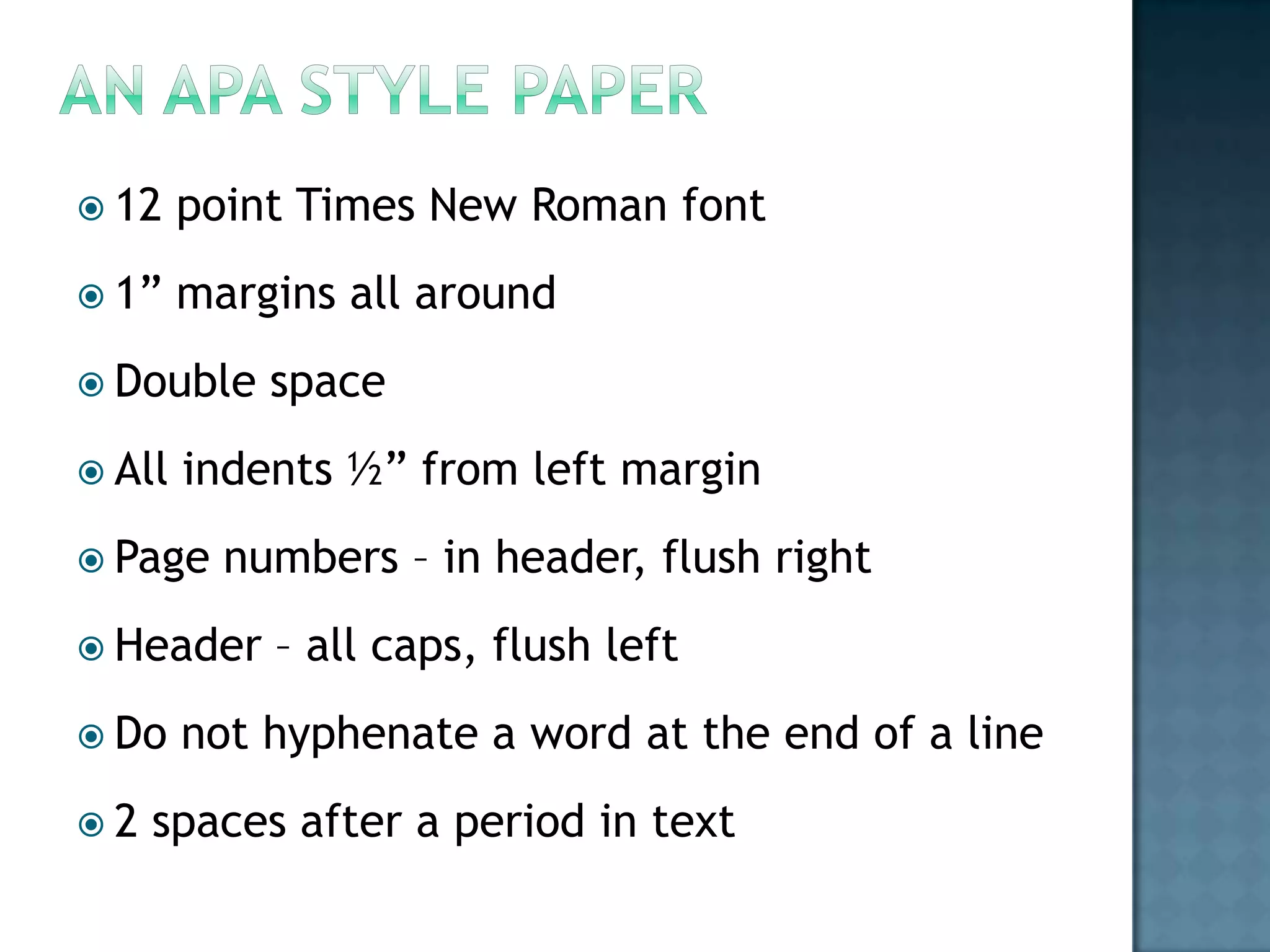
 12

point Times New Roman font

 1”

margins all around

 Double
 All

indents ½” from left margin

 Page

numbers – in header, flush right

 Header
 Do
2

space

– all caps, flush left

not hyphenate a word at the end of a line

spaces after a period in text
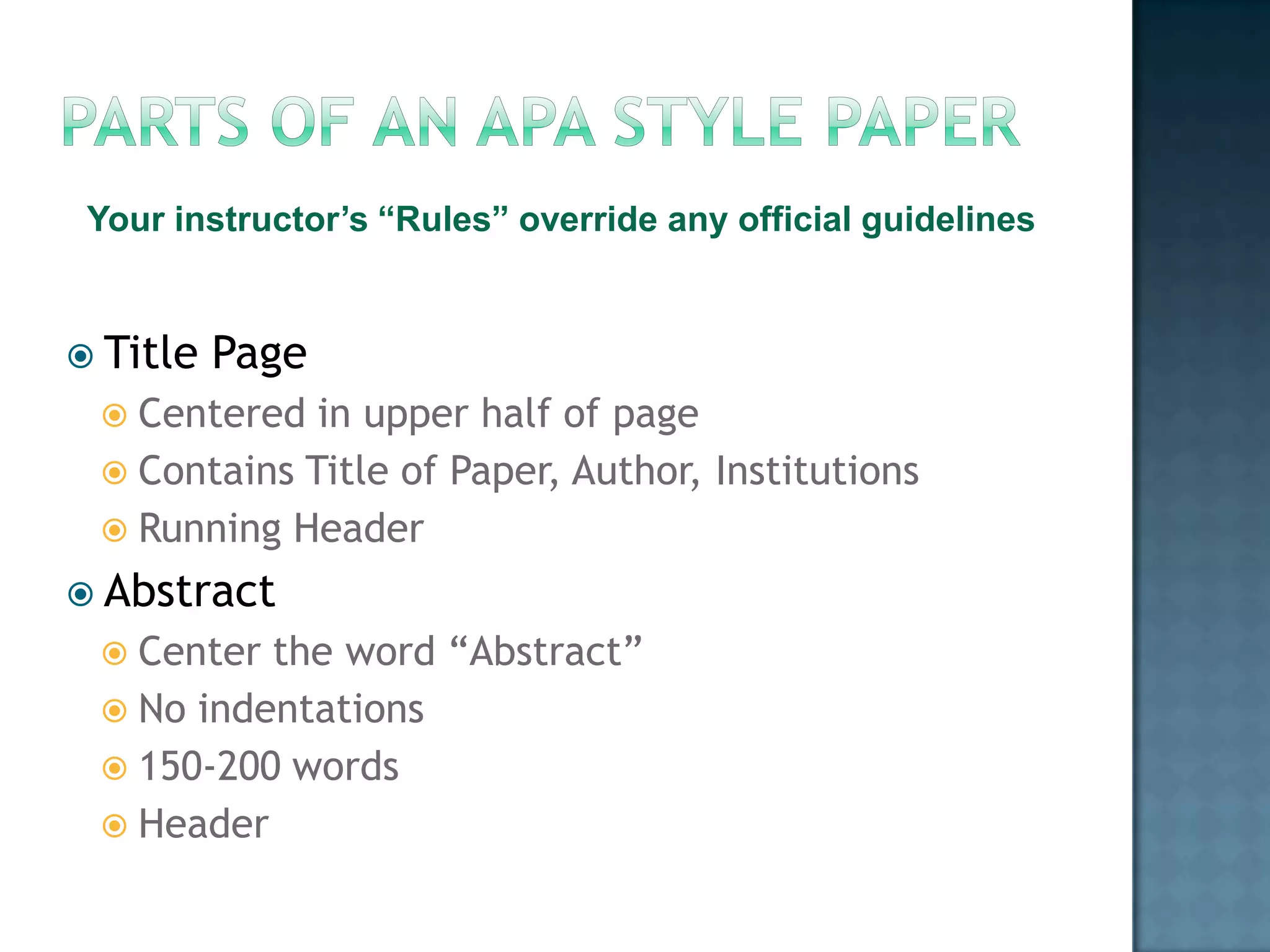
Your instructor’s “Rules” override any official guidelines
 Title

Page

 Centered

in upper half of page
 Contains Title of Paper, Author, Institutions
 Running Header
 Abstract
 Center

the word “Abstract”
 No indentations
 150-200 words
 Header
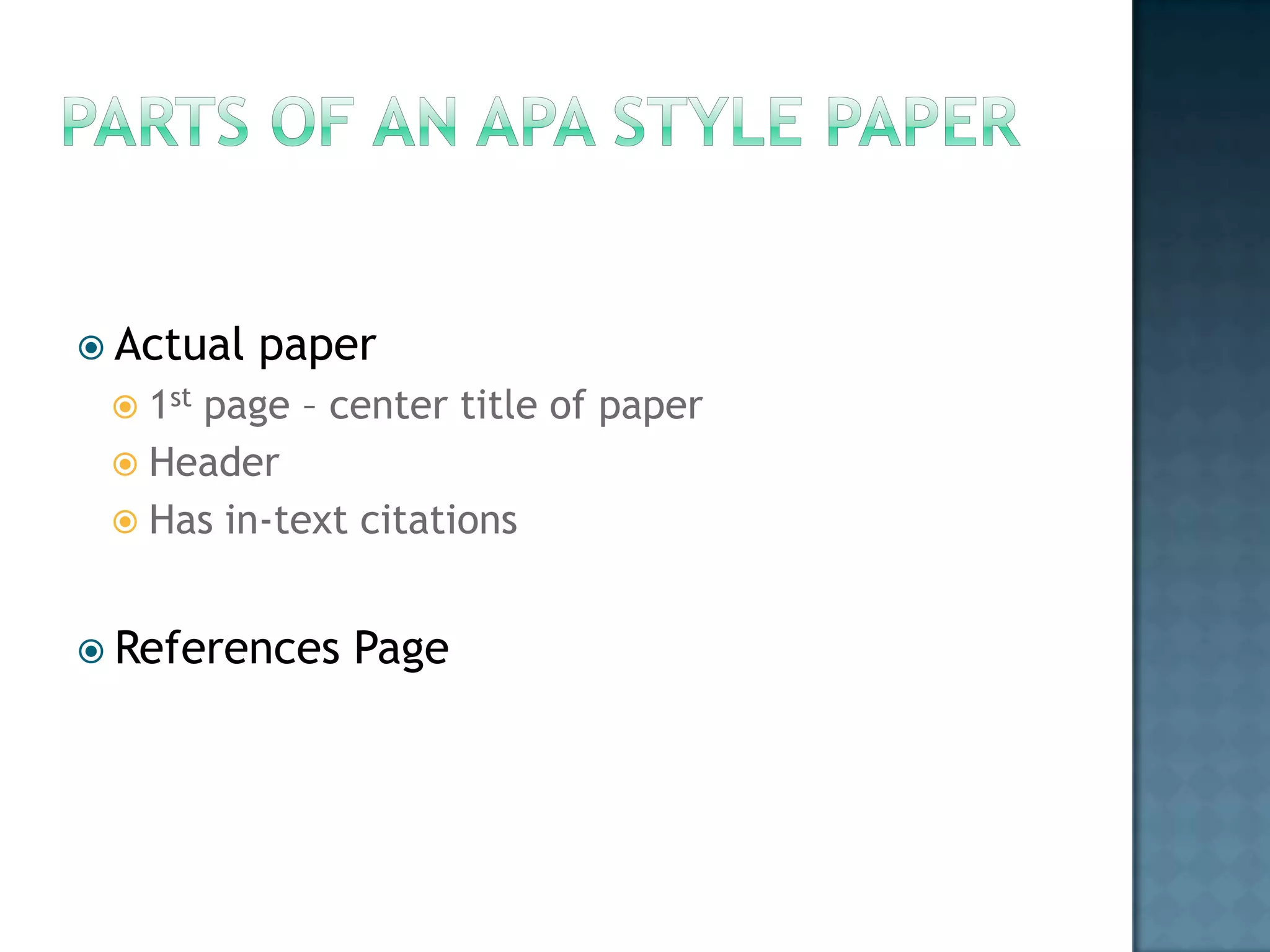
 Actual

paper

 1st

page – center title of paper
 Header
 Has in-text citations
 References

Page


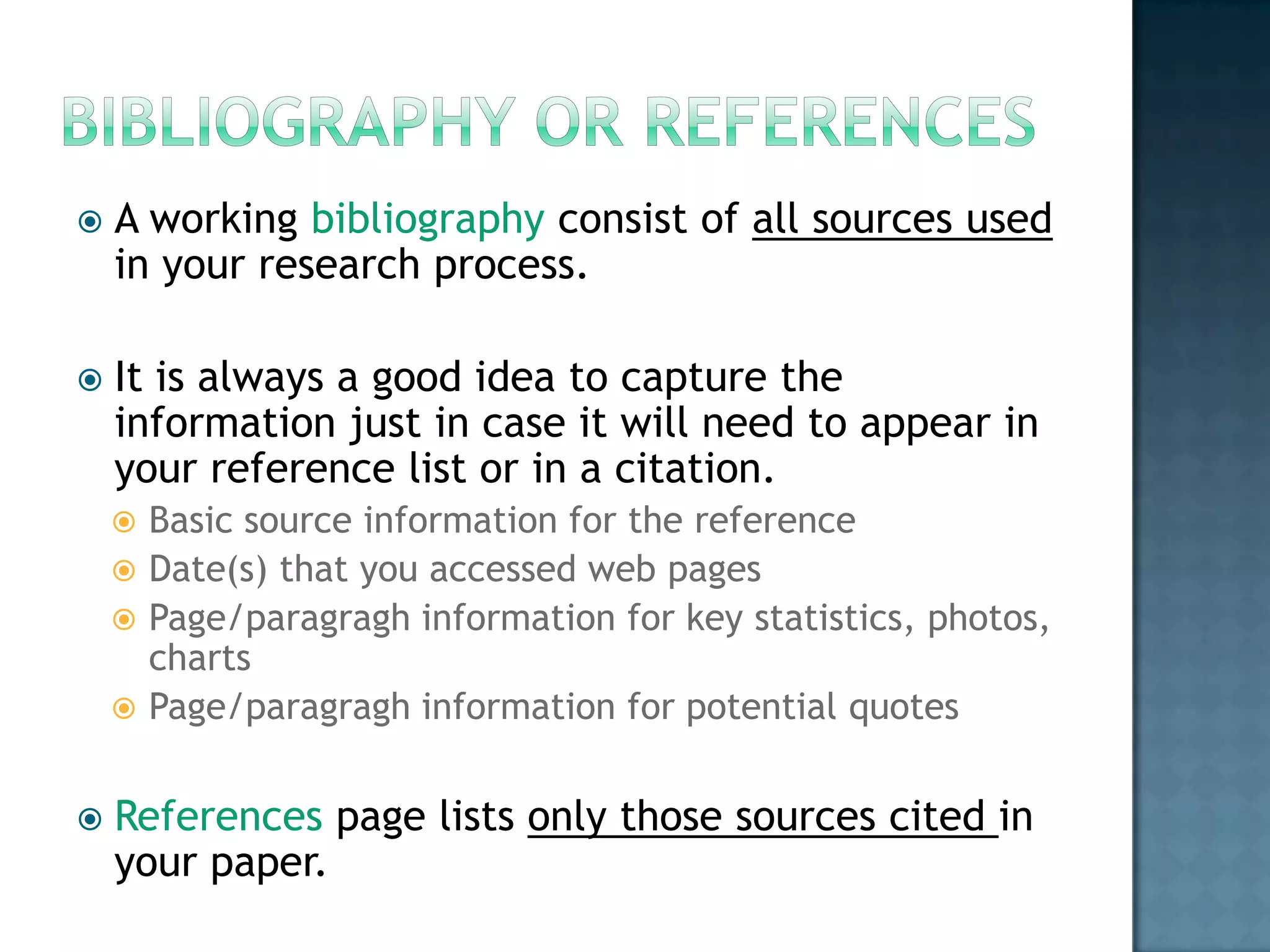
A working bibliography consist of all sources used
in your research process.



It is always a good idea to capture the
information just in case it will need to appear in
your reference list or in a citation.
Basic source information for the reference
 Date(s) that you accessed web pages
 Page/paragragh information for key statistics, photos,
charts
 Page/paragragh information for potential quotes




References page lists only those sources cited in
your paper.
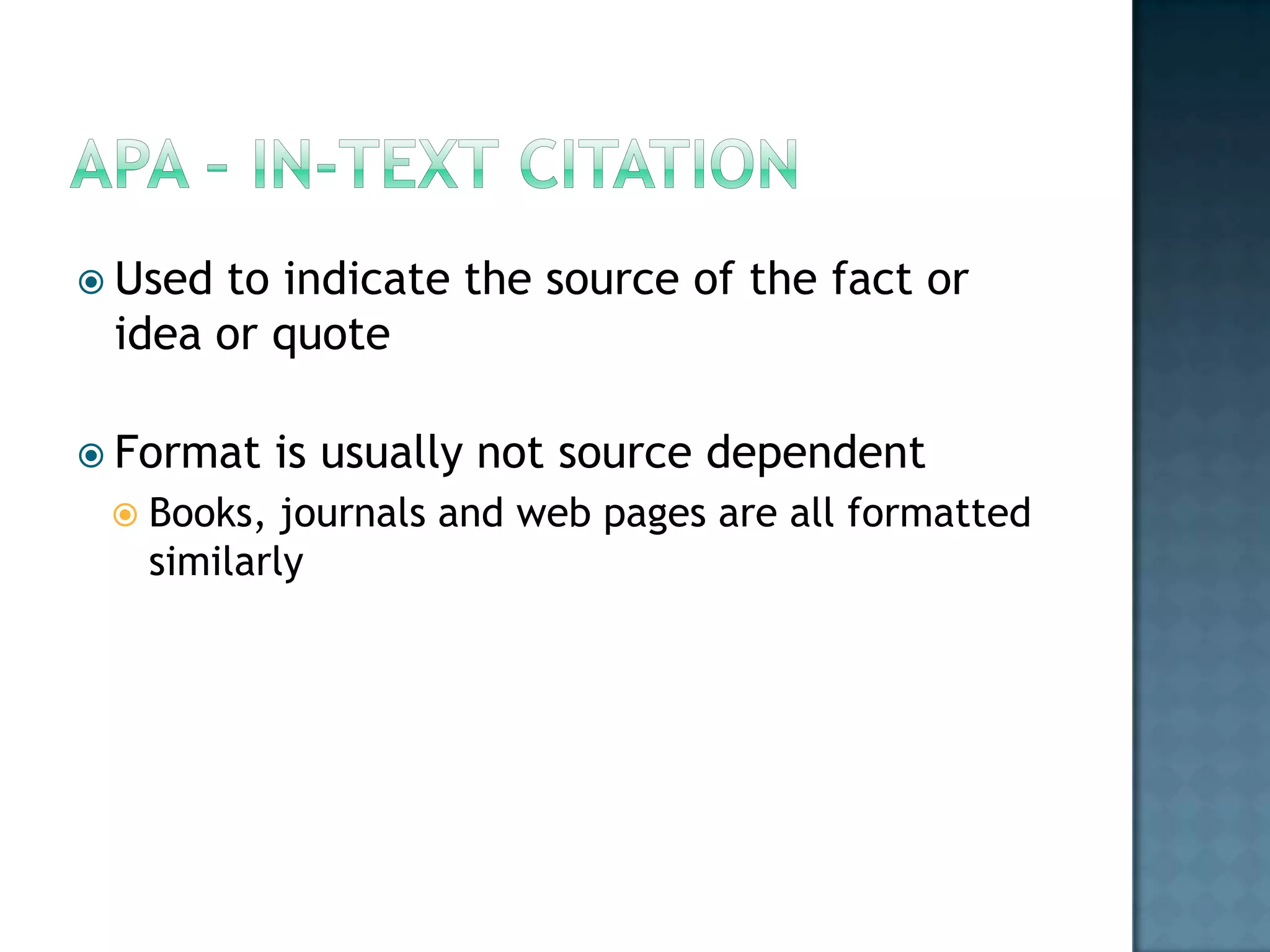
 Used

to indicate the source of the fact or
idea or quote

 Format
 Books,

is usually not source dependent

journals and web pages are all formatted
similarly
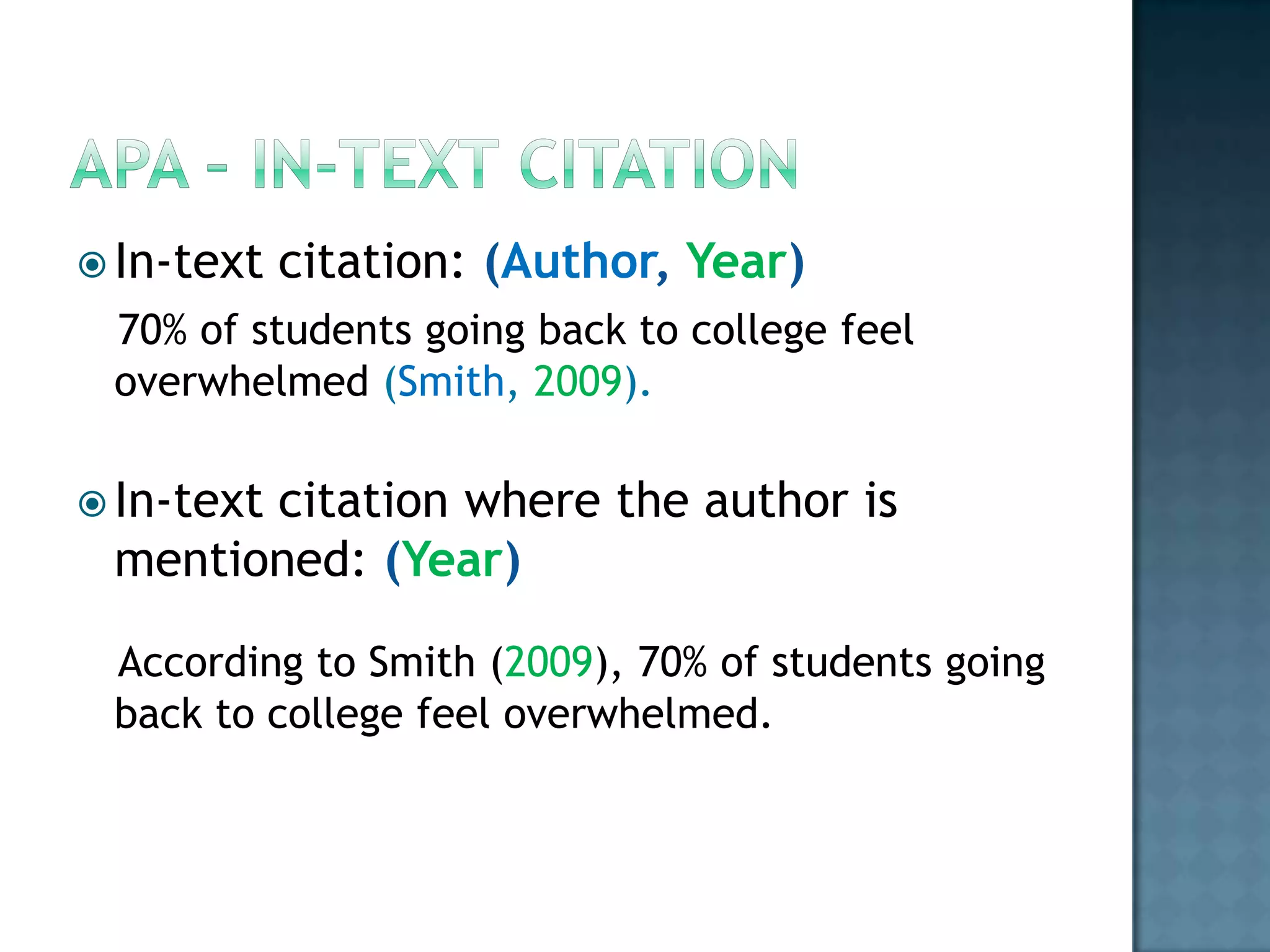
 In-text

citation: (Author, Year)

70% of students going back to college feel
overwhelmed (Smith, 2009).
 In-text

citation where the author is
mentioned: (Year)
According to Smith (2009), 70% of students going
back to college feel overwhelmed.
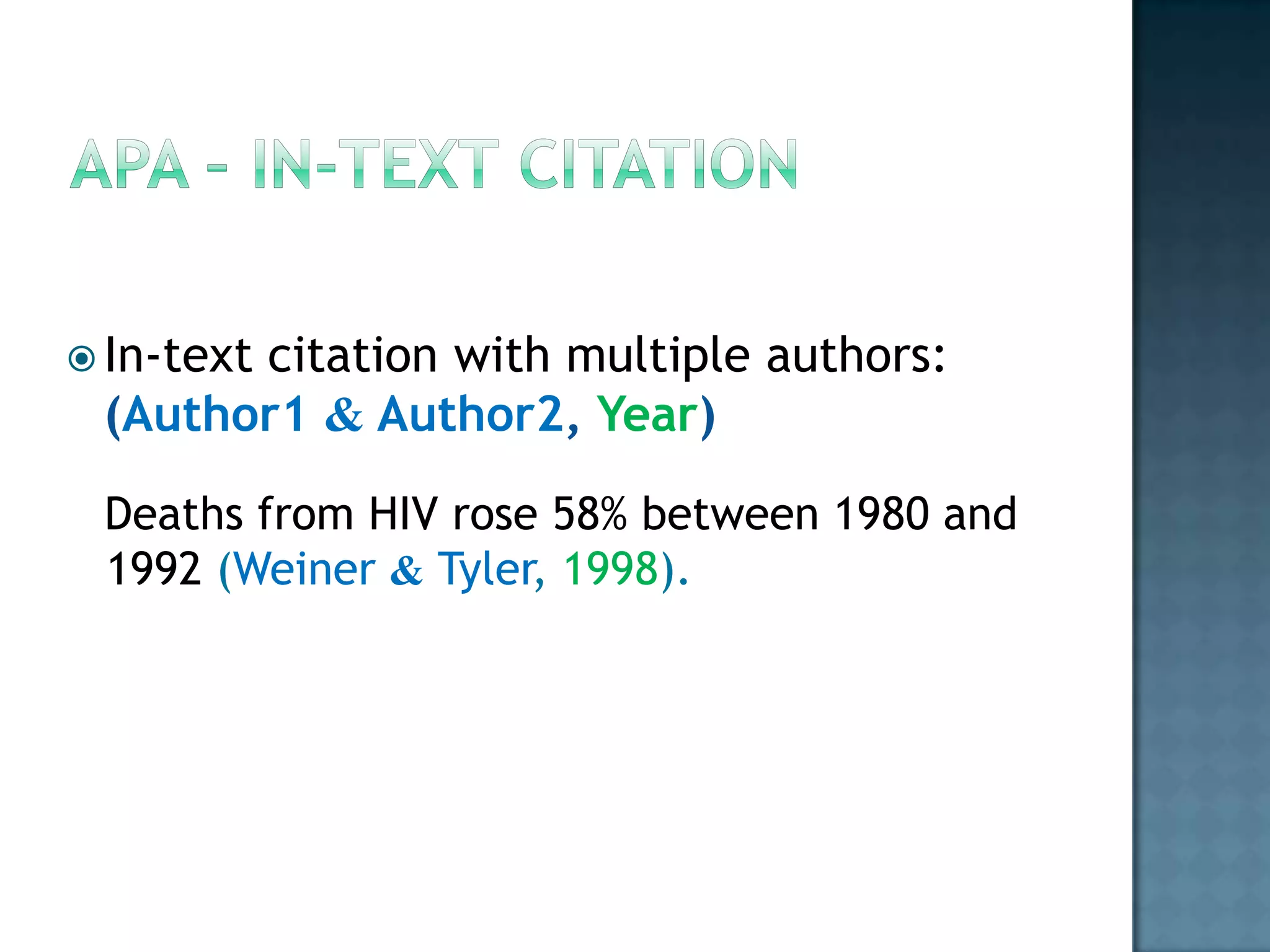
 In-text

citation with multiple authors:
(Author1 & Author2, Year)
Deaths from HIV rose 58% between 1980 and
1992 (Weiner & Tyler, 1998).
 In-text

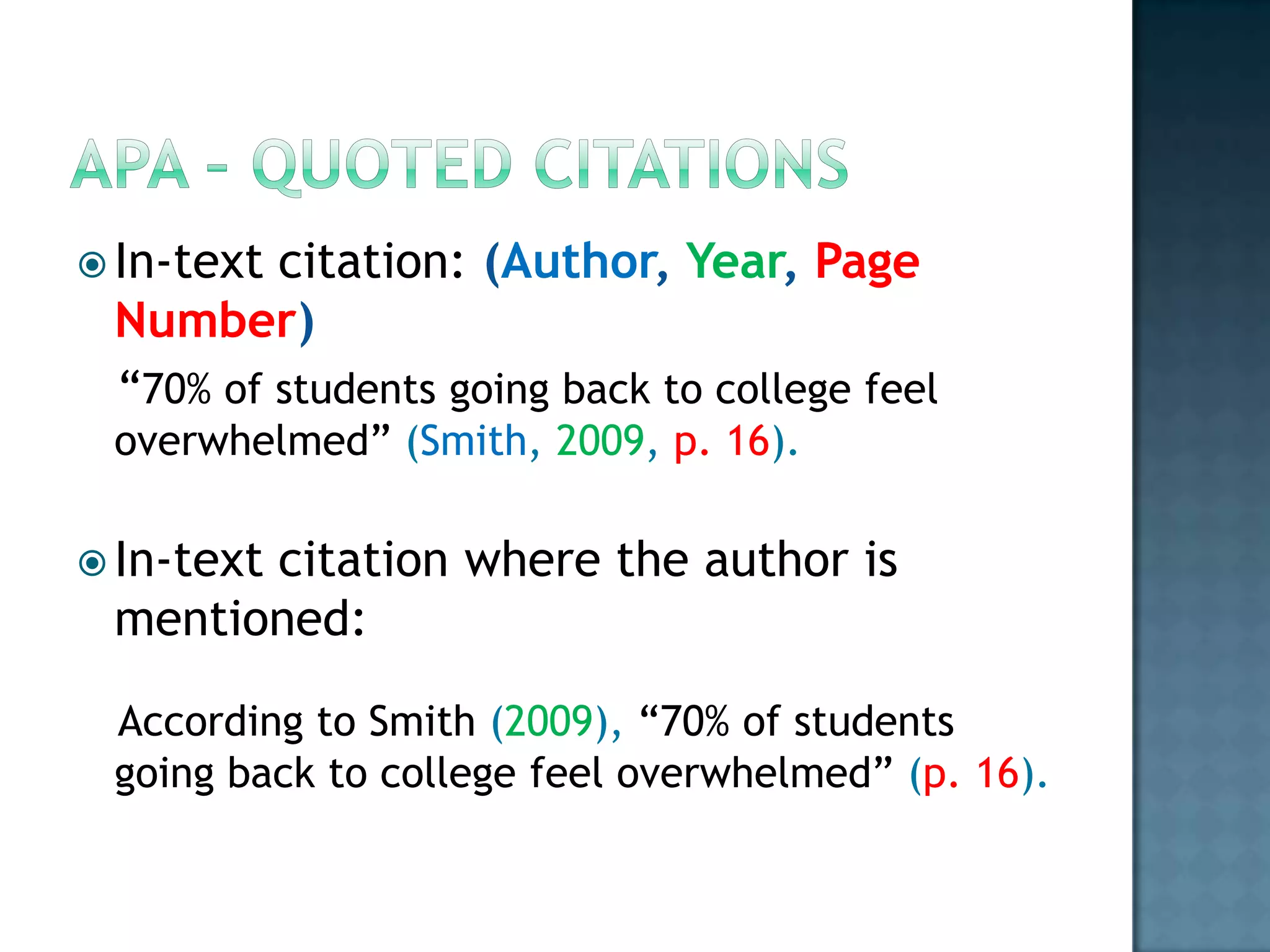
citation: (Author, Year, Page
Number)
“70% of students going back to college feel
overwhelmed” (Smith, 2009, p. 16).

 In-text

citation where the author is
mentioned:
According to Smith (2009), “70% of students
going back to college feel overwhelmed” (p. 16).
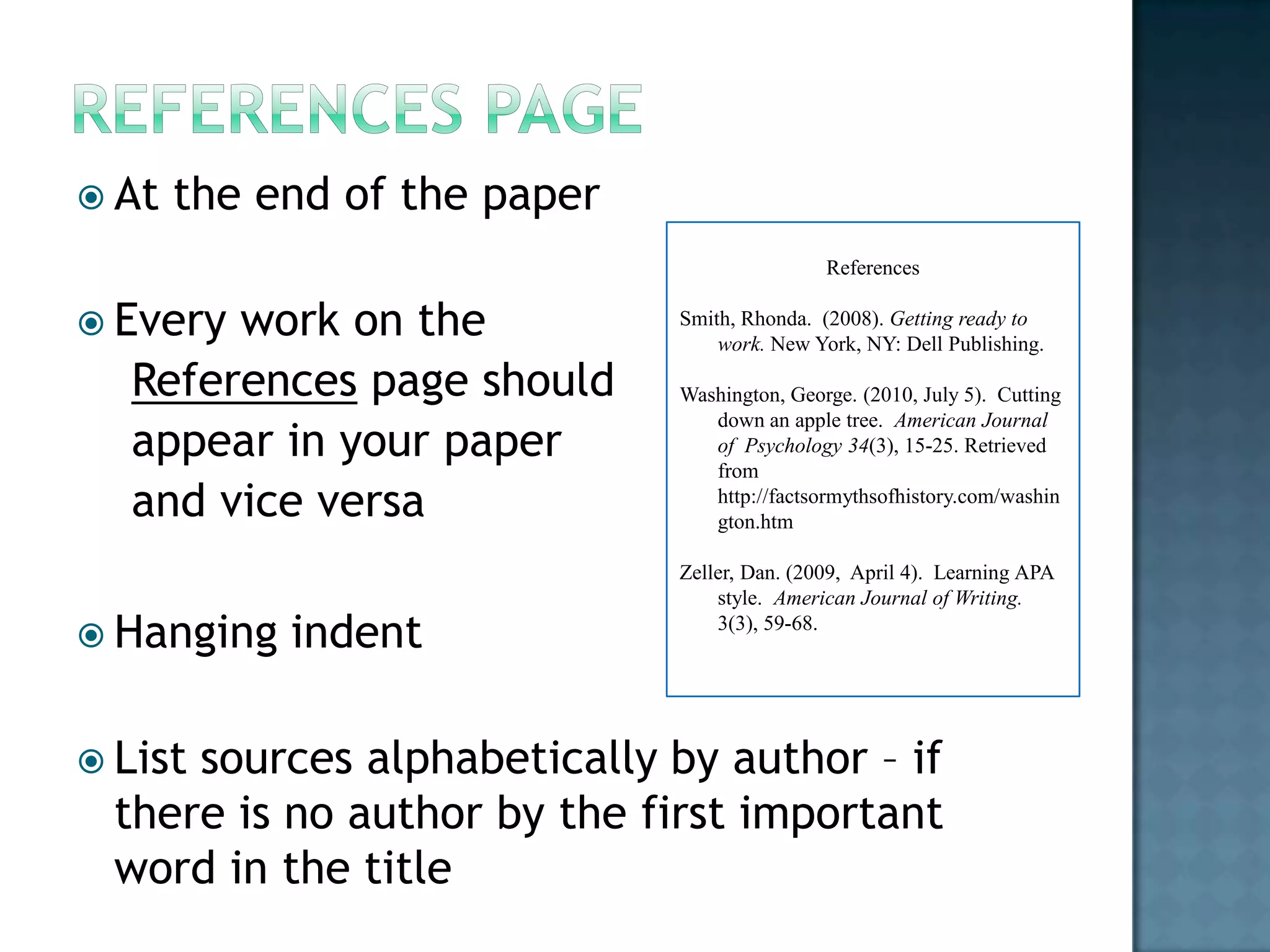
 At

the end of the paper
References

 Every

work on the
References page should
appear in your paper
and vice versa

 Hanging

 List

indent

Smith, Rhonda. (2008). Getting ready to
work. New York, NY: Dell Publishing.
Washington, George. (2010, July 5). Cutting
down an apple tree. American Journal
of Psychology 34(3), 15-25. Retrieved
from
http://factsormythsofhistory.com/washin
gton.htm
Zeller, Dan. (2009, April 4). Learning APA
style. American Journal of Writing.
3(3), 59-68.

sources alphabetically by author – if
there is no author by the first important
word in the title
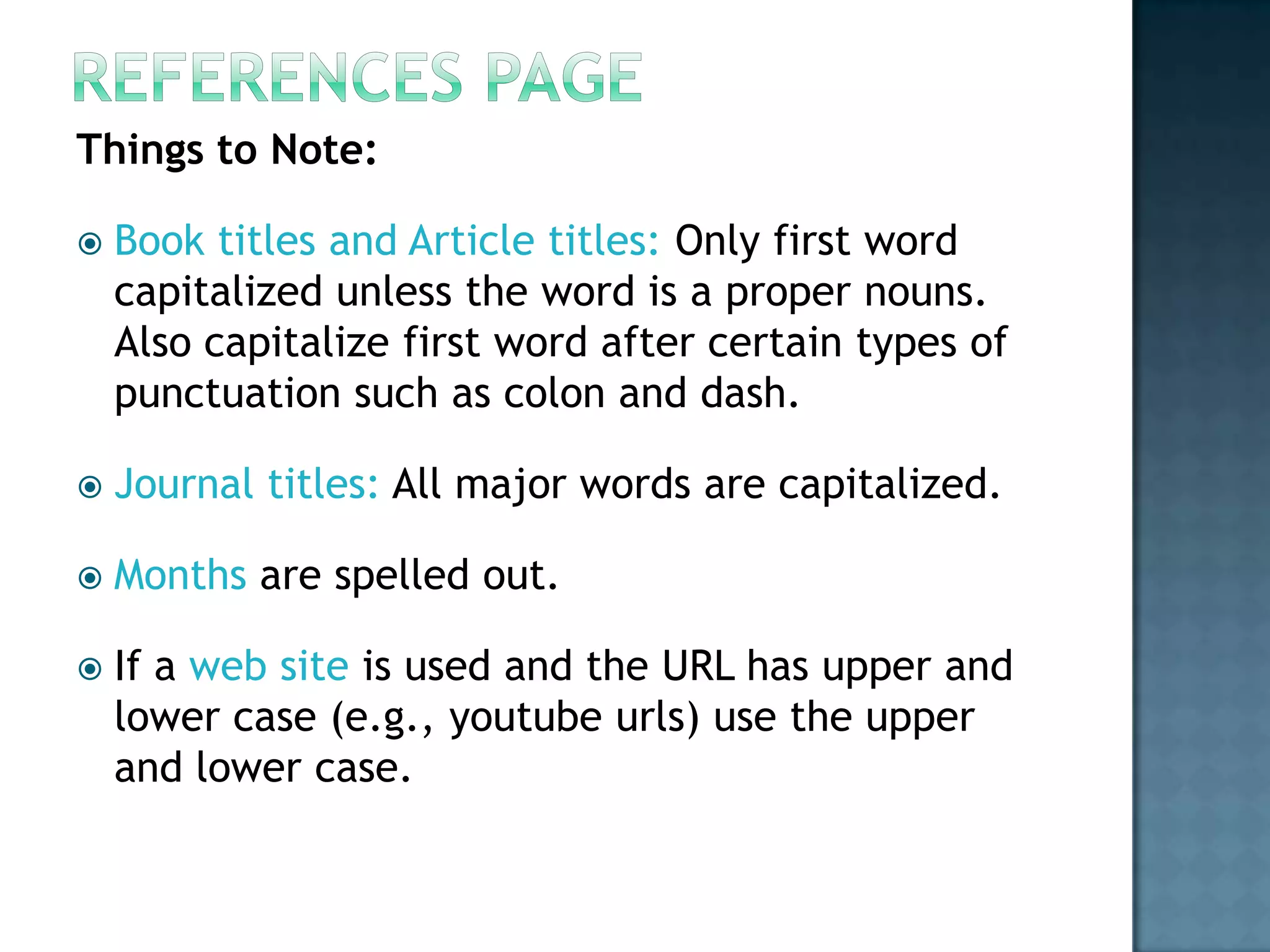
Things to Note:


Book titles and Article titles: Only first word
capitalized unless the word is a proper nouns.
Also capitalize first word after certain types of
punctuation such as colon and dash.



Journal titles: All major words are capitalized.



Months are spelled out.



If a web site is used and the URL has upper and
lower case (e.g., youtube urls) use the upper
and lower case.
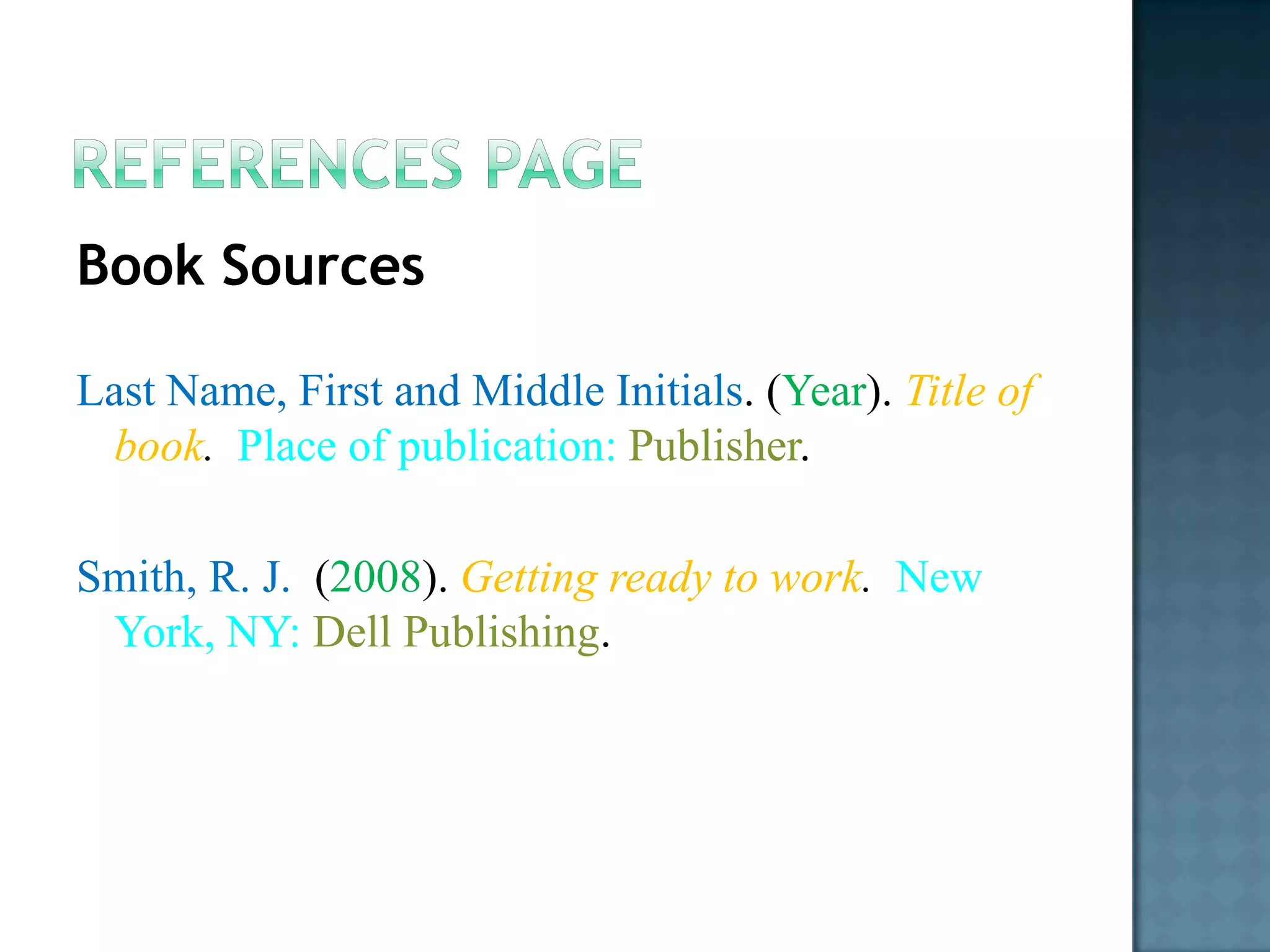
Book Sources
Last Name, First and Middle Initials. (Year). Title of
book. Place of publication: Publisher.
Smith, R. J. (2008). Getting ready to work. New
York, NY: Dell Publishing.
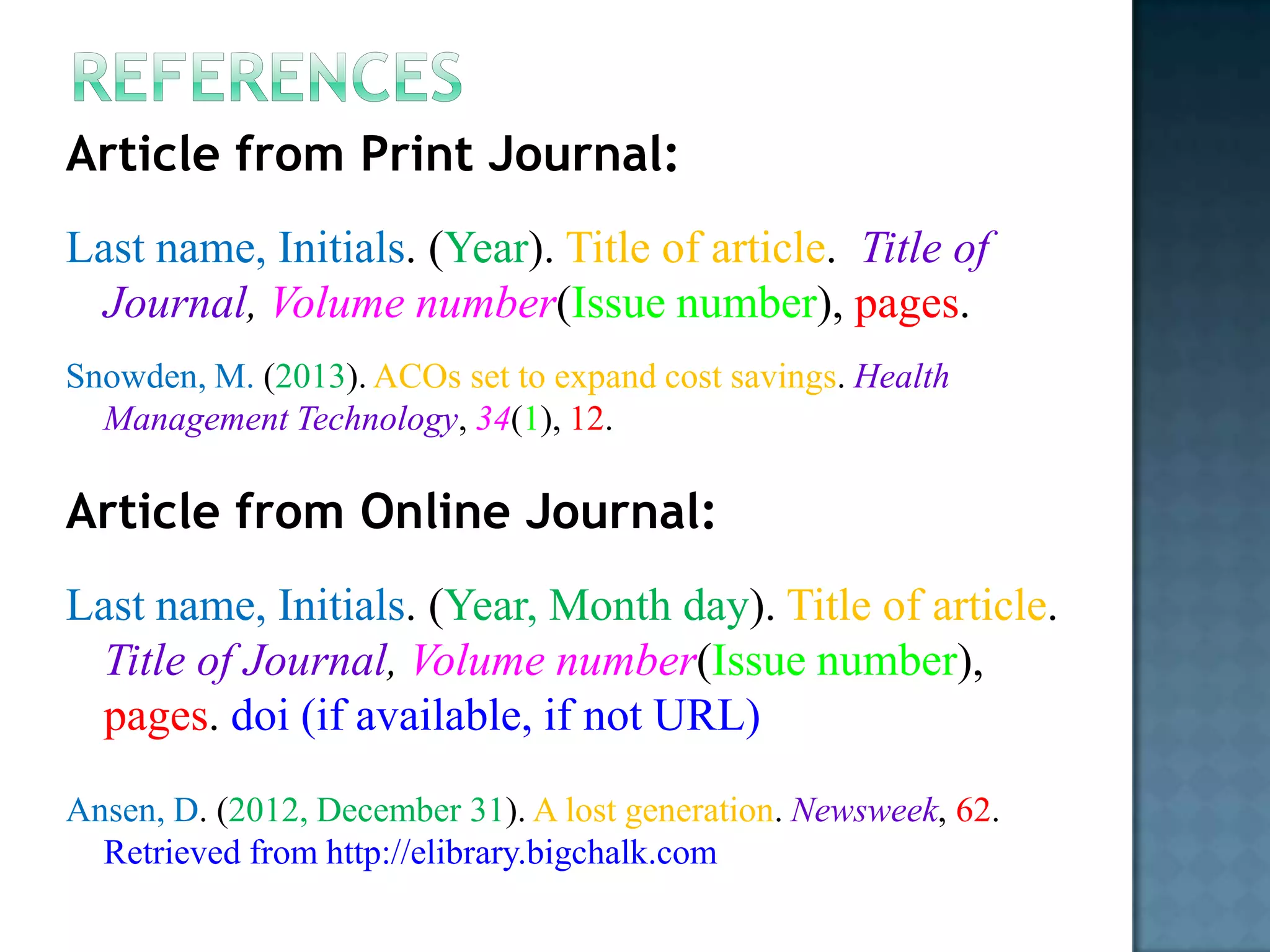
Article from Print Journal:
Last name, Initials. (Year). Title of article. Title of
Journal, Volume number(Issue number), pages.
Snowden, M. (2013). ACOs set to expand cost savings. Health
Management Technology, 34(1), 12.

Article from Online Journal:
Last name, Initials. (Year, Month day). Title of article.
Title of Journal, Volume number(Issue number),
pages. doi (if available, if not URL)
Ansen, D. (2012, December 31). A lost generation. Newsweek, 62.
Retrieved from http://elibrary.bigchalk.com
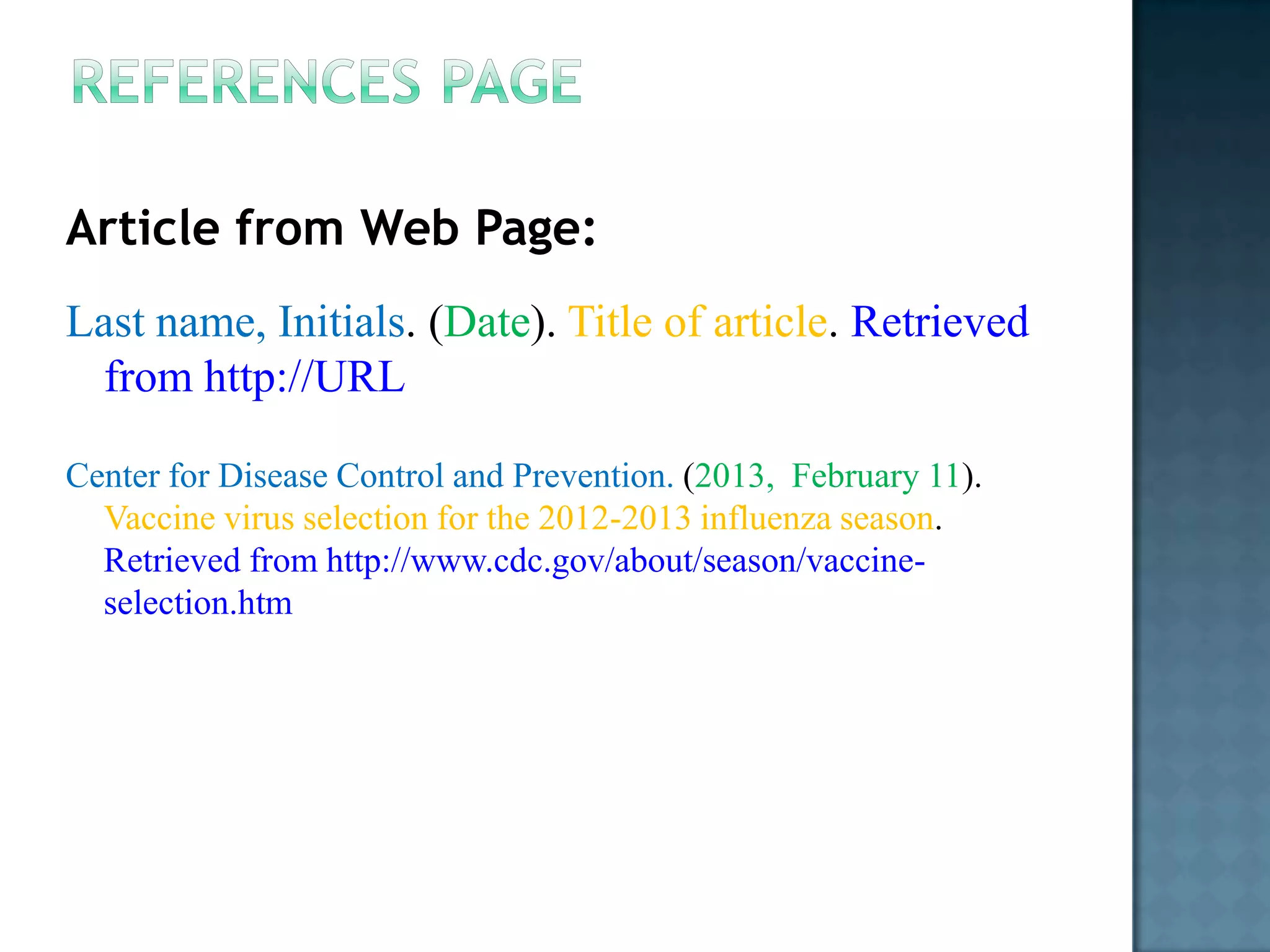
Article from Web Page:
Last name, Initials. (Date). Title of article. Retrieved
from http://URL
Center for Disease Control and Prevention. (2013, February 11).
Vaccine virus selection for the 2012-2013 influenza season.
Retrieved from http://www.cdc.gov/about/season/vaccineselection.htm
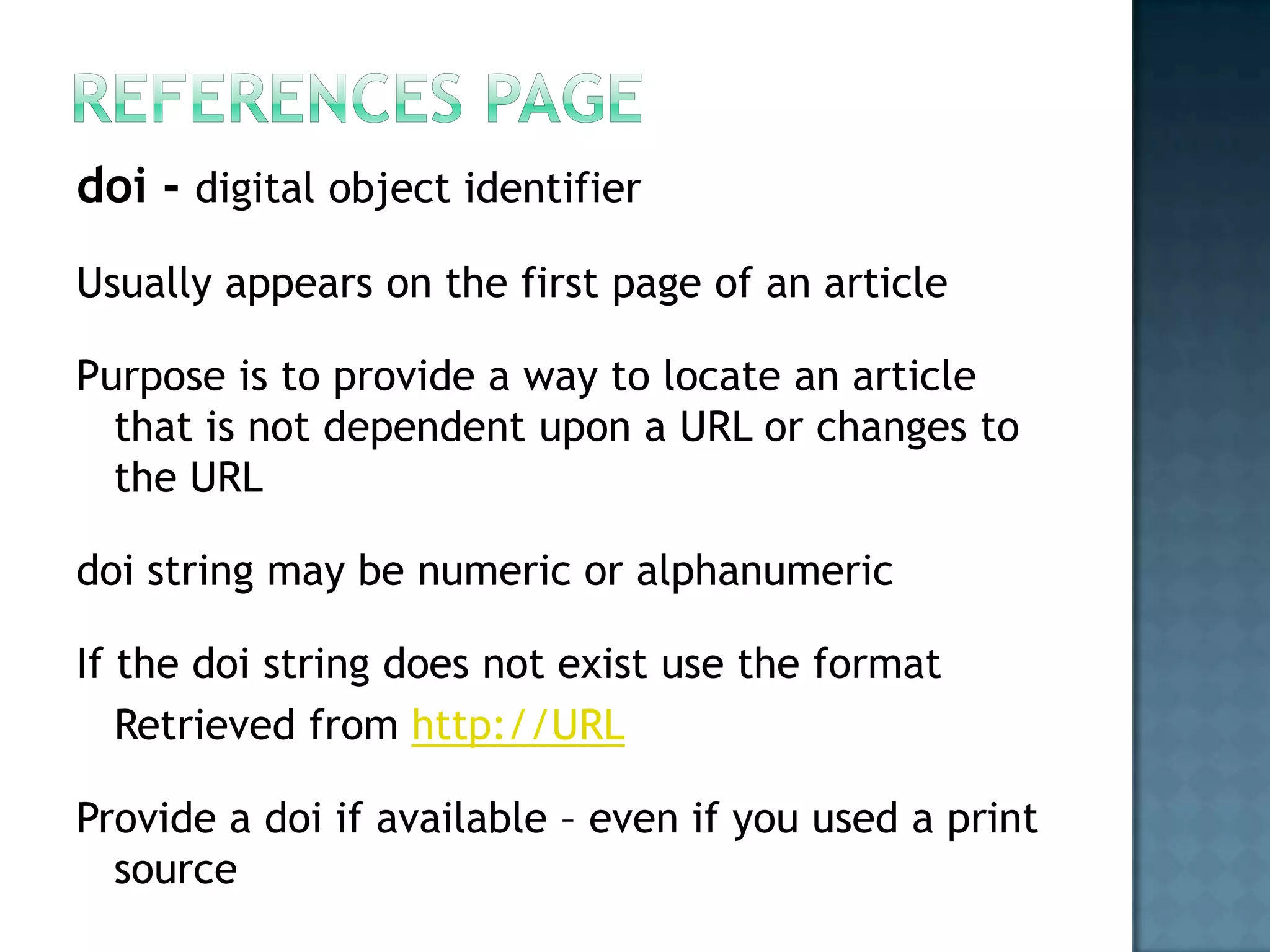
doi - digital object identifier
Usually appears on the first page of an article
Purpose is to provide a way to locate an article
that is not dependent upon a URL or changes to
the URL
doi string may be numeric or alphanumeric
If the doi string does not exist use the format
Retrieved from http://URL
Provide a doi if available – even if you used a print
source
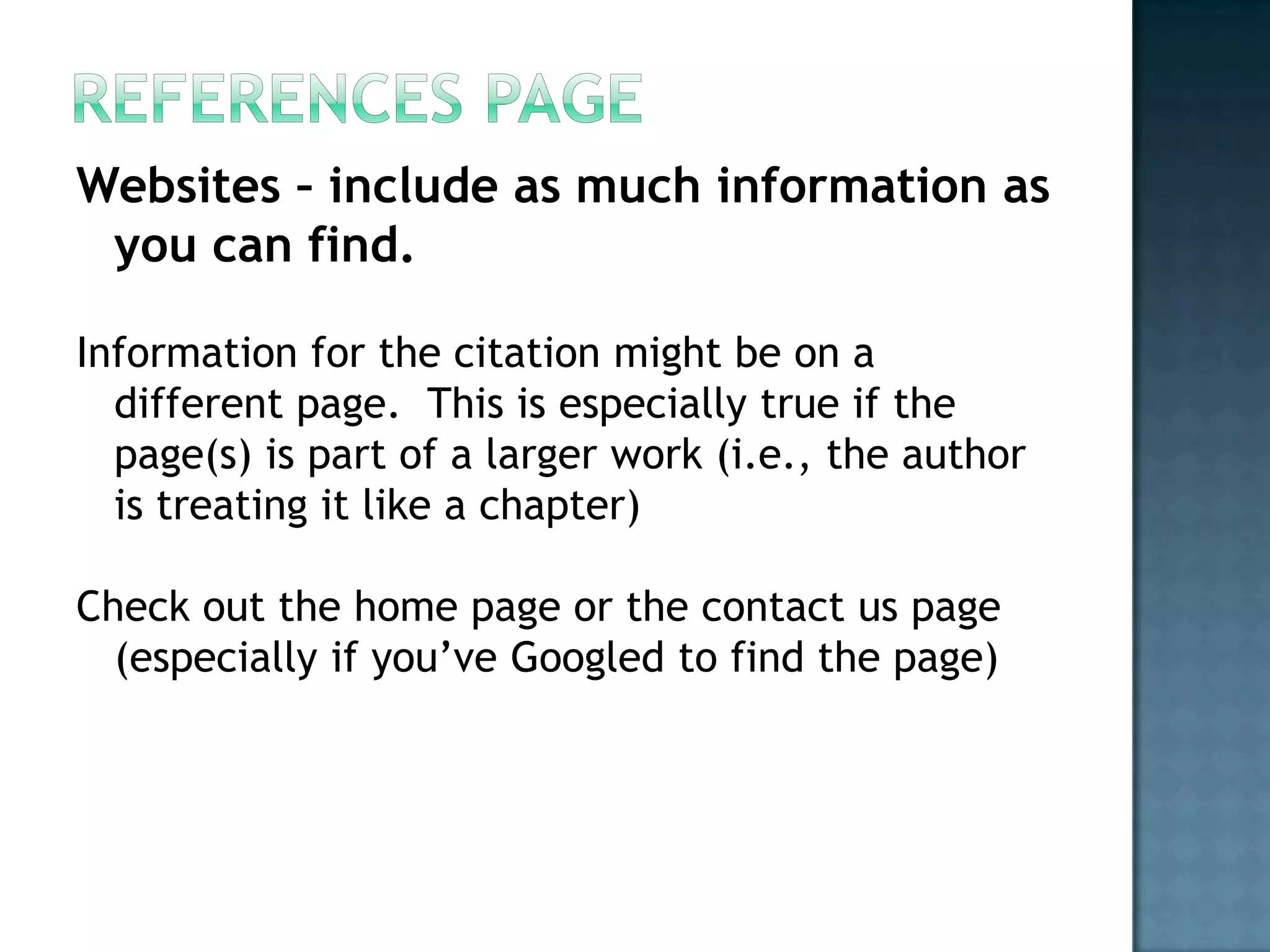
Websites – include as much information as
you can find.
Information for the citation might be on a
different page. This is especially true if the
page(s) is part of a larger work (i.e., the author
is treating it like a chapter)
Check out the home page or the contact us page
(especially if you’ve Googled to find the page)
 Print

APA Handbook
 OWL online http://owl.english.purdue.edu
 Databases – generate citations
 Citation Machine http://citationmachine.net
Nobody memorizes ALL the rules, in fact most
people have to refer to the APA guidelines
every time they write a paper.
Remember even if a source provides an APA
reference you are ultimately responsible to
make sure it is in the correct format!

Citingyoursources apa-130910080848-phpapp01

  • 1.
    Using APA Stylein a college paper
  • 2.
     Anytime you writea paper, give a speech or complete a project for class, you are going to do some research  Find statistics, quotes, definitions, case studies, business reports, etc.  Find research and ideas about a topic  These are the sources you must cite!
  • 3.
     Helps the readerunderstand the basis for information presented in your paper  Readers of your paper might want further information on your topic…your references will lead your reader to that information  You should give credit to the person who conducted the original research  Protect yourself from plagiarism
  • 4.
     Plagiarism: "To presentthe ideas or words of another as one's own" -- Merriam-Webster's Dictionary & Thesaurus 2007  Plagiarism can be intentional or unintentional  It occurs anytime you quote, reference or use someone else’s work (article, book, photo, information on a website, etc.) and you don’t cite your source  Or if you paraphrase but use too much of the original source.
  • 5.
     Citation styles werecreated to provide a guide for authors/writers to properly reference another person’s work  Citation styles have a very specific set of RULES  Punctuation, Italics, Underlining, capitalization, parentheses – IT ALL PLAYS A ROLE
  • 6.
     APA (American PsychologicalAssociation) style is most often used in the social sciences and research.  APA provides writers of research papers a style to properly reference their sources, using parentheses in their essays and a References page at the end.  Publication Manual of the American Psychological Association (6th edition)  In-text citations require an entry on the References page
  • 7.
     12 point TimesNew Roman font  1” margins all around  Double  All indents ½” from left margin  Page numbers – in header, flush right  Header  Do 2 space – all caps, flush left not hyphenate a word at the end of a line spaces after a period in text
  • 8.
    Your instructor’s “Rules”override any official guidelines  Title Page  Centered in upper half of page  Contains Title of Paper, Author, Institutions  Running Header  Abstract  Center the word “Abstract”  No indentations  150-200 words  Header
  • 9.
     Actual paper  1st page– center title of paper  Header  Has in-text citations  References Page
  • 10.
     A working bibliographyconsist of all sources used in your research process.  It is always a good idea to capture the information just in case it will need to appear in your reference list or in a citation. Basic source information for the reference  Date(s) that you accessed web pages  Page/paragragh information for key statistics, photos, charts  Page/paragragh information for potential quotes   References page lists only those sources cited in your paper.
  • 11.
     Used to indicatethe source of the fact or idea or quote  Format  Books, is usually not source dependent journals and web pages are all formatted similarly
  • 12.
     In-text citation: (Author,Year) 70% of students going back to college feel overwhelmed (Smith, 2009).  In-text citation where the author is mentioned: (Year) According to Smith (2009), 70% of students going back to college feel overwhelmed.
  • 13.
     In-text citation withmultiple authors: (Author1 & Author2, Year) Deaths from HIV rose 58% between 1980 and 1992 (Weiner & Tyler, 1998).
  • 14.
     In-text citation: (Author,Year, Page Number) “70% of students going back to college feel overwhelmed” (Smith, 2009, p. 16).  In-text citation where the author is mentioned: According to Smith (2009), “70% of students going back to college feel overwhelmed” (p. 16).
  • 15.
     At the endof the paper References  Every work on the References page should appear in your paper and vice versa  Hanging  List indent Smith, Rhonda. (2008). Getting ready to work. New York, NY: Dell Publishing. Washington, George. (2010, July 5). Cutting down an apple tree. American Journal of Psychology 34(3), 15-25. Retrieved from http://factsormythsofhistory.com/washin gton.htm Zeller, Dan. (2009, April 4). Learning APA style. American Journal of Writing. 3(3), 59-68. sources alphabetically by author – if there is no author by the first important word in the title
  • 16.
    Things to Note:  Booktitles and Article titles: Only first word capitalized unless the word is a proper nouns. Also capitalize first word after certain types of punctuation such as colon and dash.  Journal titles: All major words are capitalized.  Months are spelled out.  If a web site is used and the URL has upper and lower case (e.g., youtube urls) use the upper and lower case.
  • 17.
    Book Sources Last Name,First and Middle Initials. (Year). Title of book. Place of publication: Publisher. Smith, R. J. (2008). Getting ready to work. New York, NY: Dell Publishing.
  • 18.
    Article from PrintJournal: Last name, Initials. (Year). Title of article. Title of Journal, Volume number(Issue number), pages. Snowden, M. (2013). ACOs set to expand cost savings. Health Management Technology, 34(1), 12. Article from Online Journal: Last name, Initials. (Year, Month day). Title of article. Title of Journal, Volume number(Issue number), pages. doi (if available, if not URL) Ansen, D. (2012, December 31). A lost generation. Newsweek, 62. Retrieved from http://elibrary.bigchalk.com
  • 19.
    Article from WebPage: Last name, Initials. (Date). Title of article. Retrieved from http://URL Center for Disease Control and Prevention. (2013, February 11). Vaccine virus selection for the 2012-2013 influenza season. Retrieved from http://www.cdc.gov/about/season/vaccineselection.htm
  • 20.
    doi - digitalobject identifier Usually appears on the first page of an article Purpose is to provide a way to locate an article that is not dependent upon a URL or changes to the URL doi string may be numeric or alphanumeric If the doi string does not exist use the format Retrieved from http://URL Provide a doi if available – even if you used a print source
  • 21.
    Websites – includeas much information as you can find. Information for the citation might be on a different page. This is especially true if the page(s) is part of a larger work (i.e., the author is treating it like a chapter) Check out the home page or the contact us page (especially if you’ve Googled to find the page)
  • 22.
     Print APA Handbook OWL online http://owl.english.purdue.edu  Databases – generate citations  Citation Machine http://citationmachine.net Nobody memorizes ALL the rules, in fact most people have to refer to the APA guidelines every time they write a paper. Remember even if a source provides an APA reference you are ultimately responsible to make sure it is in the correct format!