APA Style
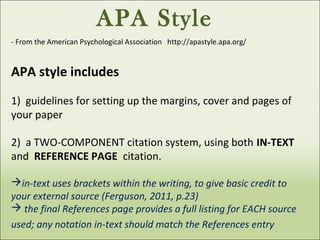
- From the American Psychological Association http://apastyle.apa.org/
APA style includes
1) guidelines for setting up the margins, cover and pages of
your paper
2) a TWO-COMPONENT citation system, using both IN-TEXT
and REFERENCE PAGE citation.
in-text uses brackets within the writing, to give basic credit to
your external source (Ferguson, 2011, p.23)
 the final References page provides a full listing for EACH source
used; any notation in-text should match the References entry
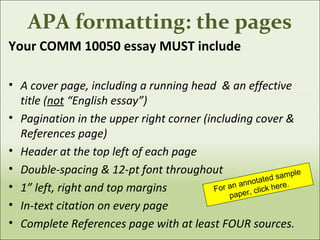
APA formatting: the pages
Your COMM 10050 essay MUST include
• A cover page, including a running head & an effective
title (not “English essay”)
• Pagination in the upper right corner (including cover &
References page)
• Header at the top left of each page
• Double-spacing & 12-pt font throughout
• 1” left, right and top margins
• In-text citation on every page
• Complete References page with at least FOUR sources.
For an annotated sample
paper, click here.
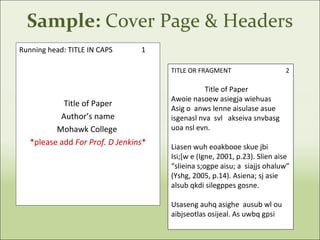
Sample: Cover Page & Headers
Running head: TITLE IN CAPS 1
Title of Paper
Author’s name
Mohawk College
*please add For Prof. D Jenkins*
TITLE OR FRAGMENT 2
Title of Paper
Awoie nasoew asiegja wiehuas
Asig o anws lenne aisulase asue
isgenasl nva svl akseiva snvbasg
uoa nsl evn.
Liasen wuh eoakbooe skue jbi
Isi;[w e (Igne, 2001, p.23). Slien aise
“slieina s;ogpe aisu; a siajjs ohaluw”
(Yshg, 2005, p.14). Asiena; sj asie
alsub qkdi silegppes gosne.
Usaseng auhq asighe ausub wl ou
aibjseotlas osijeal. As uwbq gpsi
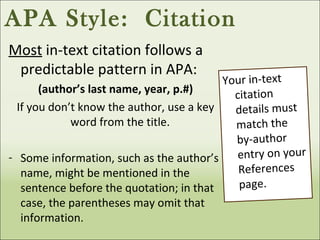
Most in-text citation follows a
predictable pattern in APA:
(author’s last name, year, p.#)
If you don’t know the author, use a key
word from the title.
- Some information, such as the author’s
name, might be mentioned in the
sentence before the quotation; in that
case, the parentheses may omit that
information.
Your in-text
citation
details must
match the
by-author
entry on your
References
page.
APA Style: Citation
I cite my sources when I:
- use someone else’s original words – even if it
isn’t a full sentence
- summarize or paraphrase someone else’s ideas
- use someone else’s diagram or illustration
- use ideas from a speech, lecture, scientific
experiment, interview or conversation, video ,
film or television program
Source: Pearson Education, Inc. 2006
I don’t need to cite my sources when I:
- employ an easy verifiable fact
Aspirin is a commonly used painkiller.
- employ common knowledge
Drunk driving costs lives.
- employ an idea that is easily observable
Patients in the ER often wait a long time before being seen.
Source: Pearson Education, Inc. 2006
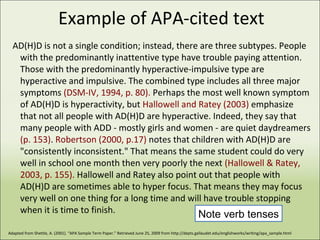
Example of APA-cited text
AD(H)D is not a single condition; instead, there are three subtypes. People
with the predominantly inattentive type have trouble paying attention.
Those with the predominantly hyperactive-impulsive type are
hyperactive and impulsive. The combined type includes all three major
symptoms (DSM-IV, 1994, p. 80). Perhaps the most well known symptom
of AD(H)D is hyperactivity, but Hallowell and Ratey (2003) emphasize
that not all people with AD(H)D are hyperactive. Indeed, they say that
many people with ADD - mostly girls and women - are quiet daydreamers
(p. 153). Robertson (2000, p.17) notes that children with AD(H)D are
"consistently inconsistent." That means the same student could do very
well in school one month then very poorly the next (Hallowell & Ratey,
2003, p. 155). Hallowell and Ratey also point out that people with
AD(H)D are sometimes able to hyper focus. That means they may focus
very well on one thing for a long time and will have trouble stopping
when it is time to finish.
Adapted from Shettle, A. (2001). “APA Sample Term Paper.” Retrieved June 25, 2009 from http://depts.gallaudet.edu/englishworks/writing/apa_sample.html
Note verb tenses
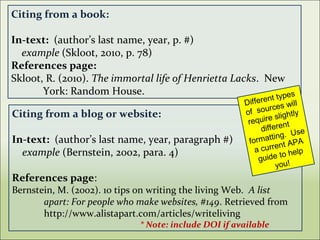
Citing from a book:
In-text: (author’s last name, year, p. #)
example (Skloot, 2010, p. 78)
References page:
Skloot, R. (2010). The immortal life of Henrietta Lacks. New
York: Random House.
Citing from a blog or website:
In-text: (author’s last name, year, paragraph #)
example (Bernstein, 2002, para. 4)
References page:
Bernstein, M. (2002). 10 tips on writing the living Web. A list
apart: For people who make websites, #149. Retrieved from
http://www.alistapart.com/articles/writeliving
* Note: include DOI if available
Different types
of sources will
require slightly
different
formatting. Use
a current APA
guide to help
you!
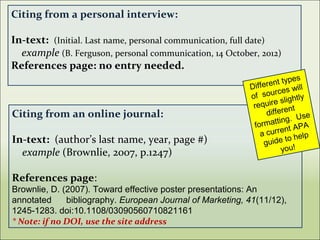
Citing from a personal interview:
In-text: (Initial. Last name, personal communication, full date)
example (B. Ferguson, personal communication, 14 October, 2012)
References page: no entry needed.
Citing from an online journal:
In-text: (author’s last name, year, page #)
example (Brownlie, 2007, p.1247)
References page:
Brownlie, D. (2007). Toward effective poster presentations: An
annotated bibliography. European Journal of Marketing, 41(11/12),
1245-1283. doi:10.1108/03090560710821161
* Note: if no DOI, use the site address
Different types
of sources will
require slightly
different
formatting. Use
a current APA
guide to help
you!
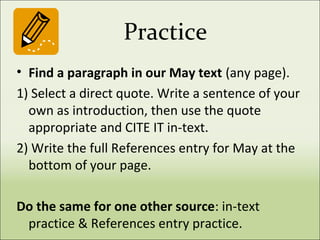
Practice
• Find a paragraph in our May text (any page).
1) Select a direct quote. Write a sentence of your
own as introduction, then use the quote
appropriate and CITE IT in-text.
2) Write the full References entry for May at the
bottom of your page.
Do the same for one other source: in-text
practice & References entry practice.
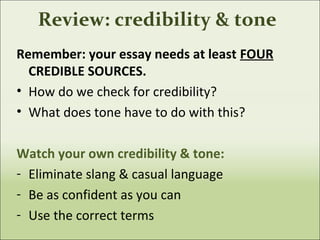
Review: credibility & tone
Remember: your essay needs at least FOUR
CREDIBLE SOURCES.
• How do we check for credibility?
• What does tone have to do with this?
Watch your own credibility & tone:
- Eliminate slang & casual language
- Be as confident as you can
- Use the correct terms
Plagiarism
= Academic Dishonesty
= Zero
To prevent plagiarism,
understand what we
mean by the term, and
do what you can to
avoid it.
College Policy #705
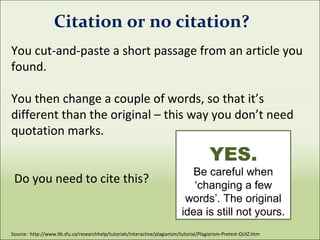
You cut-and-paste a short passage from an article you
found.
You then change a couple of words, so that it’s
different than the original – this way you don’t need
quotation marks.
Do you need to cite this?
Source: http://www.lib.sfu.ca/researchhelp/tutorials/interactive/plagiarism/tutorial/Plagiarism-Pretest-QUIZ.htm
Citation or no citation?
YES.
Be careful when
‘changing a few
words’. The original
idea is still not yours.
Citation or no citation?
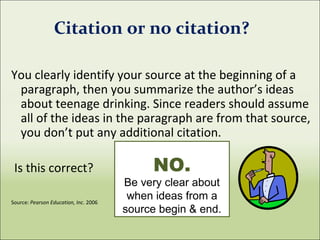
You clearly identify your source at the beginning of a
paragraph, then you summarize the author’s ideas
about teenage drinking. Since readers should assume
all of the ideas in the paragraph are from that source,
you don’t put any additional citation.
Is this correct?
Source: Pearson Education, Inc. 2006
NO.
Be very clear about
when ideas from a
source begin & end.
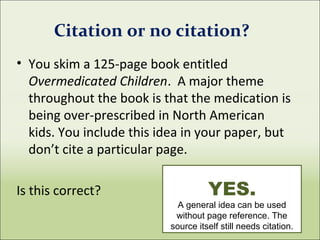
• You skim a 125-page book entitled
Overmedicated Children. A major theme
throughout the book is that the medication is
being over-prescribed in North American
kids. You include this idea in your paper, but
don’t cite a particular page.
Is this correct?
Citation or no citation?
YES.
A general idea can be used
without page reference. The
source itself still needs citation.
Make your life easier!
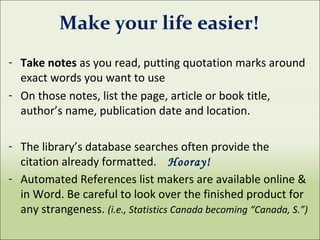
- Take notes as you read, putting quotation marks around
exact words you want to use
- On those notes, list the page, article or book title,
author’s name, publication date and location.
- The library’s database searches often provide the
citation already formatted. Hooray!
- Automated References list makers are available online &
in Word. Be careful to look over the finished product for
any strangeness. (i.e., Statistics Canada becoming “Canada, S.”)
Where can I find help with citation?
The most up-to-date resources are online:
The APA itself: http://apastyle.apa.org
The BRAIN’s citation resources.
(homepage> “How To’s”> Cite your
sources)
Purdue University’s Online Writing Lab
resources. 17

APA Guidelines & Formatting

  • 1.
    APA Style - Fromthe American Psychological Association http://apastyle.apa.org/ APA style includes 1) guidelines for setting up the margins, cover and pages of your paper 2) a TWO-COMPONENT citation system, using both IN-TEXT and REFERENCE PAGE citation. in-text uses brackets within the writing, to give basic credit to your external source (Ferguson, 2011, p.23)  the final References page provides a full listing for EACH source used; any notation in-text should match the References entry
  • 2.
    APA formatting: thepages Your COMM 10050 essay MUST include • A cover page, including a running head & an effective title (not “English essay”) • Pagination in the upper right corner (including cover & References page) • Header at the top left of each page • Double-spacing & 12-pt font throughout • 1” left, right and top margins • In-text citation on every page • Complete References page with at least FOUR sources. For an annotated sample paper, click here.
  • 3.
    Sample: Cover Page& Headers Running head: TITLE IN CAPS 1 Title of Paper Author’s name Mohawk College *please add For Prof. D Jenkins* TITLE OR FRAGMENT 2 Title of Paper Awoie nasoew asiegja wiehuas Asig o anws lenne aisulase asue isgenasl nva svl akseiva snvbasg uoa nsl evn. Liasen wuh eoakbooe skue jbi Isi;[w e (Igne, 2001, p.23). Slien aise “slieina s;ogpe aisu; a siajjs ohaluw” (Yshg, 2005, p.14). Asiena; sj asie alsub qkdi silegppes gosne. Usaseng auhq asighe ausub wl ou aibjseotlas osijeal. As uwbq gpsi
  • 4.
    Most in-text citationfollows a predictable pattern in APA: (author’s last name, year, p.#) If you don’t know the author, use a key word from the title. - Some information, such as the author’s name, might be mentioned in the sentence before the quotation; in that case, the parentheses may omit that information. Your in-text citation details must match the by-author entry on your References page. APA Style: Citation
  • 5.
    I cite mysources when I: - use someone else’s original words – even if it isn’t a full sentence - summarize or paraphrase someone else’s ideas - use someone else’s diagram or illustration - use ideas from a speech, lecture, scientific experiment, interview or conversation, video , film or television program Source: Pearson Education, Inc. 2006
  • 6.
    I don’t needto cite my sources when I: - employ an easy verifiable fact Aspirin is a commonly used painkiller. - employ common knowledge Drunk driving costs lives. - employ an idea that is easily observable Patients in the ER often wait a long time before being seen. Source: Pearson Education, Inc. 2006
  • 7.
    Example of APA-citedtext AD(H)D is not a single condition; instead, there are three subtypes. People with the predominantly inattentive type have trouble paying attention. Those with the predominantly hyperactive-impulsive type are hyperactive and impulsive. The combined type includes all three major symptoms (DSM-IV, 1994, p. 80). Perhaps the most well known symptom of AD(H)D is hyperactivity, but Hallowell and Ratey (2003) emphasize that not all people with AD(H)D are hyperactive. Indeed, they say that many people with ADD - mostly girls and women - are quiet daydreamers (p. 153). Robertson (2000, p.17) notes that children with AD(H)D are "consistently inconsistent." That means the same student could do very well in school one month then very poorly the next (Hallowell & Ratey, 2003, p. 155). Hallowell and Ratey also point out that people with AD(H)D are sometimes able to hyper focus. That means they may focus very well on one thing for a long time and will have trouble stopping when it is time to finish. Adapted from Shettle, A. (2001). “APA Sample Term Paper.” Retrieved June 25, 2009 from http://depts.gallaudet.edu/englishworks/writing/apa_sample.html Note verb tenses
  • 8.
    Citing from abook: In-text: (author’s last name, year, p. #) example (Skloot, 2010, p. 78) References page: Skloot, R. (2010). The immortal life of Henrietta Lacks. New York: Random House. Citing from a blog or website: In-text: (author’s last name, year, paragraph #) example (Bernstein, 2002, para. 4) References page: Bernstein, M. (2002). 10 tips on writing the living Web. A list apart: For people who make websites, #149. Retrieved from http://www.alistapart.com/articles/writeliving * Note: include DOI if available Different types of sources will require slightly different formatting. Use a current APA guide to help you!
  • 9.
    Citing from apersonal interview: In-text: (Initial. Last name, personal communication, full date) example (B. Ferguson, personal communication, 14 October, 2012) References page: no entry needed. Citing from an online journal: In-text: (author’s last name, year, page #) example (Brownlie, 2007, p.1247) References page: Brownlie, D. (2007). Toward effective poster presentations: An annotated bibliography. European Journal of Marketing, 41(11/12), 1245-1283. doi:10.1108/03090560710821161 * Note: if no DOI, use the site address Different types of sources will require slightly different formatting. Use a current APA guide to help you!
  • 10.
    Practice • Find aparagraph in our May text (any page). 1) Select a direct quote. Write a sentence of your own as introduction, then use the quote appropriate and CITE IT in-text. 2) Write the full References entry for May at the bottom of your page. Do the same for one other source: in-text practice & References entry practice.
  • 11.
    Review: credibility &tone Remember: your essay needs at least FOUR CREDIBLE SOURCES. • How do we check for credibility? • What does tone have to do with this? Watch your own credibility & tone: - Eliminate slang & casual language - Be as confident as you can - Use the correct terms
  • 12.
    Plagiarism = Academic Dishonesty =Zero To prevent plagiarism, understand what we mean by the term, and do what you can to avoid it. College Policy #705
  • 13.
    You cut-and-paste ashort passage from an article you found. You then change a couple of words, so that it’s different than the original – this way you don’t need quotation marks. Do you need to cite this? Source: http://www.lib.sfu.ca/researchhelp/tutorials/interactive/plagiarism/tutorial/Plagiarism-Pretest-QUIZ.htm Citation or no citation? YES. Be careful when ‘changing a few words’. The original idea is still not yours.
  • 14.
    Citation or nocitation? You clearly identify your source at the beginning of a paragraph, then you summarize the author’s ideas about teenage drinking. Since readers should assume all of the ideas in the paragraph are from that source, you don’t put any additional citation. Is this correct? Source: Pearson Education, Inc. 2006 NO. Be very clear about when ideas from a source begin & end.
  • 15.
    • You skima 125-page book entitled Overmedicated Children. A major theme throughout the book is that the medication is being over-prescribed in North American kids. You include this idea in your paper, but don’t cite a particular page. Is this correct? Citation or no citation? YES. A general idea can be used without page reference. The source itself still needs citation.
  • 16.
    Make your lifeeasier! - Take notes as you read, putting quotation marks around exact words you want to use - On those notes, list the page, article or book title, author’s name, publication date and location. - The library’s database searches often provide the citation already formatted. Hooray! - Automated References list makers are available online & in Word. Be careful to look over the finished product for any strangeness. (i.e., Statistics Canada becoming “Canada, S.”)
  • 17.
    Where can Ifind help with citation? The most up-to-date resources are online: The APA itself: http://apastyle.apa.org The BRAIN’s citation resources. (homepage> “How To’s”> Cite your sources) Purdue University’s Online Writing Lab resources. 17