

Why and How to Write 
APA- Style References in 
the Body and Reference 
Section of Your Papers
The purpose of this presentation is to 
explain WHY it is necessary to cite 
the sources you use to support what 
you write in your papers and HOW 
to cite these sources in correct APA 
style (i.e., according to the 
Publication Manual of the American 
Psychological Association).
References 
 Bibliography: contains sources listed in 
the paper plus sources consulted in 
writing the paper 
 References: contains only sources 
listed in the paper 
 Use reference pages
APA-Style References in 
the Body of Your Paper
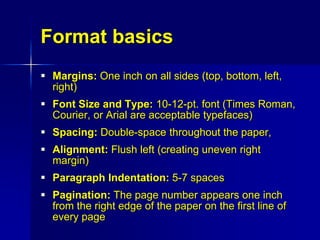
Format basics 
 Margins: One inch on all sides (top, bottom, left, 
right) 
 Font Size and Type: 10-12-pt. font (Times Roman, 
Courier, or Arial are acceptable typefaces) 
 Spacing: Double-space throughout the paper, 
 Alignment: Flush left (creating uneven right 
margin) 
 Paragraph Indentation: 5-7 spaces 
 Pagination: The page number appears one inch 
from the right edge of the paper on the first line of 
every page
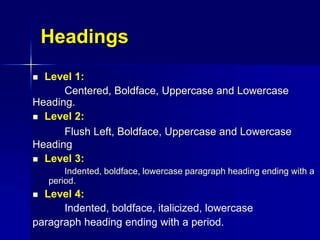
Headings 
 Level 1: 
Centered, Boldface, Uppercase and Lowercase 
Heading. 
 Level 2: 
Flush Left, Boldface, Uppercase and Lowercase 
Heading 
 Level 3: 
Indented, boldface, lowercase paragraph heading ending with a 
period. 
 Level 4: 
Indented, boldface, italicized, lowercase 
paragraph heading ending with a period.
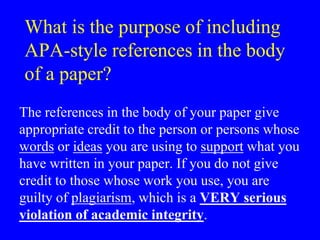
What is the purpose of including 
APA-style references in the body 
of a paper? 
The references in the body of your paper give 
appropriate credit to the person or persons whose 
words or ideas you are using to support what you 
have written in your paper. If you do not give 
credit to those whose work you use, you are 
guilty of plagiarism, which is a VERY serious 
violation of academic integrity.
If you use a direct quotation from 
an original source, give the 
author(s) credit for her/his/their 
words as follows. Include the 
page number(s) of the quotation 
to enable your readers to find it. 
“Cognitive therapy is more effective than 
psychoanalysis in the treatments of 
phobias” (Jones & Smith, 2002, p. 44).
If you paraphrase from a source 
(i.e., translate it into your own 
words), give the author(s) credit 
for their ideas as follows. 
According to Jones and Smith (2002), 
phobias can be treated more successfully 
by cognitive therapy than psychoanalysis.
If you refer to a primary source 
(e.g., a journal article by Jones) 
you read about in a secondary 
source (e.g., a textbook by 
Smith), you must create the 
following type of citation. 
According to Jones (as cited in Smith, 
2003), phobias can be treated more 
successfully by cognitive therapy than 
psychoanalysis.
If you refer to a personal 
communication (e.g., an e-mail 
message or conversation) that is 
not available to your readers, 
include it in the body of your 
paper in the following way. 
According to P. J. Jones, Director of the IUPUI 
Counseling Center (personal communication, 
May 1, 2002), phobias can be treated more 
successfully by cognitive therapy than 
psychoanalysis.
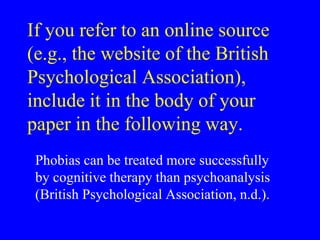
If you refer to an online source 
(e.g., the website of the British 
Psychological Association), 
include it in the body of your 
paper in the following way. 
Phobias can be treated more successfully 
by cognitive therapy than psychoanalysis 
(British Psychological Association, n.d.).
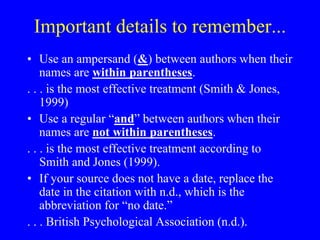
Important details to remember... 
• Use an ampersand (&) between authors when their 
names are within parentheses. 
. . . is the most effective treatment (Smith & Jones, 
1999) 
• Use a regular “and” between authors when their 
names are not within parentheses. 
. . . is the most effective treatment according to 
Smith and Jones (1999). 
• If your source does not have a date, replace the 
date in the citation with n.d., which is the 
abbreviation for “no date.” 
. . . British Psychological Association (n.d.).
APA-Style References 
in the Reference Section 
of Your Paper
What is the purpose of APA-style 
references in a reference section? 
The references in your reference 
section provide your readers with the 
information necessary to retrieve the 
sources you cited in the body of your 
paper by performing a library or 
online search.
What questions are answered in 
an APA-style reference that will 
enable a reader to perform a 
successful search? 
• Who wrote this document? 
• When was it written? 
• What was its title? 
• Where was it published? 
• Who published it?
Example 
Suppose you paraphrased information 
from a book titled Sigmund Freud: 
Champion of the Unconscious by 
Gerald R. Smith and Thomas T. 
Ferguson that was published by 
Worth Publishers of St. Paul, 
Minnesota in 2001.
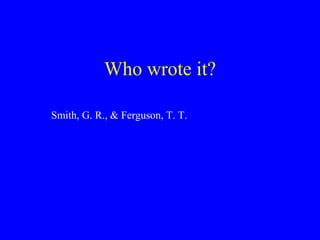
Who wrote it? 
Smith, G. R., & Ferguson, T. T.
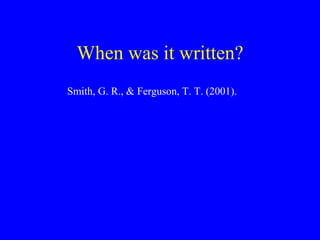
When was it written? 
Smith, G. R., & Ferguson, T. T. (2001).
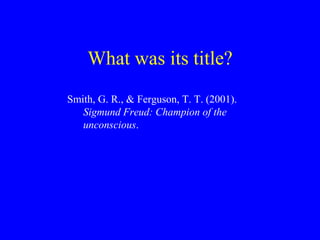
What was its title? 
Smith, G. R., & Ferguson, T. T. (2001). 
Sigmund Freud: Champion of the 
unconscious.
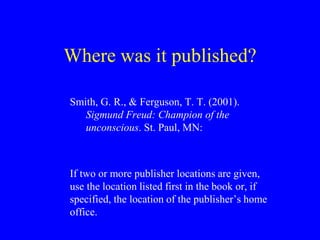
Where was it published? 
Smith, G. R., & Ferguson, T. T. (2001). 
Sigmund Freud: Champion of the 
unconscious. St. Paul, MN: 
If two or more publisher locations are given, 
use the location listed first in the book or, if 
specified, the location of the publisher’s home 
office.
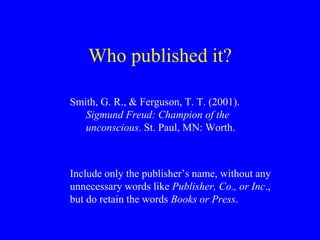
Who published it? 
Smith, G. R., & Ferguson, T. T. (2001). 
Sigmund Freud: Champion of the 
unconscious. St. Paul, MN: Worth. 
Include only the publisher’s name, without any 
unnecessary words like Publisher, Co., or Inc., 
but do retain the words Books or Press.
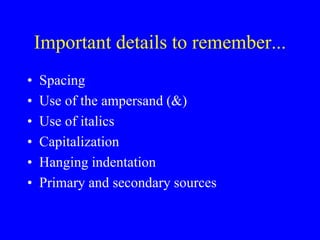
Important details to remember... 
• Spacing 
• Use of the ampersand (&) 
• Use of italics 
• Capitalization 
• Hanging indentation 
• Primary and secondary sources
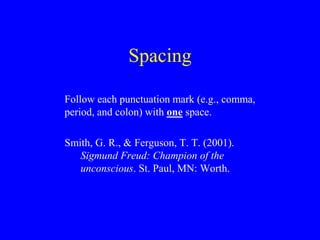
Spacing 
Follow each punctuation mark (e.g., comma, 
period, and colon) with one space. 
Smith, G. R., & Ferguson, T. T. (2001). 
Sigmund Freud: Champion of the 
unconscious. St. Paul, MN: Worth.
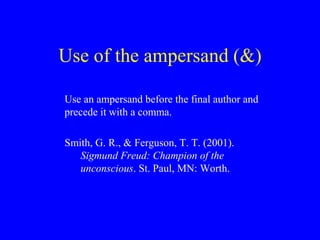
Use of the ampersand (&) 
Use an ampersand before the final author and 
precede it with a comma. 
Smith, G. R., & Ferguson, T. T. (2001). 
Sigmund Freud: Champion of the 
unconscious. St. Paul, MN: Worth.
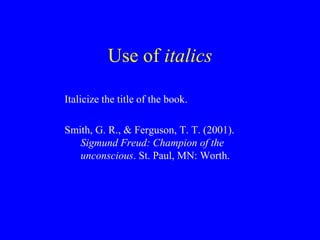
Use of italics 
Italicize the title of the book. 
Smith, G. R., & Ferguson, T. T. (2001). 
Sigmund Freud: Champion of the 
unconscious. St. Paul, MN: Worth.
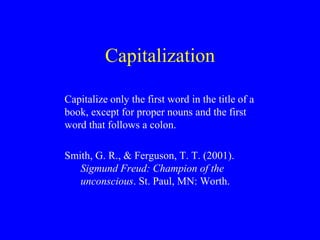
Capitalization 
Capitalize only the first word in the title of a 
book, except for proper nouns and the first 
word that follows a colon. 
Smith, G. R., & Ferguson, T. T. (2001). 
Sigmund Freud: Champion of the 
unconscious. St. Paul, MN: Worth.
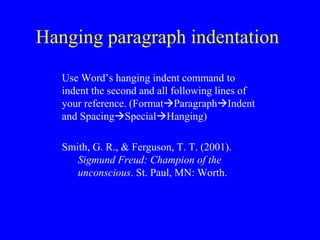
Hanging paragraph indentation 
Use Word’s hanging indent command to 
indent the second and all following lines of 
your reference. (FormatParagraphIndent 
and SpacingSpecialHanging) 
Smith, G. R., & Ferguson, T. T. (2001). 
Sigmund Freud: Champion of the 
unconscious. St. Paul, MN: Worth.
Primary and Secondary Sources 
If you cite a primary source in the body of 
your paper that you read about in a secondary 
source (but did not read in its original form), 
you should include only the secondary source 
in your reference section.
Important exceptions 
to these rules
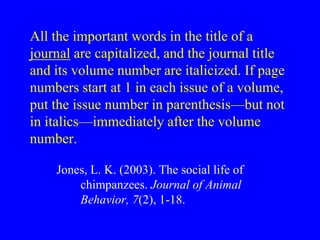
All the important words in the title of a 
journal are capitalized, and the journal title 
and its volume number are italicized. If page 
numbers start at 1 in each issue of a volume, 
put the issue number in parenthesis—but not 
in italics—immediately after the volume 
number. 
Jones, L. K. (2003). The social life of 
chimpanzees. Journal of Animal 
Behavior, 7(2), 1-18.
If two references by the same author(s) with the 
same date appear in the text of your paper, one will 
appear as Jones (2006a) and the other will appear as 
Jones (2006b). The a or b will be determined by how 
they are alphabetized in the reference section, not the 
order in which they appear in the text. In this case, 
the references in the reference section would look 
like the following because the B in Birds comes 
before the Z in Zebra. (Please note that an A or a The 
at the beginning of a title is ignored in the 
alphabetizing process.) 
Jones, T. J. (2006a). Birds are smart creatures. Dallas, TX: Harcourt. 
Jones, T. J. (2006b). A zebra is a striped horse. Peoria, IL: Wiley.
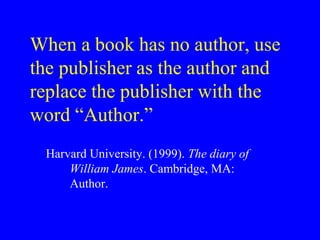
When a book has no author, use 
the publisher as the author and 
replace the publisher with the 
word “Author.” 
Harvard University. (1999). The diary of 
William James. Cambridge, MA: 
Author.
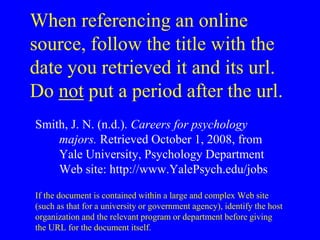
When referencing an online 
source, follow the title with the 
date you retrieved it and its url. 
Do not put a period after the url. 
Smith, J. N. (n.d.). Careers for psychology 
majors. Retrieved October 1, 2008, from 
Yale University, Psychology Department 
Web site: http://www.YalePsych.edu/jobs 
If the document is contained within a large and complex Web site 
(such as that for a university or government agency), identify the host 
organization and the relevant program or department before giving 
the URL for the document itself.
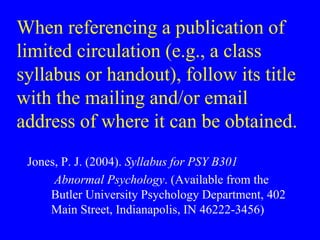
When referencing a publication of 
limited circulation (e.g., a class 
syllabus or handout), follow its title 
with the mailing and/or email 
address of where it can be obtained. 
Jones, P. J. (2004). Syllabus for PSY B301 
Abnormal Psychology. (Available from the 
Butler University Psychology Department, 402 
Main Street, Indianapolis, IN 46222-3456)
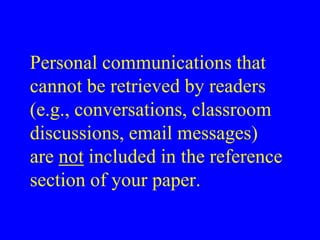
Personal communications that 
cannot be retrieved by readers 
(e.g., conversations, classroom 
discussions, email messages) 
are not included in the reference 
section of your paper.

Apa latest

  • 1.
    Why and Howto Write APA- Style References in the Body and Reference Section of Your Papers
  • 2.
    The purpose ofthis presentation is to explain WHY it is necessary to cite the sources you use to support what you write in your papers and HOW to cite these sources in correct APA style (i.e., according to the Publication Manual of the American Psychological Association).
  • 3.
    References  Bibliography:contains sources listed in the paper plus sources consulted in writing the paper  References: contains only sources listed in the paper  Use reference pages
  • 4.
    APA-Style References in the Body of Your Paper
  • 5.
    Format basics Margins: One inch on all sides (top, bottom, left, right)  Font Size and Type: 10-12-pt. font (Times Roman, Courier, or Arial are acceptable typefaces)  Spacing: Double-space throughout the paper,  Alignment: Flush left (creating uneven right margin)  Paragraph Indentation: 5-7 spaces  Pagination: The page number appears one inch from the right edge of the paper on the first line of every page
  • 6.
    Headings  Level1: Centered, Boldface, Uppercase and Lowercase Heading.  Level 2: Flush Left, Boldface, Uppercase and Lowercase Heading  Level 3: Indented, boldface, lowercase paragraph heading ending with a period.  Level 4: Indented, boldface, italicized, lowercase paragraph heading ending with a period.
  • 7.
    What is thepurpose of including APA-style references in the body of a paper? The references in the body of your paper give appropriate credit to the person or persons whose words or ideas you are using to support what you have written in your paper. If you do not give credit to those whose work you use, you are guilty of plagiarism, which is a VERY serious violation of academic integrity.
  • 8.
    If you usea direct quotation from an original source, give the author(s) credit for her/his/their words as follows. Include the page number(s) of the quotation to enable your readers to find it. “Cognitive therapy is more effective than psychoanalysis in the treatments of phobias” (Jones & Smith, 2002, p. 44).
  • 9.
    If you paraphrasefrom a source (i.e., translate it into your own words), give the author(s) credit for their ideas as follows. According to Jones and Smith (2002), phobias can be treated more successfully by cognitive therapy than psychoanalysis.
  • 10.
    If you referto a primary source (e.g., a journal article by Jones) you read about in a secondary source (e.g., a textbook by Smith), you must create the following type of citation. According to Jones (as cited in Smith, 2003), phobias can be treated more successfully by cognitive therapy than psychoanalysis.
  • 11.
    If you referto a personal communication (e.g., an e-mail message or conversation) that is not available to your readers, include it in the body of your paper in the following way. According to P. J. Jones, Director of the IUPUI Counseling Center (personal communication, May 1, 2002), phobias can be treated more successfully by cognitive therapy than psychoanalysis.
  • 12.
    If you referto an online source (e.g., the website of the British Psychological Association), include it in the body of your paper in the following way. Phobias can be treated more successfully by cognitive therapy than psychoanalysis (British Psychological Association, n.d.).
  • 13.
    Important details toremember... • Use an ampersand (&) between authors when their names are within parentheses. . . . is the most effective treatment (Smith & Jones, 1999) • Use a regular “and” between authors when their names are not within parentheses. . . . is the most effective treatment according to Smith and Jones (1999). • If your source does not have a date, replace the date in the citation with n.d., which is the abbreviation for “no date.” . . . British Psychological Association (n.d.).
  • 14.
    APA-Style References inthe Reference Section of Your Paper
  • 15.
    What is thepurpose of APA-style references in a reference section? The references in your reference section provide your readers with the information necessary to retrieve the sources you cited in the body of your paper by performing a library or online search.
  • 16.
    What questions areanswered in an APA-style reference that will enable a reader to perform a successful search? • Who wrote this document? • When was it written? • What was its title? • Where was it published? • Who published it?
  • 17.
    Example Suppose youparaphrased information from a book titled Sigmund Freud: Champion of the Unconscious by Gerald R. Smith and Thomas T. Ferguson that was published by Worth Publishers of St. Paul, Minnesota in 2001.
  • 18.
    Who wrote it? Smith, G. R., & Ferguson, T. T.
  • 19.
    When was itwritten? Smith, G. R., & Ferguson, T. T. (2001).
  • 20.
    What was itstitle? Smith, G. R., & Ferguson, T. T. (2001). Sigmund Freud: Champion of the unconscious.
  • 21.
    Where was itpublished? Smith, G. R., & Ferguson, T. T. (2001). Sigmund Freud: Champion of the unconscious. St. Paul, MN: If two or more publisher locations are given, use the location listed first in the book or, if specified, the location of the publisher’s home office.
  • 22.
    Who published it? Smith, G. R., & Ferguson, T. T. (2001). Sigmund Freud: Champion of the unconscious. St. Paul, MN: Worth. Include only the publisher’s name, without any unnecessary words like Publisher, Co., or Inc., but do retain the words Books or Press.
  • 23.
    Important details toremember... • Spacing • Use of the ampersand (&) • Use of italics • Capitalization • Hanging indentation • Primary and secondary sources
  • 24.
    Spacing Follow eachpunctuation mark (e.g., comma, period, and colon) with one space. Smith, G. R., & Ferguson, T. T. (2001). Sigmund Freud: Champion of the unconscious. St. Paul, MN: Worth.
  • 25.
    Use of theampersand (&) Use an ampersand before the final author and precede it with a comma. Smith, G. R., & Ferguson, T. T. (2001). Sigmund Freud: Champion of the unconscious. St. Paul, MN: Worth.
  • 26.
    Use of italics Italicize the title of the book. Smith, G. R., & Ferguson, T. T. (2001). Sigmund Freud: Champion of the unconscious. St. Paul, MN: Worth.
  • 27.
    Capitalization Capitalize onlythe first word in the title of a book, except for proper nouns and the first word that follows a colon. Smith, G. R., & Ferguson, T. T. (2001). Sigmund Freud: Champion of the unconscious. St. Paul, MN: Worth.
  • 28.
    Hanging paragraph indentation Use Word’s hanging indent command to indent the second and all following lines of your reference. (FormatParagraphIndent and SpacingSpecialHanging) Smith, G. R., & Ferguson, T. T. (2001). Sigmund Freud: Champion of the unconscious. St. Paul, MN: Worth.
  • 29.
    Primary and SecondarySources If you cite a primary source in the body of your paper that you read about in a secondary source (but did not read in its original form), you should include only the secondary source in your reference section.
  • 30.
  • 31.
    All the importantwords in the title of a journal are capitalized, and the journal title and its volume number are italicized. If page numbers start at 1 in each issue of a volume, put the issue number in parenthesis—but not in italics—immediately after the volume number. Jones, L. K. (2003). The social life of chimpanzees. Journal of Animal Behavior, 7(2), 1-18.
  • 32.
    If two referencesby the same author(s) with the same date appear in the text of your paper, one will appear as Jones (2006a) and the other will appear as Jones (2006b). The a or b will be determined by how they are alphabetized in the reference section, not the order in which they appear in the text. In this case, the references in the reference section would look like the following because the B in Birds comes before the Z in Zebra. (Please note that an A or a The at the beginning of a title is ignored in the alphabetizing process.) Jones, T. J. (2006a). Birds are smart creatures. Dallas, TX: Harcourt. Jones, T. J. (2006b). A zebra is a striped horse. Peoria, IL: Wiley.
  • 33.
    When a bookhas no author, use the publisher as the author and replace the publisher with the word “Author.” Harvard University. (1999). The diary of William James. Cambridge, MA: Author.
  • 34.
    When referencing anonline source, follow the title with the date you retrieved it and its url. Do not put a period after the url. Smith, J. N. (n.d.). Careers for psychology majors. Retrieved October 1, 2008, from Yale University, Psychology Department Web site: http://www.YalePsych.edu/jobs If the document is contained within a large and complex Web site (such as that for a university or government agency), identify the host organization and the relevant program or department before giving the URL for the document itself.
  • 35.
    When referencing apublication of limited circulation (e.g., a class syllabus or handout), follow its title with the mailing and/or email address of where it can be obtained. Jones, P. J. (2004). Syllabus for PSY B301 Abnormal Psychology. (Available from the Butler University Psychology Department, 402 Main Street, Indianapolis, IN 46222-3456)
  • 36.
    Personal communications that cannot be retrieved by readers (e.g., conversations, classroom discussions, email messages) are not included in the reference section of your paper.