Applied Physics
Lecture #1
Saeed ur Rehman
About Me
• MS(Software Engineering)
• Lecturer
• Bahria University Islamabad Campus.
Contact detail
• Email:saeedurrahman.buic@bahria.edu.pk
• Office Hours
• 2:30-4:30(everyday)
Some Policies and rules
• Everyone must wear the mask
• Raise your hand before asking any question and
then WAIT for the permission
• Must wear your ID card in the class
• Attendance during first 10 minutes for each hour
• After that you will be marked as absent
Some Rules
• Keep mobile phones on silent mode in the class
• Submission must be done on time
• No compensation for the missed quizzes
• No compensation for the missed assignments
Pre-Requisites
• None required!!
• But you must ask yourself
• From where we got the idea of building blocks
• How Applied Physics works,
Dishonesty, Plagiarism
• Students involved in any kind of cheating in any
• exam (Quizzes/Assignments) will get 0 (Zero) in
• that exam OR get F in the course
• In case of quizzes with cheating case, their
weightage will be highest.
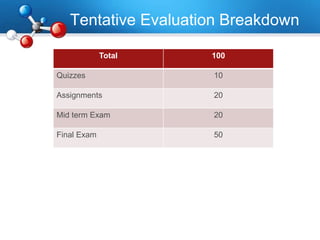
Tentative Evaluation Breakdown
Total 100
Quizzes 10
Assignments 20
Mid term Exam 20
Final Exam 50
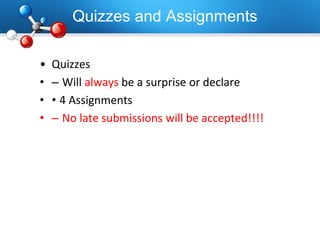
Quizzes and Assignments
• Quizzes
• – Will always be a surprise or declare
• • 4 Assignments
• – No late submissions will be accepted!!!!
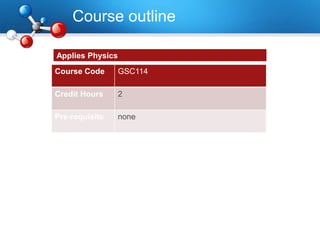
Course outline
Course Code GSC114
Credit Hours 2
Pre-requisite none
Applies Physics
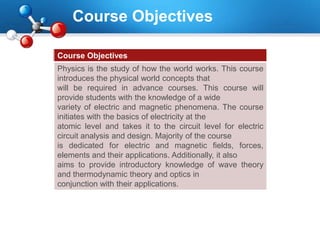
Course Objectives
Course Objectives
Course Objectives
Physics is the study of how the world works. This course
introduces the physical world concepts that
will be required in advance courses. This course will
provide students with the knowledge of a wide
variety of electric and magnetic phenomena. The course
initiates with the basics of electricity at the
atomic level and takes it to the circuit level for electric
circuit analysis and design. Majority of the course
is dedicated for electric and magnetic fields, forces,
elements and their applications. Additionally, it also
aims to provide introductory knowledge of wave theory
and thermodynamic theory and optics in
conjunction with their applications.
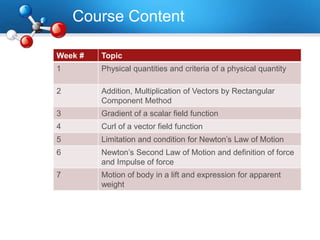
Course Content
Week # Topic
1 Physical quantities and criteria of a physical quantity
2 Addition, Multiplication of Vectors by Rectangular
Component Method
3 Gradient of a scalar field function
4 Curl of a vector field function
5 Limitation and condition for Newton’s Law of Motion
6 Newton’s Second Law of Motion and definition of force
and Impulse of force
7 Motion of body in a lift and expression for apparent
weight
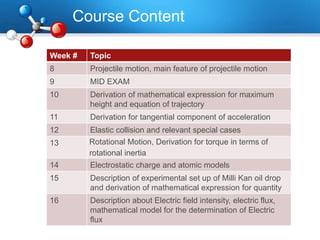
Course Content
Week # Topic
8 Projectile motion, main feature of projectile motion
9 MID EXAM
10 Derivation of mathematical expression for maximum
height and equation of trajectory
11 Derivation for tangential component of acceleration
12 Elastic collision and relevant special cases
13 Rotational Motion, Derivation for torque in terms of
rotational inertia
14 Electrostatic charge and atomic models
15 Description of experimental set up of Milli Kan oil drop
and derivation of mathematical expression for quantity
16 Description about Electric field intensity, electric flux,
mathematical model for the determination of Electric
flux
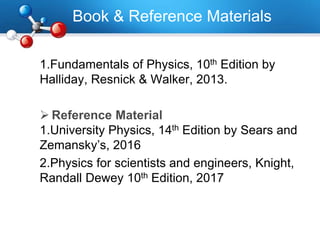
Book & Reference Materials
1.Fundamentals of Physics, 10th Edition by
Halliday, Resnick & Walker, 2013.
 Reference Material
1.University Physics, 14th Edition by Sears and
Zemansky’s, 2016
2.Physics for scientists and engineers, Knight,
Randall Dewey 10th Edition, 2017
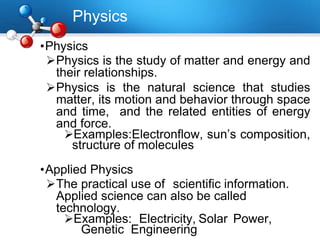
Physics
•Physics
Physics is the study of matter and energy and
their relationships.
Physics is the natural science that studies
matter, its motion and behavior through space
and time, and the related entities of energy
and force.
Examples:Electronflow, sun’s composition,
structure of molecules
•Applied Physics
The practical use of scientific information.
Applied science can also be called
technology.
Examples: Electricity, Solar Power,
Genetic Engineering
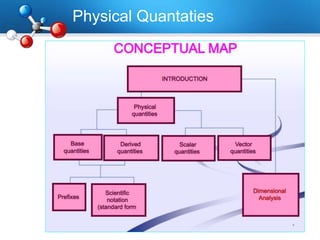
Physical Quantaties
Physical quantities & Categorization
of Physical quantities
• Physical Quantities and measurements
1. Definition
2. Types
3. Symbols
4. Unit of measurement
Physical Quantities
What is Physical Quantities
• A Physical Quantity that can be quantified by
measurements
• A Physical Quantity is a quantity which can
measure.
• A Physical Quantity always measure non living
objects.
• We measure each physical quantity in its own
units. The unit is a unique name we assign to
measures of that quantity.
Physical Quantities
• The another example of physical quantity is that
when a grocer says that each rice bag contains 10
kg, he is describing its numerical magnitude as
well as the unit of measurement. It would be
meaningless to state 10 or kg only.
Physical Quantities
• Examples
• Mass,length,temperature,time,light
• Light intensity, volume
• Any other objects
• For Example: If the length of any object is
50cm then its numerical magnitude is 50 and
cm is the unit of measurement.
Physical Quantities
• Another Example of physical quantities:
• If anybody says that each water bag contain
10 liter water.
• He is describing its numerical values and its
unit of measurements.
• The weight of a coin is 5g.
• The magnitude is 5 ,unit is g and weight is
quantity.
Physical Quantities
• The Physical quantities are two types
1.Base quantities
2.Derived quantities
Types
• Base Quantities
 Base quantities are the quantities in which other quantities are
expressed
• Example:
• Mass,length,time.Intensity of light and amount of substances.
Types
 Derived Quantities
Most physical quantities are not independent of each
other (e.g. speed = distance / time). Thus, it often
possible to define all other quantities in terms of
BASE STANDARDS including length (meter), mass
(kg) and time (second).
Derived Quantities are the quantities which are
expressed in term of base quantities.
These include area , speed, force , work , Volume
and electric charge.
Types
• Examples
SI Units
• Physical quantities are measured in specific
UNITS, i.e., by comparison to a reference
STANDARD.
Aunit has to have a special name and symbol. The
usefulness of a unit is as a means of communicating
to everyone who does science.
• Therefore, defined units must be:
- reproducible to a great accuracy
- accepted by the most people
SI Units
•The 14th General Conference of Weights and
Measures (1971) choose 7 base quantities, to form
the International System of Units.(International
System of Units = SI)
• There are also DERIVED UNITS, defined in terms
of BASE UNITS,
• e.g. 1 Watt (W) = unit of Power = 1 Kg.m2/sec2
per sec = 1 Kg.m2/s3
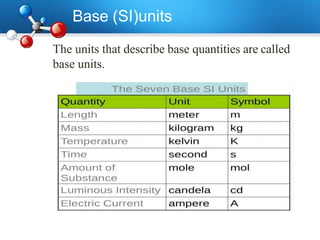
Base (SI)units
The units that describe base quantities are called
base units.
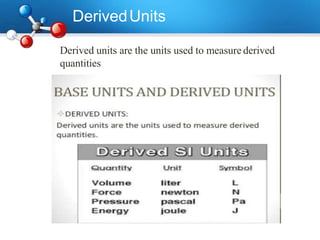
DerivedUnits
Derived units are the units used to measure derived
quantities
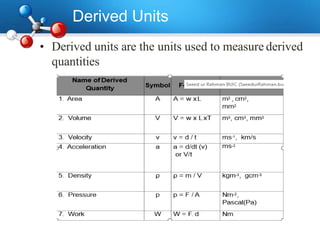
Derived Units
• Derived units are the units used to measure derived
quantities
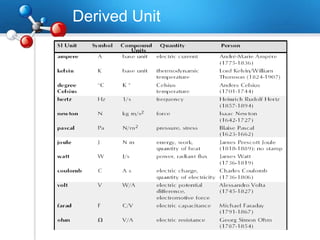
Derived Unit
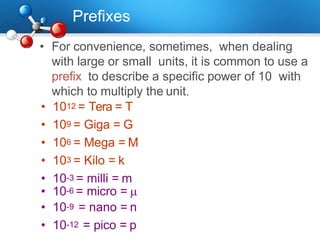
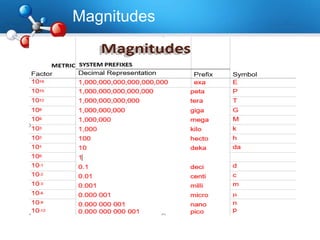
Prefixes
• For convenience, sometimes, when dealing
with large or small units, it is common to use a
prefix to describe a specific power of 10 with
which to multiply the unit.
• 1012 = Tera = T
• 109 = Giga = G
• 106 = Mega = M
• 103 = Kilo = k
• 10-3 = milli = m
• 10-6 = micro = 
• 10-9 = nano = n
• 10-12 = pico = p
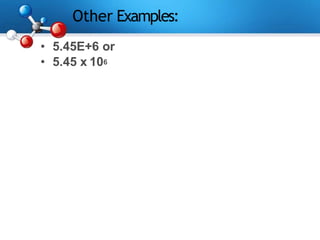
Other Examples:
• 5.45E+6 or
• 5.45 x 10⁶
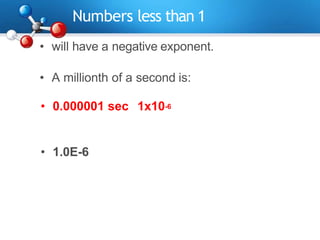
Numbers less than 1
• will have a negative exponent.
• A millionth of a second is:
• 0.000001 sec 1x10⁻⁶
• 1.0E-6
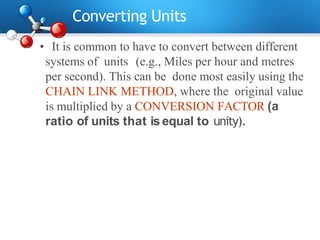
Converting Units
• It is common to have to convert between different
systems of units (e.g., Miles per hour and metres
per second). This can be done most easily using the
CHAIN LINK METHOD, where the original value
is multiplied by a CONVERSION FACTOR (a
ratio of units that is equal to unity).
Converting Units
• When multiplying through using this method, make
sure you keep the ORIGINAL UNITS in the
expression.
• e.g., 1 minute = 60 seconds, therefore (1 min / 60 secs) = 1
• and (60 secs / 1
min) = 1 Note that 60 does not equal 1
though!
• Therefore, to convert 180 seconds into minutes,
• 180 secs = (180 secs) x (1 min/ 60 secs) = 3 x 1 min = 3 min.
Converting Units
• Example: Convert 85km to m:
• Multiply the original measurement by a
conversion factor.
• New Unit
• 85km x 1,000m = 85,000m
1km Old unit
Length (Meters)
• Original (1792) definition of a metre (meter in
USA!) was 1/10,000,000 of the distance between
the north pole and the equator.
• Later the standards was changed to the distance
between two lines on particular standard Platinum-
Iridium bar kept in Paris.
• (1960) 1 m redefined as 1,650,763.73 wavelengths
of the (orange/red) light emitted from atoms of the
isotope 86Kr.
• (1983) 1m finally defined as the length travelled by
light in vacuum
• during a time interval of 1/299,792,458 of a second.
Length (Meters)
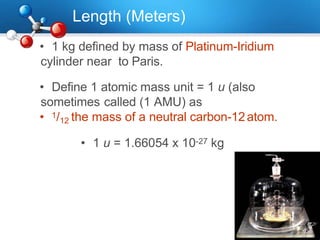
• 1 kg defined by mass of Platinum-Iridium
cylinder near to Paris.
• Define 1 atomic mass unit = 1 u (also
sometimes called (1 AMU) as
• 1/12 the mass of a neutral carbon-12atom.
• 1 u = 1.66054 x 10⁻²⁷ kg
Magnitudes
Questions and Answers

AP Lecture #1 new.pptx

  • 1.
  • 2.
    About Me • MS(SoftwareEngineering) • Lecturer • Bahria University Islamabad Campus.
  • 3.
  • 4.
    Some Policies andrules • Everyone must wear the mask • Raise your hand before asking any question and then WAIT for the permission • Must wear your ID card in the class • Attendance during first 10 minutes for each hour • After that you will be marked as absent
  • 5.
    Some Rules • Keepmobile phones on silent mode in the class • Submission must be done on time • No compensation for the missed quizzes • No compensation for the missed assignments
  • 6.
    Pre-Requisites • None required!! •But you must ask yourself • From where we got the idea of building blocks • How Applied Physics works,
  • 7.
    Dishonesty, Plagiarism • Studentsinvolved in any kind of cheating in any • exam (Quizzes/Assignments) will get 0 (Zero) in • that exam OR get F in the course • In case of quizzes with cheating case, their weightage will be highest.
  • 8.
    Tentative Evaluation Breakdown Total100 Quizzes 10 Assignments 20 Mid term Exam 20 Final Exam 50
  • 9.
    Quizzes and Assignments •Quizzes • – Will always be a surprise or declare • • 4 Assignments • – No late submissions will be accepted!!!!
  • 10.
    Course outline Course CodeGSC114 Credit Hours 2 Pre-requisite none Applies Physics
  • 11.
    Course Objectives Course Objectives CourseObjectives Physics is the study of how the world works. This course introduces the physical world concepts that will be required in advance courses. This course will provide students with the knowledge of a wide variety of electric and magnetic phenomena. The course initiates with the basics of electricity at the atomic level and takes it to the circuit level for electric circuit analysis and design. Majority of the course is dedicated for electric and magnetic fields, forces, elements and their applications. Additionally, it also aims to provide introductory knowledge of wave theory and thermodynamic theory and optics in conjunction with their applications.
  • 12.
    Course Content Week #Topic 1 Physical quantities and criteria of a physical quantity 2 Addition, Multiplication of Vectors by Rectangular Component Method 3 Gradient of a scalar field function 4 Curl of a vector field function 5 Limitation and condition for Newton’s Law of Motion 6 Newton’s Second Law of Motion and definition of force and Impulse of force 7 Motion of body in a lift and expression for apparent weight
  • 13.
    Course Content Week #Topic 8 Projectile motion, main feature of projectile motion 9 MID EXAM 10 Derivation of mathematical expression for maximum height and equation of trajectory 11 Derivation for tangential component of acceleration 12 Elastic collision and relevant special cases 13 Rotational Motion, Derivation for torque in terms of rotational inertia 14 Electrostatic charge and atomic models 15 Description of experimental set up of Milli Kan oil drop and derivation of mathematical expression for quantity 16 Description about Electric field intensity, electric flux, mathematical model for the determination of Electric flux
  • 14.
    Book & ReferenceMaterials 1.Fundamentals of Physics, 10th Edition by Halliday, Resnick & Walker, 2013.  Reference Material 1.University Physics, 14th Edition by Sears and Zemansky’s, 2016 2.Physics for scientists and engineers, Knight, Randall Dewey 10th Edition, 2017
  • 15.
    Physics •Physics Physics is thestudy of matter and energy and their relationships. Physics is the natural science that studies matter, its motion and behavior through space and time, and the related entities of energy and force. Examples:Electronflow, sun’s composition, structure of molecules •Applied Physics The practical use of scientific information. Applied science can also be called technology. Examples: Electricity, Solar Power, Genetic Engineering
  • 16.
  • 17.
    Physical quantities &Categorization of Physical quantities • Physical Quantities and measurements 1. Definition 2. Types 3. Symbols 4. Unit of measurement
  • 18.
    Physical Quantities What isPhysical Quantities • A Physical Quantity that can be quantified by measurements • A Physical Quantity is a quantity which can measure. • A Physical Quantity always measure non living objects. • We measure each physical quantity in its own units. The unit is a unique name we assign to measures of that quantity.
  • 19.
    Physical Quantities • Theanother example of physical quantity is that when a grocer says that each rice bag contains 10 kg, he is describing its numerical magnitude as well as the unit of measurement. It would be meaningless to state 10 or kg only.
  • 20.
    Physical Quantities • Examples •Mass,length,temperature,time,light • Light intensity, volume • Any other objects • For Example: If the length of any object is 50cm then its numerical magnitude is 50 and cm is the unit of measurement.
  • 21.
    Physical Quantities • AnotherExample of physical quantities: • If anybody says that each water bag contain 10 liter water. • He is describing its numerical values and its unit of measurements. • The weight of a coin is 5g. • The magnitude is 5 ,unit is g and weight is quantity.
  • 22.
    Physical Quantities • ThePhysical quantities are two types 1.Base quantities 2.Derived quantities
  • 23.
    Types • Base Quantities Base quantities are the quantities in which other quantities are expressed • Example: • Mass,length,time.Intensity of light and amount of substances.
  • 24.
    Types  Derived Quantities Mostphysical quantities are not independent of each other (e.g. speed = distance / time). Thus, it often possible to define all other quantities in terms of BASE STANDARDS including length (meter), mass (kg) and time (second). Derived Quantities are the quantities which are expressed in term of base quantities. These include area , speed, force , work , Volume and electric charge.
  • 25.
  • 26.
    SI Units • Physicalquantities are measured in specific UNITS, i.e., by comparison to a reference STANDARD. Aunit has to have a special name and symbol. The usefulness of a unit is as a means of communicating to everyone who does science. • Therefore, defined units must be: - reproducible to a great accuracy - accepted by the most people
  • 27.
    SI Units •The 14thGeneral Conference of Weights and Measures (1971) choose 7 base quantities, to form the International System of Units.(International System of Units = SI) • There are also DERIVED UNITS, defined in terms of BASE UNITS, • e.g. 1 Watt (W) = unit of Power = 1 Kg.m2/sec2 per sec = 1 Kg.m2/s3
  • 28.
    Base (SI)units The unitsthat describe base quantities are called base units.
  • 29.
    DerivedUnits Derived units arethe units used to measure derived quantities
  • 30.
    Derived Units • Derivedunits are the units used to measure derived quantities
  • 31.
  • 32.
    Prefixes • For convenience,sometimes, when dealing with large or small units, it is common to use a prefix to describe a specific power of 10 with which to multiply the unit. • 1012 = Tera = T • 109 = Giga = G • 106 = Mega = M • 103 = Kilo = k • 10-3 = milli = m • 10-6 = micro =  • 10-9 = nano = n • 10-12 = pico = p
  • 33.
    Other Examples: • 5.45E+6or • 5.45 x 10⁶
  • 34.
    Numbers less than1 • will have a negative exponent. • A millionth of a second is: • 0.000001 sec 1x10⁻⁶ • 1.0E-6
  • 35.
    Converting Units • Itis common to have to convert between different systems of units (e.g., Miles per hour and metres per second). This can be done most easily using the CHAIN LINK METHOD, where the original value is multiplied by a CONVERSION FACTOR (a ratio of units that is equal to unity).
  • 36.
    Converting Units • Whenmultiplying through using this method, make sure you keep the ORIGINAL UNITS in the expression. • e.g., 1 minute = 60 seconds, therefore (1 min / 60 secs) = 1 • and (60 secs / 1 min) = 1 Note that 60 does not equal 1 though! • Therefore, to convert 180 seconds into minutes, • 180 secs = (180 secs) x (1 min/ 60 secs) = 3 x 1 min = 3 min.
  • 37.
    Converting Units • Example:Convert 85km to m: • Multiply the original measurement by a conversion factor. • New Unit • 85km x 1,000m = 85,000m 1km Old unit
  • 38.
    Length (Meters) • Original(1792) definition of a metre (meter in USA!) was 1/10,000,000 of the distance between the north pole and the equator. • Later the standards was changed to the distance between two lines on particular standard Platinum- Iridium bar kept in Paris. • (1960) 1 m redefined as 1,650,763.73 wavelengths of the (orange/red) light emitted from atoms of the isotope 86Kr. • (1983) 1m finally defined as the length travelled by light in vacuum • during a time interval of 1/299,792,458 of a second.
  • 39.
    Length (Meters) • 1kg defined by mass of Platinum-Iridium cylinder near to Paris. • Define 1 atomic mass unit = 1 u (also sometimes called (1 AMU) as • 1/12 the mass of a neutral carbon-12atom. • 1 u = 1.66054 x 10⁻²⁷ kg

  • 40.
  • 41.