Unit 2 Metabolism & Cells
Which of the following functional groups gives ATP a replenishable form of energy? -SH -COH -COOH -PO 4 -NH 2
A feature of organic compounds NOT found in inorganic compounds is   a. ionizing chemical groups b. electrons c. carbon atoms covalently bonded to each other  d. oxygen e. hydrogen bonds
Which of the following two membranes are analogous? a. inner mitochondrial membrane  b. outer mitochondrial membrane c. cell membrane d. thylakoid membrane e. inner chloroplast membrane
Which of the following would classify as an example of anabolism? a. the digestion of starch molecules in the intestine b. a reaction involving hydrolysis c. protein synthesis (mRNA translation) d. cellular respiration e. shortening of microtubules during mitosis
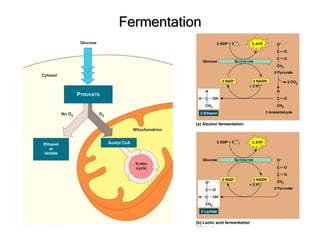
The direct purpose of fermentation is a. breakdown sugar b. restore electron acceptor NAD + c. respire in a lack of oxygen d. makeup for not having mitochondria e. produce alcohol or lactic acid
Put the following actions in order as they occur in the process of chemiosmosis. Hint: one process is not involved at all - throw it out.  a. phosphorylation b. reduction/oxidation of ETC proteins c. facilitated diffusion of H + d. condensation (formation of water) e. active transport of H +
Which organelle is structurally most similar to the Golgi complex? nucleus endoplasmic reticulum mitochondrion cell membrane lysosome
What effect would boiling a chloroplast have on photosynthesis? light reactions would occur but Calvin cycle would be disrupted reduction of DPIP would be inhibited sugar would be formed but not exported from chloroplast all light would be reflected by reaction centers Electron Transport Chain would be disrupted
A drug is formed which inhibits the polymerization of tubulin, the protein subunits that make up microtubules. At what stage would mitosis be affected by this? prophase metaphase anaphase telophase interphase
BIOCHEMISTRY
Big ideas the whole body is made of cells or the substances cells have made cells make 4 substances lipids  carbohydrates nucleic acids proteins metabolism is the sum of all chem rxns going on in the body at once
THE BOND THAT JOINS AMINO ACIDS TOGETHER
A SMALL INORGANIC SUBSTANCE THAT BINDS ENZYMES, ALLOWING THEM TO FULLY FUNCTION
WHEN AN ENZYME CAN DO NO MORE BECAUSE EVERY ENZYME MOLECULE IS CATALYZING A REACTION
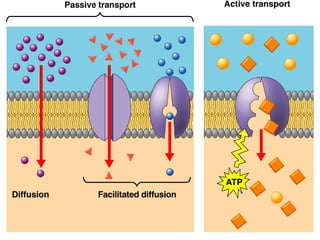
DIFFUSION
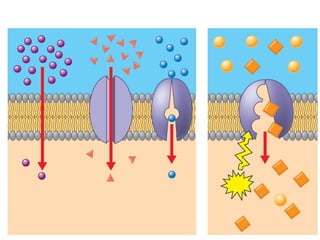
Big ideas all substances tend to even out diffusion  is spreading to even out membranes create two environments; inside cell & outside solutes follow a concentration gradient passive vs. active transport


Which of the following processes is coupled with hydrolysis of ATP? osmosis facilitated diffusion sodium ion flow into a nerve cell active transport
METABOLISM
Big ideas a single cell can perform all the necessary functions of life of all processes, supplying energy to body is most critical cells use energy building compounds uses up energy energy released by breaking bonds (hydrolysis) energy stored in bonds of compounds
Big ideas photosynthesis and respiration are  complementary products of one are reactants of other at ecosystem level structural and chemical similarities chemiosmosis membranes divide space
Meiosis
 
 
Energy Flows Matter recycles
ADP > ATP Enzyme- catalyzed
 
ETC
ETC (Chemiosmosis)
Fermentation
Photosynthesis
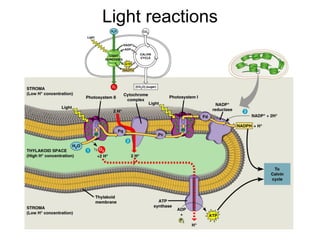
Light reactions
All of the following statements about cellular respiration are true EXCEPT: In the Kreb’s (citric acid) cycle, two molecules of CO2 and one molecule of FADH2 are produced for each acetyl-CoA that enters the cycle. ATP is converted to ADP during two of the reactions in glycolysis. The metabolic breakdown of glucose yields more energy during fermentation than during aerobic respiration.
DPIP is a blue dye that is colorless when it is reduced. After being mixed with DPIP, which of the following would show the greatest change in color? Isolated chloroplasts in the dark Isolated chloroplasts in the light Chlorophyll extract in the light Boiled chloroplasts in the dark
A CELL WITH MEMBRANE-ENCLOSED ORGANELLES
THE ENZYME THAT BINDS CARBON IN CHLOROPLASTS
THE INNER FOLDINGS OF A MITOCHONDRION
“ POISON CONTROL CENTER” OF A LIVER CELL
THE “POWERHOUSE” OF THE CELL
THE ONLY ORGANELLE SHARED BY BOTH PROKARYOTES AND EUKARYOTES
CELL DIVISION
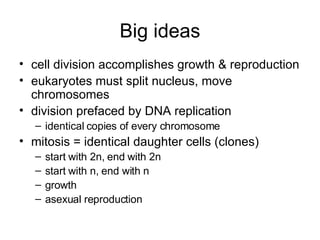
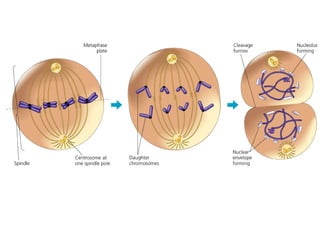
Big ideas cell division accomplishes growth & reproduction eukaryotes must split nucleus, move chromosomes division prefaced by DNA replication identical copies of every chromosome mitosis = identical daughter cells (clones) start with 2n, end with 2n start with n, end with n  growth asexual reproduction
Big ideas Meiosis reduction division daughter cells unique (genetically) start with 2n, end with n only for sexual reproduction


Meiosis Reduction of  chromosome # 2 divisions No replication in  between
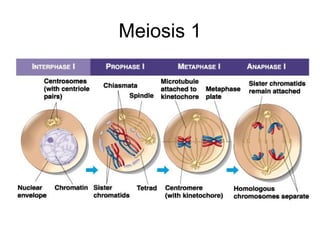
Major accomplishments: M1 reduce chromosome number (2n  n) separate homologous chromosome  pairs one of each  type  of chromosome (from homologous pairs) directed into each daughter cell crossing over
Meiosis 1
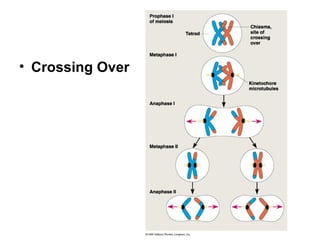
Major accomplishments: M2 separate sister chromatids increase gametic output (2 to 4) separate  crossed-over  chromatids
Independent Assortment
Crossing Over
All of the following are true statements about meiosis in fungi EXCEPT: It follows DNA replication. It occurs only in reproductive structures. It produces four genetically identical gametes. It serves to provide variation in fungi. It produces haploid cells.
IN MITOSIS, WHEN HOMOLOGOUS CHROMOSOMES SEPARATE
FROM THE GREEK WORD FOR “MARRY”, A CELL WITH THIS MANY CHROMOSOMES IS  ONLY ENOUGH TO MAKE HALF A HUMAN
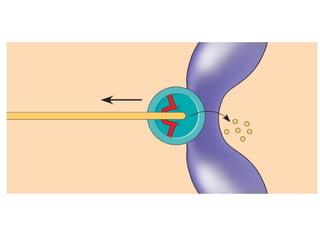
THE “HARNESS” THAT PULLS A CHROMOSOME DOWN A MICROTUBULE  DURING MITOSIS
IN LATIN, IT MEANS  “CELL CUTTING”
THE MEIOTIC PHASE SEX CELLS ARE FIRST CONSIDERED HAPLOID
BAT SPERM HAS 22 CHROMOSOMES. IT’S INTESTINAL CELLS HAVE THIS MANY.
ARMADILLO BONE MARROW CELLS HAVE 64 CHROMOSOMES. FEMALE EGGS HAVE THIS MANY.
RASPBERRY POLLEN CONTAINS 49 CHROMOSOMES. THE FRUIT CELLS YOU EAT GIVE YOU THIS MANY CHROMOSOMES.
CELL COMMUNICATION
Signal Transduction Pathway
Transduction
Transduction signal amplified ea. protein  activates 10 others signal gets “louder” exponentially
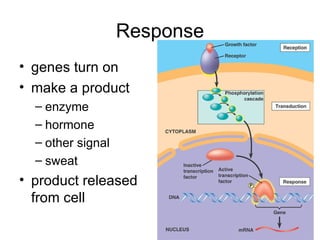
Response genes turn on make a product enzyme hormone other signal sweat product released from cell
Response depends on receptor  activated SHAPE signal molecule > receptor
The process by which a chemical signal is received and responded to by a cell is called the: cell signaling cycle signal transduction pathway telokinesis  telophase interleukinetic chain transmission
Whether a particular signal molecule will trigger a response in a cell depends on: the shape of the receptors on the cell’s surface genetic compatibility with the signal molecule temperature of the cell’s environment  ion concentration of the cell’s cytosol whether the cell likes the signal molecule

unit2

  • 1.
  • 2.
    Which of thefollowing functional groups gives ATP a replenishable form of energy? -SH -COH -COOH -PO 4 -NH 2
  • 3.
    A feature oforganic compounds NOT found in inorganic compounds is   a. ionizing chemical groups b. electrons c. carbon atoms covalently bonded to each other d. oxygen e. hydrogen bonds
  • 4.
    Which of thefollowing two membranes are analogous? a. inner mitochondrial membrane b. outer mitochondrial membrane c. cell membrane d. thylakoid membrane e. inner chloroplast membrane
  • 5.
    Which of thefollowing would classify as an example of anabolism? a. the digestion of starch molecules in the intestine b. a reaction involving hydrolysis c. protein synthesis (mRNA translation) d. cellular respiration e. shortening of microtubules during mitosis
  • 6.
    The direct purposeof fermentation is a. breakdown sugar b. restore electron acceptor NAD + c. respire in a lack of oxygen d. makeup for not having mitochondria e. produce alcohol or lactic acid
  • 7.
    Put the followingactions in order as they occur in the process of chemiosmosis. Hint: one process is not involved at all - throw it out. a. phosphorylation b. reduction/oxidation of ETC proteins c. facilitated diffusion of H + d. condensation (formation of water) e. active transport of H +
  • 8.
    Which organelle isstructurally most similar to the Golgi complex? nucleus endoplasmic reticulum mitochondrion cell membrane lysosome
  • 9.
    What effect wouldboiling a chloroplast have on photosynthesis? light reactions would occur but Calvin cycle would be disrupted reduction of DPIP would be inhibited sugar would be formed but not exported from chloroplast all light would be reflected by reaction centers Electron Transport Chain would be disrupted
  • 10.
    A drug isformed which inhibits the polymerization of tubulin, the protein subunits that make up microtubules. At what stage would mitosis be affected by this? prophase metaphase anaphase telophase interphase
  • 11.
  • 12.
    Big ideas thewhole body is made of cells or the substances cells have made cells make 4 substances lipids carbohydrates nucleic acids proteins metabolism is the sum of all chem rxns going on in the body at once
  • 13.
    THE BOND THATJOINS AMINO ACIDS TOGETHER
  • 14.
    A SMALL INORGANICSUBSTANCE THAT BINDS ENZYMES, ALLOWING THEM TO FULLY FUNCTION
  • 15.
    WHEN AN ENZYMECAN DO NO MORE BECAUSE EVERY ENZYME MOLECULE IS CATALYZING A REACTION
  • 16.
  • 17.
    Big ideas allsubstances tend to even out diffusion is spreading to even out membranes create two environments; inside cell & outside solutes follow a concentration gradient passive vs. active transport
  • 18.
  • 19.
  • 20.
  • 21.
    Which of thefollowing processes is coupled with hydrolysis of ATP? osmosis facilitated diffusion sodium ion flow into a nerve cell active transport
  • 22.
  • 23.
    Big ideas asingle cell can perform all the necessary functions of life of all processes, supplying energy to body is most critical cells use energy building compounds uses up energy energy released by breaking bonds (hydrolysis) energy stored in bonds of compounds
  • 24.
    Big ideas photosynthesisand respiration are complementary products of one are reactants of other at ecosystem level structural and chemical similarities chemiosmosis membranes divide space
  • 25.
  • 26.
  • 27.
  • 28.
  • 29.
    ADP > ATPEnzyme- catalyzed
  • 30.
  • 31.
  • 32.
  • 33.
  • 34.
  • 35.
  • 36.
    All of thefollowing statements about cellular respiration are true EXCEPT: In the Kreb’s (citric acid) cycle, two molecules of CO2 and one molecule of FADH2 are produced for each acetyl-CoA that enters the cycle. ATP is converted to ADP during two of the reactions in glycolysis. The metabolic breakdown of glucose yields more energy during fermentation than during aerobic respiration.
  • 37.
    DPIP is ablue dye that is colorless when it is reduced. After being mixed with DPIP, which of the following would show the greatest change in color? Isolated chloroplasts in the dark Isolated chloroplasts in the light Chlorophyll extract in the light Boiled chloroplasts in the dark
  • 38.
    A CELL WITHMEMBRANE-ENCLOSED ORGANELLES
  • 39.
    THE ENZYME THATBINDS CARBON IN CHLOROPLASTS
  • 40.
    THE INNER FOLDINGSOF A MITOCHONDRION
  • 41.
    “ POISON CONTROLCENTER” OF A LIVER CELL
  • 42.
  • 43.
    THE ONLY ORGANELLESHARED BY BOTH PROKARYOTES AND EUKARYOTES
  • 44.
  • 45.
    Big ideas celldivision accomplishes growth & reproduction eukaryotes must split nucleus, move chromosomes division prefaced by DNA replication identical copies of every chromosome mitosis = identical daughter cells (clones) start with 2n, end with 2n start with n, end with n growth asexual reproduction
  • 46.
    Big ideas Meiosisreduction division daughter cells unique (genetically) start with 2n, end with n only for sexual reproduction
  • 47.
  • 48.
  • 49.
  • 50.
    Meiosis Reduction of chromosome # 2 divisions No replication in between
  • 51.
    Major accomplishments: M1reduce chromosome number (2n n) separate homologous chromosome pairs one of each type of chromosome (from homologous pairs) directed into each daughter cell crossing over
  • 52.
  • 53.
    Major accomplishments: M2separate sister chromatids increase gametic output (2 to 4) separate crossed-over chromatids
  • 54.
  • 55.
  • 56.
    All of thefollowing are true statements about meiosis in fungi EXCEPT: It follows DNA replication. It occurs only in reproductive structures. It produces four genetically identical gametes. It serves to provide variation in fungi. It produces haploid cells.
  • 57.
    IN MITOSIS, WHENHOMOLOGOUS CHROMOSOMES SEPARATE
  • 58.
    FROM THE GREEKWORD FOR “MARRY”, A CELL WITH THIS MANY CHROMOSOMES IS ONLY ENOUGH TO MAKE HALF A HUMAN
  • 59.
    THE “HARNESS” THATPULLS A CHROMOSOME DOWN A MICROTUBULE DURING MITOSIS
  • 60.
    IN LATIN, ITMEANS “CELL CUTTING”
  • 61.
    THE MEIOTIC PHASESEX CELLS ARE FIRST CONSIDERED HAPLOID
  • 62.
    BAT SPERM HAS22 CHROMOSOMES. IT’S INTESTINAL CELLS HAVE THIS MANY.
  • 63.
    ARMADILLO BONE MARROWCELLS HAVE 64 CHROMOSOMES. FEMALE EGGS HAVE THIS MANY.
  • 64.
    RASPBERRY POLLEN CONTAINS49 CHROMOSOMES. THE FRUIT CELLS YOU EAT GIVE YOU THIS MANY CHROMOSOMES.
  • 65.
  • 66.
  • 67.
  • 68.
    Transduction signal amplifiedea. protein activates 10 others signal gets “louder” exponentially
  • 69.
    Response genes turnon make a product enzyme hormone other signal sweat product released from cell
  • 70.
    Response depends onreceptor activated SHAPE signal molecule > receptor
  • 71.
    The process bywhich a chemical signal is received and responded to by a cell is called the: cell signaling cycle signal transduction pathway telokinesis telophase interleukinetic chain transmission
  • 72.
    Whether a particularsignal molecule will trigger a response in a cell depends on: the shape of the receptors on the cell’s surface genetic compatibility with the signal molecule temperature of the cell’s environment ion concentration of the cell’s cytosol whether the cell likes the signal molecule