INSPIRE AND TRANSFORM St Joseph’s Academy, Kilmarnock
Higher P.E.
Model Performer
INSPIRE AND TRANSFORM St Joseph’s Academy, Kilmarnock
Today's Learning....
(01/06/2020)
(15/06/2020)
Speak with your class teacher in
person or via email.
01/02/2021
Learning Intention –
Today we will explore what a model performer is and how it can help
us during the development process.
(01/06/2020)
(15/06/2020)
Mrs Shaw’s email
debbie.shaw@eastayrshire.org.uk
Speak with your class teacher in
person or via email.
01/02/2021
What is a Model Performer?
A Model Performer is someone who can carry out a performance in any of the
4 factors to an almost ‘perfect’ level. Their performance levels are what we
strive to achieve and are who we measure ourselves against when collecting
data.
A Model Performer can be:
a) An elite athlete such as Cristiano Ronaldo, Kobe Bryant or Serena Williams.
b) A high-performing team mate such as your Captain.
Can you think of a ‘model performer’ for each of the four factors?
Physical, Mental, Social & Emotional?
(01/06/2020)
(15/06/2020)
Mrs Shaw’s email
debbie.shaw@eastayrshire.org.uk
(24/08/2020)
Speak with your class teacher in
person or via email.
01/02/2021
(01/06/2020)
(15/06/2020)
Mrs Shaw’s email
debbie.shaw@eastayrshire.org.uk
(24/08/2020)
Speak with your class teacher in
person or via email.
It is very rare to find the same model performer for all four factors.
For example, tennis player Andy Murray (below), has been almost
exemplary in the physical factor, but has often struggled to control his
emotions. You must select the most appropriate model performer for the
factor you are interested in.
01/02/2021
(01/06/2020)
(15/06/2020)
Mrs Shaw’s email
debbie.shaw@eastayrshire.org.uk
(24/08/2020)
Speak with your class teacher in
person or via email.
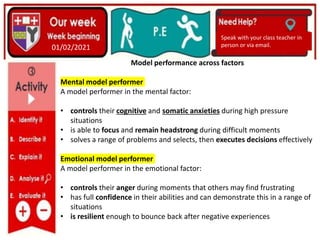
Model performance across factors
Mental model performer
A model performer in the mental factor:
• controls their cognitive and somatic anxieties during high pressure
situations
• is able to focus and remain headstrong during difficult moments
• solves a range of problems and selects, then executes decisions effectively
Emotional model performer
A model performer in the emotional factor:
• controls their anger during moments that others may find frustrating
• has full confidence in their abilities and can demonstrate this in a range of
situations
• is resilient enough to bounce back after negative experiences
01/02/2021
(01/06/2020)
(15/06/2020)
Mrs Shaw’s email
debbie.shaw@eastayrshire.org.uk
(24/08/2020)
Speak with your class teacher in
person or via email.
Physical model performer
A model performer in the physical factor:
• executes a range of skills and techniques to a high standard on a
consistent basis
• has high fitness levels in a variety of different fitness components
• is tactically astute in both offensive and defensive situations
Social model performer
A model performer in the social factor:
• communicates clearly and in a variety of different ways during
performance
• is a good team player in good and bad moments
• shows respect to opponents and officials
01/02/2021
(01/06/2020)
(15/06/2020)
Mrs Shaw’s email
debbie.shaw@eastayrshire.org.uk
(24/08/2020)
Speak with your class teacher in
person or via email.
PHYSICAL -
A Model Performer within the Physical Skills factor will be able to execute
skills almost effortlessly and fault-free. This would not just be applicable to 1
skill but rather a wide Skill Repertoire where consistency is present within
each skill/technique. These Model Performers, such as Kobe Bryant, Lionel
Messi and Serena Williams, are who we would focus upon when answering
questions regarding model performers as they are at the ‘top of their game’.
Consider Kobe Bryant in the video below. In this match he scored over 60
points alone, but look at the range of baskets he scored; they were not all 3
pointers from the same side or angle from the basket. Instead there was a
range of different shots both when in space and under close pressure from an
opponent.
https://www.youtube.com/watch?v=GTJwoWHMEw0
01/02/2021
(01/06/2020)
(15/06/2020)
Mrs Shaw’s email
debbie.shaw@eastayrshire.org.uk
(24/08/2020)
Speak with your class teacher in
person or via email.
Imagine you were asked the following question;
“Analyse your Physical strengths and limitations in comparison
to a Model Performer. (2).”
We will create an answer for volleyball. Things to consider;
What are your strengths and how does this benefit you when
playing?
What are your weaknesses and how do these compare to a
model performer?
01/02/2021
(01/06/2020)
(15/06/2020)
Mrs Shaw’s email
debbie.shaw@eastayrshire.org.uk
(24/08/2020)
Speak with your class teacher in
person or via email.
‘I share some strengths and weaknesses in relation to a Physical Model
Performer.’
‘One strength I have is my Volley because in my General Observation
Schedule I had a success rate of 85%. This meant that like a Model Performer,
both of us managed to perform a volley consistently during game situations.
Like the model performer I was able to pass high and accurately to my team
mates giving them enough time to move into position under the ball’. (1
mark)
However, unlike a model performer my Dig during games was not effective.
After completing my general observation schedule I found that I only had a
success rate of 15%. In comparison, a model performer would be able to
play an effective dig shot consistently in a performance. As a result, my dig
passes often did not have enough height on them or were not accurate
enough which resulted in my team mates being put under increased pressure
for their next shot, or the ball going out of the court costing my team points.
(1 mark)
01/02/2021
Question section
“Analyse your Physical strengths and limitations in comparison to a
Model Performer. (2).”
Considering the previous two examples and the features identified
on slide 11. Aim to answer this question.
Make your point (identify strength / development need, feature,
activity plus positive or negative terminology)
Make comparison to model performer(how does the feature affect
you? what are you able/unable to do in comparison?)
Write your impact (how does this affect the rest of the
performance? How might affect your team or opponents?)
(01/06/2020)
(15/06/2020)
Mrs Shaw’s email
debbie.shaw@eastayrshire.org.uk
(24/08/2020)
Speak with your class teacher in
person or via email.
MENTAL -
A Model Performer within the Mental factor will show high levels of Mental
Toughness in a number of different ways. This might be when training
during the off-season to develop fitness levels or during difficult and
pressurised moments in matches. Consider how Mentally Tough Andy
Murray was in that last game of the Wimbledon final in 2013.
https://www.youtube.com/watch?v=GRqgk9UZmDI
A MENTAL Model Performer will also be able to constantly make effective
Decisions. If you think of Andy Murray, he may identify an opponents
weakness being their backhand and will therefore decide to play shots to
their backhand side to place them under pressure. Or Murray has often
decided to play drop shots when in the middle of a back court rally due to
the space left at the front of the court (see video below). Model Performers
make these decisions based on their ability to read the game being played
around them to inform them on a course of action to take.
https://www.youtube.com/watch?v=5hoo6e4doS4
01/02/2021
(01/06/2020)
(15/06/2020)
Mrs Shaw’s email
debbie.shaw@eastayrshire.org.uk
(24/08/2020)
Speak with your class teacher in
person or via email.
Imagine you were asked the following question;
“Analyse your Mental strengths and limitations in comparison to a
Model Performer. (2).”
We will create an answer for volleyball. Things to consider;
What are your strengths and how does this benefit you when
playing?
What are your weaknesses and how do these compare to a model
performer?
01/02/2021
(01/06/2020)
(15/06/2020)
Mrs Shaw’s email
debbie.shaw@eastayrshire.org.uk
(24/08/2020)
Speak with your class teacher in
person or via email.
‘I share some strengths and limitations with a Mental Model
Performer.’
‘A strength of mine is my focus. Like my model performer, I scored
consistently high in my self reflection sheet with an average score of 6.5
over my three matches. This meant that, like the model performer I was
able to remain completely focused on the game at all times, especially
towards the end of the match as I became more tired. This allowed me
to make sure I was still covering for my teammates when they would
jump to block to pick up any second balls should they miss the block. (1
mark)
‘However, a limitation of mine is my Mental Toughness as unlike my
Model Performer, I scored 2/7 whilst they would have scored 7/7 in the
SRS. This meant that when I made a mistake, I was unable to move on
and bounce back. This lead to me feeling down and playing within
myself as I was scared of making future mistakes and therefore
lowering the effectiveness of my performance.’ (1 mark)
01/02/2021
Question section
“Analyse your Mental strengths and limitations in comparison to a
Model Performer. (2).”
Considering the previous two examples and the features identified
on slide 15. Aim to answer this question.
Make your point (identify strength / development need, feature,
activity plus positive or negative terminology)
Make comparison to model performer(how does the feature affect
you? what are you able/unable to do in comparison?)
Write your impact (how does this affect the rest of the
performance? How might affect your team or opponents?)
(01/06/2020)
(15/06/2020)
Mrs Shaw’s email
debbie.shaw@eastayrshire.org.uk
(24/08/2020)
Speak with your class teacher in
person or via email.
Extension Task
We have now considered the Physical & Mental performance in comparison
to a model performer. Can you Analyse your performance in comparison
to a model performer for the remaining two factors? Here is a list of the
features of each factor;
Social;
- Communication
- Co-operation
- Contributing
- Etiquette
- Roles and Responsibilities
Emotional;
- Fear
- Anger
- Happiness
- Sadness
- Anxiety
01/02/2021
(01/06/2020)
(15/06/2020)
Mrs Shaw’s email
debbie.shaw@eastayrshire.org.uk
(24/08/2020)
Speak with your class teacher in
person or via email.
Why use a model performer?
We will now consider the benefits and limiations to using a model
performer.
Benefits Limitations
It is easy to compare your strengths and
weaknesses to a model performer.
You could lose confidence if you select an elite
athlete as a model performer - they may be too
far out of your reach.
Using model performers gives you a visual of what
exemplary performance looks like.
It can be very time consuming as you must
identify your own strengths and weaknesses then
watch a model performer before even comparing.
You can get a motivation boost when watching a
model performer as you strive to reach their level.
You may not know how to accurately compare
your performance to that of a model performer.
01/02/2021
(01/06/2020)
(15/06/2020)
Mrs Shaw’s email
debbie.shaw@eastayrshire.org.uk
(24/08/2020)
Speak with your class teacher in
person or via email.
Imagine you were asked to answer this question;
Explain why the use of a Model Performer can be limited when
collecting data on Physical factors. (4)
Using a Model Performer can be limited for several reasons when
collecting data on Physical factors.
One limitation is that it can be time consuming collecting and
analysing information in regards to a Model Performer. This can lead
to you getting bored and rushing the process. This can lead to data
being incorrect and invalid.
Another limitation is that you may select a poor Model Performer who
is actually not that great in regards to the Physical factor. This can
lead to you watching and copying poor sub-routine performances and
picking up bad habits in your performance.
01/02/2021
(01/06/2020)
(15/06/2020)
Mrs Shaw’s email
debbie.shaw@eastayrshire.org.uk
(24/08/2020)
Speak with your class teacher in
person or via email.
Imagine you were asked to answer this question;
Explain why the use of a Model Performer can be limited when
collecting data on Physical factors. (4)
Continued…
A further limitation is that you may select an inappropriate level of
Model Performer such as Andy Murray. This can lead to you setting
unrealistic and unachievable goals of an elite level athlete and losing
motivation and confidence when you find that you are not meeting
them. This can mean that you then give up during your development
plan and never improve.
A final limitation is that you may not have enough knowledge to
correctly analyse a Model Performer. This can lead to you identifying
Physical strengths when they are in fact Physical weaknesses. This
can mean that you are then ignoring areas that need improving as
you have wrongly collected data on them.’
01/02/2021
(01/06/2020)
(15/06/2020)
Mrs Shaw’s email
debbie.shaw@eastayrshire.org.uk
(24/08/2020)
Speak with your class teacher in
person or via email.
Imagine you were asked to answer this question;
“Analyse the use of a model performer (4).”
One benefit to a performer using a model performer is it easily allows them
to compare their strengths and weaknesses to them. This allows a
performer to identify which skills with their performance are their biggest
development need. This will then allow them to plan a PDP specific to that
area of weakness. (1 mark)
However, on the other hand a performer may begin to lose confidence if
they select an elite athlete as their comparison. This could be due to the
athletes skill level being unachievable for the performer to try and replicate.
As a result this could lead to the performer losing motivation when training
which could result in a plateau of their development (1 mark).
01/02/2021
Question section
“Analyse the use of a model performer (4).”
Considering the previous two examples and the features identified
on slide 21. Aim to answer this question.
Make your point (identify benefit / limitation, feature plus positive
or negative terminology)
Give example (how does this reason affect you? what are you
able/unable to do?)
Write your impact (how does this affect the rest of the
performance? How might affect your team or opponents?)
(01/06/2020)
(15/06/2020)
Mrs Shaw’s email
debbie.shaw@eastayrshire.org.uk
(24/08/2020)
Speak with your class teacher in
person or via email.
Contact;
Mr Howson - david.howson@eastayrshire.org.uk
Mr Fulton – john.fulton@eastayrshire.org.uk
01/02/2021

Higher PE - Model Performer

  • 1.
    INSPIRE AND TRANSFORMSt Joseph’s Academy, Kilmarnock Higher P.E. Model Performer
  • 2.
    INSPIRE AND TRANSFORMSt Joseph’s Academy, Kilmarnock Today's Learning....
  • 3.
    (01/06/2020) (15/06/2020) Speak with yourclass teacher in person or via email. 01/02/2021
  • 4.
    Learning Intention – Todaywe will explore what a model performer is and how it can help us during the development process. (01/06/2020) (15/06/2020) Mrs Shaw’s email debbie.shaw@eastayrshire.org.uk Speak with your class teacher in person or via email. 01/02/2021
  • 5.
    What is aModel Performer? A Model Performer is someone who can carry out a performance in any of the 4 factors to an almost ‘perfect’ level. Their performance levels are what we strive to achieve and are who we measure ourselves against when collecting data. A Model Performer can be: a) An elite athlete such as Cristiano Ronaldo, Kobe Bryant or Serena Williams. b) A high-performing team mate such as your Captain. Can you think of a ‘model performer’ for each of the four factors? Physical, Mental, Social & Emotional? (01/06/2020) (15/06/2020) Mrs Shaw’s email debbie.shaw@eastayrshire.org.uk (24/08/2020) Speak with your class teacher in person or via email. 01/02/2021
  • 6.
    (01/06/2020) (15/06/2020) Mrs Shaw’s email debbie.shaw@eastayrshire.org.uk (24/08/2020) Speakwith your class teacher in person or via email. It is very rare to find the same model performer for all four factors. For example, tennis player Andy Murray (below), has been almost exemplary in the physical factor, but has often struggled to control his emotions. You must select the most appropriate model performer for the factor you are interested in. 01/02/2021
  • 7.
    (01/06/2020) (15/06/2020) Mrs Shaw’s email debbie.shaw@eastayrshire.org.uk (24/08/2020) Speakwith your class teacher in person or via email. Model performance across factors Mental model performer A model performer in the mental factor: • controls their cognitive and somatic anxieties during high pressure situations • is able to focus and remain headstrong during difficult moments • solves a range of problems and selects, then executes decisions effectively Emotional model performer A model performer in the emotional factor: • controls their anger during moments that others may find frustrating • has full confidence in their abilities and can demonstrate this in a range of situations • is resilient enough to bounce back after negative experiences 01/02/2021
  • 8.
    (01/06/2020) (15/06/2020) Mrs Shaw’s email debbie.shaw@eastayrshire.org.uk (24/08/2020) Speakwith your class teacher in person or via email. Physical model performer A model performer in the physical factor: • executes a range of skills and techniques to a high standard on a consistent basis • has high fitness levels in a variety of different fitness components • is tactically astute in both offensive and defensive situations Social model performer A model performer in the social factor: • communicates clearly and in a variety of different ways during performance • is a good team player in good and bad moments • shows respect to opponents and officials 01/02/2021
  • 9.
    (01/06/2020) (15/06/2020) Mrs Shaw’s email debbie.shaw@eastayrshire.org.uk (24/08/2020) Speakwith your class teacher in person or via email. PHYSICAL - A Model Performer within the Physical Skills factor will be able to execute skills almost effortlessly and fault-free. This would not just be applicable to 1 skill but rather a wide Skill Repertoire where consistency is present within each skill/technique. These Model Performers, such as Kobe Bryant, Lionel Messi and Serena Williams, are who we would focus upon when answering questions regarding model performers as they are at the ‘top of their game’. Consider Kobe Bryant in the video below. In this match he scored over 60 points alone, but look at the range of baskets he scored; they were not all 3 pointers from the same side or angle from the basket. Instead there was a range of different shots both when in space and under close pressure from an opponent. https://www.youtube.com/watch?v=GTJwoWHMEw0 01/02/2021
  • 10.
    (01/06/2020) (15/06/2020) Mrs Shaw’s email debbie.shaw@eastayrshire.org.uk (24/08/2020) Speakwith your class teacher in person or via email. Imagine you were asked the following question; “Analyse your Physical strengths and limitations in comparison to a Model Performer. (2).” We will create an answer for volleyball. Things to consider; What are your strengths and how does this benefit you when playing? What are your weaknesses and how do these compare to a model performer? 01/02/2021
  • 11.
    (01/06/2020) (15/06/2020) Mrs Shaw’s email debbie.shaw@eastayrshire.org.uk (24/08/2020) Speakwith your class teacher in person or via email. ‘I share some strengths and weaknesses in relation to a Physical Model Performer.’ ‘One strength I have is my Volley because in my General Observation Schedule I had a success rate of 85%. This meant that like a Model Performer, both of us managed to perform a volley consistently during game situations. Like the model performer I was able to pass high and accurately to my team mates giving them enough time to move into position under the ball’. (1 mark) However, unlike a model performer my Dig during games was not effective. After completing my general observation schedule I found that I only had a success rate of 15%. In comparison, a model performer would be able to play an effective dig shot consistently in a performance. As a result, my dig passes often did not have enough height on them or were not accurate enough which resulted in my team mates being put under increased pressure for their next shot, or the ball going out of the court costing my team points. (1 mark) 01/02/2021
  • 12.
    Question section “Analyse yourPhysical strengths and limitations in comparison to a Model Performer. (2).” Considering the previous two examples and the features identified on slide 11. Aim to answer this question. Make your point (identify strength / development need, feature, activity plus positive or negative terminology) Make comparison to model performer(how does the feature affect you? what are you able/unable to do in comparison?) Write your impact (how does this affect the rest of the performance? How might affect your team or opponents?)
  • 13.
    (01/06/2020) (15/06/2020) Mrs Shaw’s email debbie.shaw@eastayrshire.org.uk (24/08/2020) Speakwith your class teacher in person or via email. MENTAL - A Model Performer within the Mental factor will show high levels of Mental Toughness in a number of different ways. This might be when training during the off-season to develop fitness levels or during difficult and pressurised moments in matches. Consider how Mentally Tough Andy Murray was in that last game of the Wimbledon final in 2013. https://www.youtube.com/watch?v=GRqgk9UZmDI A MENTAL Model Performer will also be able to constantly make effective Decisions. If you think of Andy Murray, he may identify an opponents weakness being their backhand and will therefore decide to play shots to their backhand side to place them under pressure. Or Murray has often decided to play drop shots when in the middle of a back court rally due to the space left at the front of the court (see video below). Model Performers make these decisions based on their ability to read the game being played around them to inform them on a course of action to take. https://www.youtube.com/watch?v=5hoo6e4doS4 01/02/2021
  • 14.
    (01/06/2020) (15/06/2020) Mrs Shaw’s email debbie.shaw@eastayrshire.org.uk (24/08/2020) Speakwith your class teacher in person or via email. Imagine you were asked the following question; “Analyse your Mental strengths and limitations in comparison to a Model Performer. (2).” We will create an answer for volleyball. Things to consider; What are your strengths and how does this benefit you when playing? What are your weaknesses and how do these compare to a model performer? 01/02/2021
  • 15.
    (01/06/2020) (15/06/2020) Mrs Shaw’s email debbie.shaw@eastayrshire.org.uk (24/08/2020) Speakwith your class teacher in person or via email. ‘I share some strengths and limitations with a Mental Model Performer.’ ‘A strength of mine is my focus. Like my model performer, I scored consistently high in my self reflection sheet with an average score of 6.5 over my three matches. This meant that, like the model performer I was able to remain completely focused on the game at all times, especially towards the end of the match as I became more tired. This allowed me to make sure I was still covering for my teammates when they would jump to block to pick up any second balls should they miss the block. (1 mark) ‘However, a limitation of mine is my Mental Toughness as unlike my Model Performer, I scored 2/7 whilst they would have scored 7/7 in the SRS. This meant that when I made a mistake, I was unable to move on and bounce back. This lead to me feeling down and playing within myself as I was scared of making future mistakes and therefore lowering the effectiveness of my performance.’ (1 mark) 01/02/2021
  • 16.
    Question section “Analyse yourMental strengths and limitations in comparison to a Model Performer. (2).” Considering the previous two examples and the features identified on slide 15. Aim to answer this question. Make your point (identify strength / development need, feature, activity plus positive or negative terminology) Make comparison to model performer(how does the feature affect you? what are you able/unable to do in comparison?) Write your impact (how does this affect the rest of the performance? How might affect your team or opponents?)
  • 17.
    (01/06/2020) (15/06/2020) Mrs Shaw’s email debbie.shaw@eastayrshire.org.uk (24/08/2020) Speakwith your class teacher in person or via email. Extension Task We have now considered the Physical & Mental performance in comparison to a model performer. Can you Analyse your performance in comparison to a model performer for the remaining two factors? Here is a list of the features of each factor; Social; - Communication - Co-operation - Contributing - Etiquette - Roles and Responsibilities Emotional; - Fear - Anger - Happiness - Sadness - Anxiety 01/02/2021
  • 18.
    (01/06/2020) (15/06/2020) Mrs Shaw’s email debbie.shaw@eastayrshire.org.uk (24/08/2020) Speakwith your class teacher in person or via email. Why use a model performer? We will now consider the benefits and limiations to using a model performer. Benefits Limitations It is easy to compare your strengths and weaknesses to a model performer. You could lose confidence if you select an elite athlete as a model performer - they may be too far out of your reach. Using model performers gives you a visual of what exemplary performance looks like. It can be very time consuming as you must identify your own strengths and weaknesses then watch a model performer before even comparing. You can get a motivation boost when watching a model performer as you strive to reach their level. You may not know how to accurately compare your performance to that of a model performer. 01/02/2021
  • 19.
    (01/06/2020) (15/06/2020) Mrs Shaw’s email debbie.shaw@eastayrshire.org.uk (24/08/2020) Speakwith your class teacher in person or via email. Imagine you were asked to answer this question; Explain why the use of a Model Performer can be limited when collecting data on Physical factors. (4) Using a Model Performer can be limited for several reasons when collecting data on Physical factors. One limitation is that it can be time consuming collecting and analysing information in regards to a Model Performer. This can lead to you getting bored and rushing the process. This can lead to data being incorrect and invalid. Another limitation is that you may select a poor Model Performer who is actually not that great in regards to the Physical factor. This can lead to you watching and copying poor sub-routine performances and picking up bad habits in your performance. 01/02/2021
  • 20.
    (01/06/2020) (15/06/2020) Mrs Shaw’s email debbie.shaw@eastayrshire.org.uk (24/08/2020) Speakwith your class teacher in person or via email. Imagine you were asked to answer this question; Explain why the use of a Model Performer can be limited when collecting data on Physical factors. (4) Continued… A further limitation is that you may select an inappropriate level of Model Performer such as Andy Murray. This can lead to you setting unrealistic and unachievable goals of an elite level athlete and losing motivation and confidence when you find that you are not meeting them. This can mean that you then give up during your development plan and never improve. A final limitation is that you may not have enough knowledge to correctly analyse a Model Performer. This can lead to you identifying Physical strengths when they are in fact Physical weaknesses. This can mean that you are then ignoring areas that need improving as you have wrongly collected data on them.’ 01/02/2021
  • 21.
    (01/06/2020) (15/06/2020) Mrs Shaw’s email debbie.shaw@eastayrshire.org.uk (24/08/2020) Speakwith your class teacher in person or via email. Imagine you were asked to answer this question; “Analyse the use of a model performer (4).” One benefit to a performer using a model performer is it easily allows them to compare their strengths and weaknesses to them. This allows a performer to identify which skills with their performance are their biggest development need. This will then allow them to plan a PDP specific to that area of weakness. (1 mark) However, on the other hand a performer may begin to lose confidence if they select an elite athlete as their comparison. This could be due to the athletes skill level being unachievable for the performer to try and replicate. As a result this could lead to the performer losing motivation when training which could result in a plateau of their development (1 mark). 01/02/2021
  • 22.
    Question section “Analyse theuse of a model performer (4).” Considering the previous two examples and the features identified on slide 21. Aim to answer this question. Make your point (identify benefit / limitation, feature plus positive or negative terminology) Give example (how does this reason affect you? what are you able/unable to do?) Write your impact (how does this affect the rest of the performance? How might affect your team or opponents?)
  • 23.
    (01/06/2020) (15/06/2020) Mrs Shaw’s email debbie.shaw@eastayrshire.org.uk (24/08/2020) Speakwith your class teacher in person or via email. Contact; Mr Howson - david.howson@eastayrshire.org.uk Mr Fulton – john.fulton@eastayrshire.org.uk 01/02/2021