AO* SEARCH ALGORITHM
Problem Reduction In Artificial Intelligence
 AO* is informed search algorithm ,work based on
heuristic
 We already know about the divide and conquer strategy, a
solution to a
problem can be obtained by decomposing it into smaller sub-
problems.
 Each of this sub-problem can then be solved to get its sub
solution.
 These sub solutions can then recombined to get a
solution as a whole. That is called is Problem Reduction.
AND-OR graphs or AND - OR trees are used for
representing the solution.
 This method generates arc which is called as AND-OR arcs.
One AND arc may point to any number of successor nodes,
AO* SEARCH ALGORITHM
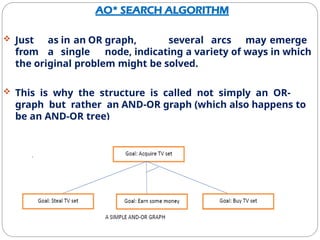
 Just as in an OR graph, several arcs may emerge
from a single node, indicating a variety of ways in which
the original problem might be solved.
 This is why the structure is called not simply an OR-
graph but rather an AND-OR graph (which also happens to
be an AND-OR tree)
AO* SEARCH ALGORITHM
 An algorithm to find a solution in an AND - OR graph
must handle AND area appropriately.
 A* algorithm can not search AND - OR graphs efficiently.
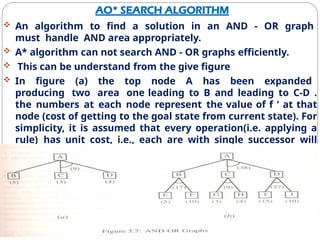
 This can be understand from the give figure
 In figure (a) the top node A has been expanded
producing two area one leading to B and leading to C-D .
the numbers at each node represent the value of f ' at that
node (cost of getting to the goal state from current state). For
simplicity, it is assumed that every operation(i.e. applying a
rule) has unit cost, i.e., each are with single successor will
have a cost of 1 and each of its components.
AO* SEARCH ALGORITHM
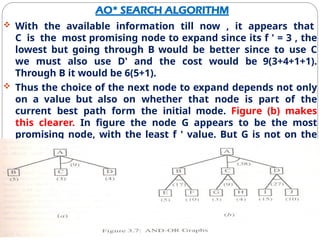
 With the available information till now , it appears that
C is the most promising node to expand since its f ' = 3 , the
lowest but going through B would be better since to use C
we must also use D' and the cost would be 9(3+4+1+1).
Through B it would be 6(5+1).
 Thus the choice of the next node to expand depends not only
on a value but also on whether that node is part of the
current best path form the initial mode. Figure (b) makes
this clearer. In figure the node G appears to be the most
promising node, with the least f ' value. But G is not on the
current beat path, since to use G we must use GH with a
cost of 9 and again this demands that arcs be used (with a
cost of 27).
AO* SEARCH ALGORITHM
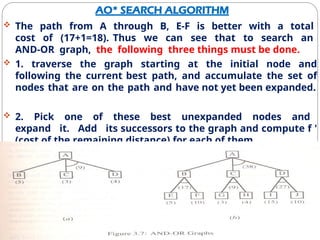
 The path from A through B, E-F is better with a total
cost of (17+1=18). Thus we can see that to search an
AND-OR graph, the following three things must be done.
 1. traverse the graph starting at the initial node and
following the current best path, and accumulate the set of
nodes that are on the path and have not yet been expanded.
 2. Pick one of these best unexpanded nodes and
expand it. Add its successors to the graph and compute f '
(cost of the remaining distance) for each of them.
AO* SEARCH ALGORITHM
 3. Change the f ' estimate of the newly expanded node
to reflect the new information produced by its successors.
Propagate this change backward through the graph. Decide
which of the current best path.
 The propagation of revised cost estimation backward is
in the tree is not necessary in A* algorithm. This is
because in AO* algorithm expanded nodes are re-examined
so that the current best path can be selected.
AO* SEARCH ALGORITHM
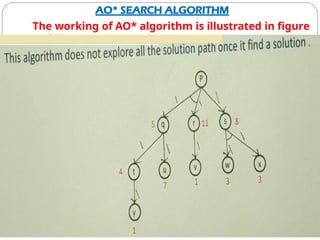
The working of AO* algorithm is illustrated in figure
as follows:
AO* SEARCH ALGORITHM
Advantages of AO*:
It is Complete
 Will not go in infinite
loop
 Less Memory
Required
Disadvantages of AO*:
 It is not optimal as it does not explore all the path once it
find a solution.
AO Star Algorithm in Artificial Intellligence

AO Star Algorithm in Artificial Intellligence

  • 1.
    AO* SEARCH ALGORITHM ProblemReduction In Artificial Intelligence  AO* is informed search algorithm ,work based on heuristic  We already know about the divide and conquer strategy, a solution to a problem can be obtained by decomposing it into smaller sub- problems.  Each of this sub-problem can then be solved to get its sub solution.  These sub solutions can then recombined to get a solution as a whole. That is called is Problem Reduction. AND-OR graphs or AND - OR trees are used for representing the solution.  This method generates arc which is called as AND-OR arcs. One AND arc may point to any number of successor nodes,
  • 2.
    AO* SEARCH ALGORITHM Just as in an OR graph, several arcs may emerge from a single node, indicating a variety of ways in which the original problem might be solved.  This is why the structure is called not simply an OR- graph but rather an AND-OR graph (which also happens to be an AND-OR tree)
  • 3.
    AO* SEARCH ALGORITHM An algorithm to find a solution in an AND - OR graph must handle AND area appropriately.  A* algorithm can not search AND - OR graphs efficiently.  This can be understand from the give figure  In figure (a) the top node A has been expanded producing two area one leading to B and leading to C-D . the numbers at each node represent the value of f ' at that node (cost of getting to the goal state from current state). For simplicity, it is assumed that every operation(i.e. applying a rule) has unit cost, i.e., each are with single successor will have a cost of 1 and each of its components.
  • 4.
    AO* SEARCH ALGORITHM With the available information till now , it appears that C is the most promising node to expand since its f ' = 3 , the lowest but going through B would be better since to use C we must also use D' and the cost would be 9(3+4+1+1). Through B it would be 6(5+1).  Thus the choice of the next node to expand depends not only on a value but also on whether that node is part of the current best path form the initial mode. Figure (b) makes this clearer. In figure the node G appears to be the most promising node, with the least f ' value. But G is not on the current beat path, since to use G we must use GH with a cost of 9 and again this demands that arcs be used (with a cost of 27).
  • 5.
    AO* SEARCH ALGORITHM The path from A through B, E-F is better with a total cost of (17+1=18). Thus we can see that to search an AND-OR graph, the following three things must be done.  1. traverse the graph starting at the initial node and following the current best path, and accumulate the set of nodes that are on the path and have not yet been expanded.  2. Pick one of these best unexpanded nodes and expand it. Add its successors to the graph and compute f ' (cost of the remaining distance) for each of them.
  • 6.
    AO* SEARCH ALGORITHM 3. Change the f ' estimate of the newly expanded node to reflect the new information produced by its successors. Propagate this change backward through the graph. Decide which of the current best path.  The propagation of revised cost estimation backward is in the tree is not necessary in A* algorithm. This is because in AO* algorithm expanded nodes are re-examined so that the current best path can be selected.
  • 7.
    AO* SEARCH ALGORITHM Theworking of AO* algorithm is illustrated in figure as follows:
  • 8.
    AO* SEARCH ALGORITHM Advantagesof AO*: It is Complete  Will not go in infinite loop  Less Memory Required Disadvantages of AO*:  It is not optimal as it does not explore all the path once it find a solution.