CLUSTER B
PERSONALITY
DISORDERS
V M SALIMA HABEEB
1St MSc Clinical Psychology
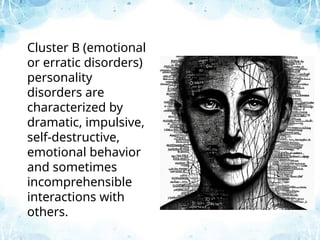
Cluster B (emotional
or erratic disorders)
personality
disorders are
characterized by
dramatic, impulsive,
self-destructive,
emotional behavior
and sometimes
incomprehensible
interactions with
others.
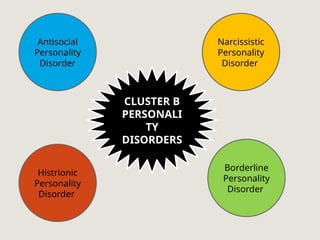
Antisocial
Personality
Disorder
Histrionic
Personality
Disorder
CLUSTER B
PERSONALI
TY
DISORDERS
Narcissistic
Personality
Disorder
Borderline
Personality
Disorder
- Characterized by a pattern of
disregard for the safety and
rights of others, without
feeling remorse.
- Individuals with this disorder
are unreliable, manipulative,
incapable of lasting
relationships, and unable to
conform to social norms.
- Early onset (before the age of
15), pervasive, and manifests
in a variety of contexts.
ANTI
SOCIAL
PERSONALI
TY
DISORDER
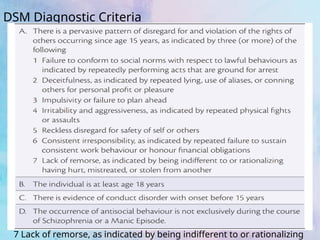
A. There is a pervasive pattern of disregard for and violation of the
rights of
others occurring since age 15 years, as indicated by three (or more) of
the
following
1 Failure to conform to social norms with respect to lawful behaviours
as
indicated by repeatedly performing acts that are ground for arrest
2 Deceitfulness, as indicated by repeated lying, use of aliases, or
conning
others for personal profi t or pleasure
3 Impulsivity or failure to plan ahead
4 Irritability and aggressiveness, as indicated by repeated physical fi
ghts
or assaults
5 Reckless disregard for safety of self or others
6 Consistent irresponsibility, as indicated by repeated failure to
sustain
consistent work behaviour or honour fi nancial obligations
7 Lack of remorse, as indicated by being indifferent to or rationalizing
DSM Diagnostic Criteria
AETIOLOGY
- Twin, adoption, and family studies have demonstrated
that genetic factors strongly contribute to the development
of antisocial personality.
- Antisocial personality in males is often associated with
hysteria in women of the same family which suggests that
the two conditions might be alternative expressions of the
same genetic endowment, belonging to ‘spectrum
conditions’.
Longitudinal studies of hyperactive children have
suggested a ‘developmental’ relationship between
antisocial behaviour and childhood hyperactivity.
-
- Aggression in antisocial personality disorder is associated
with indexes of reduced brain serotonin activity
- Parental deprivation, inconsistent maternal care, family
violence, and severe childhood physical abuse have been
reported as strong predictors for development of antisocial
personality disorders.
• Patients with antisocial personality disorder often
appear quite normal, charming, and understanding.
• However, their history reveals disturbed functioning in
the domains of behaviour and self-concept, love and
sexuality, interpersonal relations, and cognitive style.
The absence of internalized moral values is manifested
by lying, truancy, running away from home, thefts, fights,
substance abuse, and illegal activities, often starting in
early childhood.
• Antisocial behavior is most pronounced in early
adult years, and gradually decreases with age.
• Professional motivation and establishing a
stable couple or partnership may have
beneficial effects.
• Maturation of the personality might also take
with depression or hypochondriasis emerging
when rage and aggression are abandoned.
• Substance abuse and promiscuity are risky
behaviors
COURSE AND
PROGNOSIS
TREATMENT
Patients often do not seek psychiatric help and if they
do, it is usually under pressure from the legal
authorities. The therapeutic alliance is often not
sustained. The treatment methods include:
1. Individual psychotherapy.
2. Psychoanalysis or psychoanalytical psychotherapy.
3. Group psychotherapy and self-help groups.
4. Drug therapy: Pharmacotherapy is of little help. Earlier
claims of beneficial effect of pericyazine (an
antipsychotic drug) in certain behavior patterns of
antisocial personality disorder have not been
substantiated.
CONCEPTUALIZATION OF
ANTISOCIAL PERSONALITY
DISORDER
- Psychoanalytic writers describe the antisocial
personality as similar to the narcissistic personality.
Both personalities form a pathological grandiose
self.
- In antisocial individuals, the self is based on an
aggressive introject known as the "stranger self-
object."
- This self-object reflects an experience of the parent
as a stranger who cannot be trusted and harbors
bad will toward the infant. The threatening
internalized object derives from experiences of
parental neglect or cruelty.
Psychodynamic Conceptualizations
Kernberg (1984) notes that antisocial individuals are
similarly stunted in superego development.
Biosocial Conceptualization
Low levels of the neurotransmitter serotonin have
been observed in individuals prone to aggressive and
impulsive behavior. Meloy (1988) suggests that
antisocial individuals often have histories of childhood
abuse or neglect and are likely to have had a difficult
infant temperament.
Millon and Everly (1985) suggest that low thresholds
for limbic system stimulation are likely in antisocial
individuals.
Environmental factors such as parental hostility,
deficient parental role modeling, and reinforcement of
vindictive behavior interact with biological
predisposing factors in individuals prone to antisocial
Cognitive-Behavioral Conceptualization
According to Beck (2015), the behavior of individuals with
this disorder is persistently irresponsible. They hold
various core, conditional, and instrumental beliefs.
Their core beliefs are that they must look out for
themselves and be aggressive so as not to be victimized
by others. They also believe they are entitled to break
rules. They believe that their thoughts and feelings are
always accurate, and that their choices are always right
and good.
Their conditional belief is that if they don’t manipulate,
exploit, or attach others, they will never get what they
deserve. Their instrumental belief is to get others before
they get you, and take what you need since you deserve
it.
These individuals tend to view themselves as strong,
clever, self-sufficient, and invulnerable. They tend to view
others as either weak and vulnerable, or stupid and
Interpersonal Conceptualization
For Benjamin (2003a), persons with Antisocial
Personality Disorders typically have developmental
histories of harsh, neglectful parenting. The adult
consequence of this is that the antisocial individual
neglects and is insensitive to others’ needs, or
exploits others.
Furthermore, this pattern of inept parental caring
can be internalized by the antisocial individual as
substance abuse, criminal behavior, or parental
dereliction of duty. The antisocial-to-be is likely to
“take over” parental responsibilities, since no one
else did. As a consequence of this inappropriate
parental role-taking, the antisocial individual is likely
to continue controlling others as an end in itself,
without emotionally bonding with those being
controlled.
- Borderline personality
disorder (BPD) is the
denomination of a syndromal
picture characterized by
intense affective instability and
impulsivity together with an
unstable sense of self-identity.
- It is often manifested by
impulsive self-aggression and
suicide attempts, substance
abuse, chronic feelings of
emptiness, and persistent
pattern of severely unstable
interpersonal relationships.
BORDERLINE
PERSONALIT
Y DISORDER
- Family studies indicate that parents of patients
with BPD have a greater incidence of mood
disorders
- Additionally, there is also high family incidence
of antisocial personality disorder and alcoholism.
AETIOLOGY
- Among the biochemical findings, those
indicating a brain serotonin deficiency are the
more consistent.
- Hypothalamic-pituitary—adrenal axis
dysfunctions, suggesting increased feedback
inhibition, as well as increased sensitivity of some
areas of the amygdala, have been reported in
Current available data suggest that BPD might be
associated with abnormal emotional reactivity in
the limbic areas and insufficient regulatory
function at the cingulated and prefrontal areas of
the brain.
- The role of childhood trauma in the development
of borderline personality disorder could be crucial.
- Higher incidence of childhood traumatic
experiences, both for sexual/physical abuse or for
neglect, has been demonstrated in these patients.
COURSE AND OUTCOME
• Borderline patients often experience profound
dysfunction in many important aspects of life
including education, jobs, partner relationships,
and marriage.
• Alcohol and psychosexual problems are also
frequent.
• Repeated suicide attempts and premature
death from suicide are frequent complications
of borderline personality disorder; therefore
suicidal gestures and intentions should be
always taken seriously.
• The long-term outcome of borderline patients
has not been studied, but the diagnosis is
rarely made in patients aged over 40.
• It is speculated that neural structures and
defence mechanisms mature with age and that
these changes, together with social learning,
reduce symptomatology.
TREATMENT
Treatment options for borderline personality disorder
include:
1. Psychoanalysis or psychoanalytical psychotherapy.
2. Supportive psychotherapy.
3. Cognitive behavior therapy (CBT) or dialectical
behavior therapy (DBT) approaches have shown
success in treatment.
4. Drug therapy: Antidepressants are effective for
depression, while antipsychotics, lithium, valproate,
or carbamazepine may be used for aggression or
impulsivity. However, drug therapy is not the first
choice for treatment of borderline personality
disorder.
Conceptualizations of
the Borderline
Personality Disorder
Psychodynamic Conceptualization
Adler’s (1985) understanding of borderline pathology, is
that inconsistency in maternal behavior and availability
results in the borderline’s failure to develop a “holding-
nothing” internalized object. This leads to feelings of
emptiness, depressive tendencies, and oral rage.
Bateman and Fonagy’s (2007) mentalization approach
to Borderline Personality Disorder is rooted in object
relations and attachment theory. Sometimes referred to
as “mentalizing,” this is the process by which individuals
interpret their own subjective cognitions, behaviors,
and emotions, as well as those of others.
To fully develop this capacity, infants must have
a stable, affectionate, safe, and attentive adult to mirror
their experiences.
Bateman and Fonagy suggest that those with borderline
personality lack the ability to interpret mental states and
accurately understand their relationships due to
psychological trauma in early or late childhood.
Neglect, abuse, and incongruent emotional mirroring all
lead to insecure/hypersensitive attachments and poor
self regulation.
The ability to mentalize is believed to arise as a
function of childhood development by age 4.
Biosocial Conceptualization
.
Millon and Everly (1985) contend that the borderline
syndrome is essentially more severe and regressed
variants of the Dependent, Histrionic, or passive-
aggressive personality disorders. They describe three
subtypes of this disorder:
Borderline-dependent individuals tend to exhibit a passive
infantile pattern and possess family histories of low
energy levels. Parental warmth and overprotection lead to
strong attachments and dependency on a single caregiver,
limiting opportunities for social independence and self-
efficacy. This often results in rejection by those they rely
on.
Borderline-histrionic individuals typically have family
histories characterized by high autonomic reactivity
and exhibit hyperresponsiveness due to exposure to
high levels of stimulation. They seek approval through
contingent reinforcement patterns, performing to
secure support, attention, and nurturance.
Borderline-passive aggressive individuals often exhibit
"difficult child" temperaments and received
inconsistent responses from caregivers. They may have
experienced broken homes and had a parent model
erratic, passive-aggressive behavior, which they
replicate as adults.
Cognitive-Behavioral Conceptualization
According to Beck, three basic assumptions are
noted in those with this personality disorder: “I am
powerless and vulnerable”; “I am inherently
unacceptable”; and “the world is dangerous and
malevolent".
Because of their inherent beliefs, they feel helpless
in a hostile world, vacillating between autonomy
and dependence without being able to rely on
either. Additionally, borderlines tend to display
“dichotomous thinking,” evaluating experiences in
mutually exclusive categories, such as all good or all
bad, success or failure, trustworthy or deceitful. The
combination of dichotomous thinking and basic
assumptions forms the basis of borderline emotion
and behavior, including acting-out and self-
destructive behaviors.
Interpersonal Conceptualization
Benjamin’s (2003a) posits that individuals with
Borderline Personality Disorder typically grew up in a
family marked by a chaotic, soap-opera lifestyle.
Without these dilemmas, life was experienced as
hollow, boring, and empty.
The developmental histories of these individuals often
included traumatic abandonment experiences, marked
by physical and/or sexual abuse. These abuse
experiences “taught” the individual to shift from
idealization to devaluation.
In short, there is a morbid fear of abandonment and a
wish for protective nurturance, particularly from a lover
or caregiver. Initially, friendly dependency on the
nurturer gives way to hostile control when the caregiver
or lover fails to deliver enough. Borderline individuals
believe that significant others secretly like dependency
HISTRIONIC
PERSONALITY
DISORDER
• It is characterized by excessive
emotionality and attention
seeking, and by dramatic,
colourful, and extroverted
behaviour.
• Egocentric, dependent, and
demanding interpersonal
relationships are typical of this
disorder, which begins in early
adulthood and is present in a
variety of contexts.
AETIOLOGY
• Some studies suggest that histrionic
personality runs in families, traits such as
extraversion, emotional expression, and reward
dependence have a strong genetic origin and
might be constitutional.
• Biological findings associated with impulsivity,
such as serotonin deficiency, can be found in
histrionic patients with marked emotional
instability and impulsive behaviors.
• From a development perspective, histrionic
personality is considered to be a result of
abnormally intense attachment with parental
figures.
• It has been proposed that histrionic personality
in women is genotypically linked to antisocial
personality in men.
COURSE AND
PROGNOSIS
• Depressive symptoms, suicide attempts, and
frequent use of medical services are
common.
• Histrionic personality may gradually improve
with age, as if a maturation of histrionic
infantilism occurs over the years.
TREATMENT
• Depressive and anxious symptoms are
frequent in histrionic personality disorder
and can be alleviated with the use of
antidepressants and anxiolytic medications.
• Supportive therapy is indicated for acutely
distressed histrionic patients, as well as for
those at the sicker end of the continuum.
Psychoanalysis and psychoanalytic
psychotherapy are the modes of treatment
which are most successful.
Conceptualizations of the
Histrionic Personality Disorder
Psychodynamic Conceptualizations
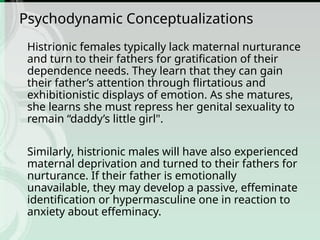
Histrionic females typically lack maternal nurturance
and turn to their fathers for gratification of their
dependence needs. They learn that they can gain
their father’s attention through flirtatious and
exhibitionistic displays of emotion. As she matures,
she learns she must repress her genital sexuality to
remain “daddy’s little girl".
Similarly, histrionic males will have also experienced
maternal deprivation and turned to their fathers for
nurturance. If their father is emotionally
unavailable, they may develop a passive, effeminate
identification or hypermasculine one in reaction to
anxiety about effeminacy.
Biosocial Conceptualizations
Millon and Davis (1996) note that individuals with
Histrionic Personality Disorders often display a high
degree of emotional lability and responsiveness
during infancy and early childhood, which they
attribute to low excitability thresholds for limbic and
posterior hypothalamic nucleus.
However, environmental factors seem to play the
major role in the development of this pathology.
Millon and Everly (1985) list three such factors:
parental reinforcement of attention-seeking
behavior; histrionic parental role models; and
reinforcement of interpersonally manipulative
behavior. In effect, as children, these individuals
learned to employ cuteness, charm, attractiveness,
Cognitive-Behavioral Conceptualizations
Beck (2015) describes a cognitive therapy view of
the Histrionic Personality Disorder based on specific
underlying assumptions and cognitive distortions.
Two underlying assumptions are posited: “I am
inadequate and unable to handle life by myself” and
“I must be loved by everyone to be worthwhile.”
Believing they are incapable of caring for
themselves, histrionic individuals actively seek the
attention and approval of others and expect others
to take care of them and their needs. Believing they
must be loved and approved by others promotes
rejection sensitivity. Finally, feeling inadequate and
desperate for approval, they are under considerable
pressure to seek attention by “performing” for
Taking a more behavioral tack, Turkat (1990)
differentiates the Histrionic Personality Disorder into
two types: the controlling type in which the basic
motivation is achieving total control through the use of
manipulative and dramatic ploys; and the reactive type
in which the basic motivation is seeking reassurance
and approval.
Interpersonal Case
Conceptualizations
For Benjamin (2003a), persons with Histrionic
Personality Disorder were likely to be loved for their
good looks and entertainment value, rather than for
competence or personal strength. They learned that
physical appearance and charm could be used to
control important others. The household of histrionic
personalities tended to be a shifting stage.
Unpredictable changes stemmed from parental
instability, possibly associated with alcohol or
substance use. The chaos in these families was more
likely to be dramatic and interesting rather than
primitive and life-threatening, as with borderline
personalities.
Narcissistic personality disorder
is characterized by an
exaggerated
sense of self-importance with a
lack of sustained positive regard
for
• others.
• Grandiosity (in fantasy or
behaviour) and constant
craving
• for admiration and external
gratifi cation are additional
features
• of this disorder.
NARCISSISTI
C
PERSONALIT
Y DISORDER
• Some aspects of narcissism might be related
with inappropriate seeking for excitement and
reward and associated to monoamine function
abnormalities at the mesolimbic reward systems.
• Behind the compensatory grandiose self, a
hungry and inferior real self- resides, as the core
problem of narcissistic personality disorder.
• Often, high parental expectations and harsh
criticism of the child is present in the family.
AETIOLOGY
COURSE AND
PROGNOSIS
• Patients often become depressed or
defensively hypomanic during middle age,
when their internal life gradually deteriorates
owing to a vicious circle of frustrations and
disappointments and diminishing narcissistic
supplies.
• Hypochondriasis and anxiety disorders are
frequent complications.
TREATMENT
• Anxiolytic agents and antidepressants may
be helpful for alleviating target episodes of
mood and anxiety symptoms.
• Psychotherapy Individual psychotherapy is
aimed at the analysis of idealizing
transference and interpretation of self-
grandiosity.
• However, during the first stages only
supportive therapy is recommended with
interpretations delayed until confident and
Conceptualizations of the
Narcissistic Personality
Disorder
Psychodynamic Conceptualizations
For Freud, parental overevaluation or erratic,
unreliable caretaking in early life were factors
disrupting the development of object love in the
child providing. As a result of this fixation or arrest
at the narcissistic phase of development, Freud
posited that narcissists would be unable to form
lasting relationships. In other words, the etiology of
the Narcissistic Personality Disorder is that it is the
outcome of insufficient gratification of the normal
narcissistic needs of infancy and childhood.
The contrary hypothesis is that the disorder stems
from narcissistic overgratification during childhood
and, because of this fixation, interferes with the
normal maturation and integration of the superego,
leading to difficulties in regulation of self-esteem
Biosocial Conceptualizations
The principal environmental factors are parental
indulgence and overvaluation, learned exploitive
behavior, and only-child status. Essentially then,
children are pampered and given special treatment
by the parents such that they learn to believe the
world revolves around them. They become
egotistical in their perspectives and narcissistic in
their expressions of love and emotion.
Not surprisingly, they come to expect special
treatment from others outside the home. When
special treatment is not forthcoming, the children
experiment with demanding and exploitive tactics
and subsequently develop considerable skill in
manipulating others so as to receive the special
consideration they believe they deserve. At the
same time, they come to believe that most others
Cognitive-Behavioral
Conceptualizations
According to Beck (2015), the key feature of this
disorder is self-aggrandizement. Individuals with
this disorder can be characterized by specific core,
conditional, and instrumental beliefs.
Their core beliefs include deserving special treatment
and dispensations because of their specialness.
They also include believing that they are not bound
by the rules and social conventions that govern
others.
Their conditional beliefs are that others should be
punished if they do not recognize their special
status, and that to maintain their special status
others must be subservient to them.
Their instrumental belief is to continually strive to
demonstrate their superiority. Underlying these
Interpersonal Conceptualizations
For Benjamin (2003a), a person with Narcissistic
Personality Disorder typically was raised in an
environment of selfless, non-contingent love and
adoration. Unfortunately, this adoration was not
accompanied by genuine self-disclosure. As a result,
the Narcissistic-Personality-Disorder-to-be learned
to be insensitive to others’ needs and views. The
adoring parent is likely to have been consistently
differential and nurturant to the narcissistic-in-
training. As a result, the adult narcissist held the
arrogant expectation that others will continue to
provide these emotional supplies.
If support is withdrawn, or lack of perfection is
evident, the self-concept degrades into severe self-
criticism. Totally devoid of empathy, these
individuals tend to treat others with contempt and
THANK YOU

CLUSTER B personality disorder presentation

  • 1.
    CLUSTER B PERSONALITY DISORDERS V MSALIMA HABEEB 1St MSc Clinical Psychology
  • 2.
    Cluster B (emotional orerratic disorders) personality disorders are characterized by dramatic, impulsive, self-destructive, emotional behavior and sometimes incomprehensible interactions with others.
  • 3.
  • 4.
    - Characterized bya pattern of disregard for the safety and rights of others, without feeling remorse. - Individuals with this disorder are unreliable, manipulative, incapable of lasting relationships, and unable to conform to social norms. - Early onset (before the age of 15), pervasive, and manifests in a variety of contexts. ANTI SOCIAL PERSONALI TY DISORDER
  • 5.
    A. There isa pervasive pattern of disregard for and violation of the rights of others occurring since age 15 years, as indicated by three (or more) of the following 1 Failure to conform to social norms with respect to lawful behaviours as indicated by repeatedly performing acts that are ground for arrest 2 Deceitfulness, as indicated by repeated lying, use of aliases, or conning others for personal profi t or pleasure 3 Impulsivity or failure to plan ahead 4 Irritability and aggressiveness, as indicated by repeated physical fi ghts or assaults 5 Reckless disregard for safety of self or others 6 Consistent irresponsibility, as indicated by repeated failure to sustain consistent work behaviour or honour fi nancial obligations 7 Lack of remorse, as indicated by being indifferent to or rationalizing DSM Diagnostic Criteria
  • 6.
    AETIOLOGY - Twin, adoption,and family studies have demonstrated that genetic factors strongly contribute to the development of antisocial personality. - Antisocial personality in males is often associated with hysteria in women of the same family which suggests that the two conditions might be alternative expressions of the same genetic endowment, belonging to ‘spectrum conditions’. Longitudinal studies of hyperactive children have suggested a ‘developmental’ relationship between antisocial behaviour and childhood hyperactivity.
  • 7.
    - - Aggression inantisocial personality disorder is associated with indexes of reduced brain serotonin activity - Parental deprivation, inconsistent maternal care, family violence, and severe childhood physical abuse have been reported as strong predictors for development of antisocial personality disorders.
  • 8.
    • Patients withantisocial personality disorder often appear quite normal, charming, and understanding. • However, their history reveals disturbed functioning in the domains of behaviour and self-concept, love and sexuality, interpersonal relations, and cognitive style. The absence of internalized moral values is manifested by lying, truancy, running away from home, thefts, fights, substance abuse, and illegal activities, often starting in early childhood.
  • 9.
    • Antisocial behavioris most pronounced in early adult years, and gradually decreases with age. • Professional motivation and establishing a stable couple or partnership may have beneficial effects. • Maturation of the personality might also take with depression or hypochondriasis emerging when rage and aggression are abandoned. • Substance abuse and promiscuity are risky behaviors COURSE AND PROGNOSIS
  • 10.
    TREATMENT Patients often donot seek psychiatric help and if they do, it is usually under pressure from the legal authorities. The therapeutic alliance is often not sustained. The treatment methods include: 1. Individual psychotherapy. 2. Psychoanalysis or psychoanalytical psychotherapy. 3. Group psychotherapy and self-help groups. 4. Drug therapy: Pharmacotherapy is of little help. Earlier claims of beneficial effect of pericyazine (an antipsychotic drug) in certain behavior patterns of antisocial personality disorder have not been substantiated.
  • 11.
  • 12.
    - Psychoanalytic writersdescribe the antisocial personality as similar to the narcissistic personality. Both personalities form a pathological grandiose self. - In antisocial individuals, the self is based on an aggressive introject known as the "stranger self- object." - This self-object reflects an experience of the parent as a stranger who cannot be trusted and harbors bad will toward the infant. The threatening internalized object derives from experiences of parental neglect or cruelty. Psychodynamic Conceptualizations Kernberg (1984) notes that antisocial individuals are similarly stunted in superego development.
  • 13.
    Biosocial Conceptualization Low levelsof the neurotransmitter serotonin have been observed in individuals prone to aggressive and impulsive behavior. Meloy (1988) suggests that antisocial individuals often have histories of childhood abuse or neglect and are likely to have had a difficult infant temperament. Millon and Everly (1985) suggest that low thresholds for limbic system stimulation are likely in antisocial individuals. Environmental factors such as parental hostility, deficient parental role modeling, and reinforcement of vindictive behavior interact with biological predisposing factors in individuals prone to antisocial
  • 14.
    Cognitive-Behavioral Conceptualization According toBeck (2015), the behavior of individuals with this disorder is persistently irresponsible. They hold various core, conditional, and instrumental beliefs. Their core beliefs are that they must look out for themselves and be aggressive so as not to be victimized by others. They also believe they are entitled to break rules. They believe that their thoughts and feelings are always accurate, and that their choices are always right and good. Their conditional belief is that if they don’t manipulate, exploit, or attach others, they will never get what they deserve. Their instrumental belief is to get others before they get you, and take what you need since you deserve it. These individuals tend to view themselves as strong, clever, self-sufficient, and invulnerable. They tend to view others as either weak and vulnerable, or stupid and
  • 15.
    Interpersonal Conceptualization For Benjamin(2003a), persons with Antisocial Personality Disorders typically have developmental histories of harsh, neglectful parenting. The adult consequence of this is that the antisocial individual neglects and is insensitive to others’ needs, or exploits others. Furthermore, this pattern of inept parental caring can be internalized by the antisocial individual as substance abuse, criminal behavior, or parental dereliction of duty. The antisocial-to-be is likely to “take over” parental responsibilities, since no one else did. As a consequence of this inappropriate parental role-taking, the antisocial individual is likely to continue controlling others as an end in itself, without emotionally bonding with those being controlled.
  • 16.
    - Borderline personality disorder(BPD) is the denomination of a syndromal picture characterized by intense affective instability and impulsivity together with an unstable sense of self-identity. - It is often manifested by impulsive self-aggression and suicide attempts, substance abuse, chronic feelings of emptiness, and persistent pattern of severely unstable interpersonal relationships. BORDERLINE PERSONALIT Y DISORDER
  • 18.
    - Family studiesindicate that parents of patients with BPD have a greater incidence of mood disorders - Additionally, there is also high family incidence of antisocial personality disorder and alcoholism. AETIOLOGY - Among the biochemical findings, those indicating a brain serotonin deficiency are the more consistent. - Hypothalamic-pituitary—adrenal axis dysfunctions, suggesting increased feedback inhibition, as well as increased sensitivity of some areas of the amygdala, have been reported in
  • 19.
    Current available datasuggest that BPD might be associated with abnormal emotional reactivity in the limbic areas and insufficient regulatory function at the cingulated and prefrontal areas of the brain. - The role of childhood trauma in the development of borderline personality disorder could be crucial. - Higher incidence of childhood traumatic experiences, both for sexual/physical abuse or for neglect, has been demonstrated in these patients.
  • 20.
    COURSE AND OUTCOME •Borderline patients often experience profound dysfunction in many important aspects of life including education, jobs, partner relationships, and marriage. • Alcohol and psychosexual problems are also frequent. • Repeated suicide attempts and premature death from suicide are frequent complications of borderline personality disorder; therefore suicidal gestures and intentions should be always taken seriously.
  • 21.
    • The long-termoutcome of borderline patients has not been studied, but the diagnosis is rarely made in patients aged over 40. • It is speculated that neural structures and defence mechanisms mature with age and that these changes, together with social learning, reduce symptomatology.
  • 22.
    TREATMENT Treatment options forborderline personality disorder include: 1. Psychoanalysis or psychoanalytical psychotherapy. 2. Supportive psychotherapy. 3. Cognitive behavior therapy (CBT) or dialectical behavior therapy (DBT) approaches have shown success in treatment. 4. Drug therapy: Antidepressants are effective for depression, while antipsychotics, lithium, valproate, or carbamazepine may be used for aggression or impulsivity. However, drug therapy is not the first choice for treatment of borderline personality disorder.
  • 23.
  • 24.
    Psychodynamic Conceptualization Adler’s (1985)understanding of borderline pathology, is that inconsistency in maternal behavior and availability results in the borderline’s failure to develop a “holding- nothing” internalized object. This leads to feelings of emptiness, depressive tendencies, and oral rage. Bateman and Fonagy’s (2007) mentalization approach to Borderline Personality Disorder is rooted in object relations and attachment theory. Sometimes referred to as “mentalizing,” this is the process by which individuals interpret their own subjective cognitions, behaviors, and emotions, as well as those of others.
  • 25.
    To fully developthis capacity, infants must have a stable, affectionate, safe, and attentive adult to mirror their experiences. Bateman and Fonagy suggest that those with borderline personality lack the ability to interpret mental states and accurately understand their relationships due to psychological trauma in early or late childhood. Neglect, abuse, and incongruent emotional mirroring all lead to insecure/hypersensitive attachments and poor self regulation. The ability to mentalize is believed to arise as a function of childhood development by age 4.
  • 26.
    Biosocial Conceptualization . Millon andEverly (1985) contend that the borderline syndrome is essentially more severe and regressed variants of the Dependent, Histrionic, or passive- aggressive personality disorders. They describe three subtypes of this disorder: Borderline-dependent individuals tend to exhibit a passive infantile pattern and possess family histories of low energy levels. Parental warmth and overprotection lead to strong attachments and dependency on a single caregiver, limiting opportunities for social independence and self- efficacy. This often results in rejection by those they rely on.
  • 27.
    Borderline-histrionic individuals typicallyhave family histories characterized by high autonomic reactivity and exhibit hyperresponsiveness due to exposure to high levels of stimulation. They seek approval through contingent reinforcement patterns, performing to secure support, attention, and nurturance. Borderline-passive aggressive individuals often exhibit "difficult child" temperaments and received inconsistent responses from caregivers. They may have experienced broken homes and had a parent model erratic, passive-aggressive behavior, which they replicate as adults.

  • 28.
    Cognitive-Behavioral Conceptualization According toBeck, three basic assumptions are noted in those with this personality disorder: “I am powerless and vulnerable”; “I am inherently unacceptable”; and “the world is dangerous and malevolent". Because of their inherent beliefs, they feel helpless in a hostile world, vacillating between autonomy and dependence without being able to rely on either. Additionally, borderlines tend to display “dichotomous thinking,” evaluating experiences in mutually exclusive categories, such as all good or all bad, success or failure, trustworthy or deceitful. The combination of dichotomous thinking and basic assumptions forms the basis of borderline emotion and behavior, including acting-out and self- destructive behaviors.
  • 29.
    Interpersonal Conceptualization Benjamin’s (2003a)posits that individuals with Borderline Personality Disorder typically grew up in a family marked by a chaotic, soap-opera lifestyle. Without these dilemmas, life was experienced as hollow, boring, and empty. The developmental histories of these individuals often included traumatic abandonment experiences, marked by physical and/or sexual abuse. These abuse experiences “taught” the individual to shift from idealization to devaluation. In short, there is a morbid fear of abandonment and a wish for protective nurturance, particularly from a lover or caregiver. Initially, friendly dependency on the nurturer gives way to hostile control when the caregiver or lover fails to deliver enough. Borderline individuals believe that significant others secretly like dependency
  • 30.
    HISTRIONIC PERSONALITY DISORDER • It ischaracterized by excessive emotionality and attention seeking, and by dramatic, colourful, and extroverted behaviour. • Egocentric, dependent, and demanding interpersonal relationships are typical of this disorder, which begins in early adulthood and is present in a variety of contexts.
  • 32.
    AETIOLOGY • Some studiessuggest that histrionic personality runs in families, traits such as extraversion, emotional expression, and reward dependence have a strong genetic origin and might be constitutional. • Biological findings associated with impulsivity, such as serotonin deficiency, can be found in histrionic patients with marked emotional instability and impulsive behaviors.
  • 33.
    • From adevelopment perspective, histrionic personality is considered to be a result of abnormally intense attachment with parental figures. • It has been proposed that histrionic personality in women is genotypically linked to antisocial personality in men.
  • 34.
    COURSE AND PROGNOSIS • Depressivesymptoms, suicide attempts, and frequent use of medical services are common. • Histrionic personality may gradually improve with age, as if a maturation of histrionic infantilism occurs over the years.
  • 35.
    TREATMENT • Depressive andanxious symptoms are frequent in histrionic personality disorder and can be alleviated with the use of antidepressants and anxiolytic medications. • Supportive therapy is indicated for acutely distressed histrionic patients, as well as for those at the sicker end of the continuum. Psychoanalysis and psychoanalytic psychotherapy are the modes of treatment which are most successful.
  • 36.
  • 37.
    Psychodynamic Conceptualizations Histrionic femalestypically lack maternal nurturance and turn to their fathers for gratification of their dependence needs. They learn that they can gain their father’s attention through flirtatious and exhibitionistic displays of emotion. As she matures, she learns she must repress her genital sexuality to remain “daddy’s little girl". Similarly, histrionic males will have also experienced maternal deprivation and turned to their fathers for nurturance. If their father is emotionally unavailable, they may develop a passive, effeminate identification or hypermasculine one in reaction to anxiety about effeminacy.
  • 38.
    Biosocial Conceptualizations Millon andDavis (1996) note that individuals with Histrionic Personality Disorders often display a high degree of emotional lability and responsiveness during infancy and early childhood, which they attribute to low excitability thresholds for limbic and posterior hypothalamic nucleus. However, environmental factors seem to play the major role in the development of this pathology. Millon and Everly (1985) list three such factors: parental reinforcement of attention-seeking behavior; histrionic parental role models; and reinforcement of interpersonally manipulative behavior. In effect, as children, these individuals learned to employ cuteness, charm, attractiveness,
  • 39.
    Cognitive-Behavioral Conceptualizations Beck (2015)describes a cognitive therapy view of the Histrionic Personality Disorder based on specific underlying assumptions and cognitive distortions. Two underlying assumptions are posited: “I am inadequate and unable to handle life by myself” and “I must be loved by everyone to be worthwhile.” Believing they are incapable of caring for themselves, histrionic individuals actively seek the attention and approval of others and expect others to take care of them and their needs. Believing they must be loved and approved by others promotes rejection sensitivity. Finally, feeling inadequate and desperate for approval, they are under considerable pressure to seek attention by “performing” for
  • 40.
    Taking a morebehavioral tack, Turkat (1990) differentiates the Histrionic Personality Disorder into two types: the controlling type in which the basic motivation is achieving total control through the use of manipulative and dramatic ploys; and the reactive type in which the basic motivation is seeking reassurance and approval.
  • 41.
    Interpersonal Case Conceptualizations For Benjamin(2003a), persons with Histrionic Personality Disorder were likely to be loved for their good looks and entertainment value, rather than for competence or personal strength. They learned that physical appearance and charm could be used to control important others. The household of histrionic personalities tended to be a shifting stage. Unpredictable changes stemmed from parental instability, possibly associated with alcohol or substance use. The chaos in these families was more likely to be dramatic and interesting rather than primitive and life-threatening, as with borderline personalities.
  • 42.
    Narcissistic personality disorder ischaracterized by an exaggerated sense of self-importance with a lack of sustained positive regard for • others. • Grandiosity (in fantasy or behaviour) and constant craving • for admiration and external gratifi cation are additional features • of this disorder. NARCISSISTI C PERSONALIT Y DISORDER
  • 44.
    • Some aspectsof narcissism might be related with inappropriate seeking for excitement and reward and associated to monoamine function abnormalities at the mesolimbic reward systems. • Behind the compensatory grandiose self, a hungry and inferior real self- resides, as the core problem of narcissistic personality disorder. • Often, high parental expectations and harsh criticism of the child is present in the family. AETIOLOGY
  • 45.
    COURSE AND PROGNOSIS • Patientsoften become depressed or defensively hypomanic during middle age, when their internal life gradually deteriorates owing to a vicious circle of frustrations and disappointments and diminishing narcissistic supplies. • Hypochondriasis and anxiety disorders are frequent complications.
  • 46.
    TREATMENT • Anxiolytic agentsand antidepressants may be helpful for alleviating target episodes of mood and anxiety symptoms. • Psychotherapy Individual psychotherapy is aimed at the analysis of idealizing transference and interpretation of self- grandiosity. • However, during the first stages only supportive therapy is recommended with interpretations delayed until confident and
  • 47.
  • 48.
    Psychodynamic Conceptualizations For Freud,parental overevaluation or erratic, unreliable caretaking in early life were factors disrupting the development of object love in the child providing. As a result of this fixation or arrest at the narcissistic phase of development, Freud posited that narcissists would be unable to form lasting relationships. In other words, the etiology of the Narcissistic Personality Disorder is that it is the outcome of insufficient gratification of the normal narcissistic needs of infancy and childhood. The contrary hypothesis is that the disorder stems from narcissistic overgratification during childhood and, because of this fixation, interferes with the normal maturation and integration of the superego, leading to difficulties in regulation of self-esteem
  • 49.
    Biosocial Conceptualizations The principalenvironmental factors are parental indulgence and overvaluation, learned exploitive behavior, and only-child status. Essentially then, children are pampered and given special treatment by the parents such that they learn to believe the world revolves around them. They become egotistical in their perspectives and narcissistic in their expressions of love and emotion. Not surprisingly, they come to expect special treatment from others outside the home. When special treatment is not forthcoming, the children experiment with demanding and exploitive tactics and subsequently develop considerable skill in manipulating others so as to receive the special consideration they believe they deserve. At the same time, they come to believe that most others
  • 50.
    Cognitive-Behavioral Conceptualizations According to Beck(2015), the key feature of this disorder is self-aggrandizement. Individuals with this disorder can be characterized by specific core, conditional, and instrumental beliefs. Their core beliefs include deserving special treatment and dispensations because of their specialness. They also include believing that they are not bound by the rules and social conventions that govern others. Their conditional beliefs are that others should be punished if they do not recognize their special status, and that to maintain their special status others must be subservient to them. Their instrumental belief is to continually strive to demonstrate their superiority. Underlying these
  • 51.
    Interpersonal Conceptualizations For Benjamin(2003a), a person with Narcissistic Personality Disorder typically was raised in an environment of selfless, non-contingent love and adoration. Unfortunately, this adoration was not accompanied by genuine self-disclosure. As a result, the Narcissistic-Personality-Disorder-to-be learned to be insensitive to others’ needs and views. The adoring parent is likely to have been consistently differential and nurturant to the narcissistic-in- training. As a result, the adult narcissist held the arrogant expectation that others will continue to provide these emotional supplies. If support is withdrawn, or lack of perfection is evident, the self-concept degrades into severe self- criticism. Totally devoid of empathy, these individuals tend to treat others with contempt and
  • 52.