COMBATING MULTIDRUG
RESISTANT BACTERIA WITH
ESSENTIAL OILS
Miguel Diaz
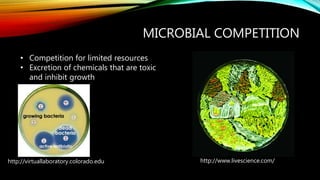
MICROBIAL COMPETITION
http://www.livescience.com/
• Competition for limited resources
• Excretion of chemicals that are toxic
and inhibit growth
http://virtuallaboratory.colorado.edu
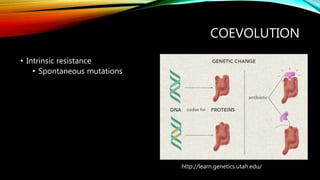
COEVOLUTION
• Intrinsic resistance
• Spontaneous mutations
http://learn.genetics.utah.edu/
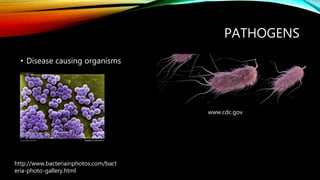
PATHOGENS
• Disease causing organisms
www.cdc.gov
http://www.bacteriainphotos.com/bact
eria-photo-gallery.html
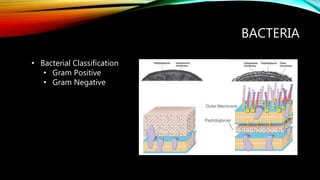
BACTERIA
• Bacterial Classification
• Gram Positive
• Gram Negative
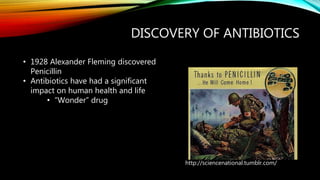
DISCOVERY OF ANTIBIOTICS
• 1928 Alexander Fleming discovered
Penicillin
• Antibiotics have had a significant
impact on human health and life
• “Wonder” drug
http://sciencenational.tumblr.com/
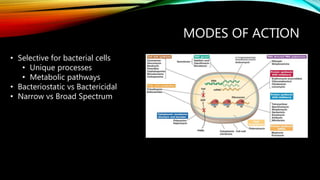
MODES OF ACTION
• Selective for bacterial cells
• Unique processes
• Metabolic pathways
• Bacteriostatic vs Bactericidal
• Narrow vs Broad Spectrum
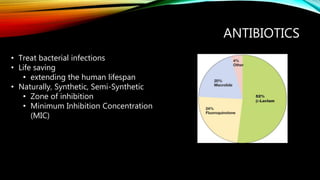
ANTIBIOTICS
• Treat bacterial infections
• Life saving
• extending the human lifespan
• Naturally, Synthetic, Semi-Synthetic
• Zone of inhibition
• Minimum Inhibition Concentration
(MIC)
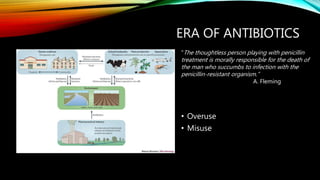
ERA OF ANTIBIOTICS
• Overuse
• Misuse
"The thoughtless person playing with penicillin
treatment is morally responsible for the death of
the man who succumbs to infection with the
penicillin-resistant organism.”
A. Fleming
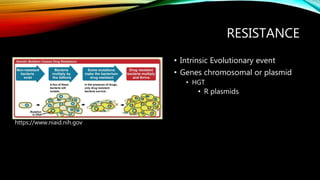
RESISTANCE
• Intrinsic Evolutionary event
• Genes chromosomal or plasmid
• HGT
• R plasmids
https://www.niaid.nih.gov
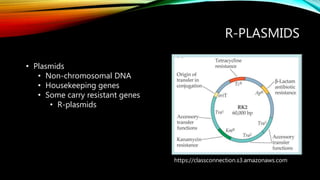
R-PLASMIDS
https://classconnection.s3.amazonaws.com
• Plasmids
• Non-chromosomal DNA
• Housekeeping genes
• Some carry resistant genes
• R-plasmids
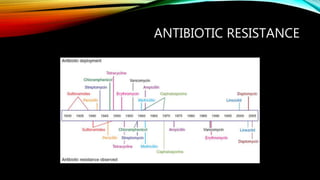
ANTIBIOTIC RESISTANCE
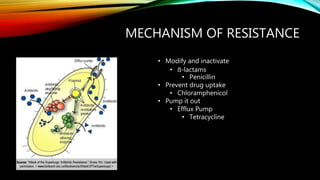
MECHANISM OF RESISTANCE
• Modify and inactivate
• ẞ-lactams
• Penicillin
• Prevent drug uptake
• Chloramphenicol
• Pump it out
• Efflux Pump
• Tetracycline
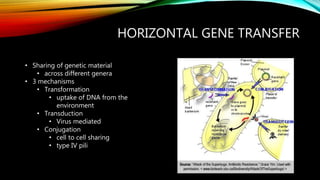
HORIZONTAL GENE TRANSFER
• Sharing of genetic material
• across different genera
• 3 mechanisms
• Transformation
• uptake of DNA from the
environment
• Transduction
• Virus mediated
• Conjugation
• cell to cell sharing
• type IV pili
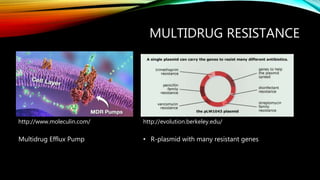
MULTIDRUG RESISTANCE
http://www.moleculin.com/
Multidrug Efflux Pump
http://evolution.berkeley.edu/
• R-plasmid with many resistant genes
MULTIDRUG RESISTANCE
• ESKAPE Pathogens
• Enterococcus faecium (VRE)
• Staphylococcus aureus (MRSA)
• Klebsiella and Escherichia coli producing ESBL
• Acinetobacter baumannii
• Pseudomonas aeruginosa
• Enterbacteriaceae
POST ANTIBIOTIC ERA?
• Little research and development
• Mutations can happen quickly and
are easily shared
• What now?
“ We are headed to a post antibiotic era, in which common infections and minor
injuries can once again kill” WHO 2015
http://bk.asia-city.com
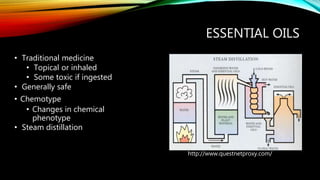
ESSENTIAL OILS
http://www.questnetproxy.com/
• Traditional medicine
• Topical or inhaled
• Some toxic if ingested
• Generally safe
• Chemotype
• Changes in chemical
phenotype
• Steam distillation
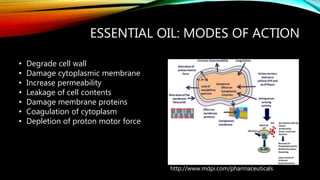
ESSENTIAL OIL: MODES OF ACTION
http://www.mdpi.com/pharmaceuticals
• Degrade cell wall
• Damage cytoplasmic membrane
• Increase permeability
• Leakage of cell contents
• Damage membrane proteins
• Coagulation of cytoplasm
• Depletion of proton motor force
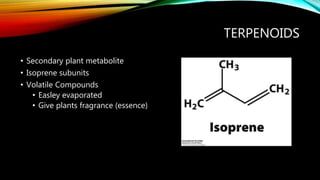
TERPENOIDS
• Secondary plant metabolite
• Isoprene subunits
• Volatile Compounds
• Easley evaporated
• Give plants fragrance (essence)
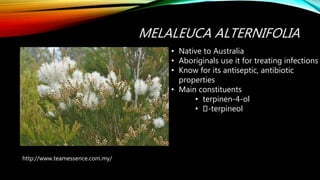
MELALEUCA ALTERNIFOLIA
http://www.teamessence.com.my/
• Native to Australia
• Aboriginals use it for treating infections
• Know for its antiseptic, antibiotic
properties
• Main constituents
• terpinen-4-ol
• -terpineol
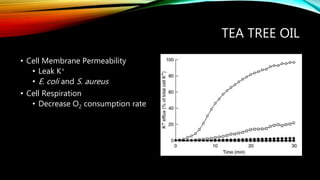
TEA TREE OIL
• Cell Membrane Permeability
• Leak K+
• E. coli and S. aureus
• Cell Respiration
• Decrease O2 consumption rate
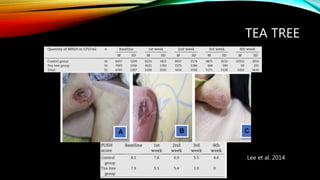
TEA TREE
Lee et al. 2014
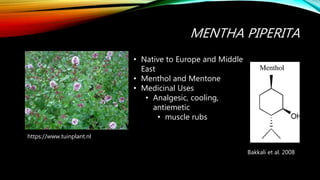
MENTHA PIPERITA
https://www.tuinplant.nl
• Native to Europe and Middle
East
• Menthol and Mentone
• Medicinal Uses
• Analgesic, cooling,
antiemetic
• muscle rubs
Bakkali et al. 2008
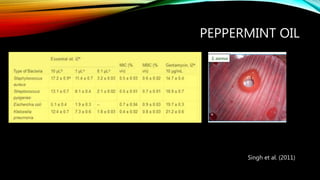
PEPPERMINT OIL
Singh et al. (2011)
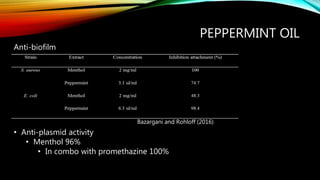
PEPPERMINT OIL
Bazargani and Rohloff (2016)
• Anti-plasmid activity
• Menthol 96%
• In combo with promethazine 100%
Anti-biofilm
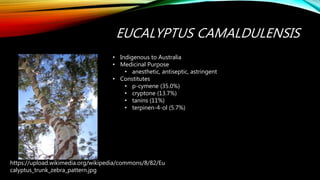
EUCALYPTUS CAMALDULENSIS
https://upload.wikimedia.org/wikipedia/commons/8/82/Eu
calyptus_trunk_zebra_pattern.jpg
• Indigenous to Australia
• Medicinal Purpose
• anesthetic, antiseptic, astringent
• Constitutes
• p-cymene (35.0%)
• cryptone (13.7%)
• tanins (11%)
• terpinen-4-ol (5.7%)
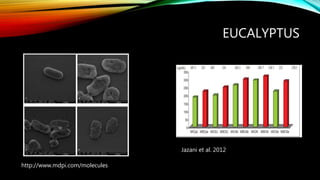
EUCALYPTUS
http://www.mdpi.com/molecules
Jazani et al. 2012
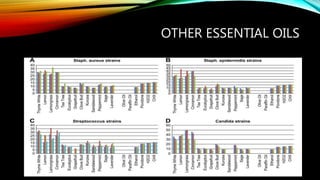
OTHER ESSENTIAL OILS
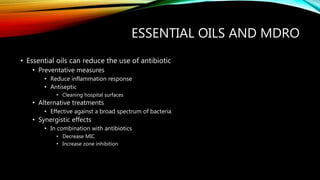
ESSENTIAL OILS AND MDRO
• Essential oils can reduce the use of antibiotic
• Preventative measures
• Reduce inflammation response
• Antiseptic
• Cleaning hospital surfaces
• Alternative treatments
• Effective against a broad spectrum of bacteria
• Synergistic effects
• In combination with antibiotics
• Decrease MIC
• Increase zone inhibition
REFRENCES
• Bazargani MM, Rohloff J. 2016. Antibiofilm activity of essential oils and plant extracts against Staphylococcus
aureus and Escherichia coli biofilms. Food Control 61:156–164.
• www.cdc.gov
• Cox.S.D. 2000. The model of antimicrobial action of the essential oil of Melaleuca alternifolia. J. Appl.
Microbiol. 88:170–175.
• Jazani NH, Mikaili P, Shayegh J, Haghighi N, Aghamohammadi N, Zartoshti M. 2012. The hydro-alcoholic
extract of leaves of Eucalyptus camaldulensis Dehnh. has antibacterial activity on multi-drug resistant bacteria
isolates. J. Appl. Biol. Sci. 6:37–40.
• Knezevic P, Aleksic V, Simin N, Svircev E, Petrovic A, Mimica-Dukic N. 2016. Antimicrobial activity of
Eucalyptus camaldulensis essential oils and their interactions with conventional antimicrobial agents against
multi-drug resistant Acinetobacter baumannii. J. Ethnopharmacol. 178:125–136.
• Lee RLP, Leung PHM, Wong TKS. 2014. A randomized controlled trial of topical tea tree preparation for MRSA
colonized wounds. Int. J. Nurs. Sci. 1:7–14.
• Singh R, Shushni MAM, Belkheir A. 2015. Antibacterial and antioxidant activities of Mentha piperita L. Arab. J.
Chem. 8:322–328.

Combating multidrug resistance bacteria with essential oils

  • 1.
    COMBATING MULTIDRUG RESISTANT BACTERIAWITH ESSENTIAL OILS Miguel Diaz
  • 2.
    MICROBIAL COMPETITION http://www.livescience.com/ • Competitionfor limited resources • Excretion of chemicals that are toxic and inhibit growth http://virtuallaboratory.colorado.edu
  • 3.
    COEVOLUTION • Intrinsic resistance •Spontaneous mutations http://learn.genetics.utah.edu/
  • 4.
    PATHOGENS • Disease causingorganisms www.cdc.gov http://www.bacteriainphotos.com/bact eria-photo-gallery.html
  • 5.
    BACTERIA • Bacterial Classification •Gram Positive • Gram Negative
  • 6.
    DISCOVERY OF ANTIBIOTICS •1928 Alexander Fleming discovered Penicillin • Antibiotics have had a significant impact on human health and life • “Wonder” drug http://sciencenational.tumblr.com/
  • 7.
    MODES OF ACTION •Selective for bacterial cells • Unique processes • Metabolic pathways • Bacteriostatic vs Bactericidal • Narrow vs Broad Spectrum
  • 8.
    ANTIBIOTICS • Treat bacterialinfections • Life saving • extending the human lifespan • Naturally, Synthetic, Semi-Synthetic • Zone of inhibition • Minimum Inhibition Concentration (MIC)
  • 9.
    ERA OF ANTIBIOTICS •Overuse • Misuse "The thoughtless person playing with penicillin treatment is morally responsible for the death of the man who succumbs to infection with the penicillin-resistant organism.” A. Fleming
  • 10.
    RESISTANCE • Intrinsic Evolutionaryevent • Genes chromosomal or plasmid • HGT • R plasmids https://www.niaid.nih.gov
  • 11.
    R-PLASMIDS https://classconnection.s3.amazonaws.com • Plasmids • Non-chromosomalDNA • Housekeeping genes • Some carry resistant genes • R-plasmids
  • 12.
  • 13.
    MECHANISM OF RESISTANCE •Modify and inactivate • ẞ-lactams • Penicillin • Prevent drug uptake • Chloramphenicol • Pump it out • Efflux Pump • Tetracycline
  • 14.
    HORIZONTAL GENE TRANSFER •Sharing of genetic material • across different genera • 3 mechanisms • Transformation • uptake of DNA from the environment • Transduction • Virus mediated • Conjugation • cell to cell sharing • type IV pili
  • 15.
    MULTIDRUG RESISTANCE http://www.moleculin.com/ Multidrug EffluxPump http://evolution.berkeley.edu/ • R-plasmid with many resistant genes
  • 16.
    MULTIDRUG RESISTANCE • ESKAPEPathogens • Enterococcus faecium (VRE) • Staphylococcus aureus (MRSA) • Klebsiella and Escherichia coli producing ESBL • Acinetobacter baumannii • Pseudomonas aeruginosa • Enterbacteriaceae
  • 17.
    POST ANTIBIOTIC ERA? •Little research and development • Mutations can happen quickly and are easily shared • What now? “ We are headed to a post antibiotic era, in which common infections and minor injuries can once again kill” WHO 2015 http://bk.asia-city.com
  • 18.
    ESSENTIAL OILS http://www.questnetproxy.com/ • Traditionalmedicine • Topical or inhaled • Some toxic if ingested • Generally safe • Chemotype • Changes in chemical phenotype • Steam distillation
  • 19.
    ESSENTIAL OIL: MODESOF ACTION http://www.mdpi.com/pharmaceuticals • Degrade cell wall • Damage cytoplasmic membrane • Increase permeability • Leakage of cell contents • Damage membrane proteins • Coagulation of cytoplasm • Depletion of proton motor force
  • 20.
    TERPENOIDS • Secondary plantmetabolite • Isoprene subunits • Volatile Compounds • Easley evaporated • Give plants fragrance (essence)
  • 21.
    MELALEUCA ALTERNIFOLIA http://www.teamessence.com.my/ • Nativeto Australia • Aboriginals use it for treating infections • Know for its antiseptic, antibiotic properties • Main constituents • terpinen-4-ol • -terpineol
  • 22.
    TEA TREE OIL •Cell Membrane Permeability • Leak K+ • E. coli and S. aureus • Cell Respiration • Decrease O2 consumption rate
  • 23.
  • 24.
    MENTHA PIPERITA https://www.tuinplant.nl • Nativeto Europe and Middle East • Menthol and Mentone • Medicinal Uses • Analgesic, cooling, antiemetic • muscle rubs Bakkali et al. 2008
  • 25.
  • 26.
    PEPPERMINT OIL Bazargani andRohloff (2016) • Anti-plasmid activity • Menthol 96% • In combo with promethazine 100% Anti-biofilm
  • 27.
    EUCALYPTUS CAMALDULENSIS https://upload.wikimedia.org/wikipedia/commons/8/82/Eu calyptus_trunk_zebra_pattern.jpg • Indigenousto Australia • Medicinal Purpose • anesthetic, antiseptic, astringent • Constitutes • p-cymene (35.0%) • cryptone (13.7%) • tanins (11%) • terpinen-4-ol (5.7%)
  • 28.
  • 29.
  • 30.
    ESSENTIAL OILS ANDMDRO • Essential oils can reduce the use of antibiotic • Preventative measures • Reduce inflammation response • Antiseptic • Cleaning hospital surfaces • Alternative treatments • Effective against a broad spectrum of bacteria • Synergistic effects • In combination with antibiotics • Decrease MIC • Increase zone inhibition
  • 31.
    REFRENCES • Bazargani MM,Rohloff J. 2016. Antibiofilm activity of essential oils and plant extracts against Staphylococcus aureus and Escherichia coli biofilms. Food Control 61:156–164. • www.cdc.gov • Cox.S.D. 2000. The model of antimicrobial action of the essential oil of Melaleuca alternifolia. J. Appl. Microbiol. 88:170–175. • Jazani NH, Mikaili P, Shayegh J, Haghighi N, Aghamohammadi N, Zartoshti M. 2012. The hydro-alcoholic extract of leaves of Eucalyptus camaldulensis Dehnh. has antibacterial activity on multi-drug resistant bacteria isolates. J. Appl. Biol. Sci. 6:37–40. • Knezevic P, Aleksic V, Simin N, Svircev E, Petrovic A, Mimica-Dukic N. 2016. Antimicrobial activity of Eucalyptus camaldulensis essential oils and their interactions with conventional antimicrobial agents against multi-drug resistant Acinetobacter baumannii. J. Ethnopharmacol. 178:125–136. • Lee RLP, Leung PHM, Wong TKS. 2014. A randomized controlled trial of topical tea tree preparation for MRSA colonized wounds. Int. J. Nurs. Sci. 1:7–14. • Singh R, Shushni MAM, Belkheir A. 2015. Antibacterial and antioxidant activities of Mentha piperita L. Arab. J. Chem. 8:322–328.