INTRODUCTION TO
PHARMACY PRACTICE
&
CONCEPT OF
CLINICAL PHARMACY
Dr. Sharad Chand Pharm. D., Ph.D.
Assistant Professor,
AIP, AUUP, Lucknow.
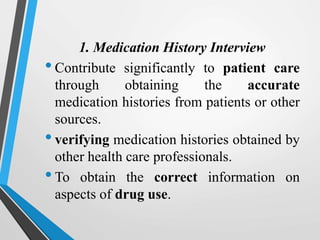
1. Medication History Interview
•Contribute significantly to patient care
through obtaining the accurate
medication histories from patients or other
sources.
•verifying medication histories obtained by
other health care professionals.
•To obtain the correct information on
aspects of drug use.
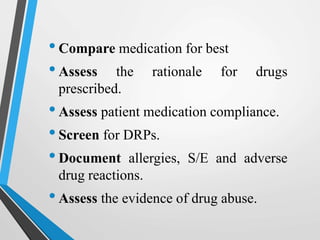
•Compare medication for best
•Assess the rationale for drugs
prescribed.
•Assess patient medication compliance.
•Screen for DRPs.
•Document allergies, S/E and adverse
drug reactions.
•Assess the evidence of drug abuse.
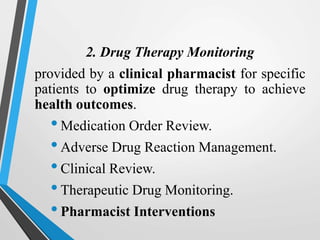
2. Drug Therapy Monitoring
provided by a clinical pharmacist for specific
patients to optimize drug therapy to achieve
health outcomes.
•Medication Order Review.
•Adverse Drug Reaction Management.
•Clinical Review.
•Therapeutic Drug Monitoring.
•Pharmacist Interventions
3. Ward Round Participation
•Member of a healthcare team
•Contribute to patient care through the provision
of drug information
•Promotion of rational drug therapy.
•Timely decision making in selection of drugs.
4. Identification and Management of DRPs
•DDIs
•ADRs
•Untreated Condition
•Unwanted
medications
•Ineffective therapy
•Use of unsafe
medications
•Dosage too low
•Toxic dose
•Non-Compliance
5. Drug & Poison Information Services
•Provide information on drug-related matters.
•Initiated by the pharmacist or may be in
response to a request.
•Preparation of specific drug-related resources,
(Protocols and PILs).
6. Patient Counseling
•Provide sufficient information and
counseling on disease, diet, lifestyle and
outcomes and to enable patients/their
representatives to achieve judicious use of
their medicines.
7. Drug Utilization Evaluation/Review
•Quality assurance/management activity for
drug therapy.
•Promote rational and economical drug use.
•Improve drug therapy outcomes.
•Review of medical prescribing, pharmacy
dispensing and patient use of drugs.
Quality Assurance of Clinical Pharmacy
Services
•Procedures to set, promote, maintain and
monitor the desired standards for services.
•Efficient, effective and accepted standards
of professional ethics and knowledge.
•Clinical pharmacy services are
documented.
•Administrative responsibility
Scopes of Clinical Pharmacy
•Hospital/Clinical Pharmacy practice
•Institute-based and community-based
pharmacists
•Policy making
•Disaster and Pandemics
•Liaison with hospital, dispensing, industrial
and community services.
•Education and research
•Clinical trials
•Quality assurance
•Guideline and protocol formulation &
evaluation
•Health Promotion
•Pharmacovigilance
•Manufacture of the drugs till the drug
disposal, covers all spectrum of drugs.
Clinical pharmacist activities.pptx

Clinical pharmacist activities.pptx

  • 1.
    INTRODUCTION TO PHARMACY PRACTICE & CONCEPTOF CLINICAL PHARMACY Dr. Sharad Chand Pharm. D., Ph.D. Assistant Professor, AIP, AUUP, Lucknow.
  • 8.
    1. Medication HistoryInterview •Contribute significantly to patient care through obtaining the accurate medication histories from patients or other sources. •verifying medication histories obtained by other health care professionals. •To obtain the correct information on aspects of drug use.
  • 9.
    •Compare medication forbest •Assess the rationale for drugs prescribed. •Assess patient medication compliance. •Screen for DRPs. •Document allergies, S/E and adverse drug reactions. •Assess the evidence of drug abuse.
  • 10.
    2. Drug TherapyMonitoring provided by a clinical pharmacist for specific patients to optimize drug therapy to achieve health outcomes. •Medication Order Review. •Adverse Drug Reaction Management. •Clinical Review. •Therapeutic Drug Monitoring. •Pharmacist Interventions
  • 11.
    3. Ward RoundParticipation •Member of a healthcare team •Contribute to patient care through the provision of drug information •Promotion of rational drug therapy. •Timely decision making in selection of drugs.
  • 12.
    4. Identification andManagement of DRPs •DDIs •ADRs •Untreated Condition •Unwanted medications •Ineffective therapy •Use of unsafe medications •Dosage too low •Toxic dose •Non-Compliance
  • 13.
    5. Drug &Poison Information Services •Provide information on drug-related matters. •Initiated by the pharmacist or may be in response to a request. •Preparation of specific drug-related resources, (Protocols and PILs).
  • 14.
    6. Patient Counseling •Providesufficient information and counseling on disease, diet, lifestyle and outcomes and to enable patients/their representatives to achieve judicious use of their medicines.
  • 15.
    7. Drug UtilizationEvaluation/Review •Quality assurance/management activity for drug therapy. •Promote rational and economical drug use. •Improve drug therapy outcomes. •Review of medical prescribing, pharmacy dispensing and patient use of drugs.
  • 16.
    Quality Assurance ofClinical Pharmacy Services •Procedures to set, promote, maintain and monitor the desired standards for services. •Efficient, effective and accepted standards of professional ethics and knowledge. •Clinical pharmacy services are documented. •Administrative responsibility
  • 17.
    Scopes of ClinicalPharmacy •Hospital/Clinical Pharmacy practice •Institute-based and community-based pharmacists •Policy making •Disaster and Pandemics •Liaison with hospital, dispensing, industrial and community services. •Education and research
  • 18.
    •Clinical trials •Quality assurance •Guidelineand protocol formulation & evaluation •Health Promotion •Pharmacovigilance •Manufacture of the drugs till the drug disposal, covers all spectrum of drugs.