VIVEKANANDHA
Submitted to:
Ms.S.Anandhi
Assistant Professor
PG & Research Department of Biotechnology
Vivekanandha Arts and Science College For Women
Sankari.
Submitted by :
N.DEVIKA
II-BSC BIOTECHNOLOGY
PG AND RESEARCH DEPARTMENT OF BIOTECHNOLOGY
VIVEKANADHA ARTS AND SCIENCE COLLEGE FOR
WOMEN VEERACHIPALAYAM,SANKAGIRI.
Title : ANTIGEN:CHARACTERISTICS AND TYPES.
Subject: IMMUNE AND IMMUNOTECHNOLOGY
ARTS & SCIENCE COLLEGE FOR WOMEN
Dt., Tamil Nadu[An ISO 9001:2015 Certified Institution]
(Affiliated to Periyar University, Salem
Recognised Under Section 2(f) &12(B) of the UGC Act, 1956)
Veerachipalayam, Sankari West (Post) – 637 303, Sankari Tk, Salem
PG & RESEARCH DEPARTMENT OF BIOTECHNOLOGY
ANTIGEN:CHARACTERISTI
CS
AND TYPES
1. Introduction
2. Definition
3. Structure of Antigen
4. Properties of Antigen
5. characteristics of Antigen
6. Types of Antigen
7. Conclusion
SYNOPSIS
Antigens are substances that trigger an immune response, causing
the body to produce antibodies to fight them. Antigens can be:
- Proteins (e.g., viruses, bacteria, toxins)
- Carbohydrates (e.g., bacterial cell walls)
- Nucleic acids (e.g., DNA, RNA)
- Lipids (e.g., bacterial cell membranes)
INTRODUCTION
Antigens have specific regions called epitopes, which are
recognized by the immune system. When an antigen enters
the body, it is processed by immune cells, and the epitopes are
presented to T-cells and B-cells, triggering an immune
response.
Antigens can be:-
1. Exogenous (from outside the body, e.g., viruses, bacteria)-
2. Endogenous (from within the body, e.g., cancer cells, self-
proteins)
Understanding antigens is crucial in immunology,
DEFINITION
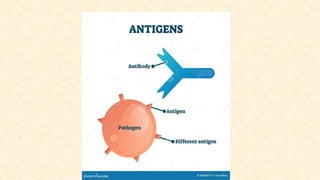
Antigens are substances that can trigger an immune response,
causing the body to produce antibodies or immune cells that
recognize and bind to them. Antigens are typically proteins,
carbohydrates, nucleic acids, or lipids that have specific regions
(epitopes) recognized by the immune system.
Key points:
- Substances that trigger an immune response
- Recognized by immune cells (T-cells, B-cells)
- Stimulate antibody production or immune cell activation
- Can be proteins, carbohydrates, nucleic acids, or lipids
STRUCTURE OF ANTIGEN
-Antigens have a unique structure that allows them to be
recognized by the immune system.
The key features are:
1. Epitopes (Antigenic Determinants): Specific regions on the
antigen’s surface that are recognized by immune cells (T-cells,
B-cells).
2. Molecular Shape: Antigens have a unique 3D shape that
allows them to bind to immune cells.
3. Chemical Composition: Antigens can be proteins, carbohydrates,
nucleic acids, or lipids, each with distinct chemical properties.
4. Size: Antigens can vary in size from small molecules to large
proteins.
5. Complexity: Antigens can have complex structures, such as
branched chains or repeating units.
The structure of an antigen determines:
- Which immune cells recognize it
- How it is processed and presented to immune cells
- The type of immune response it triggers.
PROPERTIES OF ANTIGEN
Antigens have several key properties that determine their
interaction with the immune system:
1. Immunogenicity: Ability to stimulate an immune response.
2. Antigenicity: Ability to bind to antibodies or immune cells.
3. Specificity: Unique structure recognized by specific immune
cells.
4. Diversity: Wide range of antigens with different structures and
properties.
5. Complexity: Can have complex structures, such as branched
chains or repeating units.
7. Chemical Composition: Can be proteins, carbohydrates, nucleic
acids, or lipids.
8. Stability: Can be stable or unstable, affecting their persistence in
the body.
9. Solubility: Can be soluble or insoluble, affecting their interaction
with immune cells.
These properties determine:
- How antigens are recognized and processed by the immune
system
- The type and strength of the immune response
- The effectiveness of vaccines and diagnostic tests.
CHARACTERISTICS OF ANTIGEN
1. Specificity: Unique structure recognized by specific immune
cells.
2. Immunogenicity: Ability to stimulate an immune response.
3. Reactivity: Ability to bind to antibodies or immune cells.
4. Diversity: Wide range of antigens with different structures
and properties.
5. Complexity: Can have complex structures, such as branched
chains or repeating units.
6. Molecular Weight: Can vary in size from small molecules to
large proteins.
7. Chemical Composition: Can be proteins, carbohydrates, nucleic
acids, or lipids.
8. Stability: Can be stable or unstable, affecting their persistence
in the body.
9. Solubility: Can be soluble or insoluble, affecting their
interaction with immune cells.
10. Epitope Density: Number of epitopes (antigenic determinants)
per molecule.
These characteristics determine how antigens interact with the
immune system and influence the immune response.
TYPES OF ANTIGEN
The main types of antigens;
1. Exogenous Antigens: Come from outside the body (e.g., viruses,
bacteria, toxins).
2. Endogenous Antigens: Originate from within the body (e.g.,
cancer cells, self-proteins).
3. Hapten Antigens: Small molecules that become antigenic when
attached to a carrier protein.
4. Conjugate Antigens: Consist of a hapten attached to a carrier
protein.
5. T-Independent Antigens: Stimulate B-cells without T-cell help
6. T-Dependent Antigens: Require T-cell help to stimulate B-cells
(e.g., proteins).
7. Autoantigens: Self-proteins recognized as foreign by the
immune system (e.g., in autoimmune diseases).
8. Tumor Antigens: Proteins or other molecules expressed by
cancer cells.
9. Allergens: Substances that trigger allergic reactions (e.g.,
pollen, dust mites).
10. Superantigens: Powerful antigens that activate large numbers
of T-cells (e.g., bacterial toxins).
Each type of antigen elicits a unique immune response, and
understanding these differences is crucial for developing effective
vaccines, diagnostics, and treatments.
CONCLUSION
Antigens are substances that trigger an immune response,
playing a crucial role in protecting the body against
pathogens and diseases. Understanding antigens and their
properties, types, and characteristics is essential for:
1. Developing effective vaccines and diagnostics
2. Understanding autoimmune diseases and allergies
3. Designing targeted therapies for cancer and infectiou.
4. Improving transplantation outcomes.
In summary, antigens are:
- Substances recognized by the immune system
- Triggers of immune responses
- Essential for immune function and protection
- Diverse in structure, properties, and functions
- Critical for medical research, diagnostics, and treatments
By understanding antigens, we can harness the power of the
immune system to prevent and treat diseases, improving
human health and well-being.
1. Murphy, K., & Weaver, C. (2016). Janeway's immunobiology (9th ed.). Garland
Science.
2. Parham, P. (2020). The immune system (5th ed.). Cengage Learning.
3. Owen, J., Punt, J., & Stranford, S. (2013). Kuby immunology (7th ed.). W.H.
Freeman.
4. Roitt, I., & Male, H. (2016). Immunology (9th ed.). Elsevier.
5. Abbas, A. K., Lichtman, A. H., & Pillai, S. (2021). Cellular and molecular
immunology (10th ed.). Elsevier.
6. Mahmoudi, M. (2013). Immunology made ridiculously simple (3rd ed.). MedMaster
Inc.
7. Abbas, A. K., Lichtman, A. H., & Pillai, S. (2022). Basic immunology: Functions and
disorders of the immune system (6th ed.). Elsevier.
8. Coico, R., & Sunshine, G. (2015). Immunology: A short course (7th ed.). Wiley.
9. Shand, M. H. D. O. (2018). Advanced immunology. Cambridge University Press.
10.Paul, W. E. (2018). Fundamental immunology (7th ed.). Lippincott Williams &
Wilkins.
Reference
Books:
Websites
:
1. National Institute of Allergy and Infectious Diseases. (n.d.). Home.
https://www.niaid.nih.gov
2. American Association of Immunologists. (n.d.). Home.
https://www.aai.org
3. The Journal of Immunology. (n.d.). Home.
https://www.jimmunol.org
4. British Society for Immunology. (n.d.). Home.
https://www.immunology.org
5. Nature Reviews Immunology. (n.d.). Home.
https://www.nature.com/nri/
6. PubMed. (n.d.). Home. https://pubmed.ncbi.nlm.nih.gov
7. World Health Organization. (n.d.). Immunization.
https://www.who.int/topics/immunization
8. Immunopaedia. (n.d.). Home. https://www.immunopaedia.org.za
9. Centers for Disease Control and Prevention. (n.d.). Vaccines.
THANK YOU

ANTIGEN:characteristics and types .pptx

  • 1.
    VIVEKANANDHA Submitted to: Ms.S.Anandhi Assistant Professor PG& Research Department of Biotechnology Vivekanandha Arts and Science College For Women Sankari. Submitted by : N.DEVIKA II-BSC BIOTECHNOLOGY PG AND RESEARCH DEPARTMENT OF BIOTECHNOLOGY VIVEKANADHA ARTS AND SCIENCE COLLEGE FOR WOMEN VEERACHIPALAYAM,SANKAGIRI. Title : ANTIGEN:CHARACTERISTICS AND TYPES. Subject: IMMUNE AND IMMUNOTECHNOLOGY ARTS & SCIENCE COLLEGE FOR WOMEN Dt., Tamil Nadu[An ISO 9001:2015 Certified Institution] (Affiliated to Periyar University, Salem Recognised Under Section 2(f) &12(B) of the UGC Act, 1956) Veerachipalayam, Sankari West (Post) – 637 303, Sankari Tk, Salem PG & RESEARCH DEPARTMENT OF BIOTECHNOLOGY
  • 2.
  • 3.
    1. Introduction 2. Definition 3.Structure of Antigen 4. Properties of Antigen 5. characteristics of Antigen 6. Types of Antigen 7. Conclusion SYNOPSIS
  • 4.
    Antigens are substancesthat trigger an immune response, causing the body to produce antibodies to fight them. Antigens can be: - Proteins (e.g., viruses, bacteria, toxins) - Carbohydrates (e.g., bacterial cell walls) - Nucleic acids (e.g., DNA, RNA) - Lipids (e.g., bacterial cell membranes) INTRODUCTION
  • 5.
    Antigens have specificregions called epitopes, which are recognized by the immune system. When an antigen enters the body, it is processed by immune cells, and the epitopes are presented to T-cells and B-cells, triggering an immune response. Antigens can be:- 1. Exogenous (from outside the body, e.g., viruses, bacteria)- 2. Endogenous (from within the body, e.g., cancer cells, self- proteins) Understanding antigens is crucial in immunology,
  • 6.
    DEFINITION Antigens are substancesthat can trigger an immune response, causing the body to produce antibodies or immune cells that recognize and bind to them. Antigens are typically proteins, carbohydrates, nucleic acids, or lipids that have specific regions (epitopes) recognized by the immune system. Key points: - Substances that trigger an immune response - Recognized by immune cells (T-cells, B-cells) - Stimulate antibody production or immune cell activation - Can be proteins, carbohydrates, nucleic acids, or lipids
  • 7.
    STRUCTURE OF ANTIGEN -Antigenshave a unique structure that allows them to be recognized by the immune system. The key features are: 1. Epitopes (Antigenic Determinants): Specific regions on the antigen’s surface that are recognized by immune cells (T-cells, B-cells). 2. Molecular Shape: Antigens have a unique 3D shape that allows them to bind to immune cells.
  • 8.
    3. Chemical Composition:Antigens can be proteins, carbohydrates, nucleic acids, or lipids, each with distinct chemical properties. 4. Size: Antigens can vary in size from small molecules to large proteins. 5. Complexity: Antigens can have complex structures, such as branched chains or repeating units. The structure of an antigen determines: - Which immune cells recognize it - How it is processed and presented to immune cells - The type of immune response it triggers.
  • 10.
    PROPERTIES OF ANTIGEN Antigenshave several key properties that determine their interaction with the immune system: 1. Immunogenicity: Ability to stimulate an immune response. 2. Antigenicity: Ability to bind to antibodies or immune cells. 3. Specificity: Unique structure recognized by specific immune cells. 4. Diversity: Wide range of antigens with different structures and properties. 5. Complexity: Can have complex structures, such as branched chains or repeating units.
  • 11.
    7. Chemical Composition:Can be proteins, carbohydrates, nucleic acids, or lipids. 8. Stability: Can be stable or unstable, affecting their persistence in the body. 9. Solubility: Can be soluble or insoluble, affecting their interaction with immune cells. These properties determine: - How antigens are recognized and processed by the immune system - The type and strength of the immune response - The effectiveness of vaccines and diagnostic tests.
  • 12.
    CHARACTERISTICS OF ANTIGEN 1.Specificity: Unique structure recognized by specific immune cells. 2. Immunogenicity: Ability to stimulate an immune response. 3. Reactivity: Ability to bind to antibodies or immune cells. 4. Diversity: Wide range of antigens with different structures and properties. 5. Complexity: Can have complex structures, such as branched chains or repeating units. 6. Molecular Weight: Can vary in size from small molecules to large proteins.
  • 13.
    7. Chemical Composition:Can be proteins, carbohydrates, nucleic acids, or lipids. 8. Stability: Can be stable or unstable, affecting their persistence in the body. 9. Solubility: Can be soluble or insoluble, affecting their interaction with immune cells. 10. Epitope Density: Number of epitopes (antigenic determinants) per molecule. These characteristics determine how antigens interact with the immune system and influence the immune response.
  • 14.
    TYPES OF ANTIGEN Themain types of antigens; 1. Exogenous Antigens: Come from outside the body (e.g., viruses, bacteria, toxins). 2. Endogenous Antigens: Originate from within the body (e.g., cancer cells, self-proteins). 3. Hapten Antigens: Small molecules that become antigenic when attached to a carrier protein. 4. Conjugate Antigens: Consist of a hapten attached to a carrier protein. 5. T-Independent Antigens: Stimulate B-cells without T-cell help
  • 15.
    6. T-Dependent Antigens:Require T-cell help to stimulate B-cells (e.g., proteins). 7. Autoantigens: Self-proteins recognized as foreign by the immune system (e.g., in autoimmune diseases). 8. Tumor Antigens: Proteins or other molecules expressed by cancer cells. 9. Allergens: Substances that trigger allergic reactions (e.g., pollen, dust mites). 10. Superantigens: Powerful antigens that activate large numbers of T-cells (e.g., bacterial toxins). Each type of antigen elicits a unique immune response, and understanding these differences is crucial for developing effective vaccines, diagnostics, and treatments.
  • 16.
    CONCLUSION Antigens are substancesthat trigger an immune response, playing a crucial role in protecting the body against pathogens and diseases. Understanding antigens and their properties, types, and characteristics is essential for: 1. Developing effective vaccines and diagnostics 2. Understanding autoimmune diseases and allergies 3. Designing targeted therapies for cancer and infectiou. 4. Improving transplantation outcomes.
  • 17.
    In summary, antigensare: - Substances recognized by the immune system - Triggers of immune responses - Essential for immune function and protection - Diverse in structure, properties, and functions - Critical for medical research, diagnostics, and treatments By understanding antigens, we can harness the power of the immune system to prevent and treat diseases, improving human health and well-being.
  • 18.
    1. Murphy, K.,& Weaver, C. (2016). Janeway's immunobiology (9th ed.). Garland Science. 2. Parham, P. (2020). The immune system (5th ed.). Cengage Learning. 3. Owen, J., Punt, J., & Stranford, S. (2013). Kuby immunology (7th ed.). W.H. Freeman. 4. Roitt, I., & Male, H. (2016). Immunology (9th ed.). Elsevier. 5. Abbas, A. K., Lichtman, A. H., & Pillai, S. (2021). Cellular and molecular immunology (10th ed.). Elsevier. 6. Mahmoudi, M. (2013). Immunology made ridiculously simple (3rd ed.). MedMaster Inc. 7. Abbas, A. K., Lichtman, A. H., & Pillai, S. (2022). Basic immunology: Functions and disorders of the immune system (6th ed.). Elsevier. 8. Coico, R., & Sunshine, G. (2015). Immunology: A short course (7th ed.). Wiley. 9. Shand, M. H. D. O. (2018). Advanced immunology. Cambridge University Press. 10.Paul, W. E. (2018). Fundamental immunology (7th ed.). Lippincott Williams & Wilkins. Reference Books:
  • 19.
    Websites : 1. National Instituteof Allergy and Infectious Diseases. (n.d.). Home. https://www.niaid.nih.gov 2. American Association of Immunologists. (n.d.). Home. https://www.aai.org 3. The Journal of Immunology. (n.d.). Home. https://www.jimmunol.org 4. British Society for Immunology. (n.d.). Home. https://www.immunology.org 5. Nature Reviews Immunology. (n.d.). Home. https://www.nature.com/nri/ 6. PubMed. (n.d.). Home. https://pubmed.ncbi.nlm.nih.gov 7. World Health Organization. (n.d.). Immunization. https://www.who.int/topics/immunization 8. Immunopaedia. (n.d.). Home. https://www.immunopaedia.org.za 9. Centers for Disease Control and Prevention. (n.d.). Vaccines.
  • 20.