ANTI-FUNGAL
AGENTS
Prepared By
DOPPALAPUDI SANDEEP
M. Pharmacy,
Assistant Professor
Department of Physiology & Pharmacology
Chebrolu Hanumaiah Institute of Pharmaceutical
Sciences, Chandramoulipuram, Chowdavaram, Guntur,
Andhra Pradesh, India – 522019
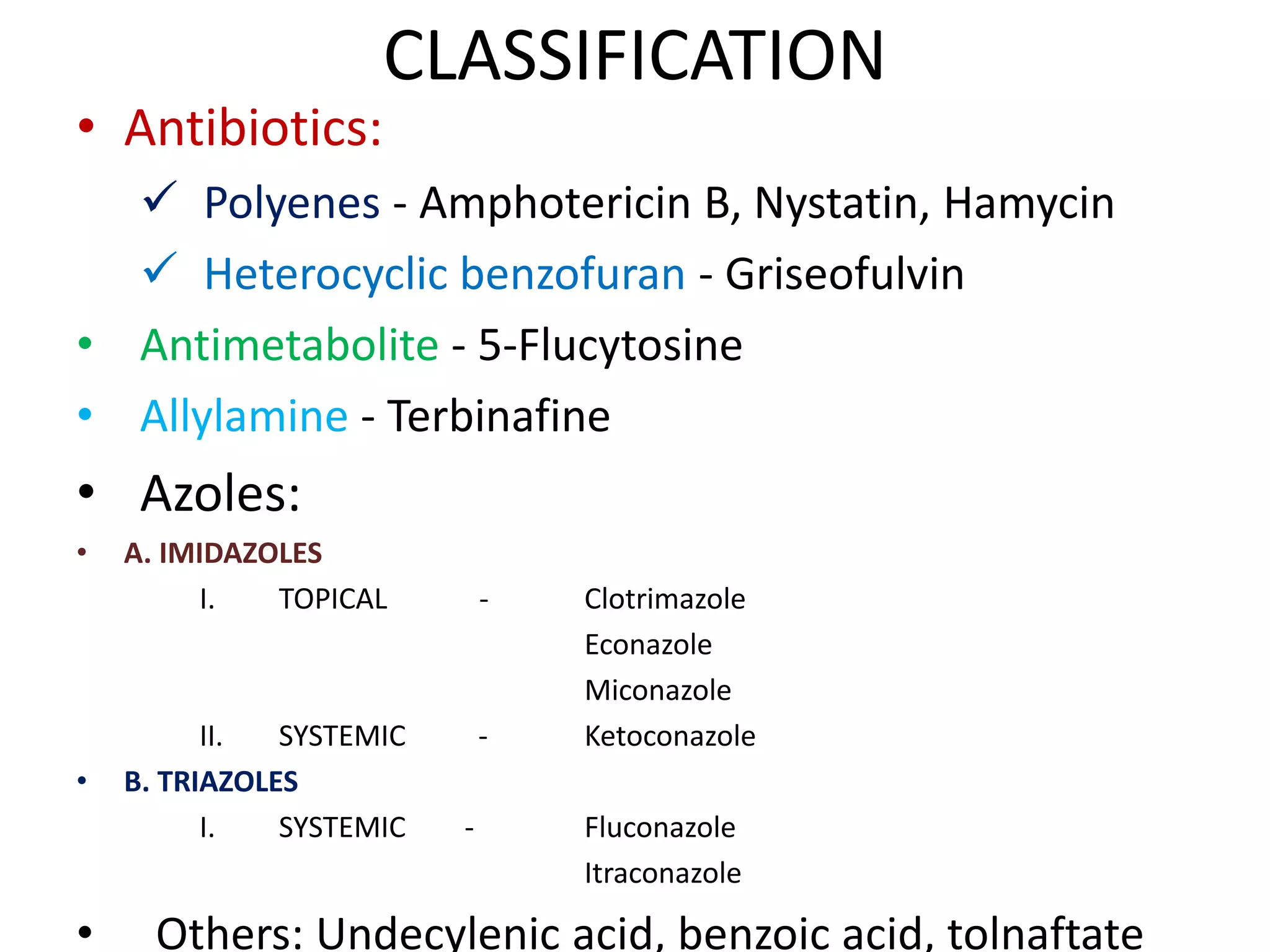
CLASSIFICATION
• Antibiotics:
 Polyenes - Amphotericin B, Nystatin, Hamycin
 Heterocyclic benzofuran - Griseofulvin
• Antimetabolite - 5-Flucytosine
• Allylamine - Terbinafine
• Azoles:
• A. IMIDAZOLES
I. TOPICAL - Clotrimazole
Econazole
Miconazole
II. SYSTEMIC - Ketoconazole
• B. TRIAZOLES
I. SYSTEMIC - Fluconazole
Itraconazole
• Others: Undecylenic acid, benzoic acid, tolnaftate
• Extracted from “Penicillium griseofulvum”.
• Active against dermatophytes.
Eg: epidermophyton, trichophyton, microsporum
• Not active against Candida.
• Dermatophytes actively concentrate it-selective toxicity.
• It doesn’t has any anti-bacterial activity.
• It is FUNGISTATIC but not fungicidal.
GRISEOFULVIN
• Interferes with MITOSIS.
• Causes abnormal metaphase configurations.
• The daughter nuclei fail to move apart or move only a
short distance.
• As a result, multi-nucleated and stunted fungal hyphae
occurs.
• Disorients the microtubules (pulls chromosomes apart).
MECHANISM OF ACTION
• Absorption: Irregular due to low water solubility.
• It can be improved by taking it with fats and by
microfining the drug particles.
• Deposited in keratin forming cells of skin, hair and nails.
• Newly formed keratin is not invaded by fungus, but the
fungus which persists in already infected keratin, till it
sheds off.
• It persists for weeks in skin and keratin.
PHARMACOKINETICS
• Very low.
• Headache is the commonest complaint.
• G.I.T disturbances are observed.
• Discontinuation – if Rashes, Photoallergy was
observed.
• USES:
• Used systemically only for dermatophytosis.
ADVERSE EFFECTS & USES
• 125 – 250 mg QID with meals.
• Duration of Treatment depends upon Site of infection, Thickness of infected
keratin and Turnover rate.
• Body skin – 3 weeks
• Palm, soles - 4 – 6 weeks
• Finger nails - 4 – 6 months
• Toe nails - 8 – 12 months
• INTERACTIONS:
• Induces warfarin metabolism.
• Reduces efficacy of oral contraceptives.
• Failure of therapy with phenobarbitone.
• Causes intolerance to alcohol.
DOSES & INTERACTIONS
• Extracted from “Streptomyces nodosus”.
• Chemistry:
• contains macrocyclic ring- one side has several conjugated
double bonds (highly lipophilic) and other side with many
OH groups (hydrophilic).
• Selectivity of AMB is low.
• also effects cholesterol in human cell membrane due to
structural resemblence with ergosterol.
• Active against wide range of yeast and fungi.
• DOSE: 50-100 mg QID
AMPHOTERICIN-B
• AMB has high affinity with ergosterol in fungal cell wall.
• combines with it, gets inserted into membrane and several
AMB molecules orient together to form a micropore.
• hydrophilic side forms interior through which water, ions,
aminoacids move out.
• micropore is stabilized by sterols of AMB.
• This leads to increased cell permeability.
• AMB enhaces immunity in animals
MECHANISM OF ACTION
• Absorption: Not absorbed. Can be given orally for
intestinal candidiasis without systemic toxicity.
• IV suspension is taken made with deoxycholate-widely
distributed.
• Poor CSF penetration.
• Binds to sterols in body tissues and stays for longer
periods.
• Half life-15 days. metabolized in liver.
• Excretes slowly through urine and bile.
PHARMACOKINETICS
• Acute reaction: chills, aches, fever,
Nausea,vomiting, dyspnea.
• Thrombophlebitis.
• nephrotoxicity-long term
• Reduced GFR, acidosis, hypokalemia
• Anaemia, CNS toxicity
• USES: for oral, vaginal and cutaneous candidiasis,
leishmaniasis.
ADVERSE EFFECTS & USES
• 5-FLUCYTOSINE:
• Pyrimidine antimetabolite, inactive as such.
5-FC
taken up by fungal cells & converted to
5-Fluorouracil
Converted to
5- Fluorodeoxyuridylic acid
(INHIBITS thymidilate synthesis)
No DNA formation in fungal cell
ANTIMETABOLITES
• Mammalian cells have low capacity to convert 5-FC to 5-FU. So
fungal selectivity action occurs.
• Active against Cryptococcus, Torula and few strains of Candida.
• ADVERSE EFFECTS:
1. Leucopenia
2. thrombocytopenia
3. bone marrow depression
4. G.I disturbaces
5. Diarrhoea in some cases
6. Mild liver dysfunction – reversible.
• USES: Not used as a SOLE therapy.
• Used in cryptococciasis with Amphotericin-B.
5 - FLUCYTOSINE
• Currently most extensively used antifungals.
• They have broad spectrum activity. Effective against
dermatophytes, Candida, Nocardia, Staph. aureus, Strept. faecalis,
Bac. fragilis and Leishmania.
• Mechanism of action: AZOLES
INHIBITS
ERGOSTEROL
Membrane abnormalities in fungus
DEATH OF FUNGUS
AZOLE ANTIFUNGALS
LANOSTEROL 14-DEMETHYLASE
• Effective in topical treatment of tinea infections – 60 to 100% cure
rates with 2 – 4 weeks application on a twice daily schedule.
• Effective for athletes foot,
otomycosis,
oral, cutaneous, vaginal candidias.
• Mostly for vaginitis due to long lasting residual effect after one
application.( 7 day course)
• For oropharyngeal candidias, 10mg in mouth 3-4 times a day
• Well tolerated
• Local irritation with burning sensation occurs sometime
CLOTRIMAZOLE
• ECONAZOLE:
• Similar to clotrimazole. Effectively penetrates through skin.
• Highly effective in dermatophytosis, otomycosis, oral thrush, but somewhat
inferior to clotrimazole in vaginitis.
• NO adverse effects. Local irritation in a few was reported.
• 1% ointment & 150 mg vaginal tab.
• MICONAZOLE:
• Highly efficacious drug (>90% cure rate) for tinea, cutaneous and vaginal
candidias, otomycosis.
• Has very good penetrating power. Even single application on skin acts for few days.
• A higher evidence of vaginal irritation was reported.
• 2% gel & 2% powder solution.
ECONAZOLE & MICONAZOLE
• First ORALLY effective broad spectrum antifungal drug.
• Oral absorption is facilitated by gastric acidity, as it is soluble at lower pH.
• Larger binding to albumin, extensive hepatic metabolism, excretion in
urine and faeces.
• A short t1/2 - 11/2 to 6 hours.
• DOSE: 200 mg OD or BD.
• ADVERSE EFFECTS:
• Nausea, vomiting – reduced by taking with meals.
• Loss of appetite, headache, rashes and hair loss.
• Decreases androgen production (testosterone) in men. It results in
gynaecomastia, loss of hair and libido.
• Menstrual irregularities in women due to suppression of estradiol
synthesis.
• Contraindicated in pregnants and nursing women.
KETOCONAZOLE (KTZ)
• DRUG INTERACTIONS:
• Antacids – Decreases oral absorption.
• Rifampicin, phenobarbitone, Phenytoin – Induces metabolism
• Warfarin, diazepam, sulfonyl ureas – Increased concentration.
(due to inhibition of CytP450 by Ketoconazole)
 Terfenadine, cisapride – Induces Ventricular tachycardia, fatal
ventricular fibrillation.
 USES:
 In dermatophytosis – concentrated in stratum corneum.
 High doses are used in Cushing’s syndrome.
 Fluconazole and itraconazole have replaced the KTZ largely due to their lesser side
effects, toxicity (lower affinity for mammalian CytP450) and higher efficacy.
KETOCONAZOLE
• Newer water soluble triazole having wide range of activity than KTZ.
• Mostly used in crpytococcal meningitis, systemic and mucosal candidiasis.
PREFERRED drug fro Fungal Meningitis.
• Doesn’t inhibit the steroid synthesis –NO Antiandrogenic effect.
• PHARMACOKINETICS:
• 94% absorbed- Oral BA is not affected by food or gastric pH.
• Excreted unchanged in urine. T1/2 is 25-30 hrs.
• Fungicidal concentrations are achieved in Nails, vagina and saliva.
• Penetration into Brain and CSF is good.
• Dose reduction is needed in renal impairment.
• ADVERSE EFFECTS:
• Nausea, vomiting, abdominal pain, rash, headache.
• NOT recommended in pregnant women and lactating mothers.
FLUCONAZOLE
• DRUG INTERACTIONS:
• Increases plasma levels of phenytoin, cisapride, warfarin, zidovudine, etc.
• With cisapride – produces ventricular tachycardia.
• USES:
• In vaginal candidiasis – 150 mg p.o
• Tinea and cutaneous infections – 150 mg weekly for 4 weeks
• Cryptococcal meningitis – 200-400 mg/day for 4-12 weeks
• Fungal keratitis – eye drops (0.3%).
• It is Longer acting,
Safer and
More efficacious than KTZ.
FLUCONAZOLE
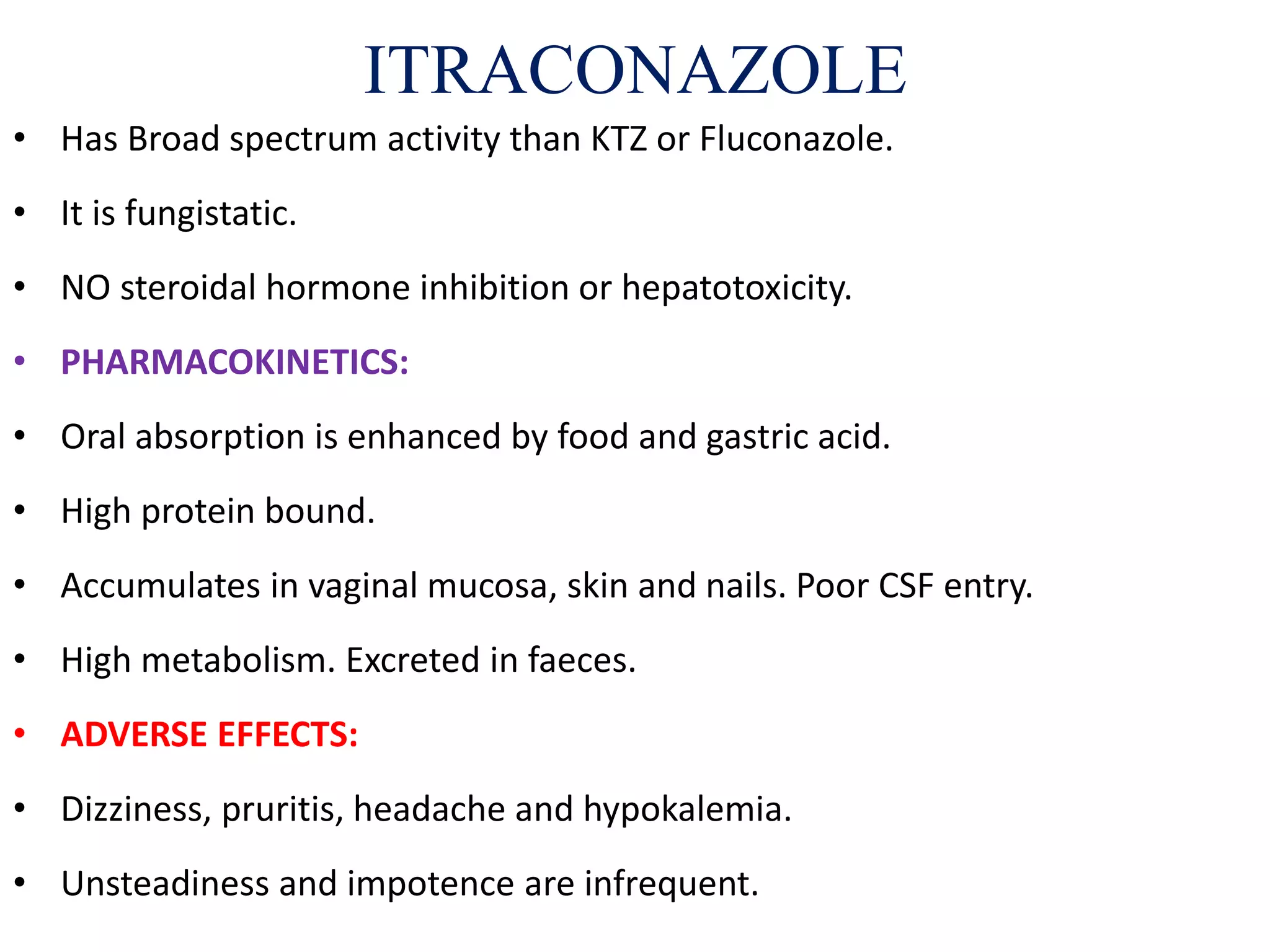
• Has Broad spectrum activity than KTZ or Fluconazole.
• It is fungistatic.
• NO steroidal hormone inhibition or hepatotoxicity.
• PHARMACOKINETICS:
• Oral absorption is enhanced by food and gastric acid.
• High protein bound.
• Accumulates in vaginal mucosa, skin and nails. Poor CSF entry.
• High metabolism. Excreted in faeces.
• ADVERSE EFFECTS:
• Dizziness, pruritis, headache and hypokalemia.
• Unsteadiness and impotence are infrequent.
ITRACONAZOLE
• DRUG INTERACTIONS:
• Antacids – Reduces oral absorption.
• Phenytoin, rifampicin, Phenobarbitone – Induces metabolism
• Warfarin, digoxin – concentration in plasma increases.
• Cisapride – induces Ventricular arrhythmias.
• USES:
• Drug of choice for chromomycosis and paracoccidiomycosis.
• In aspergillosis – 200mg OD/BD with meals for 3 months.
• Vaginal candidiasis – 200 mg OD for 3 days.
• Dermatophytosis - 100 – 200 mg OD for 7 – 15 days.
 Onchomycosis - 200 mg/day for 3 months.
ITRACONAZOLE
• An allylamine – orally and topically active against candida and
dermatophytes (1st line drug).
• It is fungicidal. More efficacious than griseofulvin, itraconazole.
TERBINAFINE
INHIBITS
Squalene deposits in fungi
NO ERGOSTEROL SYNTHESIS
FUNGICIDAL ACTION
TERBINAFINE
SQUALENE EPOXIDASE
• PHARMACOKINETICS:
• 75% is absorbed. FIRST PASS metabolism reduces Oral BA.
• Lipophilic, widely distributed in body.
• Concentrated in sebum, stratum corneum and nail plates.
• Mostly excreted in urine. Less through faeces.
• SIDE EFFECTS:
• Gastric upset, rashes, taste disturbance.
• Topical route causes erythema, itching, dryness, irritation and rashes.
• Enzyme inducers lower and enzyme inhibitors raise the steady state plasma levels
of terbinafine.
• USES:
• Topically 1% cream or Orally 250 mg OD in case of Tinea infections. 2 to 6 weeks
treatment depending upon site.
• Onchomycosis – 3 to 12 months oral therapy.
TERBINAFINE
• TOLNAFTATE:
• Effective drug for Tinea cruris and T. corporis.(1-3 weeks)
• Poor penetrability – Less effective in T. capitis (scalp) T. unguium (nails). Relapses
are common. Not effective in candidiasis.
• Salicylic acid is used along for keratolytic action.
• Causes little irritation. Inferior in action to imidazoles.
• UNDECYLENIC ACID:
• Fungistatic. Used topically in combination with Zinc salt.
• Lower cure rates even after prolonged treatment.
• Still used for T. pedis, nappy rashes and T. cruris.
• BENZOIC ACID: (RING CUTTER ointment)
• Fungistatic. Needs prolonged application till keratin sheds off
• In Hyperkeratotic lesions, used with salicylic acid as WHITFIELDS OINTMENT
(Benzoic acid-5% and Salicylic acid- 3%).
• Salicylic acid helps to remove the infected tissue and promotes penetration of
benzoic acid into the lesion.
• Irritation and burning sensation occurs
OTHER ANTIFUNGALS

Antifungals

  • 1.
    ANTI-FUNGAL AGENTS Prepared By DOPPALAPUDI SANDEEP M.Pharmacy, Assistant Professor Department of Physiology & Pharmacology Chebrolu Hanumaiah Institute of Pharmaceutical Sciences, Chandramoulipuram, Chowdavaram, Guntur, Andhra Pradesh, India – 522019
  • 2.
    CLASSIFICATION • Antibiotics:  Polyenes- Amphotericin B, Nystatin, Hamycin  Heterocyclic benzofuran - Griseofulvin • Antimetabolite - 5-Flucytosine • Allylamine - Terbinafine • Azoles: • A. IMIDAZOLES I. TOPICAL - Clotrimazole Econazole Miconazole II. SYSTEMIC - Ketoconazole • B. TRIAZOLES I. SYSTEMIC - Fluconazole Itraconazole • Others: Undecylenic acid, benzoic acid, tolnaftate
  • 3.
    • Extracted from“Penicillium griseofulvum”. • Active against dermatophytes. Eg: epidermophyton, trichophyton, microsporum • Not active against Candida. • Dermatophytes actively concentrate it-selective toxicity. • It doesn’t has any anti-bacterial activity. • It is FUNGISTATIC but not fungicidal. GRISEOFULVIN
  • 4.
    • Interferes withMITOSIS. • Causes abnormal metaphase configurations. • The daughter nuclei fail to move apart or move only a short distance. • As a result, multi-nucleated and stunted fungal hyphae occurs. • Disorients the microtubules (pulls chromosomes apart). MECHANISM OF ACTION
  • 5.
    • Absorption: Irregulardue to low water solubility. • It can be improved by taking it with fats and by microfining the drug particles. • Deposited in keratin forming cells of skin, hair and nails. • Newly formed keratin is not invaded by fungus, but the fungus which persists in already infected keratin, till it sheds off. • It persists for weeks in skin and keratin. PHARMACOKINETICS
  • 6.
    • Very low. •Headache is the commonest complaint. • G.I.T disturbances are observed. • Discontinuation – if Rashes, Photoallergy was observed. • USES: • Used systemically only for dermatophytosis. ADVERSE EFFECTS & USES
  • 7.
    • 125 –250 mg QID with meals. • Duration of Treatment depends upon Site of infection, Thickness of infected keratin and Turnover rate. • Body skin – 3 weeks • Palm, soles - 4 – 6 weeks • Finger nails - 4 – 6 months • Toe nails - 8 – 12 months • INTERACTIONS: • Induces warfarin metabolism. • Reduces efficacy of oral contraceptives. • Failure of therapy with phenobarbitone. • Causes intolerance to alcohol. DOSES & INTERACTIONS
  • 8.
    • Extracted from“Streptomyces nodosus”. • Chemistry: • contains macrocyclic ring- one side has several conjugated double bonds (highly lipophilic) and other side with many OH groups (hydrophilic). • Selectivity of AMB is low. • also effects cholesterol in human cell membrane due to structural resemblence with ergosterol. • Active against wide range of yeast and fungi. • DOSE: 50-100 mg QID AMPHOTERICIN-B
  • 9.
    • AMB hashigh affinity with ergosterol in fungal cell wall. • combines with it, gets inserted into membrane and several AMB molecules orient together to form a micropore. • hydrophilic side forms interior through which water, ions, aminoacids move out. • micropore is stabilized by sterols of AMB. • This leads to increased cell permeability. • AMB enhaces immunity in animals MECHANISM OF ACTION
  • 10.
    • Absorption: Notabsorbed. Can be given orally for intestinal candidiasis without systemic toxicity. • IV suspension is taken made with deoxycholate-widely distributed. • Poor CSF penetration. • Binds to sterols in body tissues and stays for longer periods. • Half life-15 days. metabolized in liver. • Excretes slowly through urine and bile. PHARMACOKINETICS
  • 11.
    • Acute reaction:chills, aches, fever, Nausea,vomiting, dyspnea. • Thrombophlebitis. • nephrotoxicity-long term • Reduced GFR, acidosis, hypokalemia • Anaemia, CNS toxicity • USES: for oral, vaginal and cutaneous candidiasis, leishmaniasis. ADVERSE EFFECTS & USES
  • 12.
    • 5-FLUCYTOSINE: • Pyrimidineantimetabolite, inactive as such. 5-FC taken up by fungal cells & converted to 5-Fluorouracil Converted to 5- Fluorodeoxyuridylic acid (INHIBITS thymidilate synthesis) No DNA formation in fungal cell ANTIMETABOLITES
  • 13.
    • Mammalian cellshave low capacity to convert 5-FC to 5-FU. So fungal selectivity action occurs. • Active against Cryptococcus, Torula and few strains of Candida. • ADVERSE EFFECTS: 1. Leucopenia 2. thrombocytopenia 3. bone marrow depression 4. G.I disturbaces 5. Diarrhoea in some cases 6. Mild liver dysfunction – reversible. • USES: Not used as a SOLE therapy. • Used in cryptococciasis with Amphotericin-B. 5 - FLUCYTOSINE
  • 14.
    • Currently mostextensively used antifungals. • They have broad spectrum activity. Effective against dermatophytes, Candida, Nocardia, Staph. aureus, Strept. faecalis, Bac. fragilis and Leishmania. • Mechanism of action: AZOLES INHIBITS ERGOSTEROL Membrane abnormalities in fungus DEATH OF FUNGUS AZOLE ANTIFUNGALS LANOSTEROL 14-DEMETHYLASE
  • 15.
    • Effective intopical treatment of tinea infections – 60 to 100% cure rates with 2 – 4 weeks application on a twice daily schedule. • Effective for athletes foot, otomycosis, oral, cutaneous, vaginal candidias. • Mostly for vaginitis due to long lasting residual effect after one application.( 7 day course) • For oropharyngeal candidias, 10mg in mouth 3-4 times a day • Well tolerated • Local irritation with burning sensation occurs sometime CLOTRIMAZOLE
  • 16.
    • ECONAZOLE: • Similarto clotrimazole. Effectively penetrates through skin. • Highly effective in dermatophytosis, otomycosis, oral thrush, but somewhat inferior to clotrimazole in vaginitis. • NO adverse effects. Local irritation in a few was reported. • 1% ointment & 150 mg vaginal tab. • MICONAZOLE: • Highly efficacious drug (>90% cure rate) for tinea, cutaneous and vaginal candidias, otomycosis. • Has very good penetrating power. Even single application on skin acts for few days. • A higher evidence of vaginal irritation was reported. • 2% gel & 2% powder solution. ECONAZOLE & MICONAZOLE
  • 17.
    • First ORALLYeffective broad spectrum antifungal drug. • Oral absorption is facilitated by gastric acidity, as it is soluble at lower pH. • Larger binding to albumin, extensive hepatic metabolism, excretion in urine and faeces. • A short t1/2 - 11/2 to 6 hours. • DOSE: 200 mg OD or BD. • ADVERSE EFFECTS: • Nausea, vomiting – reduced by taking with meals. • Loss of appetite, headache, rashes and hair loss. • Decreases androgen production (testosterone) in men. It results in gynaecomastia, loss of hair and libido. • Menstrual irregularities in women due to suppression of estradiol synthesis. • Contraindicated in pregnants and nursing women. KETOCONAZOLE (KTZ)
  • 18.
    • DRUG INTERACTIONS: •Antacids – Decreases oral absorption. • Rifampicin, phenobarbitone, Phenytoin – Induces metabolism • Warfarin, diazepam, sulfonyl ureas – Increased concentration. (due to inhibition of CytP450 by Ketoconazole)  Terfenadine, cisapride – Induces Ventricular tachycardia, fatal ventricular fibrillation.  USES:  In dermatophytosis – concentrated in stratum corneum.  High doses are used in Cushing’s syndrome.  Fluconazole and itraconazole have replaced the KTZ largely due to their lesser side effects, toxicity (lower affinity for mammalian CytP450) and higher efficacy. KETOCONAZOLE
  • 19.
    • Newer watersoluble triazole having wide range of activity than KTZ. • Mostly used in crpytococcal meningitis, systemic and mucosal candidiasis. PREFERRED drug fro Fungal Meningitis. • Doesn’t inhibit the steroid synthesis –NO Antiandrogenic effect. • PHARMACOKINETICS: • 94% absorbed- Oral BA is not affected by food or gastric pH. • Excreted unchanged in urine. T1/2 is 25-30 hrs. • Fungicidal concentrations are achieved in Nails, vagina and saliva. • Penetration into Brain and CSF is good. • Dose reduction is needed in renal impairment. • ADVERSE EFFECTS: • Nausea, vomiting, abdominal pain, rash, headache. • NOT recommended in pregnant women and lactating mothers. FLUCONAZOLE
  • 20.
    • DRUG INTERACTIONS: •Increases plasma levels of phenytoin, cisapride, warfarin, zidovudine, etc. • With cisapride – produces ventricular tachycardia. • USES: • In vaginal candidiasis – 150 mg p.o • Tinea and cutaneous infections – 150 mg weekly for 4 weeks • Cryptococcal meningitis – 200-400 mg/day for 4-12 weeks • Fungal keratitis – eye drops (0.3%). • It is Longer acting, Safer and More efficacious than KTZ. FLUCONAZOLE
  • 21.
    • Has Broadspectrum activity than KTZ or Fluconazole. • It is fungistatic. • NO steroidal hormone inhibition or hepatotoxicity. • PHARMACOKINETICS: • Oral absorption is enhanced by food and gastric acid. • High protein bound. • Accumulates in vaginal mucosa, skin and nails. Poor CSF entry. • High metabolism. Excreted in faeces. • ADVERSE EFFECTS: • Dizziness, pruritis, headache and hypokalemia. • Unsteadiness and impotence are infrequent. ITRACONAZOLE
  • 22.
    • DRUG INTERACTIONS: •Antacids – Reduces oral absorption. • Phenytoin, rifampicin, Phenobarbitone – Induces metabolism • Warfarin, digoxin – concentration in plasma increases. • Cisapride – induces Ventricular arrhythmias. • USES: • Drug of choice for chromomycosis and paracoccidiomycosis. • In aspergillosis – 200mg OD/BD with meals for 3 months. • Vaginal candidiasis – 200 mg OD for 3 days. • Dermatophytosis - 100 – 200 mg OD for 7 – 15 days.  Onchomycosis - 200 mg/day for 3 months. ITRACONAZOLE
  • 23.
    • An allylamine– orally and topically active against candida and dermatophytes (1st line drug). • It is fungicidal. More efficacious than griseofulvin, itraconazole. TERBINAFINE INHIBITS Squalene deposits in fungi NO ERGOSTEROL SYNTHESIS FUNGICIDAL ACTION TERBINAFINE SQUALENE EPOXIDASE
  • 24.
    • PHARMACOKINETICS: • 75%is absorbed. FIRST PASS metabolism reduces Oral BA. • Lipophilic, widely distributed in body. • Concentrated in sebum, stratum corneum and nail plates. • Mostly excreted in urine. Less through faeces. • SIDE EFFECTS: • Gastric upset, rashes, taste disturbance. • Topical route causes erythema, itching, dryness, irritation and rashes. • Enzyme inducers lower and enzyme inhibitors raise the steady state plasma levels of terbinafine. • USES: • Topically 1% cream or Orally 250 mg OD in case of Tinea infections. 2 to 6 weeks treatment depending upon site. • Onchomycosis – 3 to 12 months oral therapy. TERBINAFINE
  • 25.
    • TOLNAFTATE: • Effectivedrug for Tinea cruris and T. corporis.(1-3 weeks) • Poor penetrability – Less effective in T. capitis (scalp) T. unguium (nails). Relapses are common. Not effective in candidiasis. • Salicylic acid is used along for keratolytic action. • Causes little irritation. Inferior in action to imidazoles. • UNDECYLENIC ACID: • Fungistatic. Used topically in combination with Zinc salt. • Lower cure rates even after prolonged treatment. • Still used for T. pedis, nappy rashes and T. cruris. • BENZOIC ACID: (RING CUTTER ointment) • Fungistatic. Needs prolonged application till keratin sheds off • In Hyperkeratotic lesions, used with salicylic acid as WHITFIELDS OINTMENT (Benzoic acid-5% and Salicylic acid- 3%). • Salicylic acid helps to remove the infected tissue and promotes penetration of benzoic acid into the lesion. • Irritation and burning sensation occurs OTHER ANTIFUNGALS