ANTIFUNGALS
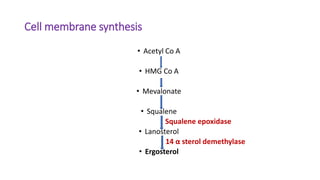
Cell membrane synthesis
• Acetyl Co A
• HMG Co A
• Mevalonate
• Squalene
Squalene epoxidase
• Lanosterol
14 α sterol demethylase
• Ergosterol
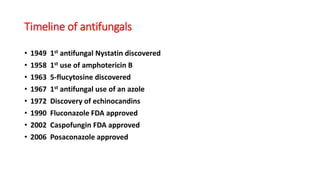
Timeline of antifungals
• 1949 1st antifungal Nystatin discovered
• 1958 1st use of amphotericin B
• 1963 5-flucytosine discovered
• 1967 1st antifungal use of an azole
• 1972 Discovery of echinocandins
• 1990 Fluconazole FDA approved
• 2002 Caspofungin FDA approved
• 2006 Posaconazole approved
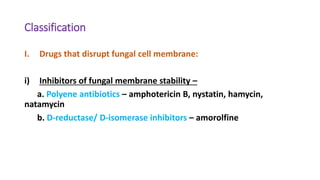
Classification
I. Drugs that disrupt fungal cell membrane:
i) Inhibitors of fungal membrane stability –
a. Polyene antibiotics – amphotericin B, nystatin, hamycin,
natamycin
b. D-reductase/ D-isomerase inhibitors – amorolfine
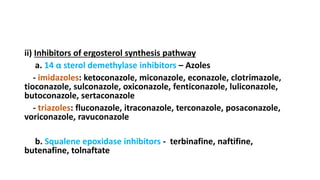
ii) Inhibitors of ergosterol synthesis pathway
a. 14 α sterol demethylase inhibitors – Azoles
- imidazoles: ketoconazole, miconazole, econazole, clotrimazole,
tioconazole, sulconazole, oxiconazole, fenticonazole, luliconazole,
butoconazole, sertaconazole
- triazoles: fluconazole, itraconazole, terconazole, posaconazole,
voriconazole, ravuconazole
b. Squalene epoxidase inhibitors - terbinafine, naftifine,
butenafine, tolnaftate
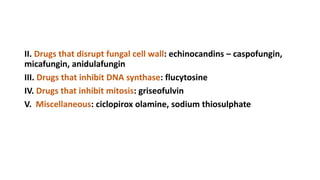
II. Drugs that disrupt fungal cell wall: echinocandins – caspofungin,
micafungin, anidulafungin
III. Drugs that inhibit DNA synthase: flucytosine
IV. Drugs that inhibit mitosis: griseofulvin
V. Miscellaneous: ciclopirox olamine, sodium thiosulphate
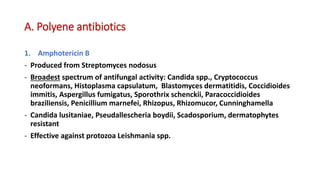
A. Polyene antibiotics
1. Amphotericin B
- Produced from Streptomyces nodosus
- Broadest spectrum of antifungal activity: Candida spp., Cryptococcus
neoformans, Histoplasma capsulatum, Blastomyces dermatitidis, Coccidioides
immitis, Aspergillus fumigatus, Sporothrix schenckii, Paracoccidioides
braziliensis, Penicillium marnefei, Rhizopus, Rhizomucor, Cunninghamella
- Candida lusitaniae, Pseudallescheria boydii, Scadosporium, dermatophytes
resistant
- Effective against protozoa Leishmania spp.
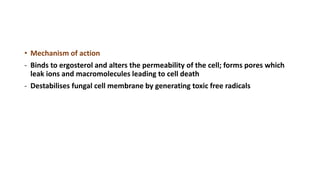
• Mechanism of action
- Binds to ergosterol and alters the permeability of the cell; forms pores which
leak ions and macromolecules leading to cell death
- Destabilises fungal cell membrane by generating toxic free radicals
Pharmacokinetics
- Poorly absorbed – oral AMB used for luminal infections
- For systemic use - complexed with sodium deoxycholate (ABCD for iv) or as
liposomes
- Highly ppb
- t ½ 15 days
- CSF penetration poor
- Crosses placenta
- Excreted slowly via kidneys
Adverse effects
• Immediate (cytokine storm): due to release of TNF α /IL-1; fever, chills, muscle
spasms, headache, vomiting, hypotension, thrombophlebitis
- Decrease rate or pre treat with NSAIDs/ hydrocortisone
• Delayed: renal damage (80%), hypokalemia, anaemia, thrombocytopenia
Indications
• DOC for life-threatening mycotic infections – aspergillosis, coccidioidomycosis,
blastomycosis, mucormycosis, histoplasmosis, sporotrichosis
• With flucytosine in cryptococcal meningitis
Dose
• 50-100 mg qid
• 0.3 mg/kg iv
• 3-6 mg/kg/day liposomal
2. Nystatin
• Named after New York Health State Laboratory
• Produced from Streptomyces noursei or albidus
• Similar to AMB
• Too toxic for parenteral use
• Use topically for superficial candidiasis of mouth, oesophagus, skin, vagina
3. Hamycin
• Indian discovery- Thirumalachar, Menon, Bhate from Streptomyces pimprina at
Hindustan Antibiotics, Pimpri, Pune
• Similar to nystatin
• Used topically for superficial candidiasis of mouth, skin, vagina
B. Azoles
Mechanism of action
• Inhibit ergosterol synthesis by selective inhibition of 14 α sterol demethylase
• Primarily fungistatic
• Imidazoles more toxic systemically; used topically except ketoconazole
• Triazoles less toxic, used systemically
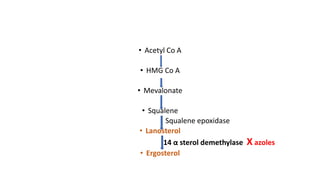
• Acetyl Co A
• HMG Co A
• Mevalonate
• Squalene
Squalene epoxidase
• Lanosterol
14 α sterol demethylase X azoles
• Ergosterol
Systemic azoles
1. Ketoconazole
Spectrum of activity
• Broad spectrum- C albicans, H capsulatum, B dermatitidis, C immitis, Malassezia
furfur, dermatophytes
Pharmacokinetics
• Well absorbed orally – salt formation in acidic pH
• Food increases, antacids decrease absorption
• t ½ 7-10 hrs, highly ppb
• CSF concentration low, secreted in breast milk
• Hepatic elimination; biliary excretion
Adverse effects
• N, V, giddiness, photophobia common
• Decreases human gonadal steroid synthesis – decreases testosterone causing
decrease in libido, oligozoospermia, impotence, menstrual irregularities,
gynaecomastia
• Hepatotoxicity rare 1-2%
• Teratogenic in animals- CI in pregnancy and lactation
Drug interactions
• Antacids, H2 blockers, PPI, sucralfate decrease absorption
• Inhibits metabolism of oral anticoagulants, phenytoin, cyclosporine
• Can cause disulfiram-like reaction with alcohol
Indications
• Coccidioidomycosis, blastomycosis, histoplasmosis, candidiasis – 200 mg bd
after meals
• Seborrheic dermatitis – 2% shampoo twice weekly for 2-4 weeks
• Pityriasis versicolor – 2% ointment od for 5 days
• Dermatophytosis
2. Fluconazole
Spectrum of activity
• Broad spectrum- Candida, H capsulatum, Cryptococcus, C immitis
Pharmacokinetics
• Almost 100% bioavailability, not affected by food or pH
• Good CSF penetration
• t ½ 30 hrs
• 80% excreted unchanged in urine, 10% unchanged in faeces
Adverse effects
• Widest TI of azoles
• N, headache, abdominal pain in 10%
• Reversible alopecia
• Rash, hepatic necrosis, SJ Syndrome, neutropenia rare; esp in HIV pts
Drug interactions
• Inhibits metabolism of oral anticoagulants, phenytoin, amitriptyline (mild)
• Effect of fluconazole decreased by carbamazepine, INH
Indications
• DOC for coccidioidal meningitis, histoplasmosis
• Azole of choice for cryptococcal meningitis
• Systemic candidiasis (150 mg weekly for 4 weeks), vulvovaginal candidiasis
(150 mg SD)
3. Itraconazole
Spectrum of activity
• Candida, Histoplasma capsulatum, Blastomyces dermatitidis, Coccidioides
immitis, Aspergillus fumigatus, Sporothrix schenckii, Pseudallescheria boydii,
Malassezia furfur, dermatophytes, agents of chromoblastomycosis
Pharmacokinetics
• Absorption increased by food, low pH
• Highly ppb
• Active hydroxy itraconazole has 50% activity
• t ½ 24-42 hrs
• Poor entry in CSF, urine
Adverse effects
• N, V, hypertriglyceridaemia, hypokalemia, pedal oedema
• Rarely CHF, arrhythmias, peripheral neuropathy
Drug interactions
• H2 blockers, antacids, PPI decrease absorption
• Interacts with many drugs and decreases the metabolism of H1 antagonists,
warfarin, cyclosporin, tacrolimus, digoxin, lovastatin, methylprednisolone,
glibenclamide , phenytoin, saquinavir and nortriptyline.
Indications
• Dermatophytosis, onychomycosis, oropharyngeal / cutaneous / vaginal
candidiasis, coccidioidomycosis, histoplasmosis, aspergillosis,
pseudallescheriasis, pityriasis versicolor
• Azole of choice in blastomycosis, sporotrichosis, chromoblastomycosis (with
flucytosine)
Dose
• For superficial mycosis: 100 mg daily for 15 days
• For deep mycosis: 600-800 mg daily for 3 days ; 200-400 mg daily for 6-12
months
4. Voriconazole
• Spectrum similar to itraconazole
• Fatty food decreases bioavailability
• CSF entry good
• t½ 6-24 hrs
• ADRs include visual disturbances (colour changes imm after dose),
hepatotoxicity, rash; photosensitivity, dermatitis (on chronic use)
• Azole of choice in invasive aspergillosis
• Indicated in candidiasis (inc C krusei), histoplasmosis, blastomycosis, fusariosis,
pseudallescheriasis and infection by Scadosporium apiospermum
• Dose: 400 mg daily on empty stomach
5. Posaconazole
• Broadest spectrum among azoles; activity against zygomycetes and mucoralis sp
• High fatty meals increase absorption
• Rapid tissue distribution
• t½ 20-65 hrs
• ADRs include GIT disturbances, abnormal LFTs, headache
• Indicated in invasive aspergillosis, zygomycosis, mucormycosis
• Used for prophylaxis during induction chemo for leukaemia or bone marrow
transplant pts
• Dose: 400 mg bd/ 200 mg qid
Topical azoles
• Cause direct damage to fungal cytoplasmic membrane
• <1% absorbed systemically , 4% absorbed through damaged skin
• Rarely cause itching, burning
• Indicated in cutaneous candidiasis, vaginal candidiasis, fungal keratitis,
dermatophytosis, seborrheic dermatitis and pityriasis versicolor
• Not useful in onychomycosis, tinea capitis, sporotrichosis and chromomycosis
Squalene epoxidase inhibitors
1. Terbinafine
• Mainly effective against Trichophyton rubrum /mentagrophytes, Candida
• Gets concentrated in cornea, nail plates and hair
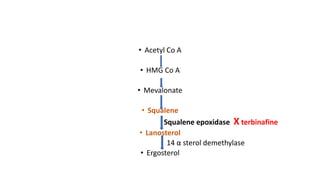
• Inhibits squalene epoxidase thus causing accumulation of toxic squalene
• 50-70% bioavailability
• t ½ 300 hrs
• CI in pregnancy and lactation
• ADRs include GIT disturbances, taste disturbances, hepatitis, rash, dizziness,
pancytopenia
• DOC in dermatophytosis; used in onychomycosis, sporotrichosis
• Dose: 250 mg od for 2-4 weeks; 3 months (finger nails), 6 months (toe nails);
1% cream
• Acetyl Co A
• HMG Co A
• Mevalonate
• Squalene
Squalene epoxidase X terbinafine
• Lanosterol
14 α sterol demethylase
• Ergosterol
2. Naftifine
Similar to terbinafine, but only topical for dermatophytosis
3. Butenafine
Topical like naftifine , also effective against M furfur
Griseofulvin
• Narrow spectrum fungistatic antibiotic from Penicillium griseofulvum
• Interacts with microtubules and interferes with mitosis of dermatophytes
• t ½ 24 hrs
• ADRs include GIT upsets, rash, fever; headache (15 %), exacerbated by alcohol
• Indicated in superficial dermatophytosis- 125-250 mg qid
Flucytosine
• Useful activity against C neoformans and agents of chromoblastomycosis
• Never used alone – resistance
• ADRs include anaemia, leucopenia, thrombocytopenia, toxic enterocolitis, N,V,D
• Indications:
- Cryptococcosis (with AMB)
- Chromoblastomycosis (with itraconazole)
Echinocandins
• Inhibit β-(1,3)-D-glucan synthase, preventing formation of β-glucan, a main
component of cell wall
• Effective against Candida, aspergillus (static), histoplasma
• ADRs include N, V, fever, venous thrombophlebitis, flushing
• Indicated in invasive refractory aspergillosis, candida oesophagitis, candidemia
• Cyclopirox olamine- tinea infections, pityriasis versicolor, vaginal candidiasis,
onychomycosis (8% laquer)
• Sodium thiosulphate- only against M furfur
THANK YOU

Antifungals NURSING.pptx

  • 1.
  • 2.
    Cell membrane synthesis •Acetyl Co A • HMG Co A • Mevalonate • Squalene Squalene epoxidase • Lanosterol 14 α sterol demethylase • Ergosterol
  • 3.
    Timeline of antifungals •1949 1st antifungal Nystatin discovered • 1958 1st use of amphotericin B • 1963 5-flucytosine discovered • 1967 1st antifungal use of an azole • 1972 Discovery of echinocandins • 1990 Fluconazole FDA approved • 2002 Caspofungin FDA approved • 2006 Posaconazole approved
  • 4.
    Classification I. Drugs thatdisrupt fungal cell membrane: i) Inhibitors of fungal membrane stability – a. Polyene antibiotics – amphotericin B, nystatin, hamycin, natamycin b. D-reductase/ D-isomerase inhibitors – amorolfine
  • 5.
    ii) Inhibitors ofergosterol synthesis pathway a. 14 α sterol demethylase inhibitors – Azoles - imidazoles: ketoconazole, miconazole, econazole, clotrimazole, tioconazole, sulconazole, oxiconazole, fenticonazole, luliconazole, butoconazole, sertaconazole - triazoles: fluconazole, itraconazole, terconazole, posaconazole, voriconazole, ravuconazole b. Squalene epoxidase inhibitors - terbinafine, naftifine, butenafine, tolnaftate
  • 6.
    II. Drugs thatdisrupt fungal cell wall: echinocandins – caspofungin, micafungin, anidulafungin III. Drugs that inhibit DNA synthase: flucytosine IV. Drugs that inhibit mitosis: griseofulvin V. Miscellaneous: ciclopirox olamine, sodium thiosulphate
  • 7.
    A. Polyene antibiotics 1.Amphotericin B - Produced from Streptomyces nodosus - Broadest spectrum of antifungal activity: Candida spp., Cryptococcus neoformans, Histoplasma capsulatum, Blastomyces dermatitidis, Coccidioides immitis, Aspergillus fumigatus, Sporothrix schenckii, Paracoccidioides braziliensis, Penicillium marnefei, Rhizopus, Rhizomucor, Cunninghamella - Candida lusitaniae, Pseudallescheria boydii, Scadosporium, dermatophytes resistant - Effective against protozoa Leishmania spp.
  • 8.
    • Mechanism ofaction - Binds to ergosterol and alters the permeability of the cell; forms pores which leak ions and macromolecules leading to cell death - Destabilises fungal cell membrane by generating toxic free radicals
  • 9.
    Pharmacokinetics - Poorly absorbed– oral AMB used for luminal infections - For systemic use - complexed with sodium deoxycholate (ABCD for iv) or as liposomes - Highly ppb - t ½ 15 days - CSF penetration poor - Crosses placenta - Excreted slowly via kidneys
  • 10.
    Adverse effects • Immediate(cytokine storm): due to release of TNF α /IL-1; fever, chills, muscle spasms, headache, vomiting, hypotension, thrombophlebitis - Decrease rate or pre treat with NSAIDs/ hydrocortisone • Delayed: renal damage (80%), hypokalemia, anaemia, thrombocytopenia
  • 11.
    Indications • DOC forlife-threatening mycotic infections – aspergillosis, coccidioidomycosis, blastomycosis, mucormycosis, histoplasmosis, sporotrichosis • With flucytosine in cryptococcal meningitis Dose • 50-100 mg qid • 0.3 mg/kg iv • 3-6 mg/kg/day liposomal
  • 12.
    2. Nystatin • Namedafter New York Health State Laboratory • Produced from Streptomyces noursei or albidus • Similar to AMB • Too toxic for parenteral use • Use topically for superficial candidiasis of mouth, oesophagus, skin, vagina
  • 13.
    3. Hamycin • Indiandiscovery- Thirumalachar, Menon, Bhate from Streptomyces pimprina at Hindustan Antibiotics, Pimpri, Pune • Similar to nystatin • Used topically for superficial candidiasis of mouth, skin, vagina
  • 14.
    B. Azoles Mechanism ofaction • Inhibit ergosterol synthesis by selective inhibition of 14 α sterol demethylase • Primarily fungistatic • Imidazoles more toxic systemically; used topically except ketoconazole • Triazoles less toxic, used systemically
  • 15.
    • Acetyl CoA • HMG Co A • Mevalonate • Squalene Squalene epoxidase • Lanosterol 14 α sterol demethylase X azoles • Ergosterol
  • 16.
    Systemic azoles 1. Ketoconazole Spectrumof activity • Broad spectrum- C albicans, H capsulatum, B dermatitidis, C immitis, Malassezia furfur, dermatophytes Pharmacokinetics • Well absorbed orally – salt formation in acidic pH • Food increases, antacids decrease absorption • t ½ 7-10 hrs, highly ppb • CSF concentration low, secreted in breast milk • Hepatic elimination; biliary excretion
  • 17.
    Adverse effects • N,V, giddiness, photophobia common • Decreases human gonadal steroid synthesis – decreases testosterone causing decrease in libido, oligozoospermia, impotence, menstrual irregularities, gynaecomastia • Hepatotoxicity rare 1-2% • Teratogenic in animals- CI in pregnancy and lactation
  • 18.
    Drug interactions • Antacids,H2 blockers, PPI, sucralfate decrease absorption • Inhibits metabolism of oral anticoagulants, phenytoin, cyclosporine • Can cause disulfiram-like reaction with alcohol
  • 19.
    Indications • Coccidioidomycosis, blastomycosis,histoplasmosis, candidiasis – 200 mg bd after meals • Seborrheic dermatitis – 2% shampoo twice weekly for 2-4 weeks • Pityriasis versicolor – 2% ointment od for 5 days • Dermatophytosis
  • 20.
    2. Fluconazole Spectrum ofactivity • Broad spectrum- Candida, H capsulatum, Cryptococcus, C immitis Pharmacokinetics • Almost 100% bioavailability, not affected by food or pH • Good CSF penetration • t ½ 30 hrs • 80% excreted unchanged in urine, 10% unchanged in faeces
  • 21.
    Adverse effects • WidestTI of azoles • N, headache, abdominal pain in 10% • Reversible alopecia • Rash, hepatic necrosis, SJ Syndrome, neutropenia rare; esp in HIV pts
  • 22.
    Drug interactions • Inhibitsmetabolism of oral anticoagulants, phenytoin, amitriptyline (mild) • Effect of fluconazole decreased by carbamazepine, INH Indications • DOC for coccidioidal meningitis, histoplasmosis • Azole of choice for cryptococcal meningitis • Systemic candidiasis (150 mg weekly for 4 weeks), vulvovaginal candidiasis (150 mg SD)
  • 23.
    3. Itraconazole Spectrum ofactivity • Candida, Histoplasma capsulatum, Blastomyces dermatitidis, Coccidioides immitis, Aspergillus fumigatus, Sporothrix schenckii, Pseudallescheria boydii, Malassezia furfur, dermatophytes, agents of chromoblastomycosis
  • 24.
    Pharmacokinetics • Absorption increasedby food, low pH • Highly ppb • Active hydroxy itraconazole has 50% activity • t ½ 24-42 hrs • Poor entry in CSF, urine
  • 25.
    Adverse effects • N,V, hypertriglyceridaemia, hypokalemia, pedal oedema • Rarely CHF, arrhythmias, peripheral neuropathy Drug interactions • H2 blockers, antacids, PPI decrease absorption • Interacts with many drugs and decreases the metabolism of H1 antagonists, warfarin, cyclosporin, tacrolimus, digoxin, lovastatin, methylprednisolone, glibenclamide , phenytoin, saquinavir and nortriptyline.
  • 26.
    Indications • Dermatophytosis, onychomycosis,oropharyngeal / cutaneous / vaginal candidiasis, coccidioidomycosis, histoplasmosis, aspergillosis, pseudallescheriasis, pityriasis versicolor • Azole of choice in blastomycosis, sporotrichosis, chromoblastomycosis (with flucytosine) Dose • For superficial mycosis: 100 mg daily for 15 days • For deep mycosis: 600-800 mg daily for 3 days ; 200-400 mg daily for 6-12 months
  • 27.
    4. Voriconazole • Spectrumsimilar to itraconazole • Fatty food decreases bioavailability • CSF entry good • t½ 6-24 hrs • ADRs include visual disturbances (colour changes imm after dose), hepatotoxicity, rash; photosensitivity, dermatitis (on chronic use) • Azole of choice in invasive aspergillosis • Indicated in candidiasis (inc C krusei), histoplasmosis, blastomycosis, fusariosis, pseudallescheriasis and infection by Scadosporium apiospermum • Dose: 400 mg daily on empty stomach
  • 28.
    5. Posaconazole • Broadestspectrum among azoles; activity against zygomycetes and mucoralis sp • High fatty meals increase absorption • Rapid tissue distribution • t½ 20-65 hrs • ADRs include GIT disturbances, abnormal LFTs, headache • Indicated in invasive aspergillosis, zygomycosis, mucormycosis • Used for prophylaxis during induction chemo for leukaemia or bone marrow transplant pts • Dose: 400 mg bd/ 200 mg qid
  • 29.
    Topical azoles • Causedirect damage to fungal cytoplasmic membrane • <1% absorbed systemically , 4% absorbed through damaged skin • Rarely cause itching, burning • Indicated in cutaneous candidiasis, vaginal candidiasis, fungal keratitis, dermatophytosis, seborrheic dermatitis and pityriasis versicolor • Not useful in onychomycosis, tinea capitis, sporotrichosis and chromomycosis
  • 30.
    Squalene epoxidase inhibitors 1.Terbinafine • Mainly effective against Trichophyton rubrum /mentagrophytes, Candida • Gets concentrated in cornea, nail plates and hair • Inhibits squalene epoxidase thus causing accumulation of toxic squalene • 50-70% bioavailability • t ½ 300 hrs • CI in pregnancy and lactation • ADRs include GIT disturbances, taste disturbances, hepatitis, rash, dizziness, pancytopenia • DOC in dermatophytosis; used in onychomycosis, sporotrichosis • Dose: 250 mg od for 2-4 weeks; 3 months (finger nails), 6 months (toe nails); 1% cream
  • 31.
    • Acetyl CoA • HMG Co A • Mevalonate • Squalene Squalene epoxidase X terbinafine • Lanosterol 14 α sterol demethylase • Ergosterol
  • 32.
    2. Naftifine Similar toterbinafine, but only topical for dermatophytosis 3. Butenafine Topical like naftifine , also effective against M furfur
  • 33.
    Griseofulvin • Narrow spectrumfungistatic antibiotic from Penicillium griseofulvum • Interacts with microtubules and interferes with mitosis of dermatophytes • t ½ 24 hrs • ADRs include GIT upsets, rash, fever; headache (15 %), exacerbated by alcohol • Indicated in superficial dermatophytosis- 125-250 mg qid
  • 34.
    Flucytosine • Useful activityagainst C neoformans and agents of chromoblastomycosis • Never used alone – resistance • ADRs include anaemia, leucopenia, thrombocytopenia, toxic enterocolitis, N,V,D • Indications: - Cryptococcosis (with AMB) - Chromoblastomycosis (with itraconazole)
  • 35.
    Echinocandins • Inhibit β-(1,3)-D-glucansynthase, preventing formation of β-glucan, a main component of cell wall • Effective against Candida, aspergillus (static), histoplasma • ADRs include N, V, fever, venous thrombophlebitis, flushing • Indicated in invasive refractory aspergillosis, candida oesophagitis, candidemia
  • 36.
    • Cyclopirox olamine-tinea infections, pityriasis versicolor, vaginal candidiasis, onychomycosis (8% laquer) • Sodium thiosulphate- only against M furfur
  • 37.