Dr. RAGHU PRASADA M S
MBBS,MD
ASSISTANT PROFESSOR
DEPT. OF PHARMACOLOGY
SSIMS & RC.
1
Muscarinic Agonists
Natural Alkaloids:
Muscarine
Pilocarpine
Arecholine
Synthetic Alkaloid:
Oxotramorine
Mainly Nicotinic Agonists
Natural Alkaloids:
Nicotine
Synthetic Alkaloids:
Dimethylphenylpiperazinium(DMPP)
Reversible
Tertiary amines
Physostigmine
Quaternary Ammonium compounds
Neostigmine
Pyridostigmine
Distigmine
Ambenonium
Demecarium
Tacrine
Miscelloneous Donepezil
Galantamine
Rivastigmine
Irreversible Anticholinesterases
(Organophosphorus Compounds)
Ecothiophate
2) War Gases:
Sarin
Tuban,
Soman
3) Insecticides:-
Parathion
Malathion
Diisopropyl Flurophosphate (DFP)
Tetramethyl Pyrophosphate (TMPP)
Octamethyl Pyrophosphotetra amide (OMPA)
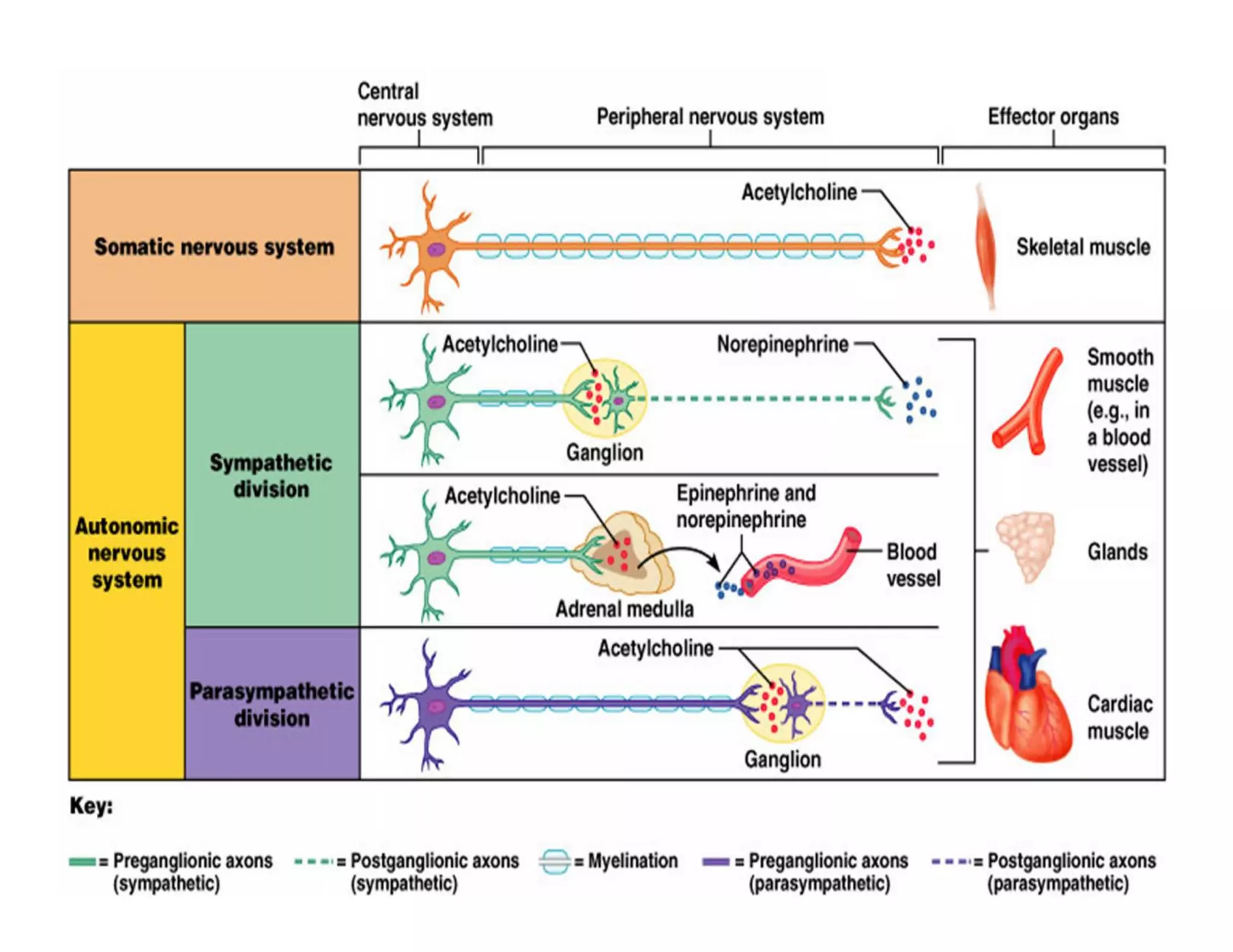
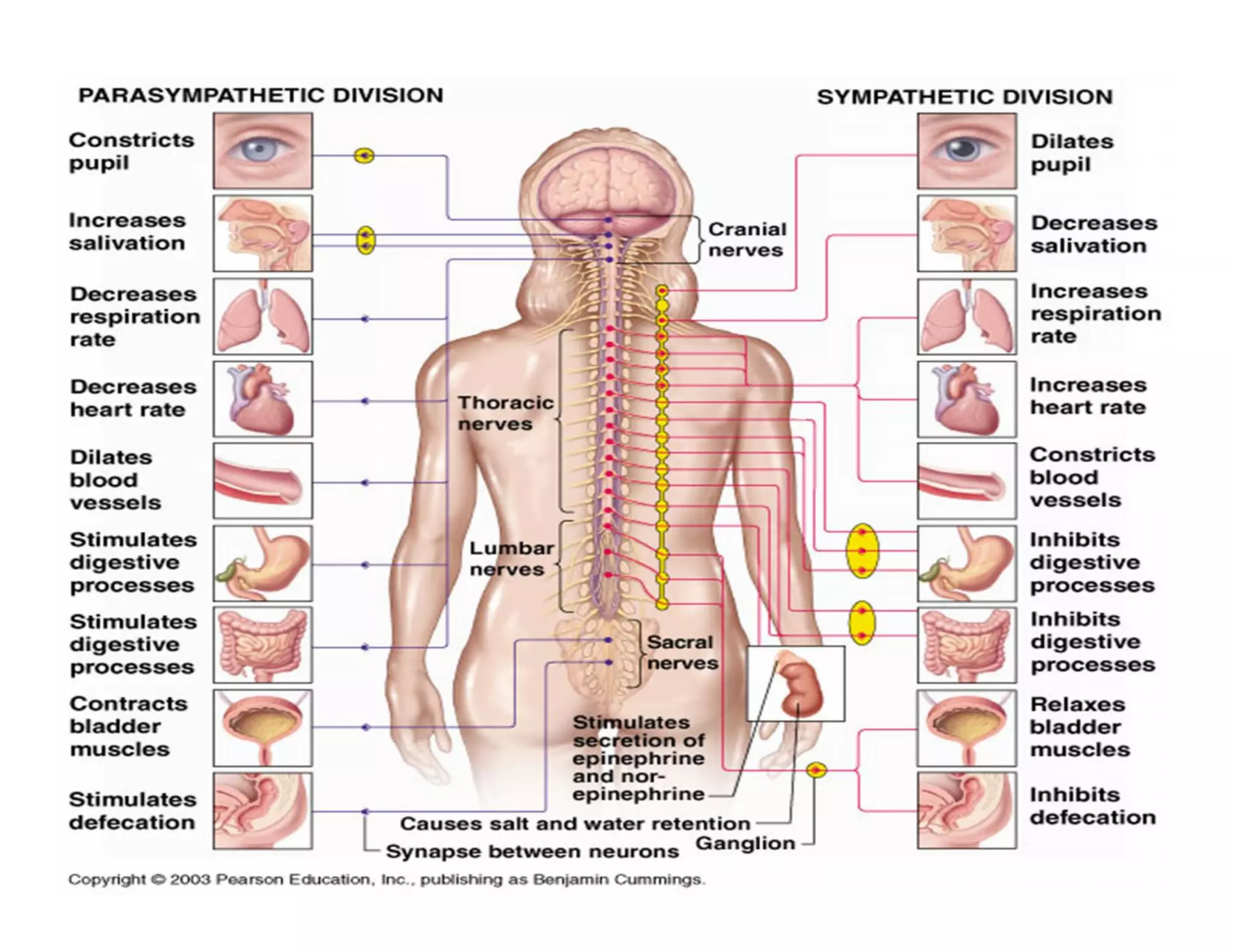
 Central Nervous System (CNS) - Brain and spinal
cord
 Peripheral Nervous System (PNS) - Located outside
the brain & spinal cord Autonomic Nervous
System (ANS) & the somatic
 The PNS receives stimuli from the CNS & initiates
responses to the stimuli after it’s interpreted by the
brain
HEMICHOLIUM
VESAMICOL
BOTULINUM
Sites of Cholinergic Activity
-Preganglionic synapses of both sympathetic and parasympathetic ganglia
- Parasympathetic postganglionic neuroeffector junctions
- All somatic motor end plates on skeletal muscles
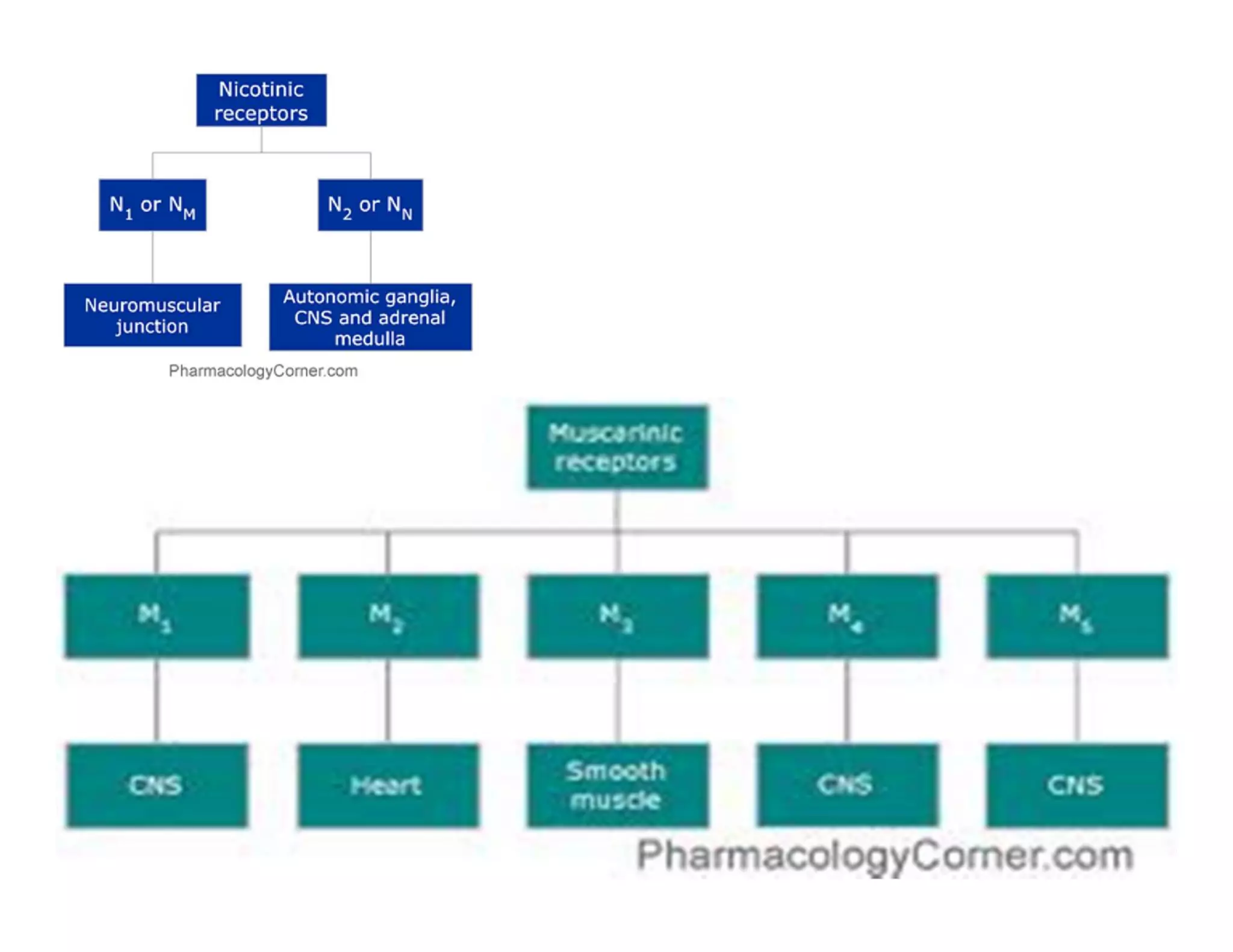
M2 M4 M5M3M1
Gi Go
Adenylyl cyclase
cAMP
Hyperpolarization (heart)
Cardiac inhibition
Antagonism of smooth
muscle relaxation
RECEPTOR
INTRACELLULAR
TRANSDUCER
ELECTRICAL
MECHANICAL
PHYSIOLOGICAL
RESPONSES
Gq
Phospholipase C
Diacyl-glycerol IP3
Depolarization
Smooth muscle contraction
Glandular secretion
Eyes: contraction of ciliary muscle and smooth muscle of the iris
sphincter (miosis) – aqueous humor outflow, drainage of the
anterior chamber
Cardiovascular: Bradycardia (possibly preceded by tachycardia),
vasodilation (all vascular beds including pulmonary and
coronary – M3) and hypotension, reduction of the
contraction strength (atrial and ventricular cells) diastolic
depolarization ,
Negative chronotropic effect (inhibition of adrenergic activation)
Negetive ionotropic effect-activation of SA node M2 receptor
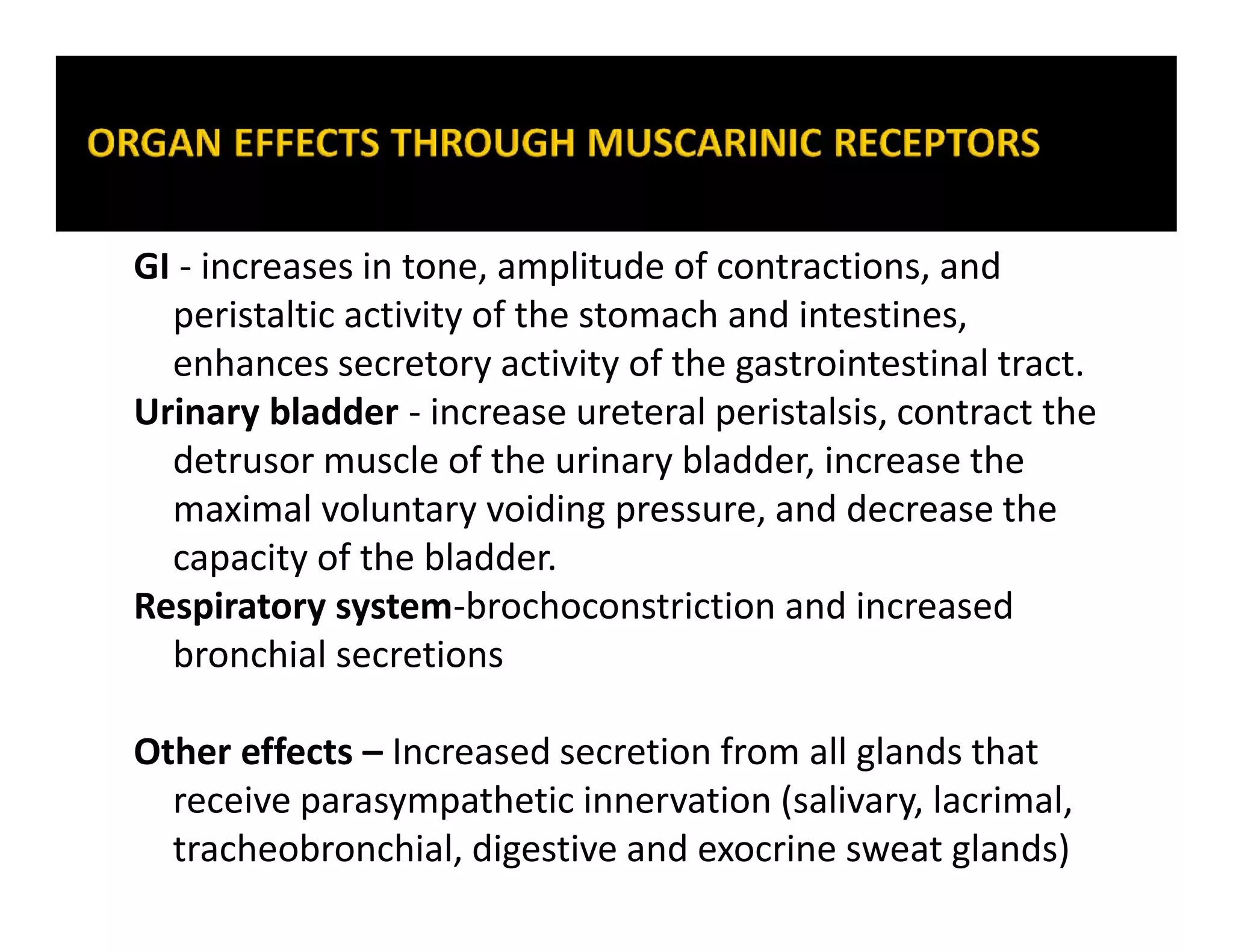
GI - increases in tone, amplitude of contractions, and
peristaltic activity of the stomach and intestines,
enhances secretory activity of the gastrointestinal tract.
Urinary bladder - increase ureteral peristalsis, contract the
detrusor muscle of the urinary bladder, increase the
maximal voluntary voiding pressure, and decrease the
capacity of the bladder.
Respiratory system-brochoconstriction and increased
bronchial secretions
Other effects – Increased secretion from all glands that
receive parasympathetic innervation (salivary, lacrimal,
tracheobronchial, digestive and exocrine sweat glands)
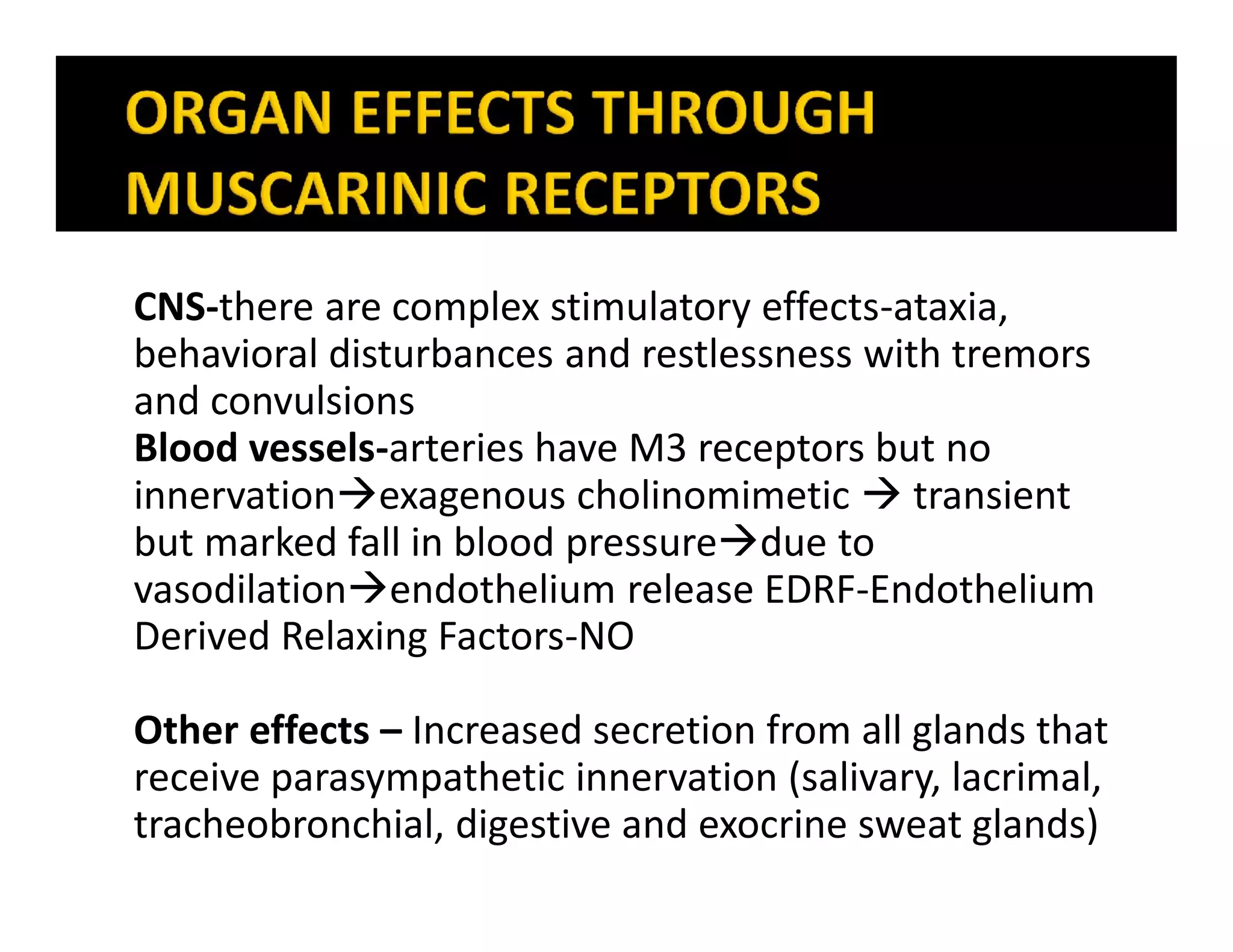
CNS-there are complex stimulatory effects-ataxia,
behavioral disturbances and restlessness with tremors
and convulsions
Blood vessels-arteries have M3 receptors but no
innervationexagenous cholinomimetic  transient
but marked fall in blood pressuredue to
vasodilationendothelium release EDRF-Endothelium
Derived Relaxing Factors-NO
Other effects – Increased secretion from all glands that
receive parasympathetic innervation (salivary, lacrimal,
tracheobronchial, digestive and exocrine sweat glands)
 Homotropic receptor interaction
 Heterotropic receptor interaction
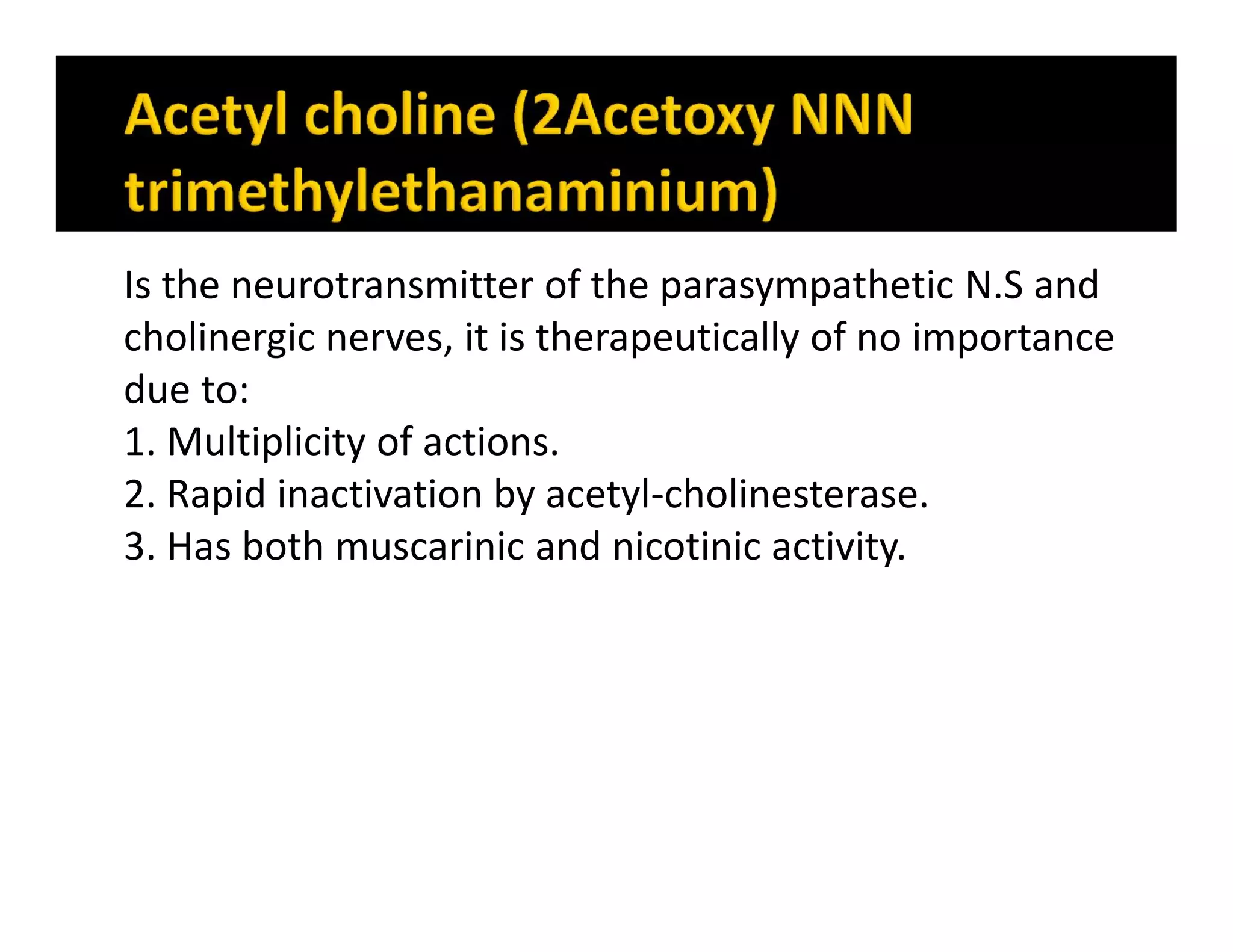
Is the neurotransmitter of the parasympathetic N.S and
cholinergic nerves, it is therapeutically of no importance
due to:
1. Multiplicity of actions.
2. Rapid inactivation by acetyl-cholinesterase.
3. Has both muscarinic and nicotinic activity.
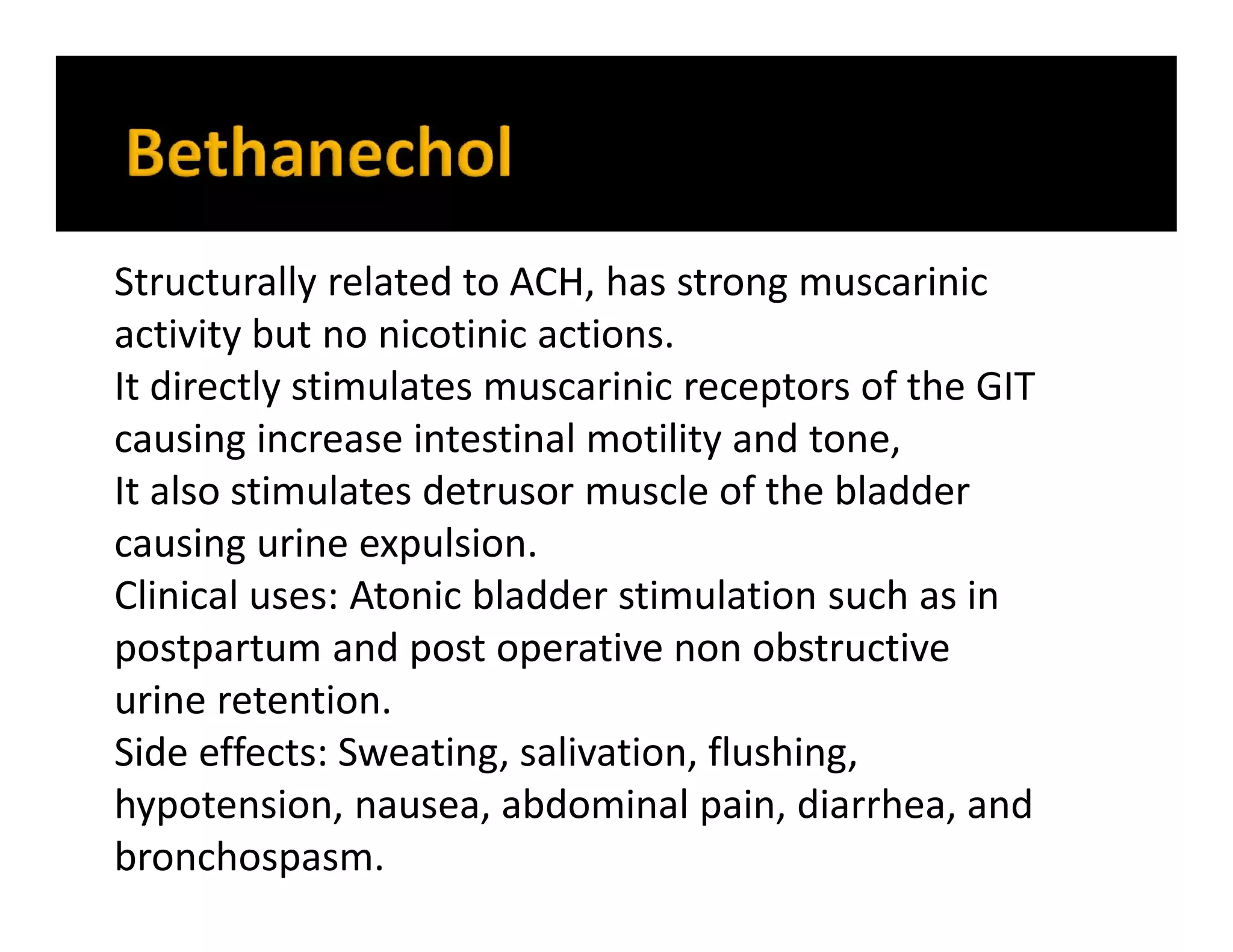
Structurally related to ACH, has strong muscarinic
activity but no nicotinic actions.
It directly stimulates muscarinic receptors of the GIT
causing increase intestinal motility and tone,
It also stimulates detrusor muscle of the bladder
causing urine expulsion.
Clinical uses: Atonic bladder stimulation such as in
postpartum and post operative non obstructive
urine retention.
Side effects: Sweating, salivation, flushing,
hypotension, nausea, abdominal pain, diarrhea, and
bronchospasm.
Has both muscarinic and nicotinic actions, has
strong effect on CVS and GIT, it causes release of
epinephrine from adrenal medulla by its nicotinic
action, using it locally on the eye cause Miosis.
Clinical uses: Rarely used because of high potency
and long duration of action except in the eye to
cause Miosis and to decrease intraocular pressure.
Mainly used in ophthalmology, it exhibit muscarinic
activity, it produces rapid miosis and contraction of the
ciliary muscle.
Clinical uses; It is the drug of choice in the emergency
lowering of inrtra-ocular pressure in case of glaucoma.
Side effects:
It can enter the brain and cause CNS disturbances, it
stimulate profuse sweating and salivation.
painful spasm of accommodation for near vision.
- sol. 1%, 2%, 4%
- in open angle glаucoma
Applied to the eye, it
penetrates cornea and
promptly causes
miosis, ciliary muscle contra-
ction, and fall in intraoccular
tension (< 22 mm) lasting 4-8 h.
Systemic effects:
sweating, salivation
Cardiovascular effects: in small doses – fall in BP, but in high
doses elicits rise in BP and tachycardia, probably due to
ganglionic stimulation (through muscarinic receptors
50
100
150
200
A B C D1 min
M- и N-effects of ACh
Bloodpressure[mmHg]
ACh
2 mcg i.v.
ACh
50 mcg
ACh
50 mcg
ACh
5 mg
M-
effect
M-
effect
N-
effect
Atropine
2 mg i.v.
Class cholinergic drugs

Class cholinergic drugs

  • 1.
    Dr. RAGHU PRASADAM S MBBS,MD ASSISTANT PROFESSOR DEPT. OF PHARMACOLOGY SSIMS & RC. 1
  • 2.
    Muscarinic Agonists Natural Alkaloids: Muscarine Pilocarpine Arecholine SyntheticAlkaloid: Oxotramorine Mainly Nicotinic Agonists Natural Alkaloids: Nicotine Synthetic Alkaloids: Dimethylphenylpiperazinium(DMPP)
  • 3.
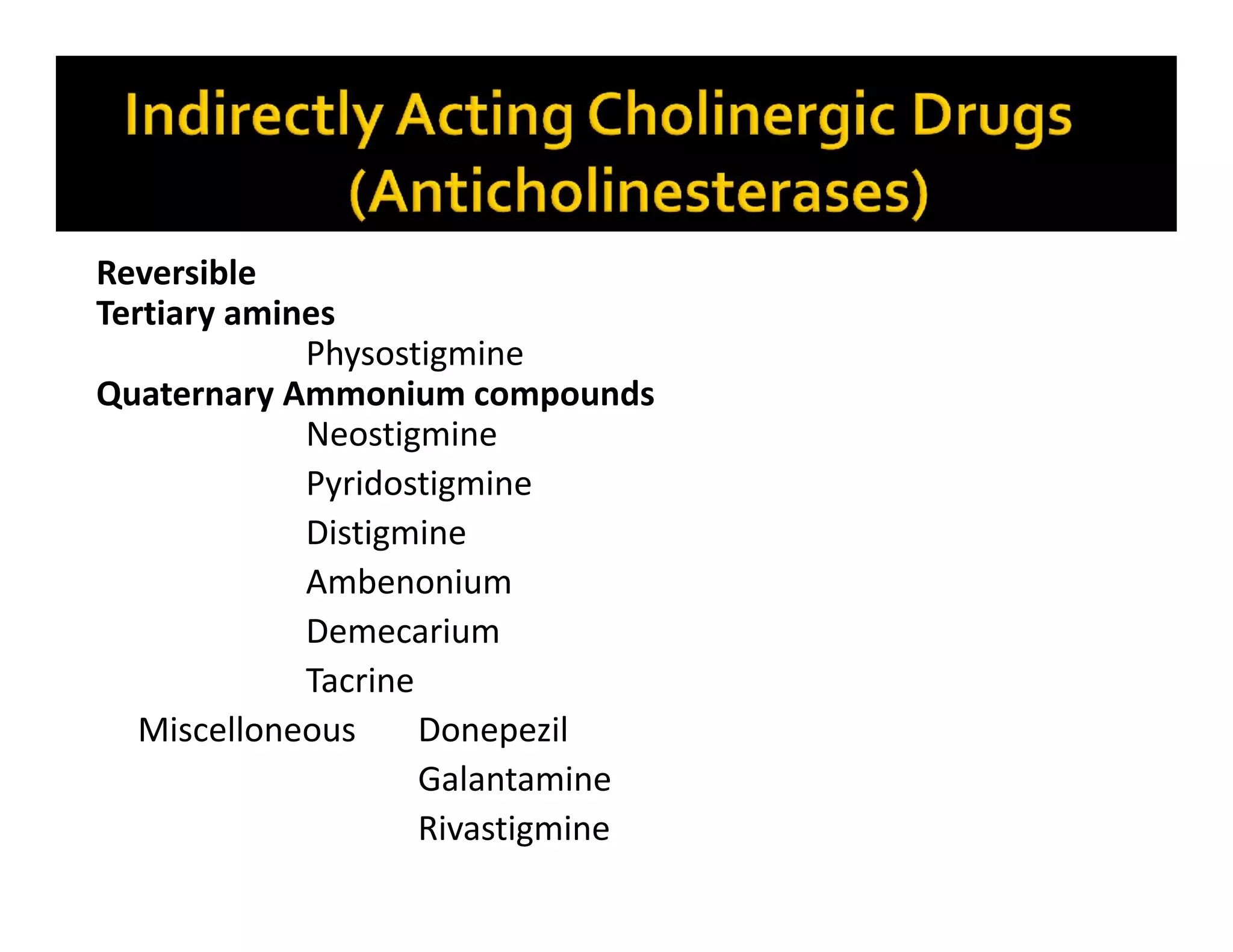
    Reversible Tertiary amines Physostigmine Quaternary Ammoniumcompounds Neostigmine Pyridostigmine Distigmine Ambenonium Demecarium Tacrine Miscelloneous Donepezil Galantamine Rivastigmine
  • 4.
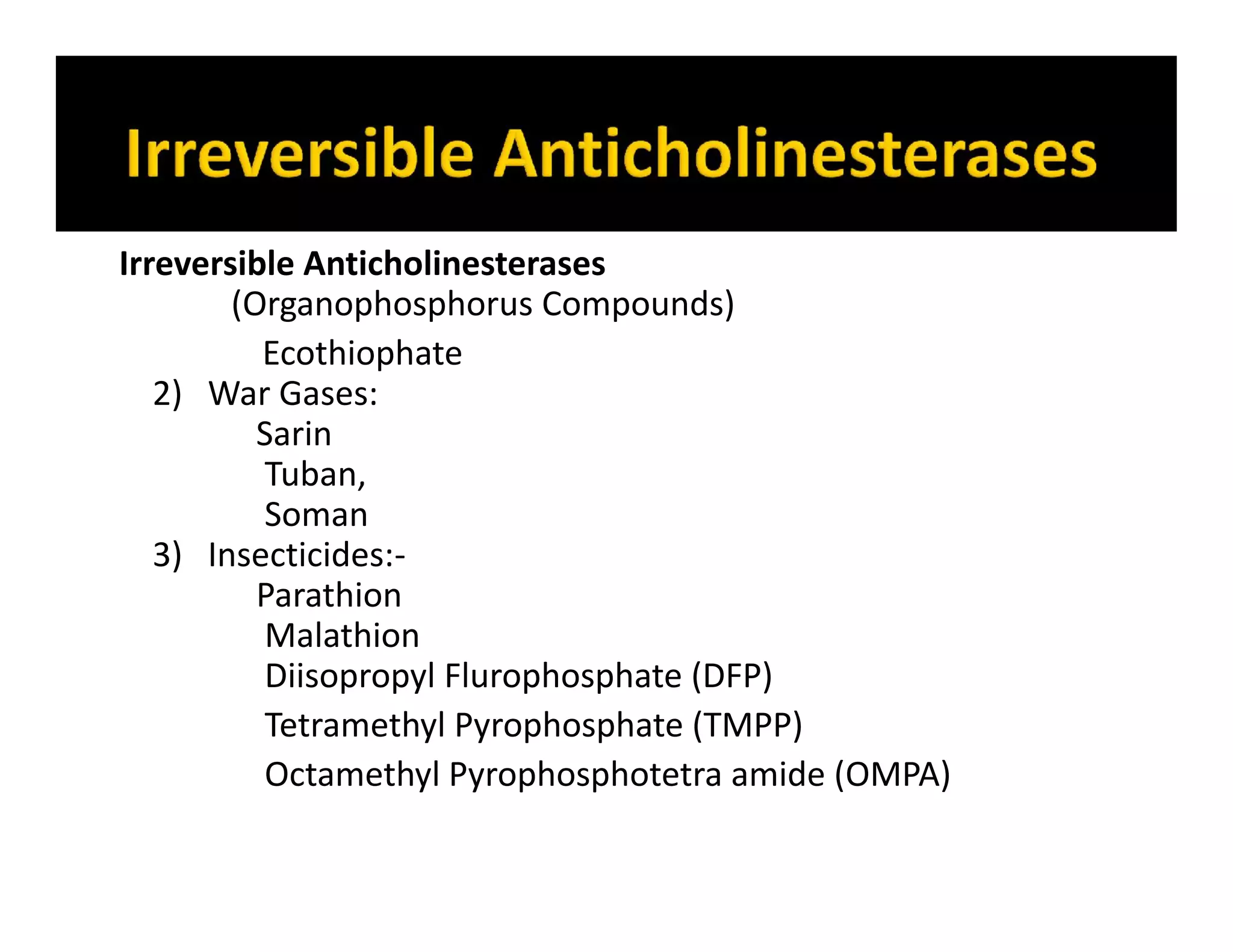
    Irreversible Anticholinesterases (Organophosphorus Compounds) Ecothiophate 2)War Gases: Sarin Tuban, Soman 3) Insecticides:- Parathion Malathion Diisopropyl Flurophosphate (DFP) Tetramethyl Pyrophosphate (TMPP) Octamethyl Pyrophosphotetra amide (OMPA)
  • 6.
     Central NervousSystem (CNS) - Brain and spinal cord  Peripheral Nervous System (PNS) - Located outside the brain & spinal cord Autonomic Nervous System (ANS) & the somatic  The PNS receives stimuli from the CNS & initiates responses to the stimuli after it’s interpreted by the brain
  • 10.
  • 14.
    Sites of CholinergicActivity -Preganglionic synapses of both sympathetic and parasympathetic ganglia - Parasympathetic postganglionic neuroeffector junctions - All somatic motor end plates on skeletal muscles M2 M4 M5M3M1 Gi Go Adenylyl cyclase cAMP Hyperpolarization (heart) Cardiac inhibition Antagonism of smooth muscle relaxation RECEPTOR INTRACELLULAR TRANSDUCER ELECTRICAL MECHANICAL PHYSIOLOGICAL RESPONSES Gq Phospholipase C Diacyl-glycerol IP3 Depolarization Smooth muscle contraction Glandular secretion
  • 15.
    Eyes: contraction ofciliary muscle and smooth muscle of the iris sphincter (miosis) – aqueous humor outflow, drainage of the anterior chamber Cardiovascular: Bradycardia (possibly preceded by tachycardia), vasodilation (all vascular beds including pulmonary and coronary – M3) and hypotension, reduction of the contraction strength (atrial and ventricular cells) diastolic depolarization , Negative chronotropic effect (inhibition of adrenergic activation) Negetive ionotropic effect-activation of SA node M2 receptor
  • 16.
    GI - increasesin tone, amplitude of contractions, and peristaltic activity of the stomach and intestines, enhances secretory activity of the gastrointestinal tract. Urinary bladder - increase ureteral peristalsis, contract the detrusor muscle of the urinary bladder, increase the maximal voluntary voiding pressure, and decrease the capacity of the bladder. Respiratory system-brochoconstriction and increased bronchial secretions Other effects – Increased secretion from all glands that receive parasympathetic innervation (salivary, lacrimal, tracheobronchial, digestive and exocrine sweat glands)
  • 17.
    CNS-there are complexstimulatory effects-ataxia, behavioral disturbances and restlessness with tremors and convulsions Blood vessels-arteries have M3 receptors but no innervationexagenous cholinomimetic  transient but marked fall in blood pressuredue to vasodilationendothelium release EDRF-Endothelium Derived Relaxing Factors-NO Other effects – Increased secretion from all glands that receive parasympathetic innervation (salivary, lacrimal, tracheobronchial, digestive and exocrine sweat glands)
  • 18.
     Homotropic receptorinteraction  Heterotropic receptor interaction
  • 19.
    Is the neurotransmitterof the parasympathetic N.S and cholinergic nerves, it is therapeutically of no importance due to: 1. Multiplicity of actions. 2. Rapid inactivation by acetyl-cholinesterase. 3. Has both muscarinic and nicotinic activity.
  • 20.
    Structurally related toACH, has strong muscarinic activity but no nicotinic actions. It directly stimulates muscarinic receptors of the GIT causing increase intestinal motility and tone, It also stimulates detrusor muscle of the bladder causing urine expulsion. Clinical uses: Atonic bladder stimulation such as in postpartum and post operative non obstructive urine retention. Side effects: Sweating, salivation, flushing, hypotension, nausea, abdominal pain, diarrhea, and bronchospasm.
  • 21.
    Has both muscarinicand nicotinic actions, has strong effect on CVS and GIT, it causes release of epinephrine from adrenal medulla by its nicotinic action, using it locally on the eye cause Miosis. Clinical uses: Rarely used because of high potency and long duration of action except in the eye to cause Miosis and to decrease intraocular pressure.
  • 22.
    Mainly used inophthalmology, it exhibit muscarinic activity, it produces rapid miosis and contraction of the ciliary muscle. Clinical uses; It is the drug of choice in the emergency lowering of inrtra-ocular pressure in case of glaucoma. Side effects: It can enter the brain and cause CNS disturbances, it stimulate profuse sweating and salivation. painful spasm of accommodation for near vision.
  • 23.
    - sol. 1%,2%, 4% - in open angle glаucoma Applied to the eye, it penetrates cornea and promptly causes miosis, ciliary muscle contra- ction, and fall in intraoccular tension (< 22 mm) lasting 4-8 h. Systemic effects: sweating, salivation Cardiovascular effects: in small doses – fall in BP, but in high doses elicits rise in BP and tachycardia, probably due to ganglionic stimulation (through muscarinic receptors
  • 25.
    50 100 150 200 A B CD1 min M- и N-effects of ACh Bloodpressure[mmHg] ACh 2 mcg i.v. ACh 50 mcg ACh 50 mcg ACh 5 mg M- effect M- effect N- effect Atropine 2 mg i.v.