OPIOIDANALGESICS
DR. ARCHANA DHAVALSHANKH
PRO & HEAD, DEPT OF PHARMACOLOGY
D Y PATIL MEDICAL COLLEGE, KOLHAPUR
OPIOID ANALGESICS
Analgesics are the drugs which selectively relieves pain by
acting in the CNS or on peripheral pain mechanisms, without
significantly altering the consciousness.
Opioids and NSAIDS(Non-opioids)
Opioids: any drug which binds to the opioid receptors
(pharmacologically related) in the CNS and antagonized by
naloxone
OPIOID ANALGESICS-
Terminology
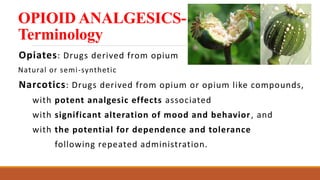
Opiates: Drugs derived from opium
Natural or semi-synthetic
Narcotics: Drugs derived from opium or opium like compounds,
with potent analgesic effects associated
with significant alteration of mood and behavior, and
with the potential for dependence and tolerance
following repeated administration.
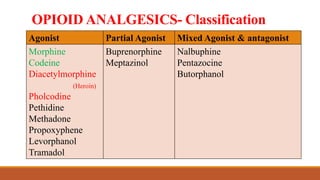
OPIOID ANALGESICS- Classification
Agonist Partial Agonist Mixed Agonist & antagonist
Morphine
Codeine
Diacetylmorphine
(Heroin)
Pholcodine
Pethidine
Methadone
Propoxyphene
Levorphanol
Tramadol
Buprenorphine
Meptazinol
Nalbuphine
Pentazocine
Butorphanol
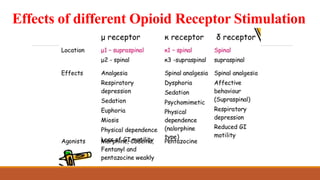
Effects of different Opioid Receptor Stimulation
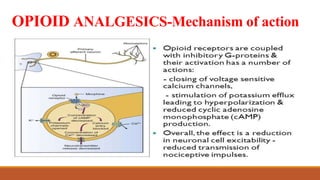
OPIOID ANALGESICS-Mechanism of action
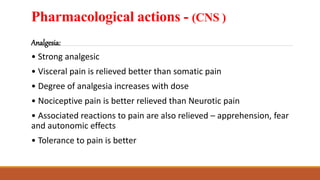
Pharmacological actions - (CNS )
Analgesia:
• Strong analgesic
• Visceral pain is relieved better than somatic pain
• Degree of analgesia increases with dose
• Nociceptive pain is better relieved than Neurotic pain
• Associated reactions to pain are also relieved – apprehension, fear
and autonomic effects
• Tolerance to pain is better
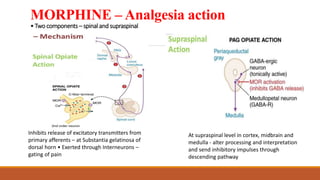
MORPHINE – Analgesia action
• Two components – spinal and supraspinal
Inhibits release of excitatory transmitters from
primary afferents – at Substantia gelatinosa of
dorsal horn • Exerted through Interneurons –
gating of pain
At supraspinal level in cortex, midbrain and
medulla - alter processing and interpretation
and send inhibitory impulses through
descending pathway
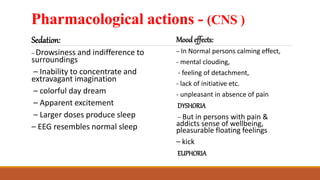
Pharmacological actions - (CNS )
Sedation:
– Drowsiness and indifference to
surroundings
– Inability to concentrate and
extravagant imagination
– colorful day dream
– Apparent excitement
– Larger doses produce sleep
– EEG resembles normal sleep
Mood effects:
– In Normal persons calming effect,
- mental clouding,
- feeling of detachment,
- lack of initiative etc.
- unpleasant in absence of pain
DYSHORIA
– But in persons with pain &
addicts sense of wellbeing,
pleasurable floating feelings
– kick
EUPHORIA
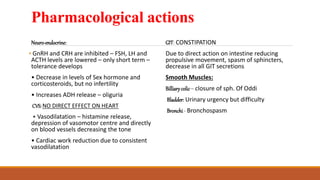
Pharmacological actions
Neuro-endocrine:
• GnRH and CRH are inhibited – FSH, LH and
ACTH levels are lowered – only short term –
tolerance develops
• Decrease in levels of Sex hormone and
corticosteroids, but no infertility
• Increases ADH release – oliguria
CVS:NO DIRECT EFFECT ON HEART
• Vasodilatation – histamine release,
depression of vasomotor centre and directly
on blood vessels decreasing the tone
• Cardiac work reduction due to consistent
vasodilatation
GIT: CONSTIPATION
Due to direct action on intestine reducing
propulsive movement, spasm of sphincters,
decrease in all GIT secretions
Smooth Muscles:
Billiarycolic– closure of sph. Of Oddi
Bladder: Urinary urgency but difficulty
Bronchi- Bronchospasm
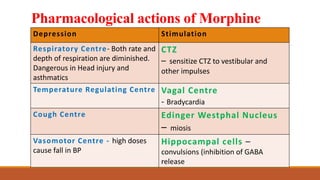
Pharmacological actions of Morphine
Depression Stimulation
Respiratory Centre- Both rate and
depth of respiration are diminished.
Dangerous in Head injury and
asthmatics
CTZ
– sensitize CTZ to vestibular and
other impulses
Temperature Regulating Centre Vagal Centre
- Bradycardia
Cough Centre Edinger Westphal Nucleus
– miosis
Vasomotor Centre - high doses
cause fall in BP
Hippocampal cells –
convulsions (inhibition of GABA
release
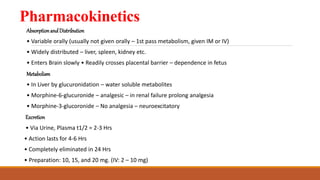
Pharmacokinetics
AbsorptionandDistribution
• Variable orally (usually not given orally – 1st pass metabolism, given IM or IV)
• Widely distributed – liver, spleen, kidney etc.
• Enters Brain slowly • Readily crosses placental barrier – dependence in fetus
Metabolism
• In Liver by glucuronidation – water soluble metabolites
• Morphine-6-glucuronide – analgesic – in renal failure prolong analgesia
• Morphine-3-glucoronide – No analgesia – neuroexcitatory
Excretion
• Via Urine, Plasma t1/2 = 2-3 Hrs
• Action lasts for 4-6 Hrs
• Completely eliminated in 24 Hrs
• Preparation: 10, 15, and 20 mg. (IV: 2 – 10 mg)
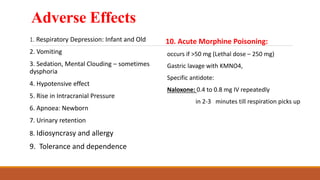
Adverse Effects
1. Respiratory Depression: Infant and Old
2. Vomiting
3. Sedation, Mental Clouding – sometimes
dysphoria
4. Hypotensive effect
5. Rise in Intracranial Pressure
6. Apnoea: Newborn
7. Urinary retention
8. Idiosyncrasy and allergy
9. Tolerance and dependence
10. Acute Morphine Poisoning:
occurs if >50 mg (Lethal dose – 250 mg)
Gastric lavage with KMNO4,
Specific antidote:
Naloxone: 0.4 to 0.8 mg IV repeatedly
in 2-3 minutes till respiration picks up
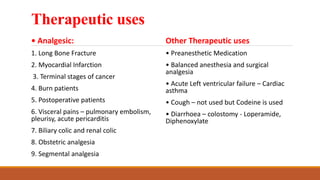
Therapeutic uses
• Analgesic:
1. Long Bone Fracture
2. Myocardial Infarction
3. Terminal stages of cancer
4. Burn patients
5. Postoperative patients
6. Visceral pains – pulmonary embolism,
pleurisy, acute pericarditis
7. Biliary colic and renal colic
8. Obstetric analgesia
9. Segmental analgesia
Other Therapeutic uses
• Preanesthetic Medication
• Balanced anesthesia and surgical
analgesia
• Acute Left ventricular failure – Cardiac
asthma
• Cough – not used but Codeine is used
• Diarrhoea – colostomy - Loperamide,
Diphenoxylate
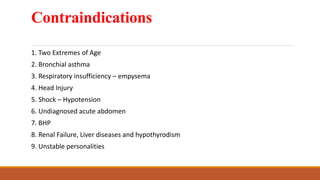
Contraindications
1. Two Extremes of Age
2. Bronchial asthma
3. Respiratory insufficiency – empysema
4. Head Injury
5. Shock – Hypotension
6. Undiagnosed acute abdomen
7. BHP
8. Renal Failure, Liver diseases and hypothyrodism
9. Unstable personalities
THANK YOU

Opioids

  • 1.
    OPIOIDANALGESICS DR. ARCHANA DHAVALSHANKH PRO& HEAD, DEPT OF PHARMACOLOGY D Y PATIL MEDICAL COLLEGE, KOLHAPUR
  • 2.
    OPIOID ANALGESICS Analgesics arethe drugs which selectively relieves pain by acting in the CNS or on peripheral pain mechanisms, without significantly altering the consciousness. Opioids and NSAIDS(Non-opioids) Opioids: any drug which binds to the opioid receptors (pharmacologically related) in the CNS and antagonized by naloxone
  • 3.
    OPIOID ANALGESICS- Terminology Opiates: Drugsderived from opium Natural or semi-synthetic Narcotics: Drugs derived from opium or opium like compounds, with potent analgesic effects associated with significant alteration of mood and behavior, and with the potential for dependence and tolerance following repeated administration.
  • 4.
    OPIOID ANALGESICS- Classification AgonistPartial Agonist Mixed Agonist & antagonist Morphine Codeine Diacetylmorphine (Heroin) Pholcodine Pethidine Methadone Propoxyphene Levorphanol Tramadol Buprenorphine Meptazinol Nalbuphine Pentazocine Butorphanol
  • 5.
    Effects of differentOpioid Receptor Stimulation
  • 6.
  • 7.
    Pharmacological actions -(CNS ) Analgesia: • Strong analgesic • Visceral pain is relieved better than somatic pain • Degree of analgesia increases with dose • Nociceptive pain is better relieved than Neurotic pain • Associated reactions to pain are also relieved – apprehension, fear and autonomic effects • Tolerance to pain is better
  • 8.
    MORPHINE – Analgesiaaction • Two components – spinal and supraspinal Inhibits release of excitatory transmitters from primary afferents – at Substantia gelatinosa of dorsal horn • Exerted through Interneurons – gating of pain At supraspinal level in cortex, midbrain and medulla - alter processing and interpretation and send inhibitory impulses through descending pathway
  • 9.
    Pharmacological actions -(CNS ) Sedation: – Drowsiness and indifference to surroundings – Inability to concentrate and extravagant imagination – colorful day dream – Apparent excitement – Larger doses produce sleep – EEG resembles normal sleep Mood effects: – In Normal persons calming effect, - mental clouding, - feeling of detachment, - lack of initiative etc. - unpleasant in absence of pain DYSHORIA – But in persons with pain & addicts sense of wellbeing, pleasurable floating feelings – kick EUPHORIA
  • 10.
    Pharmacological actions Neuro-endocrine: • GnRHand CRH are inhibited – FSH, LH and ACTH levels are lowered – only short term – tolerance develops • Decrease in levels of Sex hormone and corticosteroids, but no infertility • Increases ADH release – oliguria CVS:NO DIRECT EFFECT ON HEART • Vasodilatation – histamine release, depression of vasomotor centre and directly on blood vessels decreasing the tone • Cardiac work reduction due to consistent vasodilatation GIT: CONSTIPATION Due to direct action on intestine reducing propulsive movement, spasm of sphincters, decrease in all GIT secretions Smooth Muscles: Billiarycolic– closure of sph. Of Oddi Bladder: Urinary urgency but difficulty Bronchi- Bronchospasm
  • 11.
    Pharmacological actions ofMorphine Depression Stimulation Respiratory Centre- Both rate and depth of respiration are diminished. Dangerous in Head injury and asthmatics CTZ – sensitize CTZ to vestibular and other impulses Temperature Regulating Centre Vagal Centre - Bradycardia Cough Centre Edinger Westphal Nucleus – miosis Vasomotor Centre - high doses cause fall in BP Hippocampal cells – convulsions (inhibition of GABA release
  • 12.
    Pharmacokinetics AbsorptionandDistribution • Variable orally(usually not given orally – 1st pass metabolism, given IM or IV) • Widely distributed – liver, spleen, kidney etc. • Enters Brain slowly • Readily crosses placental barrier – dependence in fetus Metabolism • In Liver by glucuronidation – water soluble metabolites • Morphine-6-glucuronide – analgesic – in renal failure prolong analgesia • Morphine-3-glucoronide – No analgesia – neuroexcitatory Excretion • Via Urine, Plasma t1/2 = 2-3 Hrs • Action lasts for 4-6 Hrs • Completely eliminated in 24 Hrs • Preparation: 10, 15, and 20 mg. (IV: 2 – 10 mg)
  • 13.
    Adverse Effects 1. RespiratoryDepression: Infant and Old 2. Vomiting 3. Sedation, Mental Clouding – sometimes dysphoria 4. Hypotensive effect 5. Rise in Intracranial Pressure 6. Apnoea: Newborn 7. Urinary retention 8. Idiosyncrasy and allergy 9. Tolerance and dependence 10. Acute Morphine Poisoning: occurs if >50 mg (Lethal dose – 250 mg) Gastric lavage with KMNO4, Specific antidote: Naloxone: 0.4 to 0.8 mg IV repeatedly in 2-3 minutes till respiration picks up
  • 14.
    Therapeutic uses • Analgesic: 1.Long Bone Fracture 2. Myocardial Infarction 3. Terminal stages of cancer 4. Burn patients 5. Postoperative patients 6. Visceral pains – pulmonary embolism, pleurisy, acute pericarditis 7. Biliary colic and renal colic 8. Obstetric analgesia 9. Segmental analgesia Other Therapeutic uses • Preanesthetic Medication • Balanced anesthesia and surgical analgesia • Acute Left ventricular failure – Cardiac asthma • Cough – not used but Codeine is used • Diarrhoea – colostomy - Loperamide, Diphenoxylate
  • 15.
    Contraindications 1. Two Extremesof Age 2. Bronchial asthma 3. Respiratory insufficiency – empysema 4. Head Injury 5. Shock – Hypotension 6. Undiagnosed acute abdomen 7. BHP 8. Renal Failure, Liver diseases and hypothyrodism 9. Unstable personalities
  • 16.