AARTHRITIS AND AANALGESICS
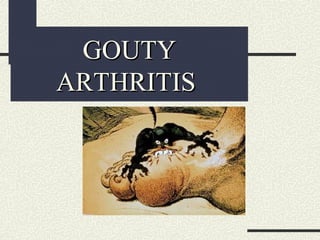
GOUTYGOUTY
ARTHRITISARTHRITIS
Gouty arthritis
A systemic disease caused by deposition
of uric acid crystals in the joint and body
tissues
ETIOLOGY
Primary
 Innate defect of purine metabolism or uric acid
excretion
 HYPERURICEMIA
 Overproduction (10%, >800mg/dL)
 Impaired renal clearance (90%, <600mg/dL)
 HGPRT (Hypoxanthine Guanine
phosphoribosyltransferase) deficiency
 PRPP (Phosphoribosyl – 1 pyrophosphate) excess
ETILOGY
Secondary
 Hematological causes
 CRF
 Drug – induced
 ASA and Salicylates (<2g/day)
 Cytotoxic drugs
 Diuretics (except spironolactone)
 Ethambutol and Nicotinic acid
 Cyclosporine, INH, L – dopa
 Ethanol
 Miscellaneous disorders
INCIDENCE
Higher in men (95%)
Onset is at 47 y/o
Marked by >7mg/dL serum uric acid
Genetic predisposition (10 – 60%)
Risk factors
 Obesity
 Heavy alcoholics
Gouty arthritis
ASSESSMENT FINDINGS
1. Severe pain in the involved joints,
initially the big toe
2. Swelling and inflammation of the joint
3. TOPHI- yellowish-whitish, irregular
deposits in the skin that break open and
reveal a gritty appearance
4. PODAGRA-big toe
Gouty arthritis
ASSESSMENT FINDINGS
5. Fever, malaise
6. Body weakness and headache
7. Renal stones
Gouty arthritis
DIAGNOSTIC TEST
Elevated levels of uric acid in the blood
(+) monosodium urate crystals
Dramatic response to colchicine
INOSINIC
ACID
HYPOXANTHINE
XANTHINE
URIC
ACID
XANTHIN
E
OXIDASE
XANTHIN
E
OXIDASE
ALLANTOIN URATE
OXIDASE
METABOLISM PATHWAYMETABOLISM PATHWAY
PATHOPHYSIOLOGY
MONOSODIUM
URATE CRYSTALS
INFLAMMATION
TOPH
ICOMPLICATIONS
•ACUTE TUBULAR OBSTRUCTION
•UROLITHIASIS
•CHRONIC URATE NEPHROPATHY
ACUTE GOUTY ARTHRITIS
 Differentials
 Pseudogout (Ca pyrophosphate dihydrate crystals)
 Septic arthritis
TREATMENT
 1. Colchicine
 Initiate within 12 – 36 hrs after attack
 DOC for ACUTE attack
 MOA: impairs leukocyte migration and disrupts
urate deposition and subsequent inflammation
- S/E: GI toxicity, BM toxicity
THERAPY FOR ACUTE GOUT
COLCHICINE
 PO
 1mg  0.5 q 2hrs  relief/ GIT discomfort
 Total : 8mg
 IV NEVER
GIVEN
IM OR
SQ!
2. Indomethacin
as effective as colchicine but less GI
toxicity
S/E: GI ulcer and bleeding
headache and dizziness (unique)
other NSAIDs are also effective
3. Corticosteroids
- for resistant patients
THERAPY FOR ACUTE GOUT
CORTICOSTEROIDS
 Intra – articular injections (Methylprednisolone
acetate)
 Systemic corticosteroid therapy
 C/I NSAIDS, colchicine
 Oral prednisone
 IM corticotropin
 IM Triamcinolone acetonide
 IV methylprednisolone
Taper
dose!
Prophylactic Therapy/Chronic
gout
1. Allopurinol (Zyloprim)
- xanthine analog
- xanthine oxidase inhibitor
- major metabolite: oxypurinol
- indicated for patients with renal failure,
leukemias
-S/E: rash, leucopenia, GI toxicity,
acute gouty attack with initiation
2. Uricosurics
- probenecid, sulfinpyrazone
- inh. renal tubular reabsorption of uric acid
- maintain adequate urine flow, alkalinize
urine with NaHCO3
-S/E: GI irritation, rash, acute gout,
renal stones
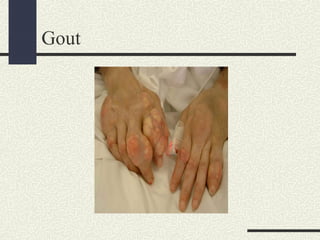
Gout
Gout
NONDRUG
 Avoid purines!
 Control weight
 Avoid alcohol
Goodbye meat,
organ meats,
seafood, beans,
peas,
asparagus…
CHRONIC TOPACEOUS
GOUT
May remain
undetected and
untreated for years
Development of tophi
in pinna of external
ear
Allopurinol and
probenecid
OSTEOARTHRITISOSTEOARTHRITIS
DEFINITION and ETIOLOGY
OSTEOARTHRITIS (OA)
 “Degenerative Joint Disease”
 Chronic cartilage degeneration
 Most common form of arthritis
 >55 y/o, M = F, F> M if > 55y/o
AGING
∀↓ tendon, ligament,
muscle strength
∀↓ chondrocytes
∀↓ proteoglycan
production
AGING
∀↓ tendon, ligament,
muscle strength
∀↓ chondrocytes
∀↓ proteoglycan
production
CHONDROCYTES
∀↓ healing and remodelling
 cartilage matrix
degeneration
∀↓ proteoglycans
CHONDROCYTES
∀↓ healing and remodelling
 cartilage matrix
degeneration
∀↓ proteoglycans
↑ IL – 1 and
Proinflammatory cytokines
↑ IL – 1 and
Proinflammatory cytokines
PAIN
Osteophytes
Synovitis
Bursitis
Tendonitis
PAIN
Osteophytes
Synovitis
Bursitis
Tendonitis
RISK FACTORS
Advanced age
Female gender 
Muscle weakness
Obesity
Joint trauma
Heredity
Congenital defects
Repetitive stress
SIGNS AND SYMPTOMS
Deep, localized joint pain with rest or
immobility
Lasts < 30 minutes
Mild inflammation
Crepitus upon joint movement
DIAGNOSIS
Physical examination
 Joint tenderness, diminished motion range,
crepitus, abnormalities in joint shape
Radiography
 Narrowing of joint space
 (+) Osteophytes
TREATMENT
NONDRUG
 Weight reduction
 Aerobic exercises and physical therapy
 Devices
 Avoid prolonged standing, kneeling, and
squatting
 Thermal therapy
Pharmacologic:
1. Acetaminophen
- first-line drug for pain in OA
- dose: 325-650 mg 4x daily
S/E: hepatotoxicity
2. NSAIDS
3. Capsaicin
- extract of red peppers
- MOA: release and depletion of substance
P from nerve fibers
-S/E: burning at site of application
4. Glucosamine and chondroitin dietary
supplements
- shown to alleviate pain, slows down loss
of cartilage
5. Corticosteroids
- systemic steroids not recommended
- intraarticular steroids for local
inflammation
6. Hyaluronate injection (Na hyaluronate,
hylan G-F 20)
- reported to decrease pain
7. Narcotic analgesics
- for unresponsive patients and those with
contraindications to acetaminophen or
NSAIDs
RHEUMATOIDRHEUMATOID
ARTHRITISARTHRITIS
PATHOPHYSIOLOGY
TNF -
a
TNF -
a IL - 1IL - 1
IL - 6IL - 6
GFGF
INFLAMME
D
SYNOVIUM
INFLAMME
D
SYNOVIUM
PANNUSPANNUS
PROTEOLYTIC
ENZYMES
CARTILAGE
DEGRADATION
CARTILAGE
DEGRADATION
BONE
DEMINERALIZATION
BONE
DEMINERALIZATION
OSTEOCLAST
ACTIVATION
PROGNOSIS
High RF titer
Elevated ESR
> 20 joints
Early age onset
Extra – articular involvement
Rheumatoid arthritis
A type of chronic systemic inflammatory
arthritis and connective tissue disorder
affecting more women (ages 35-45) than
men
TREATMENT : NONDRUG
Joint protection
Exercises
Rest
PT and OT
Support groups
First-line
1. Methotrexate
- MOA: DHF reductase inhibitor; inhibits
cytokine production and purine synthesis
- relatively rapid onset (2 to 3 weeks)
- S/E: GI (stomatitis, nausea, vomiting,
diarrhea),
hematologic (leukopenia,
thrombocytopenia),
pulmonary (fibrosis, pneumonitis),
hepatic (elevated enzymes, cirrhosis)
Teratogenic
leucovorin
2. Leflunomide (Arava)
- inhibits pyrimidine synthesis
- S/E: liver toxicity, teratogenic
3. Hydroxychloroquine
Inhibit NA synthesis
- S/E: diarrhea, blurring of vision, rash
4. Sulfasalazine
- S/E: rash, leukopenia
Less frequently used
1. Gold preparations
- aurothioglucose (suspension in oil), gold
sodium thiomalate (aqueous solution)- IM
- auranofin- oral but less effective than IM
Taken up by macrophages,supressing
phagocytosis,then lysosomal activity
S/E: GI (nausea, vomiting, diarrhea),
derma (rash, stomatitis), renal (proteinuria),
hematologic (anemia, leukopenia)
dimercaprol
2. Azathioprine
- purine analog converted to 6-
mercaptopurine which inhibits DNA and
RNA synthesis
-S/E: bone marrow suppression,
hepatotoxicity, oncogenic
3. Penicillamine
Analog of AA cysteine
-S/E: rash, metallic taste, hypogeusia
(blunting of taste),stomatitis, proteinuria
4. Cyclosporine
- decreases production of cytokines
- S/E: hypertension, hyperglycemia,
nephrotoxicity, tremor, GI intolerance,
hirsutism, gingival hyperplasia
Biologic agents
1. Etanercept (Enbrel)
- TNF receptor; binds to and inactivates TNF
2. Infliximab (Remicade)
- anti-TNF antibody
- combination with MTX is superior than MTX
alone
- S/E: infections
3. Adalimumab (Humira)
- anti-TNF antibody
- S/E: local injection site reaction, infection
4. Anakinra (Kineret)
- IL-1 receptor antagonist
Treatment
1.NSAIDS
Analgesic and anti-inflammatory but does
not slow disease progression
2.Disease-modifying anti-rheumatic drugs
(DMARDs)
Started within the first 3 months of
symptom onset
SUCCESS is to have made aSUCCESS is to have made a
life breathe easier becauselife breathe easier because
you have livedyou have lived.

Arthritis

  • 1.
  • 2.
  • 3.
    Gouty arthritis A systemicdisease caused by deposition of uric acid crystals in the joint and body tissues
  • 4.
    ETIOLOGY Primary  Innate defectof purine metabolism or uric acid excretion  HYPERURICEMIA  Overproduction (10%, >800mg/dL)  Impaired renal clearance (90%, <600mg/dL)  HGPRT (Hypoxanthine Guanine phosphoribosyltransferase) deficiency  PRPP (Phosphoribosyl – 1 pyrophosphate) excess
  • 5.
    ETILOGY Secondary  Hematological causes CRF  Drug – induced  ASA and Salicylates (<2g/day)  Cytotoxic drugs  Diuretics (except spironolactone)  Ethambutol and Nicotinic acid  Cyclosporine, INH, L – dopa  Ethanol  Miscellaneous disorders
  • 8.
    INCIDENCE Higher in men(95%) Onset is at 47 y/o Marked by >7mg/dL serum uric acid Genetic predisposition (10 – 60%) Risk factors  Obesity  Heavy alcoholics
  • 9.
    Gouty arthritis ASSESSMENT FINDINGS 1.Severe pain in the involved joints, initially the big toe 2. Swelling and inflammation of the joint 3. TOPHI- yellowish-whitish, irregular deposits in the skin that break open and reveal a gritty appearance 4. PODAGRA-big toe
  • 10.
    Gouty arthritis ASSESSMENT FINDINGS 5.Fever, malaise 6. Body weakness and headache 7. Renal stones
  • 11.
    Gouty arthritis DIAGNOSTIC TEST Elevatedlevels of uric acid in the blood (+) monosodium urate crystals Dramatic response to colchicine
  • 13.
  • 14.
  • 16.
    ACUTE GOUTY ARTHRITIS Differentials  Pseudogout (Ca pyrophosphate dihydrate crystals)  Septic arthritis
  • 17.
    TREATMENT  1. Colchicine Initiate within 12 – 36 hrs after attack  DOC for ACUTE attack  MOA: impairs leukocyte migration and disrupts urate deposition and subsequent inflammation - S/E: GI toxicity, BM toxicity
  • 18.
    THERAPY FOR ACUTEGOUT COLCHICINE  PO  1mg  0.5 q 2hrs  relief/ GIT discomfort  Total : 8mg  IV NEVER GIVEN IM OR SQ!
  • 19.
    2. Indomethacin as effectiveas colchicine but less GI toxicity S/E: GI ulcer and bleeding headache and dizziness (unique) other NSAIDs are also effective
  • 20.
    3. Corticosteroids - forresistant patients
  • 21.
    THERAPY FOR ACUTEGOUT CORTICOSTEROIDS  Intra – articular injections (Methylprednisolone acetate)  Systemic corticosteroid therapy  C/I NSAIDS, colchicine  Oral prednisone  IM corticotropin  IM Triamcinolone acetonide  IV methylprednisolone Taper dose!
  • 22.
    Prophylactic Therapy/Chronic gout 1. Allopurinol(Zyloprim) - xanthine analog - xanthine oxidase inhibitor - major metabolite: oxypurinol - indicated for patients with renal failure, leukemias -S/E: rash, leucopenia, GI toxicity, acute gouty attack with initiation
  • 23.
    2. Uricosurics - probenecid,sulfinpyrazone - inh. renal tubular reabsorption of uric acid - maintain adequate urine flow, alkalinize urine with NaHCO3 -S/E: GI irritation, rash, acute gout, renal stones
  • 24.
  • 25.
  • 26.
    NONDRUG  Avoid purines! Control weight  Avoid alcohol Goodbye meat, organ meats, seafood, beans, peas, asparagus…
  • 27.
    CHRONIC TOPACEOUS GOUT May remain undetectedand untreated for years Development of tophi in pinna of external ear Allopurinol and probenecid
  • 28.
  • 29.
    DEFINITION and ETIOLOGY OSTEOARTHRITIS(OA)  “Degenerative Joint Disease”  Chronic cartilage degeneration  Most common form of arthritis  >55 y/o, M = F, F> M if > 55y/o
  • 30.
    AGING ∀↓ tendon, ligament, musclestrength ∀↓ chondrocytes ∀↓ proteoglycan production AGING ∀↓ tendon, ligament, muscle strength ∀↓ chondrocytes ∀↓ proteoglycan production CHONDROCYTES ∀↓ healing and remodelling  cartilage matrix degeneration ∀↓ proteoglycans CHONDROCYTES ∀↓ healing and remodelling  cartilage matrix degeneration ∀↓ proteoglycans ↑ IL – 1 and Proinflammatory cytokines ↑ IL – 1 and Proinflammatory cytokines PAIN Osteophytes Synovitis Bursitis Tendonitis PAIN Osteophytes Synovitis Bursitis Tendonitis
  • 31.
    RISK FACTORS Advanced age Femalegender  Muscle weakness Obesity Joint trauma Heredity Congenital defects Repetitive stress
  • 32.
    SIGNS AND SYMPTOMS Deep,localized joint pain with rest or immobility Lasts < 30 minutes Mild inflammation Crepitus upon joint movement
  • 33.
    DIAGNOSIS Physical examination  Jointtenderness, diminished motion range, crepitus, abnormalities in joint shape Radiography  Narrowing of joint space  (+) Osteophytes
  • 36.
    TREATMENT NONDRUG  Weight reduction Aerobic exercises and physical therapy  Devices  Avoid prolonged standing, kneeling, and squatting  Thermal therapy
  • 37.
    Pharmacologic: 1. Acetaminophen - first-linedrug for pain in OA - dose: 325-650 mg 4x daily S/E: hepatotoxicity 2. NSAIDS
  • 38.
    3. Capsaicin - extractof red peppers - MOA: release and depletion of substance P from nerve fibers -S/E: burning at site of application
  • 39.
    4. Glucosamine andchondroitin dietary supplements - shown to alleviate pain, slows down loss of cartilage 5. Corticosteroids - systemic steroids not recommended - intraarticular steroids for local inflammation
  • 40.
    6. Hyaluronate injection(Na hyaluronate, hylan G-F 20) - reported to decrease pain 7. Narcotic analgesics - for unresponsive patients and those with contraindications to acetaminophen or NSAIDs
  • 41.
  • 42.
    PATHOPHYSIOLOGY TNF - a TNF - aIL - 1IL - 1 IL - 6IL - 6 GFGF INFLAMME D SYNOVIUM INFLAMME D SYNOVIUM PANNUSPANNUS PROTEOLYTIC ENZYMES CARTILAGE DEGRADATION CARTILAGE DEGRADATION BONE DEMINERALIZATION BONE DEMINERALIZATION OSTEOCLAST ACTIVATION
  • 44.
    PROGNOSIS High RF titer ElevatedESR > 20 joints Early age onset Extra – articular involvement
  • 46.
    Rheumatoid arthritis A typeof chronic systemic inflammatory arthritis and connective tissue disorder affecting more women (ages 35-45) than men
  • 47.
    TREATMENT : NONDRUG Jointprotection Exercises Rest PT and OT Support groups
  • 48.
    First-line 1. Methotrexate - MOA:DHF reductase inhibitor; inhibits cytokine production and purine synthesis - relatively rapid onset (2 to 3 weeks)
  • 49.
    - S/E: GI(stomatitis, nausea, vomiting, diarrhea), hematologic (leukopenia, thrombocytopenia), pulmonary (fibrosis, pneumonitis), hepatic (elevated enzymes, cirrhosis) Teratogenic leucovorin
  • 50.
    2. Leflunomide (Arava) -inhibits pyrimidine synthesis - S/E: liver toxicity, teratogenic 3. Hydroxychloroquine Inhibit NA synthesis - S/E: diarrhea, blurring of vision, rash 4. Sulfasalazine - S/E: rash, leukopenia
  • 51.
    Less frequently used 1.Gold preparations - aurothioglucose (suspension in oil), gold sodium thiomalate (aqueous solution)- IM - auranofin- oral but less effective than IM Taken up by macrophages,supressing phagocytosis,then lysosomal activity
  • 52.
    S/E: GI (nausea,vomiting, diarrhea), derma (rash, stomatitis), renal (proteinuria), hematologic (anemia, leukopenia) dimercaprol
  • 53.
    2. Azathioprine - purineanalog converted to 6- mercaptopurine which inhibits DNA and RNA synthesis -S/E: bone marrow suppression, hepatotoxicity, oncogenic
  • 54.
    3. Penicillamine Analog ofAA cysteine -S/E: rash, metallic taste, hypogeusia (blunting of taste),stomatitis, proteinuria 4. Cyclosporine - decreases production of cytokines - S/E: hypertension, hyperglycemia, nephrotoxicity, tremor, GI intolerance, hirsutism, gingival hyperplasia
  • 55.
    Biologic agents 1. Etanercept(Enbrel) - TNF receptor; binds to and inactivates TNF 2. Infliximab (Remicade) - anti-TNF antibody - combination with MTX is superior than MTX alone - S/E: infections
  • 56.
    3. Adalimumab (Humira) -anti-TNF antibody - S/E: local injection site reaction, infection 4. Anakinra (Kineret) - IL-1 receptor antagonist
  • 57.
    Treatment 1.NSAIDS Analgesic and anti-inflammatorybut does not slow disease progression 2.Disease-modifying anti-rheumatic drugs (DMARDs) Started within the first 3 months of symptom onset
  • 58.
    SUCCESS is tohave made aSUCCESS is to have made a life breathe easier becauselife breathe easier because you have livedyou have lived.