Antibiotics
Chapter 16 Notes
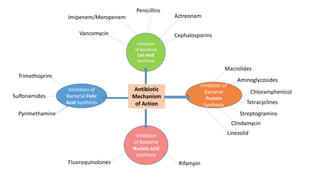
Antibiotic
Mechanism
of Action
Inhibition
of Bacterial
Cell Wall
Synthesis
Inhibition
of Bacterial
Nucleic acid
synthesis
Inhibition of
Bacterial Folic
Acid Synthesis
Inhibition of
Bacterial
Protein
Synthesis
Vancomycin
Imipenem/Meropenem
Penicillins
Aztreonam
Cephalosporins
Trimethoprim
Sulfonamides
Pyrimethamine
Fluoroquinolones Rifampin
Macrolides
Aminoglycosides
Chloramphenicol
Tetracyclines
Streptogramins
Clindamycin
Linezolid
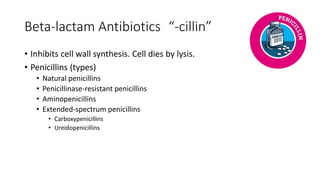
Beta-lactam Antibiotics “-cillin”
• Inhibits cell wall synthesis. Cell dies by lysis.
• Penicillins (types)
• Natural penicillins
• Penicillinase-resistant penicillins
• Aminopenicillins
• Extended-spectrum penicillins
• Carboxypenicillins
• Ureidopenicillins
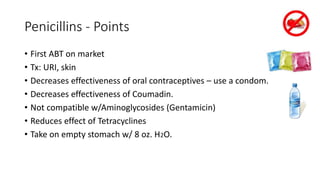
Penicillins - Points
• First ABT on market
• Tx: URI, skin
• Decreases effectiveness of oral contraceptives – use a condom.
• Decreases effectiveness of Coumadin.
• Not compatible w/Aminoglycosides (Gentamicin)
• Reduces effect of Tetracyclines
• Take on empty stomach w/ 8 oz. H2O.
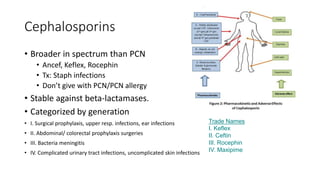
Cephalosporins
• Broader in spectrum than PCN
• Ancef, Keflex, Rocephin
• Tx: Staph infections
• Don’t give with PCN/PCN allergy
• Stable against beta-lactamases.
• Categorized by generation
• I. Surgical prophylaxis, upper resp. infections, ear infections
• II. Abdominal/ colorectal prophylaxis surgeries
• III. Bacteria meningitis
• IV. Complicated urinary tract infections, uncomplicated skin infections
Trade Names
I. Keflex
II. Ceftin
III. Rocephin
IV. Maxipime
Carbapenems “-penem”
• Imipenem/meropenem
• Broad spectrum – mixed aerobic/anaerobic
• Extended-spectrum beta-lactamases (ESBLs)
• #1 concern = drug sensitivity
• Avoid with known/likely C. difficile
• Risk: Seizures
• Nephrotoxicity/neurotoxicity/immunomodulation
• Monitor for abscess/inflammation/phlebitis/rash
• Monitor liver function
• May lead to superinfection
Carbapenem-Resistant
Enterobacteriaceae (CRE)
Monobactams
• Aztreonam (only one available in U.S.)
• Treats: UTI, dermal infection, septicemia, intra-abdominal,
gynecologic infections.
• Moderately severe systemic infections and urinary tract infections
• Admin IV or IM
• Contraindicated in pregnancy
Beta-lactamase inhibitors
• Adjunct therapy only - not useful alone
• Amoxicillin/Clavulanic acid (Augmentin)
Sulfonamides
• Target folic acid synthesis.
• Inhibit dihydropterate synthetase (enzyme)
• May blood glucose levels
• Avoid sun exposure
• Classifications
• Rapid absorption/excretion
• Poor absorption
• Rapid absorption/slow excretion
• Topical
Tetracyclines
• Doxycycline/Minocycline
• Derived from soil mold
• Broad spectrum (Gram +/-)
• Bacteriostatic
• 90-100% bioavailable
• Decrease effectiveness PCN G & OBC (oral birth control)
• Take on empty stomach w/ 8 oz. H2O.
• Report black, furry tongue
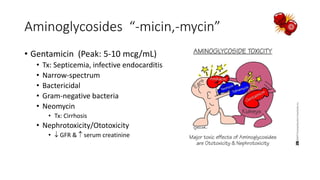
Aminoglycosides “-micin,-mycin”
• Gentamicin (Peak: 5-10 mcg/mL)
• Tx: Septicemia, infective endocarditis
• Narrow-spectrum
• Bactericidal
• Gram-negative bacteria
• Neomycin
• Tx: Cirrhosis
• Nephrotoxicity/Ototoxicity
•  GFR &  serum creatinine
MacROlides “-Romycin”
• Erythromycin -Safest ABT available
• Azithromycin “Z-pack”
• Bacteriostatic/bactericidal
• Very effective against staph. aureus
• Better patient compliance
• Avoid sun / Take on empty stomach
• AVOID in patients with cirrhosis/hepatitis
Quinolones/Fluoroquinolones “-floxacin”
• Cipro/Levaquin
• Bactericidal
• Tx: UTIs, STDs, GI, abd, respiratory, bone/joint, soft tissue
• Orally, parenterally, topically
• Avoid/limit caffeine
• Excreted by kidneys
• No antacids within 4 hours
• Monitor urine pH
• Increase fluids 2-3L/day
• Admin IV slowly – may drop B/P.
Lincosamides
• Clindamycin
• Tx: bacterial/protozoan pathogens
• Hypersensitivity is rare
• Good alternative for PCN allergy/tolerance
• Nasty side effect: Pseudomembranous colitis (2-9 days)
Vancomycin
• Bacteriocidal
• IV – serious nonresponsive infections (MRSA)
• Contraindicated in pregnancy
• Nephrotoxic
• Peak/Trough – 80-100 mg/mL
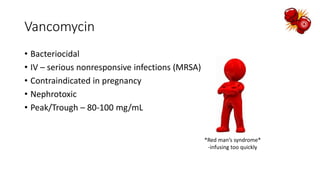
*Red man’s syndrome*
-infusing too quickly
Oxazolidinones
• Linezolid (synthetic)
• Oral/IV
• Tx: VRE/MRSA
• Avoid foods containing tyramine
• No breastfeeding
• Avoid caffeine & ETOH
• Serious CNS reaction – Serotonin Syndrome
• Excreted in urine
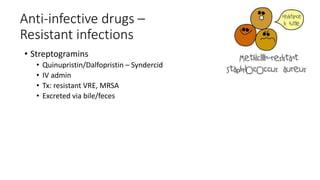
Anti-infective drugs –
Resistant infections
• Streptogramins
• Quinupristin/Dalfopristin – Syndercid
• IV admin
• Tx: resistant VRE, MRSA
• Excreted via bile/feces
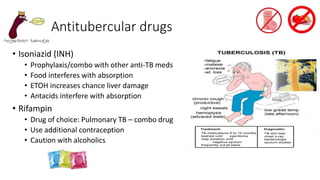
Antitubercular drugs
• Isoniazid (INH)
• Prophylaxis/combo with other anti-TB meds
• Food interferes with absorption
• ETOH increases chance liver damage
• Antacids interfere with absorption
• Rifampin
• Drug of choice: Pulmonary TB – combo drug
• Use additional contraception
• Caution with alcoholics

Antibiotic drugs

  • 1.
  • 2.
    Antibiotic Mechanism of Action Inhibition of Bacterial CellWall Synthesis Inhibition of Bacterial Nucleic acid synthesis Inhibition of Bacterial Folic Acid Synthesis Inhibition of Bacterial Protein Synthesis Vancomycin Imipenem/Meropenem Penicillins Aztreonam Cephalosporins Trimethoprim Sulfonamides Pyrimethamine Fluoroquinolones Rifampin Macrolides Aminoglycosides Chloramphenicol Tetracyclines Streptogramins Clindamycin Linezolid
  • 3.
    Beta-lactam Antibiotics “-cillin” •Inhibits cell wall synthesis. Cell dies by lysis. • Penicillins (types) • Natural penicillins • Penicillinase-resistant penicillins • Aminopenicillins • Extended-spectrum penicillins • Carboxypenicillins • Ureidopenicillins
  • 4.
    Penicillins - Points •First ABT on market • Tx: URI, skin • Decreases effectiveness of oral contraceptives – use a condom. • Decreases effectiveness of Coumadin. • Not compatible w/Aminoglycosides (Gentamicin) • Reduces effect of Tetracyclines • Take on empty stomach w/ 8 oz. H2O.
  • 5.
    Cephalosporins • Broader inspectrum than PCN • Ancef, Keflex, Rocephin • Tx: Staph infections • Don’t give with PCN/PCN allergy • Stable against beta-lactamases. • Categorized by generation • I. Surgical prophylaxis, upper resp. infections, ear infections • II. Abdominal/ colorectal prophylaxis surgeries • III. Bacteria meningitis • IV. Complicated urinary tract infections, uncomplicated skin infections Trade Names I. Keflex II. Ceftin III. Rocephin IV. Maxipime
  • 6.
    Carbapenems “-penem” • Imipenem/meropenem •Broad spectrum – mixed aerobic/anaerobic • Extended-spectrum beta-lactamases (ESBLs) • #1 concern = drug sensitivity • Avoid with known/likely C. difficile • Risk: Seizures • Nephrotoxicity/neurotoxicity/immunomodulation • Monitor for abscess/inflammation/phlebitis/rash • Monitor liver function • May lead to superinfection Carbapenem-Resistant Enterobacteriaceae (CRE)
  • 7.
    Monobactams • Aztreonam (onlyone available in U.S.) • Treats: UTI, dermal infection, septicemia, intra-abdominal, gynecologic infections. • Moderately severe systemic infections and urinary tract infections • Admin IV or IM • Contraindicated in pregnancy
  • 8.
    Beta-lactamase inhibitors • Adjuncttherapy only - not useful alone • Amoxicillin/Clavulanic acid (Augmentin)
  • 9.
    Sulfonamides • Target folicacid synthesis. • Inhibit dihydropterate synthetase (enzyme) • May blood glucose levels • Avoid sun exposure • Classifications • Rapid absorption/excretion • Poor absorption • Rapid absorption/slow excretion • Topical
  • 10.
    Tetracyclines • Doxycycline/Minocycline • Derivedfrom soil mold • Broad spectrum (Gram +/-) • Bacteriostatic • 90-100% bioavailable • Decrease effectiveness PCN G & OBC (oral birth control) • Take on empty stomach w/ 8 oz. H2O. • Report black, furry tongue
  • 11.
    Aminoglycosides “-micin,-mycin” • Gentamicin(Peak: 5-10 mcg/mL) • Tx: Septicemia, infective endocarditis • Narrow-spectrum • Bactericidal • Gram-negative bacteria • Neomycin • Tx: Cirrhosis • Nephrotoxicity/Ototoxicity •  GFR &  serum creatinine
  • 12.
    MacROlides “-Romycin” • Erythromycin-Safest ABT available • Azithromycin “Z-pack” • Bacteriostatic/bactericidal • Very effective against staph. aureus • Better patient compliance • Avoid sun / Take on empty stomach • AVOID in patients with cirrhosis/hepatitis
  • 13.
    Quinolones/Fluoroquinolones “-floxacin” • Cipro/Levaquin •Bactericidal • Tx: UTIs, STDs, GI, abd, respiratory, bone/joint, soft tissue • Orally, parenterally, topically • Avoid/limit caffeine • Excreted by kidneys • No antacids within 4 hours • Monitor urine pH • Increase fluids 2-3L/day • Admin IV slowly – may drop B/P.
  • 14.
    Lincosamides • Clindamycin • Tx:bacterial/protozoan pathogens • Hypersensitivity is rare • Good alternative for PCN allergy/tolerance • Nasty side effect: Pseudomembranous colitis (2-9 days)
  • 15.
    Vancomycin • Bacteriocidal • IV– serious nonresponsive infections (MRSA) • Contraindicated in pregnancy • Nephrotoxic • Peak/Trough – 80-100 mg/mL *Red man’s syndrome* -infusing too quickly
  • 16.
    Oxazolidinones • Linezolid (synthetic) •Oral/IV • Tx: VRE/MRSA • Avoid foods containing tyramine • No breastfeeding • Avoid caffeine & ETOH • Serious CNS reaction – Serotonin Syndrome • Excreted in urine
  • 17.
    Anti-infective drugs – Resistantinfections • Streptogramins • Quinupristin/Dalfopristin – Syndercid • IV admin • Tx: resistant VRE, MRSA • Excreted via bile/feces
  • 18.
    Antitubercular drugs • Isoniazid(INH) • Prophylaxis/combo with other anti-TB meds • Food interferes with absorption • ETOH increases chance liver damage • Antacids interfere with absorption • Rifampin • Drug of choice: Pulmonary TB – combo drug • Use additional contraception • Caution with alcoholics