Acarbose An update
Way Back When!! 1980 โ€“one oral med for Type 2 DM -  few animal derived insulins No published  standards of care No home glucose monitors The United Kingdom Prospective Diabetes Study  (UKPDS) was years away Primary objective was to prevent hyperosmolar coma and diabetic ketoacidosis Today several classes of oral medications Home glucose monitors, insulin pumps, some with built in glucose monitors Most importantly โ€œStandards of Careโ€
Diabetes a Challenging Disease Complex challenge with use of various meds Complex challenge with the psyche of each individual patient My patients are experimental models and they are told that Patients are told we will work together to find the right combination of meds, exercise and diet to control their sugars Patients lifestyle has to be considered: Activity level Hours of work Timing of meals
Todayโ€™s agenda Understanding diabetes criteria Understanding carbohydrate metabolism Understanding acarbose Studies with Acarbose Competitors Summary
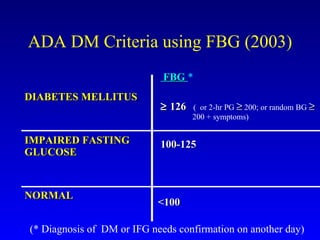
ADA DM Criteria using FBG (2003) DIABETES MELLITUS IMPAIRED FASTING GLUCOSE NORMAL FBG   * ๏‚ณ   126   (  or 2-hr PG  ๏‚ณ  200; or random BG  ๏‚ณ     200 + symptoms) 100-125   <100   (* Diagnosis of  DM or IFG needs confirmation on another day)
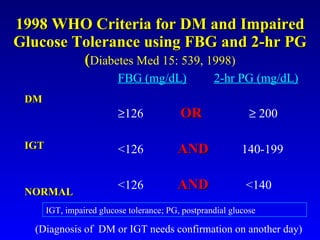
1998 WHO Criteria for DM and Impaired Glucose Tolerance using FBG and 2-hr PG ( Diabetes Med 15: 539, 1998) FBG (mg/dL) 2-hr PG (mg/dL) ๏‚ณ 126  OR   ๏‚ณ  200 <126   AND   140-199 <126  AND <140 IGT, impaired glucose tolerance; PG, postprandial glucose (Diagnosis of  DM or IGT needs confirmation on another day) DM IGT NORMAL
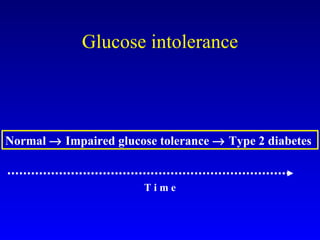
Glucose intolerance Normal  ๏‚ฎ  Impaired glucose tolerance  ๏‚ฎ  Type 2 diabetes  T i m e
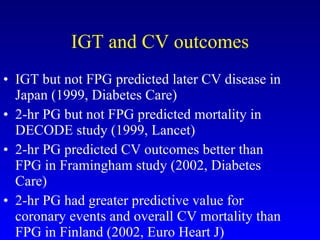
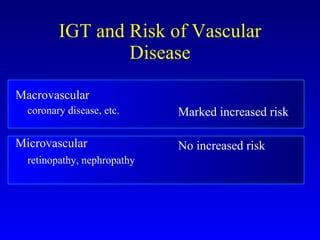
IGT and CV outcomes IGT but not FPG predicted later CV disease in Japan (1999, Diabetes Care) 2-hr PG but not FPG predicted mortality in DECODE study (1999, Lancet) 2-hr PG predicted CV outcomes better than FPG in Framingham study (2002, Diabetes Care) 2-hr PG had greater predictive value for coronary events and overall CV mortality than FPG in Finland (2002, Euro Heart J) Conclusion: Postprandial glucose, reflecting glucose intolerance, is  more predictive of CV risk and mortality than FPG.
IGT and Risk of Vascular Disease Macrovascular coronary disease, etc. Microvascular retinopathy, nephropathy Marked increased risk No increased risk
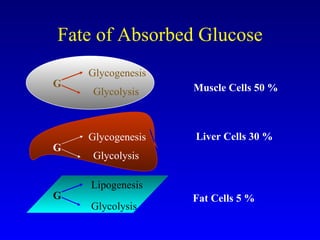
Fate of Absorbed Glucose G Glycogenesis Glycolysis Muscle Cells 50 % G Glycolysis Lipogenesis G Glycogenesis Glycolysis Liver Cells 30 % Fat Cells 5 %
Glucose Ingestion/Absorption Dietary intake of complex or simple carbs- mono-, di-, or polysaccharides Rapid transit from mouth through esophagus to stomach Gastric emptying, regulated by duodenal osmoreceptors and inhibitory GI hormones and peptides Intestinal digestion to monosaccharides by amylases and intestinal disaccharidases Rapid intestinal glucose uptake (sodium-coupled) Entry into portal blood with delivery to liver (first) and then peripheral blood (glucose โ€œexcursionsโ€) Disposal of glucose (rapid=glucose tolerance; slow=glucose intolerance)
Some Ways to Blunt Glucose Excursions into Blood Reduce total caloric intake per day and per meal Reduce % of calories as carbs (low carb) Eat/drink slower Slow gastric emptying (  ๏‚ญ  in early type 2 DM) Increase fiber composition of the diet Block enzymatic digestion of complex carbohydrate to monosaccharide  acarbose (PrecoseR) or meglitol (GlysetR)
Fate today There is an increasing preference for antidiabetic treatments to regulate post-meal blood glucose.
What are alpha-glucosidase inhibitors? Understanding Acarbose
The  ฮฑ -Glucosidase Inhibitors: Basic Characteristics of Acarbose & Miglitol Alpha-glucosidase inhibitors are saccharides that act as competitive inhibitors of enzymes needed to digest carbohydrates: specifically alpha-glucosidase enzymes  in the brush border of the small intestines.  The membrane-bound intestinal alpha-glucosidases hydrolyze oligosaccharides, trisaccharides, and disaccharides to glucose and other monosaccharides in the small intestine.
The  ฮฑ -Glucosidase Inhibitors: Basic Characteristics of Acarbose & Miglitol Acarbose also blocks pancreatic alpha-amylase in addition to inhibiting membrane-bound alpha-glucosidases.  Pancreatic alpha-amylase hydrolyzes complex starches to oligosaccharides in the lumen of the small intestine. Since alpha-glucosidase inhibitors are competitive inhibitors of the digestive enzymes, they must be taken at the start of main meals to have maximal effect.  Their effects on blood sugar levels following meals will depend on the amount of complex carbohydrates in meal.
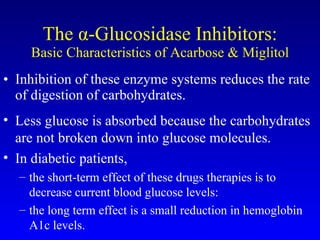
The  ฮฑ -Glucosidase Inhibitors: Basic Characteristics of Acarbose & Miglitol Inhibition of these enzyme systems reduces the rate of digestion of carbohydrates.  Less glucose is absorbed because the carbohydrates are not broken down into glucose molecules.  In diabetic patients,  the short-term effect of these drugs therapies is to decrease current blood glucose levels:  the long term effect is a small reduction in hemoglobin A1c levels.
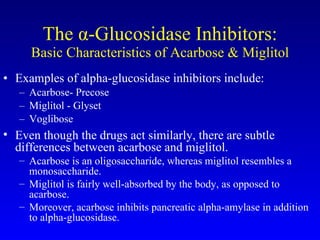
The  ฮฑ -Glucosidase Inhibitors: Basic Characteristics of Acarbose & Miglitol Examples of alpha-glucosidase inhibitors include: Acarbose- Precose Miglitol - Glyset Voglibose Even though the drugs act similarly, there are subtle differences between acarbose and miglitol.  Acarbose is an oligosaccharide, whereas miglitol resembles a monosaccharide.  Miglitol is fairly well-absorbed by the body, as opposed to acarbose.  Moreover, acarbose inhibits pancreatic alpha-amylase in addition to alpha-glucosidase.
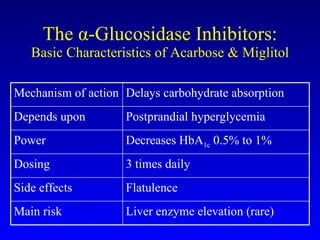
The  ฮฑ -Glucosidase Inhibitors: Basic Characteristics of Acarbose & Miglitol Medical Management of Type 2 Diabetes . 4th ed. Alexandria, Va: American Diabetes Association; 1998:1-139. 4-7 Mechanism of action Delays carbohydrate absorption Depends upon Postprandial hyperglycemia Power Decreases HbA 1c  0.5% to 1% Dosing 3 times daily Side effects Flatulence Main risk Liver enzyme elevation (rare)
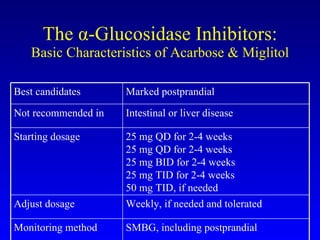
The  ฮฑ -Glucosidase Inhibitors: Basic Characteristics of Acarbose & Miglitol Medical Management of Type 2 Diabetes . 4th ed. Alexandria, Va: American Diabetes Association; 1998:1-139. 4-7 Best candidates Marked postprandial  Not recommended in Intestinal or liver disease Starting dosage 25 mg QD for 2-4 weeks 25 mg QD for 2-4 weeks 25 mg BID for 2-4 weeks 25 mg TID for 2-4 weeks 50 mg TID, if needed Adjust dosage Weekly, if needed and tolerated Monitoring method SMBG, including postprandial
ฮฑ -  Glycosidase Inhibititor Acarbose Indicated for type 2 diabetes In addition with diet  In addition with other anti-diabetic therapies Mode of action: Poorly absorbed 1% (act locally in G.I.T.) Inhibits ฮฑ glucosidase, so inhibits CHO degradation Dose: 50mg to 100mg 3 times daily before meals
Acarbose Side effects: Flatulence (77%), Diarrhea, Abdominal pain (21%) Since alpha-glucosidase inhibitors prevent the degradation of complex carbohydrates into glucose, the carbohydrates will remain in the intestine.  In the colon, bacteria will digest the complex carbohydrates, thereby causing gastrointestinal side effects such as flatulence and diarrhea.  Since these effects are dose-related, it is generally advised to start with a low dose and gradually โ†‘ the dose to the desired amount. Decreased iron absorption
Acarbose Side effects: If a patient using an alpha-glucosidase inhibitor suffers from an episode of hypoglycemia, the patient should eat something containing monosaccharides, such as glucose tablets.  Since the drug will prevent the digestion of polysaccharides (or non-monosaccharides), non-monosaccharide foods may not effectively reverse a hypoglycemic episode in a patient taking an alpha-glucosidase inhibitor.
Clinical studies Acarbose
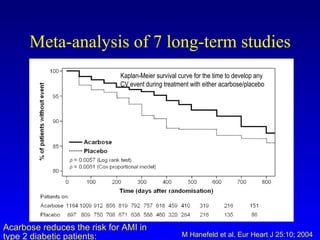
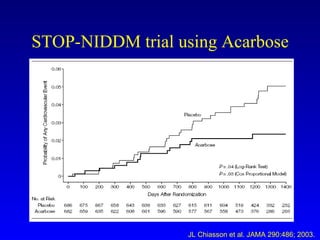
Meta-analysis of 7 long-term studies M Hanefeld et al. Eur Heart J 25:10; 2004 Acarbose reduces the risk for AMI in type 2 diabetic patients: Kaplan-Meier survival curve for the time to develop any CV event during treatment with either acarbose/placebo
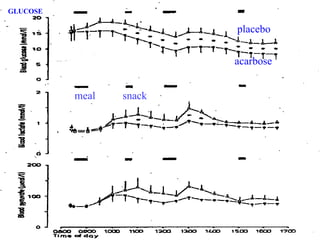
placebo acarbose GLUCOSE meal snack
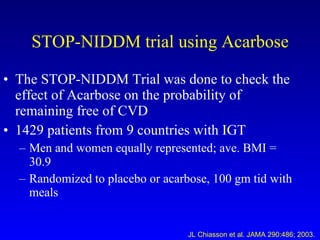
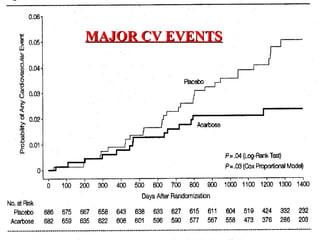
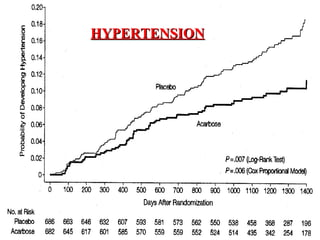
STOP-NIDDM trial using Acarbose The STOP-NIDDM Trial was done to check the effect of Acarbose on the probability of remaining free of CVD 1429 patients from 9 countries with IGT Men and women equally represented; ave. BMI = 30.9 Randomized to placebo or acarbose, 100 gm tid with meals JL Chiasson et al. JAMA 290:486; 2003.
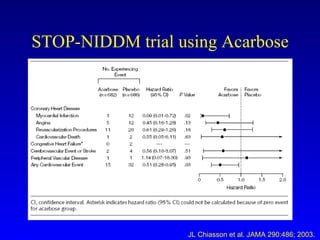
STOP-NIDDM trial using Acarbose JL Chiasson et al. JAMA 290:486; 2003.
MAJOR CV EVENTS
HYPERTENSION

Acarbose

  • 1.
  • 2.
    Way Back When!!1980 โ€“one oral med for Type 2 DM - few animal derived insulins No published standards of care No home glucose monitors The United Kingdom Prospective Diabetes Study (UKPDS) was years away Primary objective was to prevent hyperosmolar coma and diabetic ketoacidosis Today several classes of oral medications Home glucose monitors, insulin pumps, some with built in glucose monitors Most importantly โ€œStandards of Careโ€
  • 3.
    Diabetes a ChallengingDisease Complex challenge with use of various meds Complex challenge with the psyche of each individual patient My patients are experimental models and they are told that Patients are told we will work together to find the right combination of meds, exercise and diet to control their sugars Patients lifestyle has to be considered: Activity level Hours of work Timing of meals
  • 4.
    Todayโ€™s agenda Understandingdiabetes criteria Understanding carbohydrate metabolism Understanding acarbose Studies with Acarbose Competitors Summary
  • 5.
    ADA DM Criteriausing FBG (2003) DIABETES MELLITUS IMPAIRED FASTING GLUCOSE NORMAL FBG * ๏‚ณ 126 ( or 2-hr PG ๏‚ณ 200; or random BG ๏‚ณ 200 + symptoms) 100-125 <100 (* Diagnosis of DM or IFG needs confirmation on another day)
  • 6.
    1998 WHO Criteriafor DM and Impaired Glucose Tolerance using FBG and 2-hr PG ( Diabetes Med 15: 539, 1998) FBG (mg/dL) 2-hr PG (mg/dL) ๏‚ณ 126 OR ๏‚ณ 200 <126 AND 140-199 <126 AND <140 IGT, impaired glucose tolerance; PG, postprandial glucose (Diagnosis of DM or IGT needs confirmation on another day) DM IGT NORMAL
  • 7.
    Glucose intolerance Normal ๏‚ฎ Impaired glucose tolerance ๏‚ฎ Type 2 diabetes T i m e
  • 8.
    IGT and CVoutcomes IGT but not FPG predicted later CV disease in Japan (1999, Diabetes Care) 2-hr PG but not FPG predicted mortality in DECODE study (1999, Lancet) 2-hr PG predicted CV outcomes better than FPG in Framingham study (2002, Diabetes Care) 2-hr PG had greater predictive value for coronary events and overall CV mortality than FPG in Finland (2002, Euro Heart J) Conclusion: Postprandial glucose, reflecting glucose intolerance, is more predictive of CV risk and mortality than FPG.
  • 9.
    IGT and Riskof Vascular Disease Macrovascular coronary disease, etc. Microvascular retinopathy, nephropathy Marked increased risk No increased risk
  • 10.
    Fate of AbsorbedGlucose G Glycogenesis Glycolysis Muscle Cells 50 % G Glycolysis Lipogenesis G Glycogenesis Glycolysis Liver Cells 30 % Fat Cells 5 %
  • 11.
    Glucose Ingestion/Absorption Dietaryintake of complex or simple carbs- mono-, di-, or polysaccharides Rapid transit from mouth through esophagus to stomach Gastric emptying, regulated by duodenal osmoreceptors and inhibitory GI hormones and peptides Intestinal digestion to monosaccharides by amylases and intestinal disaccharidases Rapid intestinal glucose uptake (sodium-coupled) Entry into portal blood with delivery to liver (first) and then peripheral blood (glucose โ€œexcursionsโ€) Disposal of glucose (rapid=glucose tolerance; slow=glucose intolerance)
  • 12.
    Some Ways toBlunt Glucose Excursions into Blood Reduce total caloric intake per day and per meal Reduce % of calories as carbs (low carb) Eat/drink slower Slow gastric emptying ( ๏‚ญ in early type 2 DM) Increase fiber composition of the diet Block enzymatic digestion of complex carbohydrate to monosaccharide acarbose (PrecoseR) or meglitol (GlysetR)
  • 13.
    Fate today Thereis an increasing preference for antidiabetic treatments to regulate post-meal blood glucose.
  • 14.
    What are alpha-glucosidaseinhibitors? Understanding Acarbose
  • 15.
    The ฮฑ-Glucosidase Inhibitors: Basic Characteristics of Acarbose & Miglitol Alpha-glucosidase inhibitors are saccharides that act as competitive inhibitors of enzymes needed to digest carbohydrates: specifically alpha-glucosidase enzymes in the brush border of the small intestines. The membrane-bound intestinal alpha-glucosidases hydrolyze oligosaccharides, trisaccharides, and disaccharides to glucose and other monosaccharides in the small intestine.
  • 16.
    The ฮฑ-Glucosidase Inhibitors: Basic Characteristics of Acarbose & Miglitol Acarbose also blocks pancreatic alpha-amylase in addition to inhibiting membrane-bound alpha-glucosidases. Pancreatic alpha-amylase hydrolyzes complex starches to oligosaccharides in the lumen of the small intestine. Since alpha-glucosidase inhibitors are competitive inhibitors of the digestive enzymes, they must be taken at the start of main meals to have maximal effect. Their effects on blood sugar levels following meals will depend on the amount of complex carbohydrates in meal.
  • 17.
    The ฮฑ-Glucosidase Inhibitors: Basic Characteristics of Acarbose & Miglitol Inhibition of these enzyme systems reduces the rate of digestion of carbohydrates. Less glucose is absorbed because the carbohydrates are not broken down into glucose molecules. In diabetic patients, the short-term effect of these drugs therapies is to decrease current blood glucose levels: the long term effect is a small reduction in hemoglobin A1c levels.
  • 18.
    The ฮฑ-Glucosidase Inhibitors: Basic Characteristics of Acarbose & Miglitol Examples of alpha-glucosidase inhibitors include: Acarbose- Precose Miglitol - Glyset Voglibose Even though the drugs act similarly, there are subtle differences between acarbose and miglitol. Acarbose is an oligosaccharide, whereas miglitol resembles a monosaccharide. Miglitol is fairly well-absorbed by the body, as opposed to acarbose. Moreover, acarbose inhibits pancreatic alpha-amylase in addition to alpha-glucosidase.
  • 19.
    The ฮฑ-Glucosidase Inhibitors: Basic Characteristics of Acarbose & Miglitol Medical Management of Type 2 Diabetes . 4th ed. Alexandria, Va: American Diabetes Association; 1998:1-139. 4-7 Mechanism of action Delays carbohydrate absorption Depends upon Postprandial hyperglycemia Power Decreases HbA 1c 0.5% to 1% Dosing 3 times daily Side effects Flatulence Main risk Liver enzyme elevation (rare)
  • 20.
    The ฮฑ-Glucosidase Inhibitors: Basic Characteristics of Acarbose & Miglitol Medical Management of Type 2 Diabetes . 4th ed. Alexandria, Va: American Diabetes Association; 1998:1-139. 4-7 Best candidates Marked postprandial Not recommended in Intestinal or liver disease Starting dosage 25 mg QD for 2-4 weeks 25 mg QD for 2-4 weeks 25 mg BID for 2-4 weeks 25 mg TID for 2-4 weeks 50 mg TID, if needed Adjust dosage Weekly, if needed and tolerated Monitoring method SMBG, including postprandial
  • 21.
    ฮฑ - Glycosidase Inhibititor Acarbose Indicated for type 2 diabetes In addition with diet In addition with other anti-diabetic therapies Mode of action: Poorly absorbed 1% (act locally in G.I.T.) Inhibits ฮฑ glucosidase, so inhibits CHO degradation Dose: 50mg to 100mg 3 times daily before meals
  • 22.
    Acarbose Side effects:Flatulence (77%), Diarrhea, Abdominal pain (21%) Since alpha-glucosidase inhibitors prevent the degradation of complex carbohydrates into glucose, the carbohydrates will remain in the intestine. In the colon, bacteria will digest the complex carbohydrates, thereby causing gastrointestinal side effects such as flatulence and diarrhea. Since these effects are dose-related, it is generally advised to start with a low dose and gradually โ†‘ the dose to the desired amount. Decreased iron absorption
  • 23.
    Acarbose Side effects:If a patient using an alpha-glucosidase inhibitor suffers from an episode of hypoglycemia, the patient should eat something containing monosaccharides, such as glucose tablets. Since the drug will prevent the digestion of polysaccharides (or non-monosaccharides), non-monosaccharide foods may not effectively reverse a hypoglycemic episode in a patient taking an alpha-glucosidase inhibitor.
  • 24.
  • 25.
    Meta-analysis of 7long-term studies M Hanefeld et al. Eur Heart J 25:10; 2004 Acarbose reduces the risk for AMI in type 2 diabetic patients: Kaplan-Meier survival curve for the time to develop any CV event during treatment with either acarbose/placebo
  • 26.
  • 27.
    STOP-NIDDM trial usingAcarbose The STOP-NIDDM Trial was done to check the effect of Acarbose on the probability of remaining free of CVD 1429 patients from 9 countries with IGT Men and women equally represented; ave. BMI = 30.9 Randomized to placebo or acarbose, 100 gm tid with meals JL Chiasson et al. JAMA 290:486; 2003.
  • 28.
    STOP-NIDDM trial usingAcarbose JL Chiasson et al. JAMA 290:486; 2003.
  • 29.
    STOP-NIDDM trial usingAcarbose JL Chiasson et al. JAMA 290:486; 2003.
  • 30.
  • 31.