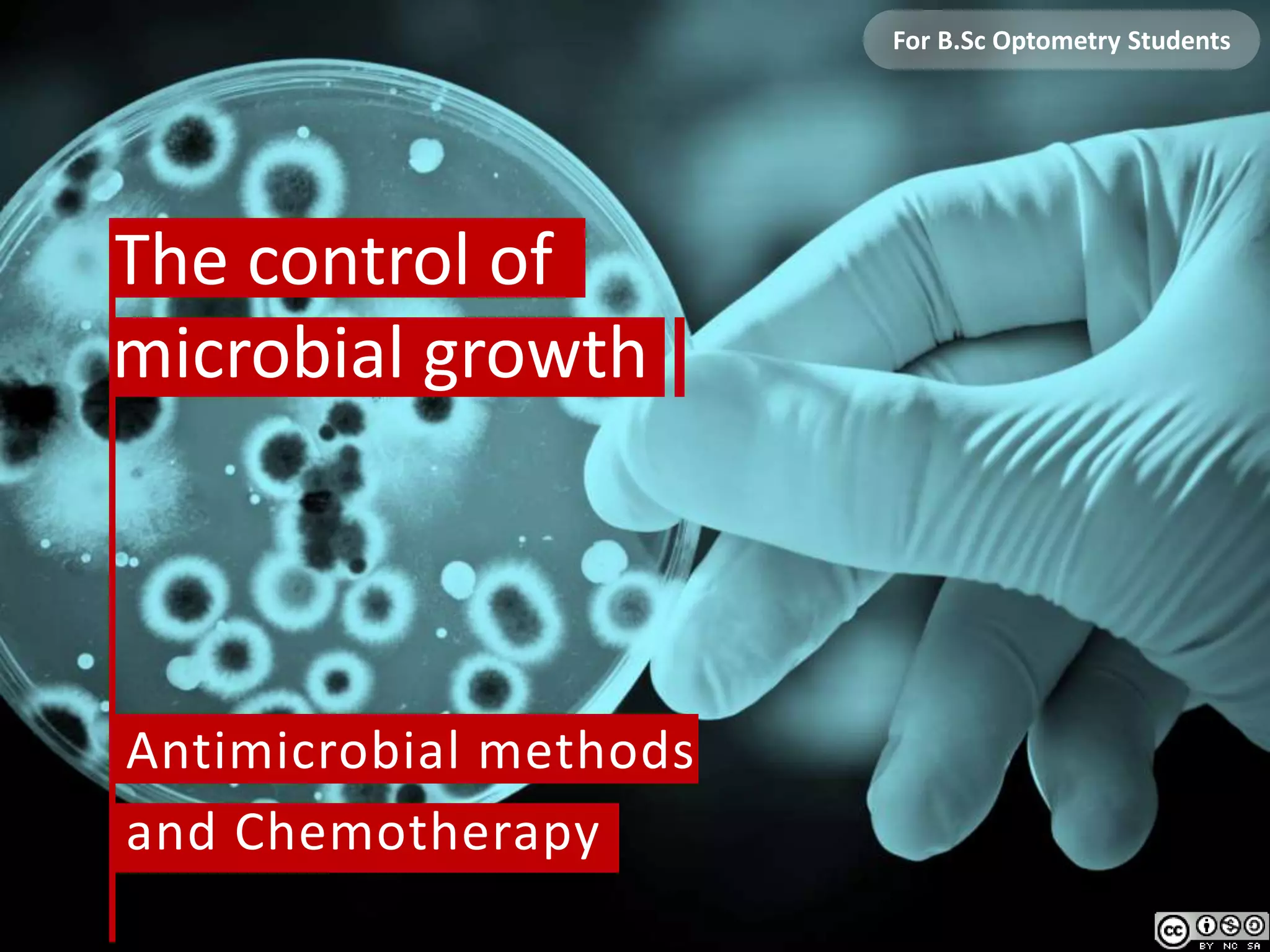
The control of
microbial growth
Antimicrobial methods
and Chemotherapy
For B.Sc Optometry Students
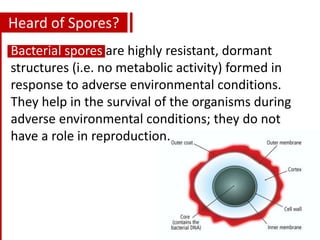
Heard of Spores?
Bacterial spores are highly resistant, dormant
structures (i.e. no metabolic activity) formed in
response to adverse environmental conditions.
They help in the survival of the organisms during
adverse environmental conditions; they do not
have a role in reproduction.
Two different meaning..!
Sterilization is the killing or removal of all
microorganisms in a material or on an object.
Disinfection is the reduction of the number of
pathogenic microorganisms to the point where
they pose no danger of disease.
Two different meaning..!
Disinfectants are typically applied to
non living objects Eg: Dettol, Iodol
antiseptics are applied
to living tissue. Eg: ethanol, propanol,
Boric acid, H2O2
An antimicrobial is an agent that
kills microorganisms or stops their growth
Can be chemical or physical agents
What are different
chemical agents
What makes them different
0.2% solution of phenol is an antiseptic and
1.0% solution of phenol is a disinfectant.
A few agents are suitable as both
disinfectants and antiseptics
most disinfectants are too harsh
for use on delicate skin tissue
Factors influencing chemical agents
• Time: the length of time the organisms are
exposed to the antimicrobialagent
• Temperature: accelerated by increasing the
temperature
• pH: Incarease in pH
• Concentration: increasing concentration increase
the effects of most antimicrobial chemical agents
Soaps contain alkali and sodium and will
kill many species of Streptococcus,
Micrococcus, and Neisseria and will
destroy influenza viruses.
Soaps and Detergents
• Detergents are cationic and anionic
• Cationic detergents are used to sanitize food
utensils. Although not effective in killing
spores, they do inactivate some viruses.
• cationic detergents are quaternary
ammonium compounds of acetate and
chloride, that is they contain NH4+
• Cetyl tri methyl ammonium bromide
Soaps and Detergents
• Anionic detergents are used for laundering
clothes and as household cleaning agents.
They are less effective than cationic
detergents
• Sodium alkyl sulphates:- Sodium lauryl
sulphate
• Sodium alkylbenzene sulphonates:- Sodium
dodecyl benzene sulphonate
Soaps and Detergents
Acids and Alkalis
• Lactic and propionic acids retard mold growth in
breads and other products.
• Benzoic acid and several of its derivatives are
used to prevent fungal growth in soft drinks,
ketchup, and margarine.
• Sorbic acid and sorbates are used to prevent
fungal growth in cheeses
• Boric acid, formerly used as an eyewash, is no
longer recommended because of its toxicity
• Soap has mid alkalinity
Heavy Metals
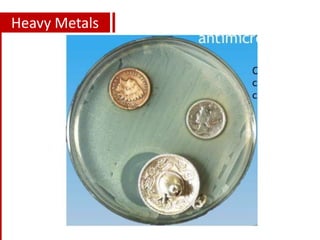
• selenium, mercury, copper, and silver
• Even tiny quantities of heavy metals can be very
effective in inhibiting bacterial growth
• Silver nitrate
• Organic mercury compounds, such as
merthiolate and mercurochrome, are used to
disinfect surface skin wounds
• Selenium sulfide kills fungi, including spores.
Shampoos that contain selenium are effective in
controlling dandruff
• Copper sulfate is used to control algal growth
Heavy Metals
Halogens
• Hypochlorous acid, formed by the addition of
chlorine to water, effectively controls
microorganisms in drinkingwater and
swimming pools
• Iodine is an effective antimicrobial agent.
Betadine and Isodine are used for surgical
scrubs and on skin before surgery
• Chloramine, Bromine are other examples
Alcohols
• When mixed with water, alcohols denature
protein. They are also lipid solvents and
dissolve membranes
• Ethyl and isopropyl alcohols can be used as
skin antiseptics
• Alcohol disinfects but does not sterilize skin
because it evaporates quickly and stays in
contact with microbes for only a few seconds
• 70% ethyl alcohol is usually used to disinfect a
thermometer.
Phenols
• Phenol and phenol derivatives called
phenolics disrupt cell membranes, denature
proteins, and inactivate enzymes.
• Amphyl, which contains amylphenol, destroys
vegetative forms of bacteria and fungi and
inactivates viruses.
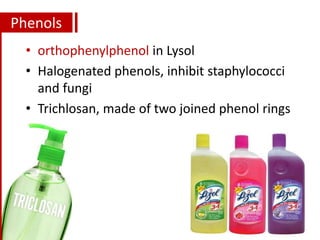
Phenols
• orthophenylphenol in Lysol
• Halogenated phenols, inhibit staphylococci
and fungi
• Trichlosan, made of two joined phenol rings
Oxidizing Agents
• disrupt disulfide bonds in proteins and thus
disrupt the structure of membranes and
proteins.
• Hydrogen peroxide (H2O2), which forms
highly reactive superoxide O2- is used to
clean puncture wounds
• very effective at disinfecting contact lenses
• Potassium permanganate, is used to disinfect
instruments and, in low concentrations, to
clean skin.
Alkylating Agents
• disrupt the structure of both proteins and
nucleic acids.
• Eg: Formaldehyde, glutaraldehyde, and b-
propiolactone are used in aqueous solutions.
Ethylene oxide is used in gaseous form.
It is exceedingly important that workers be
protected from ethylene oxide vapors, which are
toxic to skin, eyes, and mucous membranes and
may also cause cancer.
Dyes
• Acridine, can be used to clean wounds
• Methylene blue inhibits growth of some bacteria
• Crystal violet (gentian violet) blocks cell wall
synthesis. Used to treat yeast and protozoan
infections
Two different meaning..!
Bacteriostatic agent An agent that inhibits the
growth of bacteria.
Bactericide An agent that kills bacteria. Most
such agents do not kill spores
Mechanism of action
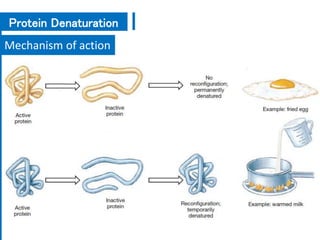
In denaturation, hydrogen and disulfide bonds
are disrupted, and the functional shape of the
protein molecule is destroyed.
There are two types of denaturation
Protein Denaturation
Mechanism of action
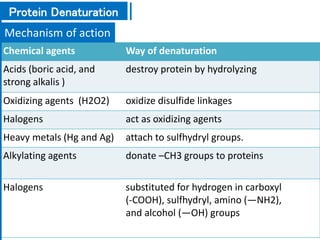
Protein Denaturation
Chemical agents Way of denaturation
Acids (boric acid, and
strong alkalis )
destroy protein by hydrolyzing
Oxidizing agents (H2O2) oxidize disulfide linkages
Halogens act as oxidizing agents
Heavy metals (Hg and Ag) attach to sulfhydryl groups.
Alkylating agents donate –CH3 groups to proteins
Halogens substituted for hydrogen in carboxyl
(-COOH), sulfhydryl, amino (—NH2),
and alcohol (—OH) groups
Mechanism of action
Protein Denaturation
Mechanism of action
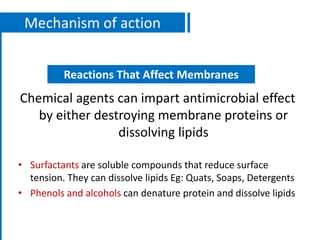
Chemical agents can impart antimicrobial effect
by either destroying membrane proteins or
dissolving lipids
• Surfactants are soluble compounds that reduce surface
tension. They can dissolve lipids Eg: Quats, Soaps, Detergents
• Phenols and alcohols can denature protein and dissolve lipids
Reactions That Affect Membranes
Mechanism of action
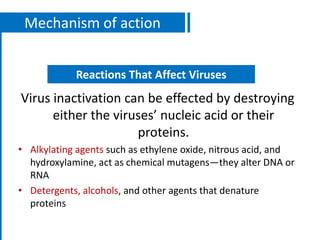
Virus inactivation can be effected by destroying
either the viruses’ nucleic acid or their
proteins.
• Alkylating agents such as ethylene oxide, nitrous acid, and
hydroxylamine, act as chemical mutagens—they alter DNA or
RNA
• Detergents, alcohols, and other agents that denature
proteins
Reactions That Affect Viruses
?
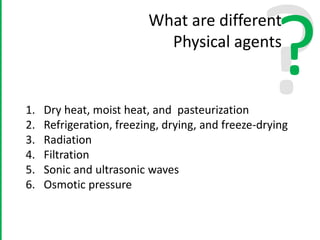
What are different
Physical agents
1. Dry heat, moist heat, and pasteurization
2. Refrigeration, freezing, drying, and freeze-drying
3. Radiation
4. Filtration
5. Sonic and ultrasonic waves
6. Osmotic pressure
• It is usually used to sterilize metal objects and
glassware and is the only suitable means of
sterilizing oils and powders
• Objects are sterilized by dry heat when
subjected to 171°C for 1 hour, 160°C for 2
hours or longer, or 121°C for 16 hours
Dry Heat
Dry Heat
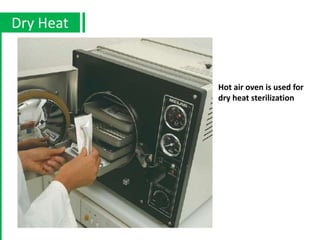
Hot air oven is used for
dry heat sterilization
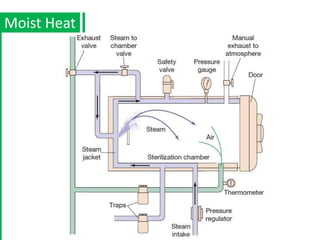
• because of its penetrating properties, is a
widely used physical agent
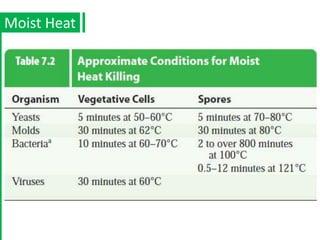
• At 15 lb/in the temperature reaches 121°C,
which kill spores, as well as living microbes,
and to disrupt the structure of nucleic acids in
viruses. This is achieved using autoclave
• heat-resistant endospores, such as those of
Bacillus stearothermophilus, to check
autoclave performance
Moist Heat
Moist Heat
Moist Heat
• a process invented by Pasteur to destroy
organisms that caused wine to sour
• Pasteurization does not sterilize a beverage, but it
does kill any pathogens present and drastically
slows spoilage by reducing the level of
microorganisms.
• Heated upto 60°C then cool down immediately
• Ultra high temperature (UHT) processing raises
the temperature from 74 to 140°C andthen drops
it back to 74°C in less than 5 sec.
Pasteurization
• Cold temperature retards the growth of
microorganisms by slowing the rate of enzyme-
controlled reactions but does not kill many
microbes
• Many fresh foods can be prevented from spoiling
by keeping them at 5°C
• storage should be limited to a few days because
some bacteria and molds continue to grow at this
temperature
Refrigeration
• Freezing at -20°C is used to preserve foods
• slow the rate of chemical reactions so that
microorganisms do not cause food to spoil
• Microorganisms are usually suspended in
glycerol or protein
• cooled with solid carbon dioxide (dry ice) -78°C
• they can be placed in liquid nitrogen and cooled
to -180°C.
F r e e z i n g
• the absence of water inhibits the action of
enzymes
• Yeast used in baking also can be preserved by
drying
• Treponema pallidum is sensitive to drying
• Drying of laundry in dryers or in the sunshine
also destroys pathogens
Drying
• is the drying of a material from the frozen state
• rapidly frozen in alcohol and dry ice or in liquid
nitrogen, are then subjected to a high vacuum
to remove all the water while in the frozen
state, and finally are sealed under a vacuum.
• Microbiologists use lyophilization for long-term
preservation of microbes
• Instant coffee, tea are made this way
lyophilization
• Four general types of radiation—ultraviolet light,
ionizing radiation, microwave radiation, and strong
visible light
• Ultraviolet (UV) light consists of light of
wavelengths between 40 and 390 nm but 200nm is
most lethal
• UV is absorbed by the purine and pyrimidine bases
of nucleic acids - permanently destroy these
molecules.
• Effective in inactivating viruses.
• Kills fewer bacteria because of DNA repair
mechanisms.
Radiation
• X rays (0.1 to 40 nm) and gamma rays
• Ionizing radiation damages DNA and produces
peroxides which act as powerful oxidizing
agents in cells
• It is used to sterilize plastic laboratory & medical
equipment and pharmaceutical products
Ionizing Radiation
• the passage of a material through a filter, or
straining device
• Membrane filters: used to sterilize materials
likely to be damaged by heat sterilization.
• Like media, special nutrients that might be
added to media, and pharmaceutical products
such as drugs, sera, and vitamins
• Cellulose acetate filters with extremely tiny
pores are capable of removing viruses from
liquids.
1Filtration
Some Defenitions
• Sterilization: The killing or removal of all microorganisms in a
material or on an object.
• Disinfection: The reduction of the number of pathogenic
microorganisms to the point where they pose no danger of disease.
• Antiseptic: A chemical agent that can safely be used externally on
living tissue to destroy microorganisms or to inhibit their growth.
• Disinfectant: A chemical agent used on inanimate objects to
destroy microorganisms. Most disinfectants do not kill spores.
• Sanitizer: A chemical agent typically used on food-handling
equipment and eating utensils to reduce bacterial numbers so as to
meet public health standards. Sanitization may simply refer to
thorough washing withonly soap or detergent.
Some Defenitions
• Bacteriostatic agent: An agent that inhibits the growth of bacteria.
• Germicide: An agent capable of killing microbes rapidly; some such
agents effectively kill certain microorganisms but only inhibit the
growth of others.
• Bactericide: An agent that kills bacteria. Most such agents do not
kill spores.
• Viricide: An agent that inactivates viruses.
• Fungicide: An agent that kills fungi.
• Sporocide: An agent that kills bacterial endospores or fungal
spores.

Antibacterial methods

  • 1.
    The control of microbialgrowth Antimicrobial methods and Chemotherapy For B.Sc Optometry Students
  • 2.
    Heard of Spores? Bacterialspores are highly resistant, dormant structures (i.e. no metabolic activity) formed in response to adverse environmental conditions. They help in the survival of the organisms during adverse environmental conditions; they do not have a role in reproduction.
  • 3.
    Two different meaning..! Sterilizationis the killing or removal of all microorganisms in a material or on an object. Disinfection is the reduction of the number of pathogenic microorganisms to the point where they pose no danger of disease.
  • 4.
    Two different meaning..! Disinfectantsare typically applied to non living objects Eg: Dettol, Iodol antiseptics are applied to living tissue. Eg: ethanol, propanol, Boric acid, H2O2
  • 5.
    An antimicrobial isan agent that kills microorganisms or stops their growth Can be chemical or physical agents What are different chemical agents
  • 6.
    What makes themdifferent 0.2% solution of phenol is an antiseptic and 1.0% solution of phenol is a disinfectant. A few agents are suitable as both disinfectants and antiseptics most disinfectants are too harsh for use on delicate skin tissue
  • 7.
    Factors influencing chemicalagents • Time: the length of time the organisms are exposed to the antimicrobialagent • Temperature: accelerated by increasing the temperature • pH: Incarease in pH • Concentration: increasing concentration increase the effects of most antimicrobial chemical agents
  • 8.
    Soaps contain alkaliand sodium and will kill many species of Streptococcus, Micrococcus, and Neisseria and will destroy influenza viruses. Soaps and Detergents
  • 9.
    • Detergents arecationic and anionic • Cationic detergents are used to sanitize food utensils. Although not effective in killing spores, they do inactivate some viruses. • cationic detergents are quaternary ammonium compounds of acetate and chloride, that is they contain NH4+ • Cetyl tri methyl ammonium bromide Soaps and Detergents
  • 10.
    • Anionic detergentsare used for laundering clothes and as household cleaning agents. They are less effective than cationic detergents • Sodium alkyl sulphates:- Sodium lauryl sulphate • Sodium alkylbenzene sulphonates:- Sodium dodecyl benzene sulphonate Soaps and Detergents
  • 11.
    Acids and Alkalis •Lactic and propionic acids retard mold growth in breads and other products. • Benzoic acid and several of its derivatives are used to prevent fungal growth in soft drinks, ketchup, and margarine. • Sorbic acid and sorbates are used to prevent fungal growth in cheeses • Boric acid, formerly used as an eyewash, is no longer recommended because of its toxicity • Soap has mid alkalinity
  • 12.
    Heavy Metals • selenium,mercury, copper, and silver • Even tiny quantities of heavy metals can be very effective in inhibiting bacterial growth • Silver nitrate • Organic mercury compounds, such as merthiolate and mercurochrome, are used to disinfect surface skin wounds • Selenium sulfide kills fungi, including spores. Shampoos that contain selenium are effective in controlling dandruff • Copper sulfate is used to control algal growth
  • 13.
  • 14.
    Halogens • Hypochlorous acid,formed by the addition of chlorine to water, effectively controls microorganisms in drinkingwater and swimming pools • Iodine is an effective antimicrobial agent. Betadine and Isodine are used for surgical scrubs and on skin before surgery • Chloramine, Bromine are other examples
  • 15.
    Alcohols • When mixedwith water, alcohols denature protein. They are also lipid solvents and dissolve membranes • Ethyl and isopropyl alcohols can be used as skin antiseptics • Alcohol disinfects but does not sterilize skin because it evaporates quickly and stays in contact with microbes for only a few seconds • 70% ethyl alcohol is usually used to disinfect a thermometer.
  • 16.
    Phenols • Phenol andphenol derivatives called phenolics disrupt cell membranes, denature proteins, and inactivate enzymes. • Amphyl, which contains amylphenol, destroys vegetative forms of bacteria and fungi and inactivates viruses.
  • 17.
    Phenols • orthophenylphenol inLysol • Halogenated phenols, inhibit staphylococci and fungi • Trichlosan, made of two joined phenol rings
  • 18.
    Oxidizing Agents • disruptdisulfide bonds in proteins and thus disrupt the structure of membranes and proteins. • Hydrogen peroxide (H2O2), which forms highly reactive superoxide O2- is used to clean puncture wounds • very effective at disinfecting contact lenses • Potassium permanganate, is used to disinfect instruments and, in low concentrations, to clean skin.
  • 19.
    Alkylating Agents • disruptthe structure of both proteins and nucleic acids. • Eg: Formaldehyde, glutaraldehyde, and b- propiolactone are used in aqueous solutions. Ethylene oxide is used in gaseous form. It is exceedingly important that workers be protected from ethylene oxide vapors, which are toxic to skin, eyes, and mucous membranes and may also cause cancer.
  • 20.
    Dyes • Acridine, canbe used to clean wounds • Methylene blue inhibits growth of some bacteria • Crystal violet (gentian violet) blocks cell wall synthesis. Used to treat yeast and protozoan infections
  • 21.
    Two different meaning..! Bacteriostaticagent An agent that inhibits the growth of bacteria. Bactericide An agent that kills bacteria. Most such agents do not kill spores
  • 22.
    Mechanism of action Indenaturation, hydrogen and disulfide bonds are disrupted, and the functional shape of the protein molecule is destroyed. There are two types of denaturation Protein Denaturation
  • 23.
  • 24.
    Chemical agents Wayof denaturation Acids (boric acid, and strong alkalis ) destroy protein by hydrolyzing Oxidizing agents (H2O2) oxidize disulfide linkages Halogens act as oxidizing agents Heavy metals (Hg and Ag) attach to sulfhydryl groups. Alkylating agents donate –CH3 groups to proteins Halogens substituted for hydrogen in carboxyl (-COOH), sulfhydryl, amino (—NH2), and alcohol (—OH) groups Mechanism of action Protein Denaturation
  • 25.
    Mechanism of action Chemicalagents can impart antimicrobial effect by either destroying membrane proteins or dissolving lipids • Surfactants are soluble compounds that reduce surface tension. They can dissolve lipids Eg: Quats, Soaps, Detergents • Phenols and alcohols can denature protein and dissolve lipids Reactions That Affect Membranes
  • 26.
    Mechanism of action Virusinactivation can be effected by destroying either the viruses’ nucleic acid or their proteins. • Alkylating agents such as ethylene oxide, nitrous acid, and hydroxylamine, act as chemical mutagens—they alter DNA or RNA • Detergents, alcohols, and other agents that denature proteins Reactions That Affect Viruses
  • 27.
    ? What are different Physicalagents 1. Dry heat, moist heat, and pasteurization 2. Refrigeration, freezing, drying, and freeze-drying 3. Radiation 4. Filtration 5. Sonic and ultrasonic waves 6. Osmotic pressure
  • 28.
    • It isusually used to sterilize metal objects and glassware and is the only suitable means of sterilizing oils and powders • Objects are sterilized by dry heat when subjected to 171°C for 1 hour, 160°C for 2 hours or longer, or 121°C for 16 hours Dry Heat
  • 29.
    Dry Heat Hot airoven is used for dry heat sterilization
  • 30.
    • because ofits penetrating properties, is a widely used physical agent • At 15 lb/in the temperature reaches 121°C, which kill spores, as well as living microbes, and to disrupt the structure of nucleic acids in viruses. This is achieved using autoclave • heat-resistant endospores, such as those of Bacillus stearothermophilus, to check autoclave performance Moist Heat
  • 31.
  • 32.
  • 33.
    • a processinvented by Pasteur to destroy organisms that caused wine to sour • Pasteurization does not sterilize a beverage, but it does kill any pathogens present and drastically slows spoilage by reducing the level of microorganisms. • Heated upto 60°C then cool down immediately • Ultra high temperature (UHT) processing raises the temperature from 74 to 140°C andthen drops it back to 74°C in less than 5 sec. Pasteurization
  • 34.
    • Cold temperatureretards the growth of microorganisms by slowing the rate of enzyme- controlled reactions but does not kill many microbes • Many fresh foods can be prevented from spoiling by keeping them at 5°C • storage should be limited to a few days because some bacteria and molds continue to grow at this temperature Refrigeration
  • 35.
    • Freezing at-20°C is used to preserve foods • slow the rate of chemical reactions so that microorganisms do not cause food to spoil • Microorganisms are usually suspended in glycerol or protein • cooled with solid carbon dioxide (dry ice) -78°C • they can be placed in liquid nitrogen and cooled to -180°C. F r e e z i n g
  • 36.
    • the absenceof water inhibits the action of enzymes • Yeast used in baking also can be preserved by drying • Treponema pallidum is sensitive to drying • Drying of laundry in dryers or in the sunshine also destroys pathogens Drying
  • 37.
    • is thedrying of a material from the frozen state • rapidly frozen in alcohol and dry ice or in liquid nitrogen, are then subjected to a high vacuum to remove all the water while in the frozen state, and finally are sealed under a vacuum. • Microbiologists use lyophilization for long-term preservation of microbes • Instant coffee, tea are made this way lyophilization
  • 38.
    • Four generaltypes of radiation—ultraviolet light, ionizing radiation, microwave radiation, and strong visible light • Ultraviolet (UV) light consists of light of wavelengths between 40 and 390 nm but 200nm is most lethal • UV is absorbed by the purine and pyrimidine bases of nucleic acids - permanently destroy these molecules. • Effective in inactivating viruses. • Kills fewer bacteria because of DNA repair mechanisms. Radiation
  • 39.
    • X rays(0.1 to 40 nm) and gamma rays • Ionizing radiation damages DNA and produces peroxides which act as powerful oxidizing agents in cells • It is used to sterilize plastic laboratory & medical equipment and pharmaceutical products Ionizing Radiation
  • 40.
    • the passageof a material through a filter, or straining device • Membrane filters: used to sterilize materials likely to be damaged by heat sterilization. • Like media, special nutrients that might be added to media, and pharmaceutical products such as drugs, sera, and vitamins • Cellulose acetate filters with extremely tiny pores are capable of removing viruses from liquids. 1Filtration
  • 41.
    Some Defenitions • Sterilization:The killing or removal of all microorganisms in a material or on an object. • Disinfection: The reduction of the number of pathogenic microorganisms to the point where they pose no danger of disease. • Antiseptic: A chemical agent that can safely be used externally on living tissue to destroy microorganisms or to inhibit their growth. • Disinfectant: A chemical agent used on inanimate objects to destroy microorganisms. Most disinfectants do not kill spores. • Sanitizer: A chemical agent typically used on food-handling equipment and eating utensils to reduce bacterial numbers so as to meet public health standards. Sanitization may simply refer to thorough washing withonly soap or detergent.
  • 42.
    Some Defenitions • Bacteriostaticagent: An agent that inhibits the growth of bacteria. • Germicide: An agent capable of killing microbes rapidly; some such agents effectively kill certain microorganisms but only inhibit the growth of others. • Bactericide: An agent that kills bacteria. Most such agents do not kill spores. • Viricide: An agent that inactivates viruses. • Fungicide: An agent that kills fungi. • Sporocide: An agent that kills bacterial endospores or fungal spores.