Control of Microorganisms
Various Physical & Chemical
Methods
Methods
Many microorganisms are beneficial.
Some are harmful.
Some are harmful.
Microbial activities – food spoilage and disease.
Introduced concept of microbial control
Ignaz Semmel Weis
Ignaz Semmel Weis [ Hungarian Physician ]
[ Hungarian Physician ]
Joseph Lister
Joseph Lister [ English Physician]
[ English Physician]
 Microbial growth controlled by
Microbial growth controlled by physical
physical &
&
chemical
chemical methods.
methods.
Kill or inhibit growth.
Kill or inhibit growth.
TERMINOLOGY RELATED TO THE CONTROL
OF MICROBIAL GROWTH
• Sterilization: A treatment that kills or removes
all living cells, including viruses and spores,
from a substance or object.
• Disinfection: A treatment that reduces the total
number of microbes on an object or surface,
but does not necessarily remove or kill all of
the microbes (Chlorination).
• Sanitation: Reduction of the microbial
population to levels considered safe by public
health standards.
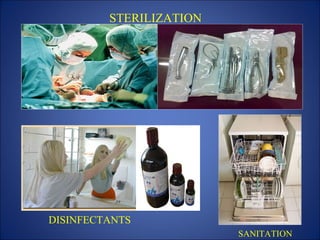
STERILIZATION
DISINFECTANTS
SANITATION
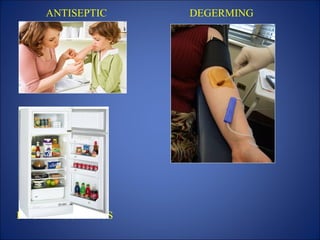
• Antiseptic: A mild disinfectant agent suitable
for use on skin surfaces.
• Germicide: “the agent kills” microbes. For
example, a bactericide agent kills bacteria,
fungicide, virucide, sporocide.
• Bacteriostatic: “the agent inhibits growth.” For
example, a fungi static agent inhibits the
growth of fungi, but doesn’t necessarily kill it.
( Refrigeration)
• Degerming: Removal of microbes from skin.
• Antimicrobial Agent: Agent kills micro
-organisms or inhibit their growth.
ANTISEPTIC DEGERMING
BACTERIOSTATICS
 Conditions influencing
1. Temperature
2. Type of Microbe
3. Physical State
 Actions
Kill
Inhibit Microbes
Damage Plasma Membrane
 Gram Positive Bacteria – Disinfectants and antiseptics
greater effect.
 Gram Negative Bacteria – Pseudomonads grow in some
disinfectants and antiseptics.
 Endospores resistant to chemical agents & physical
methods.
PHYSICAL METHODS
PHYSICAL METHODS
• Damaging cell components.
• Enzymes, DNA, Cytoplasmic membranes
disrupt.
Used in food industry.
Preparation of culture media lab ware,
sterilization of instrument.
PHYSICAL METHODS
PHYSICAL METHODS
Heat
Temperature
Desiccation
Osmotic Pressure
Filtration
Radiation
HEAT
HEAT
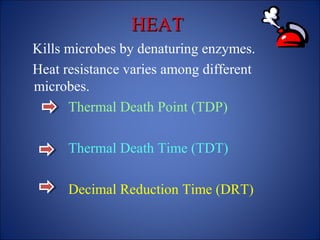
Kills microbes by denaturing enzymes.
Heat resistance varies among different
microbes.
Thermal Death Point (TDP)
Thermal Death Time (TDT)
Decimal Reduction Time (DRT)
Thermal
Thermal
Death
Death
Point
Point
Thermal Death Point (TDP)
• Lowest temperature to kill
all the bacteria in 10 minutes.
• Thermal death is useful in
purifying water.
• Boiling - Kills many
Vegetative Cells.
• Inactivates Viruses Within 10
Minutes
• No effect on spores.
Thermal Death Time
Thermal Death Time
Thermal Death Time (TDT)
• Time required to kill all the
bacteria at a given
temperature.
• Developed for food
canning.
• Applications in cosmetics
and pharmaceuticals.
Decimal Reduction Time
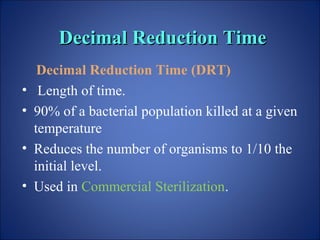
Decimal Reduction Time (DRT)
• Length of time.
• 90% of a bacterial population killed at a given
temperature
• Reduces the number of organisms to 1/10 the
initial level.
• Used in Commercial Sterilization.
Rate of Microbial Death
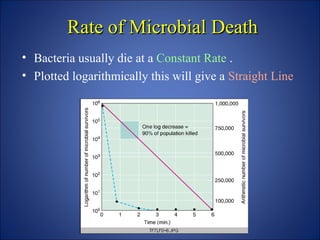
• Bacteria usually die at a Constant Rate .
• Plotted logarithmically this will give a Straight Line
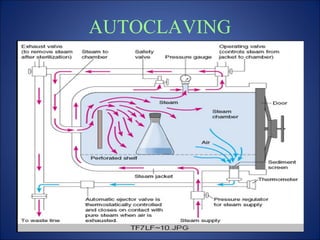
AUTOCLAVING
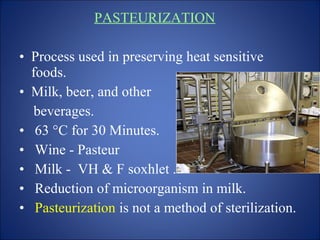
PASTEURIZATION
• Process used in preserving heat sensitive
foods.
• Milk, beer, and other
beverages.
• 63 °C for 30 Minutes.
• Wine - Pasteur
• Milk - VH & F soxhlet .
• Reduction of microorganism in milk.
• Pasteurization is not a method of sterilization.
Two different process
• High Temperature Short Time (HTST) process
- 72°C for 15s ( Quick heating and cooling).
• Ultra High Temperature (UHT) sterilization
- heating at 140°C for 3 seconds.
• Milk kept at room temperature for 2 months.
• Minimal changes in flavor.
• Equivalent Treatments – Different methods
produce same effect.
• Mycobacterium – Tuberculosis
Low Temperatures
Low Temperatures
• Decreasing temperature decreases chemical
activity.
• Low Temperature are Not Bactericidal.
• Restrict enzyme activity.
• Ordinary Refrigerator Temperature 0° – 7°C .
• Do not Reproduce.
• Survive, Restrict rate of growth.
• Use – Food Preservation, Drug, Culture
Preservation.
DRY HEAT STERILIZATION
Direct Flaming – Burning contaminants
Incineration - Burns and Physically Destroys Organisms
Used for
a. Needles
b. Inoculating Wires
c. Glassware
d. Body Parts
Hot Air Sterilization – Oxidation
160° C for 2 Hours or 170° C for 1 hour
Used for
a. Objects That Won’t Melt
b. Glassware
c. Metal
FILTRATION
FILTRATION
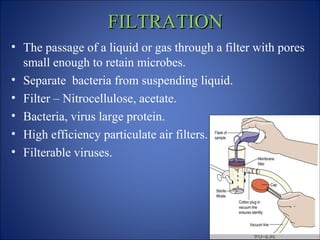
• The passage of a liquid or gas through a filter with pores
small enough to retain microbes.
• Separate bacteria from suspending liquid.
• Filter – Nitrocellulose, acetate.
• Bacteria, virus large protein.
• High efficiency particulate air filters.
• Filterable viruses.
Two types of Filters:-
• Depth Filters – Fibrous or granular material.
• Thick layer filled with twisting channels.
• Microorganisms sucked through thick layer.
• Microbes removed by physical screening.
• Membrane filters – Circular filters
• Porous membrane – 0.1mm thick
• Made of cellulose acetate, cellulose nitrate,
polycarbonate.
• Variety of pore size.
HEPA FILTERS
HEPA FILTERS
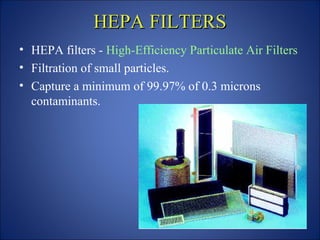
• HEPA filters - High-Efficiency Particulate Air Filters
• Filtration of small particles.
• Capture a minimum of 99.97% of 0.3 microns
contaminants.
HEPA Filters
HEPA Filters
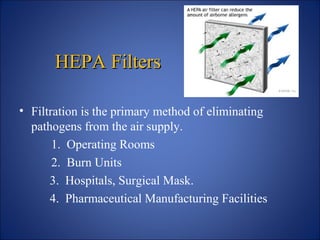
• Filtration is the primary method of eliminating
pathogens from the air supply.
1. Operating Rooms
2. Burn Units
3. Hospitals, Surgical Mask.
4. Pharmaceutical Manufacturing Facilities
DESICCATION
DESICCATION
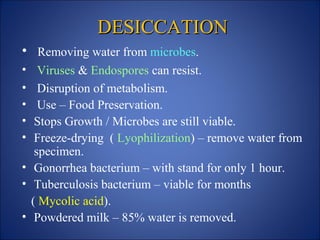
• Removing water from microbes.
• Viruses & Endospores can resist.
• Disruption of metabolism.
• Use – Food Preservation.
• Stops Growth / Microbes are still viable.
• Freeze-drying ( Lyophilization) – remove water from
specimen.
• Gonorrhea bacterium – with stand for only 1 hour.
• Tuberculosis bacterium – viable for months
( Mycolic acid).
• Powdered milk – 85% water is removed.
OSMOTIC PRESSURE
OSMOTIC PRESSURE
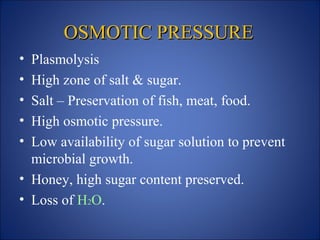
• Plasmolysis
• High zone of salt & sugar.
• Salt – Preservation of fish, meat, food.
• High osmotic pressure.
• Low availability of sugar solution to prevent
microbial growth.
• Honey, high sugar content preserved.
• Loss of H2O.
RADIATION
RADIATION
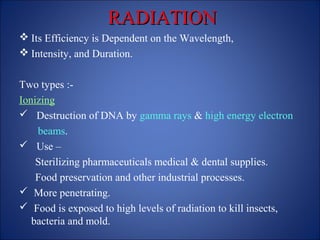
 Its Efficiency is Dependent on the Wavelength,
 Intensity, and Duration.
Two types :-
Ionizing
 Destruction of DNA by gamma rays & high energy electron
beams.
 Use –
Sterilizing pharmaceuticals medical & dental supplies.
Food preservation and other industrial processes.
 More penetrating.
 Food is exposed to high levels of radiation to kill insects,
bacteria and mold.
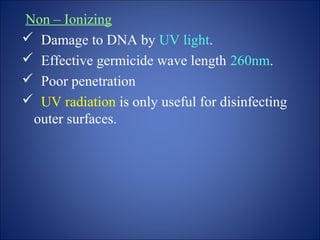
Non – Ionizing
 Damage to DNA by UV light.
 Effective germicide wave length 260nm.
 Poor penetration
 UV radiation is only useful for disinfecting
outer surfaces.
Chemical Control Methods
• Phenols and Phenolics
• Halogens
• Alcohols
• Heavy Metals and Their Compounds
• Surface-Active Agents
• Quaternary Ammonium Compounds
• Chemical Food Preservatives
• Aldehydes
• Antibiotics
Types of Disinfectants
 Phenols and Phenolics
Another Name for Carbolic Acid / Lysol / Pine-Sol
- Joseph Lister
- Exert Influence By
1. Injuring Plasma membranes
2. Inactivating Enzymes
3. Denaturing Proteins
Use – Skin surface, Environmental surface, Instruments, Mucous
membranes.
Common – Cresols, Hexachlorophene.
Phenolics are Long Lasting.
No Effect on Spores.
Effective antibacterial agents, fungi and many viruses.
CHLORHEXIDINE
CHLORHEXIDINE
• Damages plasma membranes.
• Use – Skin degerming, Surgical scrubs.
• Only Operates in Narrow pH Range (5-7).
HALOGENS
HALOGENS
 Can be Used Alone or in Solution.
 Inactivated by Sunlight
 Alter cellular component.
 Inactive enzymes.
Chlorine
- Purifies Drinking Water
- 2-4 Drops of Chlorine per Liter / 30 Min
- Forms an Acid - hypochlorous acid – Bactericidal
- Gaseous form or in Solution as Calcium Hypochlorite.
- Good disinfectants on clean surfaces.
- Inexpensive / Chlorox.
- Never Mix with Other Cleaning Agents!
- Kills legionella species ( Legionella Pneumophila
Bacteria ).
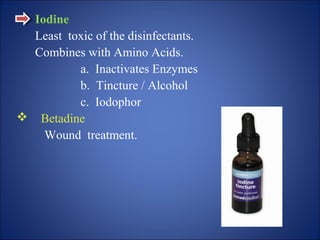
Iodine
Least toxic of the disinfectants.
Combines with Amino Acids.
a. Inactivates Enzymes
b. Tincture / Alcohol
c. Iodophor
 Betadine
Wound treatment.
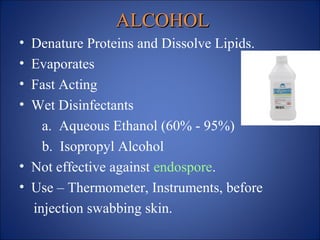
ALCOHOL
ALCOHOL
• Denature Proteins and Dissolve Lipids.
• Evaporates
• Fast Acting
• Wet Disinfectants
a. Aqueous Ethanol (60% - 95%)
b. Isopropyl Alcohol
• Not effective against endospore.
• Use – Thermometer, Instruments, before
injection swabbing skin.
HEAVY METALS
HEAVY METALS
• Silver, Mercury – germicidal or antiseptic
• Silver nitrate – prevent gonococcal eye infections.
• Copper sulfate – Algicide
• Mercurochrome – Disinfects skin and mucus membrane.
• Used for Burn Treatment
- Denature Proteins
- Example / Silvadene Ointment / Silver
• Mercuric chloride – Bacteriostatic
• Copper sulphate – destroy green algae in reservoirs.
• Zinc chloride – ingredients in mouth washes.
• Zinc oxide – anti fungal in paints.
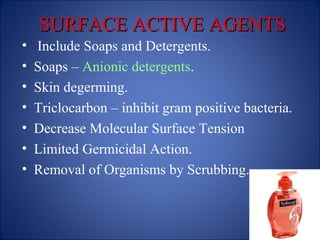
SURFACE ACTIVE AGENTS
• Include Soaps and Detergents.
• Soaps – Anionic detergents.
• Skin degerming.
• Triclocarbon – inhibit gram positive bacteria.
• Decrease Molecular Surface Tension
• Limited Germicidal Action.
• Removal of Organisms by Scrubbing.
CATIONIC DETERGENTS
CATIONIC DETERGENTS
• Quaternary Ammonium Compounds (QUATS)
- Cationic Detergents Attached to NH4
+
- Disrupt Plasma Membranes
- Most Effective on Gram-Positive Bacteria
• Enzyme inhibition, protein denaturation.
• Fungicide, Amoebocide.
• Two popular QUATS – Zephiran.
• Cepacol – Anti microbial
ORGANIC ACIDS
ORGANIC ACIDS
Chemical Food Preservatives
- Sorbic Acid
- Benzoic Acid Inhibit Fungus
- Propionic Acid
- Nitrate and Nitrite Salts / Meats
• To Prevent Germination of Clostridium
botulinum endospores.
• Calcium Propionate – Bread
Aldehydes
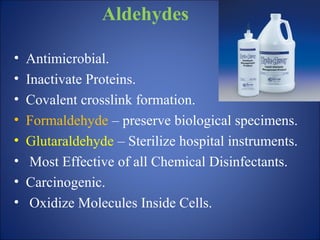
• Antimicrobial.
• Inactivate Proteins.
• Covalent crosslink formation.
• Formaldehyde – preserve biological specimens.
• Glutaraldehyde – Sterilize hospital instruments.
• Most Effective of all Chemical Disinfectants.
• Carcinogenic.
• Oxidize Molecules Inside Cells.
Antibiotics
 Used to Preserve Cheese.
 Used in Feed Given to Food Animals.
arya-ppt-141210223424-conversion-gate01 (4).pdf

arya-ppt-141210223424-conversion-gate01 (4).pdf

  • 2.
    Control of Microorganisms Controlof Microorganisms Various Physical & Chemical Various Physical & Chemical Methods Methods
  • 3.
    Many microorganisms arebeneficial. Many microorganisms are beneficial. Some are harmful. Some are harmful. Microbial activities – food spoilage and disease. Microbial activities – food spoilage and disease. Introduced concept of microbial control Introduced concept of microbial control Ignaz Semmel Weis Ignaz Semmel Weis [ Hungarian Physician ] [ Hungarian Physician ] Joseph Lister Joseph Lister [ English Physician] [ English Physician]  Microbial growth controlled by Microbial growth controlled by physical physical & & chemical chemical methods. methods. Kill or inhibit growth. Kill or inhibit growth.
  • 4.
    TERMINOLOGY RELATED TOTHE CONTROL OF MICROBIAL GROWTH • Sterilization: A treatment that kills or removes all living cells, including viruses and spores, from a substance or object. • Disinfection: A treatment that reduces the total number of microbes on an object or surface, but does not necessarily remove or kill all of the microbes (Chlorination). • Sanitation: Reduction of the microbial population to levels considered safe by public health standards.
  • 5.
  • 6.
    • Antiseptic: Amild disinfectant agent suitable for use on skin surfaces. • Germicide: “the agent kills” microbes. For example, a bactericide agent kills bacteria, fungicide, virucide, sporocide. • Bacteriostatic: “the agent inhibits growth.” For example, a fungi static agent inhibits the growth of fungi, but doesn’t necessarily kill it. ( Refrigeration) • Degerming: Removal of microbes from skin. • Antimicrobial Agent: Agent kills micro -organisms or inhibit their growth.
  • 7.
  • 8.
     Conditions influencing 1.Temperature 2. Type of Microbe 3. Physical State  Actions Kill Inhibit Microbes Damage Plasma Membrane  Gram Positive Bacteria – Disinfectants and antiseptics greater effect.  Gram Negative Bacteria – Pseudomonads grow in some disinfectants and antiseptics.  Endospores resistant to chemical agents & physical methods.
  • 9.
    PHYSICAL METHODS PHYSICAL METHODS •Damaging cell components. • Enzymes, DNA, Cytoplasmic membranes disrupt. Used in food industry. Preparation of culture media lab ware, sterilization of instrument.
  • 10.
  • 11.
    HEAT HEAT Kills microbes bydenaturing enzymes. Heat resistance varies among different microbes. Thermal Death Point (TDP) Thermal Death Time (TDT) Decimal Reduction Time (DRT)
  • 12.
    Thermal Thermal Death Death Point Point Thermal Death Point(TDP) • Lowest temperature to kill all the bacteria in 10 minutes. • Thermal death is useful in purifying water. • Boiling - Kills many Vegetative Cells. • Inactivates Viruses Within 10 Minutes • No effect on spores.
  • 13.
    Thermal Death Time ThermalDeath Time Thermal Death Time (TDT) • Time required to kill all the bacteria at a given temperature. • Developed for food canning. • Applications in cosmetics and pharmaceuticals.
  • 14.
    Decimal Reduction Time DecimalReduction Time Decimal Reduction Time (DRT) • Length of time. • 90% of a bacterial population killed at a given temperature • Reduces the number of organisms to 1/10 the initial level. • Used in Commercial Sterilization.
  • 15.
    Rate of MicrobialDeath Rate of Microbial Death • Bacteria usually die at a Constant Rate . • Plotted logarithmically this will give a Straight Line
  • 16.
  • 17.
    PASTEURIZATION • Process usedin preserving heat sensitive foods. • Milk, beer, and other beverages. • 63 °C for 30 Minutes. • Wine - Pasteur • Milk - VH & F soxhlet . • Reduction of microorganism in milk. • Pasteurization is not a method of sterilization.
  • 18.
    Two different process •High Temperature Short Time (HTST) process - 72°C for 15s ( Quick heating and cooling). • Ultra High Temperature (UHT) sterilization - heating at 140°C for 3 seconds. • Milk kept at room temperature for 2 months. • Minimal changes in flavor. • Equivalent Treatments – Different methods produce same effect. • Mycobacterium – Tuberculosis
  • 19.
    Low Temperatures Low Temperatures •Decreasing temperature decreases chemical activity. • Low Temperature are Not Bactericidal. • Restrict enzyme activity. • Ordinary Refrigerator Temperature 0° – 7°C . • Do not Reproduce. • Survive, Restrict rate of growth. • Use – Food Preservation, Drug, Culture Preservation.
  • 20.
    DRY HEAT STERILIZATION DirectFlaming – Burning contaminants Incineration - Burns and Physically Destroys Organisms Used for a. Needles b. Inoculating Wires c. Glassware d. Body Parts Hot Air Sterilization – Oxidation 160° C for 2 Hours or 170° C for 1 hour Used for a. Objects That Won’t Melt b. Glassware c. Metal
  • 21.
    FILTRATION FILTRATION • The passageof a liquid or gas through a filter with pores small enough to retain microbes. • Separate bacteria from suspending liquid. • Filter – Nitrocellulose, acetate. • Bacteria, virus large protein. • High efficiency particulate air filters. • Filterable viruses.
  • 22.
    Two types ofFilters:- • Depth Filters – Fibrous or granular material. • Thick layer filled with twisting channels. • Microorganisms sucked through thick layer. • Microbes removed by physical screening. • Membrane filters – Circular filters • Porous membrane – 0.1mm thick • Made of cellulose acetate, cellulose nitrate, polycarbonate. • Variety of pore size.
  • 23.
    HEPA FILTERS HEPA FILTERS •HEPA filters - High-Efficiency Particulate Air Filters • Filtration of small particles. • Capture a minimum of 99.97% of 0.3 microns contaminants.
  • 24.
    HEPA Filters HEPA Filters •Filtration is the primary method of eliminating pathogens from the air supply. 1. Operating Rooms 2. Burn Units 3. Hospitals, Surgical Mask. 4. Pharmaceutical Manufacturing Facilities
  • 25.
    DESICCATION DESICCATION • Removing waterfrom microbes. • Viruses & Endospores can resist. • Disruption of metabolism. • Use – Food Preservation. • Stops Growth / Microbes are still viable. • Freeze-drying ( Lyophilization) – remove water from specimen. • Gonorrhea bacterium – with stand for only 1 hour. • Tuberculosis bacterium – viable for months ( Mycolic acid). • Powdered milk – 85% water is removed.
  • 26.
    OSMOTIC PRESSURE OSMOTIC PRESSURE •Plasmolysis • High zone of salt & sugar. • Salt – Preservation of fish, meat, food. • High osmotic pressure. • Low availability of sugar solution to prevent microbial growth. • Honey, high sugar content preserved. • Loss of H2O.
  • 27.
    RADIATION RADIATION  Its Efficiencyis Dependent on the Wavelength,  Intensity, and Duration. Two types :- Ionizing  Destruction of DNA by gamma rays & high energy electron beams.  Use – Sterilizing pharmaceuticals medical & dental supplies. Food preservation and other industrial processes.  More penetrating.  Food is exposed to high levels of radiation to kill insects, bacteria and mold.
  • 28.
    Non – Ionizing Damage to DNA by UV light.  Effective germicide wave length 260nm.  Poor penetration  UV radiation is only useful for disinfecting outer surfaces.
  • 29.
    Chemical Control Methods ChemicalControl Methods • Phenols and Phenolics • Halogens • Alcohols • Heavy Metals and Their Compounds • Surface-Active Agents • Quaternary Ammonium Compounds • Chemical Food Preservatives • Aldehydes • Antibiotics
  • 30.
    Types of Disinfectants Typesof Disinfectants  Phenols and Phenolics Another Name for Carbolic Acid / Lysol / Pine-Sol - Joseph Lister - Exert Influence By 1. Injuring Plasma membranes 2. Inactivating Enzymes 3. Denaturing Proteins Use – Skin surface, Environmental surface, Instruments, Mucous membranes. Common – Cresols, Hexachlorophene. Phenolics are Long Lasting. No Effect on Spores. Effective antibacterial agents, fungi and many viruses.
  • 31.
    CHLORHEXIDINE CHLORHEXIDINE • Damages plasmamembranes. • Use – Skin degerming, Surgical scrubs. • Only Operates in Narrow pH Range (5-7).
  • 32.
    HALOGENS HALOGENS  Can beUsed Alone or in Solution.  Inactivated by Sunlight  Alter cellular component.  Inactive enzymes. Chlorine - Purifies Drinking Water - 2-4 Drops of Chlorine per Liter / 30 Min - Forms an Acid - hypochlorous acid – Bactericidal - Gaseous form or in Solution as Calcium Hypochlorite. - Good disinfectants on clean surfaces. - Inexpensive / Chlorox. - Never Mix with Other Cleaning Agents! - Kills legionella species ( Legionella Pneumophila Bacteria ).
  • 33.
    Iodine Least toxic ofthe disinfectants. Combines with Amino Acids. a. Inactivates Enzymes b. Tincture / Alcohol c. Iodophor  Betadine Wound treatment.
  • 34.
    ALCOHOL ALCOHOL • Denature Proteinsand Dissolve Lipids. • Evaporates • Fast Acting • Wet Disinfectants a. Aqueous Ethanol (60% - 95%) b. Isopropyl Alcohol • Not effective against endospore. • Use – Thermometer, Instruments, before injection swabbing skin.
  • 35.
    HEAVY METALS HEAVY METALS •Silver, Mercury – germicidal or antiseptic • Silver nitrate – prevent gonococcal eye infections. • Copper sulfate – Algicide • Mercurochrome – Disinfects skin and mucus membrane. • Used for Burn Treatment - Denature Proteins - Example / Silvadene Ointment / Silver • Mercuric chloride – Bacteriostatic • Copper sulphate – destroy green algae in reservoirs. • Zinc chloride – ingredients in mouth washes. • Zinc oxide – anti fungal in paints.
  • 36.
    SURFACE ACTIVE AGENTS SURFACEACTIVE AGENTS • Include Soaps and Detergents. • Soaps – Anionic detergents. • Skin degerming. • Triclocarbon – inhibit gram positive bacteria. • Decrease Molecular Surface Tension • Limited Germicidal Action. • Removal of Organisms by Scrubbing.
  • 37.
    CATIONIC DETERGENTS CATIONIC DETERGENTS •Quaternary Ammonium Compounds (QUATS) - Cationic Detergents Attached to NH4 + - Disrupt Plasma Membranes - Most Effective on Gram-Positive Bacteria • Enzyme inhibition, protein denaturation. • Fungicide, Amoebocide. • Two popular QUATS – Zephiran. • Cepacol – Anti microbial
  • 38.
    ORGANIC ACIDS ORGANIC ACIDS ChemicalFood Preservatives - Sorbic Acid - Benzoic Acid Inhibit Fungus - Propionic Acid - Nitrate and Nitrite Salts / Meats • To Prevent Germination of Clostridium botulinum endospores. • Calcium Propionate – Bread
  • 39.
    Aldehydes • Antimicrobial. • InactivateProteins. • Covalent crosslink formation. • Formaldehyde – preserve biological specimens. • Glutaraldehyde – Sterilize hospital instruments. • Most Effective of all Chemical Disinfectants. • Carcinogenic. • Oxidize Molecules Inside Cells.
  • 40.
    Antibiotics  Used toPreserve Cheese.  Used in Feed Given to Food Animals.