
Copyright © 2002, 1998, Elsevier Science (USA). All rights reserved.
Antihypertensive AgentsAntihypertensive Agents
Copyright © 2002, 1998, Elsevier Science (USA). All rights reserved.
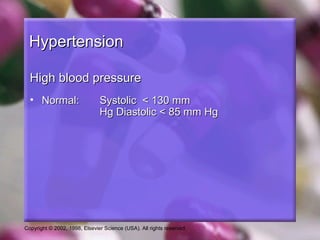
HypertensionHypertension
High blood pressureHigh blood pressure
• Normal:Normal: Systolic < 130 mmSystolic < 130 mm
Hg Diastolic < 85 mm HgHg Diastolic < 85 mm Hg
Copyright © 2002, 1998, Elsevier Science (USA). All rights reserved.
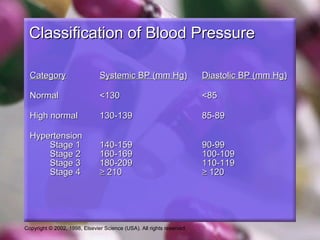
Classification of Blood PressureClassification of Blood Pressure
CategoryCategory Systemic BP (mm Hg)Systemic BP (mm Hg) Diastolic BP (mm Hg)Diastolic BP (mm Hg)
NormalNormal <130<130 <85<85
High normalHigh normal 130-139130-139 85-8985-89
HypertensionHypertension
Stage 1Stage 1 140-159140-159 90-9990-99
Stage 2Stage 2 160-169160-169 100-109100-109
Stage 3Stage 3 180-209180-209 110-119110-119
Stage 4Stage 4 ≥≥ 210210 ≥≥ 120120
Copyright © 2002, 1998, Elsevier Science (USA). All rights reserved.
Classification of Blood PressureClassification of Blood Pressure
Primary HypertensionPrimary Hypertension
• Specific cause unknownSpecific cause unknown
• 90% of the cases90% of the cases
• Also known as essential or idiopathic hypertensionAlso known as essential or idiopathic hypertension
Secondary HypertensionSecondary Hypertension
• Cause is known (such as eclampsia of pregnancy,Cause is known (such as eclampsia of pregnancy,
renal artery disease, pheochromocytoma)renal artery disease, pheochromocytoma)
• 10% of the cases10% of the cases
Copyright © 2002, 1998, Elsevier Science (USA). All rights reserved.
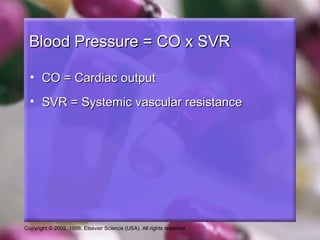
Blood Pressure = CO x SVRBlood Pressure = CO x SVR
• CO = Cardiac outputCO = Cardiac output
• SVR = Systemic vascular resistanceSVR = Systemic vascular resistance
Copyright © 2002, 1998, Elsevier Science (USA). All rights reserved.
Instructors may want to insertInstructors may want to insert
EIC Image #69:EIC Image #69:
Blood Pressure: Normal RegulationBlood Pressure: Normal Regulation
Copyright © 2002, 1998, Elsevier Science (USA). All rights reserved.
Antihypertensive AgentsAntihypertensive Agents
• Medications used to treat hypertensionMedications used to treat hypertension
Copyright © 2002, 1998, Elsevier Science (USA). All rights reserved.
Antihypertensive Agents: CategoriesAntihypertensive Agents: Categories
• Adrenergic agentsAdrenergic agents
• Angiotensin-converting enzyme inhibitorsAngiotensin-converting enzyme inhibitors
• Angiotensin II receptor blockersAngiotensin II receptor blockers
• Calcium channel blockersCalcium channel blockers
• DiureticsDiuretics
• VasodilatorsVasodilators
Copyright © 2002, 1998, Elsevier Science (USA). All rights reserved.
Antihypertensive Agents: CategoriesAntihypertensive Agents: Categories
• Adrenergic AgentsAdrenergic Agents
– Alpha1 blockersAlpha1 blockers
– Beta blockers (cardioselective and nonselective)Beta blockers (cardioselective and nonselective)
– Centrally acting alpha blockersCentrally acting alpha blockers
– Combined alpha-beta blockersCombined alpha-beta blockers
– Peripheral-acting adrenergic agentsPeripheral-acting adrenergic agents
Copyright © 2002, 1998, Elsevier Science (USA). All rights reserved.
Antihypertensive Agents:Antihypertensive Agents:
Mechanism of ActionMechanism of Action
Adrenergic AgentsAdrenergic Agents
Alpha1 Blockers (peripherally acting)Alpha1 Blockers (peripherally acting)
• Block the alpha1-adrenergic receptorsBlock the alpha1-adrenergic receptors
• The SNS is not stimulatedThe SNS is not stimulated
Result: DECREASED blood pressureResult: DECREASED blood pressure
• Stimulation of alpha1-adrenergic receptorsStimulation of alpha1-adrenergic receptors
causes HYPERtensioncauses HYPERtension
• Blocking alpha1-adrenergic receptors causesBlocking alpha1-adrenergic receptors causes
decreased blood pressuredecreased blood pressure
Copyright © 2002, 1998, Elsevier Science (USA). All rights reserved.
Antihypertensive Agents:Antihypertensive Agents:
Adrenergic AgentsAdrenergic Agents
Alpha1 BlockersAlpha1 Blockers
• doxazosin (Cardura)doxazosin (Cardura)
• prazosin (Minipress)prazosin (Minipress)
• terazosin (Hytrin)terazosin (Hytrin)
Copyright © 2002, 1998, Elsevier Science (USA). All rights reserved.
Antihypertensive Agents:Antihypertensive Agents:
Mechanism of ActionMechanism of Action
Adrenergic AgentsAdrenergic Agents
Central-Acting AdrenergicsCentral-Acting Adrenergics
• Stimulate alpha2-adrenergic receptorsStimulate alpha2-adrenergic receptors
• Sympathetic outflow from the CNS is decreasedSympathetic outflow from the CNS is decreased
Result: decreased blood pressureResult: decreased blood pressure
Copyright © 2002, 1998, Elsevier Science (USA). All rights reserved.
Antihypertensive Agents:Antihypertensive Agents:
Adrenergic AgentsAdrenergic Agents
Central-Acting AdrenergicsCentral-Acting Adrenergics
• clonidine (Catapres)clonidine (Catapres)
• methyldopa (Aldomet)methyldopa (Aldomet)
(drug of choice for hypertension in pregnancy)(drug of choice for hypertension in pregnancy)
Copyright © 2002, 1998, Elsevier Science (USA). All rights reserved.
Antihypertensive Agents:Antihypertensive Agents:
Mechanism of ActionMechanism of Action
Adrenergic AgentsAdrenergic Agents
Adrenergic Neuronal BlockersAdrenergic Neuronal Blockers
(peripherally acting)(peripherally acting)
• Inhibit release of norepinephrineInhibit release of norepinephrine
• Also deplete norepinephrine storesAlso deplete norepinephrine stores
• SNS (peripheral adrenergic nerves) is not stimulatedSNS (peripheral adrenergic nerves) is not stimulated
Result: decreased blood pressureResult: decreased blood pressure
Copyright © 2002, 1998, Elsevier Science (USA). All rights reserved.
Antihypertensive Agents:Antihypertensive Agents:
Adrenergic AgentsAdrenergic Agents
Adrenergic Neuronal BlockersAdrenergic Neuronal Blockers
(peripherally acting)(peripherally acting)
• reserpinereserpine
• guanadrel (Hylorel)guanadrel (Hylorel)
• guanethidine (Ismelin)guanethidine (Ismelin)
Copyright © 2002, 1998, Elsevier Science (USA). All rights reserved.
Antihypertensive Agents:Antihypertensive Agents:
Adrenergic AgentsAdrenergic Agents
Therapeutic UsesTherapeutic Uses
• Alpha1 blockers (peripherally acting)Alpha1 blockers (peripherally acting)
– Treatment of hypertensionTreatment of hypertension
– Relief of symptoms of BPHRelief of symptoms of BPH
– Management of of severe CHF when usedManagement of of severe CHF when used
with cardiac glycosides and diureticswith cardiac glycosides and diuretics
Copyright © 2002, 1998, Elsevier Science (USA). All rights reserved.
Antihypertensive Agents:Antihypertensive Agents:
Adrenergic AgentsAdrenergic Agents
Therapeutic UsesTherapeutic Uses
• Central-Acting AdrenergicsCentral-Acting Adrenergics
– Treatment of hypertension, either alone orTreatment of hypertension, either alone or
with other agentswith other agents
– Usually used after other agents have failedUsually used after other agents have failed
due to side effectsdue to side effects
– Also may be used for treatment of severeAlso may be used for treatment of severe
dysmenorrhea, menopausal flushing, glaucomadysmenorrhea, menopausal flushing, glaucoma
– Clonidine is useful in the management ofClonidine is useful in the management of
withdrawal symptoms in opioid- or nicotine-withdrawal symptoms in opioid- or nicotine-
dependent personsdependent persons
Copyright © 2002, 1998, Elsevier Science (USA). All rights reserved.
Antihypertensive Agents:Antihypertensive Agents:
Adrenergic AgentsAdrenergic Agents
Therapeutic UsesTherapeutic Uses
• Adrenergic neuronal blockersAdrenergic neuronal blockers
(peripherally acting)(peripherally acting)
– Treatment of hypertension, either alone or withTreatment of hypertension, either alone or with
other agentsother agents
– Seldom used because of frequent side effectsSeldom used because of frequent side effects
Copyright © 2002, 1998, Elsevier Science (USA). All rights reserved.
Antihypertensive Agents:Antihypertensive Agents:
Adrenergic AgentsAdrenergic Agents
Side EffectsSide Effects
Most common:Most common: dry mouthdry mouth drowsinessdrowsiness
sedationsedation constipationconstipation
Other:Other: headachesheadaches sleep disturbancessleep disturbances
nauseanausea rashrash
cardiac disturbances (palpitations)cardiac disturbances (palpitations)
HIGH INCIDENCE OF ORTHOSTATIC HYPOTENSIONHIGH INCIDENCE OF ORTHOSTATIC HYPOTENSION
Copyright © 2002, 1998, Elsevier Science (USA). All rights reserved.
Antihypertensive Agents:Antihypertensive Agents:
CategoriesCategories
Angiotensin-Converting Enzyme InhibitorsAngiotensin-Converting Enzyme Inhibitors
(ACE Inhibitors)(ACE Inhibitors)
• Large group of safe and effective drugsLarge group of safe and effective drugs
• Often used as first-line agents for CHFOften used as first-line agents for CHF
and hypertensionand hypertension
• May be combined with a thiazide diureticMay be combined with a thiazide diuretic
or calcium channel blockeror calcium channel blocker
Copyright © 2002, 1998, Elsevier Science (USA). All rights reserved.
Antihypertensive Agents:Antihypertensive Agents:
Mechanism of ActionMechanism of Action
ACE InhibitorsACE Inhibitors
RAAS: Renin Angiotensin-Aldosterone SystemRAAS: Renin Angiotensin-Aldosterone System
• When the enzyme angiotensin I is converted toWhen the enzyme angiotensin I is converted to
angiotensin II, the result is potent vasoconstrictionangiotensin II, the result is potent vasoconstriction
and stimulation of aldosteroneand stimulation of aldosterone
• Result of vasoconstriction: increased systemicResult of vasoconstriction: increased systemic
vascular resistance and increased afterloadvascular resistance and increased afterload
• Therefore, increased BPTherefore, increased BP
Copyright © 2002, 1998, Elsevier Science (USA). All rights reserved.
Antihypertensive Agents:Antihypertensive Agents:
Mechanism of ActionMechanism of Action
ACE InhibitorsACE Inhibitors
• Aldosterone stimulates water and sodium resorption.Aldosterone stimulates water and sodium resorption.
• Result: increased blood volume, increased preload,Result: increased blood volume, increased preload,
and increased Band increased B
Copyright © 2002, 1998, Elsevier Science (USA). All rights reserved.
Antihypertensive Agents:Antihypertensive Agents:
Mechanism of ActionMechanism of Action
ACE InhibitorsACE Inhibitors
• ACE Inhibitors block the angiotensin-convertingACE Inhibitors block the angiotensin-converting
enzyme, thus preventing the formation ofenzyme, thus preventing the formation of
angiotensin II.angiotensin II.
• Also prevent the breakdown of the vasodilatingAlso prevent the breakdown of the vasodilating
substance, bradykininsubstance, bradykinin
Result: decreased systemic vascular resistance (afterload),Result: decreased systemic vascular resistance (afterload),
vasodilation, and therefore, decreased blood pressurevasodilation, and therefore, decreased blood pressure
Copyright © 2002, 1998, Elsevier Science (USA). All rights reserved.
Antihypertensive AgentsAntihypertensive Agents
ACE InhibitorsACE Inhibitors
• captopril (Capoten)captopril (Capoten)
• Short half-life, must be dosed more frequentlyShort half-life, must be dosed more frequently
than othersthan others
• enalapril (Vasotec)enalapril (Vasotec)
• The only ACE inhibitor available in oral andThe only ACE inhibitor available in oral and
parenteral formsparenteral forms
• lisinopril (Prinivil and Zestril) and quinapril (Accupril)lisinopril (Prinivil and Zestril) and quinapril (Accupril)
• Newer agents, long half-lives, once-a-day dosingNewer agents, long half-lives, once-a-day dosing
• Several other agents availableSeveral other agents available
Copyright © 2002, 1998, Elsevier Science (USA). All rights reserved.
Antihypertensive Agents:Antihypertensive Agents:
Therapeutic UsesTherapeutic Uses
ACE InhibitorsACE Inhibitors
• HypertensionHypertension
• CHF (either alone or in combination with diureticsCHF (either alone or in combination with diuretics
or other agents)or other agents)
• Slows progression of left ventricular hypertrophySlows progression of left ventricular hypertrophy
after an MIafter an MI
• Renal protective effects in patients with diabetesRenal protective effects in patients with diabetes
Drugs of choice in hypertensive patients with CHFDrugs of choice in hypertensive patients with CHF
Copyright © 2002, 1998, Elsevier Science (USA). All rights reserved.
Antihypertensive Agents:Antihypertensive Agents:
Side EffectsSide Effects
ACE InhibitorsACE Inhibitors
• FatigueFatigue DizzinessDizziness
• HeadacheHeadache Mood changesMood changes
• Impaired tasteImpaired taste
Dry, nonproductive cough, reverses when therapy is stoppedDry, nonproductive cough, reverses when therapy is stopped
NOTE: first-dose hypotensive effect may occur!!NOTE: first-dose hypotensive effect may occur!!
Copyright © 2002, 1998, Elsevier Science (USA). All rights reserved.
Antihypertensive Agents:Antihypertensive Agents:
CategoriesCategories
Angiotensin II Receptor BlockersAngiotensin II Receptor Blockers
(A II Blockers or ARBs)(A II Blockers or ARBs)
• Newer classNewer class
• Well-toleratedWell-tolerated
• Do not cause coughingDo not cause coughing
Copyright © 2002, 1998, Elsevier Science (USA). All rights reserved.
Antihypertensive Agents:Antihypertensive Agents:
Mechanism of ActionMechanism of Action
Angiotensin II Receptor BlockersAngiotensin II Receptor Blockers
• Allow angiotensin I to be converted to angiotensin II,Allow angiotensin I to be converted to angiotensin II,
but block the receptors that receive angiotensin IIbut block the receptors that receive angiotensin II
• Block vasoconstriction and release of aldosteroneBlock vasoconstriction and release of aldosterone
Copyright © 2002, 1998, Elsevier Science (USA). All rights reserved.
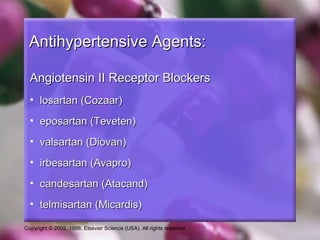
Antihypertensive Agents:Antihypertensive Agents:
Angiotensin II Receptor BlockersAngiotensin II Receptor Blockers
• losartan (Cozaar)losartan (Cozaar)
• eposartan (Teveten)eposartan (Teveten)
• valsartan (Diovan)valsartan (Diovan)
• irbesartan (Avapro)irbesartan (Avapro)
• candesartan (Atacand)candesartan (Atacand)
• telmisartan (Micardis)telmisartan (Micardis)
Copyright © 2002, 1998, Elsevier Science (USA). All rights reserved.
Antihypertensive Agents:Antihypertensive Agents:
Therapeutic UsesTherapeutic Uses
Angiotensin II Receptor BlockersAngiotensin II Receptor Blockers
• HypertensionHypertension
• Adjunctive agents for the treatment of CHFAdjunctive agents for the treatment of CHF
• May be used alone or with other agents suchMay be used alone or with other agents such
as diureticsas diuretics
Copyright © 2002, 1998, Elsevier Science (USA). All rights reserved.
Antihypertensive Agents:Antihypertensive Agents:
Side EffectsSide Effects
Angiotensin II Receptor BlockersAngiotensin II Receptor Blockers
• Upper respiratory infectionsUpper respiratory infections
• HeadacheHeadache
• May cause occasional dizziness, inability to sleep,May cause occasional dizziness, inability to sleep,
diarrhea, dyspnea, heartburn, nasal congestion,diarrhea, dyspnea, heartburn, nasal congestion,
back pain, fatigueback pain, fatigue
Copyright © 2002, 1998, Elsevier Science (USA). All rights reserved.
Antihypertensive Agents:Antihypertensive Agents:
CategoriesCategories
Calcium Channel BlockersCalcium Channel Blockers
• BenzothiazepinesBenzothiazepines
• DihydropyridinesDihydropyridines
• PhenylalkylaminesPhenylalkylamines
Copyright © 2002, 1998, Elsevier Science (USA). All rights reserved.
Antihypertensive Agents:Antihypertensive Agents:
Mechanism of ActionMechanism of Action
Calcium Channel BlockersCalcium Channel Blockers
• Cause smooth muscle relaxation by blocking theCause smooth muscle relaxation by blocking the
binding of calcium to its receptors, preventingbinding of calcium to its receptors, preventing
muscle contractionmuscle contraction
• This causes decreased peripheral smooth muscleThis causes decreased peripheral smooth muscle
tone, decreased systemic vascular resistancetone, decreased systemic vascular resistance
• Result: decreased blood pressureResult: decreased blood pressure
Copyright © 2002, 1998, Elsevier Science (USA). All rights reserved.
Antihypertensive AgentsAntihypertensive Agents
Calcium Channel BlockersCalcium Channel Blockers
• Benzothiazepines:Benzothiazepines:
– diltiazem (Cardizem, Dilacor)diltiazem (Cardizem, Dilacor)
• Phenylalkamines:Phenylalkamines:
– verapamil (Calan, Isoptin)verapamil (Calan, Isoptin)
• Dihydropyridines:Dihydropyridines:
– amlodipine (Norvasc), bepridil (Vascor),amlodipine (Norvasc), bepridil (Vascor),
nicardipine (Cardene)nicardipine (Cardene)
– nifedipine (Procardia), nimodipine (Nimotop)nifedipine (Procardia), nimodipine (Nimotop)
Copyright © 2002, 1998, Elsevier Science (USA). All rights reserved.
Antihypertensive Agents:Antihypertensive Agents:
Therapeutic UsesTherapeutic Uses
Calcium Channel BlockersCalcium Channel Blockers
• AnginaAngina
• HypertensionHypertension
• DysrhythmiasDysrhythmias
• Migraine headachesMigraine headaches
Copyright © 2002, 1998, Elsevier Science (USA). All rights reserved.
Antihypertensive Agents:Antihypertensive Agents:
Side EffectsSide Effects
Calcium Channel BlockersCalcium Channel Blockers
• CardiovascularCardiovascular
– hypotension, palpitations, tachycardiahypotension, palpitations, tachycardia
• GastrointestinalGastrointestinal
– constipation, nauseaconstipation, nausea
• OtherOther
– rash, flushing, peripheral edema, dermatitisrash, flushing, peripheral edema, dermatitis
Copyright © 2002, 1998, Elsevier Science (USA). All rights reserved.
Antihypertensive Agents: DiureticsAntihypertensive Agents: Diuretics
• Decrease the plasma and extracellular fluid volumesDecrease the plasma and extracellular fluid volumes
• Results:Results: decreased preloaddecreased preload
decreased cardiac outputdecreased cardiac output
decreased total peripheral resistancedecreased total peripheral resistance
• Overall effect:Overall effect: decreased workload of the heart,decreased workload of the heart,
and decreased blood pressureand decreased blood pressure
Copyright © 2002, 1998, Elsevier Science (USA). All rights reserved.
Antihypertensive Agents:Antihypertensive Agents:
Mechanism of ActionMechanism of Action
VasodilatorsVasodilators
• Directly relaxes arteriolar smooth muscleDirectly relaxes arteriolar smooth muscle
• Result:Result: decreased systemic vascular response,decreased systemic vascular response,
decreased afterload, anddecreased afterload, and
PERIPHERAL VASODILATIONPERIPHERAL VASODILATION
Copyright © 2002, 1998, Elsevier Science (USA). All rights reserved.
Antihypertensive AgentsAntihypertensive Agents
VasodilatorsVasodilators
• diazoxide (Hyperstat)diazoxide (Hyperstat)
• hydralazine HCl (Apresoline)hydralazine HCl (Apresoline)
• minoxidil (Loniten, Rogaine)minoxidil (Loniten, Rogaine)
• sodium nitroprusside (Nipride, Nitropress)sodium nitroprusside (Nipride, Nitropress)
Copyright © 2002, 1998, Elsevier Science (USA). All rights reserved.
Antihypertensive Agents:Antihypertensive Agents:
Therapeutic UsesTherapeutic Uses
VasodilatorsVasodilators
• Treatment of hypertensionTreatment of hypertension
• May be used in combination with other agentsMay be used in combination with other agents
• Sodium nitroprusside and diazoxide IV are reservedSodium nitroprusside and diazoxide IV are reserved
for the management of hypertensive emergenciesfor the management of hypertensive emergencies
Copyright © 2002, 1998, Elsevier Science (USA). All rights reserved.
Antihypertensive Agents: SideAntihypertensive Agents: Side
EffectsEffects
VasodilatorsVasodilators
• Hydralazine:Hydralazine:
– dizziness, headache, anxiety, tachycardia,dizziness, headache, anxiety, tachycardia,
nausea and vomiting, diarrhea, anemia,nausea and vomiting, diarrhea, anemia,
dyspnea, edema, nasal congestiondyspnea, edema, nasal congestion
• Sodium nitroprusside:Sodium nitroprusside:
– bradycardia, hypotension, possiblebradycardia, hypotension, possible
cyanide toxicitycyanide toxicity
Copyright © 2002, 1998, Elsevier Science (USA). All rights reserved.
Antihypertensive Agents:Antihypertensive Agents:
Nursing ImplicationsNursing Implications
• Before beginning therapy, obtain a thoroughBefore beginning therapy, obtain a thorough
health history and head-to-toe physicalhealth history and head-to-toe physical
examination.examination.
• Assess for contraindications to specificAssess for contraindications to specific
antihypertensive agents.antihypertensive agents.
• Assess for conditions that require cautiousAssess for conditions that require cautious
use of these agents.use of these agents.
Copyright © 2002, 1998, Elsevier Science (USA). All rights reserved.
Antihypertensive Agents:Antihypertensive Agents:
Nursing ImplicationsNursing Implications
• Educate patients about the importance of notEducate patients about the importance of not
missing a dose and taking the medications exactlymissing a dose and taking the medications exactly
as prescribed.as prescribed.
• Patients should never double up on doses if a dosePatients should never double up on doses if a dose
is missed; check with physician for instructions onis missed; check with physician for instructions on
what to do if a dose is missed.what to do if a dose is missed.
• Monitor BP during therapy. Instruct patients toMonitor BP during therapy. Instruct patients to
keep a journal of regular BP checks.keep a journal of regular BP checks.
Copyright © 2002, 1998, Elsevier Science (USA). All rights reserved.
Antihypertensive Agents:Antihypertensive Agents:
Nursing ImplicationsNursing Implications
• Instruct patients that these drugs should not beInstruct patients that these drugs should not be
stopped abruptly, as this may cause a reboundstopped abruptly, as this may cause a rebound
hypertensive crisis, and perhaps lead to CVA.hypertensive crisis, and perhaps lead to CVA.
• Oral forms should be given with meals so thatOral forms should be given with meals so that
absorption is more gradual and effective.absorption is more gradual and effective.
• Administer IV forms with extreme caution andAdminister IV forms with extreme caution and
use an IV pump.use an IV pump.
Copyright © 2002, 1998, Elsevier Science (USA). All rights reserved.
Antihypertensive Agents:Antihypertensive Agents:
Nursing ImplicationsNursing Implications
• Remind patients that medications is only part ofRemind patients that medications is only part of
therapy. Encourage patients to watch their diet,therapy. Encourage patients to watch their diet,
stress level, weight, and alcohol intake.stress level, weight, and alcohol intake.
• Patients should avoid smoking and eating foods highPatients should avoid smoking and eating foods high
in sodium.in sodium.
• Encourage supervised exercise.Encourage supervised exercise.
Copyright © 2002, 1998, Elsevier Science (USA). All rights reserved.
Antihypertensive Agents:Antihypertensive Agents:
Nursing ImplicationsNursing Implications
• Instruct patients to change positions slowly to avoidInstruct patients to change positions slowly to avoid
syncope from postural hypotension.syncope from postural hypotension.
• Patients should report unusual shortness of breath;Patients should report unusual shortness of breath;
difficulty breathing; swelling of the feet, ankles, face,difficulty breathing; swelling of the feet, ankles, face,
or around the eyes; weight gain or loss; chest pain;or around the eyes; weight gain or loss; chest pain;
palpitations; or excessive fatigue.palpitations; or excessive fatigue.
Copyright © 2002, 1998, Elsevier Science (USA). All rights reserved.
Antihypertensive Agents:Antihypertensive Agents:
Nursing ImplicationsNursing Implications
• Men taking these agents may not be aware thatMen taking these agents may not be aware that
impotence is an expected effect. This may influenceimpotence is an expected effect. This may influence
compliance with drug therapy.compliance with drug therapy.
• If patients are experiencing serious side effects,If patients are experiencing serious side effects,
or believe that the dose or medication needs toor believe that the dose or medication needs to
be changed, they should contact their physicianbe changed, they should contact their physician
immediately.immediately.
Copyright © 2002, 1998, Elsevier Science (USA). All rights reserved.
Antihypertensive Agents:Antihypertensive Agents:
Nursing ImplicationsNursing Implications
• Hot tubs, showers, or baths; hot weather; prolongedHot tubs, showers, or baths; hot weather; prolonged
sitting or standing; physical exercise; and alcoholsitting or standing; physical exercise; and alcohol
ingestion may aggravate low blood pressure,ingestion may aggravate low blood pressure,
leading to fainting and injury. Patients shouldleading to fainting and injury. Patients should
sit or lie down until symptoms subside.sit or lie down until symptoms subside.
• Patients should not take any other medications,Patients should not take any other medications,
including OTC drugs, without first getting theincluding OTC drugs, without first getting the
approval of their physician.approval of their physician.
Copyright © 2002, 1998, Elsevier Science (USA). All rights reserved.
Antihypertensive Agents:Antihypertensive Agents:
Nursing ImplicationsNursing Implications
• Monitor for side/adverse effectsMonitor for side/adverse effects
(dizziness, orthostatic hypotension, fatigue)(dizziness, orthostatic hypotension, fatigue)
and for toxic effects.and for toxic effects.
• Monitor for therapeutic effectsMonitor for therapeutic effects
• Blood pressure should be maintained at lessBlood pressure should be maintained at less
than 140/90 mm Hgthan 140/90 mm Hg

anti hypertensives

  • 1.
    Copyright © 2002,1998, Elsevier Science (USA). All rights reserved. Antihypertensive AgentsAntihypertensive Agents
  • 2.
    Copyright © 2002,1998, Elsevier Science (USA). All rights reserved. HypertensionHypertension High blood pressureHigh blood pressure • Normal:Normal: Systolic < 130 mmSystolic < 130 mm Hg Diastolic < 85 mm HgHg Diastolic < 85 mm Hg
  • 3.
    Copyright © 2002,1998, Elsevier Science (USA). All rights reserved. Classification of Blood PressureClassification of Blood Pressure CategoryCategory Systemic BP (mm Hg)Systemic BP (mm Hg) Diastolic BP (mm Hg)Diastolic BP (mm Hg) NormalNormal <130<130 <85<85 High normalHigh normal 130-139130-139 85-8985-89 HypertensionHypertension Stage 1Stage 1 140-159140-159 90-9990-99 Stage 2Stage 2 160-169160-169 100-109100-109 Stage 3Stage 3 180-209180-209 110-119110-119 Stage 4Stage 4 ≥≥ 210210 ≥≥ 120120
  • 4.
    Copyright © 2002,1998, Elsevier Science (USA). All rights reserved. Classification of Blood PressureClassification of Blood Pressure Primary HypertensionPrimary Hypertension • Specific cause unknownSpecific cause unknown • 90% of the cases90% of the cases • Also known as essential or idiopathic hypertensionAlso known as essential or idiopathic hypertension Secondary HypertensionSecondary Hypertension • Cause is known (such as eclampsia of pregnancy,Cause is known (such as eclampsia of pregnancy, renal artery disease, pheochromocytoma)renal artery disease, pheochromocytoma) • 10% of the cases10% of the cases
  • 5.
    Copyright © 2002,1998, Elsevier Science (USA). All rights reserved. Blood Pressure = CO x SVRBlood Pressure = CO x SVR • CO = Cardiac outputCO = Cardiac output • SVR = Systemic vascular resistanceSVR = Systemic vascular resistance
  • 6.
    Copyright © 2002,1998, Elsevier Science (USA). All rights reserved. Instructors may want to insertInstructors may want to insert EIC Image #69:EIC Image #69: Blood Pressure: Normal RegulationBlood Pressure: Normal Regulation
  • 7.
    Copyright © 2002,1998, Elsevier Science (USA). All rights reserved. Antihypertensive AgentsAntihypertensive Agents • Medications used to treat hypertensionMedications used to treat hypertension
  • 8.
    Copyright © 2002,1998, Elsevier Science (USA). All rights reserved. Antihypertensive Agents: CategoriesAntihypertensive Agents: Categories • Adrenergic agentsAdrenergic agents • Angiotensin-converting enzyme inhibitorsAngiotensin-converting enzyme inhibitors • Angiotensin II receptor blockersAngiotensin II receptor blockers • Calcium channel blockersCalcium channel blockers • DiureticsDiuretics • VasodilatorsVasodilators
  • 9.
    Copyright © 2002,1998, Elsevier Science (USA). All rights reserved. Antihypertensive Agents: CategoriesAntihypertensive Agents: Categories • Adrenergic AgentsAdrenergic Agents – Alpha1 blockersAlpha1 blockers – Beta blockers (cardioselective and nonselective)Beta blockers (cardioselective and nonselective) – Centrally acting alpha blockersCentrally acting alpha blockers – Combined alpha-beta blockersCombined alpha-beta blockers – Peripheral-acting adrenergic agentsPeripheral-acting adrenergic agents
  • 10.
    Copyright © 2002,1998, Elsevier Science (USA). All rights reserved. Antihypertensive Agents:Antihypertensive Agents: Mechanism of ActionMechanism of Action Adrenergic AgentsAdrenergic Agents Alpha1 Blockers (peripherally acting)Alpha1 Blockers (peripherally acting) • Block the alpha1-adrenergic receptorsBlock the alpha1-adrenergic receptors • The SNS is not stimulatedThe SNS is not stimulated Result: DECREASED blood pressureResult: DECREASED blood pressure • Stimulation of alpha1-adrenergic receptorsStimulation of alpha1-adrenergic receptors causes HYPERtensioncauses HYPERtension • Blocking alpha1-adrenergic receptors causesBlocking alpha1-adrenergic receptors causes decreased blood pressuredecreased blood pressure
  • 11.
    Copyright © 2002,1998, Elsevier Science (USA). All rights reserved. Antihypertensive Agents:Antihypertensive Agents: Adrenergic AgentsAdrenergic Agents Alpha1 BlockersAlpha1 Blockers • doxazosin (Cardura)doxazosin (Cardura) • prazosin (Minipress)prazosin (Minipress) • terazosin (Hytrin)terazosin (Hytrin)
  • 12.
    Copyright © 2002,1998, Elsevier Science (USA). All rights reserved. Antihypertensive Agents:Antihypertensive Agents: Mechanism of ActionMechanism of Action Adrenergic AgentsAdrenergic Agents Central-Acting AdrenergicsCentral-Acting Adrenergics • Stimulate alpha2-adrenergic receptorsStimulate alpha2-adrenergic receptors • Sympathetic outflow from the CNS is decreasedSympathetic outflow from the CNS is decreased Result: decreased blood pressureResult: decreased blood pressure
  • 13.
    Copyright © 2002,1998, Elsevier Science (USA). All rights reserved. Antihypertensive Agents:Antihypertensive Agents: Adrenergic AgentsAdrenergic Agents Central-Acting AdrenergicsCentral-Acting Adrenergics • clonidine (Catapres)clonidine (Catapres) • methyldopa (Aldomet)methyldopa (Aldomet) (drug of choice for hypertension in pregnancy)(drug of choice for hypertension in pregnancy)
  • 14.
    Copyright © 2002,1998, Elsevier Science (USA). All rights reserved. Antihypertensive Agents:Antihypertensive Agents: Mechanism of ActionMechanism of Action Adrenergic AgentsAdrenergic Agents Adrenergic Neuronal BlockersAdrenergic Neuronal Blockers (peripherally acting)(peripherally acting) • Inhibit release of norepinephrineInhibit release of norepinephrine • Also deplete norepinephrine storesAlso deplete norepinephrine stores • SNS (peripheral adrenergic nerves) is not stimulatedSNS (peripheral adrenergic nerves) is not stimulated Result: decreased blood pressureResult: decreased blood pressure
  • 15.
    Copyright © 2002,1998, Elsevier Science (USA). All rights reserved. Antihypertensive Agents:Antihypertensive Agents: Adrenergic AgentsAdrenergic Agents Adrenergic Neuronal BlockersAdrenergic Neuronal Blockers (peripherally acting)(peripherally acting) • reserpinereserpine • guanadrel (Hylorel)guanadrel (Hylorel) • guanethidine (Ismelin)guanethidine (Ismelin)
  • 16.
    Copyright © 2002,1998, Elsevier Science (USA). All rights reserved. Antihypertensive Agents:Antihypertensive Agents: Adrenergic AgentsAdrenergic Agents Therapeutic UsesTherapeutic Uses • Alpha1 blockers (peripherally acting)Alpha1 blockers (peripherally acting) – Treatment of hypertensionTreatment of hypertension – Relief of symptoms of BPHRelief of symptoms of BPH – Management of of severe CHF when usedManagement of of severe CHF when used with cardiac glycosides and diureticswith cardiac glycosides and diuretics
  • 17.
    Copyright © 2002,1998, Elsevier Science (USA). All rights reserved. Antihypertensive Agents:Antihypertensive Agents: Adrenergic AgentsAdrenergic Agents Therapeutic UsesTherapeutic Uses • Central-Acting AdrenergicsCentral-Acting Adrenergics – Treatment of hypertension, either alone orTreatment of hypertension, either alone or with other agentswith other agents – Usually used after other agents have failedUsually used after other agents have failed due to side effectsdue to side effects – Also may be used for treatment of severeAlso may be used for treatment of severe dysmenorrhea, menopausal flushing, glaucomadysmenorrhea, menopausal flushing, glaucoma – Clonidine is useful in the management ofClonidine is useful in the management of withdrawal symptoms in opioid- or nicotine-withdrawal symptoms in opioid- or nicotine- dependent personsdependent persons
  • 18.
    Copyright © 2002,1998, Elsevier Science (USA). All rights reserved. Antihypertensive Agents:Antihypertensive Agents: Adrenergic AgentsAdrenergic Agents Therapeutic UsesTherapeutic Uses • Adrenergic neuronal blockersAdrenergic neuronal blockers (peripherally acting)(peripherally acting) – Treatment of hypertension, either alone or withTreatment of hypertension, either alone or with other agentsother agents – Seldom used because of frequent side effectsSeldom used because of frequent side effects
  • 19.
    Copyright © 2002,1998, Elsevier Science (USA). All rights reserved. Antihypertensive Agents:Antihypertensive Agents: Adrenergic AgentsAdrenergic Agents Side EffectsSide Effects Most common:Most common: dry mouthdry mouth drowsinessdrowsiness sedationsedation constipationconstipation Other:Other: headachesheadaches sleep disturbancessleep disturbances nauseanausea rashrash cardiac disturbances (palpitations)cardiac disturbances (palpitations) HIGH INCIDENCE OF ORTHOSTATIC HYPOTENSIONHIGH INCIDENCE OF ORTHOSTATIC HYPOTENSION
  • 20.
    Copyright © 2002,1998, Elsevier Science (USA). All rights reserved. Antihypertensive Agents:Antihypertensive Agents: CategoriesCategories Angiotensin-Converting Enzyme InhibitorsAngiotensin-Converting Enzyme Inhibitors (ACE Inhibitors)(ACE Inhibitors) • Large group of safe and effective drugsLarge group of safe and effective drugs • Often used as first-line agents for CHFOften used as first-line agents for CHF and hypertensionand hypertension • May be combined with a thiazide diureticMay be combined with a thiazide diuretic or calcium channel blockeror calcium channel blocker
  • 21.
    Copyright © 2002,1998, Elsevier Science (USA). All rights reserved. Antihypertensive Agents:Antihypertensive Agents: Mechanism of ActionMechanism of Action ACE InhibitorsACE Inhibitors RAAS: Renin Angiotensin-Aldosterone SystemRAAS: Renin Angiotensin-Aldosterone System • When the enzyme angiotensin I is converted toWhen the enzyme angiotensin I is converted to angiotensin II, the result is potent vasoconstrictionangiotensin II, the result is potent vasoconstriction and stimulation of aldosteroneand stimulation of aldosterone • Result of vasoconstriction: increased systemicResult of vasoconstriction: increased systemic vascular resistance and increased afterloadvascular resistance and increased afterload • Therefore, increased BPTherefore, increased BP
  • 22.
    Copyright © 2002,1998, Elsevier Science (USA). All rights reserved. Antihypertensive Agents:Antihypertensive Agents: Mechanism of ActionMechanism of Action ACE InhibitorsACE Inhibitors • Aldosterone stimulates water and sodium resorption.Aldosterone stimulates water and sodium resorption. • Result: increased blood volume, increased preload,Result: increased blood volume, increased preload, and increased Band increased B
  • 23.
    Copyright © 2002,1998, Elsevier Science (USA). All rights reserved. Antihypertensive Agents:Antihypertensive Agents: Mechanism of ActionMechanism of Action ACE InhibitorsACE Inhibitors • ACE Inhibitors block the angiotensin-convertingACE Inhibitors block the angiotensin-converting enzyme, thus preventing the formation ofenzyme, thus preventing the formation of angiotensin II.angiotensin II. • Also prevent the breakdown of the vasodilatingAlso prevent the breakdown of the vasodilating substance, bradykininsubstance, bradykinin Result: decreased systemic vascular resistance (afterload),Result: decreased systemic vascular resistance (afterload), vasodilation, and therefore, decreased blood pressurevasodilation, and therefore, decreased blood pressure
  • 24.
    Copyright © 2002,1998, Elsevier Science (USA). All rights reserved. Antihypertensive AgentsAntihypertensive Agents ACE InhibitorsACE Inhibitors • captopril (Capoten)captopril (Capoten) • Short half-life, must be dosed more frequentlyShort half-life, must be dosed more frequently than othersthan others • enalapril (Vasotec)enalapril (Vasotec) • The only ACE inhibitor available in oral andThe only ACE inhibitor available in oral and parenteral formsparenteral forms • lisinopril (Prinivil and Zestril) and quinapril (Accupril)lisinopril (Prinivil and Zestril) and quinapril (Accupril) • Newer agents, long half-lives, once-a-day dosingNewer agents, long half-lives, once-a-day dosing • Several other agents availableSeveral other agents available
  • 25.
    Copyright © 2002,1998, Elsevier Science (USA). All rights reserved. Antihypertensive Agents:Antihypertensive Agents: Therapeutic UsesTherapeutic Uses ACE InhibitorsACE Inhibitors • HypertensionHypertension • CHF (either alone or in combination with diureticsCHF (either alone or in combination with diuretics or other agents)or other agents) • Slows progression of left ventricular hypertrophySlows progression of left ventricular hypertrophy after an MIafter an MI • Renal protective effects in patients with diabetesRenal protective effects in patients with diabetes Drugs of choice in hypertensive patients with CHFDrugs of choice in hypertensive patients with CHF
  • 26.
    Copyright © 2002,1998, Elsevier Science (USA). All rights reserved. Antihypertensive Agents:Antihypertensive Agents: Side EffectsSide Effects ACE InhibitorsACE Inhibitors • FatigueFatigue DizzinessDizziness • HeadacheHeadache Mood changesMood changes • Impaired tasteImpaired taste Dry, nonproductive cough, reverses when therapy is stoppedDry, nonproductive cough, reverses when therapy is stopped NOTE: first-dose hypotensive effect may occur!!NOTE: first-dose hypotensive effect may occur!!
  • 27.
    Copyright © 2002,1998, Elsevier Science (USA). All rights reserved. Antihypertensive Agents:Antihypertensive Agents: CategoriesCategories Angiotensin II Receptor BlockersAngiotensin II Receptor Blockers (A II Blockers or ARBs)(A II Blockers or ARBs) • Newer classNewer class • Well-toleratedWell-tolerated • Do not cause coughingDo not cause coughing
  • 28.
    Copyright © 2002,1998, Elsevier Science (USA). All rights reserved. Antihypertensive Agents:Antihypertensive Agents: Mechanism of ActionMechanism of Action Angiotensin II Receptor BlockersAngiotensin II Receptor Blockers • Allow angiotensin I to be converted to angiotensin II,Allow angiotensin I to be converted to angiotensin II, but block the receptors that receive angiotensin IIbut block the receptors that receive angiotensin II • Block vasoconstriction and release of aldosteroneBlock vasoconstriction and release of aldosterone
  • 29.
    Copyright © 2002,1998, Elsevier Science (USA). All rights reserved. Antihypertensive Agents:Antihypertensive Agents: Angiotensin II Receptor BlockersAngiotensin II Receptor Blockers • losartan (Cozaar)losartan (Cozaar) • eposartan (Teveten)eposartan (Teveten) • valsartan (Diovan)valsartan (Diovan) • irbesartan (Avapro)irbesartan (Avapro) • candesartan (Atacand)candesartan (Atacand) • telmisartan (Micardis)telmisartan (Micardis)
  • 30.
    Copyright © 2002,1998, Elsevier Science (USA). All rights reserved. Antihypertensive Agents:Antihypertensive Agents: Therapeutic UsesTherapeutic Uses Angiotensin II Receptor BlockersAngiotensin II Receptor Blockers • HypertensionHypertension • Adjunctive agents for the treatment of CHFAdjunctive agents for the treatment of CHF • May be used alone or with other agents suchMay be used alone or with other agents such as diureticsas diuretics
  • 31.
    Copyright © 2002,1998, Elsevier Science (USA). All rights reserved. Antihypertensive Agents:Antihypertensive Agents: Side EffectsSide Effects Angiotensin II Receptor BlockersAngiotensin II Receptor Blockers • Upper respiratory infectionsUpper respiratory infections • HeadacheHeadache • May cause occasional dizziness, inability to sleep,May cause occasional dizziness, inability to sleep, diarrhea, dyspnea, heartburn, nasal congestion,diarrhea, dyspnea, heartburn, nasal congestion, back pain, fatigueback pain, fatigue
  • 32.
    Copyright © 2002,1998, Elsevier Science (USA). All rights reserved. Antihypertensive Agents:Antihypertensive Agents: CategoriesCategories Calcium Channel BlockersCalcium Channel Blockers • BenzothiazepinesBenzothiazepines • DihydropyridinesDihydropyridines • PhenylalkylaminesPhenylalkylamines
  • 33.
    Copyright © 2002,1998, Elsevier Science (USA). All rights reserved. Antihypertensive Agents:Antihypertensive Agents: Mechanism of ActionMechanism of Action Calcium Channel BlockersCalcium Channel Blockers • Cause smooth muscle relaxation by blocking theCause smooth muscle relaxation by blocking the binding of calcium to its receptors, preventingbinding of calcium to its receptors, preventing muscle contractionmuscle contraction • This causes decreased peripheral smooth muscleThis causes decreased peripheral smooth muscle tone, decreased systemic vascular resistancetone, decreased systemic vascular resistance • Result: decreased blood pressureResult: decreased blood pressure
  • 34.
    Copyright © 2002,1998, Elsevier Science (USA). All rights reserved. Antihypertensive AgentsAntihypertensive Agents Calcium Channel BlockersCalcium Channel Blockers • Benzothiazepines:Benzothiazepines: – diltiazem (Cardizem, Dilacor)diltiazem (Cardizem, Dilacor) • Phenylalkamines:Phenylalkamines: – verapamil (Calan, Isoptin)verapamil (Calan, Isoptin) • Dihydropyridines:Dihydropyridines: – amlodipine (Norvasc), bepridil (Vascor),amlodipine (Norvasc), bepridil (Vascor), nicardipine (Cardene)nicardipine (Cardene) – nifedipine (Procardia), nimodipine (Nimotop)nifedipine (Procardia), nimodipine (Nimotop)
  • 35.
    Copyright © 2002,1998, Elsevier Science (USA). All rights reserved. Antihypertensive Agents:Antihypertensive Agents: Therapeutic UsesTherapeutic Uses Calcium Channel BlockersCalcium Channel Blockers • AnginaAngina • HypertensionHypertension • DysrhythmiasDysrhythmias • Migraine headachesMigraine headaches
  • 36.
    Copyright © 2002,1998, Elsevier Science (USA). All rights reserved. Antihypertensive Agents:Antihypertensive Agents: Side EffectsSide Effects Calcium Channel BlockersCalcium Channel Blockers • CardiovascularCardiovascular – hypotension, palpitations, tachycardiahypotension, palpitations, tachycardia • GastrointestinalGastrointestinal – constipation, nauseaconstipation, nausea • OtherOther – rash, flushing, peripheral edema, dermatitisrash, flushing, peripheral edema, dermatitis
  • 37.
    Copyright © 2002,1998, Elsevier Science (USA). All rights reserved. Antihypertensive Agents: DiureticsAntihypertensive Agents: Diuretics • Decrease the plasma and extracellular fluid volumesDecrease the plasma and extracellular fluid volumes • Results:Results: decreased preloaddecreased preload decreased cardiac outputdecreased cardiac output decreased total peripheral resistancedecreased total peripheral resistance • Overall effect:Overall effect: decreased workload of the heart,decreased workload of the heart, and decreased blood pressureand decreased blood pressure
  • 38.
    Copyright © 2002,1998, Elsevier Science (USA). All rights reserved. Antihypertensive Agents:Antihypertensive Agents: Mechanism of ActionMechanism of Action VasodilatorsVasodilators • Directly relaxes arteriolar smooth muscleDirectly relaxes arteriolar smooth muscle • Result:Result: decreased systemic vascular response,decreased systemic vascular response, decreased afterload, anddecreased afterload, and PERIPHERAL VASODILATIONPERIPHERAL VASODILATION
  • 39.
    Copyright © 2002,1998, Elsevier Science (USA). All rights reserved. Antihypertensive AgentsAntihypertensive Agents VasodilatorsVasodilators • diazoxide (Hyperstat)diazoxide (Hyperstat) • hydralazine HCl (Apresoline)hydralazine HCl (Apresoline) • minoxidil (Loniten, Rogaine)minoxidil (Loniten, Rogaine) • sodium nitroprusside (Nipride, Nitropress)sodium nitroprusside (Nipride, Nitropress)
  • 40.
    Copyright © 2002,1998, Elsevier Science (USA). All rights reserved. Antihypertensive Agents:Antihypertensive Agents: Therapeutic UsesTherapeutic Uses VasodilatorsVasodilators • Treatment of hypertensionTreatment of hypertension • May be used in combination with other agentsMay be used in combination with other agents • Sodium nitroprusside and diazoxide IV are reservedSodium nitroprusside and diazoxide IV are reserved for the management of hypertensive emergenciesfor the management of hypertensive emergencies
  • 41.
    Copyright © 2002,1998, Elsevier Science (USA). All rights reserved. Antihypertensive Agents: SideAntihypertensive Agents: Side EffectsEffects VasodilatorsVasodilators • Hydralazine:Hydralazine: – dizziness, headache, anxiety, tachycardia,dizziness, headache, anxiety, tachycardia, nausea and vomiting, diarrhea, anemia,nausea and vomiting, diarrhea, anemia, dyspnea, edema, nasal congestiondyspnea, edema, nasal congestion • Sodium nitroprusside:Sodium nitroprusside: – bradycardia, hypotension, possiblebradycardia, hypotension, possible cyanide toxicitycyanide toxicity
  • 42.
    Copyright © 2002,1998, Elsevier Science (USA). All rights reserved. Antihypertensive Agents:Antihypertensive Agents: Nursing ImplicationsNursing Implications • Before beginning therapy, obtain a thoroughBefore beginning therapy, obtain a thorough health history and head-to-toe physicalhealth history and head-to-toe physical examination.examination. • Assess for contraindications to specificAssess for contraindications to specific antihypertensive agents.antihypertensive agents. • Assess for conditions that require cautiousAssess for conditions that require cautious use of these agents.use of these agents.
  • 43.
    Copyright © 2002,1998, Elsevier Science (USA). All rights reserved. Antihypertensive Agents:Antihypertensive Agents: Nursing ImplicationsNursing Implications • Educate patients about the importance of notEducate patients about the importance of not missing a dose and taking the medications exactlymissing a dose and taking the medications exactly as prescribed.as prescribed. • Patients should never double up on doses if a dosePatients should never double up on doses if a dose is missed; check with physician for instructions onis missed; check with physician for instructions on what to do if a dose is missed.what to do if a dose is missed. • Monitor BP during therapy. Instruct patients toMonitor BP during therapy. Instruct patients to keep a journal of regular BP checks.keep a journal of regular BP checks.
  • 44.
    Copyright © 2002,1998, Elsevier Science (USA). All rights reserved. Antihypertensive Agents:Antihypertensive Agents: Nursing ImplicationsNursing Implications • Instruct patients that these drugs should not beInstruct patients that these drugs should not be stopped abruptly, as this may cause a reboundstopped abruptly, as this may cause a rebound hypertensive crisis, and perhaps lead to CVA.hypertensive crisis, and perhaps lead to CVA. • Oral forms should be given with meals so thatOral forms should be given with meals so that absorption is more gradual and effective.absorption is more gradual and effective. • Administer IV forms with extreme caution andAdminister IV forms with extreme caution and use an IV pump.use an IV pump.
  • 45.
    Copyright © 2002,1998, Elsevier Science (USA). All rights reserved. Antihypertensive Agents:Antihypertensive Agents: Nursing ImplicationsNursing Implications • Remind patients that medications is only part ofRemind patients that medications is only part of therapy. Encourage patients to watch their diet,therapy. Encourage patients to watch their diet, stress level, weight, and alcohol intake.stress level, weight, and alcohol intake. • Patients should avoid smoking and eating foods highPatients should avoid smoking and eating foods high in sodium.in sodium. • Encourage supervised exercise.Encourage supervised exercise.
  • 46.
    Copyright © 2002,1998, Elsevier Science (USA). All rights reserved. Antihypertensive Agents:Antihypertensive Agents: Nursing ImplicationsNursing Implications • Instruct patients to change positions slowly to avoidInstruct patients to change positions slowly to avoid syncope from postural hypotension.syncope from postural hypotension. • Patients should report unusual shortness of breath;Patients should report unusual shortness of breath; difficulty breathing; swelling of the feet, ankles, face,difficulty breathing; swelling of the feet, ankles, face, or around the eyes; weight gain or loss; chest pain;or around the eyes; weight gain or loss; chest pain; palpitations; or excessive fatigue.palpitations; or excessive fatigue.
  • 47.
    Copyright © 2002,1998, Elsevier Science (USA). All rights reserved. Antihypertensive Agents:Antihypertensive Agents: Nursing ImplicationsNursing Implications • Men taking these agents may not be aware thatMen taking these agents may not be aware that impotence is an expected effect. This may influenceimpotence is an expected effect. This may influence compliance with drug therapy.compliance with drug therapy. • If patients are experiencing serious side effects,If patients are experiencing serious side effects, or believe that the dose or medication needs toor believe that the dose or medication needs to be changed, they should contact their physicianbe changed, they should contact their physician immediately.immediately.
  • 48.
    Copyright © 2002,1998, Elsevier Science (USA). All rights reserved. Antihypertensive Agents:Antihypertensive Agents: Nursing ImplicationsNursing Implications • Hot tubs, showers, or baths; hot weather; prolongedHot tubs, showers, or baths; hot weather; prolonged sitting or standing; physical exercise; and alcoholsitting or standing; physical exercise; and alcohol ingestion may aggravate low blood pressure,ingestion may aggravate low blood pressure, leading to fainting and injury. Patients shouldleading to fainting and injury. Patients should sit or lie down until symptoms subside.sit or lie down until symptoms subside. • Patients should not take any other medications,Patients should not take any other medications, including OTC drugs, without first getting theincluding OTC drugs, without first getting the approval of their physician.approval of their physician.
  • 49.
    Copyright © 2002,1998, Elsevier Science (USA). All rights reserved. Antihypertensive Agents:Antihypertensive Agents: Nursing ImplicationsNursing Implications • Monitor for side/adverse effectsMonitor for side/adverse effects (dizziness, orthostatic hypotension, fatigue)(dizziness, orthostatic hypotension, fatigue) and for toxic effects.and for toxic effects. • Monitor for therapeutic effectsMonitor for therapeutic effects • Blood pressure should be maintained at lessBlood pressure should be maintained at less than 140/90 mm Hgthan 140/90 mm Hg