



Copyright © 2002, 1998, Elsevier Science (USA). All rights reserved.
Opioid Analgesic AgentsOpioid Analgesic Agents
Copyright © 2002, 1998, Elsevier Science (USA). All rights reserved.
AnalgesicsAnalgesics
• Medications that relieve pain without causingMedications that relieve pain without causing
loss of consciousnessloss of consciousness
• PainkillersPainkillers
Copyright © 2002, 1998, Elsevier Science (USA). All rights reserved.
Classification of PainClassification of Pain
By Onset and DurationBy Onset and Duration
• Acute painAcute pain
– Sudden in onsetSudden in onset
– Usually subsides once treatedUsually subsides once treated
• Chronic painChronic pain
– Persistent or recurringPersistent or recurring
– Often difficult to treatOften difficult to treat
Copyright © 2002, 1998, Elsevier Science (USA). All rights reserved.
Classification of PainClassification of Pain
• SomaticSomatic
• VisceralVisceral
• SuperficialSuperficial
• VascularVascular
• ReferredReferred
• NeuropathicNeuropathic
• PhantomPhantom
• CancerCancer
• PsychogenicPsychogenic
• CentralCentral
Copyright © 2002, 1998, Elsevier Science (USA). All rights reserved.
Classification of Pain By SourceClassification of Pain By Source
Vascular painVascular pain
• Possibly originates from vascular orPossibly originates from vascular or
perivascular tissuesperivascular tissues
Neuropathic painNeuropathic pain
• Results from injury to peripheral nerve fibers orResults from injury to peripheral nerve fibers or
damage to the CNSdamage to the CNS
Superficial painSuperficial pain
• Originates from skin or mucous membranesOriginates from skin or mucous membranes
Copyright © 2002, 1998, Elsevier Science (USA). All rights reserved.
Pain Transmission Gate TheoryPain Transmission Gate Theory
• Most common and well-describedMost common and well-described
• Uses the analogy of a gate to describe howUses the analogy of a gate to describe how
impulses from damaged tissues are sensedimpulses from damaged tissues are sensed
in the brainin the brain
Copyright © 2002, 1998, Elsevier Science (USA). All rights reserved.
Pain TransmissionPain Transmission
Tissue injury causes the release of:Tissue injury causes the release of:
• BradykininBradykinin
• HistamineHistamine
• PotassiumPotassium
• ProstaglandinsProstaglandins
• SerotoninSerotonin
These substances stimulate nerve endings,These substances stimulate nerve endings,
starting the pain process.starting the pain process.
Copyright © 2002, 1998, Elsevier Science (USA). All rights reserved.
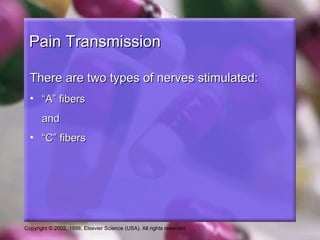
Pain TransmissionPain Transmission
There are two types of nerves stimulated:There are two types of nerves stimulated:
• ““A” fibersA” fibers
andand
• ““C” fibersC” fibers
Copyright © 2002, 1998, Elsevier Science (USA). All rights reserved.
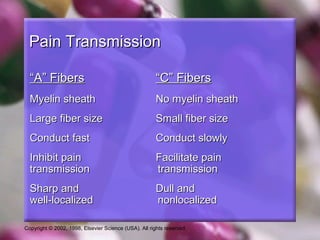
Pain TransmissionPain Transmission
““A” FibersA” Fibers “C” Fibers“C” Fibers
Myelin sheathMyelin sheath No myelin sheathNo myelin sheath
Large fiber sizeLarge fiber size Small fiber sizeSmall fiber size
Conduct fastConduct fast Conduct slowlyConduct slowly
Inhibit painInhibit pain Facilitate painFacilitate pain
transmissiontransmission transmissiontransmission
Sharp andSharp and Dull andDull and
well-localizedwell-localized nonlocalizednonlocalized
Copyright © 2002, 1998, Elsevier Science (USA). All rights reserved.
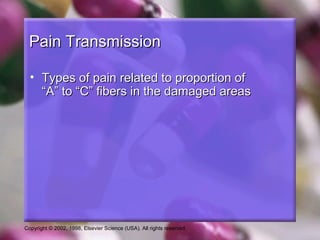
Pain TransmissionPain Transmission
• Types of pain related to proportion ofTypes of pain related to proportion of
“A” to “C” fibers in the damaged areas“A” to “C” fibers in the damaged areas
Copyright © 2002, 1998, Elsevier Science (USA). All rights reserved.
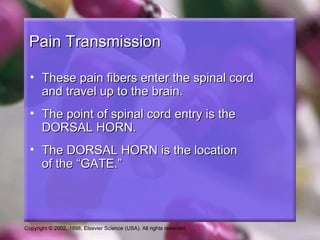
Pain TransmissionPain Transmission
• These pain fibers enter the spinal cordThese pain fibers enter the spinal cord
and travel up to the brain.and travel up to the brain.
• The point of spinal cord entry is theThe point of spinal cord entry is the
DORSAL HORN.DORSAL HORN.
• The DORSAL HORN is the locationThe DORSAL HORN is the location
of the “GATE.”of the “GATE.”
Copyright © 2002, 1998, Elsevier Science (USA). All rights reserved.
Pain TransmissionPain Transmission
• This gate regulates the flow of sensoryThis gate regulates the flow of sensory
impulses to the brain.impulses to the brain.
• Closing the gate stops the impulses.Closing the gate stops the impulses.
• If no impulses are transmitted to higherIf no impulses are transmitted to higher
centers in the brain, there is NO paincenters in the brain, there is NO pain
perception.perception.
Copyright © 2002, 1998, Elsevier Science (USA). All rights reserved.
Instructors may want to useInstructors may want to use
EIC Image #37:EIC Image #37:
Gate Theory of Pain TransmissionGate Theory of Pain Transmission
Copyright © 2002, 1998, Elsevier Science (USA). All rights reserved.
Pain TransmissionPain Transmission
• Activation of large “A” fibers CLOSES gateActivation of large “A” fibers CLOSES gate
• Inhibits transmission to brainInhibits transmission to brain
– Limits perception of painLimits perception of pain
Copyright © 2002, 1998, Elsevier Science (USA). All rights reserved.
Pain TransmissionPain Transmission
• Activation of small “B” fibers OPENS gateActivation of small “B” fibers OPENS gate
• Allows impulse transmission to brainAllows impulse transmission to brain
– Pain perceptionPain perception
Copyright © 2002, 1998, Elsevier Science (USA). All rights reserved.
Pain TransmissionPain Transmission
• Gate innervated by nerve fibers from brain,Gate innervated by nerve fibers from brain,
allowing the brain some control over gateallowing the brain some control over gate
• Allows brain to:Allows brain to:
– Evaluate, identify, and localize the painEvaluate, identify, and localize the pain
– Control the gate before the gate is openControl the gate before the gate is open
Copyright © 2002, 1998, Elsevier Science (USA). All rights reserved.
Pain TransmissionPain Transmission
““T” cellsT” cells
• Cells thatCells that controlcontrol the gate have a thresholdthe gate have a threshold
• Impulses must overcome threshold to be sentImpulses must overcome threshold to be sent
to the brainto the brain
Copyright © 2002, 1998, Elsevier Science (USA). All rights reserved.
Pain TransmissionPain Transmission
• Body has endogenous neurotransmittersBody has endogenous neurotransmitters
– EnkephalinsEnkephalins
– EndorphinsEndorphins
• Produced by body to fight painProduced by body to fight pain
• Bind to opioid receptorsBind to opioid receptors
• Inhibit transmission of pain by closing gateInhibit transmission of pain by closing gate
Copyright © 2002, 1998, Elsevier Science (USA). All rights reserved.
Pain TransmissionPain Transmission
Rubbing a painful area with massage orRubbing a painful area with massage or
liniment stimulates large sensory fibersliniment stimulates large sensory fibers
• Result:Result:
– GATE closed, recognition of pain REDUCEDGATE closed, recognition of pain REDUCED
– Same pathway used by opiatesSame pathway used by opiates
Copyright © 2002, 1998, Elsevier Science (USA). All rights reserved.
Opioid AnalgesicsOpioid Analgesics
• Pain relievers that contain opium,Pain relievers that contain opium,
derived from the opium poppyderived from the opium poppy
oror
• chemically related to opiumchemically related to opium
Narcotics: very strong pain relieversNarcotics: very strong pain relievers
Copyright © 2002, 1998, Elsevier Science (USA). All rights reserved.
Opioid AnalgesicsOpioid Analgesics
• codeine sulfatecodeine sulfate
• meperidine HCl (Demerol)meperidine HCl (Demerol)
• methadone HCl (Dolophine)methadone HCl (Dolophine)
• morphine sulfatemorphine sulfate
• propoxyphene HClpropoxyphene HCl
Copyright © 2002, 1998, Elsevier Science (USA). All rights reserved.
Opioid AnalgesicsOpioid Analgesics
Three classifications based on their actions:Three classifications based on their actions:
• AgonistAgonist
• Agonist-antagonistAgonist-antagonist
• Partial agonistPartial agonist
Copyright © 2002, 1998, Elsevier Science (USA). All rights reserved.
Opioid Analgesics: Site of actionOpioid Analgesics: Site of action
• Large “A” fibersLarge “A” fibers
• Dorsal horn of spinal cordDorsal horn of spinal cord
Copyright © 2002, 1998, Elsevier Science (USA). All rights reserved.
Opioid Analgesics:Opioid Analgesics:
Mechanism of ActionMechanism of Action
• Bind to receptors on inhibitory fibers,Bind to receptors on inhibitory fibers,
stimulating themstimulating them
• Prevent stimulation of the GATEPrevent stimulation of the GATE
• Prevent pain impulse transmissionPrevent pain impulse transmission
to the brainto the brain
Copyright © 2002, 1998, Elsevier Science (USA). All rights reserved.
Opioid Analgesics:Opioid Analgesics:
Mechanism of ActionMechanism of Action
Three types of opioid receptors:Three types of opioid receptors:
• MuMu
• KappaKappa
• DeltaDelta
Copyright © 2002, 1998, Elsevier Science (USA). All rights reserved.
Opioid Analgesics: Therapeutic UsesOpioid Analgesics: Therapeutic Uses
Main use: to alleviate moderate to severe painMain use: to alleviate moderate to severe pain
• Opioids are also used for:Opioids are also used for:
– Cough center suppressionCough center suppression
– Treatment of constipationTreatment of constipation
Copyright © 2002, 1998, Elsevier Science (USA). All rights reserved.
Opioid Analgesics: Side EffectsOpioid Analgesics: Side Effects
• EuphoriaEuphoria
• Nausea and vomitingNausea and vomiting
• Respiratory depressionRespiratory depression
• Urinary retentionUrinary retention
• Diaphoresis and flushingDiaphoresis and flushing
• Pupil constriction (miosis)Pupil constriction (miosis)
• ConstipationConstipation
Copyright © 2002, 1998, Elsevier Science (USA). All rights reserved.
Opiate AntagonistsOpiate Antagonists
naloxone (Narcan)naloxone (Narcan)
naltrexone (Revia)naltrexone (Revia)
• Opiate antagonistsOpiate antagonists
• Bind to opiate receptors and prevent a responseBind to opiate receptors and prevent a response
Used for complete or partial reversal ofUsed for complete or partial reversal of
opioid-induced respiratory depressionopioid-induced respiratory depression
Copyright © 2002, 1998, Elsevier Science (USA). All rights reserved.
Opiates: Opioid ToleranceOpiates: Opioid Tolerance
• A common physiologic result of chronicA common physiologic result of chronic
opioid treatmentopioid treatment
• Result:Result: larger dose of opioids are requiredlarger dose of opioids are required
to maintain the same level ofto maintain the same level of
analgesiaanalgesia
Copyright © 2002, 1998, Elsevier Science (USA). All rights reserved.
Opiates: Physical DependenceOpiates: Physical Dependence
• The physiologic adaptation of the body toThe physiologic adaptation of the body to
the presence of an opioidthe presence of an opioid
Copyright © 2002, 1998, Elsevier Science (USA). All rights reserved.
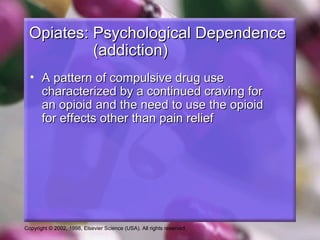
Opiates: Psychological DependenceOpiates: Psychological Dependence
(addiction)(addiction)
• A pattern of compulsive drug useA pattern of compulsive drug use
characterized by a continued craving forcharacterized by a continued craving for
an opioid and the need to use the opioidan opioid and the need to use the opioid
for effects other than pain relieffor effects other than pain relief
Copyright © 2002, 1998, Elsevier Science (USA). All rights reserved.
OpiatesOpiates
• Opioid tolerance and physical dependenceOpioid tolerance and physical dependence
are expected with long-term opioid treatmentare expected with long-term opioid treatment
and should not be confused withand should not be confused with
psychological dependence (addiction).psychological dependence (addiction).
Copyright © 2002, 1998, Elsevier Science (USA). All rights reserved.
OpiatesOpiates
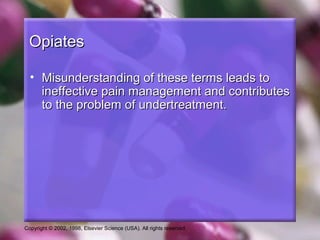
• Misunderstanding of these terms leads toMisunderstanding of these terms leads to
ineffective pain management and contributesineffective pain management and contributes
to the problem of undertreatment.to the problem of undertreatment.
Copyright © 2002, 1998, Elsevier Science (USA). All rights reserved.
OpiatesOpiates
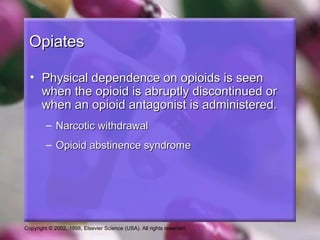
• Physical dependence on opioids is seenPhysical dependence on opioids is seen
when the opioid is abruptly discontinued orwhen the opioid is abruptly discontinued or
when an opioid antagonist is administered.when an opioid antagonist is administered.
– Narcotic withdrawalNarcotic withdrawal
– Opioid abstinence syndromeOpioid abstinence syndrome
Copyright © 2002, 1998, Elsevier Science (USA). All rights reserved.
OpiatesOpiates
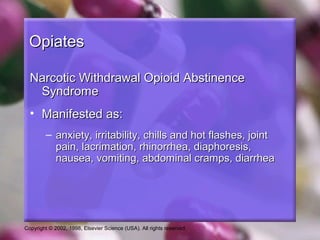
Narcotic Withdrawal Opioid AbstinenceNarcotic Withdrawal Opioid Abstinence
SyndromeSyndrome
• Manifested as:Manifested as:
– anxiety, irritability, chills and hot flashes, jointanxiety, irritability, chills and hot flashes, joint
pain, lacrimation, rhinorrhea, diaphoresis,pain, lacrimation, rhinorrhea, diaphoresis,
nausea, vomiting, abdominal cramps, diarrheanausea, vomiting, abdominal cramps, diarrhea
Copyright © 2002, 1998, Elsevier Science (USA). All rights reserved.
Opioid Analgesics:Opioid Analgesics:
Nursing ImplicationsNursing Implications
• Before beginning therapy, perform aBefore beginning therapy, perform a
thorough history regarding allergies, use ofthorough history regarding allergies, use of
other medications,health history, andother medications,health history, and
medical history.medical history.
• Obtain baseline vital signs and I & O.Obtain baseline vital signs and I & O.
• Assess for potential contraindications andAssess for potential contraindications and
drug interactions.drug interactions.
Copyright © 2002, 1998, Elsevier Science (USA). All rights reserved.
Opioid Analgesics:Opioid Analgesics:
Nursing ImplicationsNursing Implications
• Perform a thorough pain assessment,Perform a thorough pain assessment,
including nature and type of pain,including nature and type of pain,
precipitating and relieving factors, remedies,precipitating and relieving factors, remedies,
and other pain treatments.and other pain treatments.
– Assessment of pain is now being consideredAssessment of pain is now being considered
a “fifth vital sign.”a “fifth vital sign.”
Copyright © 2002, 1998, Elsevier Science (USA). All rights reserved.
Opioid Analgesics:Opioid Analgesics:
Nursing ImplicationsNursing Implications
• Be sure to medicate patients before the painBe sure to medicate patients before the pain
becomes severe as to provide adequatebecomes severe as to provide adequate
analgesia and pain control.analgesia and pain control.
• Pain management includes pharmacologicPain management includes pharmacologic
and nonpharmacologic approaches. Be sureand nonpharmacologic approaches. Be sure
to include other interventions as indicated.to include other interventions as indicated.
Copyright © 2002, 1998, Elsevier Science (USA). All rights reserved.
Opioid Analgesics:Opioid Analgesics:
Nursing ImplicationsNursing Implications
• Oral forms should be taken with food toOral forms should be taken with food to
minimize gastric upset.minimize gastric upset.
• Ensure safety measures, such as keepingEnsure safety measures, such as keeping
side rails up, to prevent injury.side rails up, to prevent injury.
• Withhold dose and contact physician if thereWithhold dose and contact physician if there
is a decline in the patient’s condition or if VSis a decline in the patient’s condition or if VS
are abnormal—especially if respiratory rateare abnormal—especially if respiratory rate
is below 12 breaths/minute.is below 12 breaths/minute.
Copyright © 2002, 1998, Elsevier Science (USA). All rights reserved.
Opioid Analgesics:Opioid Analgesics:
Nursing ImplicationsNursing Implications
• Follow proper administration guidelines forFollow proper administration guidelines for
IM injections, including site rotation.IM injections, including site rotation.
• Follow proper guidelines for IVFollow proper guidelines for IV
administration, including dilution, rate ofadministration, including dilution, rate of
administration, and so forth.administration, and so forth.
CHECK DOSAGES CAREFULLYCHECK DOSAGES CAREFULLY
Copyright © 2002, 1998, Elsevier Science (USA). All rights reserved.
Opioid Analgesics:Opioid Analgesics:
Nursing ImplicationsNursing Implications
• Constipation is a common side effect andConstipation is a common side effect and
may be prevented with adequate fluid andmay be prevented with adequate fluid and
fiber intake.fiber intake.
• Instruct patients to follow directions forInstruct patients to follow directions for
administration carefully, and to keep aadministration carefully, and to keep a
record of their pain experience andrecord of their pain experience and
response to treatments.response to treatments.
• Patients should be instructed to changePatients should be instructed to change
positions slowly to prevent possiblepositions slowly to prevent possible
orthostatic hypotension.orthostatic hypotension.
Copyright © 2002, 1998, Elsevier Science (USA). All rights reserved.
Opioid Analgesics:Opioid Analgesics:
Nursing ImplicationsNursing Implications
• Patients should not take other medicationsPatients should not take other medications
or OTC preparations without checking withor OTC preparations without checking with
their physician.their physician.
• Instruct patients to notify physician for signsInstruct patients to notify physician for signs
of allergic reaction or adverse effects.of allergic reaction or adverse effects.
Copyright © 2002, 1998, Elsevier Science (USA). All rights reserved.
Opioid Analgesics:Opioid Analgesics:
Nursing ImplicationsNursing Implications
Monitor for side effects:Monitor for side effects:
• Should VS change, patient’s condition decline,Should VS change, patient’s condition decline,
or pain continue, contact physician immediately.or pain continue, contact physician immediately.
• Respiratory depression may be manifested byRespiratory depression may be manifested by
respiratory rate of less than 12/min, dyspnea,respiratory rate of less than 12/min, dyspnea,
diminished breath sounds, or shallow breathing.diminished breath sounds, or shallow breathing.
Copyright © 2002, 1998, Elsevier Science (USA). All rights reserved.
Opioid Analgesics:Opioid Analgesics:
Nursing ImplicationsNursing Implications
Monitor for therapeutic effects:Monitor for therapeutic effects:
• Decreased complaints of painDecreased complaints of pain
• Increased periods of comfortIncreased periods of comfort
• With improved activities of daily living, appetite,With improved activities of daily living, appetite,
and sense of well-beingand sense of well-being

opioid analgesics

  • 1.
    Copyright © 2002,1998, Elsevier Science (USA). All rights reserved. Opioid Analgesic AgentsOpioid Analgesic Agents
  • 2.
    Copyright © 2002,1998, Elsevier Science (USA). All rights reserved. AnalgesicsAnalgesics • Medications that relieve pain without causingMedications that relieve pain without causing loss of consciousnessloss of consciousness • PainkillersPainkillers
  • 3.
    Copyright © 2002,1998, Elsevier Science (USA). All rights reserved. Classification of PainClassification of Pain By Onset and DurationBy Onset and Duration • Acute painAcute pain – Sudden in onsetSudden in onset – Usually subsides once treatedUsually subsides once treated • Chronic painChronic pain – Persistent or recurringPersistent or recurring – Often difficult to treatOften difficult to treat
  • 4.
    Copyright © 2002,1998, Elsevier Science (USA). All rights reserved. Classification of PainClassification of Pain • SomaticSomatic • VisceralVisceral • SuperficialSuperficial • VascularVascular • ReferredReferred • NeuropathicNeuropathic • PhantomPhantom • CancerCancer • PsychogenicPsychogenic • CentralCentral
  • 5.
    Copyright © 2002,1998, Elsevier Science (USA). All rights reserved. Classification of Pain By SourceClassification of Pain By Source Vascular painVascular pain • Possibly originates from vascular orPossibly originates from vascular or perivascular tissuesperivascular tissues Neuropathic painNeuropathic pain • Results from injury to peripheral nerve fibers orResults from injury to peripheral nerve fibers or damage to the CNSdamage to the CNS Superficial painSuperficial pain • Originates from skin or mucous membranesOriginates from skin or mucous membranes
  • 6.
    Copyright © 2002,1998, Elsevier Science (USA). All rights reserved. Pain Transmission Gate TheoryPain Transmission Gate Theory • Most common and well-describedMost common and well-described • Uses the analogy of a gate to describe howUses the analogy of a gate to describe how impulses from damaged tissues are sensedimpulses from damaged tissues are sensed in the brainin the brain
  • 7.
    Copyright © 2002,1998, Elsevier Science (USA). All rights reserved. Pain TransmissionPain Transmission Tissue injury causes the release of:Tissue injury causes the release of: • BradykininBradykinin • HistamineHistamine • PotassiumPotassium • ProstaglandinsProstaglandins • SerotoninSerotonin These substances stimulate nerve endings,These substances stimulate nerve endings, starting the pain process.starting the pain process.
  • 8.
    Copyright © 2002,1998, Elsevier Science (USA). All rights reserved. Pain TransmissionPain Transmission There are two types of nerves stimulated:There are two types of nerves stimulated: • ““A” fibersA” fibers andand • ““C” fibersC” fibers
  • 9.
    Copyright © 2002,1998, Elsevier Science (USA). All rights reserved. Pain TransmissionPain Transmission ““A” FibersA” Fibers “C” Fibers“C” Fibers Myelin sheathMyelin sheath No myelin sheathNo myelin sheath Large fiber sizeLarge fiber size Small fiber sizeSmall fiber size Conduct fastConduct fast Conduct slowlyConduct slowly Inhibit painInhibit pain Facilitate painFacilitate pain transmissiontransmission transmissiontransmission Sharp andSharp and Dull andDull and well-localizedwell-localized nonlocalizednonlocalized
  • 10.
    Copyright © 2002,1998, Elsevier Science (USA). All rights reserved. Pain TransmissionPain Transmission • Types of pain related to proportion ofTypes of pain related to proportion of “A” to “C” fibers in the damaged areas“A” to “C” fibers in the damaged areas
  • 11.
    Copyright © 2002,1998, Elsevier Science (USA). All rights reserved. Pain TransmissionPain Transmission • These pain fibers enter the spinal cordThese pain fibers enter the spinal cord and travel up to the brain.and travel up to the brain. • The point of spinal cord entry is theThe point of spinal cord entry is the DORSAL HORN.DORSAL HORN. • The DORSAL HORN is the locationThe DORSAL HORN is the location of the “GATE.”of the “GATE.”
  • 12.
    Copyright © 2002,1998, Elsevier Science (USA). All rights reserved. Pain TransmissionPain Transmission • This gate regulates the flow of sensoryThis gate regulates the flow of sensory impulses to the brain.impulses to the brain. • Closing the gate stops the impulses.Closing the gate stops the impulses. • If no impulses are transmitted to higherIf no impulses are transmitted to higher centers in the brain, there is NO paincenters in the brain, there is NO pain perception.perception.
  • 13.
    Copyright © 2002,1998, Elsevier Science (USA). All rights reserved. Instructors may want to useInstructors may want to use EIC Image #37:EIC Image #37: Gate Theory of Pain TransmissionGate Theory of Pain Transmission
  • 14.
    Copyright © 2002,1998, Elsevier Science (USA). All rights reserved. Pain TransmissionPain Transmission • Activation of large “A” fibers CLOSES gateActivation of large “A” fibers CLOSES gate • Inhibits transmission to brainInhibits transmission to brain – Limits perception of painLimits perception of pain
  • 15.
    Copyright © 2002,1998, Elsevier Science (USA). All rights reserved. Pain TransmissionPain Transmission • Activation of small “B” fibers OPENS gateActivation of small “B” fibers OPENS gate • Allows impulse transmission to brainAllows impulse transmission to brain – Pain perceptionPain perception
  • 16.
    Copyright © 2002,1998, Elsevier Science (USA). All rights reserved. Pain TransmissionPain Transmission • Gate innervated by nerve fibers from brain,Gate innervated by nerve fibers from brain, allowing the brain some control over gateallowing the brain some control over gate • Allows brain to:Allows brain to: – Evaluate, identify, and localize the painEvaluate, identify, and localize the pain – Control the gate before the gate is openControl the gate before the gate is open
  • 17.
    Copyright © 2002,1998, Elsevier Science (USA). All rights reserved. Pain TransmissionPain Transmission ““T” cellsT” cells • Cells thatCells that controlcontrol the gate have a thresholdthe gate have a threshold • Impulses must overcome threshold to be sentImpulses must overcome threshold to be sent to the brainto the brain
  • 18.
    Copyright © 2002,1998, Elsevier Science (USA). All rights reserved. Pain TransmissionPain Transmission • Body has endogenous neurotransmittersBody has endogenous neurotransmitters – EnkephalinsEnkephalins – EndorphinsEndorphins • Produced by body to fight painProduced by body to fight pain • Bind to opioid receptorsBind to opioid receptors • Inhibit transmission of pain by closing gateInhibit transmission of pain by closing gate
  • 19.
    Copyright © 2002,1998, Elsevier Science (USA). All rights reserved. Pain TransmissionPain Transmission Rubbing a painful area with massage orRubbing a painful area with massage or liniment stimulates large sensory fibersliniment stimulates large sensory fibers • Result:Result: – GATE closed, recognition of pain REDUCEDGATE closed, recognition of pain REDUCED – Same pathway used by opiatesSame pathway used by opiates
  • 20.
    Copyright © 2002,1998, Elsevier Science (USA). All rights reserved. Opioid AnalgesicsOpioid Analgesics • Pain relievers that contain opium,Pain relievers that contain opium, derived from the opium poppyderived from the opium poppy oror • chemically related to opiumchemically related to opium Narcotics: very strong pain relieversNarcotics: very strong pain relievers
  • 21.
    Copyright © 2002,1998, Elsevier Science (USA). All rights reserved. Opioid AnalgesicsOpioid Analgesics • codeine sulfatecodeine sulfate • meperidine HCl (Demerol)meperidine HCl (Demerol) • methadone HCl (Dolophine)methadone HCl (Dolophine) • morphine sulfatemorphine sulfate • propoxyphene HClpropoxyphene HCl
  • 22.
    Copyright © 2002,1998, Elsevier Science (USA). All rights reserved. Opioid AnalgesicsOpioid Analgesics Three classifications based on their actions:Three classifications based on their actions: • AgonistAgonist • Agonist-antagonistAgonist-antagonist • Partial agonistPartial agonist
  • 23.
    Copyright © 2002,1998, Elsevier Science (USA). All rights reserved. Opioid Analgesics: Site of actionOpioid Analgesics: Site of action • Large “A” fibersLarge “A” fibers • Dorsal horn of spinal cordDorsal horn of spinal cord
  • 24.
    Copyright © 2002,1998, Elsevier Science (USA). All rights reserved. Opioid Analgesics:Opioid Analgesics: Mechanism of ActionMechanism of Action • Bind to receptors on inhibitory fibers,Bind to receptors on inhibitory fibers, stimulating themstimulating them • Prevent stimulation of the GATEPrevent stimulation of the GATE • Prevent pain impulse transmissionPrevent pain impulse transmission to the brainto the brain
  • 25.
    Copyright © 2002,1998, Elsevier Science (USA). All rights reserved. Opioid Analgesics:Opioid Analgesics: Mechanism of ActionMechanism of Action Three types of opioid receptors:Three types of opioid receptors: • MuMu • KappaKappa • DeltaDelta
  • 26.
    Copyright © 2002,1998, Elsevier Science (USA). All rights reserved. Opioid Analgesics: Therapeutic UsesOpioid Analgesics: Therapeutic Uses Main use: to alleviate moderate to severe painMain use: to alleviate moderate to severe pain • Opioids are also used for:Opioids are also used for: – Cough center suppressionCough center suppression – Treatment of constipationTreatment of constipation
  • 27.
    Copyright © 2002,1998, Elsevier Science (USA). All rights reserved. Opioid Analgesics: Side EffectsOpioid Analgesics: Side Effects • EuphoriaEuphoria • Nausea and vomitingNausea and vomiting • Respiratory depressionRespiratory depression • Urinary retentionUrinary retention • Diaphoresis and flushingDiaphoresis and flushing • Pupil constriction (miosis)Pupil constriction (miosis) • ConstipationConstipation
  • 28.
    Copyright © 2002,1998, Elsevier Science (USA). All rights reserved. Opiate AntagonistsOpiate Antagonists naloxone (Narcan)naloxone (Narcan) naltrexone (Revia)naltrexone (Revia) • Opiate antagonistsOpiate antagonists • Bind to opiate receptors and prevent a responseBind to opiate receptors and prevent a response Used for complete or partial reversal ofUsed for complete or partial reversal of opioid-induced respiratory depressionopioid-induced respiratory depression
  • 29.
    Copyright © 2002,1998, Elsevier Science (USA). All rights reserved. Opiates: Opioid ToleranceOpiates: Opioid Tolerance • A common physiologic result of chronicA common physiologic result of chronic opioid treatmentopioid treatment • Result:Result: larger dose of opioids are requiredlarger dose of opioids are required to maintain the same level ofto maintain the same level of analgesiaanalgesia
  • 30.
    Copyright © 2002,1998, Elsevier Science (USA). All rights reserved. Opiates: Physical DependenceOpiates: Physical Dependence • The physiologic adaptation of the body toThe physiologic adaptation of the body to the presence of an opioidthe presence of an opioid
  • 31.
    Copyright © 2002,1998, Elsevier Science (USA). All rights reserved. Opiates: Psychological DependenceOpiates: Psychological Dependence (addiction)(addiction) • A pattern of compulsive drug useA pattern of compulsive drug use characterized by a continued craving forcharacterized by a continued craving for an opioid and the need to use the opioidan opioid and the need to use the opioid for effects other than pain relieffor effects other than pain relief
  • 32.
    Copyright © 2002,1998, Elsevier Science (USA). All rights reserved. OpiatesOpiates • Opioid tolerance and physical dependenceOpioid tolerance and physical dependence are expected with long-term opioid treatmentare expected with long-term opioid treatment and should not be confused withand should not be confused with psychological dependence (addiction).psychological dependence (addiction).
  • 33.
    Copyright © 2002,1998, Elsevier Science (USA). All rights reserved. OpiatesOpiates • Misunderstanding of these terms leads toMisunderstanding of these terms leads to ineffective pain management and contributesineffective pain management and contributes to the problem of undertreatment.to the problem of undertreatment.
  • 34.
    Copyright © 2002,1998, Elsevier Science (USA). All rights reserved. OpiatesOpiates • Physical dependence on opioids is seenPhysical dependence on opioids is seen when the opioid is abruptly discontinued orwhen the opioid is abruptly discontinued or when an opioid antagonist is administered.when an opioid antagonist is administered. – Narcotic withdrawalNarcotic withdrawal – Opioid abstinence syndromeOpioid abstinence syndrome
  • 35.
    Copyright © 2002,1998, Elsevier Science (USA). All rights reserved. OpiatesOpiates Narcotic Withdrawal Opioid AbstinenceNarcotic Withdrawal Opioid Abstinence SyndromeSyndrome • Manifested as:Manifested as: – anxiety, irritability, chills and hot flashes, jointanxiety, irritability, chills and hot flashes, joint pain, lacrimation, rhinorrhea, diaphoresis,pain, lacrimation, rhinorrhea, diaphoresis, nausea, vomiting, abdominal cramps, diarrheanausea, vomiting, abdominal cramps, diarrhea
  • 36.
    Copyright © 2002,1998, Elsevier Science (USA). All rights reserved. Opioid Analgesics:Opioid Analgesics: Nursing ImplicationsNursing Implications • Before beginning therapy, perform aBefore beginning therapy, perform a thorough history regarding allergies, use ofthorough history regarding allergies, use of other medications,health history, andother medications,health history, and medical history.medical history. • Obtain baseline vital signs and I & O.Obtain baseline vital signs and I & O. • Assess for potential contraindications andAssess for potential contraindications and drug interactions.drug interactions.
  • 37.
    Copyright © 2002,1998, Elsevier Science (USA). All rights reserved. Opioid Analgesics:Opioid Analgesics: Nursing ImplicationsNursing Implications • Perform a thorough pain assessment,Perform a thorough pain assessment, including nature and type of pain,including nature and type of pain, precipitating and relieving factors, remedies,precipitating and relieving factors, remedies, and other pain treatments.and other pain treatments. – Assessment of pain is now being consideredAssessment of pain is now being considered a “fifth vital sign.”a “fifth vital sign.”
  • 38.
    Copyright © 2002,1998, Elsevier Science (USA). All rights reserved. Opioid Analgesics:Opioid Analgesics: Nursing ImplicationsNursing Implications • Be sure to medicate patients before the painBe sure to medicate patients before the pain becomes severe as to provide adequatebecomes severe as to provide adequate analgesia and pain control.analgesia and pain control. • Pain management includes pharmacologicPain management includes pharmacologic and nonpharmacologic approaches. Be sureand nonpharmacologic approaches. Be sure to include other interventions as indicated.to include other interventions as indicated.
  • 39.
    Copyright © 2002,1998, Elsevier Science (USA). All rights reserved. Opioid Analgesics:Opioid Analgesics: Nursing ImplicationsNursing Implications • Oral forms should be taken with food toOral forms should be taken with food to minimize gastric upset.minimize gastric upset. • Ensure safety measures, such as keepingEnsure safety measures, such as keeping side rails up, to prevent injury.side rails up, to prevent injury. • Withhold dose and contact physician if thereWithhold dose and contact physician if there is a decline in the patient’s condition or if VSis a decline in the patient’s condition or if VS are abnormal—especially if respiratory rateare abnormal—especially if respiratory rate is below 12 breaths/minute.is below 12 breaths/minute.
  • 40.
    Copyright © 2002,1998, Elsevier Science (USA). All rights reserved. Opioid Analgesics:Opioid Analgesics: Nursing ImplicationsNursing Implications • Follow proper administration guidelines forFollow proper administration guidelines for IM injections, including site rotation.IM injections, including site rotation. • Follow proper guidelines for IVFollow proper guidelines for IV administration, including dilution, rate ofadministration, including dilution, rate of administration, and so forth.administration, and so forth. CHECK DOSAGES CAREFULLYCHECK DOSAGES CAREFULLY
  • 41.
    Copyright © 2002,1998, Elsevier Science (USA). All rights reserved. Opioid Analgesics:Opioid Analgesics: Nursing ImplicationsNursing Implications • Constipation is a common side effect andConstipation is a common side effect and may be prevented with adequate fluid andmay be prevented with adequate fluid and fiber intake.fiber intake. • Instruct patients to follow directions forInstruct patients to follow directions for administration carefully, and to keep aadministration carefully, and to keep a record of their pain experience andrecord of their pain experience and response to treatments.response to treatments. • Patients should be instructed to changePatients should be instructed to change positions slowly to prevent possiblepositions slowly to prevent possible orthostatic hypotension.orthostatic hypotension.
  • 42.
    Copyright © 2002,1998, Elsevier Science (USA). All rights reserved. Opioid Analgesics:Opioid Analgesics: Nursing ImplicationsNursing Implications • Patients should not take other medicationsPatients should not take other medications or OTC preparations without checking withor OTC preparations without checking with their physician.their physician. • Instruct patients to notify physician for signsInstruct patients to notify physician for signs of allergic reaction or adverse effects.of allergic reaction or adverse effects.
  • 43.
    Copyright © 2002,1998, Elsevier Science (USA). All rights reserved. Opioid Analgesics:Opioid Analgesics: Nursing ImplicationsNursing Implications Monitor for side effects:Monitor for side effects: • Should VS change, patient’s condition decline,Should VS change, patient’s condition decline, or pain continue, contact physician immediately.or pain continue, contact physician immediately. • Respiratory depression may be manifested byRespiratory depression may be manifested by respiratory rate of less than 12/min, dyspnea,respiratory rate of less than 12/min, dyspnea, diminished breath sounds, or shallow breathing.diminished breath sounds, or shallow breathing.
  • 44.
    Copyright © 2002,1998, Elsevier Science (USA). All rights reserved. Opioid Analgesics:Opioid Analgesics: Nursing ImplicationsNursing Implications Monitor for therapeutic effects:Monitor for therapeutic effects: • Decreased complaints of painDecreased complaints of pain • Increased periods of comfortIncreased periods of comfort • With improved activities of daily living, appetite,With improved activities of daily living, appetite, and sense of well-beingand sense of well-being