Copyright © 2002, 1998, Elsevier Science (USA). All rights reserved.
Pharmacologic PrinciplesPharmacologic Principles
Copyright © 2002, 1998, Elsevier Science (USA). All rights reserved.
Pharmacologic PrinciplesPharmacologic Principles
DrugDrug
• Any chemical that affects the processes ofAny chemical that affects the processes of
a living organisma living organism
Copyright © 2002, 1998, Elsevier Science (USA). All rights reserved.
Pharmacologic PrinciplesPharmacologic Principles
PharmacologyPharmacology
• The study or science of drugsThe study or science of drugs
Copyright © 2002, 1998, Elsevier Science (USA). All rights reserved.
Pharmacologic Principles: Drug NamesPharmacologic Principles: Drug Names
Chemical nameChemical name
• The drug’s chemical composition and molecularThe drug’s chemical composition and molecular
structurestructure
Generic name (nonproprietary name)Generic name (nonproprietary name)
• Name given by the United States AdoptedName given by the United States Adopted
Name CouncilName Council
Trade name (proprietary name)Trade name (proprietary name)
• The drug has a registered trademark; useThe drug has a registered trademark; use
of the name restricted by the drug’s ownerof the name restricted by the drug’s owner
(usually the manufacturer)(usually the manufacturer)
Copyright © 2002, 1998, Elsevier Science (USA). All rights reserved.
Pharmacologic Principles: Drug NamesPharmacologic Principles: Drug Names
Chemical nameChemical name
• (+/-)-2-(p-isobutylphenyl) propionic acid(+/-)-2-(p-isobutylphenyl) propionic acid
Generic nameGeneric name
• ibuprofenibuprofen
Trade nameTrade name
• MotrinMotrin
Copyright © 2002, 1998, Elsevier Science (USA). All rights reserved.
Instructors may wish to useInstructors may wish to use
EIC Image #3:EIC Image #3:
The Chemical, Generic, and TradeThe Chemical, Generic, and Trade
Names for the CommonNames for the Common
Analgesic IbuprofenAnalgesic Ibuprofen
Copyright © 2002, 1998, Elsevier Science (USA). All rights reserved.
Pharmacologic PrinciplesPharmacologic Principles
• PharmaceuticsPharmaceutics
• PharmacokineticsPharmacokinetics
• PharmacodynamicsPharmacodynamics
• PharmacotherapeuticsPharmacotherapeutics
• PharmacognosyPharmacognosy
Copyright © 2002, 1998, Elsevier Science (USA). All rights reserved.
Pharmacologic PrinciplesPharmacologic Principles
PharmaceuticsPharmaceutics
• The study of how various drug forms influenceThe study of how various drug forms influence
pharmacokinetic and pharmacodynamic activitiespharmacokinetic and pharmacodynamic activities
Copyright © 2002, 1998, Elsevier Science (USA). All rights reserved.
Pharmacologic PrinciplesPharmacologic Principles
PharmacokineticsPharmacokinetics
• The study of what the body does to the drug:The study of what the body does to the drug:
– AbsorptionAbsorption
– DistributionDistribution
– MetabolismMetabolism
– ExcretionExcretion
Copyright © 2002, 1998, Elsevier Science (USA). All rights reserved.
Pharmacologic PrinciplesPharmacologic Principles
PharmacodynamicsPharmacodynamics
• The study of what the drug does to the bodyThe study of what the drug does to the body::
– The mechanism of drug actions in living tissuesThe mechanism of drug actions in living tissues
Copyright © 2002, 1998, Elsevier Science (USA). All rights reserved.
Pharmacologic PrinciplesPharmacologic Principles
PharmacotherapeuticsPharmacotherapeutics
• The use of drugs and the clinical indications forThe use of drugs and the clinical indications for
drugs to prevent and treat diseasesdrugs to prevent and treat diseases
Copyright © 2002, 1998, Elsevier Science (USA). All rights reserved.
Pharmacologic PrinciplesPharmacologic Principles
PharmacognosyPharmacognosy
• The study of natural (plant and animal) drug sourcesThe study of natural (plant and animal) drug sources
Copyright © 2002, 1998, Elsevier Science (USA). All rights reserved.
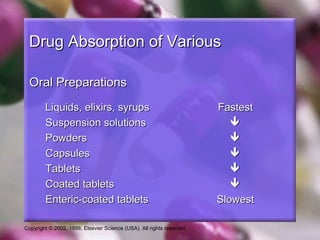
Drug Absorption of VariousDrug Absorption of Various
Oral PreparationsOral Preparations
Liquids, elixirs, syrupsLiquids, elixirs, syrups FastestFastest
Suspension solutionsSuspension solutions 
PowdersPowders 
CapsulesCapsules 
TabletsTablets 
Coated tabletsCoated tablets 
Enteric-coated tabletsEnteric-coated tablets SlowestSlowest
Copyright © 2002, 1998, Elsevier Science (USA). All rights reserved.
Pharmacokinetics: AbsorptionPharmacokinetics: Absorption
• The rate at which a drug leaves its site ofThe rate at which a drug leaves its site of
administration, and the extent to whichadministration, and the extent to which
absorption occurs.absorption occurs.
– BioavailabilityBioavailability
– BioequivalentBioequivalent
Copyright © 2002, 1998, Elsevier Science (USA). All rights reserved.
Pharmacokinetics: AbsorptionPharmacokinetics: Absorption
Factors That Affect AbsorptionFactors That Affect Absorption
• Administration route of the drugAdministration route of the drug
• Food or fluids administered with the drugFood or fluids administered with the drug
• Dosage formulationDosage formulation
• Status of the absorptive surfaceStatus of the absorptive surface
• Rate of blood flow to the small intestineRate of blood flow to the small intestine
• Acidity of the stomachAcidity of the stomach
• Status of GI motilityStatus of GI motility
Copyright © 2002, 1998, Elsevier Science (USA). All rights reserved.
Pharmacokinetics: AbsorptionPharmacokinetics: Absorption
RoutesRoutes
• A drug’s route of administration affects the rateA drug’s route of administration affects the rate
and extent of absorption of that drug.and extent of absorption of that drug.
– EnteralEnteral
– ParenteralParenteral
– TopicalTopical
Copyright © 2002, 1998, Elsevier Science (USA). All rights reserved.
Pharmacokinetics: AbsorptionPharmacokinetics: Absorption
Enteral RouteEnteral Route
• Drug is absorbed into the systemic circulationDrug is absorbed into the systemic circulation
through the oral or gastric mucosa, the smallthrough the oral or gastric mucosa, the small
intestine, or rectum.intestine, or rectum.
– OralOral
– SublingualSublingual
– BuccalBuccal
– RectalRectal
Copyright © 2002, 1998, Elsevier Science (USA). All rights reserved.
First-Pass EffectFirst-Pass Effect
The metabolism of a drug and its passageThe metabolism of a drug and its passage
from the liver into the circulation.from the liver into the circulation.
• A drug given via the oral route may be extensivelyA drug given via the oral route may be extensively
metabolized by the liver before reaching the systemicmetabolized by the liver before reaching the systemic
circulation (high first-pass effect).circulation (high first-pass effect).
• The same drug—given IV—bypasses the liver,The same drug—given IV—bypasses the liver,
preventing the first-pass effect from taking place, andpreventing the first-pass effect from taking place, and
more drug reaches the circulation.more drug reaches the circulation.
Copyright © 2002, 1998, Elsevier Science (USA). All rights reserved.
Instructors may want to useInstructors may want to use
EIC Image #4:EIC Image #4:
First-Pass EffectFirst-Pass Effect
Copyright © 2002, 1998, Elsevier Science (USA). All rights reserved.
First-Pass EffectFirst-Pass Effect
• Routes that bypass the liver:Routes that bypass the liver:
– SublingualSublingual TransdermalTransdermal
– BuccalBuccal VaginalVaginal
– Rectal*Rectal* IntramuscularIntramuscular
– IntravenousIntravenous SubcutaneousSubcutaneous
– IntranasalIntranasal InhalationInhalation
*Rectal route undergoes a higher degree of first-*Rectal route undergoes a higher degree of first-
pass effects than the other routes listed.pass effects than the other routes listed.
Copyright © 2002, 1998, Elsevier Science (USA). All rights reserved.
Pharmacokinetics: AbsorptionPharmacokinetics: Absorption
Parenteral RouteParenteral Route
• Intravenous*Intravenous*
• IntramuscularIntramuscular
• SubcutaneousSubcutaneous
• IntradermalIntradermal
• IntrathecalIntrathecal
• IntraarticularIntraarticular
*Fastest delivery into the blood circulation*Fastest delivery into the blood circulation
Copyright © 2002, 1998, Elsevier Science (USA). All rights reserved.
Pharmacokinetics: AbsorptionPharmacokinetics: Absorption
Topical RouteTopical Route
• Skin (including transdermal patches)Skin (including transdermal patches)
• EyesEyes
• EarsEars
• NoseNose
• Lungs (inhalation)Lungs (inhalation)
• VaginaVagina
Copyright © 2002, 1998, Elsevier Science (USA). All rights reserved.
Pharmacokinetics: DistributionPharmacokinetics: Distribution
The transport of a drug in the body by theThe transport of a drug in the body by the
bloodstream to its site of action.bloodstream to its site of action.
• Protein-bindingProtein-binding
• Water soluble vs. fat solubleWater soluble vs. fat soluble
• Blood-brain barrierBlood-brain barrier
• Areas of rapid distribution: heart, liver,Areas of rapid distribution: heart, liver,
kidneys, brainkidneys, brain
• Areas of slow distribution: muscle, skin, fatAreas of slow distribution: muscle, skin, fat
Copyright © 2002, 1998, Elsevier Science (USA). All rights reserved.
Pharmacokinetics: MetabolismPharmacokinetics: Metabolism
(also known as Biotransformation)(also known as Biotransformation)
The biologic transformation of a drug intoThe biologic transformation of a drug into
an inactive metabolite, a more solublean inactive metabolite, a more soluble
compound, or a more potent metabolite.compound, or a more potent metabolite.
• Liver (main organ)Liver (main organ)
• KidneysKidneys
• LungsLungs
• PlasmaPlasma
• Intestinal mucosaIntestinal mucosa
Copyright © 2002, 1998, Elsevier Science (USA). All rights reserved.
Pharmacokinetics: MetabolismPharmacokinetics: Metabolism
Factors that decrease metabolism:Factors that decrease metabolism:
• Cardiovascular dysfunctionCardiovascular dysfunction
• Renal insufficiencyRenal insufficiency
• StarvationStarvation
• Obstructive jaundiceObstructive jaundice
• Slow acetylatorSlow acetylator
• Erythromycin or ketoconazole drug therapyErythromycin or ketoconazole drug therapy
Copyright © 2002, 1998, Elsevier Science (USA). All rights reserved.
Pharmacokinetics: MetabolismPharmacokinetics: Metabolism
Factors that increase metabolism:Factors that increase metabolism:
• Fast acetylatorFast acetylator
• BarbituratesBarbiturates
• Rifampin therapyRifampin therapy
Copyright © 2002, 1998, Elsevier Science (USA). All rights reserved.
Pharmacokinetics: MetabolismPharmacokinetics: Metabolism
Delayed drug metabolism results in:Delayed drug metabolism results in:
• Accumulation of drugsAccumulation of drugs
• Prolonged action of the effects of the drugsProlonged action of the effects of the drugs
Stimulating drug metabolism causes:Stimulating drug metabolism causes:
• Diminished pharmacologic effectsDiminished pharmacologic effects
Copyright © 2002, 1998, Elsevier Science (USA). All rights reserved.
Pharmacokinetics: ExcretionPharmacokinetics: Excretion
The elimination of drugs from the bodyThe elimination of drugs from the body
• Kidneys (main organ)Kidneys (main organ)
• LiverLiver
• BowelBowel
– Biliary excretionBiliary excretion
– Enterohepatic circulationEnterohepatic circulation
Copyright © 2002, 1998, Elsevier Science (USA). All rights reserved.
Instructors may wish to useInstructors may wish to use
EIC Image #5:EIC Image #5:
Renal Drug ExcretionRenal Drug Excretion
Copyright © 2002, 1998, Elsevier Science (USA). All rights reserved.
PharmacokineticsPharmacokinetics
Half-LifeHalf-Life
• The time it takes for one half of the original amountThe time it takes for one half of the original amount
of a drug in the body to be removed.of a drug in the body to be removed.
• A measure of the rate at which drugs are removedA measure of the rate at which drugs are removed
from the body.from the body.
Copyright © 2002, 1998, Elsevier Science (USA). All rights reserved.
Instructors may wish to useInstructors may wish to use
EIC Image #6:EIC Image #6:
Drug Half-LifeDrug Half-Life
Copyright © 2002, 1998, Elsevier Science (USA). All rights reserved.
PharmacodynamicsPharmacodynamics
Drug actions:Drug actions:
• The cellular processes involved in the drug andThe cellular processes involved in the drug and
cell interactioncell interaction
Drug effect:Drug effect:
• The physiologic reaction of the body to the drugThe physiologic reaction of the body to the drug
Copyright © 2002, 1998, Elsevier Science (USA). All rights reserved.
PharmacodynamicsPharmacodynamics
OnsetOnset
• The time it takes for the drug to elicit aThe time it takes for the drug to elicit a
therapeutic responsetherapeutic response
PeakPeak
• The time it takes for a drug to reach its maximumThe time it takes for a drug to reach its maximum
therapeutic responsetherapeutic response
DurationDuration
• The time a drug concentration is sufficient to elicitThe time a drug concentration is sufficient to elicit
a therapeutic responsea therapeutic response
Copyright © 2002, 1998, Elsevier Science (USA). All rights reserved.
Pharmacodynamics:Pharmacodynamics:
Mechanisms of ActionMechanisms of Action
The ways by which drugs can produceThe ways by which drugs can produce
therapeutic effects:therapeutic effects:
• Once the drug is at the site of action, it can modifyOnce the drug is at the site of action, it can modify
the rate (increase or decrease) at which the cells orthe rate (increase or decrease) at which the cells or
tissues function.tissues function.
• A drug cannot make a cell or tissue perform aA drug cannot make a cell or tissue perform a
function it was not designed to perform.function it was not designed to perform.
Copyright © 2002, 1998, Elsevier Science (USA). All rights reserved.
Pharmacodynamics:Pharmacodynamics:
Mechanisms of ActionMechanisms of Action
• Receptor interactionReceptor interaction
• Enzyme interactionEnzyme interaction
• Nonspecific interactionsNonspecific interactions
Copyright © 2002, 1998, Elsevier Science (USA). All rights reserved.
Instructors may wish to insertInstructors may wish to insert
EIC Image #2:EIC Image #2:
Drugs and ReceptorsDrugs and Receptors
and possiblyand possibly
EIC Image #7:EIC Image #7:
Drug-Receptor Interactions: DefinitionsDrug-Receptor Interactions: Definitions
Copyright © 2002, 1998, Elsevier Science (USA). All rights reserved.
Pharmacotherapeutics:Pharmacotherapeutics:
Types of TherapiesTypes of Therapies
• Acute therapyAcute therapy
• Maintenance therapyMaintenance therapy
• Supplemental therapySupplemental therapy
• Palliative therapyPalliative therapy
• Supportive therapySupportive therapy
• Prophylactic therapyProphylactic therapy
Copyright © 2002, 1998, Elsevier Science (USA). All rights reserved.
Pharmacotherapeutics: MonitoringPharmacotherapeutics: Monitoring
• The effectiveness of the drug therapy mustThe effectiveness of the drug therapy must
be evaluated.be evaluated.
• One must be familiar with the drug’sOne must be familiar with the drug’s
• intended therapeutic action (beneficial)intended therapeutic action (beneficial)
• and the drug’s unintended but potential sideand the drug’s unintended but potential side
effects (predictable, adverse drug reactions).effects (predictable, adverse drug reactions).
Copyright © 2002, 1998, Elsevier Science (USA). All rights reserved.
Pharmacotherapeutics: MonitoringPharmacotherapeutics: Monitoring
• Therapeutic indexTherapeutic index
• Drug concentrationDrug concentration
• Patient’s conditionPatient’s condition
• Tolerance and dependenceTolerance and dependence
• InteractionsInteractions
• Side effects/adverse drug effectsSide effects/adverse drug effects
Copyright © 2002, 1998, Elsevier Science (USA). All rights reserved.
Pharmacotherapeutics: MonitoringPharmacotherapeutics: Monitoring
Therapeutic IndexTherapeutic Index
• The ratio between a drug’s therapeutic benefitsThe ratio between a drug’s therapeutic benefits
and its toxic effectsand its toxic effects
Copyright © 2002, 1998, Elsevier Science (USA). All rights reserved.
Pharmacotherapeutics: MonitoringPharmacotherapeutics: Monitoring
ToleranceTolerance
• A decreasing response to repetitive drug dosesA decreasing response to repetitive drug doses
Copyright © 2002, 1998, Elsevier Science (USA). All rights reserved.
Pharmacotherapeutics: MonitoringPharmacotherapeutics: Monitoring
DependenceDependence
• A physiologic or psychological need for a drugA physiologic or psychological need for a drug
Copyright © 2002, 1998, Elsevier Science (USA). All rights reserved.
Pharmacotherapeutics: MonitoringPharmacotherapeutics: Monitoring
Interactions may occur with other drugs or foodInteractions may occur with other drugs or food
• Drug interactions: the alteration of action ofDrug interactions: the alteration of action of
a drug by:a drug by:
– Other prescribed drugsOther prescribed drugs
– Over-the-counter medicationsOver-the-counter medications
– Herbal therapiesHerbal therapies
Copyright © 2002, 1998, Elsevier Science (USA). All rights reserved.
Pharmacotherapeutics: MonitoringPharmacotherapeutics: Monitoring
InteractionsInteractions
• Additive effectAdditive effect
• Synergistic effectSynergistic effect
• Antagonistic effectAntagonistic effect
• IncompatibilityIncompatibility
Copyright © 2002, 1998, Elsevier Science (USA). All rights reserved.
Pharmacotherapeutics: MonitoringPharmacotherapeutics: Monitoring
Medication MisadventuresMedication Misadventures
Adverse drug eventsAdverse drug events
• ALL are preventableALL are preventable
• Medication errors that result in patient harmMedication errors that result in patient harm
Adverse drug reactionsAdverse drug reactions
• Inherent, not preventable event occurring in theInherent, not preventable event occurring in the
normal therapeutic use of a drugnormal therapeutic use of a drug
• Any reaction that is unexpected, undesirable, andAny reaction that is unexpected, undesirable, and
occurs at doses normally usedoccurs at doses normally used
Copyright © 2002, 1998, Elsevier Science (USA). All rights reserved.
Pharmacotherapeutics: MonitoringPharmacotherapeutics: Monitoring
Some adverse drug reactions are classified asSome adverse drug reactions are classified as
side effects.side effects.
• Expected, well-known reactions that result in littleExpected, well-known reactions that result in little
or no change in patient managementor no change in patient management
• Predictable frequencyPredictable frequency
• The effect’s intensity and occurrence is related toThe effect’s intensity and occurrence is related to
the size of the dosethe size of the dose
Copyright © 2002, 1998, Elsevier Science (USA). All rights reserved.
Pharmacotherapeutics: MonitoringPharmacotherapeutics: Monitoring
Adverse Drug ReactionAdverse Drug Reaction
An undesirable response to drug therapyAn undesirable response to drug therapy
• IdiosyncraticIdiosyncratic
• Hypersensitivity reactionsHypersensitivity reactions
• Drug interactionsDrug interactions
Copyright © 2002, 1998, Elsevier Science (USA). All rights reserved.
Pharmacotherapeutics: MonitoringPharmacotherapeutics: Monitoring
Iatrogenic ResponsesIatrogenic Responses
Unintentional adverse effects that areUnintentional adverse effects that are
treatment-inducedtreatment-induced
• DermatologicDermatologic
• Renal damageRenal damage
• Blood dyscrasiasBlood dyscrasias
• Hepatic toxicityHepatic toxicity
Copyright © 2002, 1998, Elsevier Science (USA). All rights reserved.
Pharmacotherapeutics: MonitoringPharmacotherapeutics: Monitoring
Other Drug-Related EffectsOther Drug-Related Effects
• TeratogenicTeratogenic
• MutagenicMutagenic
• CarcinogenicCarcinogenic

pharmacologic principles

  • 1.
    Copyright © 2002,1998, Elsevier Science (USA). All rights reserved. Pharmacologic PrinciplesPharmacologic Principles
  • 2.
    Copyright © 2002,1998, Elsevier Science (USA). All rights reserved. Pharmacologic PrinciplesPharmacologic Principles DrugDrug • Any chemical that affects the processes ofAny chemical that affects the processes of a living organisma living organism
  • 3.
    Copyright © 2002,1998, Elsevier Science (USA). All rights reserved. Pharmacologic PrinciplesPharmacologic Principles PharmacologyPharmacology • The study or science of drugsThe study or science of drugs
  • 4.
    Copyright © 2002,1998, Elsevier Science (USA). All rights reserved. Pharmacologic Principles: Drug NamesPharmacologic Principles: Drug Names Chemical nameChemical name • The drug’s chemical composition and molecularThe drug’s chemical composition and molecular structurestructure Generic name (nonproprietary name)Generic name (nonproprietary name) • Name given by the United States AdoptedName given by the United States Adopted Name CouncilName Council Trade name (proprietary name)Trade name (proprietary name) • The drug has a registered trademark; useThe drug has a registered trademark; use of the name restricted by the drug’s ownerof the name restricted by the drug’s owner (usually the manufacturer)(usually the manufacturer)
  • 5.
    Copyright © 2002,1998, Elsevier Science (USA). All rights reserved. Pharmacologic Principles: Drug NamesPharmacologic Principles: Drug Names Chemical nameChemical name • (+/-)-2-(p-isobutylphenyl) propionic acid(+/-)-2-(p-isobutylphenyl) propionic acid Generic nameGeneric name • ibuprofenibuprofen Trade nameTrade name • MotrinMotrin
  • 6.
    Copyright © 2002,1998, Elsevier Science (USA). All rights reserved. Instructors may wish to useInstructors may wish to use EIC Image #3:EIC Image #3: The Chemical, Generic, and TradeThe Chemical, Generic, and Trade Names for the CommonNames for the Common Analgesic IbuprofenAnalgesic Ibuprofen
  • 7.
    Copyright © 2002,1998, Elsevier Science (USA). All rights reserved. Pharmacologic PrinciplesPharmacologic Principles • PharmaceuticsPharmaceutics • PharmacokineticsPharmacokinetics • PharmacodynamicsPharmacodynamics • PharmacotherapeuticsPharmacotherapeutics • PharmacognosyPharmacognosy
  • 8.
    Copyright © 2002,1998, Elsevier Science (USA). All rights reserved. Pharmacologic PrinciplesPharmacologic Principles PharmaceuticsPharmaceutics • The study of how various drug forms influenceThe study of how various drug forms influence pharmacokinetic and pharmacodynamic activitiespharmacokinetic and pharmacodynamic activities
  • 9.
    Copyright © 2002,1998, Elsevier Science (USA). All rights reserved. Pharmacologic PrinciplesPharmacologic Principles PharmacokineticsPharmacokinetics • The study of what the body does to the drug:The study of what the body does to the drug: – AbsorptionAbsorption – DistributionDistribution – MetabolismMetabolism – ExcretionExcretion
  • 10.
    Copyright © 2002,1998, Elsevier Science (USA). All rights reserved. Pharmacologic PrinciplesPharmacologic Principles PharmacodynamicsPharmacodynamics • The study of what the drug does to the bodyThe study of what the drug does to the body:: – The mechanism of drug actions in living tissuesThe mechanism of drug actions in living tissues
  • 11.
    Copyright © 2002,1998, Elsevier Science (USA). All rights reserved. Pharmacologic PrinciplesPharmacologic Principles PharmacotherapeuticsPharmacotherapeutics • The use of drugs and the clinical indications forThe use of drugs and the clinical indications for drugs to prevent and treat diseasesdrugs to prevent and treat diseases
  • 12.
    Copyright © 2002,1998, Elsevier Science (USA). All rights reserved. Pharmacologic PrinciplesPharmacologic Principles PharmacognosyPharmacognosy • The study of natural (plant and animal) drug sourcesThe study of natural (plant and animal) drug sources
  • 13.
    Copyright © 2002,1998, Elsevier Science (USA). All rights reserved. Drug Absorption of VariousDrug Absorption of Various Oral PreparationsOral Preparations Liquids, elixirs, syrupsLiquids, elixirs, syrups FastestFastest Suspension solutionsSuspension solutions  PowdersPowders  CapsulesCapsules  TabletsTablets  Coated tabletsCoated tablets  Enteric-coated tabletsEnteric-coated tablets SlowestSlowest
  • 14.
    Copyright © 2002,1998, Elsevier Science (USA). All rights reserved. Pharmacokinetics: AbsorptionPharmacokinetics: Absorption • The rate at which a drug leaves its site ofThe rate at which a drug leaves its site of administration, and the extent to whichadministration, and the extent to which absorption occurs.absorption occurs. – BioavailabilityBioavailability – BioequivalentBioequivalent
  • 15.
    Copyright © 2002,1998, Elsevier Science (USA). All rights reserved. Pharmacokinetics: AbsorptionPharmacokinetics: Absorption Factors That Affect AbsorptionFactors That Affect Absorption • Administration route of the drugAdministration route of the drug • Food or fluids administered with the drugFood or fluids administered with the drug • Dosage formulationDosage formulation • Status of the absorptive surfaceStatus of the absorptive surface • Rate of blood flow to the small intestineRate of blood flow to the small intestine • Acidity of the stomachAcidity of the stomach • Status of GI motilityStatus of GI motility
  • 16.
    Copyright © 2002,1998, Elsevier Science (USA). All rights reserved. Pharmacokinetics: AbsorptionPharmacokinetics: Absorption RoutesRoutes • A drug’s route of administration affects the rateA drug’s route of administration affects the rate and extent of absorption of that drug.and extent of absorption of that drug. – EnteralEnteral – ParenteralParenteral – TopicalTopical
  • 17.
    Copyright © 2002,1998, Elsevier Science (USA). All rights reserved. Pharmacokinetics: AbsorptionPharmacokinetics: Absorption Enteral RouteEnteral Route • Drug is absorbed into the systemic circulationDrug is absorbed into the systemic circulation through the oral or gastric mucosa, the smallthrough the oral or gastric mucosa, the small intestine, or rectum.intestine, or rectum. – OralOral – SublingualSublingual – BuccalBuccal – RectalRectal
  • 18.
    Copyright © 2002,1998, Elsevier Science (USA). All rights reserved. First-Pass EffectFirst-Pass Effect The metabolism of a drug and its passageThe metabolism of a drug and its passage from the liver into the circulation.from the liver into the circulation. • A drug given via the oral route may be extensivelyA drug given via the oral route may be extensively metabolized by the liver before reaching the systemicmetabolized by the liver before reaching the systemic circulation (high first-pass effect).circulation (high first-pass effect). • The same drug—given IV—bypasses the liver,The same drug—given IV—bypasses the liver, preventing the first-pass effect from taking place, andpreventing the first-pass effect from taking place, and more drug reaches the circulation.more drug reaches the circulation.
  • 19.
    Copyright © 2002,1998, Elsevier Science (USA). All rights reserved. Instructors may want to useInstructors may want to use EIC Image #4:EIC Image #4: First-Pass EffectFirst-Pass Effect
  • 20.
    Copyright © 2002,1998, Elsevier Science (USA). All rights reserved. First-Pass EffectFirst-Pass Effect • Routes that bypass the liver:Routes that bypass the liver: – SublingualSublingual TransdermalTransdermal – BuccalBuccal VaginalVaginal – Rectal*Rectal* IntramuscularIntramuscular – IntravenousIntravenous SubcutaneousSubcutaneous – IntranasalIntranasal InhalationInhalation *Rectal route undergoes a higher degree of first-*Rectal route undergoes a higher degree of first- pass effects than the other routes listed.pass effects than the other routes listed.
  • 21.
    Copyright © 2002,1998, Elsevier Science (USA). All rights reserved. Pharmacokinetics: AbsorptionPharmacokinetics: Absorption Parenteral RouteParenteral Route • Intravenous*Intravenous* • IntramuscularIntramuscular • SubcutaneousSubcutaneous • IntradermalIntradermal • IntrathecalIntrathecal • IntraarticularIntraarticular *Fastest delivery into the blood circulation*Fastest delivery into the blood circulation
  • 22.
    Copyright © 2002,1998, Elsevier Science (USA). All rights reserved. Pharmacokinetics: AbsorptionPharmacokinetics: Absorption Topical RouteTopical Route • Skin (including transdermal patches)Skin (including transdermal patches) • EyesEyes • EarsEars • NoseNose • Lungs (inhalation)Lungs (inhalation) • VaginaVagina
  • 23.
    Copyright © 2002,1998, Elsevier Science (USA). All rights reserved. Pharmacokinetics: DistributionPharmacokinetics: Distribution The transport of a drug in the body by theThe transport of a drug in the body by the bloodstream to its site of action.bloodstream to its site of action. • Protein-bindingProtein-binding • Water soluble vs. fat solubleWater soluble vs. fat soluble • Blood-brain barrierBlood-brain barrier • Areas of rapid distribution: heart, liver,Areas of rapid distribution: heart, liver, kidneys, brainkidneys, brain • Areas of slow distribution: muscle, skin, fatAreas of slow distribution: muscle, skin, fat
  • 24.
    Copyright © 2002,1998, Elsevier Science (USA). All rights reserved. Pharmacokinetics: MetabolismPharmacokinetics: Metabolism (also known as Biotransformation)(also known as Biotransformation) The biologic transformation of a drug intoThe biologic transformation of a drug into an inactive metabolite, a more solublean inactive metabolite, a more soluble compound, or a more potent metabolite.compound, or a more potent metabolite. • Liver (main organ)Liver (main organ) • KidneysKidneys • LungsLungs • PlasmaPlasma • Intestinal mucosaIntestinal mucosa
  • 25.
    Copyright © 2002,1998, Elsevier Science (USA). All rights reserved. Pharmacokinetics: MetabolismPharmacokinetics: Metabolism Factors that decrease metabolism:Factors that decrease metabolism: • Cardiovascular dysfunctionCardiovascular dysfunction • Renal insufficiencyRenal insufficiency • StarvationStarvation • Obstructive jaundiceObstructive jaundice • Slow acetylatorSlow acetylator • Erythromycin or ketoconazole drug therapyErythromycin or ketoconazole drug therapy
  • 26.
    Copyright © 2002,1998, Elsevier Science (USA). All rights reserved. Pharmacokinetics: MetabolismPharmacokinetics: Metabolism Factors that increase metabolism:Factors that increase metabolism: • Fast acetylatorFast acetylator • BarbituratesBarbiturates • Rifampin therapyRifampin therapy
  • 27.
    Copyright © 2002,1998, Elsevier Science (USA). All rights reserved. Pharmacokinetics: MetabolismPharmacokinetics: Metabolism Delayed drug metabolism results in:Delayed drug metabolism results in: • Accumulation of drugsAccumulation of drugs • Prolonged action of the effects of the drugsProlonged action of the effects of the drugs Stimulating drug metabolism causes:Stimulating drug metabolism causes: • Diminished pharmacologic effectsDiminished pharmacologic effects
  • 28.
    Copyright © 2002,1998, Elsevier Science (USA). All rights reserved. Pharmacokinetics: ExcretionPharmacokinetics: Excretion The elimination of drugs from the bodyThe elimination of drugs from the body • Kidneys (main organ)Kidneys (main organ) • LiverLiver • BowelBowel – Biliary excretionBiliary excretion – Enterohepatic circulationEnterohepatic circulation
  • 29.
    Copyright © 2002,1998, Elsevier Science (USA). All rights reserved. Instructors may wish to useInstructors may wish to use EIC Image #5:EIC Image #5: Renal Drug ExcretionRenal Drug Excretion
  • 30.
    Copyright © 2002,1998, Elsevier Science (USA). All rights reserved. PharmacokineticsPharmacokinetics Half-LifeHalf-Life • The time it takes for one half of the original amountThe time it takes for one half of the original amount of a drug in the body to be removed.of a drug in the body to be removed. • A measure of the rate at which drugs are removedA measure of the rate at which drugs are removed from the body.from the body.
  • 31.
    Copyright © 2002,1998, Elsevier Science (USA). All rights reserved. Instructors may wish to useInstructors may wish to use EIC Image #6:EIC Image #6: Drug Half-LifeDrug Half-Life
  • 32.
    Copyright © 2002,1998, Elsevier Science (USA). All rights reserved. PharmacodynamicsPharmacodynamics Drug actions:Drug actions: • The cellular processes involved in the drug andThe cellular processes involved in the drug and cell interactioncell interaction Drug effect:Drug effect: • The physiologic reaction of the body to the drugThe physiologic reaction of the body to the drug
  • 33.
    Copyright © 2002,1998, Elsevier Science (USA). All rights reserved. PharmacodynamicsPharmacodynamics OnsetOnset • The time it takes for the drug to elicit aThe time it takes for the drug to elicit a therapeutic responsetherapeutic response PeakPeak • The time it takes for a drug to reach its maximumThe time it takes for a drug to reach its maximum therapeutic responsetherapeutic response DurationDuration • The time a drug concentration is sufficient to elicitThe time a drug concentration is sufficient to elicit a therapeutic responsea therapeutic response
  • 34.
    Copyright © 2002,1998, Elsevier Science (USA). All rights reserved. Pharmacodynamics:Pharmacodynamics: Mechanisms of ActionMechanisms of Action The ways by which drugs can produceThe ways by which drugs can produce therapeutic effects:therapeutic effects: • Once the drug is at the site of action, it can modifyOnce the drug is at the site of action, it can modify the rate (increase or decrease) at which the cells orthe rate (increase or decrease) at which the cells or tissues function.tissues function. • A drug cannot make a cell or tissue perform aA drug cannot make a cell or tissue perform a function it was not designed to perform.function it was not designed to perform.
  • 35.
    Copyright © 2002,1998, Elsevier Science (USA). All rights reserved. Pharmacodynamics:Pharmacodynamics: Mechanisms of ActionMechanisms of Action • Receptor interactionReceptor interaction • Enzyme interactionEnzyme interaction • Nonspecific interactionsNonspecific interactions
  • 36.
    Copyright © 2002,1998, Elsevier Science (USA). All rights reserved. Instructors may wish to insertInstructors may wish to insert EIC Image #2:EIC Image #2: Drugs and ReceptorsDrugs and Receptors and possiblyand possibly EIC Image #7:EIC Image #7: Drug-Receptor Interactions: DefinitionsDrug-Receptor Interactions: Definitions
  • 37.
    Copyright © 2002,1998, Elsevier Science (USA). All rights reserved. Pharmacotherapeutics:Pharmacotherapeutics: Types of TherapiesTypes of Therapies • Acute therapyAcute therapy • Maintenance therapyMaintenance therapy • Supplemental therapySupplemental therapy • Palliative therapyPalliative therapy • Supportive therapySupportive therapy • Prophylactic therapyProphylactic therapy
  • 38.
    Copyright © 2002,1998, Elsevier Science (USA). All rights reserved. Pharmacotherapeutics: MonitoringPharmacotherapeutics: Monitoring • The effectiveness of the drug therapy mustThe effectiveness of the drug therapy must be evaluated.be evaluated. • One must be familiar with the drug’sOne must be familiar with the drug’s • intended therapeutic action (beneficial)intended therapeutic action (beneficial) • and the drug’s unintended but potential sideand the drug’s unintended but potential side effects (predictable, adverse drug reactions).effects (predictable, adverse drug reactions).
  • 39.
    Copyright © 2002,1998, Elsevier Science (USA). All rights reserved. Pharmacotherapeutics: MonitoringPharmacotherapeutics: Monitoring • Therapeutic indexTherapeutic index • Drug concentrationDrug concentration • Patient’s conditionPatient’s condition • Tolerance and dependenceTolerance and dependence • InteractionsInteractions • Side effects/adverse drug effectsSide effects/adverse drug effects
  • 40.
    Copyright © 2002,1998, Elsevier Science (USA). All rights reserved. Pharmacotherapeutics: MonitoringPharmacotherapeutics: Monitoring Therapeutic IndexTherapeutic Index • The ratio between a drug’s therapeutic benefitsThe ratio between a drug’s therapeutic benefits and its toxic effectsand its toxic effects
  • 41.
    Copyright © 2002,1998, Elsevier Science (USA). All rights reserved. Pharmacotherapeutics: MonitoringPharmacotherapeutics: Monitoring ToleranceTolerance • A decreasing response to repetitive drug dosesA decreasing response to repetitive drug doses
  • 42.
    Copyright © 2002,1998, Elsevier Science (USA). All rights reserved. Pharmacotherapeutics: MonitoringPharmacotherapeutics: Monitoring DependenceDependence • A physiologic or psychological need for a drugA physiologic or psychological need for a drug
  • 43.
    Copyright © 2002,1998, Elsevier Science (USA). All rights reserved. Pharmacotherapeutics: MonitoringPharmacotherapeutics: Monitoring Interactions may occur with other drugs or foodInteractions may occur with other drugs or food • Drug interactions: the alteration of action ofDrug interactions: the alteration of action of a drug by:a drug by: – Other prescribed drugsOther prescribed drugs – Over-the-counter medicationsOver-the-counter medications – Herbal therapiesHerbal therapies
  • 44.
    Copyright © 2002,1998, Elsevier Science (USA). All rights reserved. Pharmacotherapeutics: MonitoringPharmacotherapeutics: Monitoring InteractionsInteractions • Additive effectAdditive effect • Synergistic effectSynergistic effect • Antagonistic effectAntagonistic effect • IncompatibilityIncompatibility
  • 45.
    Copyright © 2002,1998, Elsevier Science (USA). All rights reserved. Pharmacotherapeutics: MonitoringPharmacotherapeutics: Monitoring Medication MisadventuresMedication Misadventures Adverse drug eventsAdverse drug events • ALL are preventableALL are preventable • Medication errors that result in patient harmMedication errors that result in patient harm Adverse drug reactionsAdverse drug reactions • Inherent, not preventable event occurring in theInherent, not preventable event occurring in the normal therapeutic use of a drugnormal therapeutic use of a drug • Any reaction that is unexpected, undesirable, andAny reaction that is unexpected, undesirable, and occurs at doses normally usedoccurs at doses normally used
  • 46.
    Copyright © 2002,1998, Elsevier Science (USA). All rights reserved. Pharmacotherapeutics: MonitoringPharmacotherapeutics: Monitoring Some adverse drug reactions are classified asSome adverse drug reactions are classified as side effects.side effects. • Expected, well-known reactions that result in littleExpected, well-known reactions that result in little or no change in patient managementor no change in patient management • Predictable frequencyPredictable frequency • The effect’s intensity and occurrence is related toThe effect’s intensity and occurrence is related to the size of the dosethe size of the dose
  • 47.
    Copyright © 2002,1998, Elsevier Science (USA). All rights reserved. Pharmacotherapeutics: MonitoringPharmacotherapeutics: Monitoring Adverse Drug ReactionAdverse Drug Reaction An undesirable response to drug therapyAn undesirable response to drug therapy • IdiosyncraticIdiosyncratic • Hypersensitivity reactionsHypersensitivity reactions • Drug interactionsDrug interactions
  • 48.
    Copyright © 2002,1998, Elsevier Science (USA). All rights reserved. Pharmacotherapeutics: MonitoringPharmacotherapeutics: Monitoring Iatrogenic ResponsesIatrogenic Responses Unintentional adverse effects that areUnintentional adverse effects that are treatment-inducedtreatment-induced • DermatologicDermatologic • Renal damageRenal damage • Blood dyscrasiasBlood dyscrasias • Hepatic toxicityHepatic toxicity
  • 49.
    Copyright © 2002,1998, Elsevier Science (USA). All rights reserved. Pharmacotherapeutics: MonitoringPharmacotherapeutics: Monitoring Other Drug-Related EffectsOther Drug-Related Effects • TeratogenicTeratogenic • MutagenicMutagenic • CarcinogenicCarcinogenic