WHAT       ARE
       CORRUPTION
AND ANTI
CORRUPTION?
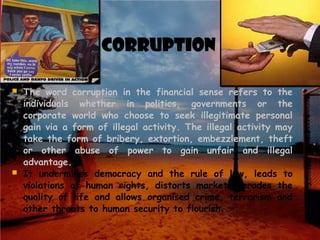
   The word corruption in the financial sense refers to the
    individuals whether in politics, governments or the
    corporate world who choose to seek illegitimate personal
    gain via a form of illegal activity. The illegal activity may
    take the form of bribery, extortion, embezzlement, theft
    or other abuse of power to gain unfair and illegal
    advantage.
   It undermines democracy and the rule of law, leads to

    violations of human rights, distorts markets, erodes the
    quality of life and allows organised crime, terrorism and
    other threats to human security to flourish.
   A     scam      worth    Rs.
    176,000 crore had former
    Union Cabinet Minister for
    Communications           and
    Information      Technology,
    Andimuthu Raja at the
    centre. A. Raja as he is
    generally called, was the
    prime accused in the 2G
    spectrum scam, which was
    the    largest    that   the
    country had seen in a long
    time.      Following     the
    shocking exposure, Raja
    was indicted and forced to
    resign. Presently, he too
    has been lodged at the
    Tihar jail and is awaiting
    his trial.
 
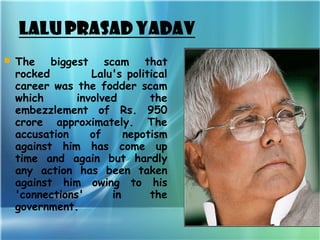
   The biggest scam that
    rocked         Lalu's political
    career was the fodder scam
    which       involved       the
    embezzlement of Rs. 950
    crore approximately. The
    accusation     of     nepotism
    against him has come up
    time and again but hardly
    any action has been taken
    against him owing to his
    'connections'      in      the
    government.
   Former Jharkand Chief Minister,
    and only the third independent
    legislator to assume the office of
    chief minister in India, Madhu
    Koda was responsible for a scam
    worth over Rs. 4000 crore. The
    man exploited the state's natural
    resources by licensing illegal
    mining leases and stashing away
    the wealth amassed during the
    undertaking. Furthermore, the
    Maoists received a 30% share of
    the booty. Koda was arrested on
    charges of money laundering and
    is still in prison following the
    rejection     of   numerous    bail
    applications.
    

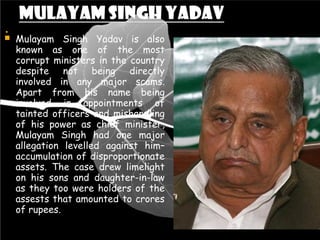
   Mulayam Singh Yadav is also
    known as one of the most
    corrupt ministers in the country
    despite not being directly
    involved in any major scams.
    Apart from his name being
    involved in appointments of
    tainted officers and mishandling
    of his power as chief minister,
    Mulayam Singh had one major
    allegation levelled against him–
    accumulation of disproportionate
    assets. The case drew limelight
    on his sons and daughter-in-law
    as they too were holders of the
    assests that amounted to crores
    of rupees.
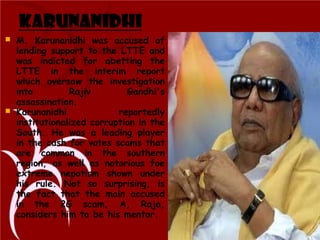
   M. Karunanidhi was accused of
    lending support to the LTTE and
    was indicted for abetting the
    LTTE in the interim report
    which oversaw the investigation
    into         Rajiv        Gandhi's
    assassination.
   Karunanidhi             reportedly
    institutionalized corruption in the
    South. He was a leading player
    in the cash for votes scams that
    are common in the southern
    region, as well as notorious foe
    extreme nepotism shown under
    his rule. Not so surprising, is
    the fact that the main accused
    in the 2G scam, A, Raja,
    considers him to be his mentor.
   Every now and then, Pawar
    draws    flak   for    alleged
    investments made by him and
    his family in various illegal
    projects. He was named by
    Abdul Karim Telgi, during a
    narcoanalysis test, stating
    that it was Pawar's brainchild
    to print fake stamp papers
    across the country and mint
    money. He was also accused in
    a multi-crore scam involving
    wheat imports and institutions
    headed by him and his close
    associates    were     served
    notices by the Bombay High
    Court for showing favoritism
    to his family
 
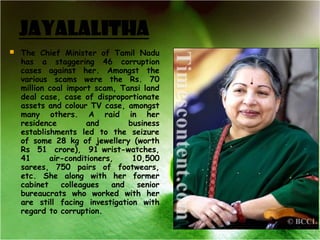
   The Chief Minister of Tamil Nadu
    has a staggering 46 corruption
    cases against her. Amongst the
    various scams were the Rs. 70
    million coal import scam, Tansi land
    deal case, case of disproportionate
    assets and colour TV case, amongst
    many others. A raid in her
    residence         and       business
    establishments led to the seizure
    of some 28 kg of jewellery (worth
    Rs 51 crore), 91 wrist-watches,
    41      air-conditioners,    10,500
    sarees, 750 pairs of footwears,
    etc. She along with her former
    cabinet    colleagues   and   senior
    bureaucrats who worked with her
    are still facing investigation with
    regard to corruption.
 
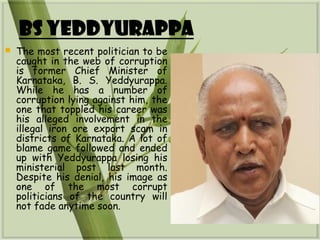
   The most recent politician to be
    caught in the web of corruption
    is former Chief Minister of
    Karnataka, B. S. Yeddyurappa.
    While he has a number of
    corruption lying against him, the
    one that toppled his career was
    his alleged involvement in the
    illegal iron ore export scam in
    districts of Karnataka. A lot of
    blame game followed and ended
    up with Yeddyurappa losing his
    ministerial post last month.
    Despite his denial, his image as
    one of the most corrupt
    politicians of the country will
    not fade anytime soon.  
Some important features of the proposed bill are:
   To establish a central government anti-corruption institution called Lokpal,
    supported by Lokayukta at the state level.
   As in the case of the Supreme Court and Cabinet Secretariat, the Lokpal
    will be supervised by the Cabinet Secretary and the Election Commission.
    As a result , it will be completely independent of the government and free
    from ministerial influence in its investigations.
   Members will be appointed by judges, Indian Administrative Service
    officers with a clean record, private citizens and constitutional authorities
    through a transparent and participator process.
   A selection committee will invite short-listed candidates for interviews,
    video recordings of which will thereafter be made public.
   Every month on its website, the Lokayukta will publish a list of cases dealt
    with , brief details of each, their outcome and any action taken or
    proposed. It will also publish lists of all cases received by the Lokayukta
    during the previous month, cases dealt with and those which are pending.
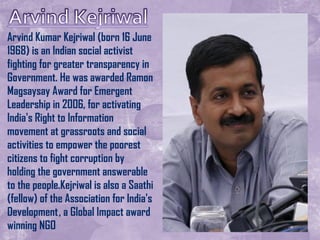
Arvind Kumar Kejriwal (born 16 June
1968) is an Indian social activist
fighting for greater transparency in
Government. He was awarded Ramon
Magsaysay Award for Emergent
Leadership in 2006, for activating
India's Right to Information
movement at grassroots and social
activities to empower the poorest
citizens to fight corruption by
holding the government answerable
to the people.Kejriwal is also a Saathi
(fellow) of the Association for India's
Development , a Global Impact award
winning NGO.
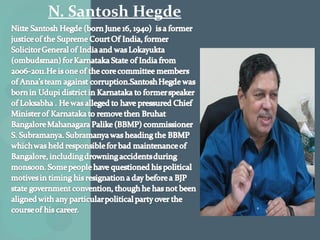
N. Santosh Hegde
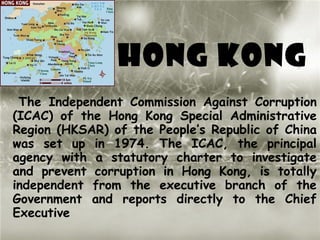
HONG KONG
 The Independent Commission Against Corruption
(ICAC) of the Hong Kong Special Administrative
Region (HKSAR) of the People’s Republic of China
was set up in 1974. The ICAC, the principal
agency with a statutory charter to investigate
and prevent corruption in Hong Kong, is totally
independent from the executive branch of the
Government and reports directly to the Chief
Executive
AUSTRALIA

 Australia's anti-corruption for development policy provides a
  framework for planning, resourcing, and reviewing anti
  corruption activities on a country and regional basis. The overall
  goal of Australia's anti-corruption for development policy is to
  assist developing countries bring about a sustainable reduction in
  corrupt behaviour for the purpose of improving economic and
  social development. Australia's approach to anti-corruption will
  focus on three mutually reinforcing elements:
 Building constituencies for anti-corruption reform
 Reducing opportunities for corruption
 Changing incentives for corrupt behaviour:
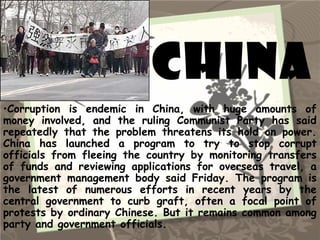
CHINA
•Corruption is endemic in China, with huge amounts of
money involved, and the ruling Communist Party has said
repeatedly that the problem threatens its hold on power.
China has launched a program to try to stop corrupt
officials from fleeing the country by monitoring transfers
of funds and reviewing applications for overseas travel, a
government management body said Friday. The program is
the latest of numerous efforts in recent years by the
central government to curb graft, often a focal point of
protests by ordinary Chinese. But it remains common among
party and government officials.
Anti Corruption
Anti Corruption
Anti Corruption
Anti Corruption
Anti Corruption

Anti Corruption

  • 2.
    WHAT ARE CORRUPTION AND ANTI CORRUPTION?
  • 3.
    The word corruption in the financial sense refers to the individuals whether in politics, governments or the corporate world who choose to seek illegitimate personal gain via a form of illegal activity. The illegal activity may take the form of bribery, extortion, embezzlement, theft or other abuse of power to gain unfair and illegal advantage.  It undermines democracy and the rule of law, leads to violations of human rights, distorts markets, erodes the quality of life and allows organised crime, terrorism and other threats to human security to flourish.
  • 14.
    A scam worth Rs. 176,000 crore had former Union Cabinet Minister for Communications and Information Technology, Andimuthu Raja at the centre. A. Raja as he is generally called, was the prime accused in the 2G spectrum scam, which was the largest that the country had seen in a long time. Following the shocking exposure, Raja was indicted and forced to resign. Presently, he too has been lodged at the Tihar jail and is awaiting his trial.
  • 16.
       The biggest scam that rocked Lalu's political career was the fodder scam which involved the embezzlement of Rs. 950 crore approximately. The accusation of nepotism against him has come up time and again but hardly any action has been taken against him owing to his 'connections' in the government.
  • 17.
    Former Jharkand Chief Minister, and only the third independent legislator to assume the office of chief minister in India, Madhu Koda was responsible for a scam worth over Rs. 4000 crore. The man exploited the state's natural resources by licensing illegal mining leases and stashing away the wealth amassed during the undertaking. Furthermore, the Maoists received a 30% share of the booty. Koda was arrested on charges of money laundering and is still in prison following the rejection of numerous bail applications.
  • 18.
       Mulayam Singh Yadav is also known as one of the most corrupt ministers in the country despite not being directly involved in any major scams. Apart from his name being involved in appointments of tainted officers and mishandling of his power as chief minister, Mulayam Singh had one major allegation levelled against him– accumulation of disproportionate assets. The case drew limelight on his sons and daughter-in-law as they too were holders of the assests that amounted to crores of rupees.
  • 19.
    M. Karunanidhi was accused of lending support to the LTTE and was indicted for abetting the LTTE in the interim report which oversaw the investigation into Rajiv Gandhi's assassination.  Karunanidhi reportedly institutionalized corruption in the South. He was a leading player in the cash for votes scams that are common in the southern region, as well as notorious foe extreme nepotism shown under his rule. Not so surprising, is the fact that the main accused in the 2G scam, A, Raja, considers him to be his mentor.
  • 20.
    Every now and then, Pawar draws flak for alleged investments made by him and his family in various illegal projects. He was named by Abdul Karim Telgi, during a narcoanalysis test, stating that it was Pawar's brainchild to print fake stamp papers across the country and mint money. He was also accused in a multi-crore scam involving wheat imports and institutions headed by him and his close associates were served notices by the Bombay High Court for showing favoritism to his family
  • 21.
       The Chief Minister of Tamil Nadu has a staggering 46 corruption cases against her. Amongst the various scams were the Rs. 70 million coal import scam, Tansi land deal case, case of disproportionate assets and colour TV case, amongst many others. A raid in her residence and business establishments led to the seizure of some 28 kg of jewellery (worth Rs 51 crore), 91 wrist-watches, 41 air-conditioners, 10,500 sarees, 750 pairs of footwears, etc. She along with her former cabinet colleagues and senior bureaucrats who worked with her are still facing investigation with regard to corruption.
  • 22.
       The most recent politician to be caught in the web of corruption is former Chief Minister of Karnataka, B. S. Yeddyurappa. While he has a number of corruption lying against him, the one that toppled his career was his alleged involvement in the illegal iron ore export scam in districts of Karnataka. A lot of blame game followed and ended up with Yeddyurappa losing his ministerial post last month. Despite his denial, his image as one of the most corrupt politicians of the country will not fade anytime soon.  
  • 24.
    Some important featuresof the proposed bill are:  To establish a central government anti-corruption institution called Lokpal, supported by Lokayukta at the state level.  As in the case of the Supreme Court and Cabinet Secretariat, the Lokpal will be supervised by the Cabinet Secretary and the Election Commission. As a result , it will be completely independent of the government and free from ministerial influence in its investigations.  Members will be appointed by judges, Indian Administrative Service officers with a clean record, private citizens and constitutional authorities through a transparent and participator process.  A selection committee will invite short-listed candidates for interviews, video recordings of which will thereafter be made public.  Every month on its website, the Lokayukta will publish a list of cases dealt with , brief details of each, their outcome and any action taken or proposed. It will also publish lists of all cases received by the Lokayukta during the previous month, cases dealt with and those which are pending.
  • 28.
    Arvind Kumar Kejriwal(born 16 June 1968) is an Indian social activist fighting for greater transparency in Government. He was awarded Ramon Magsaysay Award for Emergent Leadership in 2006, for activating India's Right to Information movement at grassroots and social activities to empower the poorest citizens to fight corruption by holding the government answerable to the people.Kejriwal is also a Saathi (fellow) of the Association for India's Development , a Global Impact award winning NGO.
  • 30.
  • 32.
    HONG KONG TheIndependent Commission Against Corruption (ICAC) of the Hong Kong Special Administrative Region (HKSAR) of the People’s Republic of China was set up in 1974. The ICAC, the principal agency with a statutory charter to investigate and prevent corruption in Hong Kong, is totally independent from the executive branch of the Government and reports directly to the Chief Executive
  • 33.
    AUSTRALIA  Australia's anti-corruptionfor development policy provides a framework for planning, resourcing, and reviewing anti corruption activities on a country and regional basis. The overall goal of Australia's anti-corruption for development policy is to assist developing countries bring about a sustainable reduction in corrupt behaviour for the purpose of improving economic and social development. Australia's approach to anti-corruption will focus on three mutually reinforcing elements:  Building constituencies for anti-corruption reform  Reducing opportunities for corruption  Changing incentives for corrupt behaviour:
  • 34.
    CHINA •Corruption is endemicin China, with huge amounts of money involved, and the ruling Communist Party has said repeatedly that the problem threatens its hold on power. China has launched a program to try to stop corrupt officials from fleeing the country by monitoring transfers of funds and reviewing applications for overseas travel, a government management body said Friday. The program is the latest of numerous efforts in recent years by the central government to curb graft, often a focal point of protests by ordinary Chinese. But it remains common among party and government officials.