Corruption in India
Presented By:
MANISH KUMAR
MBA I-A
Enrollment no :060
INTRODUCTION
 Corruption is a type of strategic action.
 Two or more people undertake an exchange relation
by way of a successful transfer of money or power
which sidesteps legality or morality to regulate the
relation.
 India is the 79th most corrupted country in the
world.
 A corrupt society stops valuing integrity, virtue or
moral principals.
 It exploits India’s scarce resources.
 Derail country's credibility and economic stability.
Causes of corruption
• Excessive regulations
• Complicated tax
• Licensing Systems
• Numerous government departments with
opaque bureaucracy & discretionary powers.
• Monopoly of government controlled institutions
on certain goods and services delivery
• Lack of transparent laws and processes.
Significant level of corruption
Politics
Bureaucracy
Land and property
Tendering processes & awarding contracts
Hospitals and health cares
Science & Technology
Income tax department
Driver Licensing
Trends
Index trends in major states by
respective anti-corruption effort
Consequences of Corruption
Loss of National Health
Hindrance and obstruction in development
Backwardness
Authority and power in wrong hands.
Brain Drain
Rise of terrorism and crime
Rise in suicide cases
Psychological and Social Disorders
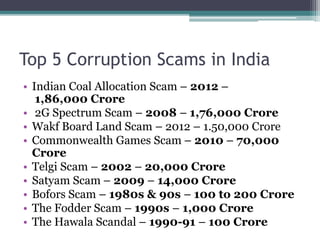
Top 5 Corruption Scams in India
• Indian Coal Allocation Scam – 2012 –
1,86,000 Crore
• 2G Spectrum Scam – 2008 – 1,76,000 Crore
• Wakf Board Land Scam – 2012 – 1.50,000 Crore
• Commonwealth Games Scam – 2010 – 70,000
Crore
• Telgi Scam – 2002 – 20,000 Crore
• Satyam Scam – 2009 – 14,000 Crore
• Bofors Scam – 1980s & 90s – 100 to 200 Crore
• The Fodder Scam – 1990s – 1,000 Crore
• The Hawala Scandal – 1990-91 – 100 Crore
Indian Coal Allocation Scam
• While many think that 2G scam remains the biggest
one in size in India. But this coal allocation scam
dwarfs it by the amount involved. This scam is in
regards to Indian Government’s allocation of
nation’s coal deposit to PSU’s and private
companies. The scam happened under Manmohan
Singh government and came out in 2012.
• The basic premise of this scam was that wrongful
allocation of Coal deposits by Government without
resorting to competitive bidding, which would have
made huge amounts to the Government (to tune of
1.86 Lakh crore). However, the coal deposits were
allocated arbitrarily
2G Spectrum Scam
• We have had a number of scams in India; but
none bigger than the scam involving the process
of allocating unified access service licenses. At
the heart of this Rs.1.76-lakh crore worth of
scam is the former Telecom minister A Raja –
who according to the CAG, has evaded norms at
every level as he carried out the dubious 2G
license awards in 2008 at a throw-away price
which were pegged at 2001 prices.
Wakf Board Land Scam
• In March of 2012, Anwar Maniapddy, the chairman of Karnataka
State Minorities Commission submitted a sensational report which
alleged 27,000 acres of land, which was controlled by Karnataka
Wakf Board had been allocated illegally or misappropriated. The
value of land which was misappropriated was in tune of 1.5 to 2 lakh
crore rupees.
• The land managed by Wakf board, a Muslim charitable trust, is
typically donated to under-privileged and poor people of Muslim
community. However, the report alleged that nearly 50 percent of
the land owned by Wakf board was misappropriated by Politicians
and Board members in conjunction with real estate mafia at fraction
of actual land cost.
• The investigations for this are currently ongoing.
•
Commonwealth Games Scam
• Another feather in the cap of Indian scandal list
is Commonwealth Games loot. Yes, literally a loot! Even
before the long awaited sporting bonanza could see the
day of light, the grand event was soaked in the
allegations of corruption.
• It is estimated that out of Rs. 70000 crore spent on the
Games, only half the said amount was spent on Indian
sportspersons. The Central Vigilance Commission,
involved in probing the alleged corruption in various
Commonwealth Games-related projects, has found
discrepancies in tenders – like payment to non-existent
parties, will-ful delays in execution of contracts, over-
inflated price and bungling in purchase of equipment
through tendering – and misappropriation of funds.
Telgi Scam
• As they say, every scam must have something
unique in it to make money out of it in an
unscrupulous manner- and Telgi scam had all the
suspense and drama that the scandal needed to
thrive and be busted. Abdul Karim Telgi had
mastered the art of forgery in printing duplicate
stamp papers and sold them to banks and other
institutions. The tentacles of the fake stamp and
stamp paper case had penetrated 12 states and was
estimated at a whooping Rs. 20000 crore plus. The
Telgi clearly had a lot of support from government
departments that were responsible for the
production and sale of high security stamps
Satyam Scam
• The scam at Satyam Computer Services is something
that will shatter the peace and tranquility of Indian
investors and shareholder community beyond
repair. Satyam is the biggest fraud in the
corporate history to the tune of Rs. 14000
crore.
• The company’s disgraced former chairman
Ramalinga Raju kept everyone in the dark for a
decade by fudging the books of accounts for several
years and inflating revenues and profit figures of
Satyam. Finally, the company was taken over by the
Tech Mahindra which has done wonderfully well to
revive the brand Satyam.
Bofors Scam
• The Bofors scandal is known as the hallmark of Indian
corruption. The Bofors scam was a major corruption scandal
in India in the 1980s; when the then PM Rajiv Gandhi and
several others including a powerful NRI family named the
Hindujas, were accused of receiving kickbacks from Bofors AB
for winning a bid to supply India’s 155 mm field howitzer.
• The Swedish State Radio had broadcast a startling report
about an undercover operation carried out by Bofors,
Sweden’s biggest arms manufacturer, whereby $16 million
were allegedly paid to members of PM Rajiv Gandhi’s
Congress.
• Most of all, the Bofors scam had a strong emotional appeal
because it was a scam related to the defense services and
India’s security interests.
The Fodder Scam
• If you haven’t heard of Bihar’s fodder scam of
1996, you might still be able to recognize it by
the name of “Chara Ghotala,” as it is popularly
known in the vernacular language. In this
corruption scandal worth Rs.900 crore, an
unholy nexus was traced involved in fabrication
of “vast herds of fictitious livestock” for which
fodder, medicine and animal husbandry
equipment was supposedly procured.
The Hawala Scandal
• The Hawala case to the tune of $18 million bribery
scandal, which came in the open in 1996, involved
payments allegedly received by country’s leading
politicians through hawala brokers. From the list of
those accused also included Lal Krishna Advani who
was then the Leader of Opposition.
• Thus, for the first time in Indian politics, it gave a
feeling of open loot all around the public, involving
all the major political players being accused of
having accepted bribes and also alleged connections
about payments being channeled to Hizbul
Mujahedeen militants in Kashmir.
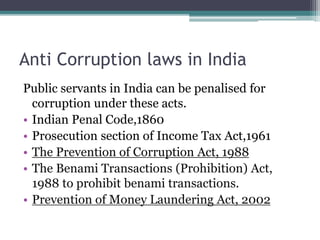
Anti Corruption laws in India
Public servants in India can be penalised for
corruption under these acts.
• Indian Penal Code,1860
• Prosecution section of Income Tax Act,1961
• The Prevention of Corruption Act, 1988
• The Benami Transactions (Prohibition) Act,
1988 to prohibit benami transactions.
• Prevention of Money Laundering Act, 2002
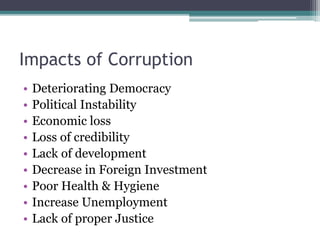
Impacts of Corruption
• Deteriorating Democracy
• Political Instability
• Economic loss
• Loss of credibility
• Lack of development
• Decrease in Foreign Investment
• Poor Health & Hygiene
• Increase Unemployment
• Lack of proper Justice
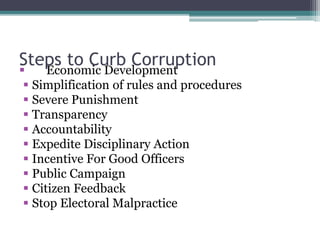
Steps to Curb Corruption
 Economic Development
 Simplification of rules and procedures
 Severe Punishment
 Transparency
 Accountability
 Expedite Disciplinary Action
 Incentive For Good Officers
 Public Campaign
 Citizen Feedback
 Stop Electoral Malpractice
Corruption in india
Corruption in india

Corruption in india

  • 1.
    Corruption in India PresentedBy: MANISH KUMAR MBA I-A Enrollment no :060
  • 2.
    INTRODUCTION  Corruption isa type of strategic action.  Two or more people undertake an exchange relation by way of a successful transfer of money or power which sidesteps legality or morality to regulate the relation.  India is the 79th most corrupted country in the world.  A corrupt society stops valuing integrity, virtue or moral principals.  It exploits India’s scarce resources.  Derail country's credibility and economic stability.
  • 3.
    Causes of corruption •Excessive regulations • Complicated tax • Licensing Systems • Numerous government departments with opaque bureaucracy & discretionary powers. • Monopoly of government controlled institutions on certain goods and services delivery • Lack of transparent laws and processes.
  • 4.
    Significant level ofcorruption Politics Bureaucracy Land and property Tendering processes & awarding contracts Hospitals and health cares Science & Technology Income tax department Driver Licensing Trends
  • 5.
    Index trends inmajor states by respective anti-corruption effort
  • 6.
    Consequences of Corruption Lossof National Health Hindrance and obstruction in development Backwardness Authority and power in wrong hands. Brain Drain Rise of terrorism and crime Rise in suicide cases Psychological and Social Disorders
  • 7.
    Top 5 CorruptionScams in India • Indian Coal Allocation Scam – 2012 – 1,86,000 Crore • 2G Spectrum Scam – 2008 – 1,76,000 Crore • Wakf Board Land Scam – 2012 – 1.50,000 Crore • Commonwealth Games Scam – 2010 – 70,000 Crore • Telgi Scam – 2002 – 20,000 Crore • Satyam Scam – 2009 – 14,000 Crore • Bofors Scam – 1980s & 90s – 100 to 200 Crore • The Fodder Scam – 1990s – 1,000 Crore • The Hawala Scandal – 1990-91 – 100 Crore
  • 8.
    Indian Coal AllocationScam • While many think that 2G scam remains the biggest one in size in India. But this coal allocation scam dwarfs it by the amount involved. This scam is in regards to Indian Government’s allocation of nation’s coal deposit to PSU’s and private companies. The scam happened under Manmohan Singh government and came out in 2012. • The basic premise of this scam was that wrongful allocation of Coal deposits by Government without resorting to competitive bidding, which would have made huge amounts to the Government (to tune of 1.86 Lakh crore). However, the coal deposits were allocated arbitrarily
  • 9.
    2G Spectrum Scam •We have had a number of scams in India; but none bigger than the scam involving the process of allocating unified access service licenses. At the heart of this Rs.1.76-lakh crore worth of scam is the former Telecom minister A Raja – who according to the CAG, has evaded norms at every level as he carried out the dubious 2G license awards in 2008 at a throw-away price which were pegged at 2001 prices.
  • 10.
    Wakf Board LandScam • In March of 2012, Anwar Maniapddy, the chairman of Karnataka State Minorities Commission submitted a sensational report which alleged 27,000 acres of land, which was controlled by Karnataka Wakf Board had been allocated illegally or misappropriated. The value of land which was misappropriated was in tune of 1.5 to 2 lakh crore rupees. • The land managed by Wakf board, a Muslim charitable trust, is typically donated to under-privileged and poor people of Muslim community. However, the report alleged that nearly 50 percent of the land owned by Wakf board was misappropriated by Politicians and Board members in conjunction with real estate mafia at fraction of actual land cost. • The investigations for this are currently ongoing. •
  • 11.
    Commonwealth Games Scam •Another feather in the cap of Indian scandal list is Commonwealth Games loot. Yes, literally a loot! Even before the long awaited sporting bonanza could see the day of light, the grand event was soaked in the allegations of corruption. • It is estimated that out of Rs. 70000 crore spent on the Games, only half the said amount was spent on Indian sportspersons. The Central Vigilance Commission, involved in probing the alleged corruption in various Commonwealth Games-related projects, has found discrepancies in tenders – like payment to non-existent parties, will-ful delays in execution of contracts, over- inflated price and bungling in purchase of equipment through tendering – and misappropriation of funds.
  • 12.
    Telgi Scam • Asthey say, every scam must have something unique in it to make money out of it in an unscrupulous manner- and Telgi scam had all the suspense and drama that the scandal needed to thrive and be busted. Abdul Karim Telgi had mastered the art of forgery in printing duplicate stamp papers and sold them to banks and other institutions. The tentacles of the fake stamp and stamp paper case had penetrated 12 states and was estimated at a whooping Rs. 20000 crore plus. The Telgi clearly had a lot of support from government departments that were responsible for the production and sale of high security stamps
  • 13.
    Satyam Scam • Thescam at Satyam Computer Services is something that will shatter the peace and tranquility of Indian investors and shareholder community beyond repair. Satyam is the biggest fraud in the corporate history to the tune of Rs. 14000 crore. • The company’s disgraced former chairman Ramalinga Raju kept everyone in the dark for a decade by fudging the books of accounts for several years and inflating revenues and profit figures of Satyam. Finally, the company was taken over by the Tech Mahindra which has done wonderfully well to revive the brand Satyam.
  • 14.
    Bofors Scam • TheBofors scandal is known as the hallmark of Indian corruption. The Bofors scam was a major corruption scandal in India in the 1980s; when the then PM Rajiv Gandhi and several others including a powerful NRI family named the Hindujas, were accused of receiving kickbacks from Bofors AB for winning a bid to supply India’s 155 mm field howitzer. • The Swedish State Radio had broadcast a startling report about an undercover operation carried out by Bofors, Sweden’s biggest arms manufacturer, whereby $16 million were allegedly paid to members of PM Rajiv Gandhi’s Congress. • Most of all, the Bofors scam had a strong emotional appeal because it was a scam related to the defense services and India’s security interests.
  • 15.
    The Fodder Scam •If you haven’t heard of Bihar’s fodder scam of 1996, you might still be able to recognize it by the name of “Chara Ghotala,” as it is popularly known in the vernacular language. In this corruption scandal worth Rs.900 crore, an unholy nexus was traced involved in fabrication of “vast herds of fictitious livestock” for which fodder, medicine and animal husbandry equipment was supposedly procured.
  • 16.
    The Hawala Scandal •The Hawala case to the tune of $18 million bribery scandal, which came in the open in 1996, involved payments allegedly received by country’s leading politicians through hawala brokers. From the list of those accused also included Lal Krishna Advani who was then the Leader of Opposition. • Thus, for the first time in Indian politics, it gave a feeling of open loot all around the public, involving all the major political players being accused of having accepted bribes and also alleged connections about payments being channeled to Hizbul Mujahedeen militants in Kashmir.
  • 17.
    Anti Corruption lawsin India Public servants in India can be penalised for corruption under these acts. • Indian Penal Code,1860 • Prosecution section of Income Tax Act,1961 • The Prevention of Corruption Act, 1988 • The Benami Transactions (Prohibition) Act, 1988 to prohibit benami transactions. • Prevention of Money Laundering Act, 2002
  • 18.
    Impacts of Corruption •Deteriorating Democracy • Political Instability • Economic loss • Loss of credibility • Lack of development • Decrease in Foreign Investment • Poor Health & Hygiene • Increase Unemployment • Lack of proper Justice
  • 19.
    Steps to CurbCorruption  Economic Development  Simplification of rules and procedures  Severe Punishment  Transparency  Accountability  Expedite Disciplinary Action  Incentive For Good Officers  Public Campaign  Citizen Feedback  Stop Electoral Malpractice