The word ‘anthropometry’ means Measurement of the human
body.
It is derived from the Greek words ‘anthropos’ (man) and ‘metron’
(measure).
1. Structural Anthropometric Data
2. Functional Anthropometric Data
TYPES OF ANTHROPOMETRIC DATA
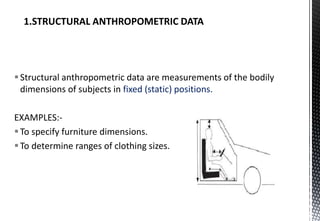
Structural anthropometric data are measurements of the bodily
dimensions of subjects in fixed (static) positions.
EXAMPLES:-
To specify furniture dimensions.
To determine ranges of clothing sizes.
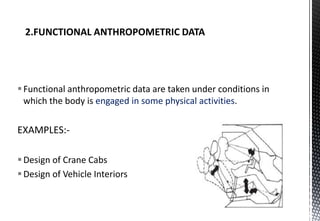
Functional anthropometric data are taken under conditions in
which the body is engaged in some physical activities.
EXAMPLES:-
Design of Crane Cabs
Design of Vehicle Interiors
Some of the applications of anthropometric data are
1.Determine the body dimensions.
2.Determine what principle is to be applied.
3.Defining equipment and facilities.
4.Space requirements.
A door handle must not be lower than the highest standing knuckle,
height in a population so that all users can open the door without
bending.
Minimum dimensions
The width of a chair must be no narrower than the hip breadth
of a healthy person .
The height of a doorway must be no lower than the stature of a
tall man (plus an allowance for clothing and shoes).
A Door lock must not be higher than the maximum vertical reach
of a small person.
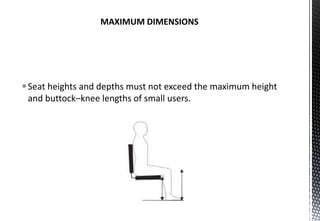
Seat heights and depths must not exceed the maximum height
and buttock–knee lengths of small users.
Criteria of judgment of design features of physical equipment
and facilities:-
 Comfort
 Work performance
 Safety & Physical effects
Equipment's are of three kinds:-
 Spaces into which a person can fit
 Tools or controls which a person can use
 Protective clothing and devices
One of the applications of anthropometric data is the design of work
spaces, including the work-space envelopes.
 The limits of the work-space envelope for seated personnel are
determined by functional arm reach, which is influenced by
 presence of any restraints
 apparel worn
 angle of back
Increase accuracy
Reduce Fatigue
Better comfort
Reduce chance of injuries
Time management
Doctor’s Cabin
Reception
Waiting Area
Pantry
Staff Toilet
Patient Toilet
Pharmacy
Pathology Lab
Examine Room
DESK CHAIR
Anthropometry plays a major role in increasing productivity of the
organization.
Based on the population we have to design the workspace and
equipment's.
According to the level of comfort ability the quality of the product
will get raise.
ANTHROPOMETRY (DOCTOR'S CLINIC)

ANTHROPOMETRY (DOCTOR'S CLINIC)

  • 2.
    The word ‘anthropometry’means Measurement of the human body. It is derived from the Greek words ‘anthropos’ (man) and ‘metron’ (measure).
  • 3.
    1. Structural AnthropometricData 2. Functional Anthropometric Data TYPES OF ANTHROPOMETRIC DATA
  • 4.
    Structural anthropometric dataare measurements of the bodily dimensions of subjects in fixed (static) positions. EXAMPLES:- To specify furniture dimensions. To determine ranges of clothing sizes.
  • 5.
    Functional anthropometric dataare taken under conditions in which the body is engaged in some physical activities. EXAMPLES:- Design of Crane Cabs Design of Vehicle Interiors
  • 6.
    Some of theapplications of anthropometric data are 1.Determine the body dimensions. 2.Determine what principle is to be applied. 3.Defining equipment and facilities. 4.Space requirements.
  • 7.
    A door handlemust not be lower than the highest standing knuckle, height in a population so that all users can open the door without bending. Minimum dimensions
  • 8.
    The width ofa chair must be no narrower than the hip breadth of a healthy person .
  • 9.
    The height ofa doorway must be no lower than the stature of a tall man (plus an allowance for clothing and shoes).
  • 10.
    A Door lockmust not be higher than the maximum vertical reach of a small person.
  • 11.
    Seat heights anddepths must not exceed the maximum height and buttock–knee lengths of small users.
  • 12.
    Criteria of judgmentof design features of physical equipment and facilities:-  Comfort  Work performance  Safety & Physical effects Equipment's are of three kinds:-  Spaces into which a person can fit  Tools or controls which a person can use  Protective clothing and devices
  • 13.
    One of theapplications of anthropometric data is the design of work spaces, including the work-space envelopes.  The limits of the work-space envelope for seated personnel are determined by functional arm reach, which is influenced by  presence of any restraints  apparel worn  angle of back
  • 14.
    Increase accuracy Reduce Fatigue Bettercomfort Reduce chance of injuries Time management
  • 16.
    Doctor’s Cabin Reception Waiting Area Pantry StaffToilet Patient Toilet Pharmacy Pathology Lab Examine Room
  • 21.
  • 30.
    Anthropometry plays amajor role in increasing productivity of the organization. Based on the population we have to design the workspace and equipment's. According to the level of comfort ability the quality of the product will get raise.