What is Ergonomics or Human Factors Engineering (HFE)?  Who are Human Factors Engineers? What do they do? What are the applications of  HFE? Why is it important ? Compiled and Presented by: Avinash Konkani   BE, MS (BME) Biomedical & Human Factors Engineer How HFE is applied in Biomedical Engineering ?
Acknowledgement : This presentation was complied by me from the references mentioned at the end. The presentation was aimed for undergraduate biomedical engineering students and to introduce them to Human Factors Engineering (HFE)  and its applications in Biomedical Engineering. I am thankful to all the professionals whose work / presentations have been used in this document. (Solely for educational purpose)
“ Ergonomics  is a  multidisciplinary  activity that assembles information on people’s capacities and applies that information in  designing  jobs, products, devices, workplaces, and equipments.” Ergonomics is also known as Human Factors Engineering (HFE). The word Human Factors originated in the United States and Ergonomics primarily in Europe.   “ Ergonomics” combines 2 Greek words ERGON  means  WORK NOMOS  means  NATURAL LAWS It deals with the effect of tools, equipment, workstations and environment on both, worker’s PERFORMANCE and HEALTH Definition of Ergonomics / Human Factors Engineering
Dr. Alphonse Chapanis  is considered  as the father of Ergonomics. Dr.Chapanis’s definition of HFE is: “ Human factors engineering is the application of human factors information to the design of tools, machines, systems, tasks, jobs, and environment for safe, comfortable, and effective human use."  For more information please visit : http://www.cs.umd.edu/hcil/muiseum/chapanis/chapanis_page.htm He has written the first ergonomics textbook, "Applied Experimental Psychology: Human Factors in Engineering Design". Reference:  http://www.jhu.edu/~gazette/2002/14oct02/14obit.html Who is the father of Ergonomics ?
Types of Ergonomics or Human Factors Engineering (HFE):  Informational or Cognitive-   Concerned with information interfaces and transfer Physical-   Concerned with physical interfaces including workplace and tool design Organizational- Concerned with the design of organizations,  jobs and activities (“Macro- ergonomics, where large organizations or entities are  involved”)
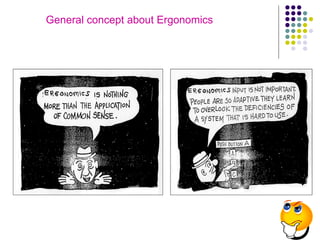
General concept about Ergonomics
System Safety Philosophy After - The – Fact  (Old Concept) Or Fly - Fix - Fly Vs... Before  - The - Fact Or Identify - Analyze – Control (Ergonomics)
What is good human factors engineering?
Comfort
Effectiveness
Convenience
Efficiency
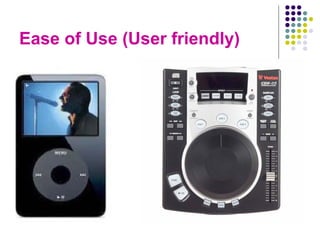
Ease of Use (User friendly)
Satisfaction
Safety
Fun
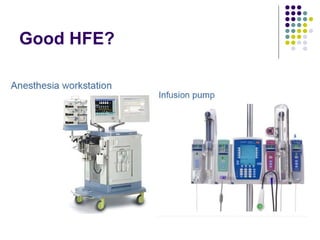
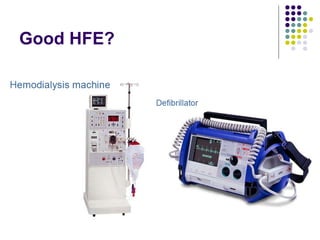
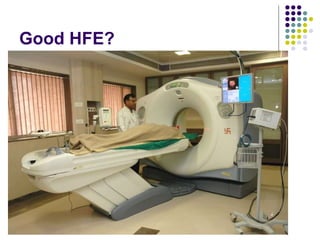
Human Factors Engineering in Medical Devices Does the following medical equipments represent good Human Factors Engineering? (By just looking at them can you explore their human factors qualities?)
Good HFE?
Good HFE?
Good HFE?
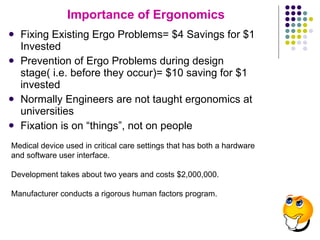
Importance of Ergonomics Fixing Existing Ergo Problems= $4 Savings for $1 Invested Prevention of Ergo Problems during design stage( i.e. before they occur)= $10 saving for $1 invested Normally Engineers are not taught ergonomics at universities Fixation is on “things”, not on people Medical device used in critical care settings that has both a hardware and software user interface. Development takes about two years and costs $2,000,000. Manufacturer conducts a rigorous human factors program.
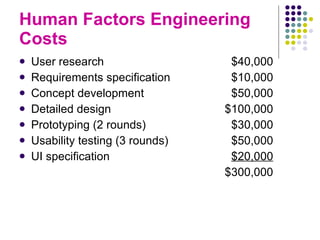
Human Factors Engineering Costs User research $40,000 Requirements specification $10,000 Concept development $50,000 Detailed design $100,000 Prototyping (2 rounds) $30,000 Usability testing (3 rounds) $50,000 UI specification $20,000 $300,000
Opportunities for Savings and Returns : Benefits of HFE Simplified learning tools Faster time to market Increased sales Product liability protection Reduced customer support Longer design life
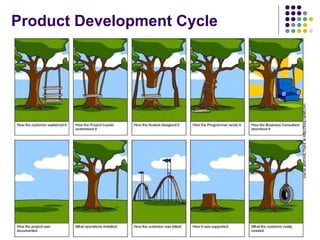
Product Development Cycle
How can Ergonomics help Biomedical Engineers? Ergonomically designing instrumentation & devices for medical care. Ergonomics plays an  important role in Product Development process ( usability testing ) . Applying ergonomic techniques in bioinstrumentation, biomechanics, orthopedic& prosthetic engineering, clinical engineering & rehabilitation engineering. Establishing performance testing & maintenance of medical equipments & devices.
How can Ergonomics help Biomedical Engineers? In conducting Safety Tests established by Occupational Safety & Health Administration (OSHA)  and Food & Drug Administration (FDA). Developing health & safety procedures to improve productivity. Reducing Workers’ Comp. cost & back injuries during patient care. Working with vendors to incorporate ergonomics during the installation of medical equipment.
Role of Ergonomics Methods & operation design System & interface design Product & equipment design Workstation & hand tool design Information design Environmental design improve productivity, Safety & health, which will improve the bottom line of the company.
Basic mistakes made by Engineers during design process   1) I am satisfied with the design and therefore it must be satisfactory to employees/end users. 2) I have designed for the average person and therefore it must satisfy all employees 3) There is so much variability in human beings that no design will be satisfactory. 4) Ergonomic design is very expensive, however human beings are so flexible and adaptable that they can adapt to any design. 5) Ergonomic design is based on common sense. Discussion:  Can you define an average person? There is no average person in the world. Can you show me one average person?, if there is no average person, then how are you designing for an average person.
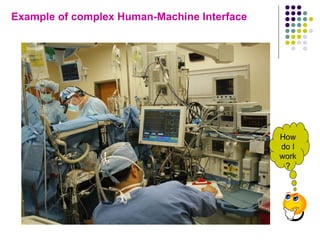
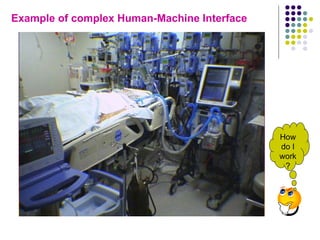
Example of complex Human-Machine Interface How do I work?
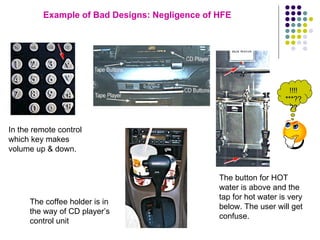
Example of Bad Designs: Negligence of HFE In the remote control which key makes volume up & down. The button for HOT water is above and the tap for hot water is very below. The user will get confuse. The coffee holder is in the way of CD player’s control unit !!!!***????
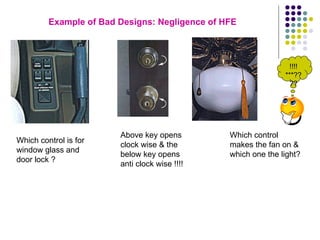
Example of Bad Designs: Negligence of HFE Which control is for window glass and door lock ? Above key opens clock wise & the below key opens anti clock wise !!!! Which control makes the fan on & which one the light? !!!!***????
Conclusion: KISS – Principle “ Keep It Simple Stupid” -Kelly Johnson
Questions???? Reference : Federal Aviation Administration (FAA) Human Factors Awareness Course:  http://www.hf.faa.gov/Webtraining/HFModel/HFModel1.htm International Ergonomics Association :  http://www.iea.cc/ Human Factors and Ergonomics Society:  http://www.hfes.org/   Biomedical Engineering Society:  http://www.bmes.org/     Bad Designs :  http://www.baddesigns.com/examples.html Human Factors & Medical Devices :   http://www.ahcpr.gov/clinic/ptsafety/chap41a.htm FDA’s Human Factors Program :   http://www.fda.gov/cdrh/humanfactors/index.html Overview of FDA's New Human Factors Program Plan:  Implications for the Medical Device Industry: http://www.fda.gov/cdrh/humfac/hufacpbc.html Michael Wiklund’s presentation on Human Factors Methodologies-  http://www.wiklundrd.com/index.html Dr.Robert E.Thomas’s class notes -  http://www.eng.auburn.edu/users/thomare/index.htm

Ergonomics In Medical Device Design

  • 1.
    What is Ergonomicsor Human Factors Engineering (HFE)? Who are Human Factors Engineers? What do they do? What are the applications of HFE? Why is it important ? Compiled and Presented by: Avinash Konkani BE, MS (BME) Biomedical & Human Factors Engineer How HFE is applied in Biomedical Engineering ?
  • 2.
    Acknowledgement : Thispresentation was complied by me from the references mentioned at the end. The presentation was aimed for undergraduate biomedical engineering students and to introduce them to Human Factors Engineering (HFE) and its applications in Biomedical Engineering. I am thankful to all the professionals whose work / presentations have been used in this document. (Solely for educational purpose)
  • 3.
    “ Ergonomics is a multidisciplinary activity that assembles information on people’s capacities and applies that information in designing jobs, products, devices, workplaces, and equipments.” Ergonomics is also known as Human Factors Engineering (HFE). The word Human Factors originated in the United States and Ergonomics primarily in Europe. “ Ergonomics” combines 2 Greek words ERGON means WORK NOMOS means NATURAL LAWS It deals with the effect of tools, equipment, workstations and environment on both, worker’s PERFORMANCE and HEALTH Definition of Ergonomics / Human Factors Engineering
  • 4.
    Dr. Alphonse Chapanis is considered as the father of Ergonomics. Dr.Chapanis’s definition of HFE is: “ Human factors engineering is the application of human factors information to the design of tools, machines, systems, tasks, jobs, and environment for safe, comfortable, and effective human use." For more information please visit : http://www.cs.umd.edu/hcil/muiseum/chapanis/chapanis_page.htm He has written the first ergonomics textbook, "Applied Experimental Psychology: Human Factors in Engineering Design". Reference: http://www.jhu.edu/~gazette/2002/14oct02/14obit.html Who is the father of Ergonomics ?
  • 5.
    Types of Ergonomicsor Human Factors Engineering (HFE): Informational or Cognitive- Concerned with information interfaces and transfer Physical- Concerned with physical interfaces including workplace and tool design Organizational- Concerned with the design of organizations, jobs and activities (“Macro- ergonomics, where large organizations or entities are involved”)
  • 6.
  • 7.
    System Safety PhilosophyAfter - The – Fact (Old Concept) Or Fly - Fix - Fly Vs... Before - The - Fact Or Identify - Analyze – Control (Ergonomics)
  • 8.
    What is goodhuman factors engineering?
  • 9.
  • 10.
  • 11.
  • 12.
  • 13.
    Ease of Use(User friendly)
  • 14.
  • 15.
  • 16.
  • 17.
    Human Factors Engineeringin Medical Devices Does the following medical equipments represent good Human Factors Engineering? (By just looking at them can you explore their human factors qualities?)
  • 18.
  • 19.
  • 20.
  • 21.
    Importance of ErgonomicsFixing Existing Ergo Problems= $4 Savings for $1 Invested Prevention of Ergo Problems during design stage( i.e. before they occur)= $10 saving for $1 invested Normally Engineers are not taught ergonomics at universities Fixation is on “things”, not on people Medical device used in critical care settings that has both a hardware and software user interface. Development takes about two years and costs $2,000,000. Manufacturer conducts a rigorous human factors program.
  • 22.
    Human Factors EngineeringCosts User research $40,000 Requirements specification $10,000 Concept development $50,000 Detailed design $100,000 Prototyping (2 rounds) $30,000 Usability testing (3 rounds) $50,000 UI specification $20,000 $300,000
  • 23.
    Opportunities for Savingsand Returns : Benefits of HFE Simplified learning tools Faster time to market Increased sales Product liability protection Reduced customer support Longer design life
  • 24.
  • 25.
    How can Ergonomicshelp Biomedical Engineers? Ergonomically designing instrumentation & devices for medical care. Ergonomics plays an important role in Product Development process ( usability testing ) . Applying ergonomic techniques in bioinstrumentation, biomechanics, orthopedic& prosthetic engineering, clinical engineering & rehabilitation engineering. Establishing performance testing & maintenance of medical equipments & devices.
  • 26.
    How can Ergonomicshelp Biomedical Engineers? In conducting Safety Tests established by Occupational Safety & Health Administration (OSHA) and Food & Drug Administration (FDA). Developing health & safety procedures to improve productivity. Reducing Workers’ Comp. cost & back injuries during patient care. Working with vendors to incorporate ergonomics during the installation of medical equipment.
  • 27.
    Role of ErgonomicsMethods & operation design System & interface design Product & equipment design Workstation & hand tool design Information design Environmental design improve productivity, Safety & health, which will improve the bottom line of the company.
  • 28.
    Basic mistakes madeby Engineers during design process 1) I am satisfied with the design and therefore it must be satisfactory to employees/end users. 2) I have designed for the average person and therefore it must satisfy all employees 3) There is so much variability in human beings that no design will be satisfactory. 4) Ergonomic design is very expensive, however human beings are so flexible and adaptable that they can adapt to any design. 5) Ergonomic design is based on common sense. Discussion: Can you define an average person? There is no average person in the world. Can you show me one average person?, if there is no average person, then how are you designing for an average person.
  • 29.
    Example of complexHuman-Machine Interface How do I work?
  • 30.
    Example of complexHuman-Machine Interface How do I work?
  • 31.
    Example of BadDesigns: Negligence of HFE In the remote control which key makes volume up & down. The button for HOT water is above and the tap for hot water is very below. The user will get confuse. The coffee holder is in the way of CD player’s control unit !!!!***????
  • 32.
    Example of BadDesigns: Negligence of HFE Which control is for window glass and door lock ? Above key opens clock wise & the below key opens anti clock wise !!!! Which control makes the fan on & which one the light? !!!!***????
  • 33.
    Conclusion: KISS –Principle “ Keep It Simple Stupid” -Kelly Johnson
  • 34.
    Questions???? Reference :Federal Aviation Administration (FAA) Human Factors Awareness Course: http://www.hf.faa.gov/Webtraining/HFModel/HFModel1.htm International Ergonomics Association : http://www.iea.cc/ Human Factors and Ergonomics Society: http://www.hfes.org/ Biomedical Engineering Society: http://www.bmes.org/   Bad Designs : http://www.baddesigns.com/examples.html Human Factors & Medical Devices : http://www.ahcpr.gov/clinic/ptsafety/chap41a.htm FDA’s Human Factors Program : http://www.fda.gov/cdrh/humanfactors/index.html Overview of FDA's New Human Factors Program Plan: Implications for the Medical Device Industry: http://www.fda.gov/cdrh/humfac/hufacpbc.html Michael Wiklund’s presentation on Human Factors Methodologies- http://www.wiklundrd.com/index.html Dr.Robert E.Thomas’s class notes - http://www.eng.auburn.edu/users/thomare/index.htm