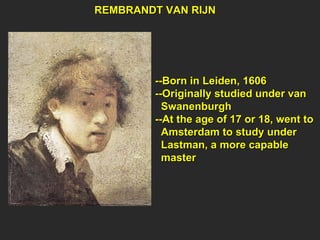
REMBRANDT VAN RIJN --Born in Leiden, 1606 --Originally studied under van Swanenburgh --At the age of 17 or 18, went to Amsterdam to study under Lastman, a more capable master
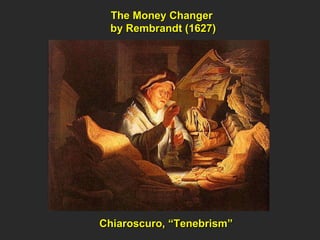
The Money Changer  by Rembrandt (1627) Chiaroscuro, “Tenebrism”
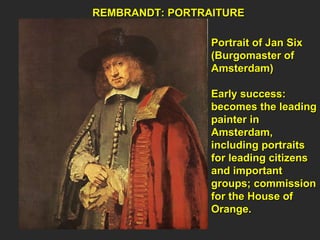
Portrait of Jan Six  (Burgomaster of  Amsterdam) Early success: becomes the leading painter in  Amsterdam,  including portraits for leading citizens and important groups; commission for the House of  Orange. REMBRANDT: PORTRAITURE
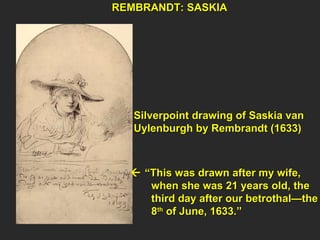
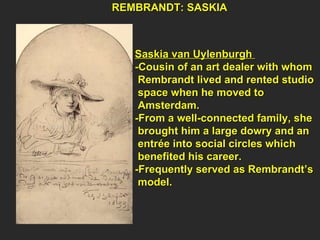
Silverpoint drawing of Saskia van  Uylenburgh by Rembrandt (1633)   “ This was drawn after my wife,  when she was 21 years old, the  third day after our betrothal—the  8 th  of June, 1633.” REMBRANDT: SASKIA
Saskia van Uylenburgh  -Cousin of an art dealer with whom  Rembrandt lived and rented studio  space when he moved to  Amsterdam. -From a well-connected family, she  brought him a large dowry and an  entrée into social circles which  benefited his career. -Frequently served as Rembrandt’s  model. REMBRANDT: SASKIA
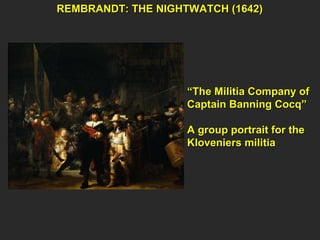
REMBRANDT: THE NIGHTWATCH (1642) “ The Militia Company of Captain Banning Cocq” A group portrait for the Kloveniers militia
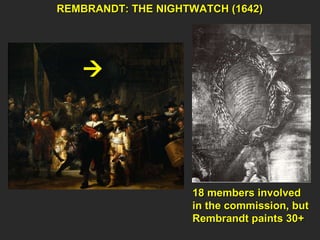
REMBRANDT: THE NIGHTWATCH (1642)  18 members involved  in the commission, but Rembrandt paints 30+
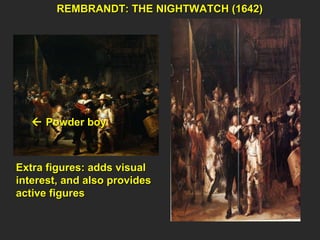
REMBRANDT: THE NIGHTWATCH (1642)    Powder boy  Extra figures: adds visual interest, and also provides active figures
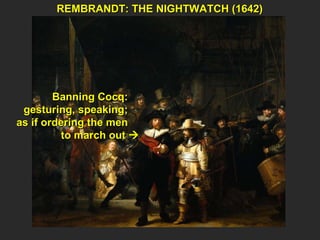
REMBRANDT: THE NIGHTWATCH (1642) Banning Cocq:  gesturing, speaking;  as if ordering the men  to march out  
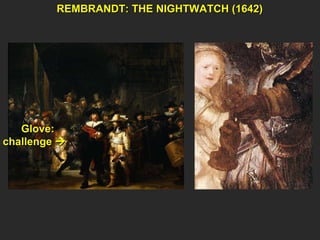
REMBRANDT: THE NIGHTWATCH (1642) Glove:  challenge  
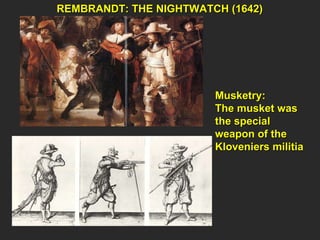
REMBRANDT: THE NIGHTWATCH (1642) Musketry: The musket was the special weapon of the Kloveniers militia
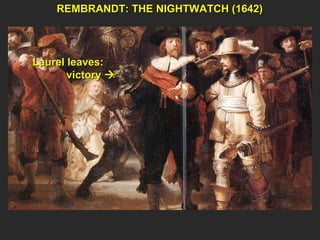
REMBRANDT: THE NIGHTWATCH (1642) Laurel leaves:  victory  
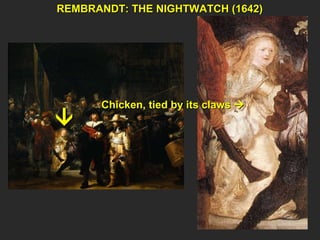
REMBRANDT: THE NIGHTWATCH (1642)  Chicken, tied by its claws  
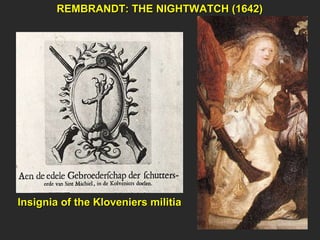
REMBRANDT: THE NIGHTWATCH (1642) Insignia of the Kloveniers militia
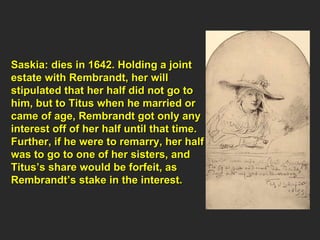
Saskia: dies in 1642. Holding a joint  estate with Rembrandt, her will  stipulated that her half did not go to  him, but to Titus when he married or  came of age, Rembrandt got only any  interest off of her half until that time.  Further, if he were to remarry, her half  was to go to one of her sisters, and  Titus’s share would be forfeit, as  Rembrandt’s stake in the interest.
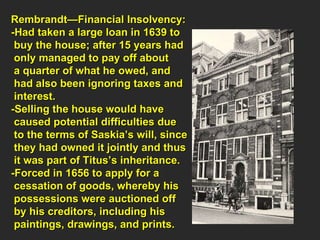
Rembrandt—Financial Insolvency: -Had taken a large loan in 1639 to  buy the house; after 15 years had  only managed to pay off about  a quarter of what he owed, and  had also been ignoring taxes and  interest. -Selling the house would have  caused potential difficulties due  to the terms of Saskia’s will, since they had owned it jointly and thus  it was part of Titus’s inheritance. -Forced in 1656 to apply for a  cessation of goods, whereby his  possessions were auctioned off  by his creditors, including his  paintings, drawings, and prints.
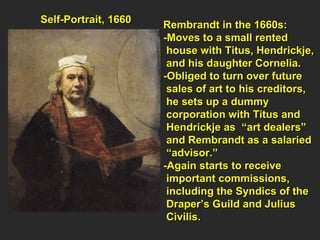
Self-Portrait, 1660  Rembrandt in the 1660s:  -Moves to a small rented  house with Titus, Hendrickje,  and his daughter Cornelia. -Obliged to turn over future  sales of art to his creditors,  he sets up a dummy  corporation with Titus and  Hendrickje as  “art dealers”  and Rembrandt as a salaried “ advisor.” -Again starts to receive  important commissions,  including the Syndics of the  Draper’s Guild and Julius Civilis.
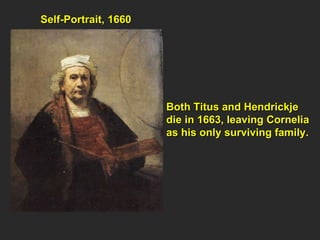
Self-Portrait, 1660  Both Titus and Hendrickje  die in 1663, leaving Cornelia  as his only surviving family.
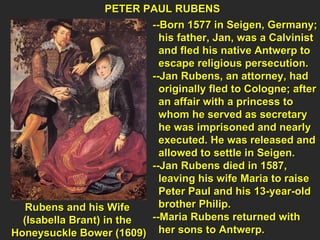
Rubens and his Wife  (Isabella Brant) in the  Honeysuckle Bower (1609) PETER PAUL RUBENS --Born 1577 in Seigen, Germany; his father, Jan, was a Calvinist  and fled his native Antwerp to  escape religious persecution. --Jan Rubens, an attorney, had  originally fled to Cologne; after an affair with a princess to  whom he served as secretary  he was imprisoned and nearly  executed. He was released and  allowed to settle in Seigen. --Jan Rubens died in 1587,  leaving his wife Maria to raise  Peter Paul and his 13-year-old  brother Philip. --Maria Rubens returned with  her sons to Antwerp.
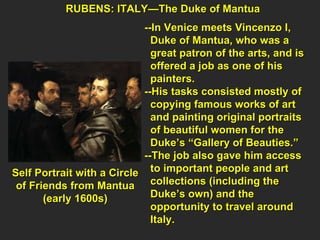
RUBENS: ITALY—The Duke of Mantua --In Venice meets Vincenzo I,  Duke of Mantua, who was a  great patron of the arts, and is  offered a job as one of his  painters. --His tasks consisted mostly of  copying famous works of art and painting original portraits  of beautiful women for the  Duke’s “Gallery of Beauties.” --The job also gave him access  to important people and art  collections (including the  Duke’s own) and the  opportunity to travel around  Italy. Self Portrait with a Circle of Friends from Mantua (early 1600s)
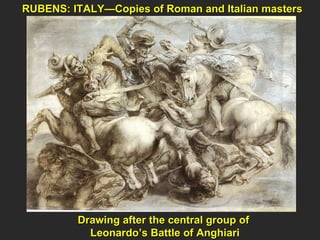
RUBENS: ITALY—Copies of Roman and Italian masters  Drawing after the central group of  Leonardo’s Battle of Anghiari
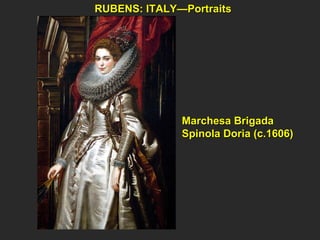
RUBENS: ITALY—Portraits Marchesa Brigada Spinola Doria (c.1606)
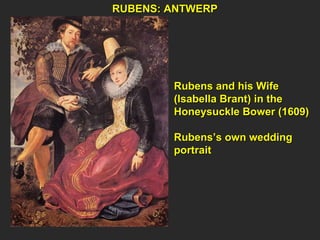
RUBENS: ANTWERP Rubens and his Wife  (Isabella Brant) in the  Honeysuckle Bower (1609) Rubens’s own wedding  portrait
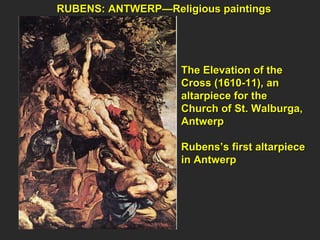
RUBENS: ANTWERP—Religious paintings  The Elevation of the  Cross (1610-11), an altarpiece for the Church of St. Walburga,  Antwerp Rubens’s first altarpiece  in Antwerp
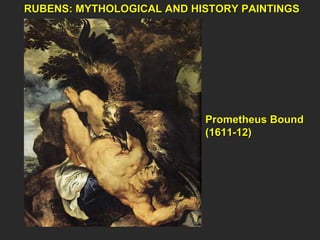
RUBENS: MYTHOLOGICAL AND HISTORY PAINTINGS  Prometheus Bound (1611-12)
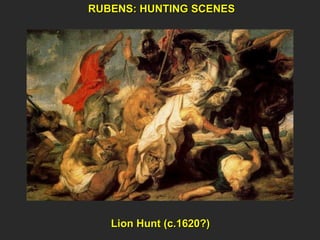
RUBENS: HUNTING SCENES  Lion Hunt (c.1620?)
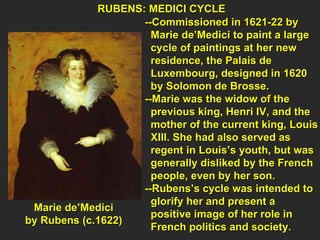
RUBENS: MEDICI CYCLE  --Commissioned in 1621-22 by  Marie de’Medici to paint a large  cycle of paintings at her new  residence, the Palais de  Luxembourg, designed in 1620  by Solomon de Brosse. --Marie was the widow of the  previous king, Henri IV, and the  mother of the current king, Louis  XIII. She had also served as  regent in Louis’s youth, but was generally disliked by the French  people, even by her son.  --Rubens’s cycle was intended to  glorify her and present a  positive image of her role in  French politics and society. Marie de’Medici  by Rubens (c.1622)
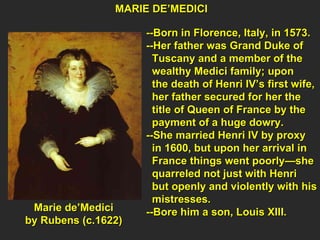
MARIE DE’MEDICI  --Born in Florence, Italy, in 1573. --Her father was Grand Duke of  Tuscany and a member of the  wealthy Medici family; upon  the death of Henri IV’s first wife, her father secured for her the  title of Queen of France by the  payment of a huge dowry. --She married Henri IV by proxy  in 1600, but upon her arrival in  France things went poorly—she  quarreled not just with Henri  but openly and violently with his mistresses. --Bore him a son, Louis XIII. Marie de’Medici  by Rubens (c.1622)
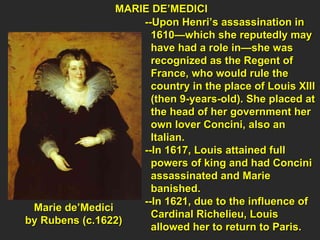
MARIE DE’MEDICI  --Upon Henri’s assassination in  1610—which she reputedly may have had a role in—she was  recognized as the Regent of  France, who would rule the  country in the place of Louis XIII (then 9-years-old). She placed at the head of her government her  own lover Concini, also an  Italian. --In 1617, Louis attained full  powers of king and had Concini assassinated and Marie  banished.  --In 1621, due to the influence of  Cardinal Richelieu, Louis  allowed her to return to Paris.  Marie de’Medici  by Rubens (c.1622)
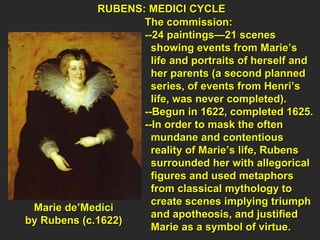
RUBENS: MEDICI CYCLE  The commission: --24 paintings—21 scenes  showing events from Marie’s  life and portraits of herself and  her parents (a second planned  series, of events from Henri’s  life, was never completed). --Begun in 1622, completed 1625. --In order to mask the often  mundane and contentious  reality of Marie’s life, Rubens  surrounded her with allegorical  figures and used metaphors  from classical mythology to  create scenes implying triumph  and apotheosis, and justified  Marie as a symbol of virtue. Marie de’Medici  by Rubens (c.1622)
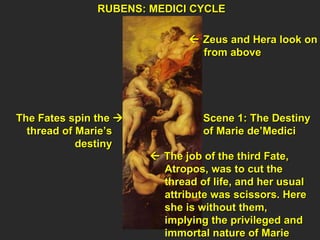
RUBENS: MEDICI CYCLE  Scene 1: The Destiny of Marie de’Medici    Zeus and Hera look on from above The Fates spin the   thread of Marie’s  destiny     The job of the third Fate,  Atropos, was to cut the  thread of life, and her usual  attribute was scissors. Here  she is without them,  implying the privileged and  immortal nature of Marie
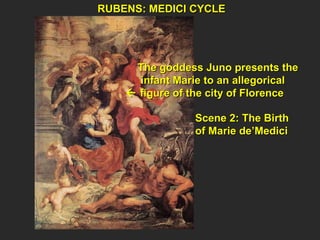
RUBENS: MEDICI CYCLE  Scene 2: The Birth of Marie de’Medici The goddess Juno presents the  infant Marie to an allegorical     figure of the city of Florence
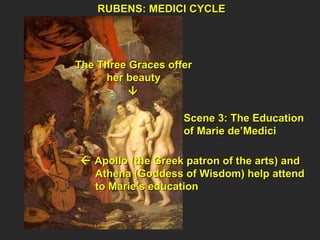
RUBENS: MEDICI CYCLE  Scene 3: The Education  of Marie de’Medici    Apollo (the Greek patron of the arts) and  Athena (Goddess of Wisdom) help attend  to Marie’s education The Three Graces offer her beauty 
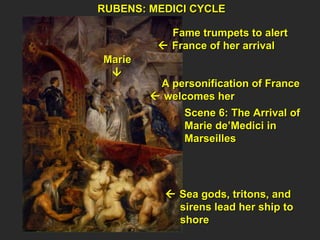
RUBENS: MEDICI CYCLE  Scene 6: The Arrival of  Marie de’Medici in  Marseilles A personification of France    welcomes her Fame trumpets to alert     France of her arrival     Sea gods, tritons, and  sirens lead her ship to  shore  Marie 
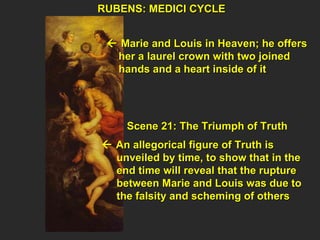
RUBENS: MEDICI CYCLE  Scene 21: The Triumph of Truth    An allegorical figure of Truth is  unveiled by time, to show that in the  end time will reveal that the rupture  between Marie and Louis was due to  the falsity and scheming of others     Marie and Louis in Heaven; he offers  her a laurel crown with two joined  hands and a heart inside of it
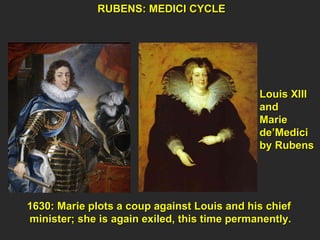
RUBENS: MEDICI CYCLE  Louis XIII and  Marie de’Medici by Rubens 1630: Marie plots a coup against Louis and his chief  minister; she is again exiled, this time permanently.

2ND HALF OF CLASS 6, FIRST HALF OF CLASS 7 REVIEWS

  • 1.
    REMBRANDT VAN RIJN--Born in Leiden, 1606 --Originally studied under van Swanenburgh --At the age of 17 or 18, went to Amsterdam to study under Lastman, a more capable master
  • 2.
    The Money Changer by Rembrandt (1627) Chiaroscuro, “Tenebrism”
  • 3.
    Portrait of JanSix (Burgomaster of Amsterdam) Early success: becomes the leading painter in Amsterdam, including portraits for leading citizens and important groups; commission for the House of Orange. REMBRANDT: PORTRAITURE
  • 4.
    Silverpoint drawing ofSaskia van Uylenburgh by Rembrandt (1633)  “ This was drawn after my wife, when she was 21 years old, the third day after our betrothal—the 8 th of June, 1633.” REMBRANDT: SASKIA
  • 5.
    Saskia van Uylenburgh -Cousin of an art dealer with whom Rembrandt lived and rented studio space when he moved to Amsterdam. -From a well-connected family, she brought him a large dowry and an entrée into social circles which benefited his career. -Frequently served as Rembrandt’s model. REMBRANDT: SASKIA
  • 6.
    REMBRANDT: THE NIGHTWATCH(1642) “ The Militia Company of Captain Banning Cocq” A group portrait for the Kloveniers militia
  • 7.
    REMBRANDT: THE NIGHTWATCH(1642)  18 members involved in the commission, but Rembrandt paints 30+
  • 8.
    REMBRANDT: THE NIGHTWATCH(1642)  Powder boy Extra figures: adds visual interest, and also provides active figures
  • 9.
    REMBRANDT: THE NIGHTWATCH(1642) Banning Cocq: gesturing, speaking; as if ordering the men to march out 
  • 10.
    REMBRANDT: THE NIGHTWATCH(1642) Glove: challenge 
  • 11.
    REMBRANDT: THE NIGHTWATCH(1642) Musketry: The musket was the special weapon of the Kloveniers militia
  • 12.
    REMBRANDT: THE NIGHTWATCH(1642) Laurel leaves: victory 
  • 13.
    REMBRANDT: THE NIGHTWATCH(1642)  Chicken, tied by its claws 
  • 14.
    REMBRANDT: THE NIGHTWATCH(1642) Insignia of the Kloveniers militia
  • 15.
    Saskia: dies in1642. Holding a joint estate with Rembrandt, her will stipulated that her half did not go to him, but to Titus when he married or came of age, Rembrandt got only any interest off of her half until that time. Further, if he were to remarry, her half was to go to one of her sisters, and Titus’s share would be forfeit, as Rembrandt’s stake in the interest.
  • 16.
    Rembrandt—Financial Insolvency: -Hadtaken a large loan in 1639 to buy the house; after 15 years had only managed to pay off about a quarter of what he owed, and had also been ignoring taxes and interest. -Selling the house would have caused potential difficulties due to the terms of Saskia’s will, since they had owned it jointly and thus it was part of Titus’s inheritance. -Forced in 1656 to apply for a cessation of goods, whereby his possessions were auctioned off by his creditors, including his paintings, drawings, and prints.
  • 17.
    Self-Portrait, 1660 Rembrandt in the 1660s: -Moves to a small rented house with Titus, Hendrickje, and his daughter Cornelia. -Obliged to turn over future sales of art to his creditors, he sets up a dummy corporation with Titus and Hendrickje as “art dealers” and Rembrandt as a salaried “ advisor.” -Again starts to receive important commissions, including the Syndics of the Draper’s Guild and Julius Civilis.
  • 18.
    Self-Portrait, 1660 Both Titus and Hendrickje die in 1663, leaving Cornelia as his only surviving family.
  • 19.
    Rubens and hisWife (Isabella Brant) in the Honeysuckle Bower (1609) PETER PAUL RUBENS --Born 1577 in Seigen, Germany; his father, Jan, was a Calvinist and fled his native Antwerp to escape religious persecution. --Jan Rubens, an attorney, had originally fled to Cologne; after an affair with a princess to whom he served as secretary he was imprisoned and nearly executed. He was released and allowed to settle in Seigen. --Jan Rubens died in 1587, leaving his wife Maria to raise Peter Paul and his 13-year-old brother Philip. --Maria Rubens returned with her sons to Antwerp.
  • 20.
    RUBENS: ITALY—The Dukeof Mantua --In Venice meets Vincenzo I, Duke of Mantua, who was a great patron of the arts, and is offered a job as one of his painters. --His tasks consisted mostly of copying famous works of art and painting original portraits of beautiful women for the Duke’s “Gallery of Beauties.” --The job also gave him access to important people and art collections (including the Duke’s own) and the opportunity to travel around Italy. Self Portrait with a Circle of Friends from Mantua (early 1600s)
  • 21.
    RUBENS: ITALY—Copies ofRoman and Italian masters Drawing after the central group of Leonardo’s Battle of Anghiari
  • 22.
    RUBENS: ITALY—Portraits MarchesaBrigada Spinola Doria (c.1606)
  • 23.
    RUBENS: ANTWERP Rubensand his Wife (Isabella Brant) in the Honeysuckle Bower (1609) Rubens’s own wedding portrait
  • 24.
    RUBENS: ANTWERP—Religious paintings The Elevation of the Cross (1610-11), an altarpiece for the Church of St. Walburga, Antwerp Rubens’s first altarpiece in Antwerp
  • 25.
    RUBENS: MYTHOLOGICAL ANDHISTORY PAINTINGS Prometheus Bound (1611-12)
  • 26.
    RUBENS: HUNTING SCENES Lion Hunt (c.1620?)
  • 27.
    RUBENS: MEDICI CYCLE --Commissioned in 1621-22 by Marie de’Medici to paint a large cycle of paintings at her new residence, the Palais de Luxembourg, designed in 1620 by Solomon de Brosse. --Marie was the widow of the previous king, Henri IV, and the mother of the current king, Louis XIII. She had also served as regent in Louis’s youth, but was generally disliked by the French people, even by her son. --Rubens’s cycle was intended to glorify her and present a positive image of her role in French politics and society. Marie de’Medici by Rubens (c.1622)
  • 28.
    MARIE DE’MEDICI --Born in Florence, Italy, in 1573. --Her father was Grand Duke of Tuscany and a member of the wealthy Medici family; upon the death of Henri IV’s first wife, her father secured for her the title of Queen of France by the payment of a huge dowry. --She married Henri IV by proxy in 1600, but upon her arrival in France things went poorly—she quarreled not just with Henri but openly and violently with his mistresses. --Bore him a son, Louis XIII. Marie de’Medici by Rubens (c.1622)
  • 29.
    MARIE DE’MEDICI --Upon Henri’s assassination in 1610—which she reputedly may have had a role in—she was recognized as the Regent of France, who would rule the country in the place of Louis XIII (then 9-years-old). She placed at the head of her government her own lover Concini, also an Italian. --In 1617, Louis attained full powers of king and had Concini assassinated and Marie banished. --In 1621, due to the influence of Cardinal Richelieu, Louis allowed her to return to Paris. Marie de’Medici by Rubens (c.1622)
  • 30.
    RUBENS: MEDICI CYCLE The commission: --24 paintings—21 scenes showing events from Marie’s life and portraits of herself and her parents (a second planned series, of events from Henri’s life, was never completed). --Begun in 1622, completed 1625. --In order to mask the often mundane and contentious reality of Marie’s life, Rubens surrounded her with allegorical figures and used metaphors from classical mythology to create scenes implying triumph and apotheosis, and justified Marie as a symbol of virtue. Marie de’Medici by Rubens (c.1622)
  • 31.
    RUBENS: MEDICI CYCLE Scene 1: The Destiny of Marie de’Medici  Zeus and Hera look on from above The Fates spin the  thread of Marie’s destiny  The job of the third Fate, Atropos, was to cut the thread of life, and her usual attribute was scissors. Here she is without them, implying the privileged and immortal nature of Marie
  • 32.
    RUBENS: MEDICI CYCLE Scene 2: The Birth of Marie de’Medici The goddess Juno presents the infant Marie to an allegorical  figure of the city of Florence
  • 33.
    RUBENS: MEDICI CYCLE Scene 3: The Education of Marie de’Medici  Apollo (the Greek patron of the arts) and Athena (Goddess of Wisdom) help attend to Marie’s education The Three Graces offer her beauty 
  • 34.
    RUBENS: MEDICI CYCLE Scene 6: The Arrival of Marie de’Medici in Marseilles A personification of France  welcomes her Fame trumpets to alert  France of her arrival  Sea gods, tritons, and sirens lead her ship to shore Marie 
  • 35.
    RUBENS: MEDICI CYCLE Scene 21: The Triumph of Truth  An allegorical figure of Truth is unveiled by time, to show that in the end time will reveal that the rupture between Marie and Louis was due to the falsity and scheming of others  Marie and Louis in Heaven; he offers her a laurel crown with two joined hands and a heart inside of it
  • 36.
    RUBENS: MEDICI CYCLE Louis XIII and Marie de’Medici by Rubens 1630: Marie plots a coup against Louis and his chief minister; she is again exiled, this time permanently.

Editor's Notes

  • #2 Unique—life story told in pictuere?? STATS PERCENT SELF PORTS irony, study of major netherlandish artists from this century revolves around two really monumental names, vermeer and rembrandt, and in every way they come to us as very opposite—about one we no next to nothing, but about the other we know so much that to study him is feel a kind of intimacy, the intimacy is of course a delusion, but he is unique in that no other artist has left within his body of work such introspection, and this introspection seems to be an open invitation into his life, and we can watch him grow, in art’s finest series of self-portraits, from a cocky and energetic kid, into a confident and headstrong man at the top of his field, then through a series of tragedies turn into a sober middle-aged man, and in the end confront himself with a merciless eye as an old man searching for meaning.
  • #4 so starts getting involved in the portraits, helps make him money; this later, from 50s
  • #8 Like I said, it was a traditional thing, group ports and militia ports, but rembr changes the formula drastically. for one thing, 18 people involed in the comm, but he paints much more, even kids in there
  • #9 kid, wearing a man’s helmet, too big, they would use kids to run gun powder to the musketeers—partly cropped when painting cut down—that dot on him not part of the painting, what that is, honestly, is what happens when you try to scan small details at high fidelity without taking the time to clean the plate of the scanner. ANYWAY, ACTIVE FIGURES, SCENE OF ACTION
  • #10 TO GIVE SOME VARIETY, SOME EXTRA VISUAL INTEREST, BUT ALSO ACTIVE FIGURES—TRY TO MOVE IT AWAY FROM BEING A PASSIVE SCENE OF GUYS JUST STANDING AROUND, DRUMMER, POWDERBOY, ACTIVE FIGURES, TURN IT INTO A SCENE OF ACTION, LIKE HE IS ORDERING THEM OUT TO MARCH
  • #11 Also tries to give it more profound level of meaning by using allegories and metaphors
  • #12 Allegorical figures—GO TO THE RIGHT, OTHERS TO THE LEFT, SO TWO DIFF REALITIES, DEFINED BY DIRECTION OF MOVEMENT, ALSO ARCHIAC COSTUME, PLUS SCALE SMALLER, GUY LOADING A TRANSITION? NOT AS ARCHAIC COSTUME, AND ONLY TURNING THE OTHER WAY
  • #13 defintiely allegorical, because not only dangerous, it was technically illegal
  • #14 Actually girls, because two of them
  • #15 Standard bearer
  • #16 it is not thought she did this with ill intention—in fact, it is thought that she believed that since he had been so successful, that he would continue to be, and able to provide for both himself and titus quite ably, so he really didn’t need her half. this would cause him great trouble, because he had been living high on the hog, way beyond his means, and had of course just purchased a large house he could barely afford with a very heavy mortgage, and a total spendthrift, auctions, etc., and his style was beginning to go out of style, and in fact it turned out that he was not able to continue to support himself and titus, and this stipulation in the will was a real dagger in the end. among other things, can’t marry—sued by gertghe, first nurse he had brought in, claimed they had been shacking up and he had promised to marry her. to marry her would have violated the will and been a major problem for him and titus, he denied this charge, but was forced to pay her support, so that added a debt.
  • #17 that house really brought him down—NOT JUST PAINTINGS BY HIM, BUT AN AMAZING ART COLLECTION HE HAD AQUIRED, INCLUDING PAINTINGS BY RAPHAEL AND GIORGIONE.
  • #20 when he died they did have an older son, but he was grown and had left to italy to pursue his studies
  • #21 the duke was a real womanizer, so had this gallery. but he also had a great art collection, his family had always been great patrons—palazzo del te, giulio romano, works from the greatest ren and mannerist masters—of the paintings, none are definitely attributed to him, not like he would nec sign them or anything, but many drawings of this time in italy
  • #22 the duke was a real womanizer, so had this gallery. but he also had a great art collection, his family had always been great patrons—palazzo del te, giulio romano, works from the greatest ren and mannerist masters—of the paintings, none are definitely attributed to him, not like he would nec sign them or anything, but many drawings of this time in italy
  • #23 the duke was a real womanizer, so had this gallery, gallery of beauties, so rubens would go around doing ports of beautiful women—whether this was actually for it or doen independently I don’t know if anyone knows, but this would be the kind of thing he would do, if he didn’t do this for the gallery of beauties the duke would have probably gone nuts, because this is simplyone of the most beautiful ports of a woman that has ever been porduced.
  • #24 GOES BACK TO ANTWERP IN 1608 BECAUSE HIS MOTHER IS SERIOUSLY ILL—INTENDS TO RETURN TO ITALY, NEVER MAKES IT BACK—intended to go back to italy, back stays in antwerp—offered a position painting for archduke albert and his wife isabella, and also winds up getting married in 1609, this painting I showed you is actaully his wedding portrait—it is antwerp that he will come into his own
  • #25 will coem to his own at first as the leading religious painter in the area, with a drama and power that few in history could ever match, and certainly no one in antwerp
  • #26 also becomes a major painter of mythology and history –then go to things like hunting scenes, etc., all of this really succeeds in spreading his name, becomes famous throughout europe, one upshot is that he winds up so famous that they send him as dipomat, and in major demand throughtout the contintent—france, marie
  • #27 HIS TALENT AND STYLE, SOMETHING HE IS JUST REALLY GOOD AT AND THESE ARE ALSO VERY WELL KNOWNS
  • #28 marie de med—all of this had made him very famous throughout europe, and very much in demand, offers flooding in from all over, and the most famous of his commissions for the queen mother of france, marie de med
  • #29 marie de med—all of this had made him very famous throughout europe, and very much in demand, offers flooding in from all over, and the most famous of his commissions for the queen mother of france, marie de med
  • #30 marie de med—all of this had made him very famous throughout europe, and very much in demand, offers flooding in from all over, and the most famous of his commissions for the queen mother of france, marie de med
  • #31 >>>>contentious—realism would have been dangerous, if he presented the story of her life too realisitacally, could have offended either her, louis xiii or both. paid 20k crowns
  • #32 >>>>contentious—realism would have been dangerous, if he presented the story of her life too realisitacally, could have offended either her, louis xiii or both. paid 20k crowns
  • #33 >>>>contentious—realism would have been dangerous, if he presented the story of her life too realisitacally, could have offended either her, louis xiii or both. paid 20k crowns
  • #34 >>>>contentious—realism would have been dangerous, if he presented the story of her life too realisitacally, could have offended either her, louis xiii or both. paid 20k crowns
  • #35 >>>>contentious—realism would have been dangerous, if he presented the story of her life too realisitacally, could have offended either her, louis xiii or both. paid 20k crowns
  • #36 >>>>contentious—realism would have been dangerous, if he presented the story of her life too realisitacally, could have offended either her, louis xiii or both. paid 20k crowns
  • #37 plots vs. richelieu, who ironically had been with her at first, and was the one who arranged the reconciliation.