RIPER
AUTONOMOUS
NAAC &
NBA (UG)
SIRO- DSIR
Raghavendra Institute of Pharmaceutical Education and Research - Autonomous
K.R.Palli Cross, Chiyyedu, Anantapuramu, A. P- 515721 1
A Seminar as a part of curricular requirement
for I year M. Pharm I semester
Presented by
N. Ramya
(Reg. No. 20L81S0110)
Department of Pharmacology
Under the guidance/Mentorship of
Mr. A. Sudheer Kumar., M.Pharm.
Associate Professor
Dept. of Pharmacology
Anticoagulants
RIPER
AUTONOMOUS
NAAC &
NBA (UG)
SIRO- DSIR
Raghavendra Institute of Pharmaceutical Education and Research - Autonomous
K.R.Palli Cross, Chiyyedu, Anantapuramu, A. P- 515721 2
Contents
• Coagulants
• Local agents
• Systemic agents
• Anticoagulants
• Heparin
• Low molecular weight heparins
• Heparinoids
• Oral anticoagulants (Warfarin)
• Therapeutic uses
• References
RIPER
AUTONOMOUS
NAAC &
NBA (UG)
SIRO- DSIR
Raghavendra Institute of Pharmaceutical Education and Research - Autonomous
K.R.Palli Cross, Chiyyedu, Anantapuramu, A. P- 515721 3
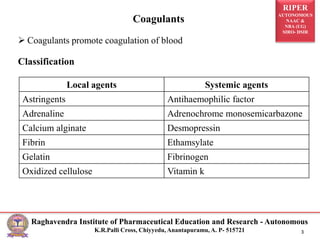
Coagulants
 Coagulants promote coagulation of blood
Classification
Local agents Systemic agents
Astringents Antihaemophilic factor
Adrenaline Adrenochrome monosemicarbazone
Calcium alginate Desmopressin
Fibrin Ethamsylate
Gelatin Fibrinogen
Oxidized cellulose Vitamin k
RIPER
AUTONOMOUS
NAAC &
NBA (UG)
SIRO- DSIR
Raghavendra Institute of Pharmaceutical Education and Research - Autonomous
K.R.Palli Cross, Chiyyedu, Anantapuramu, A. P- 515721 4
Local agents
o Astringents
Precipitate proteins locally in bleeding site and control capillary oozing.
example: fecl3 solution, tannic acid
o Adrenaline
It cause vasoconstriction and arrest bleeding cotton pad soaked in 0.1%
adrenaline solution.
Applied on bleeding site causes control oozing.
o Thrombin
Freeze dried powder from bovine or human plasma.
It causes control bleeding
o Fibrin
It contains fibrinogen, xIII, thrombin, calcium and clotting factors
It is use as spray form durning surgary
RIPER
AUTONOMOUS
NAAC &
NBA (UG)
SIRO- DSIR
Raghavendra Institute of Pharmaceutical Education and Research - Autonomous
K.R.Palli Cross, Chiyyedu, Anantapuramu, A. P- 515721 5
Systematic agents
o Vitamin K
It is a fat soluble vitamin which is used in synthesis of clotting factors.
K1[phytonodione] from plants and animals
k2 [menoquinone] from intestinal bacteria
k3 [ menadione fat solube] synthetic form
Dieatary source : spinach, cabbage, butter milk, cauliflower and tomatoes
Actions : cofactor for γ carboxylation of glutamic acid resiues of clotting factors
[ 2,7,9and10]
Uses
Treat bleeding associated with obstructive jaundice , vitamin K deficiency
Treat salicylate poisoning
RIPER
AUTONOMOUS
NAAC &
NBA (UG)
SIRO- DSIR
Raghavendra Institute of Pharmaceutical Education and Research - Autonomous
K.R.Palli Cross, Chiyyedu, Anantapuramu, A. P- 515721 6
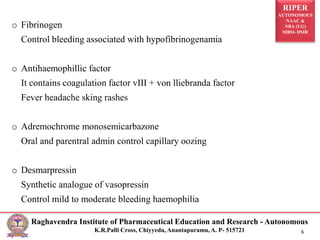
o Fibrinogen
Control bleeding associated with hypofibrinogenamia
o Antihaemophillic factor
It contains coagulation factor vIII + von lliebranda factor
Fever headache sking rashes
o Adremochrome monosemicarbazone
Oral and parentral admin control capillary oozing
o Desmarpressin
Synthetic analogue of vasopressin
Control mild to moderate bleeding haemophilia
RIPER
AUTONOMOUS
NAAC &
NBA (UG)
SIRO- DSIR
Raghavendra Institute of Pharmaceutical Education and Research - Autonomous
K.R.Palli Cross, Chiyyedu, Anantapuramu, A. P- 515721 7
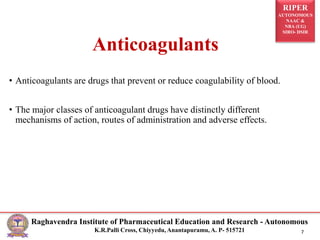
• Anticoagulants are drugs that prevent or reduce coagulability of blood.
• The major classes of anticoagulant drugs have distinctly different
mechanisms of action, routes of administration and adverse effects.
Anticoagulants
RIPER
AUTONOMOUS
NAAC &
NBA (UG)
SIRO- DSIR
Raghavendra Institute of Pharmaceutical Education and Research - Autonomous
K.R.Palli Cross, Chiyyedu, Anantapuramu, A. P- 515721 8
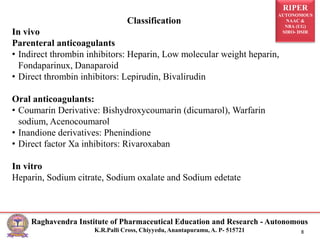
Classification
In vivo
Parenteral anticoagulants
• Indirect thrombin inhibitors: Heparin, Low molecular weight heparin,
Fondaparinux, Danaparoid
• Direct thrombin inhibitors: Lepirudin, Bivalirudin
Oral anticoagulants:
• Coumarin Derivative: Bishydroxycoumarin (dicumarol), Warfarin
sodium, Acenocoumarol
• Inandione derivatives: Phenindione
• Direct factor Xa inhibitors: Rivaroxaban
In vitro
Heparin, Sodium citrate, Sodium oxalate and Sodium edetate
RIPER
AUTONOMOUS
NAAC &
NBA (UG)
SIRO- DSIR
Raghavendra Institute of Pharmaceutical Education and Research - Autonomous
K.R.Palli Cross, Chiyyedu, Anantapuramu, A. P- 515721 9
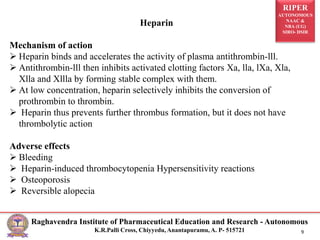
Heparin
Mechanism of action
 Heparin binds and accelerates the activity of plasma antithrombin-lll.
 Antithrombin-lll then inhibits activated clotting factors Xa, lla, lXa, Xla,
Xlla and Xllla by forming stable complex with them.
 At low concentration, heparin selectively inhibits the conversion of
prothrombin to thrombin.
 Heparin thus prevents further thrombus formation, but it does not have
thrombolytic action
Adverse effects
 Bleeding
 Heparin-induced thrombocytopenia Hypersensitivity reactions
 Osteoporosis
 Reversible alopecia
RIPER
AUTONOMOUS
NAAC &
NBA (UG)
SIRO- DSIR
Raghavendra Institute of Pharmaceutical Education and Research - Autonomous
K.R.Palli Cross, Chiyyedu, Anantapuramu, A. P- 515721 10
Pharmacokinetics
• Heparin is not absorbed after oral administration because of its high
negative charge and large molecular size.
• Therefore, it must be given parenterally.
• On i.v. administration, the anticoagulant effect starts immediately, whereas on
s.c. route, it takes 1-2 hours. Heparin is highly protein bound.
• It does not cross the BBB or placental barrier and is safe during pregnancy.
RIPER
AUTONOMOUS
NAAC &
NBA (UG)
SIRO- DSIR
Raghavendra Institute of Pharmaceutical Education and Research - Autonomous
K.R.Palli Cross, Chiyyedu, Anantapuramu, A. P- 515721 11
Low molecular weight heparins (LMWH)
o Enoxaparin
o Dalteparin
o Tinzaparin
o Ardeparin
• LMWHs produce anticoagulant effect mainly by antifactor Xa activity.
• LMWH therapy usually does not require a PPT (Partial thromboplastin time).
• LMWHs are given subcutaneously.
Advantages of LMWHs
o They have longer duration of action.
o They do no routinely require a PPT monitoring.
o There is a lower incidence of thrombocytopenia.
o Better patient compliance as there is no need for blood tests.
RIPER
AUTONOMOUS
NAAC &
NBA (UG)
SIRO- DSIR
Raghavendra Institute of Pharmaceutical Education and Research - Autonomous
K.R.Palli Cross, Chiyyedu, Anantapuramu, A. P- 515721 12
Heparinoids
LEPIRUDIN:
 It is a recombinant hirudin.
 It directly inhibits thrombin and is used as an anticoagulant in patients with
heparin-induced thrombocytopaenia (HIT).
 It is administered i.v, it requires a PPT monitoring.
 No antidote is available.
BILVALIRUDIN:
 It is a synthetic heparinoid and has a mechanism similar to that of lepirudin.
 It can be used in coronary angioaplasty as an alternative to heparin.
RIPER
AUTONOMOUS
NAAC &
NBA (UG)
SIRO- DSIR
Raghavendra Institute of Pharmaceutical Education and Research - Autonomous
K.R.Palli Cross, Chiyyedu, Anantapuramu, A. P- 515721 13
DANAPAROID:
It is isolated from pig intestinal mucosa, and it has mainly antifactor Xa
activity.
 It is administered subcutaneously for prophylaxis and intravenously for
treatment of deep vein thrombosis especially in patients with HIT.
RIPER
AUTONOMOUS
NAAC &
NBA (UG)
SIRO- DSIR
Raghavendra Institute of Pharmaceutical Education and Research - Autonomous
K.R.Palli Cross, Chiyyedu, Anantapuramu, A. P- 515721 14
oral anticoagulants
Among oral anticoagulants, coumarin derivatives are commonly used.
Oral anti coagulants like warfarin act only in vivo.
They are vitamin K antagonists.
Warfarin
Mechanism of action
Warfarin acts by inhibiting the synthesis of vitamin K-dependent clotting
factors, which include Factors II, VII, IX, and X, and the anticoagulant
proteins C and S.
Vitamin K is an essential cofactor for the post ribosomal synthesis of the
vitamin K-dependent clotting factors.
RIPER
AUTONOMOUS
NAAC &
NBA (UG)
SIRO- DSIR
Raghavendra Institute of Pharmaceutical Education and Research - Autonomous
K.R.Palli Cross, Chiyyedu, Anantapuramu, A. P- 515721 15
Pharmacokinetics
• Completely absorbed after oral administration. It can also be given
i.v or rectal.
• Food interferes with the absorption of warfarin.
• Highly bound to plasma proteins, freely crosses the placental barrier.
• Metabolized in liver, inactive metabolities are excreted in urine and stool.
Half life – 40hours. Duration of action is 2-5 days.
Adverse effects
oBleeding
oTeratogenic effect
oSkin necrosis
Other rare side effects: diarrhoea, alopecia, dermatitis, abdominal cramps,
anorexia.
RIPER
AUTONOMOUS
NAAC &
NBA (UG)
SIRO- DSIR
Raghavendra Institute of Pharmaceutical Education and Research - Autonomous
K.R.Palli Cross, Chiyyedu, Anantapuramu, A. P- 515721 16
Drug interactions
Warfarin X cholestyramine :
Cholestyramine is a bile acid-binding resin. It reduces the absorption of
warfarin from gut, thus decreases bioavailability of warfarin.
Oral anticoagulants X barbiturates/rifampicin:
They are enzyme inducers, increase metabolic clearance of oral anticoagulants
and hence decrease the anticoagulant effect.
Wafarin X salicylates/sulphonamide:
Warfarin is highly protein bond. These drugs displace warfarin from plasma-
protein binding site and increase the free plasma concentration of warfarin and
thus lead to bleeding.
Warfarin X alcohol,chloramphenicol,isoniazid:
They are enzyme inhibitors, decrease metabolic clearance of warfarin and
hence increase the anticoagulant effect.
RIPER
AUTONOMOUS
NAAC &
NBA (UG)
SIRO- DSIR
Raghavendra Institute of Pharmaceutical Education and Research - Autonomous
K.R.Palli Cross, Chiyyedu, Anantapuramu, A. P- 515721 17
Therapeutic uses of anti coagulants
o To prevent the formation of intravascular thrombus or to prevent the future
extension of the already formed clot.
o Treatment is initiated with LMWH or UFH and continued for at least 4-5
days.
1.Deep-vein thrombosis and pulmonary embolism:
Venous thrombi are mainly formed of fibrin network with a long tail that can
easily detach and result in a mobilization of pulmonary arteries.
2. Myocardial infarction:
Help to prevent recurrent attacks of MI and stroke especially when given in
combination with a low dose of aspirin.
It is also used during and after stent placement, coronary angioplasty.
RIPER
AUTONOMOUS
NAAC &
NBA (UG)
SIRO- DSIR
Raghavendra Institute of Pharmaceutical Education and Research - Autonomous
K.R.Palli Cross, Chiyyedu, Anantapuramu, A. P- 515721 18
3. Unstableangina:
The use of LMWH reduces the occurrence of MI in these patients.
4. Atrialfibrillation:
These patients require prolonged anticoagulant therapy as they are at high risk
for stroke.
5. Thromboembolism:
Anticoagulants are used along with low-dose aspirin to prevent thrombo-
embolism in patients undergoing haemodialysis and those with prosthetic
heart valves.
RIPER
AUTONOMOUS
NAAC &
NBA (UG)
SIRO- DSIR
Raghavendra Institute of Pharmaceutical Education and Research - Autonomous
K.R.Palli Cross, Chiyyedu, Anantapuramu, A. P- 515721 19
References
• Patel MR, Mahaffey KW, Garg J, Pan G, Singer DE, Hacke W, Breithardt G,
Halperin JL, Hankey GJ, Piccini JP, et al. Rivaroxaban versus warfarin in
nonvalvular atrial fibrillation.2011;365:883–891.
• Granger CB, Alexander JH, McMurray JJ, Lopes RD, Hylek EM, Hanna M,
Al‐Khalidi HR, Ansell J, Atar D, Avezum A, et al. Apixaban versus warfarin in
patients with atrial fibrillation.2011; 365:981–992.
• van der Hulle T, Kooiman J, den Exter PL, Dekkers OM, Klok FA, Huisman
MV. Effectiveness and safety of novel oral anticoagulants as compared with
vitamin K antagonists in the treatment of acute symptomatic venous
thromboembolism: a systematic review and meta‐analysis.2014;12:320–328.
RIPER
AUTONOMOUS
NAAC &
NBA (UG)
SIRO- DSIR
Raghavendra Institute of Pharmaceutical Education and Research - Autonomous
K.R.Palli Cross, Chiyyedu, Anantapuramu, A. P- 515721 20