1
2
SYMPTOMS
4 4
1
Dull aching;
Throbbing sensation;
Worse at night;
Referred mainly to forehead and scalp.
2
Due to circumcorneal congestion;
Which is a result of active hyperemia of
anterior ciliary vessels due to effect of toxins,
histamine and histamine-like substances and
axon reflex.
SYMPTOMS
4
5
3
Due to reflex between sensory
fibres of 5th nerve (which are
irritated) and motor fibres of 7th
nerve, supplying the orbicularis
oculi muscle
occurs as a result of
lacrimatory reflex mediated by
5th nerve (afferent) and
secretomotor fibres of 7th
nerve (efferent).
6
5
DEFECTIVE VISION
May vary from slight blur in early phase to
marked deterioration in late phase.
Factors responsible include:
•Induced myopia due to ciliary
spasm,
•Corneal haze due to odema and
KPs,
•Aqueous turbidity,
•Pupillary block due to exudates,
•Complicated cataract,
•Vitreous haze,
•Cyclitic membrane,
•Associated macular odema,
•Papillitis or
•secondary glaucoma
“
Slit lamp biomicroscopic examination is essential to elicit
most of the signs of uveitis.
7
SIGNS
8
It is usually mild, may
accompany a severe attack
of acute anterior uveitis.
Lid Odema
A
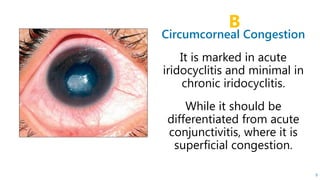
It is marked in acute
iridocyclitis and minimal in
chronic iridocyclitis.
While it should be
differentiated from acute
conjunctivitis, where it is
superficial congestion.
9
B
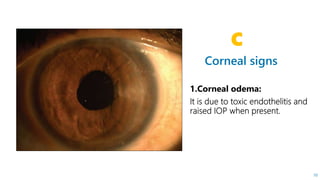
Corneal signs
C
10
Corneal signs
C
11
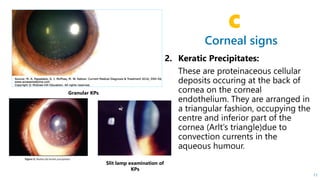
Granular KPs
Slit lamp examination of
KPs
The composition and
morphology of KPs varies
with the severeity, duration
and type of uveitis.
Types of keratic
precipitates
12
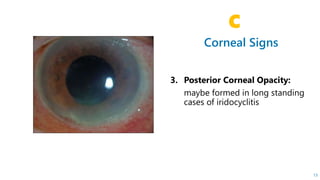
Corneal Signs
C
13
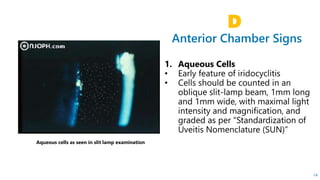
Anterior Chamber Signs
D
14
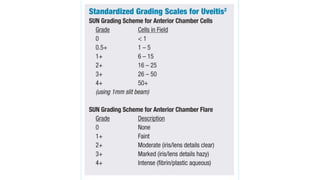
Aqueous cells as seen in slit lamp examination
Anterior Chamber Signs
D
15
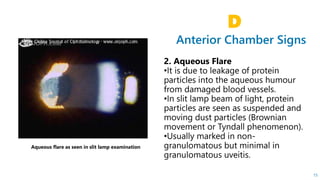
Aqueous flare as seen in slit lamp examination
“
Anterior Chamber Signs
D
17
Anterior Chamber Signs
D
18
Iris Signs
E
19
Iris signs
E
20
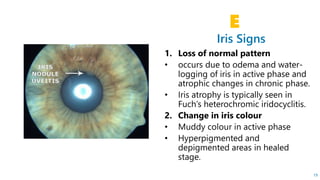
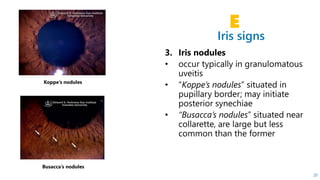
Koppe’s nodules
Busacca’s nodules
Iris signs
E
21
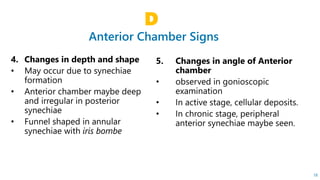
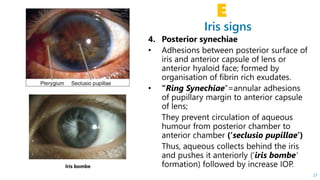
Iris bombe
Iris signs
E
22
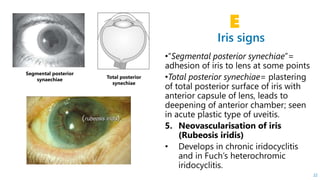
Segmental posterior
synaechiae Total posterior
synechiae
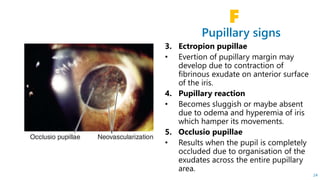
Pupillary signs
F
23
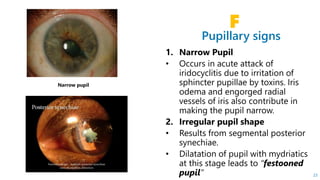
Narrow pupil
Pupillary signs
F
24
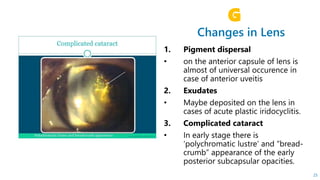
Changes in Lens
G
25
Changes in Intraocular
Pressure
I
26
Changes in vitreous and retina
H
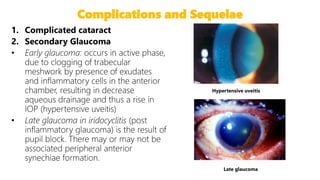
Complications and Sequelae
27
Hypertensive uveitis
Late glaucoma
28
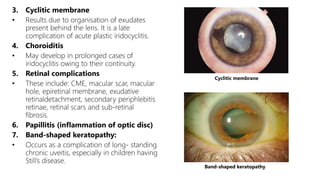
Cyclitic membrane
Band-shaped keratopathy
29
30
“Differential Diagnosis
1. Acute red eye
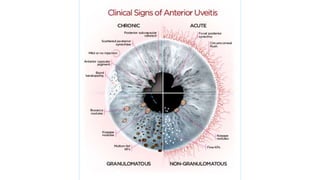
2. Granulomatous Vs Non-Granulomatous uveitis
3. Etiological differential Diagnosis
31
“
32
Feature Granulomatous Uveitis Non-granulomatous Uveitis
1. Onset Insidious Acute
2. Pain Minimal Marked
3. Photophobia Slight Marked
4. Ciliary congestion minimal Marked
5. Keratic precipitates (KPs) Mutton fat Small
6. Aqueous flare Mild Marked
7. Iris Nodules Usually present Absent
8. Posterior Synechiae Thick and broad based Thin and tenuous
9. Fundus Nodular lesions Diffuse involvement
Neal Creative | click & Learn moreNeal Creative ©

Anterior Uveitis

Editor's Notes

  • #10 Combine an image and multiple key statements with a strong grid.