Answers to self-tests and exercises
CHAPTER 1
Self-tests
S1.1
80
35 Br + 1
0 n 81
35 Br + γ
S1.2 d orbitals, 5 orbitals
S1.3 4
S1.4 3p
S1.5 The added p electron is in a different (p)
orbital, so it is less shielded.
S1.6 8 2
Ni :[Ar]3 4
d s , 2 8
Ni :[Ar]3d
+
S1.7 Period 4, Group 2, s block
S1.8 Going down a group the atomic radius
increases and the first ionization energy
generally decreases.
S1.9 Group 16. The first four electrons are
removed with gradually increasing values.
Removing the fifth electron requires a large
increase in energy, indicating breaking into a
complete subshell.
S1.10 Adding another electron to C would result in
the stable half filled p subshell.
S1.11 Cs+
Exercises
1.1 (a) 7
14
N+2
4
He→ 8
17
O+1
1
p +γ
(b) 6
12
C+1
1
p→ 7
13
N + γ
(c) 7
14
N+0
1
n→1
3
H+ 6
12
C
1.2 96
246
Cm+ 6
12
C→112
257
Uub+0
1
n
1.3 The higher value of I2 for Cr relative to Mn is
a consequence of the special stability of half-
filled subshell configurations and the higher
Zeff of a 3d electron verses a 4s electron.
1.4 22 4 25 1
10 2 12 0
Ne He Mg n
+ → +
1.5 4
9
Be+4
9
Be→ 6
12
C+2
4
He +20
1
n
1.6 Since helium-4 is the basic building block,
most additional fusion processes will produce
nuclei with even atomic numbers.
1.7 Take the summation of the rest masses of all
the nuclei of the products minus the masses of
the nuclei of the reactants. If you get a
negative number, energy will be released.
But what you have calculated is the mass
difference, which in the case of a nuclear
reaction is converted to energy.
1.8 0.25
1.9 –13.2 eV
1.10 1524nm, 1.524 X 10⁴
cm-1
1.11
1
λ
= R
1
12
−
1
∞2
⎛
⎝
⎜
⎞
⎠
⎟ =1.0974X10⁷m−1
1
λ
= R
1
12
−
1
42
⎛
⎝
⎜
⎞
⎠
⎟ =1.0288X10⁷m−1
1
λ
= R
1
12
−
1
32
⎛
⎝
⎜
⎞
⎠
⎟ = 9.7547X10⁶m−1
1
λ
= R
1
12
−
1
22
⎛
⎝
⎜
⎞
⎠
⎟ = 8.2305X10⁶m−1
1.12 0 up to n-X
1.13 n2
1.14
N l ml Orbital
designation
Number
of
orbitals
2 1 +1, 0,
−1
2p 3
3 2 +2, +1,
…, −2
3d 5
4 0 0 4s 1
4 3 +3, +2,
…, −3
4f 7
1.15 n=5, l = 3, and ml = -3,-2,-1,0,1,2,3
1.16 Li: σ = Z – Zeff ; σ = 3-1.28 = 1.72
Be: σ = Z – Zeff ; σ = 4-1.19 = 2.09
B: σ = Z – Zeff ; σ = 5-2.42 = 2.58
C: σ = Z – Zeff ; σ = 6-3.14 = 2.86
N: σ = Z – Zeff ; σ = 7-3.83 = 3.17
O: σ = Z – Zeff ; σ = 8-4.45 = 3.55
F: σ = Z – Zeff ; σ = 9-5.10 = 3.90
1.17 The 1s electrons shield the positive charge
form the 2s electrons.
1
Shriver & Atkins: Inorganic Chemistry 5e
ANSWERS TO SELF-TESTS AND EXERCISES
2
1.18 See Figs 1.11 through 1.16
1.19 See Table 1.6 and discussion.
1.20 Table 1.6 shows SR > Ba < Ra. Ra is
anomalous because of higher Zeff due to
lanthanide contraction.
1.21 Anomalously high value for Cr is associated
with the stability of a half filled d shell.
1.22 (a) [He]2s2
2p2
(b) [He]2s2
2p5
(c) [Ar]4s2
(d) [Ar]3d10
(e) [Xe]4f14
5d10
6s2
6p3
(f) [Xe]4f14
5d10
6s2
1.23 (a) [Ar]3d1
4s2
(b) [Ar]3d2
(c) [Ar]3d5
(d) [Ar]3d4
(e) [Ar]3d6
(f) [Ar]
(g) [Ar]3d10
4s1
(h) [Xe]4f 7
1.24 (a) Xe]4f14
5d4
6s2
(b) [Kr]4d6
(c) [Xe]4f6
(d) [Xe]4f7
(e) [Ar]
(f) [Kr]4d2
1.25 (a) S
(b) Sr
(c) V
(d) Tc
(e) In
(f) Sm
1.26 See Figure 1.4.
1.27 (a) I1 increases across the row except for a dip
at S; (b) Ae tends to increase except for Mg
(filled subshell), P (half filled subshell), and
at AR (filled shell).
1.28 Radii of Period 4 and 5 d-metals are similar
because of lanthanide contraction.
1.29 2s2
and 2p0
1.30
CHAPTER 2
Self-tests
S2.1
S2.2 (a) Angular
(b) square planar
S2.3 Linear
S2.4 S2
2–
: 1σg
2
2σu
2
3σg
2
1πu
4
2πg
4
;
Cl2
–
: 1σg
2
2σu
2
3σg
2
1πu
4
2πg
4
4σu
1
.
S2.5 1σg
2
2σu
2
3σg
2
1πu
4
2πg
4
S2.6 ½[2-2+4+2] = 3
S2.7 Bond order: C≡N, C=N, and C–N; Bond
strength: C≡N > C=N > C–N.
S2.8 If it contains 4 or fewer electrons.
S2.9 –21 kJ mol–1
S2.10 (a) +1/2
(b) +5
Exercises
2.1 (a) angular
(b) tetrahedral
(c) tetrahedral
2.2 (a) trigonal planar
(b) trigonal pyramidal
(c) square pyramidal
2.3 (a) T-shaped
Shriver & Atkins: Inorganic Chemistry 5e
ANSWERS TO SELF-TESTS AND EXERCISES 3
(b) square planar
(c) linear
2.4 (a)
I
Cl Cl
Cl Cl
(b)
S
F
F
F
F
1200
1800
2.5 (a) tetrahedral
(b) octahedral
2.6 (a) 176 pm
(b) 217 pm
(c) 221 pm
2.7 2(Si–O) = 932kJ > Si=O = 640kJ; therefore
two Si–O are preferred and SiO2 should (and
does) have four single Si–O bonds.
2.8 Multiple bonds are much stronger for period 2
elements than heavier elements
2.9 –483 kJ difference is smaller than expected
because bond energies are not accurate.
2.10 (a) 0
(b) 205 kJ mol-1
2.11 Difference in electronegativities are AB 0.5,
AD 2.5, BD 2.0, and AC 1.0. The increasing
covalent character AD < BD < AC < AB.
2.12 (a) covalent
(b) ionic
(c) ionic
2.13 (a) sp2
(b) sp3
(c) sp3
d or spd3
(d) p2
d2
or sp2
d.
2.14 (a) one
(b) one
(c) none
(d) two
2.15 (a) 1σg
2
2σu
2
(b) 1σg
2
2σu
2
1πu
2
(c) 1σg
2
2σu
2
1πu
4
3σg
1
(d) 1σg
2
2σu
2
3σg
2
1πu
4
2πg
3
2.16 The configuration for the neutral C2 would be
1σg
2
1σu
2
1πu
4
. The bond order would be ½[2-
2+4] = 2.
2.17 (a) 1σg
2
2σu
2
3σg
2
1πu
4
2πg
4
(b) 1
(c) There is no bond between the two atoms.
2.18 (a) 2
(b) 1
(c) 2
2.19 (a) +0.5
(b) –0.5
(c) +0.5
2.20
2.21 (a-c)
(d) Possibly stable in isolation (only bonding
and nonbonding orbitals are filled; not stable
in solution because solvents would have
higher proton affinity than He.
2.22 1
2.23 HOMO exclusively F; LUMO mainly S.
2.24 (a) electron deficient
Shriver & Atkins: Inorganic Chemistry 5e
ANSWERS TO SELF-TESTS AND EXERCISES
4
(b) electron precise
CHAPTER 3
Self-tests
S3.1 See Fig. 3.7 and Fig. 3.32.
S3.2 See Figure 3.35.
S3.3 52%
S3.4 rh = ((3/2)1/2
– 1) r = 0.225 r
S3.5 409 pm
S3.6 401 pm
S3.7 FeCr3
S3.8 X2A3.
S3.9 Ti CN = 6 (thought these are as two slightly
different distances it is often described as 4 +
2) and O CN = 3.
S3.10 LaInO3
S3.11 2421 kJ mol–1
S3.12 Unlikely
S3.13 MgSO4 < CaSO4 < SrSO4 < BaSO4.
S3.14 NaClO4
S3.15 Schottky defects.
S3.16 Phosphorus and aluminium.
S3.17 The dx2-y2 and dz2 have lobes pointing along
the cell edges to the nearest neighbor metals.
S3.18 (a) n-type
(b) p-type
Exercises
3.1 a ≠ b ≠ c and α = 90°, = 90°, = 90°
3.2 Points on the cell corners at (0,0,0), (1,0,0),
(0,1,0), (0,0,1), (1,1,0), (1,0,1), (0,1,1), and
(1,1,1) and in the cell faces at (½,½,0),
(½,1,½), (0,½,½) (½,½,1), (½,1,½), and
(1,½,½).
3.3 (c) and (f) are not as they have neighbouring
layers of the same position.
3.4 XA2
3.5 K3C60
3.6 281 pm
3.7 429 pm
3.8 CuAu. Primitive 12 carat.
3.9 Zintl phase region
3.10 (a) 6:6 and 8:8
(b) CsCI
3.11 6
3.12 2B type and 4A type – in a distorted
octahedral arrangement.
3.13 (a) ρ = 0.78, so fluorite
(b) FrI? ρ = 0.94, so CsCl
(c) BeO? ρ = 0.19, so ZnS
(d) InN? ρ = 0.46, so NaCl
3.14 CsCl.
3.15 Lattice enthalpies for the di- and the trivalent
ions. Also, the bond energy and third electron
gain enthalpy for nitrogen will be large.
3.16 4 four times the NaCl value or 3144 kJmol–1
.
3.17 (a) 10906 kJmol–1
(b) 1888 kJ mol–1
(c) 664 kJ mol–1
3.18 (a) MgSO4
(b) NaBF4
3.19 CsI < RbCl < LiF < CaO < NiO < AlN
3.20 Ba2+
; solubilities decrease with increasing
radius of the cation.
3.21 (a) Schottky defects
(b) Frenkel defects
3.22 Solids have a greater number of defects as
temperatures approaches their melting points.
3.23 The origin of the blue color involves electron
transfer from cationic centres.
3.24 Vanandium carbide and manganese oxide.
Shriver & Atkins: Inorganic Chemistry 5e
ANSWERS TO SELF-TESTS AND EXERCISES 5
3.25 Yes.
3.26 A semiconductor is a substance with an
electrical conductivity that decreases with
increasing temperature. It has a small,
measurable band gap. A semimetal is a solid
whose band structure has a zero density of
states and no measurable band gap.
3.27 Ag2S and CuBr: p-type; VO2: n-type.
CHAPTER 4
Self-tests
S4.1 (a) HNO3 + H2O → H3O+
+ NO3
–
HNO3, acid. Nitrate ion, conjugate base. H2O,
base. H3O+
, conjugate acid.
(b) CO3
2–
+ H2O → HCO3
–
+ OH–
carbonate ion, base; hydrogen carbonate, or
bicarbonate, conjugate acid; H2O, acid;
hydroxide ion, conjugate base.
(c) NH3 + H2S → NH4
+
+ HS–
Ammonia, base; NH4
+
, conjugate acid;
hydrogen sulphide, acid; HS–
, conjugate base.
S4.2 What is the pH of a 0.10 M HF solution?
pH= 2.24
S4.3 Calculate the pH of a 0.20 M tartaric acid
solution?
pH=1.85
S4.4 Which solvent?
dimethylsulfoxide (DMSO) and ammonia.
S4.5 Is aKBrF4 an acid or a base in BrF3?
A base.
S4.6 Arrange in order of increasing acidity?
The order of increasing acidity is [Na(H2O)6]+
< [Mn(H2O)6]2+
< [Ni(H2O)6]2+
<
[Sc(H2O)6]3+
.
S4.7 Predict pKa values? (a) H3PO4 pKa ≈ 3. The
actual value, given in Table 4.1, is 2.1.
(b) H2PO4
–
pKa(2) ≈ 8. The actual value,
given in Table 4.1, is 7.4.
(c) HPO4
2–
pKa(3) ≈ 13. The actual value,
given in Table 4.1, is 12.7.
S4.8 What happens to Ti(IV) in aqueous
solution as the pH is raised?
Treatment with ammonia causes the
precipitation of TiO2. Further treatment with
NaOH causes the TiO2 to redissolve.
S4.9 Identify the acids and bases?
(a) FeCl3 + Cl–
→ [FeCl4]–
, acid is FeCl3,
base is Cl–
.
(b) I–
+ I2 → I3
–
, acid is I2, base is I–
.
S4.10 The difference in structure between
(H3Si)3N and (H3C)3N? The N atom of
(H3Si)3N is trigonal planar, whereas the N
atom of (H3C)3N is trigonal pyramidal.
S4.11 Draw the structure of BF3·OEt2?
Exercises
4.1 Sketch an outline of the s and p blocks of
the periodic table, showing the elements
that form acidic, basic, and amphoteric
oxides?
The elements that form basic oxides are in
plain type, those forming acidic oxides are in
outline type, and those forming amphoteric
oxides are in boldface type.
4.2 Identify the conjugate bases of the
following acids?
(a) [Co(NH3)5(OH2)]3+
, conjugate base is
[Co(NH3)5(OH)]2+
.
(b) HSO4
–
? The conjugate base is SO4
–
.
(c) CH3OH? The conjugate base is CH3O–
.
(d) H2PO4
–
? The conjugate base is HPO4
2–
.
(e) Si(OH)4? The conjugate base is
SiO(OH)3
–
.
(f) HS−
? The conjugate base is S2–
.
4.3 Identify the conjugate acids of the
following bases?
Shriver & Atkins: Inorganic Chemistry 5e
ANSWERS TO SELF-TESTS AND EXERCISES
6
(a) C5H5N (pyridine)? The conjugate acid
is pyridinium ion, C5H6N+
.
(b) HPO4
2–
? The conjugate acid is H2PO4
2–
.
(c) O2–
? The conjugate acid is OH–
.
(d) CH3COOH? The conjugate acid is
CH3C(OH)2
+
.
(e) [Co(CO)4]–
? The conjugate acid is
HCo(CO)4.
(f) CN–
? The conjugate acid is HCN.
4.4 Calculate the [H3O+
] and pH of a 0.10 M
butanoic acid solution? pH=2.85
4.5 What is the Kb of ethanoic acid?
Kb = 5.6 × 10⁻¹⁰
4.6 What is the Ka for C5H5NH+
?
Ka = 5.6 × 10⁻⁶
4.7 Predict if F
-
will behave as an acid or a
base in water?
F
-
will behave as a base in water.
4.8 What are the structures and the pKa values
of chloric (HClO3) and chlorous (HClO2)
acid?
Cl
O
O O
H Cl
O
O
H
chloricacid chlorousacid
Chloric acid, the predicted pKa = –2; actual
value = –1.
Chlorous acid, the predicted pKa = 3; actual
value = 2.
4.8 Which bases are too strong or too weak to
be studied experimentally? (a) CO3
2–
O2–
,
ClO4
–
, and NO3
–
in water?
CO3
2–
is of directly measurable base strength.
O2–
, is too strong to be studied experimentally
in water.
ClO4
2–
and NO3
–
are too weak to be studied
experimentally.
(b) HSO4
–
, NO3
–
, and ClO4
–
, in H2SO4?
HSO4
–
, not too strong to be studied
experimentally.
NO3
–
is of directly measurable base strength
in liquid H2SO4.
ClO4
–
, cannot be studied in sulfuric acid.
4.9 Is the –CN group electron donating or
withdrawing?
electron withdrawing
4.11 Is the pKa for HAsO4
2–
consistent with
Pauling’s rules? No. Pauling’s rules are
only approximate.
4.12 What is the order of increasing acid
strength for HNO2, H2SO4, HBrO3, and
HClO4?
the order is HClO4 > HBrO3 > H2SO4 >
HNO2.
4.13 Account for the trends in the pKa values of
the conjugate acids of SiO4
4–
, PO4
3–
, SO4
2–
,
and ClO4
–
?
The acidity of the four conjugate acids
increases in the order HSiO4
3–
< HPO4
2–
<
HSO4
–
< HClO4.
4.14 Which of the following is the stronger acid?
(a) [Fe(OH2)6]3+
or [Fe(OH2)6]2+
? The
Fe(III) complex, [Fe(OH2)6]3+
, is the stronger
acid.
(b) [Al(OH2)6]3+
or [Ga(OH2)6]3+
?
the aluminum-containing species is more
acidic.
(c) Si(OH)4 or Ge(OH)4?
Si(OH)4, is more acidic.
(d) HClO3 or HClO4?
HClO4 is a stronger acid.
(e) H2CrO4 or HMnO4?
HMnO4 is the stronger acid.
(f) H3PO4 or H2SO4?
H2SO4 is a stronger acid.
4.15 Arrange the following oxides in order of
increasing basicity? Al2O3, B2O3, BaO,
CO2, Cl2O7, and SO3?
order of increasing basicity is Cl2O7 < SO3 <
CO2 < B2O3 < Al2O3 < BaO.
4.16 Arrange the following in order of
increasing acidity? HSO4
−
, H3O+
, H4SiO4,
CH3GeH3, NH3, and HSO3F?
increasing acidity is NH3 < CH3GeH3 <
H4SiO4 < HSO4
–
< H3O+
< HSO3F.
4.17 Which aqua ion is the stronger acid, Na+
or
Ag+
? Ag+
(aq).
Shriver & Atkins: Inorganic Chemistry 5e
ANSWERS TO SELF-TESTS AND EXERCISES 7
4.18 Which of the following elements form oxide
polyanions or polycations? Al, As, Cu, Mo,
Si, B, Ti?
polycations: Al, Cu, and Ti.
polyoxoanions (oxide polyanions): Mo
polyoxoanions: As, B, and Si.
4.19 The change in charge upon aqua ion
polymerization?
Polycation formation reduces the average
positive charge per central M atom by +1 per
M.
4.20 Write balanced equations for the formation
of P4O12
4–
from PO4
3–
and for the formation
of [(H2O) 4Fe(OH)2Fe(OH2)4]4+
from
[Fe(OH2)6]3+
?
4PO4
3–
+ 8H3O+
→ P4O12
4–
+ 12H2O
2[Fe(OH2)6]3+
→
[(H2O)4Fe(OH)2Fe(OH2)4+
+ 2H3O+
4.21 More balanced equations?
(a) H3PO4 and Na2HPO4?
H3PO4 + HPO4
2-
ÅÆ 2H2PO4
-
(b) CO2 and CaCO3?
CO2 + CaCO3 + H2O Ca2+
+ 2HCO3
-
4.22 Give the equations for HF in H2SO4 and
HF in liquid NH3?
H2SO4 + HF ⇔ H3SO4
+
+ F-
NH3 + HF NH2
-
+ H2F+
4.23 Why is H2Se a stronger acid than H2S? As
you go down a family in the periodic chart,
the acidy of the homologous hydrogen
compounds increases.
4.24 Identifying elements that form Lewis
acids? All of the p-block elements except
nitrogen, oxygen, fluorine, and the lighter
noble gases form Lewis acids in one of their
oxidation states.
4.25 Identifying acids and bases: (a) SO3 + H2O
→ HSO4
–
+ H+
? The acids in this reaction
are the Lewis acids SO3 and H+
and the base
is the Lewis base OH–
.
(b) Me[B12]–
+ Hg2+
→ [B12] +
MeHg+
? The Lewis acid Hg2+
displaces the
Lewis acid [B12] from the Lewis base CH3
–
.
(c) KCl + SnCl2 → K+
+ [SnCl3]–
? The
Lewis acid SnCl2 displaces the Lewis acid K+
from the Lewis base Cl–
.
(d) AsF3(g) + SbF5(g) → [AsF2][SbF6]?
The very strong Lewis acid SbF5 displaces the
Lewis acid [AsF2]+
from the Lewis base F–
.
(e) EtOH readily dissolves in pyridine? A
Lewis acid–base complex formation reaction
between EtOH (the acid) and py (the base)
produces the adduct EtOH–py.
4.26 Select the compound with the named
characteristic? (a) Strongest Lewis acid:
BF3, BCl3, or BBr3? BBr3.
BeCl2 or BCl3? Boron trichloride.
B(n-Bu)3 or B(t-Bu)3? B(n-Bu)3.
(b) More basic toward BMe3: NMe3 or
NEt3? NMe3.
2-Me-py or 4-Me-py? 4-Me-py.
4.27 Which of the following reactions have Keq >
1? (a) R3P–BBr3 + R3N–BF3→ R3P–BF3 +
R3N–BBr3? <1
(b) SO2 + Ph3P–HOCMe3 → Ph3P–SO2 +
HOCMe3? > 1.
(c) CH3HgI + HCl → CH3HgCl + HI? <1
(d) [AgCl2]–
(aq) + 2 CN–
(aq) → [Ag (CN)2]–
(aq) + 2Cl–
(aq)? >1
4.28 Choose between the two basic sites in
Me2NPF2?
The phosphorus atom in Me2NPF2 is the
softer of the two basic sites, so it will bond
more strongly with the softer Lewis acid BH3
The hard nitrogen atom will bond more
strongly to the hard Lewis acid BF3.
4.29 Why is trimethylamine out of line?
Trimethyl amine is sterically large enough to
fall out of line with the given enthalpies of
reaction.
4.30 Discuss relative basicities? (a) Acetone and
DMSO?
DMSO is the stronger base regardless of how
hard or how soft the Lewis acid is. The
ambiguity for DMSO is that both the oxygen
atom and sulfur atom are potential basic sites.
(b) Me2S and DMSO? Depending on the
EA and CA values for the Lewis acid, either
base could be stronger.
4.31 Write a balanced equation for the
dissolution of SiO2 by HF?
Shriver & Atkins: Inorganic Chemistry 5e
ANSWERS TO SELF-TESTS AND EXERCISES
8
SiO + 6HF
2 2H O + H SiF
SiO2 + 4HF
2 2 6
or
2H2O + SiF4
Both a Brønsted acid–base reaction and a
Lewis acid–base reaction.
4.32 Write a balanced equation to explain the
foul odor of damp Al2S3? The foul odor
suggests H2S formation.
Al2S3 + 3H2O Al2O3 + 3H2S
4.33 Describe solvent properties? (a) Favor
displacement of Cl–
by I–
from an acid
center? If you choose a solvent that
decreases the activity of chloride relative to
iodide, you can shift the following
equilibrium to the right:
acid-Cl-
+ I- acid-I- + Cl-
(b) Favor basicity of R3As over
R3N? Alcohols such as methanol or ethanol
would be suitable.
(c) Favor acidity of Ag+
over Al3+
? An
example of a suitable solvent is diethyl ether.
Another suitable solvent is H2O.
(d) Promote the reaction 2FeCl3 + ZnCl2
→Zn2+
+ 2[FeCl4]−
? A suitable solvent is
acetonitrile, MeCN.
4.34 Propose a mechanism for the acylation of
benzene? An alumina surface, such as the
partially dehydroxylated one shown below,
would provide Lewis acidic sites that could
abstract Cl–
:
4.35 Why does Hg(II) occur only as
HgS? Mercury(II) is a soft Lewis acid, and
so is found in nature only combined with soft
Lewis bases, the most common of which is
S2–
.
4.36 Write Brønsted acid–base reactions in
liquid HF?
(a) CH3CH2OH? The balanced equation
is:
CH3CH2OH + HF CH3CH2OH2
+ + F-
(b) NH3? The equation is
(c) C6H5COOH?
C6H5COOH + HF C6H5COO- + H2F+
4.37 The dissolution of silicates by HF? both
4.38 Are the f-block elements hard? yes.
4.39 Calculate the enthalpy change for I2 with
phenol?
ΔfH
φ
= -20.0kJ/mol
CHAPTER 5
Self-tests
S5.1 Half-reactions and balanced reaction for
oxidation of zinc metal by permanganate
ions?
2[MnO4
−
(aq) + 8H+
(aq) + 5e–
→ Mn2+
(aq)
+ 4H2O(l)] reduction
5 [ Zn(s) → Zn2+
(aq) + 2e–
] oxidation
2MnO4
−
(aq) + 5Zn(s) + 16H+
(aq) →
5Zn2+
(aq) + 2Mn2+
(aq) + 8H2O(l)
S5.2 Does Cu metal dissolve in dilute HCl? No.
S5.3 Can Cr2O7
2–
be used to oxidize Fe2+
, and
would Cl–
oxidation be a problem? Yes.
Cl-
oxidation is not a problem.
S5.4 Fuel cell emf with oxygen and hydrogen
gases at 5.0 bar?
E = 1.25 V.
S5.5 The fate of SO2 emitted into clouds? The
aqueous solution of SO4
2–
and H+
ions
precipitates as acid rain.
S5.6 Can Fe2+
disproportionate under standard
conditions? No.
S5.7 bpy binding to Fe(III) or Fe(II)? Fe(II)
preferentially.
S5.8 Potential of AgCl/Ag,Cl–
couple?
Eox= – 1.38 V
S5.9 Latimer diagram for Pu? (a) Pu(IV)
disproportionates to Pu(III) and Pu(V) in
aqueous solution; (b) Pu(V) does not
disproportionate into Pu(VI) and Pu(IV).
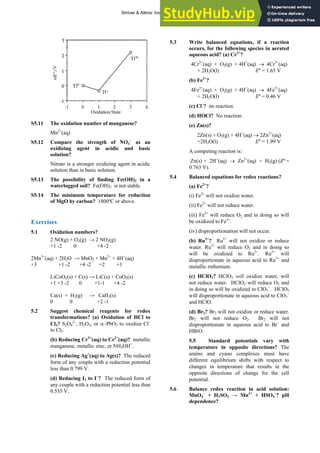
S5.10 Frost diagram for thallium in aqueous
acid?
N H 4
+ + F -
N H 3 + H F
Shriver & Atkins: Inorganic Chemistry 5e
ANSWERS TO SELF-TESTS AND EXERCISES 9
S5.11 The oxidation number of manganese?
Mn2+
(aq)
S5.12 Compare the strength of NO3
–
as an
oxidizing agent in acidic and basic
solution?
Nitrate is a stronger oxidizing agent in acidic
solution than in basic solution.
S5.13 The possibility of finding Fe(OH)3 in a
waterlogged soil? Fe(OH)3 is not stable.
S5.14 The minimum temperature for reduction
of MgO by carbon? 1800ºC or above.
Exercises
5.1 Oxidation numbers?
2 NO(g) + O2(g) → 2 NO2(g)
+1 -2 0 +4 -2
2Mn3+
(aq) + 2H2O → MnO2 + Mn2+
+ 4H+
(aq)
+3 +1 -2 +4 -2 +2 +1
LiCoO2(s) + C(s) → LiC(s) + CoO2(s)
+1 +3 -2 0 +1-1 +4 -2
Ca(s) + H2(g) → CaH2(s)
0 0 +2 -1
5.2 Suggest chemical reagents for redox
transformations? (a) Oxidation of HCl to
Cl2? S2O8
2–
, H2O2, or α–PbO2 to oxidize Cl–
to Cl2.
(b) Reducing Cr3+
(aq) to Cr2+
(aq)? metallic
manganese, metallic zinc, or NH3OH+
.
(c) Reducing Ag+
(aq) to Ag(s)? The reduced
form of any couple with a reduction potential
less than 0.799 V.
(d) Reducing I2 to I–
? The reduced form of
any couple with a reduction potential less than
0.535 V.
5.3 Write balanced equations, if a reaction
occurs, for the following species in aerated
aqueous acid? (a) Cr2+
?
4Cr2+
(aq) + O2(g) + 4H+
(aq) → 4Cr3+
(aq)
+ 2H2O(l) Eº = 1.65 V
(b) Fe2+
?
4Fe2+
(aq) + O2(g) + 4H+
(aq) → 4Fe3+
(aq)
+ 2H2O(l) Eº = 0.46 V
(c) Cl–
? no reaction.
(d) HOCl? No reaction.
(e) Zn(s)?
2Zn(s) + O2(g) + 4H+
(aq) → 2Zn2+
(aq)
+2H2O(l) Eº = 1.99 V
A competing reaction is:
Zn(s) + 2H+
(aq) → Zn2+
(aq) + H2(g) (Eº =
0.763 V).
5.4 Balanced equations for redox reactions?
(a) Fe2+
?
(i) Fe2+
will not oxidize water.
(ii) Fe2+
will not reduce water.
(iii) Fe2+
will reduce O2 and in doing so will
be oxidized to Fe3+
.
(iv) disproportionation will not occur.
(b) Ru2+
? Ru2+
will not oxidize or reduce
water. Ru2+
will reduce O2 and in doing so
will be oxidized to Ru3+
. Ru2+
will
disproportionate in aqueous acid to Ru3+
and
metallic ruthenium.
(c) HClO2? HClO2 will oxidize water, will
not reduce water. HClO2 will reduce O2 and
in doing so will be oxidized to ClO3
–
. HClO2
will disproportionate in aqueous acid to ClO3
–
and HClO.
(d) Br2? Br2 will not oxidize or reduce water.
Br2 will not reduce O2. Br2 will not
disproportionate in aqueous acid to Br–
and
HBrO.
5.5 Standard potentials vary with
temperature in opposite directions? The
amino and cyano complexes must have
different equilibrium shifts with respect to
changes in temperature that results in the
opposite directions of change for the cell
potential.
5.6 Balance redox reaction in acid solution:
MnO4
–
+ H2SO3 → Mn2+
+ HSO4
–
? pH
dependence?
Shriver & Atkins: Inorganic Chemistry 5e
ANSWERS TO SELF-TESTS AND EXERCISES
10
2MnO4
−
(aq) + 5H2SO3(aq) + H+
(aq) →
2Mn2+
(aq) +5HSO3
−
(aq) + 3H2O(l)
The potential decreases as the pH increases.
5.7 Write the Nernst equation for (a) The
reduction of O2?
Q = 1/(p(O2)[H+
]4
)
and
E = Eº – [(0.059V)/4][log(1/(p(O2)[H+
]4
)]
(b) The reduction of Fe2O3(s)?
Q = 1/[H+
]6
and E = Eº – (RT/nF)(13.8 pH)
5.8 Using Frost diagrams? (a) What happens
when Cl2 is dissolved in aqueous basic
solution? Cl2 is thermodynamically
susceptible to disproportionation to Cl–
and
ClO4
–
when it is dissolved in aqueous base.
The oxidation of ClO–
is slow, so a solution of
Cl–
and ClO–
is formed when Cl2 is dissolved
in aqueous base.
(b) What happens when Cl2 is dissolved in
aqueous acid solution? Cl2 will not
disproportionate. Cl2 is thermodynamically
capable of oxidizing water.
(c) Should HClO3 disproportionate in
aqueous acid solution? Kinetic.
5.9 Write equations for the following
reactions: (a) N2O is bubbled into aqueous
NaOH solution?
5N2O(aq) + 2OH–
(aq) → 2NO3
–
(aq) +
4N2 (g) + H2O(l)
(b) Zinc metal is added to aqueous acidic
sodium triiodide?
Zn(s) + I3
–
(aq) → Zn2+
(aq) + 3I–
(aq)
(c) I2 is added to excess aqueous acidic
HClO3?
3I2(s) + 5ClO3
–
(aq) + 3H2O(l) → 6IO3
–
(aq) + 5Cl–
(aq) + 6H+
(aq)
5.10 Electrode potential for Ni2+
/Ni couple at pH
= 14? E =– 0.21 V
5.11 Will acid or base most favour the following
half-reactions? (a) Mn2+
→ MnO4
–
? Base
(b) ClO4
–
→ ClO3
–
? Acid
(c) H2O2 → O2? Base
(d) I2 → 2I–
? Acid or base, no difference.
5.12 Determine the standard potential for the
reduction of ClO4
–
to Cl2? 1.392 V
5.13 Calculate the equilibrium constant for
Au+
(aq) + 2CN–
(aq) → [Au(CN)2]–
(aq)?
K = 5.7 × 1038
5.14 Find the approximate potential of an
aerated lake at pH = 6, and predict the
predominant species? (a) Fe? 0.5 – 0.6 V
(b) Mn? E = 0.55 V
(c) S? At pH 0, 0.387 V. At pH 14, SO4
2–
would again predominate. HSO4
–
is the
predominant sulfur species at pH 6.
5.15 Frost diagram and standard potential for
the HSO4
−
/S8(s) couple? 0.387 V
5.16 Equilibrium constant for the reaction
Pd2+
(aq) + 4 Cl–
(aq) ≡ [PdCl4]2–
(aq) in 1 M
HCl(aq)? K = 4.37 × 10¹⁰
5.17 Reduction potential for MnO4
–
to MnO2(s)
at pH = 9.00? E = 0.98 V
5.18 Tendency of mercury species to act as an
oxidizing agent, a reducing agent, or to
undergo disproportionation? Hg2+
and
Hg2
2+
are both oxidizing agents. None of
these species are likely to be good reducing
agents. Hg2
2+
is not likely to undergo
disproportionation.
5.19 Thermodynamic tendency of HO2 to
undergo disproportionation? E = +1.275 V.
(is positive), HO2 will undergo
disproportionation.
5.20 Dissolved carbon dioxide corrosive towards
iron? Carbon dioxide and water generate
carbonic acid which encourages the corrosion
process by lowering solution pH.
5.21 What is the maximum E for an anaerobic
environment rich in Fe2+
and H2S? –0.1 V.
5.22 How will edta4–
complexation affect M2+
→
M0
reductions? The reduction of a M(edta)2–
complex will be more difficult than the
reduction of the analogous M2+
aqua ion.
5.23 Which of the boundaries depend on the
choice of [Fe2+
]? Any boundary between a
soluble species and an insoluble species will
change as the concentration of the soluble
species changes. The boundaries between the
two soluble species, and between the two
insoluble species, will not depend on the
choice of [Fe2+
].
5.24 Under what conditions will Al reduce
MgO? Above about 1400ºC.
Shriver & Atkins: Inorganic Chemistry 5e
ANSWERS TO SELF-TESTS AND EXERCISES 11
CHAPTER 6
Self-tests
S6.1 Sketch the S4 axis of an NH4
+
ion. How
many of these axes are there in the ion?
Three S4 axes.
S6.2 (a) BF3 point group? D3h.
(b) SO4
2–
point group? Td.
S6.3 Symmetry species of all five d orbitals of
the central Xe atom in XeF4 (D4h, Fig. 6.3)?
dx2-y2 is B1g;
dxy is B2g;
dxz and dyz are Eg;
dz2 is A1g.
S6.4 What is the maximum possible degeneracy
for an Oh molecule? 3.
S6.5 A conformation of the ferrocene molecule
that lies 4 kJ mol–1
above the lowest energy
configuration is a pentagonal antiprism. Is
it polar? No.
S6.6 Is the skew form of H2O2 chiral? Yes.
S6.7 Can the bending mode of N2O be Raman
active? Yes.
S6.8 Confirm that the symmetric mode is Ag?
D2h character table, which is the Ag symmetry
type.
S6.9 Show that the four CO displacements in
the square-planar (D4h) [Pt(CO)4]2+
cation
transform as A1g + B1g + Eu. How many
bands would you expect in the IR and
Raman spectra for the [Pt(CO)4]2+
cation?
The reducible representation:
D4h E 2C4 C2
2C2
’
2C2
″
i 2S4
σh 2σv 2σd
Γ3N 4 0 0 2
0 0 0 4 2 0
Reduces to A1g + B1g + Eu
A1g + B1g are Raman active. Eu is IR active.
S6.10 Orbital symmetry for a tetrahedral array
of H atoms in methane? A1
S6.11 Orbital symmetry for a square-planar
array of H atoms? B2g.
S6.12 Which Pt atomic orbitals can combine with
which of these SALCs? The atomic orbitals
much have matching symmetries to
generate SALCs. 5s and 4dz2 have A1g
symmetry; the dx2-y2 has B1g symmetry; and
5px and 5py have Eu symmetry.
S6.13 Predict how the IR and Raman spectra of
SF5Cl differ from that of SF6?
SF6 has Oh symmetry. Analysis of the
stretching vibrations leads to:
Γstr = A1g (Raman, polarized) + Eg
(Raman) + T1u (IR).
SF5Cl has C4v symmetry. Analysis of the
stretching vibrations leads to:
Γstr = 3A1 (IR and Raman, polarized)
+ 2B1 (Raman) + E (IR, Raman).
S6.14 Symmetries of all the vibration modes of
[PdCl4]2-
? A1g + B1g + B2g + A2u + B2u + 2Eu
S6.15 SALCs for sigma bonding in O? A1g + Eg
+T1u.
Exercises
6.1 Symmetry elements? (a) a C3 axis and a σv
plane in the NH3 molecule?
N
H
H
H
H
N
H
H
C3 σv
(b) a C4 axis and a σh plane in the square-
planar [PtCl4]2–
ion?
Pt
Cl
Cl Cl
Cl
Pt
Cl
Cl Cl
Cl
C4 σh
6.2 S4 or i? (a) CO2? i
(b) C2H2? i.
(c) BF3? neither.
(d) SO4
2–
? three different S4.
6.3 Assigning point groups: (a) NH2Cl? Cs
(b) CO3
2–
? D3h
(c) SiF4? Td
(d) HCN? C∞v.
(e) SiFClBrI? C1.
(f) BrF4
–
? D4h.
Shriver & Atkins: Inorganic Chemistry 5e
ANSWERS TO SELF-TESTS AND EXERCISES
12
6.4 How many planes of symmetry does a
benzene molecule possess? What chloro-
substituted benzene has exactly four planes
of symmetry? 7,and C6H3Cl3.
6.5 The symmetry elements of orbitals? (a) An
s orbital? Infinite number of Cn axes, plus
an infinite number of mirror planes of
symmetry, plus center of inversion, i.
(b) A p orbital? An infinite number of mirror
planes that pass through both lobes and
include the long axis of the orbital. In
addition, the long axis is a Cn axis, where n
can be any number from 1 to ∞.
(c) A dxy orbital? Center of symmetry, three
mutually perpendicular C2 axes, three
mutually perpendicular mirror planes of
symmetry, two planes that are rotated by 45º
about the z axis from the xz plane and the yz
plane.
(d) A dz2 orbital? In addition to the
symmetry elements possessed by a p orbital:
(i) a center of symmetry, (ii) a mirror plane
that is perpendicular to the C∞ axis, (iii) an
infinite number of C2 axes that pass through
the center of the orbital and are perpendicular
to the C∞ axis, and (iv) an S∞ axis.
6.6 SO3
2–
ion? (a) Point group? C3v
(b) Degenerate MOs? 2
(c) Which s and p orbitals have the
maximum degeneracy? 3px and 3py orbitals
are doubly degenerate.
6.7 PF5? (a) Point group? D3h.
(b) Degenerate MOs? 2.
(c) Which p orbitals have the maximum
degeneracy? 3px and 3py atomic orbitals are
doubly degenerate
6.8 AsCl5 Raman spectrum consistent with a
trigonal bipyamidal geometry? No.
6.9 Vibrational modes of SO3? (a) In the plane
of the nuclei? 5
(b) Perpendicular to the molecular plane?
1
6.10 Vibrations that are IR and Raman active?
(a) SF6? None.
(b) BF3? The E′ modes are active in both IR
and Raman.
6.11 Vibrations of a C6v molecule that are
neither IR nor Raman active? Any A2, B1,
or B2 vibrations of a C6v molecule will not be
observed in either the IR spectrum or the
Raman spectrum.
6.12 [AuCl4]−
ion? Γ of all 3N displacements
and irreducible representations?
A1g + A2g + B1g + B2g + Eg + 2A2u + B2u + 3Eu
6.13 IR and Raman to distinguish between: (a)
planar and pyramidal forms of PF3, (b)
planar and 90o
-twisted forms of B2F4 (D2h
and D2d respectively)?
(a) Planar PF3, D3h, vibrations are: A1’
(Raman, polarized) + 2E’ (IR and Raman) +
A2” (IR).
Pyramidal PF3, C3v, vibrations are: 2A1 (IR
and Raman, polarized) + 2E’ (IR and Raman)
(b) For the planar form of B2F4 (D2h):
The vibrations are:
3Ag (Raman, polarized) + 2B2g (Raman) +
B3g (Raman) + Au(inactive) + 2B1u (IR) +
B2u (IR) + 2B3u (IR).
For the 90o
-twisted form of B2F4 (D2d)
The vibrations are: 3A1 (Raman, polarized) +
B1 (Raman) + 2B2 (IR and Raman ) + 3E (IR
and Raman).
6.14 (a) Take the 4 hydrogen 1s orbitals of CH4
and determine how they transform under
Td. (b) Confirm that it is possible to reduce
this representation to A1 + T2. (c) Which
atomic orbitals on C can form MOs with
H1s SALCs?
Using symmetry Td, Γ3N reduces to: A1 + T2.
The MOs would be constructed from SALCs
with H1s and 2s and 2p atomic orbitals on C.
6.15 Use the projection operator method to
construct the SALCs of A1 + T2 symmetry
that derive from the four H1s orbitals in
methane..
s = (1
/2)(ϕ1 + ϕ2 + ϕ3 + ϕ3) (= A1)
px = (1
/2)(ϕ1 – ϕ2 + ϕ3 – ϕ3) (= T2)
py = (1
/2)(ϕ1 – ϕ2 – ϕ3 + ϕ3) (= T2)
pz = (1
/2)(ϕ1 + ϕ2 – ϕ3 – ϕ3) (= T2)
SALCs for σ-bonds
(a) BF3?
(1
/√3)(ϕ1 + ϕ2 + ϕ3) (= A1’)
(1
/√6)(2ϕ1 – ϕ2 – ϕ3) and (1
/√2)(ϕ2 – ϕ3) (=
E’)
(b) PF5?
(axial F atoms are ϕ4 + ϕ5)
(1
/√2)(ϕ4 + ϕ5) (= A1’)
(1
/√2)(ϕ4 − ϕ5) (= A2”)
(1
/√3)(ϕ1 + ϕ2 + ϕ3) (= A1’)
(1
/√6)(2ϕ1 – ϕ2 – ϕ3) and (1
/√2)(ϕ2 – ϕ3) (=
E’)
Shriver & Atkins: Inorganic Chemistry 5e
ANSWERS TO SELF-TESTS AND EXERCISES 13
CHAPTER 7
Self-tests
S7.1 Give formulas corresponding to the
following names? (a) Cis-
diaquadichloroplatinum(II)? cis-
[PtCl2(OH2)2],
trans-diaquadichloroplatinum(II), trans-
[PtCl2(OH2)2].
(b) Diamminetetra(isothiocyanato)
chromate(III)?
[Cr(NCS)4(NH3)2] –
. ,can exist as, cis-
[Cr(NCS)4(NH3)2] –
or trans-
[Cr(NCS)4(NH3)2] –
.
(c) Tris(ethylenediamine)rhodium (III)?
[Rh(en)3]3+
.
(d) Bromopentacarbonylmanganese
(I)? [MnBr (CO)5].
(e) Chlorotris(triphenylphosphine)rhodium
(I)? [RhCl(PPh3)3].
S7.2 What type of isomers are possible for
[Cr(NO2)2•6H2O]? The hydrate isomers
and linkage isomers of the NO2 group. Also,
[Cr(ONO)(H2O)5]NO2 •H2O.
S7.3 Identifying isomers? Note that the two
phosphine ligands in the trans isomer are
related, therefore, they exhibit the same
chemical shift.
S7.4 Sketches of the mer and fac isomers of
[Co(gly)3]?
S7.5 Which of the following are chiral? (a) cis-
[CrCl2 (ox)2]3–
? Chiral .
(b) trans-[CrCl2(ox)2]3–
? Not chiral.
(c) cis-[RhH(CO)(PR3)2]? Not chiral.
S7.6 Calculate all of the stepwise formation
constants? Kf1 = 1 X 10⁵
. Kf2 will be 30%
less or 30000, Kf3 = 9000, Kf4 = 2700, Kf5 =
810, and finally Kf6 = 243.
Exercises
7.1 Name and draw the structures of the
complexes? (a) [Ni(CO)4]? Nickel
tetracarbonyl or tetracarbonyl nickel(0).
CO
Ni
OC
CO
CO
(b) [Ni(CN)4]2–
? Tetracyanonickelate (II).
2-
Ni
NC
NC CN
CN
(c) [CoCl4]2–
? Tetrachlorocobaltate (II)
2-
Cl
Co
Cl
Cl
Cl
(d) [Mn(NH3)6]2+
?
Hexaamminemanganesium (II)
2
+
M
n
H
3
N
H
3
N N
H
3
N
H
3
N
H
3
N
H
3
7.2 Write the formulas for the following
complexes?
(a) [CoCl(NH3)5]Cl2
(b) [Fe(OH2)6](NO3)3
(c) cis-[FeCl2(en)2]
(d) [Cr(NH3)5μ–OH–Cr(NH3)5]Cl5
7.3 Name the following complexes?
(a) cis-[CrCl2(NH3)4]+
? cis-
tetra(ammine)di(chloro)chromium(III)
(b) trans-[Cr(NCS)4(NH3)2]
-
? trans-
di(ammine)tetrakis(isothiocyanato)chromate
(III)
(c) [Co(C2O4)(en)2]+
?
bis(ethylenediamine)oxalatocobalt(III).
Shriver & Atkins: Inorganic Chemistry 5e
ANSWERS TO SELF-TESTS AND EXERCISES
14
7.4 Four-coordinate complexes? (a) Sketch the
two observed structures?
(b) Isomers expected for MA2B2?
tetrahedral complex, no isomers, for a square-
planar complex, two isomers, cis and trans.
7.5 For five-coordinate complexes, sketch the
two observed structures?
7.6 Six-coordinate complexes? (a) Sketch the
two observed structures?
(b) Which one of these is rare? Trigonal
prism.
7.7 Explain the difference between
monodentate, bidentate, and
quadridentate? A monodentate ligand can
bond to a metal atom only at a single atom, a
bidentate ligand can bond through two atoms,
a quadridentate ligand can bond through four
atoms.
7.8 What type of isomers do you get with
ambidentate ligands? linkage isomers.
7.9 Which ligand could act like a chelating
ligand? (a) Triphenylphosphite, no/
(b) Bis(dimethyl)phosphino ethane (dmpe)
yes.
(c) Bipyridine (bipy), yes.
(d) Pyrazine, no.
7.10 Draw structures of complexes that contain
the ligands (a) en, (b) ox, (c) phen, and (d)
edta? .
M
L L
L L
M
L
L
L
L
tetrahedral square plana
[Mg(edta)(OH2)]2–
7.11 What types of isomers are [RuBr(NH3)5]Cl
and [RuCl(NH3)5]Br? Ionization isomers.
7.12 Which complexes have isomers?
[CoBrClI(OH2)]
7.13 Which complexes have isomers?
(a) [Pt(ox)(NH3)2] no isomers
(b) [PdBrCl(PEt3)2] has two isomers.
(c) [IrHCO(PR3)2] has two isomers.
(d) [Pd(gly)2] has two isomers.
7.14 How many isomers are possible for the
following complexes?
(a) [FeCl(OH2)5]2+
? None.
(b) [IrCl3(PEt3)2]? 2
(c) [Ru(biby)3]2+
? 2
(d) [CoCl2(en)(NH3)2]+
? 4
(e) [W(CO)4(py)2] 2
r
M
A
A
E
E
E
Trigonal Bipyramidal
A = axial ligands
E = equatorial ligands
M
A
B
B
B B
Square based pyramid
A = axial
B = basal
Shriver & Atkins: Inorganic Chemistry 5e
ANSWERS TO SELF-TESTS AND EXERCISES 15
7.15 Draw all possible isomers for [MA2BCDE]?
Including optical isomers, 15 isomers are
possible! .
M
A
E
C D
A
B
M
A
D
E C
A
B
M
A
C
D E
A
B
M
A
A
D C
E
B
M
A
A
C D
E
B
M
A
A
D E
C
B
M
A
C
B D
A
E
M
A
B
E C
A
D
M
A
E
D B
A
C
7.16 Which of the following complexes are
chiral? (a) [Cr(ox)3]3–
? Chiral
(b) cis-[PtCl2(en)]? Chiral (The en is not
planar).
(c) cis-[RhCl2(NH3)4]+
? not chiral.
(d) [Ru(bipy)3]2+
? chiral
(e) fac-[Co(NO2)3(dien)]? Not chiral.
(f) mer-[Co(NO2)3(dien)]? Chiral (dien is
not planar).
7.17 Which isomer, Λ or Δ, is the complex
Mn(acac)3, shown in the exercise? The Λ
isomer.
7.18 Draw both isomers, Λ or Δ, of the complex
[Ru(en)3]+2
?
7.19 Suggest a reason why Kf5 is so different?
Because of a change in coordination.
7.20 Compare these values with those of
ammonia given in exercise 7.19 and suggest
why they are different? The chelate effect.
CHAPTER 8
Self-tests
S8.1 Main features of the CrO2 powder XRD
pattern? XRD pattern for CrO2 will show
identical reflections to those of rutile TiO2 but
shifted to slightly higher diffraction angles.
S8.2 TiO2 in sunscreens?
Titania articles absorb this ultraviolet
radiation
S8.3 Molecular shape and vibrational modes for
XeF2? Trigonal bipyramidal, 4 total
vibrational modes.
S8.4 (a) 77
Se-NMR spectrum consists of a triplet
of triplets? The triplet of triplets.
(b) Proton resonance of the hydrido ligand
consist of eight equal intensity lines? yes.
S8.5 EPR signal of new material arises from W
sites?
14% of naturally occurring tungsten is 183
W,
which has I = ½. Thus, the signal is split into
2 lines.
S8.6 Isomer shift for iron in Sr2FeO4? The
Smaller and less positive.
S8.7 Why does the mass spectrum of ClBr3 have
five peaks separated by 2 u? Halogen
isomers.
Exercises
8.1 How would you determine crystalline
components in mineral sample? Powder X-
ray diffraction.
8.2 Why are there no diffraction maxima in
borosilicate glass? Glass has no long-range
periodicity or order.
8.3 What is the minimum size of a cubic
crystal that can be studied? 0.5 μm by 0.5
μm by 0.5 μm.
Ru
N
N
N
N
N
N
Ru
N
N
N
N
N
N
Δ isomer
Λ isomer
8.4 Wavelength of neutron at 2.20 km/s? 1.80 ×
10–12
m or 180 pm.
8.5 Order of stretching frequencies? The
smaller effective mass of the oscillator for
CN−
causes the molecule to have the higher
stretching frequency. The bond order for NO
is 2.5, and N is heavier than C, hence CO has
a higher stretching frequency than NO.
8.6 Wavenumber for O–O in O2
+
? In the region
of 1800 cm1
.
8.7 UV photoelectron spectrum of NH3? The
band at 11 eV is due to the lone pair and the
pyramidal angle. The ionised molecule has
greater planarity, thus the long progression.
8.8 Raman bands assignments? N(SiH3)3 is
planar. N(CH3) 3 is pyramidal.
Shriver & Atkins: Inorganic Chemistry 5e
ANSWERS TO SELF-TESTS AND EXERCISES
16
8.9 Single 13
C peak in NMR? Chemically
distinct carbonyls are exchanging position
sufficiently quickly.
8.10 Form of 19
F-NMR and 77
Se-NMR spectra
of 77
SeF4? 19
F NMR spectrum reveals two
1:3:3:1 quartets. The 77
Se-NMR spectrum is a
triplet of triplets.
8.11 NMR spectral features for XeF5
−
? All 5 of
the F atoms are chemically equivalent.
Approximately 25% is present as 129
Xe, I =
1/2, and in this case the 19
F resonance is a
doublet. The final result is a composite: two
lines of 12.5% intensity from the 19
F coupled
to the 129
Xe, and one remaining line of 75%.
8.12 g-values? 1.94, 1.74, and 1.56.
8.13 Slower process, NMR or EPR? NMR.
8.14 Differences in EPR spectrum for d-metal
with one electron in solution versus frozen?
In aqueous solution at room temperature,
molecular tumbling removes the effect of the
g-value anisotropy. In frozen solution, g-
value anisotropy can be observed.
8.15 Isomer shift for iron in BaFe(VI)
O4? A
positive shift for Fe(VI) well below +0.2 mm
s-1
.
8.16 Charge on Fe atoms in Fe4[Fe(CN)6]3? EPR
and Mössbauer.
8.17 No quadrupole splitting in Mössbauer
spectrum of SbF5? The geometry must be
close to cubic in the solid state.
8.18 No peak in the mass spectrum of Ag at 108
u? Two isotopes, 107
Ag (51.82%) and 109
Ag
(48.18%). Compounds that contain silver will
have two mass peaks.
8.19 Peaks in mass spectrum of
Mo(C6H6)(CO)3? 258, 230, 200, 186, and
174.
8.20 Cyclic voltammogram of Fe(III) complex?
The complex undergoes a reversible one-
electron reduction with a reduction potential
of 0.21 V. Above 0.720 V the complex is
oxidized.
8.21 Zeolite of composition CaAl2Si6O16.nH2O,
determine n.? n=7.2 As an integer, n = 7.
8.22 Ratio of cobalt to acetylacetonate in the
product? The ratio is 3:1.
CHAPTER 9
Self-tests
S9.1 Found in aluminosilicate minerals or
sulfides?
Cd and Pb will be found as sulfides.
Rb and Sr can be found in aluminosilicate
minerals.
Cr and Pd can be found in both oxides and
sulfides.
S9.2 Sulfur forms catenated polysulfides
whereas polyoxygen anions are unknown?
Owing to a strong tendency to form strong
double bonds, it is more likely that
polyoxygen anions will form pi bonds that
limit extended bonding owing to restrictions
on pi orbital overlap through multiple
bridging centres.
S9.3 Shape of XeO4 and identify the Z + 8
compound with the same structure?
A tetrahedral geometry. The same structure is
SmO4.
S9.4 Comment on ΔfHө
values? It is evident from
the values that as we move down the group,
steric crowding of the fluorines is minimized.
S9.5 Further data useful when drawing
comparisons with the value for V2O5? We
would have to know the products formed
upon decomposition.
Exercises
9.1 Maximum stable oxidation state? (a) Ba;
+2, (b) As; +5, (c) P; +5, (d) Cl; +7.
9.2 Form saline hydrides, oxides and
peroxides, and all the carbides react with
water to liberate a hydrocarbon?
the alkaline earth metals or Group 2 elements.
9.3 Elements vary from metals through
metalloids to non-metals; form halides in
oxidation states +5 and +3 and toxic
gaseous hydrides? Elements in Group 15.
9.4 Born–Haber cycle for the formation of the
hypothetical compound NaCl2? Which
thermochemical step is responsible for the
fact that NaCl2 does not exist?
The second ionization energy of
sodium is 4562 kJ mol-1
and is responsible for
the fact that the compound does not exist.
9.5 Inert pair effect beyond Group 15? The
relative stability of an oxidation state in which
the oxidation number is 2 less than the group
number is an example of the inert pair effect.
Shriver & Atkins: Inorganic Chemistry 5e
ANSWERS TO SELF-TESTS AND EXERCISES 17
9.6 Ionic radii, ionization energy, and metallic
character? Metallic character, ionic radii
decrease across a period and down a group.
Ionization energy increases across a period
and decreases down a group.
9.7 Names of ores? (a) Mg; MgCO3 magnesite,
(b) Al; Al2O3 bauxite, and (c) Pb; PbS galena.
9.8 Identify the Z + 8 element for P.
Similarities? V (vanadium).
9.9 Calculate ΔfHө
for SeF6?
ΔfHө
= −1397 kJ mol-1
.
CHAPTER 10
Self-tests
S10.1 Which of the following CH4, SiH4,, or GeH4
would best H+
or H
-
donor?
CH4, the strongest Bronsted acid. GeH4
would be the best hydride donor.
S10.2 Reactions of hydrogen compounds?
(a) Ca(s) + H2(g) → CaH2(s).
(b) NH3(g) + BF3(g) → H3N–BF3(g).
(c) LiOH(s) + H2(g) → NR.
S10.3 A procedure for making Et3MeSn?
2Et3SnH + 2Na → 2Na+
Et3Sn–
+ H2
Na+
Et3Sn–
+ CH3Br → Et3MeSn + NaBr
Exercises
10.1 Where does Hydrogen fit in the periodic
chart? (a) Hydrogen in group 1? Hydrogen
has one valence electron like the group 1
metals and is stable as H+
, especially in
aqueous media.
(b) Hydrogen in group 17? Hydrogen can
fill its 1s orbital and make a hydride H–
. The
halogens are diatomic gases just like
hydrogen, but chemically it fits well in both
group 1 and group 17.
(c) Hydrogen in group 14? There is no
reason for hydrogen to be placed in this
group.
10.2 Low reactivity of hydrogen? Hydrogen
exists as a diatomic molecule (H2). It has a
high bond enthalpy. It also only has two
electrons shared between two protons.
10.3 Assign oxidation numbers to elements?
(a) H2S? H = +1, S = –2.
(b) KH? H = –1, K = +1.
(c) [ReH9]2–
? H = –1, Re = +7.
(d) H2SO4? H = +1, O = –2, S = +6.
(e) H2PO(OH)? H bonded to an oxygen
atom = +1. H bonded to the phosphorus atom?
If they are assigned an oxidation number of
+1, and O = –2, then P = +1.
10.4 Preparation of hydrogen gas?
(i) CH4(g) + H2O → CO(g) + 3H2(g) (1000°C)
(ii) C(s) + H2O → CO(g) + H2(g) (1000°C)
(iii) CO(g) + H2O → CO2(g) + H2 (g)
10.5 Properties of hydrides of the elements? (a)
Position in the periodic table? See Figure
10.2.
(b) Trends in ΔfGº? See Table 10.1.
(c) Different molecular
hydrides? Molecular hydrides are found in
groups 13/III through 17/VII.
10.6 What are the physical properties of water
without hydrogen bonding? It most likely
would be a gas at room temperature; ice
would be denser than water.
10.7 Which molecule has the stronger hydrogen
bonds? S–H···O has a weaker hydrogen bond
than O–H···S.
10.8 Name and classify the following?
(a) BaH2? barium hydride.
(b) SiH4? silane.
(c) NH3? ammonia,
(d) AsH3? Arsine.
(e) PdH0.9? palladium hydride.
(f) HI? hydrogen iodide.
10.9 Chemical characteristics of hydrides?
(a) Hydridic character? Barium hydride
(b) Brønsted acidity? Hydrogen iodide.
(c) Variable composition? PdH0.9 .
(d) Lewis basicity? Ammonia.
10.10 Phases of hydrides of the elements? BaH2
and PdH0.9 are solids, none is a liquid, and
SiH4, NH3, AsH3, and HI are gases.
10.11 Structures of H2Se, P2H4, and H3O+
? The
Lewis structures of these three species are:
Shriver & Atkins: Inorganic Chemistry 5e
ANSWERS TO SELF-TESTS AND EXERCISES
18
H3O+
should be trigonal pyramidal.
10.12 The reaction that will give the highest
proportion of HD? Reaction (b) will
produce 100% HD and no H2 or D2.
10.13 Most likely to undergo radical
reactions? (CH3)3SnH, the tin compound is
the most likely to undergo radical reactions
with alkyl halides.
10.14 Arrange H2O, H2S, and H2Se in order?
(a) Increasing acidity? H2O < H2S < H2Se.
(b) Increasing basicity toward a hard
acid? H2Se < H2S < H2O.
10.15 The synthesis of binary hydrogen
compounds? (i) direct combination of the
elements, (ii) protonation of a Brønsted base,
and (iii) metathesis using a compound such as
LiH, NaBH4, or LiAlH4.
10.16 Compare BH4
–
, AlH4
–
, and GaH4
–
? Since
AlH4
–
is more “hydride-like,” it is the
strongest reducing agent.
10.17 Compare period 2 and period 3 hydrogen
compounds? Period 2 compounds:
- except for B2H6, are all exoergic
- tend to be weaker Brønsted acids and
stronger Brønsted bases
- bond angles in period 2 hydrogen
compounds reflect a greater degree of sp3
hybridization
- Several period 2 compounds exhibit strong
hydrogen bonding.
- boiling points of HF, H2O, and NH3 are all
higher than their respective period 3
homologues.
10.18 Suggest a method for the preparation of
BiH3?
The redistribution of methylbismuthine,
BiH2Me.
3BiH2Me → 2BiH3 + BiMe3
10.19 Describe the compound formed between
water and Kr? A clathrate hydrate.
10.20 Potential energy surfaces for hydrogen
bonds? (See Figure 10.9) The surface for
the H2O, Cl–
system has a double minimum,
while the surface for the bifluoride ion has a
single minimum.
10.21.1 Dihydrogen as an oxidizing agent? It’s
reaction with an active s-block metal such as
sodium.
CHAPTER 11
Self-tests
S11.1 Change in cell parameter for CsCl? At 445
°C the CsCl structure changes to rock-salt and
assumes the face centered cubic.
S11.2 Lattice enthalpies of formation? LiF is 625
kJ mol−1
and for NaF is 535 kJ mol−1
.
S11.3 Trend is stability of Group 1 ozonides?
Group 1 ozonides are less stable compared to
the superoxides.
S11.4 Sketch the thermodynamic cycle of Group
1 carbonate.
M2CO3(s) M2O(s) +
CO2(g)
2M+
(g) + CO3
2−
(g) 2M+
(g) +
O2−
(g) + CO2(g)
S11.5 Explain the differences in temperature of
decomposition of LiNO3 and KNO3? KNO3
decomposes in two steps at two different
temperatures.
KNO3(s) → KNO2(s) + 1
/2O2(g)
2KNO2(s) → K2O(s) + 2NO2(g) + 1
/2O2(g)
LiNO3 decomposes in one step.
LiNO3(s) → 1
/2 Li2O(s) + NO2(g) + 1
/4O2(g)
S11.6 Predicted 7
Li NMR of Li3N? Two peaks in
the NMR spectrum at low temperature. Only
one resonance in the NMR at high
temperature.
Exercises
11.1 (a) Why are group 1 metals good reducing
agents? They have one valence electron in
the ns1
subshell, and relatively low first
ionization energies.
Shriver & Atkins: Inorganic Chemistry 5e
ANSWERS TO SELF-TESTS AND EXERCISES 19
(b) Why are group 1 metals poor
complexing agents? They are large,
electropositive metals and have little tendency
to act as Lewis acids.
11.2 Trends of the fluorides and chlorides of the
group 1 metals?
Fluoride is a hard Lewis base and will form
strong complexes with hard Lewis acids. The
trends reverse for the chloride ion.
11.3 Synthesis of group 1 alkyls? Most alkyl
lithiums are made using elemental lithium
with the corresponding alkyl chlorides.
11.4 Which is more likely to lead to the desired
result? (a) Cs+
or Mg2+
, form an acetate
complex? Mg2+
.
(b) Be or Sr, dissolve in liquid
ammonia? Strontium.
(c) Li+
or K+
, form a complex with
C2.2.2? Potassium ion.
11.5 Identify the compounds?
NaOH ← H2O + Sodium metal + O2 → Na2O2 +
heat → Na2O
+ NH3
↓
NaNH2
11.6 Trends in solubility? Higher for LiF and
CsI, lower for CsF and LiI.
11.7 Thermal stability of hydrides versus
carbonates? Hydrides decompose to
elements. Carbonates decompose to oxides.
11.8 The structures of CsCl and NaCl?
6-coordinate Na+
, 8-coordinate Cs+
.
11.9 The effect of the alkyl group on the
structure of lithium alkyls? Whether a
molecule is monomeric or polymeric is based on
the streric size of the alkyl group – less bulky
alkyl groups lead to polymerization.
11.10 Predict the products of the following
reactions?
(a) CH3Br + Li → Li(CH3) + LiBr
(b) MgCl2 + LiC2H5 → Mg(C2H5)Br + LiBr
(c) C2H5Li + C6H6 → LiC6H5 + C2H6
CHAPTER 12
Self-tests
S12.1 Predict whether (a) BeCl2 and (b) BaCl2
are predominantly ionic or covalent?
BeCl2 is covalent; BaCl2 is ionic.
S12.2 Calculate the lattice enthalpies for CaO
and CaO2 and check that the above trend is
confirmed?
Calcium oxide and calcium peroxide are 3465
kJ mol–1
and 3040 kJ mol–1
.
S12.3 Use ionic radii to predict a structure type
of BeSe?
According to Table 3.6 should be close to
ZnS-like structure.
S12.4 Calculate the lattice enthalpy of MgF2 and
comment on how it will affect the solubility
compared to MgCl2?
MgF2 is 2991 kJ mol–1
, will reduce solubility
compared to MgCl2.
Exercises
12.1 Why are compounds of beryllium covalent
whereas those of the other group 2
elements are predominantly ionic?
Be has large polarizing power and a high
charge density due.
12.2 Why are the properties of beryllium more
similar to aluminium and zinc than to
magnesium?
Because of a diagonal relationship between
Be and Al.
12.3 Identify the compounds A, B, C, and D of
the group 2 element M?
M + H2O → M(OH)2; A = M(OH)2
M(OH)2 + CO2 → MCO3; B = MCO3
2MCO3 + 5C → 2MC2 + 3CO2; C = MC2
MC2 + 2H2O → M(OH)2 + C2H2
M(OH)2 + 2HCl → MCl2 + 2H2O; D = MCl2.
12.4 Why does beryllium fluoride form a glass
when cooled from a melt?
BeF2 adopts SiO2 like arrangement.
12.5 Why is magnesium hydroxide a much more
effective antacid than calcium or barium
hydroxide? Mg(OH)2 is sparingly soluble
and mildly basic.
Shriver & Atkins: Inorganic Chemistry 5e
ANSWERS TO SELF-TESTS AND EXERCISES
20
12.6 Explain why Group 1 hydroxides are much
more corrosive to metals than Group 2
hydroxides?
Group 1 hydroxides are more soluble than
group 2 hydroxides, and therefore have higher
OH−
concentrations.
12.7 Which of the salts MgSeO4 or BaSeO4 would
be expected to be more soluble in water?
MgSeO4
12.8 Which Group 2 salts are used as drying
agents and why?
Anhydrous Mg, and Ca sulphates are
preferred as drying agents, because of the
higher affinity of Mg and Ca sulphates for
water.
12.9 How do group 2 salts give rise to scaling
from hard water?
Salts of divalent ions have low solubility.
12.10 Predict structures for BeTe and BaTe.
BeTe, close to ZnS-like structure. BaTe, close
to CsCl-like structure.
12.11 Use the data in Table 1.7 and the Ketelaar
triangle in Fig. 2.38 to predict the nature of
the bonding in BeBr2, MgBr2, and BaBr2.
BeBr2 should be covalent. MgBr2 should be
ionic. BaBr2 should be ionic
12.12 The two Grignard compounds C2H5MgBr
and 2,4,6-(CH3)3C6H2MgBr dissolve in THF.
What differences would be expected in the
structures of the species formed in these
solutions?
C2H5MgBr will be tetrahedral with two
molecules of solvent coordinated to the
magnesium. The bulky organic group in
2,4,6-(CH3)3C6 H2MgBr leads to a
coordination number of two.
12.13 Predict the products of the following
reactions?
(a) MgCl2 + 2LiC2H5 → 2LiCl +
Mg(C2H5)2
(b) Mg + (C2H5)2Hg → Mg(C2H5)2 + Hg
(c) Mg + C2H5HgCl → C2H5MgCl + Hg
CHAPTER 13
Self-tests
S13.1 11
B nuclei have I = 3/2. Predict the number
of lines and their relative intensities in the
1
H-NMR spectrum of BH4
–
? 4. Relative
intensity ratio is 1:3:3:1.
S13.2 Write an equation for the reaction of
LiBH4 with propene in ether solvent and a
1:1 stoichiometry and another equation for
its reaction with ammonium chloride in
THF with the same stoichiometry?
Simple alkenes are inert towards LiBH4.
LiBH4 + NH4Cl
THF
BH3NH3 + LiCl + H2
S13.3 Write and justify balanced equations for
plausible reactions between (a) BCl3 and
ethanol, (b) BCl3 and pyridine in
hydrocarbon solution, (c) BBr3 and
F3BN(CH3)3?
(a) BCl3 and ethanol?
BCl3(g) + 3 EtOH(l) → B(OEt)3(l) + 3 HCl(g)
(b) BCl3 and pyridine in hydrocarbon
solution?
BCl3(g) + py(l) → Cl3B − py(s)
(c) BBr3 and F3BN(CH3)3?
BBr3(l) + F3BN(CH3)3(s) → BF3(g) +
Br3BN(CH3)3(s)
S13.4 Suggest a reaction or series of reactions for
the preparation of N, N’, N’’-trimethyl-
B,B’,B’’-trimethylborazine starting with
methylamine and boron trichloride?
Cl3BNCH3 + 3CH3MgBr
(CH3)3B3N3(CH3)3 + 3Mg(Br, Cl)2
S13.5 How many framework electron pairs are
present in B4H10 and to what structural
category does it belong? Sketch its
structure?
7, arachno species.
The structure of B4H10:
S13.6 Propose a plausible product for the
reaction between Li[B10H13] and Al2(CH3)6?
[B10H11 (AlCH3)]–
Shriver & Atkins: Inorganic Chemistry 5e
ANSWERS TO SELF-TESTS AND EXERCISES 21
S13.7 Propose a synthesis for the polymer
precursor 1,7-B10C2H10(Si(CH3)2Cl)2 from 1,2-
B10C2H12 and other reagents of your choice?
1,2 - B10C2H12 1,7-B10C2H12 (90%) + 1,12-
B10C2H12 (10%)
⎯→
⎯Δ
1,7-B10C2H10Li2 + 2Si(CH3)2Cl2 → 1,7 -
B10C2H10(Si(CH3)2 + 2LiCl
S13.8 Propose, with reasons, the chemical
equation (or indicate no reaction) for
reactions between (a) (CH3)2SAlCl3 and
GaBr3?
(Me)2SalCl3 + GaBr3 → Me2SGaBr3 + AlCl3.
(b) TlCl and formaldehyde (HCHO) in
acidic aqueous solution? No reaction.
Exercises
13.1 Give a balanced chemical equation and
conditions for the recovery of boron?
B2O3 + 3Mg → 2B + 3MgO ΔH < 0
13.2 Describe the bonding in (a) BF3? Covalent.
(b) AlCl3? In the solid state, a layered
structure. At melting point, dimers. (c) B2H6?
Electron-deficient dimer.
13.3 Arrange the following in order of
increasing Lewis acidity: BF3, BCl3, AlCl3.
In the light of this order, write balanced
chemical reactions (or no reaction) for (a)
BF3N(CH3)3 + BCl3 →, (b) BH3CO +
BBr3→?
BCl3 > BF3 > AlCl3
(a) BF3N(CH3)3 + BCl3
BCl3N(CH3)3 + BF3 (BCl3 > BF3)
(b) BH3CO + BBr3 NR
13.4 Thallium tribromide (1.11 g) reacts
quantitatively with 0.257 g of NaBr to form
a product A. Deduce the formula of A.
Identify the cation and anion?
TlBr3 + NaBr → NaTlBr4
13.5 Identify compounds A, B, and C?
A
BF3
H2O
LiAlH4
B
C
heat
CaF2
(a) A = B2H6
(b) B = B(OH)3
rvive in air? If not, write the
2O3 + 3 H2O2
3.7 Predict how many different boron
13.8 products from the
(c) C = B2O3
13.6 Does B2H6 su
equation for the reaction?
No, it explodes in air.
B2H6 + 3 O2 → B
1
environments would be present in the
proton-decoupled 11
B-NMR of a) B5H11, b)
B4H10? a) 3 b) 2.
Predict the
hydroboration of (a) (CH3)2C=CH2, (b)
CH CH?
(a) H3 +
B (CH )2C=CH2
3
B[CH2-CH(CH3)2]3
(b) BH3 + CH CH
B(CH=CH2)3
Diborane ha
13.9 s been used as a rocket
extremely toxic, and the boron
3.10 Using BCl3 as a starting material and other
Æ B2Cl4 + 2HgCl2
3.11 Given NaBH4, a hydrocarbon of your
(a) BCl3 + 3C2H5MgCl
propellant. Calculate the energy released
from 1.00 kg of diborane given the
following values of ΔfHө
/kJ mol-1
: B2H6 =
31, H2O = -242, B2O3 = -1264. The
combustion reaction is B2H6 (g) + 3 O2(g)
→ 3 H2O (g) + B2O3 (s). What would be the
problem with diborane as a fuel?
-73,172 kJ.
Diborane is
containing product of combustion is a solid,
B2O3.
1
reagents of your choice, devise a synthesis
for the Lewis acid chelating agent, F2B–
C2H4–BF2?
2BCl3 + 2Hg
B2Cl4 + 4AgF Æ B2F4 + 4AgCl
B2F4 + C2H4 Æ F2CH2CH2BF2
1
choice, and appropriate ancillary reagents
and solvents, give formulas and conditions
for the synthesis of (a) B(C2H5)3, (b)
Et3NBH3?
Heat, Ether
B(C2H5)3 + 3MgCl2
(b) [HN(C2H5)3]Cl + NaBH4
H2 + H3BN(C2H5)3 + NaCl
3.12 Draw the B12 unit that is a common motif
1
of boron structures; take a viewpoint along
a C2 axis?
Shriver & Atkins: Inorganic Chemistry 5e
ANSWERS TO SELF-TESTS AND EXERCISES
22
13.13 Which boron hydride would you expect to
be more thermally stable, B6H10 or B6H12?
Give a generalization by which the thermal
stability of a borane can be judged?
B6H10
13.14 How many skeletal electrons are present in
B5H9? 14
13.15 (a) Give a balanced chemical equation
(including the state of each reactant and
product) for the air oxidation of
pentaborane(9). (b) Describe the probable
disadvantages, other than cost, for the use
of pentaborane as a fuel for an internal
combustion engine?
(a) 2B5H9 (l) + 12O2 (g)
Heat
5B2O3 (s) + 9H2O (l)
(b) The boron containing product of
combustion is a solid, B2O3.
13.16 (a) From its formula, classify B10H14 as
closo, nido, or arachno. (b) Use Wade’s
rules to determine the number of
framework electron pairs for
decaborane(14). (c) Verify by detailed
accounting of valence electrons that the
number of cluster valence electrons of
B10H14 is the same as that determined in
(b)?
(a) nido .
(b) 12.
(c) The total number of valence elections is
(10x3)+(14x1)=44; the number of cluster
valence is the remainder of 44-20=24.
13.17 Starting with B10H14 and other reagents of
your choice, give the equations for the
synthesis of [Fe(nido-B9C2H11)2]2-
, and
sketch the structure of this species?
(1) B10H14 + 2SEt2
B10H12(SEt2)2 + H2
(2) B10H12(SEt2)2 + C2H2
B10C2H12 + 2SEt2 + H2
(3) 2 B10C2H12 + 2EtO–
+ 4EtOH
2 B9C2H12
–
+ 2B(OEt)3 + 2H2
(4) Na[B9C2H12] + NaH
Na2[B9C2H11] + H2
(5) 2Na2[B9C2H11] + FeCl2
THF
2NaCl + Na2[Fe(B9C2H11)2]
B
B
B
B
C
C
B
B
B
B
B
Fe
H
H
H
H
H
H
H
H
H
H
H
H
H
H
H
H
H
H
H
H
H
H
B
B
B
B
C
C
B
B
B
B
B
2-
13.18 (a) What are the similarities and
differences in structure of layered BN and
graphite (Section 13.9)? (b) Contrast their
reactivity with Na and Br2. (c) Suggest a
rationalization for the differences in
structure and reactivity.
(a) Their structures? Both of these
substances have layered structures.
(b) Their reactivity with Na and
Br2? Graphite reacts, boron nitride is
unreactive.
(c) Explain the differences? The large
HOMO–LUMO gap in BN means it is more
difficult to remove an electron from it than
from the HOMO of graphite.
13.19 Devise a synthesis for the borazines (a)
Ph3N3B3Cl3 and (b) Me3N3B3H3, starting
with BCl3 and other reagents of your
choice. Draw the structures of the
products?
(a) Ph3N3B3Cl3?
3 PhNH3
+
Cl−
+ 3 BCl3 → Ph3N3B3Cl3 + 9 HCl
(b) Me3N3B3H3?
3 MeNH3
+
Cl−
+ 3 BCl3 → Me3N3B3Cl3 + 9 HCl
Me3N3B3Cl3 + 3 LiH → Me3N3B3H3 + 3 LiCl
The structures:
Shriver & Atkins: Inorganic Chemistry 5e
ANSWERS TO SELF-TESTS AND EXERCISES 23
13.20 Give the structural type and describe the
structures of B4H10, B5H9, and 1,2-
B10C2H12?
B4H10, is an arachno borane.
B5H9, is a nido borane.
1,2-B10C2H12 is a closo carborane
13.21 Arrange the following boron hydrides in
order of increasing Brønsted acidity, and
draw a structure for the probable structure
of the deprotonated form of one of them:
B2H6, B10H14, B5H9? In a series of boranes,
the acidity increases as the size of the borane
increases.
CHAPTER 14
Self-tests
S14.1 Describe how the electronic structure of
graphite is altered when it reacts with (a)
potassium, (b) bromine?
(a) With potassium? Potassium results in a
material with a higher conductivity.
(b) With bromine? Bromine can remove
electrons from the π-symmetry HOMOs of
graphite. This also results in a material with a
higher conductivity.
S14.2 Use the bond enthalpy data in Table 14.2
and above to calculate the standard
enthalpy of formation of CH4 and SiH4?
CH4: ΔfH= –61kJ mol–1
SiH4: ΔfH= +39 kJ mol–1
S14.3 Propose a synthesis of D13
CO2
–
starting
from 13
CO?
13
CO(g) + 2MnO2(s) → 13
CO2(g) + Mn2O3(s)
2Li(s) + D2 → 2LiD(s)
13
CO2(g) + LiD(et) → Li+
D13
CO2
−
(et)
Exercises
14.1 Silicon forms the chlorofluorides SiCl3F,
SiCl2F2, and SiClF3. Sketch the structures
of these molecules?
14.2 Explain why CH4 burns in air whereas CF4
does not. The enthalpy of combustion of
CH4 is −888 kJ mol−1
and the C–H and C–F
bond enthalpies are −413 and −489 kJ
mol−1
respectively?
The bond enthalpy of a C–F bond is higher
than the bond enthalpy of a C–H bond.
14.3 SiF4 reacts with (CH3)4NF to form
[(CH3)4N][SiF5]. (a) Use the VSEPR rules
to determine the shape of the cation and
anion in the product; (b) Account for the
fact that the 19
F NMR spectrum shows two
fluorine environments?
(a) The cation is [(CH3)4N]+
N
CH3
CH3
H3C
+
C
H3
The anion is SiF5
–
Si F
F
F
F
F
-
(b) There are two different fluorine
environments.
14.4 Draw the structure and determine the
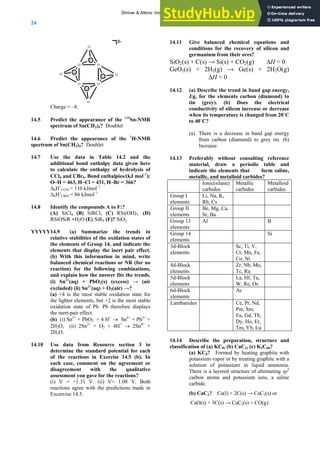
charge on the cyclic anion [Si4O12]ν฀
?
Shriver & Atkins: Inorganic Chemistry 5e
ANSWERS TO SELF-TESTS AND EXERCISES
24
O
O O
O
O
Si
Si
Si
Si
O
O
O
8-
Charge = –8.
14.5 Predict the appearance of the 119
Sn-NMR
spectrum of Sn(CH3)4? Doublet
14.6 Predict the appearance of the 1
H-NMR
spectrum of Sn(CH3)4? Doublet
14.7 Use the data in Table 14.2 and the
additional bond enthalpy data given here
to calculate the enthalpy of hydrolysis of
CCl4 and CBr4. Bond enthalpies/(kJ mol–1
):
O–H = 463, H–Cl = 431, H–Br = 366?
ΔhH˚CCl4 = 110 kJmol–1
ΔhH˚CBr4 = 86 kJmol–1
14.8 Identify the compounds A to F:?
(A) SiCl4 (B) SiRCl3 (C) RSi(OH)3. (D)
RSiOSiR +H2O (E) SiR4 (F)? SiO2
YYYYY14.9 (a) Summarize the trends in
relative stabilities of the oxidation states of
the elements of Group 14, and indicate the
elements that display the inert pair effect.
(b) With this information in mind, write
balanced chemical reactions or NR (for no
reaction) for the following combinations,
and explain how the answer fits the trends.
(i) Sn2+
(aq) + PbO2(s) (excess) → (air
excluded) (ii) Sn2+
(aq) + O2(air) →?
(a) +4 is the most stable oxidation state for
the lighter elements, but +2 is the most stable
oxidation state of Pb. Pb therefore displays
the inert-pair effect.
(b) (i) Sn2+
+ PbO2 + 4 H+
→ Sn4+
+ Pb2+
+
2H2O, (ii) 2Sn2+
+ O2 + 4H+
→ 2Sn4+
+
2H2O.
14.10 Use data from Resource section 3 to
determine the standard potential for each
of the reactions in Exercise 14.5 (b). In
each case, comment on the agreement or
disagreement with the qualitative
assessment you gave for the reactions?
(i) V = +1.31 V. (ii) V= 1.08 V. Both
reactions agree with the predictions made in
Excercise 14.5.
14.11 Give balanced chemical equations and
conditions for the recovery of silicon and
germanium from their ores?
SiO2(s) + C(s) → Si(s) + CO2(g) ΔH < 0
GeO2(s) + 2H2(g) → Ge(s) + 2H2O(g)
ΔH < 0
14.12 (a) Describe the trend in band gap energy,
Eg, for the elements carbon (diamond) to
tin (grey). (b) Does the electrical
conductivity of silicon increase or decrease
when its temperature is changed from 20˚C
to 40˚C?
(a) There is a decrease in band gap energy
from carbon (diamond) to grey tin. (b)
Increase.
14.13 Preferably without consulting reference
material, draw a periodic table and
indicate the elements that form saline,
metallic, and metalloid carbides?
Ionic(silane)
carbides
Metallic
carbides
Metalloid
carbides
Group I
elements
Li, Na, K,
Rb, Cs
Group II
elements
Be, Mg, Ca,
Sr, Ba
Group 13
elements
Al B
Group 14
elements
Si
3d-Block
elements
Sc, Ti, V,
Cr, Mn, Fe,
Co, Ni
4d-Block
elements
Zr, Nb, Mo,
Tc, Ru
5d-Block
elements
La, Hf, Ta,
W, Re, Os
6d-Block
elements
Ac
Lanthanides Ce, Pr, Nd,
Pm, Sm,
Eu, Gd, Tb,
Dy, Ho, Er,
Tm, Yb, Lu
14.14 Describe the preparation, structure and
classification of (a) KC8, (b) CaC2, (c) K3C60?
(a) KC8? Formed by heating graphite with
potassium vapor or by treating graphite with a
solution of potassium in liquid ammonia.
There is a layered structure of alternating sp2
carbon atoms and potassium ions, a saline
carbide.
(b) CaC2? Ca(l) + 2C(s) → CaC2(s) or
CaO(s) + 3C(s) → CaC2(s) + CO(g)
Shriver & Atkins: Inorganic Chemistry 5e
ANSWERS TO SELF-TESTS AND EXERCISES 25
Calcium carbide contains discrete C2
2–
ions.
(c) K3C60? A solution of C60 can be treated
with elemental potassium. It is ionic.
14.15 Write balanced chemical equations for the
reactions of K2CO3 with HCl(aq) and of
Na4SiO4 with aqueous acid?
K2CO3(aq) + 2HCl(aq) → 2KCl(aq) + CO2(g) +
H2O(l)
Na4SiO4(aq) + 4HCl(aq) → 4NaCl(aq) + SiO2(s) +
2H2O(l)
14.16 Describe in general terms the nature of the
[SiO3]n
2ν฀
ion in jadeite and the silica-
alumina framework in kaolinite?
The structures of jadeite and kaolinite consist
of extended one- and two-dimensional
structures, respectively. The [SiO3
2–
]n ions in
jadeite are a linear polymer of SiO4
tetrahedra. The two-dimensional
aluminosilicate layers in kaolinite represent
another way of connecting SiO4 tetrahedra.
14.17 (a) How many bridging O atoms are in the
framework of a single sodalite cage? (b)
Describe the (supercage) polyhedron at the
centre of the Zeolite A structure in Fig.
14.3?
(a) 48.
(b) Eight sodalite cages are linked together to
form the large cage of zeolite A.
CHAPTER 15
Self-tests
S15.1 Consider the Lewis structure of a segment
of the structure of bismuth shown in Fig.
15.2. Is this puckered structure consistent
with the VSEPR model? Yes.
S15.2 Refined hydrocarbons and liquid hydrogen
are also used as rocket fuel. What are the
advantages of dimethylhydrazine over
these fuels?
Dimehylhydrazine ignites spontaneously, and
produces less CO2.
S15.3 From trends in the periodic table, decide
whether phosphorus or sulphur is likely to
be the stronger oxidizing agent? Sulphur.
S15.4 Summarize the reactions that are used for
the synthesis of hydrazine and
hydroxylamine. Are these reactions best
described as electron-transfer processes or
nucleophilic displacements?
NH3 + ClO−
+ H+
→ [H3N—Cl-O]−
+ H+
→
H2NCl + H2O
H2NCl + NH3 → H2NNH2 + HCl
Both can be thought of as redox reactions.
S15.5 When titrated against base a sample of
polyphosphate gave end points at 30.4 and
45.6 cm3
. What is the chain length?
There are (30.4 cm3
)/(7.6 cm3
) = 4 strongly
acidic OH groups per molecule. A molecule
with 2 terminal OH groups and four further
OH groups is a tetrapolyphosphate.
Exercises
15.1 List the elements in Groups 15 and indicate
the ones that are (a) diatomic gases, (b)
nonmetals, (c) metalloids, (d) true metals.
Indicate those elements that display the
inert-pair effect?
Type of
element
Diatomic
gas?
Inert pair
effect?
N Non-
metal
yes No
P Non-
metal
no No
As nonmetal no No
Sb metalloid no No
Bi metalloid no Yes
O nonmetal yes No
S nonmetal no No
Se nonmetal no No
Te nonmetal no No
15.2 (a) Give complete and balanced chemical
equations for each step in the synthesis of
H3PO4 from hydroxyapatite to yield (a)
high-purity phosphoric acid and (b)
fertilizer-grade phosphoric acid. (c)
Account for the large difference in costs
between these two methods?
(a) high-purity phosphoric acid?
2Ca3(PO4)2 + 10C + 6SiO2 →
P4
−
+ 10CO + 6CaSiO3
P4 (pure) + 5O2 → P4O10
P4O10 + 6H2O → 4H3PO4 (pure)
(b) Fertilizer grade H3PO4?
Ca5(PO4)3OH + 5H2SO4 →
3H3PO4 (impure) + 5CaSO4 + H2O
(c) Account for the difference in cost?
Shriver & Atkins: Inorganic Chemistry 5e
ANSWERS TO SELF-TESTS AND EXERCISES
26
Fertilizer-grade phosphoric acid involves a
single synthetic step for a product that
requires little or no purification.
15.3 Ammonia can be prepared by (a) the
hydrolysis of Li3N or (b) the high-
temperature, high-pressure reduction of N2
by H2. Give balanced chemical equations
for each method starting with N2, Li, and
H2, as appropriate. (c) Account for the
lower cost of the second method?
(a) Hydrolysis of Li3N?
6Li + N2 → 2Li3N
2Li3N + 3H2O → 2NH3 + 3Li2O
(b) Reduction of N2 by H2?
N2 + 3H2 → 2NH3
(c) Account for the difference in cost? The
second process is considerably cheaper than
the first, because lithium is very expensive.
15.4 Show with an equation why aqueous
solutions of NH4NO3 are acidic?
NH4NO3(s) + H2O Æ NH4
+
+ NO3
-
(aq)
15.5 Carbon monoxide is a good ligand and is
toxic. Why is the isoelectronic N2 molecule
not toxic?
N2 itself, with a triple bond between the two
atoms, is strikingly unreactive.
15.6 Compare and contrast the formulas and
stabilities of the oxidation states of the
common nitrogen chlorides with the
phosphorus chlorides?
The only isolable nitrogen chloride is NCl3,
and it is thermodynamically unstable. Both
PCl3 and PCl5 are stable.
15.7 Use the VSEPR model to predict the
probable shapes of (a) PCl4
+
, (b) PCl4
–
, (c)
AsCl5?
(a) PCl4
+
? tetrahedron.
(b) PCl4
–
? A see-saw.
(c) AsCl5? A trigonal bipyramid.
15.8 Give balanced chemical equations for each
of the following reactions: (a) oxidation of
P4 with excess oxygen, (b) reaction of the
product from part (a) with excess water, (c)
reaction of the product from part (b) with
a solution of CaCl2 and name the product?
(a) Oxidation of P4 with excess O2?
P4 + 5O2 → P4O10
(b) Reaction of the product from part (a)
with excess H2O?
P4O10 + 6H2O → 4H3PO4
(c) Reaction of the product from part (b)
with CaCl2?
2H3PO4(l) + 3CaCl2(aq) →
Ca3(PO4)2(s) + 6HCl(aq)
15.9 Starting with NH3(g) and other reagents of
your choice, give the chemical equations
and conditions for the synthesis of (a)
HNO3, (b) NO2
–
, (c) NH2OH, (d) N3
–
?
(a) HNO3?
4NH3(aq) + 7O2(g) → 6H2O(g) + 4NO2(g)
High temperature
(b) NO2
–
?
2NO2(aq) + 2OH−
(aq) →
NO2
−
(aq) + NO3
−
(aq) + H2O(l)
(c) NH2OH? cold aqueous acidic solution
NO2
−
(aq) + 2HSO3
−
(aq) + H2O(l) →
NH3OH+
(aq) + 2SO4
2−
(aq)
(d) N3
–
? at elevated temperatures:
3NaNH2(l) + NaNO3 →
NaN3 + 3NaOH + NH3(g)
2NaNH2(l) + N2O → NaN3 + NaOH +
NH3
15.10 Write the balanced chemical equation
corresponding to the standard enthalpy of
formation of P4O10(s). Specify the structure,
physical state (s, l, or g), and allotrope of
the reactants. Do either of the reactants
differ from the usual practice of taking as
reference state the most stable form of an
element?
P4(s) + 5O2(g) → P4O10(s)
15.11 Without reference to the text, sketch the
general form of the Frost diagrams for
phosphorus (oxidation states 0 to +5) and
bismuth (0 to +5) in acidic solution and
discuss the relative stabilities of the +3 and
+5 oxidation states of both elements?
(i) Bi(III) is much more stable than Bi(V), and
(ii) P(III) and P(V) are both about equally
stable.
Shriver & Atkins: Inorganic Chemistry 5e
ANSWERS TO SELF-TESTS AND EXERCISES 27
15.12 Are reactions of NO2
–
as an oxidizing agent
generally faster or slower when pH is
lowered? Give a mechanistic explanation
for the pH dependence of NO2
–
oxidations?
The rates of reactions in which nitrite ion is
reduced are increased as the pH is lowered.
15.13 When equal volumes of nitric oxide (NO)
and air are mixed at atmospheric pressure
a rapid reaction occurs, to form NO2 and
N2O4. However, nitric oxide from an
automobile exhaust, which is present in the
parts per million concentration range,
reacts slowly with air. Give an explanation
for this observation in terms of the rate law
and the probable mechanism?
The rate law must be more than first order in
NO concentration.
15.14 Give balanced chemical equations for the
reactions of the following reagents with
PCl5 and indicate the structures of the
products: (a) water (1:1), (b) water in
excess, (c) AlCl3, (d) NH4Cl?
(a) H2O? tetrahedral POCl3.
PCl5 + H2O → POCl3 + 2HCl
(b) H2O in excess?
2PCl5(g) + 8H2O(l) → 2H3PO4(aq) +
10HCl(aq)
(c) AlCl3? tetrahedral.
PCl5 + AlCl3 → [PCl4]+
[AlCl4]−
(d) NH4Cl? Cyclic molecules or linear
chain polymers
nPCl5 + nNH4Cl →
−[(N = P(Cl)2)n]−
+ 4nHCl
15.15 Use standard potentials (Resource section
3) to calculate the standard potential of the
reaction of H3PO2 with Cu2+
. Are HPO2
2−
and H2PO2
2−
useful as oxidizing or
reducing agents?
Eº = 0.839 V.
HPO3
2–
and H2PO2
–
ions will be much better
reducing agents than oxidizing agents.
15.16 Identify the compounds A, B, C, and D?
A
AS B
C
D
Cl2
LiAlH4
Cl2/hv
3RMgBr
(a) A = AsCl3
(b) B = AsCl5
(c) C = AsR3
(d) D = AsH3
15.17 Sketch the two possible geometric isomers
of the octahedral [AsF4Cl2]–
and explain
how they could be distinguished by 19
F–
NMR?
The cis isomer gives two 19
F signals and the
trans isomer gives one signal.
15.18 Identify the nitrogen compounds A, B, C,
D, and E?
(a) A = NO2
(b) B = HNO3; C = NO
(c) D = N2O4
(d) E= NO2
(e) F = NH4
+
Shriver & Atkins: Inorganic Chemistry 5e
ANSWERS TO SELF-TESTS AND EXERCISES
28
1 Use the Latimer diagr
5.19 ams in Resource
R 16
ermine whether the decomposition of
ition of H2O2 is
ion of H2O2 is
–
S16.2 obable structures of SO2F and
with
xercis
e whether the following oxides are
mphoteric.
16.2 urce
section 3 to determine which species of N
and P disproportionate in acid conditions?
The species of N and P that disproportionate
+
are N2O4, NO, N2O, NH3OH , H4P2O6, and P.
CHAPTE
elf-tests
S
S16.1 Det
H2O2 is spontaneous in the presence of
either Br2 or Cl2?
The decompos
thermodynamically favored in presence of Br–
In Presence of Cl–
The decomposit
thermodynamically favored in presence of Cl
.
Pr -
(CH3) 3NSO2, and predict reactions
-
.
OH
Both are trigonal pyramidal. OH-
displaces
F— or (CH3) 3N—.
es
E
16.1 Stat
acidic, basic, neutral, or amphoteric: CO2,
P2O5, SO3, MgO, K2O, Al2O3, CO?
CO2, SO3, P2O5, and Al2O3 are a
CO is neutral; MgO and K2O are acidic.
(a) Use standard potentials (Reso
section 3) to calculate the standard
potential of the disproportionation of H2O2
in acid solution. (b) Is Cr2+
a likely catalyst
for the disproportionation of H2O2? (c)
Given the Latimer diagram
O2
HO2
-
-0.13 1.51
H2O2
in acidic solution, calculate Δr
ө
for the
of H2O2 and
Cr ? Cr is not capable
tion of HO2? ΔrG° =
157 kJ. For the disproportionation of H2O2
(part (a)), ΔrG° = 103 kJ.
16.3
tronger.
or SO2 (which
not react
16.5 pecies from the
agent: SO4 ,SO3 ,O3SO2SO3 ?
16.6
c
16.7 formula for Te(VI) in acidic
sible
ncrease its
16.8
ill disproportionate in
16.9
3 to predict whether
ble in acidic or basic
16.10 ether any of the following will be
: VO , Fe , Cu , Co ?
16.11 F4]. Use
hapes of the
cation and anion?
6.12 g)
nic
product. (a) Write a balanced equation for
G
disproportionation of hydrogen superoxide
(HO2–
)
into O2 and H2O2, and compare the
result with its value for the
disproportionation of H2O2?
(a) The disproportionation
HO2? 1.068 V.
(b) Catalysis by 2+ 2+
of decomposing H2O2.
(c) The disproportiona
Which hydrogen bond would be stronger:
S—H . . . O or O—H . . . S?
O–H hydrogen bonds are s
16.4 Which of the solvents ethylenediamine
(which is basic and reducing)
is acidic and oxidizing) might
with (a) Na2S4, (b) K2Te3?
ethylenediamine is a better solvent than sulfur
dioxide.
Rank the following s
strongest reducing agent to the strongest
oxidizing 2– 2– 2–
S2O8
2–
> SO4
2–
> SO3
2–
Predict which oxidation states of Mn will
be reduced by sulfite ions in basi
conditions?
Mn (+VII, +VI, +V, +IV, +III) will be
reduced by sulfite ions in basic solution.
(a) Give the
aqueous solution and contrast it with the
formula for S(VI). (b) Offer a plau
explanation for this difference?
(a) Formulas? H5TeO6
–
and HSO4
–
(b) An explanation? Tellurium is a larger
element than sulfur and can i
coordination number.
Use the standard potential data in
Resource section 3 to predict which
oxoanions of sulfur w
acidic conditions?
S2O6
2−
and S2O3
2−
.
Use the standard potential data in
Resource section
2–
SeO3 is more sta
solut on?
i
The SeO3
2–
is marginally more stable in acid
solutions.
Predict wh
reduced by thiosulfate ions,S2O3
2–
, in acidic
conditions 2+ 3+ + 3+
Fe3+
and Co3+
will be reduced.
SF4 reacts with BF3 to form [SF3][B
VSEPR theory to predict the s
SF4
+
trigonal pyramidal, BF4
−
tetrahedral.
1 Tetramethylammonium fluoride (0.70
reacts with SF4 (0.81 g) to form an io
Shriver & Atkins: Inorganic Chemistry 5e
ANSWERS TO SELF-TESTS AND EXERCISES 29
the reaction and (b) sketch the structure of
the anion. (c) How many lines would be
observed in the 19
F-NMR spectrum of the
anion?
(a) SF4 + (CH3)4NF → [(CH3)4N]+
[SF5]−
; (b)
square pyramidal structure; (c) two F
environments.
.13
of iodine is sodium iodate,
O3. Which of the reducing agents
SO (aq) or Sn2+
(aq) would seem practical
S17.2 r IF7?
and
several polyhalides that
to [py–I–py]+
, and describe
orbitals, one bonding, one
Exerci
17.1 reference
erial, write out the halogens and noble
y appear in the periodic table,
16 Identify the sulfur-containing compounds
A, B, C, D, E, and F?
A = S2Cl2, B = S4N4, C = S2N2, D = K2S2O3,
E = S2O6
2−
, F = SO2.
CHAPTER 17
Self-tests
S17.1 One source
NaI
2
from the standpoints of thermodynamic
feasibility and plausible judgements about
cost? Standard potentials are given in
Resource section 3?
Both. SO2 is cheaper.
Predict the 19
F-NMR pattern fo
2 resonances.
S17.3 From the perspective of structure
bonding, indicate
are analogous
their bonding?
Examples include I3
–
, IBr2
–
, ICl2
–
, and IF2
–
.
The three centers contribute four electrons to
three molecular
nonbonding, and one antibonding.
ses
Preferably without consulting
mat
gases as the
and indicate the trends in (a) physical state
(s, l, or g) at room temperature and
pressure, (b) electronegativity, (c) hardness
of the halide ion, (d) color?
Phy
sica
l
Electron
egativit
y
Har
dnes
s of
Col
or
stat
e
hali
de
ion
F
2
hest
(4.0)
light
yell
ow
gas hig hard
est
C
l2
gas lower soft
er
yell
ow-
gree
n
B
r2
liqu
id
lower soft
er
dark
red-
bro
wn
I2 soli
d
lowest soft
est
dark
viol
et
H
e
gas Col
orle
ss
N
e
gas colo
rless
A gas o
r
col
rless
K
r
gas colo
rless
X
e
gas colo
rless
17.2 Describe how the halogens are recovered
from their naturally occurring halides and
rationalize the approach in terms of
CaSO4 + 2 HF
2 KF → 2 K+
HF2
−
2 + 2 KF
Cl2 → X2 + 2 Cl−
(X−
= Br−
,
17.3 ow th
he dir
usion of the ions. Give the chemical
) → Cl2(g) + 2 e
cathod
H2O(l)
standard potentials. Give balanced
chemical equations and conditions where
appropriate?
For F:
F2 + H2SO4 →
2 HF +
2 K+
HF2
−
+ electricity → F2 + H
For Cl:
2 Cl−
+ 2 H2O + electricity → Cl2 + H2 +
2 OH−
For Br and I:
2 X−
+
I−
)
Sketch a choralkali cell. Sh e half-cell
reactions and indicate t ection of
diff
equation for the unwanted reaction that
would occur if OH–
migrated through the
membrane and into the anode
compartment?
A drawing of the cell is shown in Figure 17.3.
anode: 2 Cl−
(aq −
e: 2 H2O(l) + 2 e−
→ 2 OH−
(aq) + H2(g)
- unwanted reaction:
2 OH−
(aq) + Cl2(aq) → ClO−
(aq) +
Cl−
(aq) +
Shriver & Atkins: Inorganic Chemistry 5e
ANSWERS TO SELF-TESTS AND EXERCISES
30
17.4 Ske
a dihalogen ribe its role
tch the form of the vacant s* orbital of
molecule and desc
in the Lewis acidity of the dihalogens?
Since the 2σu* antibonding orbital is the
LUMO for a X2 molecule, it is the orbital that
17.5
le of oxidizing H2O to O2?
17.6 at –129˚C
void of Lewis basicity. By
.
effect in NF3
17.7 ogy between halogens
and pseudohalogens write: (a) the balanced
→ CN−
(aq) +
(b
aqueous aci
Mn (aq) + 2 H2O(l)
(c) l
cyan ins
17.8 3 reacts with 0.93 g of
[(CH3)4N]F to form a product X, (a) identify
X, (b) use the VSEPR model to predict the
accepts the pair of electrons from a Lewis
base.
Which dihalogens are thermodynamically
capab
Cl2 and F2.
Nitrogen trifluoride, NF3, boils
and is de
contrast, the lower molar mass compound
NH3 boils at –33˚C and is well known as a
Lewis base. (a) Describe the origins of this
very large difference in volatility. (b)
Describe the probable origins of the
difference in basicity?
(a) Difference in volatility? Ammonia
exhibits hydrogen bonding
(b) Explain the difference in basicity? The
strong electron-withdrawing
reduces the basicity.
Based on the anal
equation for the probable reaction of
cyanogen, (CN)2, with aqueous sodium
hydroxide, (b) the equation for the
probable reaction of excess thiocyanate
with the oxidizing agent MnO2(s) in acidic
aqueous solution, (c) a plausible structure
for trimethylsilyl cyanide?
(a) The reaction of NCCN with NaOH?
NCCN(aq) + 2 OH−
(aq)
NCO−
(aq) + H2O(l)
) The reaction of SCN–
with MnO2 in
d?
2SCN−
(aq) + MnO2(s) + 4 H+
(aq) →
(SCN)2(aq) + 2+
The structure of trimethylsily
ide? Trimethylsilyl cyanide conta
an Si–CN single bond.
Given that 1.84 g of IF
shapes of IF3 and the cation and anion in X,
(c) predict how many 19
F-NMR signals
would be observed in IF3 and X?
a). X = IF4N(CH3)4
b) Different possible arrangements of
IF3:
The shape of anion IF4 is Square planar.
The shape of cation (CH3)4N+
is
Tetrahedral.
c)
7.9 l to predict the shapes
5 3 ClF6]+
?
7.10
17.11 of the complexes
l3F3. Indicate how many
ents would be indicated
–
.IF3, two. IF4
–
, one.
1 Use the VSEPR mode
of SbCl, FClO , and [
SbCl5 is trigonal bipyramidal, FClO3 is
pyramidal, and ClF6 is octahedral.
1 Indicate the product of the reaction
between ClF5 and SbF5?
[ClF4]+
[SbF6] –
.
Sketch all the isomers
MCl4F2 and MC
fluorine environm
in the 19
F-NMR spectrum of each isomer?
MCl4F2, the cis isomer, 1; the trans isomer, 2.
MCl3F3, the fac isomer, 1 the mer isomer, 2.
Shriver & Atkins: Inorganic Chemistry 5e
ANSWERS TO SELF-TESTS AND EXERCISES 31
17.12 (a) Use the VSEPR model to predict the
probable shapes of [IF6]+
and IF7. (b) Give a
plausible chemical equation for the
preparation of [IF6][SbF6]?
(a) The structures of [IF6]+
and IF7? IF6
+
,
octahedral; IF7, pentagonal bipyramid.
(b) The preparation of [IF6] [SbF6]?
IF7 + SbF5 → [IF6][SbF6]
7.14
al, Cs
17.15 the following
s likely to make liquid BrF3 a
a stronger Lewis
he acidity or basicity
3
17.16 r
f IF5
+
? Two resonances.
17.17
xplain
) F2,
Since SbF5 cannot be oxidized, it
3.
reasoning?
2 IBr + Br−
17.19
not?
arge cations stabilize large, unstable anions.
17.13 Predict the shape of the doubly chlorine–
bridged I2Cl6 molecule by using the VSEPR
model and assign the point group?
A planar dimer (I2Cl6).
1 Predict the structure and identify the point
group of ClO F? trigonal pyramid
2
symmetry.
Predict whether each of
solutes i
stronger Lewis acid or
base: (a) SbF5, (b) SF6, (c) CsF?
(a) SbF5? increases the acidity of BrF3.
(b) SF6? No effect on t
of BrF .
(c) CsF? Increases the basicity of BrF3.
Predict the appea ance of the 19
F-NMR
spectrum o
.
Predict whether each of the following
compounds is likely to be dangerously
explosive in contact with BrF3 and e
your answer: (a) SbF5, (b) CH3OH, (c
(d) S2Cl2?
(a) SbF5?
will not form an explosive mixture with BrF
(b) CH3OH? Methanol, being an organic
compound, is readily oxidized by strong
oxidants.
(c) F2? No.
(d) S2Cl2? S2Cl2 will be oxidized to higher
valent sulfur fluorides.
17.18 The formation of Br3
–
from a
tetraalkylammonium bromide and Br2 is
only slightly exoergic. Write an equation
(or NR for no reaction) for the interaction
of [NR4][Br3] with I2 in CH2Cl2 solution and
give your
Br3
−
+ I2 →
Explain why CsI3(s) is stable with respect to
the elements but NaI3(s) is
L
17.20 Write plausible Lewis structures for (a)
ClO2 and (b) I2O6 and predict their shapes
and the associated point group?
(a).
(b) I2O5?
17.21 (a) Give the formulas and the probable
relative acidities of perbromic acid and
periodic acid. (b) Which is the more stable?
rmulas are HBrO4 and H5IO6. The
in iodine’s ability to expand its
coordination shell.
(b) Relative stabilities? Periodic acid is
thermodynamically more stable.
17.22 (a) Describe the expected trend in the
standard potential of an oxoanion in a
17.23
cission.
17.24 readily
chloric acid
a mechanistic
erence?
(a) The fo
difference lies
solution with decreasing pH. (b)
Demonstrate this phenomenon by
calculating the reduction potential of ClO4
–
at pH = 7 and comparing it with the
tabulated value at pH = 0?
(a) The expected trend? E decreases as the
pH increases.
(b) E at pH 0 and pH 7 for ClO4
–
?
Eº = 1.201 V (see Appendix 2).
At pH 7, V = 0.788 V
With regard to the general influence of pH
on the standard potentials of oxoanions,
explain why the disproportionation of an
oxoanion is often promoted by low pH?
Low pH results in a kinetic promotion:
protonation of an oxo group aids oxygen–
halogen bond s
Which oxidizing agent reacts more
in dilute aqueous solution, per
or periodic acid? Give
explanation for the diff
Periodic acid.
Shriver & Atkins: Inorganic Chemistry 5e
ANSWERS TO SELF-TESTS AND EXERCISES
32
17.25
lly
–
dard potentials.) (b)
7.26 following compounds present
4, (
losion hazard.
)
CHAP
f-tests
S18.1
e production of perxenate
O q OH−
(aq) → XeO6
4−
(aq) + Xe(g)
+ O2(g) + 2 H2O(l)
lain why helium is present in low
concentration in the atmosphere even
tive decay.
8.2 Which of the noble gases would you choose
(a) The lowest-temperature
igerant? Helium.
) XeF2? Xe and F2
ut have a large
) → XeF6(s)
18.4
(b) XeO2F2?
(a) For which of the following anions is
disproportionation thermodynamica
favourable in acidic solution: OCl2, ClO2 ,
ClO2
–
, and ClO4
–
? (If you do not know the
properties of these ions, determine them
from a table of stan
For which of the favourable cases is the
reaction very slow at room temperature?
The rates of disproportionation are probably
HClO > HClO2 > ClO3
–
.
1 Which of the
an explosion hazard? (a) NH4ClO4, (b)
Mg(ClO4)2, (c) NaClO d) [Fe(H2O)6][ClO4]2.
Explain your reasoning?
(a) NH4ClO4? Ammonium perchlorate is a
dangerous compound, since the N atom of the
NH4
+
ion is in its lowest oxidation state and
can be oxidized.
(b) Mg(ClO4)2? Not an explosion hazard.
(c) NaClO4? Not an exp
(d) [Fe(H2O)6] [ClO4]2? An explosion
hazard, since Fe(II) can be oxidized to Fe(III).
17.27 Use standard potentials to predict which of
the following will be oxidized by ClO–
ions
in acidic conditions: (a) Cr3+
, (b) V3+
, (c)
Fe2+
, (d) Co2+
?
(a) Cr3+
? No. (b) V3+
? Yes. (c) Fe2+
? Yes. (d
Co2+
? No.
TER 18
Sel
Write a balanced equation for the
decomposition of xenate ions in basic
solution for th
ions, xenon, and oxygen
4
−
(a ) + 2
2 HXe
xercises
E
18.1 Exp
though it is the second most abundant
element in the universe?
Helium present in today’s atmosphere is the
product of ongoing radioac
1
as
refr
(b) An electric discharge light source
requiring a safe gas with the lowest
ionization energy? Xenon.
(c) The least expensive inert
atmosphere? Argon.
18.3 By means of balanced chemical equations
and a statement of conditions, describe a
suitable synthesis of (a
at 400ºC, or photolyze Xe and F2 in glass:
Xe(g) + F2(g) → XeF2(s)
(b) XeF6? High temperature, b
excess of F2:
Xe(g) + 3 F2(g
(c) XeO3?
XeF6(s) + 3 H2O(l) → XeO3(s) + 6 HF(g)
Draw the Lewis structures of (a) XeOF4?
(c) XeO6
4−
?
18.5 ive the formula and describe the
structure of a noble gas species that is
isostructural with (a) ICl4
−
? XeF4
(b) IBr2
–
? Linear geometry. Isostructural
with XeF2.
(c) BrO3
–
? Trigonal pyramidal geometry.
Isostructural with XeO3.
(d) ClF? Isostructural with the cation XeF+
.
G
18.6 (a) Give a Lewis structure for XeF7
–
?
ith
bipyramid.
(b) Speculate on its possible structures by
using the VSEPR model and analogy w
other xenon fluoride anions? Pentagonal
Shriver & Atkins: Inorganic Chemistry 5e
ANSWERS TO SELF-TESTS AND EXERCISES 33
18.7 Use molecular orbital theory to calculate
the bond order of the diatomic species E2
+
with E=He and Ne? He2
2+
= 0.5, Ne2
2+
= 0.5.
18.8 Identify the xenon compounds A, , C, D,
and E?
4
other lines
b ted around the central
CHAP
19.1 Refer to the appropriate Latimer diagram
the
e and formula of the species
n?
19.2 Suggest a use for molybdenum(IV) sulfide
makes use of its solid-state structure.
onalize your suggestion? MoS2 used as
S19.3
ntaining PPh3?
olecular species such as Re3Cl12
3–
Exerci
19.1
es of the d block,
tion
ose for which
oup oxidation number is not achieved
by N?
B
A = XeF2(g)
B = [XeF]+
[MeBF3]
−
C = XeF6
D = XeO3
E = XeF (g).
18.9 Predict the appearance of the 129
Xe-NMR
spectrum of XeOF3
+
.
1:3:3:1 quartet
18.10 Predict the appearance of the 19
F-NMR
spectrum of XeOF4.
Strong c nt
e ral line, two
symmetrically distri u
line.
TER 19
Self-tests
S
in Resource section 3 and identify
oxidation stat
that is thermodynamically favoured when
an acidic aqueous solution of V2+
is exposed
to oxyge
+4; VO2
+
S
that
Rati
a lubricant. The slipperiness of MoS2 is
because of the ease with which one layer can
glide over another.
Describe the probable structure of the
compound formed when Re3Cl9 is dissolved
in a solvent co
Discrete m
or Re3Cl9(PPh3)3 are formed.
ses
Without reference to a periodic table,
sketch the first seri
including the symbols of the elements.
Indicate those elements for which the
group oxidation number is common by C,
those for which the group oxida
number can be reached but is a powerful
oxidizing agent by O, and th
the gr
19.2
As atoms become heavier, more energy is
needed to vaporize them.
19.3 State the trend in the stability of the group
oxidation state on descending a group of
metallic elements in the d block. Illustrate
the trend using standard potentials in
in
as you descend a group.
19.4
action) and
Fe2+
(aq)
(aq) →?
− 3+
1H2O →
19.5 q), is more
presence of
ith the
tren s
Pe al
More
Hardnes in the d
block.
19.6
e or fluorite
n of
example?
Explain why the enthalpy of sublimation of
Re(s) is significantly greater than that of
Mn(s)?
acidic solution for Groups 5 and 6.
The group oxidation number increases
stability
For each part, give balanced chemical
quations or NR (for no re
e
rationalize your answer in terms of trends
in oxidation states.
(a) Cr2+
(aq) + Fe3+
(aq) →?
Cr2+
(aq) + Fe3+
(aq) → Cr3+
(aq) +
(b) CrO4
2–
(aq) + MoO2 (s) →?
2 CrO4
2−
+ 3 MoO2(s) + 10 H+
→
2 Cr3+
+ 3 H2MoO4 + 2 H2O
(c) MnO4
–
(aq) + Cr3+
6 MnO4 + 10Cr + 1
6Mn2+
+ 5Cr2O7
2−
+ 22 H+
(a) Which ion, Ni2+
(aq) or Mn2+
(a
likely to form a sulfide in the
H2S? (b) Rationalize your answer w
ds in hard and soft character acros
riod 4. (c) Give a balanced chemic
equation for the reaction.
likely for Ni2+
to form a sulphide.
s decreases from left to right
Ni2+
(aq) + H2S(aq) → NiS(s) + 2 H+
(aq)
Preferably without reference to the text (a)
write out the d block of the periodic table,
(b) indicate the metals that form
difluorides with the rutil
structures, and (c) indicate the regio
the periodic table in which metal-metal
bonded halide compounds are formed,
giving one
Shriver & Atkins: Inorganic Chemistry 5e
ANSWERS TO SELF-TESTS AND EXERCISES
34
Metal–metal bonded halide compounds are
found within bold border. Example: Sc5Cl6.
19.7
ic
solution at +0.2 V is made strongly basic at
the same potential. Write a balanced
equation for each of the successive
reactions when this same complex at pH =
6 and +0.2 V is exposed to progressively
more oxidizing environments up to +1.0 V
–
tions
llowing
s for your
q) in
er an inert
O +
(a
(
Hg2+
(aq) + Cd(s) Cd2+
(aq)
19.9
r answers:
]
e cis-
o 4 , has a
an apical oxo
(b) significantly
19.11
ng
3)4]? σ2
π4
δ2
configuration,
2CC2H5)4]? σ2
π4
δ2
,chromium–
19.12 following
19.13 oate to aqueous
Write a balanced chemical equation for the
reaction that occurs when cis-
[RuLCl(OH2)]+
(see Fig. 19.9) in acid
.
Give other examples and a reason for the
redox state of the metal center affecting the
extent of protonation of coordinated
oxygen.
cis-[RuII
LCl(OH2)]+
+ Ox + OH−
→ cis-
[RuIII
LCl(OH)]+
+ Red + H2O
cis-[RuII
LCl(OH2)]+
+ H2O → cis-
[RuIII
LCl(OH)]+
+ H3O+
+ e−
cis-[RuIII
LCl(OH2)]+
+ H2O → cis-
[RuIV
LCl(OH)]+
+ H3O+
+ e−
As oxidation state of the metal increases,
ability to accept electron density from an OH
or O2–
ligand increases.
19.8 Give plausible balanced chemical reac
(or NR for no reaction) for the fo
combinations, and state the basi
answer: (a) MoO4
2–
(aq) plus Fe2+
(a
acidic solution? No reaction.
(b) The preparation of [Mo6O19]2−
(aq) from
K2MoO4(s)? 6 MoO4
2−
(aq) + 10 H+
(aq) →
[Mo6O19]2−
(aq) + 5 H2O(l)
(c) ReCl5 (s) plus KMnO4(aq)?
5 ReCl5(s) + 2 MnO4
−
(aq) + 12 H2O(l) →
5 ReO4
−
(aq) + 2 Mn2+
(aq) + 25 Cl−
(aq) +
24 H+
(aq)
(d) MoCl2(s) plus warm HBr(aq)?
6 MoCl2(s) + 2 Br−
(aq) → [Mo6Cl12]2−
(aq)
+ Br2(aq)
(e) TiO(s) with HCl(aq) und
atmosphere? 2Ti (s) + 6H q) Æ
2Ti3+
+ H2(g) + 2H2O(l) E˚ = +0.37 V.
f) Cd(s) added to Hg2+
(aq)?
Æ Hg(l) +
Speculate on the structures of the following
species and present bonding models to
justify you
(a) [Re(O)2 (py)4]+
, (b) [V (O)2 (ox)2]3–
, (c)
[Mo(O)2(CN)4
4–
, (d) [VOCl4]2–
? The first
three are dioxo complexes and will hav
metal structural units. (d) VOCl 2–
diox
square-pyramidal structure with
ligand.
19.10 Which of the following are likely to have
structures that are typical of (a)
predominantly ionic,
covalent, (c) metal-metal bonded
compounds: NiI2, NbCl4, FeF2, PtS, and
WCl2? Rationalize the differences and
speculate on the structures? (a) NiI2? ionic
compound with significant degree of covalent
character
(b) NbCl4? significantly covalent.
(c) FeF2? ionic.
(d) PtS ? significant amount of covalent
character.
(e) WCl2 ? metal–metal bonding.
Indicate the probable occupancy of s, p,
and d bonding and antibonding orbitals,
and the bond order for the followi
tetragonal prismatic complexes?
(a) [Mo2(O2CCH
molybdenum-molybdenum quadruple bond.
(b) [Cr2(O
chromium quadruple bond.
(c) [Cu2(O2CCH3)4]? σ2
π4
δ2
δ*2
π*4
σ*2
configuration, no metal–metal bond in this
molecule.
Explain the differences in the
redox couples, measured at 25o
C?
Higher oxidation states become more stable
.
on descending a group
Addition of sodium ethan
solutions of Cr(II) gives a red diamagnetic
product. Draw the structure of the
product, noting any features of interest?
Shriver & Atkins: Inorganic Chemistry 5e
ANSWERS TO SELF-TESTS AND EXERCISES 35
Cr O
O
O
O O
O
O
Cr
O
19.14 Consider the two ruthenium complexes in
Table 19.8. Using the bonding scheme
depicted in Figure 19.19, confirm the
bonding orders and electron configurations
given in the table.
[Ru2Cl2(ClCO2)4]-
:
2.5 +, mixed valence at the Ru center, in line
with the energy level scheme [0.5 (8-3)].
[Ru2 (CH3COCH3)2(ClCO2)4]: 2+, the bond
order of 2.0 should also be expected [0.5x(8-
4)].
CHAPTER 20
Self-tests
S20.1 What is the LFSE for both high- and low-
spin d7
configurations? A high-spin d7
configuration is t2
5
geg
2
. High spin, 0.8 Δo.
S20.2 The magnetic moment of the complex
[Mn(NCS)6]4–
is 6.06μB. What is its electron
configuration? t2g
3
eg
2
S20.3 Account for the variation in lattice
enthalpy of the solid fluorides in which
each metal ion is surrounded by an
octahedral array of F–
ions: MnF–
(2780 kJ
mol–1
), FeF2 (2926 kJ mol–1
), CoF2 (2976 kJ
mol–1
), NiF2 (3060 kJ mol–1
), and ZnF2
(2985 kJ mol–1
).
If it were not for ligand field stabilization
energy (LFSE), MF2 lattice enthalpies would
increase from Mn(II) to Zn(II).
S20.4 Suggest an interpretation of the
photoelectron spectra of [Fe(C5H5)2] and
[Mg(C5H5)2] shown in Fig. 20.18?
In the spectrum of [Mo(CO)6], the ionization
energy around 8 eV was attributed to the t2g
electrons that are largely metal-based. The
differences in the 6–8 eV region can be
attributed to the lack of d electrons for Mg(II).
S20.5 What terms arise from a p1
d1
configuration? 1
F and 3
F terms are possible.
S20.6 Identifying ground terms (Hint: Because d9
is one electron short of a closed shell with L
= 0 and S = 0, treat it on the same footing
as a d1
configuration.) (a) 2p2
? 3
P (called a
“triplet P” term).
(b) 3d9
? 2
D (called a “doublet D” term).
S20.7 What terms in a d2
complex of Oh
symmetry correlate with the 3
F and 1
D
terms of the free atom? An F terms are
3
T1g, 3
T2g, and 3
A2g. Similarly, D terms are
1
T2g and 1
Eg.
S20.8 Use the same Tanabe-Sugano diagram to
predict the energy of the first two spin-
allowed quartet bands in the spectrum of
[Cr(OH2)6]3+
for which Δo = 17 600 cm-1
and B = 700 cm-1
.
17500 cm–1
and 22400 cm–1
.
S20.9 The spectrum of [Cr(NCS)6]3-
has a very
weak band near 16 000 cm-1
, a band at 17
700 cm-1
with εmax= 5160 dm3
mol-1
cm-1
, a
band at 23 800 cm-1
with εmax= 5130 dm3
mol-1
cm-1
, and a very strong band at 32
400 cm-1.
Assign these transitions using the
d3
Tanabe-Sugano diagram and selection
rule considerations. (Hint: NCS-
has low-
lying π* orbitals.)
(i) The very low intensity of the band at 16,000
cm–1
is a clue that it is a spin-forbidden
transition, probably 2
Eg ← 4
A2g.
(ii) Spin-allowed but Laporte-forbidden bands
typically have ε ~ 100 M–1
cm–1
, so it is
likely that the bands at 17,700 cm–1
and
23,800 cm–1
are of this type.
(iii) The band at 32,400 cm–1
is probably a charge
transfer band, since its intensity is too
high to be a ligand field (d–d) band.
Exercises
20.1 Determine the configuration (in the form
t2g
x
eg
y
or ex
t2
y
, as appropriate), the
number of unpaired electrons, and the
ligand-field stabilization energy in terms of
ΔO or ΔT and P for each of the following
complexes using the spectrochemical series
to decide, where relevant, which are likely
to be high-spin and which low-spin.
(a) [Co(NH3)6]3+
? d6
, low spin, no unpaired
electrons, LFSE = 2.4Δ0.
(b) [Fe(OH2)6]2+
? d6
, high spin, four
unpaired electrons, LFSE = 0.4Δ0.
Shriver & Atkins: Inorganic Chemistry 5e
ANSWERS TO SELF-TESTS AND EXERCISES
36
(c) [Fe(CN)6]3–
? d5
, low spin, one unpaired
electron. LFSE is 2.0Δ0.
(d) [Cr(NH3)6]3+
? d3
, three unpaired
electrons, low spin, LFSE = 1.2Δ0.
(e) [W(CO)6]? d6
, low spin, no unpaired
electrons, LFSE = 2.4Δ0.
(f) Tetrahedral [FeCl4]2−
? d6
, high spin,
four unpaired electrons, LFSE = 0.6 ΔT.
(g) Tetrahedral [Ni(CO)4]? d10
, 0 unpaired
electrons, LFSE = 0.
20.2 Both H-
and P(C6H5)3 are ligands of similar
field strength, high in the spectrochemical
series. Recalling that phosphines act as π
acceptors, is π-acceptor character required
for strong-field behaviour? What orbital
factors account for the strength of each
ligand?
No.
Thus there are two ways for a complex to
develop a large value of Δ0, by possessing
ligands that are π-acids or by possessing
ligands that are strong σ-bases (or both).
20.3 Estimate the spin-only contribution to the
magnetic moment for each complex in
Exercise 20.1. Spin-only contributions are:
complex N μSO = [(N)(N + 2)]1/2
[Co(NH3)6]3+
0 0
[Fe(OH2)6]2+
4 4.9
[Fe(CN)6]3–
1 1.7
[Cr(NH3)6]3+
3 3.9
[W(CO)6] 0 0
[FeCl4]2–
4 4.9
[Ni(CO)4] 0 0
20.4 Solutions of the complexes [Co(NH3)6]2+
,
[Co(OH2)6]2+
(both Oh), and [CoCl4]2-
are
colored. One is pink, another is yellow, and
the third is blue. Considering the
spectrochemical series and the relative
magnitudes of ΔT and ΔO, assign each color
to one of the complexes. [CoCl4]2–
is blue,
[Co(NH3)6]2+
is yellow, [Co(OH2)6]2+
is pink.
20.5 For each of the following pairs of
complexes, identify the one that has the
larger LFSE:
(a) [Cr(OH2)6]2+
or [Mn(OH2)6]2+
(b) [Mn(OH2)6]2+
or [Fe(OH2)6]3+
(c) [Fe(OH2)6]3+
or [Fe(CN)6]3-
(d) [Fe(CN)6]3–
or [Ru(CN)6]
(e) tetrahedral [FeCl4]2–
or tetrahedral
[CoCl4]2–
(a) The chromium complex.
(b) The Fe3+
complex.
(c) [Fe(CN)6]3–
(d) The ruthenium complex.
(e) The Co2+
complex.
20.6 Interpret the variation, including the overall
trend across the 3d series, of the following
values of oxide lattice enthalpies (in kJ
mol–1
). All the compounds have the rock-
salt structure: CaO (3460), TiO (3878), VO
(3913), MnO (3810), FeO (3921), CoO
(3988), NiO (4071)? There are two factors
that lead to the values: (i) decreasing ionic
radius from left to right across the d block,
and (ii) LFSE.
.20.7 A neutral macrocyclic ligand with four
donor atoms produces a red diamagnetic
low-spin d8
complex of Ni(II) if the anion is
the weakly coordinating perchlorate ion.
When perchlorate is replaced by two
thiocyanate ions, SCN–
, the complex turns
violet and is high-spin with two unpaired
electrons. Interpret the change in terms of
structure? Shift from square planar to
tetragonal complex.
20.8 Bearing in mind the Jahn-Teller theorem,
Predict the structure of
[Cr(OH2)6]2+
? Elongated octahedron.
20.9 The spectrum of d1
Ti3+
(aq) is attributed to
a single electronic transition eg ← t2g. The
band shown in Fig. 20.3 is not symmetrical
and suggests that more than one state is
involved. Suggest how to explain this
observation using the Jahn-Teller
theorem? The electronic excited state of
Ti(OH2)6
3+
has the configuration t2g
0
eg
1
, and
so the excited state possesses eg degeneracy.
Therefore, the “single” electronic transition is
really the superposition of two transitions, one
from an Oh ground-state ion to an Oh excited-
state ion, and a lower energy transition from
an Oh ground-state ion to a lower energy
distorted excited-state ion.
20.10 Write the Russell–Saunders term symbols
for states with the angular momentum
quantum numbers (L,S):
(a) L = 0, S = 5/2? 6
S
(b) L = 3, S = 3/2? 4
F
(c) L = 2, S = 1/2? 2
D
(d) L = 1, S = 1? 3
P
20.11 Identify the ground term from each set of
terms: (a) 3
F, 3
P, 1
P, 1
G? 3
F.
(b) 5
D, 3
H, 3
P, 1
G, 1
I? 5
D
(c) 6
S, 4
G, 4
P, 2
I? 6
S
Shriver & Atkins: Inorganic Chemistry 5e
ANSWERS TO SELF-TESTS AND EXERCISES 37
20.12 Give the Russell-Saunders terms of the
configurations and identify the ground
term? (a) 4 s1
? 2
S.
(b) 3p2
? 1
D, 3
P, 1
S. The ground term is 3
P.
20.13 The gas-phase ion V3+
has a 3
F ground term.
The 1
D and 3
P terms lie, respectively, 10
642 and 12 920 cm–1
above it. The energies
of the terms are given in terms of Racah
parameters as E(3
F) = A - 8B, E(3
P) = A +
7B, E(1
D) = A - 3B + 2C. Calculate the
values of B and C for V3+
. B = (12920 cm–
1
)/(15) = 861.33 cm–1
and C = 3167.7 cm–1
.
20.14 Write the d-orbital configurations and use
the Tanabe–Sugano diagrams (Resource
section 6) to identify the ground term of (a)
Low-spin [Rh(NH3)6]3+
? 1
A1g.
(b) [Ti(H2O)6]3+
? 2
T2g.
(c) High-spin [Fe(H2O)6]3+
? 6
A1g.
20.15 Using the Tanabe-Sugano diagrams in
Resource section 6, estimate ΔO and B for
(a) [Ni(H2O)6]2+
(absorptions at 8500, 15400
and 26000 cm-1
) ? Δ0 = 8500 cm–1
and B ≈
770 cm–1
.
(b) [Ni(NH3)6]2+
(absorptions at 10750,
17500 and 28200 cm-1
)? Δ0 = 10,750 cm–1
and B ≈ 720 cm–1
.
20.16 The spectrum of [Co(NH3)6]3+
has a very
weak band in the red and two moderate
intensity bands in the visible to near-UV.
How should these transitions be assigned?
The first two transitions listed above
correspond to two low-spin bands. The very
weak band in the red corresponds to a spin-
forbidden transition.
20.17 Explain why [FeF6]3-
is colorless whereas
[CoF6]3–
is colored but exhibits only a
single band in the visible. No spin-allowed
transitions are possible for the Fe3+
; the
complex is expected to be colorless. The d6
Co3+
ion in [CoF6]3–
is also high spin, but in
this case a single spin-allowed transition
makes the complex colored and gives it a one-
band spectrum.
20.18 The Racah parameter B is 460 cm–1
in
[Co(CN)6]3-
and 615 cm-1
in [Co(NH3)6]3+
.
Consider the nature of bonding with the
two ligands and explain the difference in
nephelauxetic effect? Ammonia and cyanide
ion are both σ-bases, but cyanide is also a π-
acid.
20.19 An approximately ‘octahedral’ complex of
Co(III) with ammine and chloro ligands
gives two bands with εmax between 60 and
80 dm3
mol–1
cm–1
, one weak peak with
εmax52 dm3
mol-1
cm-1
, and a strong band at
higher energy with εmax= 2 x 10⁴
dm3
mol–1
cm–1
. What do you suggest for the origins
of these transitions? First, the intense band
at relatively high energy is undoubtedly a
spin-allowed charge-transfer transition. The
two bands with εmax = 60 and 80 M–1
cm–1
are
probably spin-allowed ligand field transitions.
The very weak peak is most likely a spin-
forbidden ligand field transition.
20.20 Ordinary bottle glass appears nearly
colorless when viewed through the wall of
the bottle but green when viewed from the
end so that the light has a long path
through the glass. The color is associated
with the presence of Fe3+
in the silicate
matrix. Suggest which transitions are
responsible for the color? The faint green
color, which is only observed when looking
through a long pathlength of bottle glass, is
caused by spin-forbidden ligand field
transitions.
20.21 Solutions of [Cr(OH2)6]3+
ions are pale blue–
green but the chromate ion, CrO4
2–
, is an
intense yellow. Characterize the origins of
the transitions and explain the relative
intensities. The blue-green color of the Cr3+
ions in [Cr(H2O)6]3+
is caused by spin-
allowed but Laporte-forbidden ligand field
transitions. The relatively low molar
absorption coefficient is the reason that the
intensity of the color is weak. The oxidation
state of chromium in dichromate dianion is
Cr(VI); the intense yellow color is due to
LMCT transitions.
20.22 Classify the symmetry type of the d orbital
in a tetragonal C4v symmetry complex, such
as [CoCl(NH3)5] –
, where the Cl lies on the
z-axis. (a) Which orbitals will be displaced
from their position in the octahedral
molecular orbital diagram by π
interactions with the lone pairs of the Cl–
ligand? (b) Which orbital will move
because the Cl–
ligand is not as strong a
base as NH3? (c) Sketch the qualitative
molecular orbital diagram for the C4v
complex. The Cl atom lone pairs of electrons
can form π molecular orbitals with dxz and dyz.
These metal atomic orbitals are π-antibonding
MOs, and so they will be raised in energy.
Shriver & Atkins: Inorganic Chemistry 5e
ANSWERS TO SELF-TESTS AND EXERCISES
38
20.23 Consider the molecular orbital diagram for
a tetrahedral complex (based on Fig. 20.7)
and the relevant d-orbital configuration
and show that the purple color of MnO4
-
ions cannot arise from a ligand-field
transition. Given that the wavenumbers of
the two transitions in MnO4
-
are 18 500 and
32 200 cm–1
, explain how to estimate ΔT
from an assignment of the two charge-
transfer transitions, even though ΔT cannot
be observed directly. The oxidation state of
manganese in permanganate anion is
Mn(VII), which is d0
. Therefore, no ligand
field transitions are possible.
The difference in energy between the two
transitions, E(t2) – E(e) = 13700 cm–1
, is just
equal to ΔT.
20.24 The lowest energy band in the spectrum of
[Fe(OH2)6]3+
(in 1M HClO4) occurs at
lower energy than the equivalent transition
in the spectrum of [Mn(OH2)6]2+
. Explain
why this is.
The extra charge of the iron complexes keeps
the eg and t2g levels close
CHAPTER 21
Self-tests
S21.1 Calculate the second-order rate constant
for the reaction of trans-[PtCl(CH3)
(PEt3)2] with NO2
–
in MeOH, for which npt
= 3.22 ? k2(NO2
−
) = 100.71
= 5.1 M−1
s−1
S21.2 Given the reactants PPh3, NH3, and [PtCl4]2-
,
Propose efficient routes to both cis- and
trans- [PtCl2(NH3)(PPh3)]?
S21.3 Use the data in Table 21.8 to estimate an
appropriate value for KE and calculate kr2
for the reactions of V(II) with Cl-
if the
observed second-order rate constant is
1.2x10²
dm3
mol–1
s–1
. KE = 1 M–1
, k = 1.2 ×
102
s–1
.
Exercises
21.1 The rate constants for the formation of
[CoX(NH3)5]2+
from [Co(NH3)5OH2]3+
for X
= Cl2, Br2, N3
–
, and SCN¯ differ by no more
than a factor of two. What is the
mechanism of the substitution? Dissociative.
21.2 If a substitution process is associative, why
may it be difficult to characterize an aqua
ion as labile or inert? The rate of an
associative process depends on the identity of
the entering ligand and, therefore, it is not an
inherent property of [M(OH2)6]n+
.
21.3 The reactions of Ni(CO)4 in which
phosphines or phosphites replace CO to
give Ni(CO)3L all occur at the same rate
regardless of which phosphine or phosphite
is being used. Is the reaction d or a? d.
21.4 Write the rate law for formation of
[MnX(OH2)5]1 from the aqua ion and X–
.
How would you undertake to determine if
the reaction is d or a?
rate = (kKE[Mn(OH2)6
2+
][X−
])/(1 + KE[X−
])
21.5 Octahedral complexes of metal centers with
high oxidation numbers or of d metals of
the second and third series are less labile
than those of low oxidation number and d
metals of the first series of the block.
Account for this observation on the basis of
a dissociative rate-determining step.
Metal centers with high oxidation numbers
have stronger bonds to ligands than metal
centers with low oxidation numbers.
Furthermore, period 5 and 6 d-block metals
have stronger metal ligand bonds.
21.6 A Pt(II) complex of
tetramethyldiethylenetriamine is attacked
by Cl-
105
times less rapidly than the
diethylenetriamine analogue. Explain this
observation in terms of an associative rate-
determining step. The greater steric
hindrance.
21.7 The rate of loss of chlorobenzene, PhCl,
from [W(CO)4L(PhCl)] increases with
increase in the cone angle of L. What does
this observation suggest about the
mechanism? The mechanism is
dissociative.
21.8 The pressure dependence of the
replacement of chlorobenzene (PhCl) by
piperidine in the complex
[W(CO)4(PPh3)(PhCl)] has been studied.
The volume of activation is found to be
111.3 cm3
mol–1
. What does this value
suggest about the mechanism? Mechanism
must be dissociative.
Shriver & Atkins: Inorganic Chemistry 5e
ANSWERS TO SELF-TESTS AND EXERCISES 39
21.9 Does the fact that [Ni(CN)5]3–
can be
isolated help to explain why substitution
reactions of [Ni(CN)4]2–
are very rapid?
For a detectable amount of [Ni(CN)5]3–
to
build up in solution, the forward rate constant
kf must be numerically close to or greater than
the reverse rate constant kr.
21.10 Reactions of [Pt(Ph)2(SMe2)2] with the
bidentate ligand 1,10-phenanthroline
(phen) give [Pt(Ph)2phen]. There is a
kinetic pathway with activation
parameters Δ‡
H = 1101 kJ mol–1
and Δ‡
S
= 142 J K–1
mol–1
. Propose a mechanism.
A possible mechanism is loss of one
dimethyl sulfide ligand, followed by the
coordination of 1,10-phenanthroline.
21.11 A two-step synthesis for cis- and trans-
[PtCl2(NO2) (NH3)] –
start with [PtCl4]2–
?
21.12 How does each of the following affect the
rate of square-planar substitution
reactions? (a) Changing a trans ligand
from H to Cl? Rate decreases.
(b) Changing the leaving group from Cl–
to
I–
? The rate decreases.
(c) Adding a bulky substituent to a cis
ligand? The rate decreases.
(d) Increasing the positive charge on the
complex? Rate increase.
21.13 The rate of attack on Co(III) by an entering
group Y is nearly independent of Y with
the spectacular exception of the rapid
reaction with OH–
. Explain the anomaly.
What is the implication of your explanation
for the behaviour of a complex lacking
Brønsted acidity on the ligands? (i) The
general trend: octahedral Co(III) complexes
undergo dissociatively activated ligand
substitution.
(ii) The anomalously high rate of substitution
by OH–
signals an alternate path, that of base
hydrolysis.
(iii) The implication is that a complex without
protic ligands will not undergo anomalously
fast OH–
ion substitution.
21.14 Predict the products of the following
reactions: (a) [Pt(PR3)4]2+
+ 2Cl–
? cis-
[PtCl2(PR3)2].
(b) [PtCl4]2–
+ 2PR3? trans-[PtCl2(PR3)2].
(c) cis-[Pt(NH3)2(py)2]2+
+ 2Cl–
? trans-
[PtCl2(NH3)(py)].
21.15 Put in order of increasing rate of
substitution by H2O the complexes:
[Co(NH3)6]3+
, [Rh(NH3)6]3+
, [Ir(NH3)6]3+
,
[Mn(OH2)6]2+
, [Ni(OH2)6]2+
?
The order of increasing rate is [Ir(NH3)6]3+
<
[Rh(NH3)6]3+
< [Co(NH3)6]3+
< [Ni(OH2)6]2+
< [Mn(OH2)6]2+
.
21.16 State the effect on the rate of dissociatively
activated reactions of Rh(III) complexes of
each of (a) an increase in the positive
charge on the complex? decreased rate.
(b) changing the leaving group from NO3
–
to Cl–
? Decreased rate.
(c) changing the entering group from Cl–
to
I–
? This change will have little or no effect
on the rate.
(d) changing the cis ligands from NH3 to
H2O? Decreased rate.
21.17 Write out the inner- and outer-sphere
pathways for reduction of
azidopentaamminecobalt(III) ion with
V2+
(aq). What experimental data might be
used to distinguish between the two
pathways?
The inner-sphere pathway:
[Co(N3)(NH3)5]2+
+ [V(OH2)6]2+
→
[[Co(N3)(NH3)5]2+
, [V(OH2)6]2+
}
{[Co(N3)(NH3)5]2+
, [V(OH2)6]2+
} →
{[Co(N3)(NH3)5]2+
, [V(OH2)5]2+
, H2O}
{[Co(N3)(NH3)5]2+
, [V(OH2)5]2+
, H2O} →
[(NH3)5Co–N=N=N–V(OH2)5]4+
[(NH3)5Co–N=N=N–V(OH2)5]4+
→ [(NH3)5Co–
N=N=N–V(OH2)5]4+
[(NH3)5Co–N=N=N–V(OH2)5]4+
→ [Co(OH2)6]2+
+
[V(N3)(OH2)5]2+
The outer sphere pathway:
[Co(N3)(NH3)5]2+
+ [V(OH2)6]2+
→
{[Co(N3)(NH3)5]2+
[V(OH2)6]2+
}
Shriver & Atkins: Inorganic Chemistry 5e
ANSWERS TO SELF-TESTS AND EXERCISES
40
{[Co(N3)(NH3)5]2+
,[V(OH2)6]2+
} → {[Co(N3)(NH3)5]+
,
[V(OH2)6]3+
}
{[Co(N3)(NH3)5] +
,[V(OH2)6]3+
} → {[Co(OH2)6]2+
,
[V(OH2)6]3+
21.18 The compound [Fe(SCN)(OH2)5]2+
can be
detected in the reaction of
[Co(NCS)(NH3)5]2+
with Fe2+
(aq) to give
Fe3+
(aq) and Co2+
(aq). What does this
observation suggest about the
mechanism? Appears to be an inner-sphere
electron transfer reaction.
21.19 Calculate the rate constants for electron
transfer in the oxidation of [V(OH2)6]2+
(Eσ
(V3+
/V2+
) = –0.255 V) and the oxidants (a)
[Ru(NH3)6]3+
(EO
(Ru3+
/Ru2+
) = + 0.07 V),
(b) [Co(NH3)6]3+
(EO
(Co3+
/Co2+
) = +0.10 V).
Comment on the relative sizes of the rate
constants.
(a) [Ru(NH3)6]3+
k = 4.53 × 10³
dm3
mol−1
s−1
(b) [Co(NH3)6]3+
k = 1.41 × 10⁻²
dm3
mol−1
s−1
Relative sizes? The reduction of the Ru
complex is more thermodynamically favoured
and faster.
21.20 Calculate the rate constants for electron
transfer in the oxidation of [Cr(OH2)6]2+
(EO
–(Cr3+
/Cr2+
) = –0.41 V) and each of the
oxidants [Ru(NH3)6]3+
(EO
(Ru3+
/Ru2+
) =
+0.07 V), [Fe(OH2)6]3+
(EO
(Fe3+
/Fe2+
) =
+0.77 V) and [Ru(bpy)3]3+
(EO
(Ru3+
/Ru2+
) =
+1.26 V). Comment on the relative sizes of
the rate constants
(a) k11 (Cr3+
/Cr2+
) = 1 × 10⁻⁵
dm3
mol−1
s−1
; k22
(Ru3+
/Ru2+
for the hexamine complex) = 6.6 ×
103
dm3
mol−1
s−1
; f12 = 1; K12 = e [nF εo/RT]
where εo
= 0.07 V – (–0.41V) = 0.48 V; n = 1;
F = 96485 C; R = 8.31 Jmol−1
K−1
and T = 298
K. Using these values gives K12 = 1.32 × 10⁸
.
Substitution of these values in the Marcus-
Cross relationship gives k12 = 2.95 × 10³
dm3
mol−1
s−1
.
(b) k11 (Cr3+
/Cr2+
) = 1 × 10⁻⁵
dm3
mol−1
s−1
; k22
(Fe3+
/Fe2+
for the aqua complex) = 1.1
dm3
mol−1
s−1
; f12 = 1; K12 = e[nF εo/RT]
where εo
= 0.77 V – (−0.41V) = 1.18 V; n = 1; F =
96485 C; R = 8.31 Jmol−1
K−1
and T = 298 K.
Using these values we get K12 = 9.26 × 10¹⁹
.
Substitution of these values in the Marcus-
Cross relationship gives k12 = 3.19 × 10⁷
dm3
mol−1
s−1
.
(c) k11 (Cr3+
/Cr2+
) = 1 × 10⁻⁵
dm3
mol−1
s−1
;
k22 (Ru3+
/Ru2+
for the bipy complex) = 4 × 10⁸
dm3
mol−1
s−1
; f12 = 1; K12 = e[nF εo/RT]
where εo
= 1.26 V – (–0.41V) = 1.67 V; n = 1; F =
96485 C; R = 8.31 Jmol−1
K−1
and T = 298 K.
Using these values gives K12 = 1.81 × 1028
.
Substitution of these values in the Marcus-
Cross relationship gives k12 = 8.51 × 10¹⁵
dm3
mol−1
s−1
.21.21 The
photochemical substitution of
[W(CO)5(py)] (py = pyridine) with
triphenylphosphine gives
W(CO)5(P(C6H5)3). In the presence of
excess phosphine, the quantum yield is
approximately 0.4. A flash photolysis study
reveals a spectrum that can be assigned to
the intermediate W(CO)5. What product
and quantum yield do you predict for
substitution of [W(CO)5(py)] in the
presence of excess triethylamine? Is this
reaction expected to be initiated from the
ligand field or MLCT excited state of the
complex? The product will be
[W(CO)5(NEt3)], and the quantum yield will
be 0.4.
21.22 From the spectrum of [CrCl(NH3)s]2+
shown
in Fig. 20.32, propose a wavelength for
photoinitiation of reduction of Cr(III) to
Cr(II) accompanied by oxidation of a
ligand. ~250 nm.
CHAPTER 22
Self-tests
S22.1 Is Mo(CO)7 likely to be stable? No.
S22.2 What is the electron count for and
oxidation number of platinum in the anion
of Zeise’s salt, [PtCl3(C2H4)]–
? Treat
CH2=CH2 as a neutral two-electron donor.
Electron count, 16; oxidation number, +4.
S22.3 What is the formal name of
[Ir(Br)2(CH3)(CO)(PPh3)2]?
Dibromocarbonylmethylbis(triphenylphos-
phine)iridium(III).
S22.4 Which of the two iron compounds Fe(CO)5
and [Fe(CO)4(PEt3)] will have the higher
CO stretching frequency? Which will have
the longer M–C bond? Fe(CO)5
S22.5 Show that both are 18-electron species.
(a) [(η6
-C7H8)Mo(CO)3] (49)?
η6
-C7H8 = 6 electrons, Mo atom = 6.
carbonyl = 2 electrons, total = 18.
(b) [(η7
-C7H7)Mo(CO)3]+
(51)? η7
-C7H7
+
= 6
electrons, Mo atom = 6, 3 COs = 6, total = 18.
S22.6 Propose a synthesis for
Mn(CO)4(PPh3)(COCH3) starting with
[Mn2(CO)10], PPh3, Na and CH3I.
Shriver & Atkins: Inorganic Chemistry 5e
ANSWERS TO SELF-TESTS AND EXERCISES 41
Mn2(CO)10 + 2 Na → 2Na[Mn(CO)5]
Na[Mn(CO)5] + CH3I → Mn(CH3)(CO)5 + NaI
Mn(CH3)(CO)5 + PPh3 → Mn(CO)4(PPh3)(COCH3)
S22.7 The IR spectrum of [Ni2(η5-Cp)2(CO)2] has
a pair of CO stretching bands at 1857 cm–1
(strong) and 1897 cm–1
(weak). Does this
complex contain bridging or terminal CO
ligands, or both? (Substitution of η5-C5H5
ligands for CO ligands leads to small shifts
in the CO stretching frequencies for a
terminal CO ligand.) Bridging
S22.8 By using the same molecular orbital
diagram, comment on whether the removal
of an electron from [Fe(η5-Cp)2] to
produce [Fe(η5-Cp)2]+
should produce a
substantial change in M–C bond length
relative to neutral ferrocene. It will not.
S 22.9 The compound [Fe4(Cp)4(CO)4] is a dark-
green solid. Its IR spectrum shows a single
CO stretch at 1640 cm–1
. The 1
H NMR
spectrum is a single line even at low
temperatures. From this spectroscopic
information and the CVE, propose a
structure for [Fe4(Cp)4(CO)4]. TA
tetrahedron with 4 terminal Cp rings and four
capping COs.
S22.10 If Mo(CO)3L3 is desired, which of the
ligands P(CH3)3 or P(t-Bu)3 would be
preferred? Give reasons for your choice.
PMe3 would be preferred.
S22.11 Assess the relative substitutional
reactivities of indenyl and fluorenyl (86)
compounds? Fluorenyl compounds are more
reactive than indenyl.
S22.12 Show that the reaction is an example of
reductive elimination?
Pd
Ph PPh3
Ph3P Cl
Cl
Cl
Pd
Ph3P Cl
Cl PPh3
+ PhCl
The decrease in both coordination number and
oxidation number by 2.
S22.13 Explain why [Pt(PEt3)2(Et)(Cl)] readily
decomposes, whereas [Pt(PEt3)2 (Me)(Cl)]
does not? The ethyl group in
[Pt(PEt3)2(Et)(Cl)] is prone to β-hydride
elimination.
Exercises
22.1 Name the species, draw the structures of,
and give valence electron counts to the
metal atoms? Do any of the complexes
deviate from the 18-electron rule? If so,
how is this reflected in their structure or
chemical properties?
(a) Fe(CO)5? Pentacarbonyliron(0), 18e–
;
(b) Mn2(CO)10?
decacarbonyldimanganese(0), 18e–
;
(c) V(CO)6? hexcarbonylvanadium(0), 17e–
(d) [Fe(CO)4]2–
? tetracarbonylferrate(–2),
18e–
;
(e) La(η5
-Cp*)3?
tris(pentamethylcyclopentadienyl)lanthanum(I
II), 18e–
;
(f) Fe(η3
-allyl)(CO)3Cl?
allyltricarbonylchloroiron(II), 18e–
;
(g) Fe(CO)4(PEt3)?
tetracarbonyltriethylphosphineiron(0);
(h) Rh(CO)2(Me)(PPh3)?
dicarbonylmethyltriphenylphosphinerhodium(
I),16e-
(i) Pd(Cl)(Me)(PPh3)2?
chloromethylbis(triphenylphosphine)
palladium(II), 16e–
;
(j) Co(η5
-C5H5)(η4
-C4Ph4)?
cyclopentadienyltetraphenylcylcobutadinecob
alt(I), 18e–
;
(k) [Fe(η5
-C5H5)(CO2)]–
?
dicarbonylcyclopentadienylferrate(0), 18e–
;
(l) Cr(η6
-C6H6)(η6
-C7H8)?
benzenecycloheptatrienechromium(0), 18e–
;
(m) Ta(η5
-C5H5)2Cl3?
trichlorobiscyclopentadineyltanatalum(V),
18e–
;
(n) Ni(η5
-C5H5)NO?
cyclopentadineylnitrosylnickel(0),18e–
.
22.2 Sketch an η2
the interactions of 1,4-
butadiene with a metal atom and (b) do the
same for an η4
interaction.
22.3 What hapticities are possible for the
interaction of each of the following ligands
Shriver & Atkins: Inorganic Chemistry 5e
ANSWERS TO SELF-TESTS AND EXERCISES
42
with a single d-block metal atom such as
cobalt? (a) C2H4? η2
(b) Cyclopentadienyl? Can be η5
, η3
, or η1
.
(c) C6H6? η6
, η4
, and η2
.
(d) Cyclooctadiene? η2
and η4
.
(e) Cyclooctatetraene?η8
, η6
, η4
, η2
.
22.4 Draw plausible structures and give the
electron count of (a) Ni(η3
-C3H5)2 (b)
Co(η4
-C4H4)(η5
-C5H5) (c) Co(η3
-
C3H5)(CO)3. If the electron count deviates
from 18, is the deviation explicable in
terms of periodic terms.
(a) Ni(η3
-C3H5)2 16, very common for group
9 and group 10 elements.
(b) Co(η4
-C4H4)(η5
-C5H5)? 18.
(c) Co(η3
-C3H5)(CO)3? 18.
22.5 State the two common methods for the
preparation of simple metal carbonyls and
illustrate your answer with chemical
equations. Is the selection of method based
on thermodynamic or kinetic
considerations?
(1) Mo(s) + 6 CO(g) → Mo(CO)6(s) (high
temperature and pressure required)
(2) 2 CoCO3(s) + 2 H2(g) + 8 CO(g) →
Co2(CO)8(s) + 2 CO2 + 2 H2O
The reason that the second method is
preferred is kinetic.
22.6 Suggest a sequence of reactions for the
preparation of Fe(CO)3(dppe), given iron
metal, CO, dppe (Ph2PCH2CH2PPh2), and
other reagents of your choice.
Fe(s) + 5 CO(g) → Fe(CO)5(l) (high temperature
and pressure required)
Fe(CO)5(l) + diphos(s) → Fe(CO)3(diphos)(s) + 2
CO(g)
22.7 Suppose that you are given a series of
metal tricarbonyl compounds having the
respective symmetries C2v, D3h, and Cs.
Without consulting reference material,
which of these should display the greatest
number of CO stretching bands in the IR
spectrum? Check your answer and give the
number of expected bands for each by
consulting Table 22.7.
Cs symmetry complex, 3
22.8 Provide plausible reasons for the
differences in IR wavenumbers between each of the
following pairs:
(a) Mo(PF3)3(CO)3 2040, 1991 cm–1
versus
Mo(PMe3)3(CO)3 1945, 1851 cm–1
? CO
bands of the trimethylphosphine complex are
100 cm–1
or more lower in frequency. PMe3 is
primarily a σ-donor ligand. PF3 is primarily
a π-acid ligand.
(b) MnCp(CO)3 2023, 1939 cm–1
vs.
MnCp*(CO)3 2017, 1928 cm–1
? CO bands
of the Cp* complex are lower in frequency
than the corresponding bands of the Cp
complex. Cp* is a stronger donor ligand than
Cp.
22.9 The compound Ni3(C5H5)3(CO)2 has a
single CO stretching absorption at 1761
cm–1
. The IR data indicate that all C5H5
ligands are pentahapto and probably in
identical environments. (a) On the basis of
these data, propose a structure.
(b) Does the electron count for each metal
in your structure agree with the 18-
electron rule? If not, is nickel in a
region of the periodic table where
deviations from the 18-electron rule
are common? No. Deviations from the
rule are common for cyclopentadienyl
complexes to the right of the d block.
22.10 Decide which of the two complexes W(CO)6
or IrCl(CO)(PPh3)2 should undergo the
faster exchange with 13
CO. Justify your
answer. The Ir complex. It has an A
mechanism.
22.11 Which metal carbonyl in each of (a)
[Fe(CO)4]2–
or [Co(CO)4]–
(b) [Mn(CO)5]–
or [Re(CO)5]–
should be the most basic
toward a proton? What are the trends on
which your answer is based ?
(a) [Fe(CO)4]2–
The trend involved is the
greater affinity for a cation that a species with
a higher negative charge has.
Shriver & Atkins: Inorganic Chemistry 5e
ANSWERS TO SELF-TESTS AND EXERCISES 43
(b) The rhenium complex. The trend involved
is the greater M–H bond enthalpy for a period
6 metal ion relative to a period 4 metal ion in
the same group.
22.12 Using the 18-electron rule as a guide,
indicate the probable number of carbonyl
ligands in (a) W(η6
-C6H6)(CO)n, (b) Rh(η5
-
C5H5)(CO)n, and (c) Ru3(CO)n.
(a) 3 (b) 2 (c) 12
22.13 Propose two syntheses for MnMe(CO)5,
both starting with Mn2(CO)10, with one
using Na and one using Br2? You may use
other reagents of your choice. (i) Reduce
Mn2(CO)10 with Na to give Mn(CO)5
–
; react
with MeI to give MnMe(CO)5. (ii), Oxidize
with Br2. to give MnBr(CO)5; displace the
bromide with MeLi to give MnMe(CO)5.
22.14 Give the probable structure of the product
obtained when Mo(CO)6 is allowed to react
first with LiPh and then with the strong
carbocation reagent, CH3OSO2CF3.
Mo(CO)5(C(OCH3)Ph)
22.15 Na[W(η5
-C5H5)(CO)3] reacts with 3-
chloroprop-1-ene to give a solid, A, which
has the molecular formula
W(C3H5)(C5H5)(CO)3. Compound A loses
carbon monoxide on exposure to light and
forms compound B, which has the formula
W(C3H5)(C5H5)(CO)2. Treating compound
A with hydrogen chloride and then
potassium hexafluorophosphate, K+
PF6–
,
results in the formation of a salt, C.
Compound C has the molecular formula
[W(C3H6)(C5H5)(CO)3]PF6. Use this
information and the 18-electron rule to
identify the compounds A, B, and C.
Sketch a structure for each, paying
particular attention to the hapticity of the
hydrocarbon.
W
CO
CO
CO
A:
W
CO
CO
B:
W
CO
CO
CO
C:
η3
η2
η1
+
22.16 Treatment of TiCl4 at low temperature
with EtMgBr gives a compound that is
unstable above 270ºC. However, treatment
of TiCl4 at low temperature with MeLi or
LiCH2SiMe3 gives compounds that are
stable at room temperature. Rationalize
these observations.
The compounds formed are TiR4; ethyl has
the low energy β-hydride elimination
decomposition.
22.17 Suggest syntheses of (a) [Mo(η7
-
C7H7)(CO)3]BF4 from Mo(CO)6 and (b)
[IrCl2(COMe)(CO)(PPh3)2] from
[IrCl(CO)(PPh3)2]?
(a) Reflux Mo(CO)6 with cycloheptatriene to
give [Mo(η6
-C7H8)(CO)3]; treat with the trityl
tetrafluoroborate to give [Mo(η7
-
C7H7)(CO)3]BF4.
(b) React [IrCl(CO)(PPh3)2] with MeCl, then
expose to CO atmosphere to give
[IrCl2(COMe)(CO)(PPh3)2].
22.18 When Fe(CO)5 is refluxed with
cyclopentadiene compound A is formed
which has the empirical formula C8H6O3Fe
and a complicated 1
H NMR spectrum.
Compound A readily loses CO to give
compound B with two 1
H-NMR resonances,
one at negative chemical shift (relative
intensity one) and one at around 5ppm
(relative intensity 5). Subsequent heating of
B results in the loss of H2 and the
formation of compound C. Compound C
has a single 1
H-NMR resonance and the
empirical formula C7H5O2Fe. Compounds
A, B, and C all have 18 valence electrons:
identify them and explain the observed
spectroscopic data.
+ Fe(C O )5
Fe
O C C O
C O
-2C O -C O
F e
O C
C O
H
-H
A B
[π-C5H5Fe(CO)2]2
C
The compound B shows two 1
H NMR
resonances due to Fe-H proton and the
aromatic Cp ring. C shows a single 1
H NMR
resonance because of aromatic Cp ring.
22.19 When Mo(CO)6 is refluxed with
cyclopentadiene compound D is formed
which has the empirical formula
C8H5O3Mo and an absorption in the IR
spectrum at 1960 cm–1
. Compound D can
be treated with bromine to yield E or with
Na/Hg to give compound F. There are
absorptions in the IR spectra of E and F at
2090 and 1860 cm–1
, respectively.
Compounds D, E, and F all have 18 valence
electrons: identify them and explain the
observed spectroscopic data.
D = C5H5Mo(CO)3. E = C5H5Mo(CO)3Br.
F = C5H5Mo(CO)3Na.
22.20 Which compound would you expect to be
more stable,RhCp2 or RuCp2? Give a
plausible explanation for the difference in
terms of simple bonding concepts
Shriver & Atkins: Inorganic Chemistry 5e
ANSWERS TO SELF-TESTS AND EXERCISES
44
RuCp2 has 18 electrons.
22.21 Give the equation for a workable reaction
for the conversion of Fe(η5
-C5H5)2 to Fe(η5
-
C5H5) (η5
-C5H4COCH3) and (b) Fe(η5
-
C5H5) (η5
-C5H4CO2H)
(a) Fe(η5
– C5H5)2 + CH3COCl →
Fe(η5
– C5H5)(η5
– C5H4COCH3) + HCl
(b)
Fe +
C l O
C l
A lCl3
CH 2Cl2
Fe
O
C l
H 2O , t-B uO K
D M E
Fe
C O 2H
22.22 Sketch the a1’ symmetry-adapted orbitals
for the two eclipsed C5H5 ligands stacked
together with D5h symmetry. Identify the s,
p, and d orbitals of a metal atom lying
between the rings that may have nonzero
overlap, and state how many a1’ molecular
orbitals may be formed.
The symmetry-adapted orbitals of the two
eclipsed C5H5 rings in a metallocene are
shown in Resource Section 5, the dz2 orbital
on the metal has a1′ symmetry, as does s.
Three a1′ MOs will be formed.
22.23 The compound Ni(η5
-C5H5)2 readily adds
one molecule of HF to yield [Ni(η5
-
C5H5)(η4
-C5H6)]+
whereas Fe(η5
-C5H5)2
reacts with strong acid to yield [Fe(η5
-
C5H5)2H]+
. In the latter compound the H
atom is attached to the Fe atom. Provide a
reasonable explanation for this difference.
Protonation of FeCp2 at iron does not change
its number of valence electrons.
22.24 Write a plausible mechanism, giving your
reasoning, for the reactions: (a)
[Mn(CO)5(CF2)]+
+ H2O → [Mn(CO)6]+
+
2HF?
(i) The F atoms render the C atom subject to
nucleophilic attack
(ii)two equivalents of HF are eliminated
(b) Rh(C2H5) (CO) (PR3)2 →
RhH(CO)(PR3)2 + C2H4? A β-hydrogen
elimination reaction.
22.25 Given mechanism of CO insertion, what
rate constant can be extracted from rate
data? Rate = ka[RMn(CO)5]
22.26 (a) What cluster valence electron (CVE)
count is characteristic of octahedral and
trigonal prismatic complexes?
octahedral M6, 86; trigonal prismatic M6, 90.
(b) Can these CVE values be derived from
the 18-electron rule? No.
(c) Determine the probable geometry of
[Fe6(C)(CO)16]2–
and [Co6(C)(CO)15]2-
? The iron complex probably contains an
octahedral Fe6 array. The cobalt complex
probably contains a trigonal-prismatic Co6
array.
22.27 Based on isolobal analogies, choose the
groups that might replace the group in
boldface in (a) Co3(CO)9CH→ OCH3,
N(CH3)2, or SiCH3? SiCH3.
(b) (OC)5MnMn(CO)5 → I, CH2, or
CCH3? I.
22.28 Ligand substitution reactions on metal
clusters are often found to occur by associative
mechanisms, and it is postulated that these occur by
initial breaking of an M-M bond, thereby providing
an open coordination site for the incoming ligand. If
the proposed mechanism is applicable, which would
you expect to undergo the fastest exchange with
added13
CO, Co4(CO)12 or Ir4(CO)12? Suggest an
explanation. Co. This is because metal–metal bond
strengths increase down a group in the d block.
CHAPTER 23
Self-tests
S23.1 Derive the ground state of the Tm3+
ion
3
H6.
S23.2 The product of the reaction above is in fact
a hydride bridged dimer (9). Suggest a
strategy to ensure that the hydride is
monomeric. A simple approach would be to
use the Cp rings substituted by bulky groups
and examine rate of formation.
S23.3 Use the Frost diagrams and data in
Resource section 2 to determine the most
stable uranium ion in acid aqueous solution
in the presence of air and give its
formula. UO2
2+
if sufficient oxygen is
present.
Exercises
23.1 (a) Give a balanced equation for the
reaction of any of the lanthanoids with
aqueous acid. (b) Justify your answer with
redox potentials and with a generalization
on the most stable positive oxidation states
for the lanthanoids. (c) Name the two
lanthanoids that have the greatest tendency
to deviate from the usual positive oxidation
Shriver & Atkins: Inorganic Chemistry 5e
ANSWERS TO SELF-TESTS AND EXERCISES 45
state and correlate this deviation with
electronic structure. ? (a) Balanced
equation 2 Ln(s) + 6 H3O+
(aq) →
2 Ln3+
(aq) + 3 H2(g) + 6 H2O(l)
(b) Redox potentials The potentials for the
Ln0
/Ln3+
oxidations in acid solution range
from a low of 1.99 V for europium to 2.38 V.
(c) Two unusual lanthanides Ce4+
, Eu2+
.
23.2 Explain the variation in the ionic radii
between La3+
and Lu3+
.
The lanthanide contraction.
23.3 From a knowledge of their chemical
properties, speculate on why Ce and Eu
were the easiest lanthanoids to isolate
before the development of ion-exchange
chromatography. Ce4+
and Eu2+
, unusual
oxidation states were used in separation
procedures.
23.4 How would you expect the first and second
ionization energies of the lanthanoids to
vary across the series? Sketch the graph
that you would get if you plotted the third
ionization energy of the lanthanoids versus
atomic number? Identify elements at any
peaks or troughs and suggest a reason for
their occurrence? First and second IEs
would show general increase across the
lanthanoids. With the third, anomalies arise.
23.5 Derive the ground state of the Tb3+
ion.
7
F6
23.6 Predict the magnetic moment of a
compound containing the Tb3+
ion.
μ= 9.72 μB
23.7 Explain why stable and readily isolable
carbonyl complexes are unknown for the
lanthanoids? Carbonyl compounds need
back-bonding from metal orbitals of the
appropriate symmetry.
23.8 Suggest a synthesis of neptunocene from
NpCl4?
Np(COT)2 was prepared by the reaction of
K2COT with NpCl4 under inert
atmosphere.
23.9 Account for the similar electronic spectra
of Eu3+
complexes with various ligands and
the variation of the electronic spectra of
Am3+
complexes as the ligand is varied.
The 5f orbitals of the actinide ions interact
strongly with ligand orbitals, and the splitting
of the 5f subshell, as well as the color of the
complex, varies as a function of ligand.
23.10 Predict a structure type for BkN based on
the ionic radii r(Bk3+
) = 96 pm and r(N3−
) =
146 pm.
The rock-salt structure.
23.11 Describe the general nature of the
distribution of the elements formed in the
thermal neutron fission of 235U, and
decide which of the following highly
radioactive nuclides are likely to present
the greatest radiation hazard in the spent
fuel from nuclear power reactors: (a) 39
Ar,
(b) 228
Th, (c) 90
Sr, (d) 144
Ce. 90
Sr and 144
Ce.
CHAPTER 24
Self-tests
S24.1 Synthesis for Sr2MoO4? Sealed tube, high
temperature, 6 SrO(s) + Mo(s) + 2 MoO3(s)
Æ 3 Sr2MoO4.
S24.2 Why does increased pressure reduce the
conductivity of K+
more than that of Na+
in
β-alumina? Because K+
is larger than Na+
.
S24.3 Rationalize the observation that FeCr2O4 is
a normal spinel? The A2+
ions (Fe2+
in this
example) occupy tetrahedral sites and the B3+
ions (Cr3+
) occupy octahedral sites.
Exercises
24.1 NiO doped with Li2O? The electronic
conductivity of the solid increases owing to
formation of Ni1–xLix)O.
24.2 What is a crystallographic shear plane?
Both.
24.3 How might you distinguish between a solid
solution and a series of discrete
crystallographic shear plane structures? A
solid solution would contain a random
collection of crystallographic shear planes.
24.4 Wurtzite crystal structure and bottleneck?
The wurtzite structure is shown in Figure
3.35. The normal sites for cations in this
structure are the tetrahedral holes. The
bottleneck involves the space formed by three
close packed anions.
24.5 Synthesis of? (a) MgCr2O4 - heat
(NH4)2Mg(CrO4)2 gradually to 1100-1200°C;
(b) SrFeO3Cl - heat SrO + SrCl2 + Fe2O3 in a
sealed tube; (c) Ta3N5 - heat Ta2O5 under
NH3 at 700°C.
24.6 Products of reactions? (a) LiNiO2, (b)
Sr2WMnO6.
Shriver & Atkins: Inorganic Chemistry 5e
ANSWERS TO SELF-TESTS AND EXERCISES
46
24.7 Where might intercalated Na+
ions reside
in the ReO3 structure? The unit cell for
ReO3 is shown in Figure 24.16(a), the
structure is very open.
24.8 Antiferromagnet ordering? In an
antiferromagnetic substance, the spins on
different metal centers are coupled into an
antiparallel alignment. As the temperature
approaches 0 K, the net magnetic moment
goes to zero.
24.9 Magnetic measurements on ferrite? inverse
spinel.
24.10 Using LFSEs determine site preference for
A= Ni(II) and B = Fe(III)? Better ligand
field stabilization and a strong preference for
inverse spinel.
24.11 High-temperature superconductors? All
except Gd2Ba2Ti2Cu2O11, which contains only
Cu2+
, are superconductors.
24.12 Classify oxides as glass-forming or
nonglass-forming? BeO, B2O3, and to some
extent GeO2, glass forming. Transition metal
and rare earth oxides are typically nonglass-
forming.
24.13 Which metal sulfides might be glass
forming? Metalloid and nonmetal sulfides.
24.14 Examples of spinels containing? (a)
sulfide? Zn(II)Cr(III)2S4 (b) fluoride?
Li2NiF4
24.15 Synthesis of LiTaS2? Direct reaction of TaS2
with BuLi, or through electrochemical
insertion of Li ions.
24.16 Oxotetrahedral species in framework
structures? Be, Ga, Zn, and P.
24.17 Formulas for structures isomorphous with
SiO2 containing Al, P, B, and Zn replacing
Si? (AlP)O4, (BP)O4, (ZnP2)O6.
24.18 Mass percent of hydrogen in NaBH4 and
hydrogen storage? 10.7 %, it is a good
candidate to consider.
24.19 Formula for this lithium aluminium
magnesium dihydride and structures?
Mg1-x(M)xH2y (M=Al, Li), The Li and Al will
be incorporated as metal hydride solid
solutions.
24.20 Color intensity differences in Egyptian blue
pale versue blue-green spinel? The Cu site
in Egyptian blue is square planar. In copper
aluminate spinel blue, the site is tetrahedral.
24.21 Order of band gaps? BN > C(diamond) >
AlP > InSb.
24.22 Fulleride structures? In Na2C60, all of the
tetrahedral holes are filled with sodium
cations. In Na3C60, all of the tetrahedral holes
and all of the octahedral holes are filled with
sodium cations.
CHAPTER 25
Self-tests
S25.1 Synthesis of core-shell nanoparticles? The
thermodynamic driving force is adjusted to a
level that allows for heterogeneous nucleation
of the shell material on the core but prevents
homogeneous nucleation of the shell material.
S25.2 Hemispherical imprint for 2 nm
nanoparticle? The radius is 4.21 nm and the
diameter is 8.42 nm.
S25.3 Host for QDs? MCM-41.
Exercises
25.1 (a) Surface areas? 3.14 × 10²
nm2
versus
3.14 × 10⁶
nm2
(a factor of 104
). (b)
Nanoparticles based on size? The 10 nm
particle. (c) Nanoparticles based on
properties? A nanoparticle should exhibit
properties different from those of a molecule
or an extended solid.
25.2 Electron length and quantum
confinement? A characteristic length is the
exciton Bohr radius.
25.3 Why are QDs better for bioimaging? One
light source can be used to excite different
quantum dots.
25.4 Band energies for QD versus bulk
semiconductor? The energies of the band
edges for a QD nanocrystal are more widely
separated.
25.5 (a) Top-down versus bottom-up? The “top-
down” approach requires one to “carve out”
nanoscale features from a larger object. The
“bottom-up” approach requires one to “build
up” nanoscale features from smaller entities.
(b) Advangtages and disadvantages? Top-
down methods allow for precise control over
the spatial relationships. Bottom-up methods
Shriver & Atkins: Inorganic Chemistry 5e
ANSWERS TO SELF-TESTS AND EXERCISES 47
allow for the precise spatial control over
atoms and molecules.
25.6 (a) What are SPMs? A method to image the
microscale features by scanning a very small
probe over the surface and measuring some
physical interaction between the tip and the
material. (b) SPM and a specific
nanomaterial? Local magnetic domains of
magnetic nanomaterials, such as nanorods of
iron oxide, can be imaged using magnetic
force microscopy.
25.7 SEM versus TEM? SEM, an electron beam
is scanned over a material, and an image is
generated by recording the intensity of
secondary or back-scattered electrons. TEM,
an electron beam is transmitted through the
materials, and the image is the spatial
variation in the number of transmitted
electrons.
SEM sample preparation, ensure the material
is conductive. In TEM, the sample needs to be
made transparent to the electron beam..
25.8 (a) Steps in solutions synthesis of
nanoparticles? (i) solvation; (ii) stable nuclei
of nanometer dimensions formed; (iii) growth
of particles to desired size occurs.
(b) Why should the last two steps occur
independently? So that nucleation fixes the
total number of particles and growth leads to
controlled size and narrow size distribution.
(c) Stabilizers? Prevent surface oxidation and
aggregation, and they limit traps for the holes
and electrons, and improve quantum yields
and luminescence.
25.9 Vapor-phase versus solution-based
techniques? (a) Vapor-phase, large sizes. (b)
Vapor-phase, more agglomeration.
25.10 (a) What is a core-shell nanoparticle?
(b) How are they made? Nucleation in one
solution, then grow the particle in another. (c)
Purpose? In biosensing, the dielectric
property of the shell can control the surface
plasmon of the core. In drug delivery, the
shell could react with a specific location and
the core could be used as a treatment.
25.11 (a) Homogeneous versus heterogeneous?
Homogeneous nucleation leads to solid
formation throughout the vapour phase. (b)
thin film? Heterogeneous nucleation is
preferred in thin-film growth. (c)
nanoparticles? Homogeneous nucleation is
generally preferred for nanoparticle synthesis.
25.12 PVD versus CVD? In CVD, the atomic
species of interest are bound chemically to
other species. Also, their thermal energies are
typically rather low. In PVD, the atomic
species of interest are typically atomic.
25.13 (a) Purpose of QD layers? Multiple layers of
quantum dots can increase the intensity of any
optical absorption or emission. They can also
be used to form quantum cascade lasers. (b)
Limitations? The limitations come from the
requirements on how coherent the interface
between the two materials must be.
25.14 (a) Applications of quatum wells? Lasers
and optical sensors. (b) Why are they used
over other materials? They exhibit
properties that are not observed in molecular
or traditional solid state materials. (c) How
are they made? Molecular beam epitaxy.
25.15 Superlattices and improved properties?
AlN and TiN - different elastic constants,
large number of interfaces spaced on the
nanoscale.
Results are much improved hardness values.
25.16 (a) Self-assembly? (a) Offers methods to
bridge bottom-up and top-down approaches to
synthesis. (b) In nanotechnology? Offers a
route to assemble nanosized particles into
macroscopic structures.
25.17 Common features of self-assembly?
(i) molecular or nanoscale subunits; (ii)
spontaneous assembly of the subunits; (iii)
noncovalent interactions between the
assembled subunits; (iv) longer-range
structures arising from the assembly process.
Shell
Core
25.18 Static versus dynamic self-assembly? Static
self-assembly is when a system self-
assembles to a stable state, eg. a liquid crystal.
Dynamic self-assembly is when the system is
oscillating between states and is dissipating
energy in the process, eg. an oscillating
chemical reaction.
Shriver & Atkins: Inorganic Chemistry 5e
ANSWERS TO SELF-TESTS AND EXERCISES
48
25.19 Compare SAMs and cell membranes? SAM
can structurally resemble a phospholipid
bilayer.
25.20 What is morphosynthesis? Control of
nanoarchitectures in inorganic materials
through changes in synthesis parameters.
25.21 (a) What are the two classes of inorganic-
organic nanocomposites? Class I, hybrid
materials where no covalent or ionic bonds
are present. Class II, at least some of the
components are linked through chemical
bonds. (b) Examples? Class I, block
copolymers. Class II, polymer/clay
nanocomposites.
25.22 (a) Why is dispersion important in
nanocomposites? They lead to increased
exposed surface areas. (b) Why is dispersion
difficult? The often nonpolar organic
polymers do not have strong interactions with
the polar or ionic inorganic components.
25.23 A bionanomaterial and its application?
PPF/PPF-DA is an injectable bionanomaterial
used for bone-tissue engineering.
25.24. (a) Biomimetics? Designing nanomaterials
that mimic biological systems. (b) example of
biomimetics? Cellulose fibers in paper have
been used to template the growth of titanium
oxide nanotubes.
25.25 Bionanocomposites and improved
mechanical strength? Biomimetics need
trabecular and cortical bone tissues, which
combine compressibility and tensile strength.
Hybrid alumoxane nanoparticles dispersed in
PPF/PPF-DA shows enhanced strength.
CHAPTER 26
Self-tests
S26.1 The effect of added phosphine on the
catalytic activity of RhH(CO)(PPh3)3?
Added phosphine will result in a lower
concentration of the catalytically active 16-
electron complex.
S26.2 γ-Alumina heated to 900ºC, cooled, and
exposed to pyridine vapor? complete
dehydroxylation.
S26.3 Would a pure silica analog of ZSM-5 be an
active catalyst for benzene alkylation (see
Figure 26.24)? No.
S26.4 Demonstate that the polymerization of
propene with a simple Cp2ZrCl2 catalyst
would give rise to atactic polypropene?
Without R groups attached to the Zr center
there is no preference for specific binding
during polymerization.
Exercises
26.1 Which of the following constitute catalysis?
(a) H2 and C2H4 in contact with Pt? An
example of genuine catalysis.
(b) H2 plus O2 plus an electrical arc? Not
catalysis..
(c) The production of Li3N and its reaction
with H2O? Not catalysis.
26.2 Define the following terms? (a) Turnover
frequency? The amount of product formed
per unit time per unit amount of catalyst.
(b) Selectivity? How much of the desired
product is formed relative to by-products.
(c) Catalyst? A substance that increases the
rate of a reaction but is not itself consumed.
(d) Catalytic cycle? Sequence of chemical
reactions involving the catalyst that transform
the reactants into products.
(e) Catalyst support? Generally a ceramic
like γ-alumina or silica gel.
26.3 Classify the following as homogeneous or
heterogeneous catalysis? (a) The increased
rate of SO2 oxidation in the presence of
NO? Homogeneous.
(b) The hydrogenation of oil using a finely
divided Ni catalyst? Heterogeneous.
(c) The conversion of D-glucose to a D,L
mixture by HCl? Homogeneous.
26.4 Which of the following processes would be
worth investigating? (a) The splitting of
H2O into H2 and O2? Not worthwhile.
(b) The decomposition of CO2 into C and
O2? A waste of time.
(c) The combination of N2 with H2 to
produce NH3? Very worthwhile reaction to
try to catalyze efficiently at 80ºC.
(d) The hydrogenation of double bonds in
vegetable oil? The process can be readily
set up with existing technology.
26.5 Why does the addition of PPh3 to
RhCl(PPh3)3 reduce the hydrogenation
Shriver & Atkins: Inorganic Chemistry 5e
ANSWERS TO SELF-TESTS AND EXERCISES 49
turnover frequency? The catalytic species
that enters the cycle is RhCl(PPh3)2(Sol) (Sol
= a solvent molecule).
26.6 Explain the trend in rates of H2 absorption
by various olefins catalyzed by
RhCl(PPh3)3? In both cases, the alkene that
is hydrogenated more slowly has a greater
degree of substitution and so is sterically
more demanding.
26.7 Hydroformylation catalysis with and
without added P(n-Bu)3? The
transformation of (E) into CoH(CO)4 must be
the rate-determining step in the absence of
added P(n-Bu)3. In the presence of added
P(n-Bu)3, the formation of either (A) or (E) is
the rate-determining step.
26.8 How does starting with MeCOOMe instead
of MeOH lead to ethanoic anhydride
instead of ethanoic acid using the
Monsanto acetic acid process? The reaction
of the ethanoate ion with the acetyl iodide
leads to ethanoic anhydride.
26.9 Suggest a reason why? (a) Ring opening
alkene metathesis polymerization (ROMP)
proceeds? ROMP can result in reduced
steric strain. (b) Ring-closing metathesis
(RCM) reaction proceeds? RCM results in
the loss of ethane.
26.10 (a) Attack by dissolved hydroxide?
Structure C in Figure 26.11 (b) Attack by
coordinated hydroxide? Structure E given in
Figure 26.11 (c) Can one differentiate the
stereochemistry? Yes.
26.11 (a) Enhanced acidity? When Al3+
replaces
Si4+
on lattice site charge is balanced by
H3O+
.
(b) Three other ions? Ga3+
, Co3+
, and Fe3+
.
26.12 Why is the platinum-rhodium in
automobile catalytic converters dispersed
on the surface of a ceramic rather than
used in the form of thin foil? A thin foil of
platinum-rhodium will not have as much
surface area as an equal amount of small
particles finely dispersed on the surface of a
ceramic support.
26.13 Devise a plausible mechanism to explain
the deuteration of 3,3-dimethylpentane?
(i) The mechanism of deuterium exchange is
probably related to the reverse of the last two
reactions in Figure 26.20.
(ii) The second observation can be explained
by invoking a mechanism for rapid deuterium
exchange of the methyl group in the
chemisorbed –CHR(CH3) group (R =
C(CH3)2(C2H5)).
26.14 Why does CO decrease the effectiveness of
Pt in catalyzing the reaction 2H+
(aq) + 2e–
→ H2(g)? Platinum has a strong tendency to
chemisorb CO.
26.15 Describe the role of an electrocatalyst?
Platinum is the most efficient electrocatalyst
for accelerating oxygen reduction at the fuel
cell cathode, but is expensive.
CHAPTER 27
Self-tests
S27.1 Is Iron (II) expected to be present in the
cell as uncomplexed ions? No.
S27.2 Unusual coordination of Mg? The protein’s
3D structure can place any particular atom in
a suitable position for axial coordination.
S27.3 Why does saline contain NaCl? Osmotic
balance.
S27.4 Explain the significance of the Calcium ion
pumps activation by calmodulin? The
binding of calmodulin is a signal informing
the pump that the cytoplasmic Ca2+
level has
risen above a certain level.
S27.5 Why are iron-porphyrin complexes unable
to bind O2 reversibly? The Fe(II) gets
oxidized to Fe(III), yielding an oxo-Iron(III)
porphyrin complex.
S27.6 What is the nature of binding at Cu blue
centers as indicated by the EPR spectrum?
There is greater covalence in blue Cu centers
than in simple Cu(II) compounds.
S27.7 What is the nature of an active site with
Copper (III)? Diamagnetic with square-
planar geometry.
S27.8 Why mercury is so toxic because of the
action of enzymes containing cobalamin?
Cobalamins are very active methyl transfer
reactions, which can methylate anything in
the cell.
S27.9 Suggest experiments that could establish
the structure of the MoFe cofactor? EPR,
single-crystal X-ray diffraction, and EXAFS.
S27.10 Why might Cu sensors be designed to bind
Cu(I) rather than Cu(II)? Cu(I) has an
almost unique ability to undergo linear
coordination by sulphur-containing ligands.
Shriver & Atkins: Inorganic Chemistry 5e
ANSWERS TO SELF-TESTS AND EXERCISES
50
Exercises
27.1 Lanthanides versus calcium? They are hard
Lewis acids and prefer coordination by hard
bases. Gd3+
has excellent fluorescence.
27.2 Substituting Co2+
for Zn2+
? Co(II)
commonly adopts distorted tetrahedral and
five-coordinate geometries typical of Zn(II) in
enzymes. Co(II) is paramagnetic, enabling Zn
enzymes to be studied by EPR.
27.3 Compare the acid/base catalytic activities
of Zn(II), Fe(III), and Mg(II)? Acid
strengths: Fe(III) > Zn(II) > Mg(II). Ligand
binding rates are Mg(II) > Zn(II) > Fe(III).
27.4 Propose a physical method for the
determination of Fe(V)? EPR or
Mossbauer.
27.5 Interpret the Mossbauer spectra of
ferredoxin? In the spectrum, the oxidized
spectrum is consistent with the iron atoms
having the same valence, intermediate
between the 3+ and the 2+ states, with one
pair spin-up and the other pair spin-down.
27.6 Explain the differences in the structures of
the oxidized and reduced forms of the P-
cluster in nitrogenase? The change in
structure suggest that the coupling of proton
and electron transfer can also occur at the P-
cluster, by controlling protonation of the
exchangeable ligands.
27.7 What metals are involved in the synthesis
of acetyl groups? Co(II), Fe(II) and Cu(I).
Shriver & Atkins: Inorganic Chemistry 5e

Answers To Self-Tests And Exercises

  • 1.
    Answers to self-testsand exercises CHAPTER 1 Self-tests S1.1 80 35 Br + 1 0 n 81 35 Br + γ S1.2 d orbitals, 5 orbitals S1.3 4 S1.4 3p S1.5 The added p electron is in a different (p) orbital, so it is less shielded. S1.6 8 2 Ni :[Ar]3 4 d s , 2 8 Ni :[Ar]3d + S1.7 Period 4, Group 2, s block S1.8 Going down a group the atomic radius increases and the first ionization energy generally decreases. S1.9 Group 16. The first four electrons are removed with gradually increasing values. Removing the fifth electron requires a large increase in energy, indicating breaking into a complete subshell. S1.10 Adding another electron to C would result in the stable half filled p subshell. S1.11 Cs+ Exercises 1.1 (a) 7 14 N+2 4 He→ 8 17 O+1 1 p +γ (b) 6 12 C+1 1 p→ 7 13 N + γ (c) 7 14 N+0 1 n→1 3 H+ 6 12 C 1.2 96 246 Cm+ 6 12 C→112 257 Uub+0 1 n 1.3 The higher value of I2 for Cr relative to Mn is a consequence of the special stability of half- filled subshell configurations and the higher Zeff of a 3d electron verses a 4s electron. 1.4 22 4 25 1 10 2 12 0 Ne He Mg n + → + 1.5 4 9 Be+4 9 Be→ 6 12 C+2 4 He +20 1 n 1.6 Since helium-4 is the basic building block, most additional fusion processes will produce nuclei with even atomic numbers. 1.7 Take the summation of the rest masses of all the nuclei of the products minus the masses of the nuclei of the reactants. If you get a negative number, energy will be released. But what you have calculated is the mass difference, which in the case of a nuclear reaction is converted to energy. 1.8 0.25 1.9 –13.2 eV 1.10 1524nm, 1.524 X 104 cm-1 1.11 1 λ = R 1 12 − 1 ∞2 ⎛ ⎝ ⎜ ⎞ ⎠ ⎟ =1.0974X10⁷m−1 1 λ = R 1 12 − 1 42 ⎛ ⎝ ⎜ ⎞ ⎠ ⎟ =1.0288X10⁷m−1 1 λ = R 1 12 − 1 32 ⎛ ⎝ ⎜ ⎞ ⎠ ⎟ = 9.7547X10⁶m−1 1 λ = R 1 12 − 1 22 ⎛ ⎝ ⎜ ⎞ ⎠ ⎟ = 8.2305X10⁶m−1 1.12 0 up to n-X 1.13 n2 1.14 N l ml Orbital designation Number of orbitals 2 1 +1, 0, −1 2p 3 3 2 +2, +1, …, −2 3d 5 4 0 0 4s 1 4 3 +3, +2, …, −3 4f 7 1.15 n=5, l = 3, and ml = -3,-2,-1,0,1,2,3 1.16 Li: σ = Z – Zeff ; σ = 3-1.28 = 1.72 Be: σ = Z – Zeff ; σ = 4-1.19 = 2.09 B: σ = Z – Zeff ; σ = 5-2.42 = 2.58 C: σ = Z – Zeff ; σ = 6-3.14 = 2.86 N: σ = Z – Zeff ; σ = 7-3.83 = 3.17 O: σ = Z – Zeff ; σ = 8-4.45 = 3.55 F: σ = Z – Zeff ; σ = 9-5.10 = 3.90 1.17 The 1s electrons shield the positive charge form the 2s electrons. 1 Shriver & Atkins: Inorganic Chemistry 5e
  • 2.
    ANSWERS TO SELF-TESTSAND EXERCISES 2 1.18 See Figs 1.11 through 1.16 1.19 See Table 1.6 and discussion. 1.20 Table 1.6 shows SR > Ba < Ra. Ra is anomalous because of higher Zeff due to lanthanide contraction. 1.21 Anomalously high value for Cr is associated with the stability of a half filled d shell. 1.22 (a) [He]2s2 2p2 (b) [He]2s2 2p5 (c) [Ar]4s2 (d) [Ar]3d10 (e) [Xe]4f14 5d10 6s2 6p3 (f) [Xe]4f14 5d10 6s2 1.23 (a) [Ar]3d1 4s2 (b) [Ar]3d2 (c) [Ar]3d5 (d) [Ar]3d4 (e) [Ar]3d6 (f) [Ar] (g) [Ar]3d10 4s1 (h) [Xe]4f 7 1.24 (a) Xe]4f14 5d4 6s2 (b) [Kr]4d6 (c) [Xe]4f6 (d) [Xe]4f7 (e) [Ar] (f) [Kr]4d2 1.25 (a) S (b) Sr (c) V (d) Tc (e) In (f) Sm 1.26 See Figure 1.4. 1.27 (a) I1 increases across the row except for a dip at S; (b) Ae tends to increase except for Mg (filled subshell), P (half filled subshell), and at AR (filled shell). 1.28 Radii of Period 4 and 5 d-metals are similar because of lanthanide contraction. 1.29 2s2 and 2p0 1.30 CHAPTER 2 Self-tests S2.1 S2.2 (a) Angular (b) square planar S2.3 Linear S2.4 S2 2– : 1σg 2 2σu 2 3σg 2 1πu 4 2πg 4 ; Cl2 – : 1σg 2 2σu 2 3σg 2 1πu 4 2πg 4 4σu 1 . S2.5 1σg 2 2σu 2 3σg 2 1πu 4 2πg 4 S2.6 ½[2-2+4+2] = 3 S2.7 Bond order: C≡N, C=N, and C–N; Bond strength: C≡N > C=N > C–N. S2.8 If it contains 4 or fewer electrons. S2.9 –21 kJ mol–1 S2.10 (a) +1/2 (b) +5 Exercises 2.1 (a) angular (b) tetrahedral (c) tetrahedral 2.2 (a) trigonal planar (b) trigonal pyramidal (c) square pyramidal 2.3 (a) T-shaped Shriver & Atkins: Inorganic Chemistry 5e
  • 3.
    ANSWERS TO SELF-TESTSAND EXERCISES 3 (b) square planar (c) linear 2.4 (a) I Cl Cl Cl Cl (b) S F F F F 1200 1800 2.5 (a) tetrahedral (b) octahedral 2.6 (a) 176 pm (b) 217 pm (c) 221 pm 2.7 2(Si–O) = 932kJ > Si=O = 640kJ; therefore two Si–O are preferred and SiO2 should (and does) have four single Si–O bonds. 2.8 Multiple bonds are much stronger for period 2 elements than heavier elements 2.9 –483 kJ difference is smaller than expected because bond energies are not accurate. 2.10 (a) 0 (b) 205 kJ mol-1 2.11 Difference in electronegativities are AB 0.5, AD 2.5, BD 2.0, and AC 1.0. The increasing covalent character AD < BD < AC < AB. 2.12 (a) covalent (b) ionic (c) ionic 2.13 (a) sp2 (b) sp3 (c) sp3 d or spd3 (d) p2 d2 or sp2 d. 2.14 (a) one (b) one (c) none (d) two 2.15 (a) 1σg 2 2σu 2 (b) 1σg 2 2σu 2 1πu 2 (c) 1σg 2 2σu 2 1πu 4 3σg 1 (d) 1σg 2 2σu 2 3σg 2 1πu 4 2πg 3 2.16 The configuration for the neutral C2 would be 1σg 2 1σu 2 1πu 4 . The bond order would be ½[2- 2+4] = 2. 2.17 (a) 1σg 2 2σu 2 3σg 2 1πu 4 2πg 4 (b) 1 (c) There is no bond between the two atoms. 2.18 (a) 2 (b) 1 (c) 2 2.19 (a) +0.5 (b) –0.5 (c) +0.5 2.20 2.21 (a-c) (d) Possibly stable in isolation (only bonding and nonbonding orbitals are filled; not stable in solution because solvents would have higher proton affinity than He. 2.22 1 2.23 HOMO exclusively F; LUMO mainly S. 2.24 (a) electron deficient Shriver & Atkins: Inorganic Chemistry 5e
  • 4.
    ANSWERS TO SELF-TESTSAND EXERCISES 4 (b) electron precise CHAPTER 3 Self-tests S3.1 See Fig. 3.7 and Fig. 3.32. S3.2 See Figure 3.35. S3.3 52% S3.4 rh = ((3/2)1/2 – 1) r = 0.225 r S3.5 409 pm S3.6 401 pm S3.7 FeCr3 S3.8 X2A3. S3.9 Ti CN = 6 (thought these are as two slightly different distances it is often described as 4 + 2) and O CN = 3. S3.10 LaInO3 S3.11 2421 kJ mol–1 S3.12 Unlikely S3.13 MgSO4 < CaSO4 < SrSO4 < BaSO4. S3.14 NaClO4 S3.15 Schottky defects. S3.16 Phosphorus and aluminium. S3.17 The dx2-y2 and dz2 have lobes pointing along the cell edges to the nearest neighbor metals. S3.18 (a) n-type (b) p-type Exercises 3.1 a ≠ b ≠ c and α = 90°, = 90°, = 90° 3.2 Points on the cell corners at (0,0,0), (1,0,0), (0,1,0), (0,0,1), (1,1,0), (1,0,1), (0,1,1), and (1,1,1) and in the cell faces at (½,½,0), (½,1,½), (0,½,½) (½,½,1), (½,1,½), and (1,½,½). 3.3 (c) and (f) are not as they have neighbouring layers of the same position. 3.4 XA2 3.5 K3C60 3.6 281 pm 3.7 429 pm 3.8 CuAu. Primitive 12 carat. 3.9 Zintl phase region 3.10 (a) 6:6 and 8:8 (b) CsCI 3.11 6 3.12 2B type and 4A type – in a distorted octahedral arrangement. 3.13 (a) ρ = 0.78, so fluorite (b) FrI? ρ = 0.94, so CsCl (c) BeO? ρ = 0.19, so ZnS (d) InN? ρ = 0.46, so NaCl 3.14 CsCl. 3.15 Lattice enthalpies for the di- and the trivalent ions. Also, the bond energy and third electron gain enthalpy for nitrogen will be large. 3.16 4 four times the NaCl value or 3144 kJmol–1 . 3.17 (a) 10906 kJmol–1 (b) 1888 kJ mol–1 (c) 664 kJ mol–1 3.18 (a) MgSO4 (b) NaBF4 3.19 CsI < RbCl < LiF < CaO < NiO < AlN 3.20 Ba2+ ; solubilities decrease with increasing radius of the cation. 3.21 (a) Schottky defects (b) Frenkel defects 3.22 Solids have a greater number of defects as temperatures approaches their melting points. 3.23 The origin of the blue color involves electron transfer from cationic centres. 3.24 Vanandium carbide and manganese oxide. Shriver & Atkins: Inorganic Chemistry 5e
  • 5.
    ANSWERS TO SELF-TESTSAND EXERCISES 5 3.25 Yes. 3.26 A semiconductor is a substance with an electrical conductivity that decreases with increasing temperature. It has a small, measurable band gap. A semimetal is a solid whose band structure has a zero density of states and no measurable band gap. 3.27 Ag2S and CuBr: p-type; VO2: n-type. CHAPTER 4 Self-tests S4.1 (a) HNO3 + H2O → H3O+ + NO3 – HNO3, acid. Nitrate ion, conjugate base. H2O, base. H3O+ , conjugate acid. (b) CO3 2– + H2O → HCO3 – + OH– carbonate ion, base; hydrogen carbonate, or bicarbonate, conjugate acid; H2O, acid; hydroxide ion, conjugate base. (c) NH3 + H2S → NH4 + + HS– Ammonia, base; NH4 + , conjugate acid; hydrogen sulphide, acid; HS– , conjugate base. S4.2 What is the pH of a 0.10 M HF solution? pH= 2.24 S4.3 Calculate the pH of a 0.20 M tartaric acid solution? pH=1.85 S4.4 Which solvent? dimethylsulfoxide (DMSO) and ammonia. S4.5 Is aKBrF4 an acid or a base in BrF3? A base. S4.6 Arrange in order of increasing acidity? The order of increasing acidity is [Na(H2O)6]+ < [Mn(H2O)6]2+ < [Ni(H2O)6]2+ < [Sc(H2O)6]3+ . S4.7 Predict pKa values? (a) H3PO4 pKa ≈ 3. The actual value, given in Table 4.1, is 2.1. (b) H2PO4 – pKa(2) ≈ 8. The actual value, given in Table 4.1, is 7.4. (c) HPO4 2– pKa(3) ≈ 13. The actual value, given in Table 4.1, is 12.7. S4.8 What happens to Ti(IV) in aqueous solution as the pH is raised? Treatment with ammonia causes the precipitation of TiO2. Further treatment with NaOH causes the TiO2 to redissolve. S4.9 Identify the acids and bases? (a) FeCl3 + Cl– → [FeCl4]– , acid is FeCl3, base is Cl– . (b) I– + I2 → I3 – , acid is I2, base is I– . S4.10 The difference in structure between (H3Si)3N and (H3C)3N? The N atom of (H3Si)3N is trigonal planar, whereas the N atom of (H3C)3N is trigonal pyramidal. S4.11 Draw the structure of BF3·OEt2? Exercises 4.1 Sketch an outline of the s and p blocks of the periodic table, showing the elements that form acidic, basic, and amphoteric oxides? The elements that form basic oxides are in plain type, those forming acidic oxides are in outline type, and those forming amphoteric oxides are in boldface type. 4.2 Identify the conjugate bases of the following acids? (a) [Co(NH3)5(OH2)]3+ , conjugate base is [Co(NH3)5(OH)]2+ . (b) HSO4 – ? The conjugate base is SO4 – . (c) CH3OH? The conjugate base is CH3O– . (d) H2PO4 – ? The conjugate base is HPO4 2– . (e) Si(OH)4? The conjugate base is SiO(OH)3 – . (f) HS− ? The conjugate base is S2– . 4.3 Identify the conjugate acids of the following bases? Shriver & Atkins: Inorganic Chemistry 5e
  • 6.
    ANSWERS TO SELF-TESTSAND EXERCISES 6 (a) C5H5N (pyridine)? The conjugate acid is pyridinium ion, C5H6N+ . (b) HPO4 2– ? The conjugate acid is H2PO4 2– . (c) O2– ? The conjugate acid is OH– . (d) CH3COOH? The conjugate acid is CH3C(OH)2 + . (e) [Co(CO)4]– ? The conjugate acid is HCo(CO)4. (f) CN– ? The conjugate acid is HCN. 4.4 Calculate the [H3O+ ] and pH of a 0.10 M butanoic acid solution? pH=2.85 4.5 What is the Kb of ethanoic acid? Kb = 5.6 × 10⁻¹⁰ 4.6 What is the Ka for C5H5NH+ ? Ka = 5.6 × 10⁻⁶ 4.7 Predict if F - will behave as an acid or a base in water? F - will behave as a base in water. 4.8 What are the structures and the pKa values of chloric (HClO3) and chlorous (HClO2) acid? Cl O O O H Cl O O H chloricacid chlorousacid Chloric acid, the predicted pKa = –2; actual value = –1. Chlorous acid, the predicted pKa = 3; actual value = 2. 4.8 Which bases are too strong or too weak to be studied experimentally? (a) CO3 2– O2– , ClO4 – , and NO3 – in water? CO3 2– is of directly measurable base strength. O2– , is too strong to be studied experimentally in water. ClO4 2– and NO3 – are too weak to be studied experimentally. (b) HSO4 – , NO3 – , and ClO4 – , in H2SO4? HSO4 – , not too strong to be studied experimentally. NO3 – is of directly measurable base strength in liquid H2SO4. ClO4 – , cannot be studied in sulfuric acid. 4.9 Is the –CN group electron donating or withdrawing? electron withdrawing 4.11 Is the pKa for HAsO4 2– consistent with Pauling’s rules? No. Pauling’s rules are only approximate. 4.12 What is the order of increasing acid strength for HNO2, H2SO4, HBrO3, and HClO4? the order is HClO4 > HBrO3 > H2SO4 > HNO2. 4.13 Account for the trends in the pKa values of the conjugate acids of SiO4 4– , PO4 3– , SO4 2– , and ClO4 – ? The acidity of the four conjugate acids increases in the order HSiO4 3– < HPO4 2– < HSO4 – < HClO4. 4.14 Which of the following is the stronger acid? (a) [Fe(OH2)6]3+ or [Fe(OH2)6]2+ ? The Fe(III) complex, [Fe(OH2)6]3+ , is the stronger acid. (b) [Al(OH2)6]3+ or [Ga(OH2)6]3+ ? the aluminum-containing species is more acidic. (c) Si(OH)4 or Ge(OH)4? Si(OH)4, is more acidic. (d) HClO3 or HClO4? HClO4 is a stronger acid. (e) H2CrO4 or HMnO4? HMnO4 is the stronger acid. (f) H3PO4 or H2SO4? H2SO4 is a stronger acid. 4.15 Arrange the following oxides in order of increasing basicity? Al2O3, B2O3, BaO, CO2, Cl2O7, and SO3? order of increasing basicity is Cl2O7 < SO3 < CO2 < B2O3 < Al2O3 < BaO. 4.16 Arrange the following in order of increasing acidity? HSO4 − , H3O+ , H4SiO4, CH3GeH3, NH3, and HSO3F? increasing acidity is NH3 < CH3GeH3 < H4SiO4 < HSO4 – < H3O+ < HSO3F. 4.17 Which aqua ion is the stronger acid, Na+ or Ag+ ? Ag+ (aq). Shriver & Atkins: Inorganic Chemistry 5e
  • 7.
    ANSWERS TO SELF-TESTSAND EXERCISES 7 4.18 Which of the following elements form oxide polyanions or polycations? Al, As, Cu, Mo, Si, B, Ti? polycations: Al, Cu, and Ti. polyoxoanions (oxide polyanions): Mo polyoxoanions: As, B, and Si. 4.19 The change in charge upon aqua ion polymerization? Polycation formation reduces the average positive charge per central M atom by +1 per M. 4.20 Write balanced equations for the formation of P4O12 4– from PO4 3– and for the formation of [(H2O) 4Fe(OH)2Fe(OH2)4]4+ from [Fe(OH2)6]3+ ? 4PO4 3– + 8H3O+ → P4O12 4– + 12H2O 2[Fe(OH2)6]3+ → [(H2O)4Fe(OH)2Fe(OH2)4+ + 2H3O+ 4.21 More balanced equations? (a) H3PO4 and Na2HPO4? H3PO4 + HPO4 2- ÅÆ 2H2PO4 - (b) CO2 and CaCO3? CO2 + CaCO3 + H2O Ca2+ + 2HCO3 - 4.22 Give the equations for HF in H2SO4 and HF in liquid NH3? H2SO4 + HF ⇔ H3SO4 + + F- NH3 + HF NH2 - + H2F+ 4.23 Why is H2Se a stronger acid than H2S? As you go down a family in the periodic chart, the acidy of the homologous hydrogen compounds increases. 4.24 Identifying elements that form Lewis acids? All of the p-block elements except nitrogen, oxygen, fluorine, and the lighter noble gases form Lewis acids in one of their oxidation states. 4.25 Identifying acids and bases: (a) SO3 + H2O → HSO4 – + H+ ? The acids in this reaction are the Lewis acids SO3 and H+ and the base is the Lewis base OH– . (b) Me[B12]– + Hg2+ → [B12] + MeHg+ ? The Lewis acid Hg2+ displaces the Lewis acid [B12] from the Lewis base CH3 – . (c) KCl + SnCl2 → K+ + [SnCl3]– ? The Lewis acid SnCl2 displaces the Lewis acid K+ from the Lewis base Cl– . (d) AsF3(g) + SbF5(g) → [AsF2][SbF6]? The very strong Lewis acid SbF5 displaces the Lewis acid [AsF2]+ from the Lewis base F– . (e) EtOH readily dissolves in pyridine? A Lewis acid–base complex formation reaction between EtOH (the acid) and py (the base) produces the adduct EtOH–py. 4.26 Select the compound with the named characteristic? (a) Strongest Lewis acid: BF3, BCl3, or BBr3? BBr3. BeCl2 or BCl3? Boron trichloride. B(n-Bu)3 or B(t-Bu)3? B(n-Bu)3. (b) More basic toward BMe3: NMe3 or NEt3? NMe3. 2-Me-py or 4-Me-py? 4-Me-py. 4.27 Which of the following reactions have Keq > 1? (a) R3P–BBr3 + R3N–BF3→ R3P–BF3 + R3N–BBr3? <1 (b) SO2 + Ph3P–HOCMe3 → Ph3P–SO2 + HOCMe3? > 1. (c) CH3HgI + HCl → CH3HgCl + HI? <1 (d) [AgCl2]– (aq) + 2 CN– (aq) → [Ag (CN)2]– (aq) + 2Cl– (aq)? >1 4.28 Choose between the two basic sites in Me2NPF2? The phosphorus atom in Me2NPF2 is the softer of the two basic sites, so it will bond more strongly with the softer Lewis acid BH3 The hard nitrogen atom will bond more strongly to the hard Lewis acid BF3. 4.29 Why is trimethylamine out of line? Trimethyl amine is sterically large enough to fall out of line with the given enthalpies of reaction. 4.30 Discuss relative basicities? (a) Acetone and DMSO? DMSO is the stronger base regardless of how hard or how soft the Lewis acid is. The ambiguity for DMSO is that both the oxygen atom and sulfur atom are potential basic sites. (b) Me2S and DMSO? Depending on the EA and CA values for the Lewis acid, either base could be stronger. 4.31 Write a balanced equation for the dissolution of SiO2 by HF? Shriver & Atkins: Inorganic Chemistry 5e
  • 8.
    ANSWERS TO SELF-TESTSAND EXERCISES 8 SiO + 6HF 2 2H O + H SiF SiO2 + 4HF 2 2 6 or 2H2O + SiF4 Both a Brønsted acid–base reaction and a Lewis acid–base reaction. 4.32 Write a balanced equation to explain the foul odor of damp Al2S3? The foul odor suggests H2S formation. Al2S3 + 3H2O Al2O3 + 3H2S 4.33 Describe solvent properties? (a) Favor displacement of Cl– by I– from an acid center? If you choose a solvent that decreases the activity of chloride relative to iodide, you can shift the following equilibrium to the right: acid-Cl- + I- acid-I- + Cl- (b) Favor basicity of R3As over R3N? Alcohols such as methanol or ethanol would be suitable. (c) Favor acidity of Ag+ over Al3+ ? An example of a suitable solvent is diethyl ether. Another suitable solvent is H2O. (d) Promote the reaction 2FeCl3 + ZnCl2 →Zn2+ + 2[FeCl4]− ? A suitable solvent is acetonitrile, MeCN. 4.34 Propose a mechanism for the acylation of benzene? An alumina surface, such as the partially dehydroxylated one shown below, would provide Lewis acidic sites that could abstract Cl– : 4.35 Why does Hg(II) occur only as HgS? Mercury(II) is a soft Lewis acid, and so is found in nature only combined with soft Lewis bases, the most common of which is S2– . 4.36 Write Brønsted acid–base reactions in liquid HF? (a) CH3CH2OH? The balanced equation is: CH3CH2OH + HF CH3CH2OH2 + + F- (b) NH3? The equation is (c) C6H5COOH? C6H5COOH + HF C6H5COO- + H2F+ 4.37 The dissolution of silicates by HF? both 4.38 Are the f-block elements hard? yes. 4.39 Calculate the enthalpy change for I2 with phenol? ΔfH φ = -20.0kJ/mol CHAPTER 5 Self-tests S5.1 Half-reactions and balanced reaction for oxidation of zinc metal by permanganate ions? 2[MnO4 − (aq) + 8H+ (aq) + 5e– → Mn2+ (aq) + 4H2O(l)] reduction 5 [ Zn(s) → Zn2+ (aq) + 2e– ] oxidation 2MnO4 − (aq) + 5Zn(s) + 16H+ (aq) → 5Zn2+ (aq) + 2Mn2+ (aq) + 8H2O(l) S5.2 Does Cu metal dissolve in dilute HCl? No. S5.3 Can Cr2O7 2– be used to oxidize Fe2+ , and would Cl– oxidation be a problem? Yes. Cl- oxidation is not a problem. S5.4 Fuel cell emf with oxygen and hydrogen gases at 5.0 bar? E = 1.25 V. S5.5 The fate of SO2 emitted into clouds? The aqueous solution of SO4 2– and H+ ions precipitates as acid rain. S5.6 Can Fe2+ disproportionate under standard conditions? No. S5.7 bpy binding to Fe(III) or Fe(II)? Fe(II) preferentially. S5.8 Potential of AgCl/Ag,Cl– couple? Eox= – 1.38 V S5.9 Latimer diagram for Pu? (a) Pu(IV) disproportionates to Pu(III) and Pu(V) in aqueous solution; (b) Pu(V) does not disproportionate into Pu(VI) and Pu(IV). S5.10 Frost diagram for thallium in aqueous acid? N H 4 + + F - N H 3 + H F Shriver & Atkins: Inorganic Chemistry 5e
  • 9.
    ANSWERS TO SELF-TESTSAND EXERCISES 9 S5.11 The oxidation number of manganese? Mn2+ (aq) S5.12 Compare the strength of NO3 – as an oxidizing agent in acidic and basic solution? Nitrate is a stronger oxidizing agent in acidic solution than in basic solution. S5.13 The possibility of finding Fe(OH)3 in a waterlogged soil? Fe(OH)3 is not stable. S5.14 The minimum temperature for reduction of MgO by carbon? 1800ºC or above. Exercises 5.1 Oxidation numbers? 2 NO(g) + O2(g) → 2 NO2(g) +1 -2 0 +4 -2 2Mn3+ (aq) + 2H2O → MnO2 + Mn2+ + 4H+ (aq) +3 +1 -2 +4 -2 +2 +1 LiCoO2(s) + C(s) → LiC(s) + CoO2(s) +1 +3 -2 0 +1-1 +4 -2 Ca(s) + H2(g) → CaH2(s) 0 0 +2 -1 5.2 Suggest chemical reagents for redox transformations? (a) Oxidation of HCl to Cl2? S2O8 2– , H2O2, or α–PbO2 to oxidize Cl– to Cl2. (b) Reducing Cr3+ (aq) to Cr2+ (aq)? metallic manganese, metallic zinc, or NH3OH+ . (c) Reducing Ag+ (aq) to Ag(s)? The reduced form of any couple with a reduction potential less than 0.799 V. (d) Reducing I2 to I– ? The reduced form of any couple with a reduction potential less than 0.535 V. 5.3 Write balanced equations, if a reaction occurs, for the following species in aerated aqueous acid? (a) Cr2+ ? 4Cr2+ (aq) + O2(g) + 4H+ (aq) → 4Cr3+ (aq) + 2H2O(l) Eº = 1.65 V (b) Fe2+ ? 4Fe2+ (aq) + O2(g) + 4H+ (aq) → 4Fe3+ (aq) + 2H2O(l) Eº = 0.46 V (c) Cl– ? no reaction. (d) HOCl? No reaction. (e) Zn(s)? 2Zn(s) + O2(g) + 4H+ (aq) → 2Zn2+ (aq) +2H2O(l) Eº = 1.99 V A competing reaction is: Zn(s) + 2H+ (aq) → Zn2+ (aq) + H2(g) (Eº = 0.763 V). 5.4 Balanced equations for redox reactions? (a) Fe2+ ? (i) Fe2+ will not oxidize water. (ii) Fe2+ will not reduce water. (iii) Fe2+ will reduce O2 and in doing so will be oxidized to Fe3+ . (iv) disproportionation will not occur. (b) Ru2+ ? Ru2+ will not oxidize or reduce water. Ru2+ will reduce O2 and in doing so will be oxidized to Ru3+ . Ru2+ will disproportionate in aqueous acid to Ru3+ and metallic ruthenium. (c) HClO2? HClO2 will oxidize water, will not reduce water. HClO2 will reduce O2 and in doing so will be oxidized to ClO3 – . HClO2 will disproportionate in aqueous acid to ClO3 – and HClO. (d) Br2? Br2 will not oxidize or reduce water. Br2 will not reduce O2. Br2 will not disproportionate in aqueous acid to Br– and HBrO. 5.5 Standard potentials vary with temperature in opposite directions? The amino and cyano complexes must have different equilibrium shifts with respect to changes in temperature that results in the opposite directions of change for the cell potential. 5.6 Balance redox reaction in acid solution: MnO4 – + H2SO3 → Mn2+ + HSO4 – ? pH dependence? Shriver & Atkins: Inorganic Chemistry 5e
  • 10.
    ANSWERS TO SELF-TESTSAND EXERCISES 10 2MnO4 − (aq) + 5H2SO3(aq) + H+ (aq) → 2Mn2+ (aq) +5HSO3 − (aq) + 3H2O(l) The potential decreases as the pH increases. 5.7 Write the Nernst equation for (a) The reduction of O2? Q = 1/(p(O2)[H+ ]4 ) and E = Eº – [(0.059V)/4][log(1/(p(O2)[H+ ]4 )] (b) The reduction of Fe2O3(s)? Q = 1/[H+ ]6 and E = Eº – (RT/nF)(13.8 pH) 5.8 Using Frost diagrams? (a) What happens when Cl2 is dissolved in aqueous basic solution? Cl2 is thermodynamically susceptible to disproportionation to Cl– and ClO4 – when it is dissolved in aqueous base. The oxidation of ClO– is slow, so a solution of Cl– and ClO– is formed when Cl2 is dissolved in aqueous base. (b) What happens when Cl2 is dissolved in aqueous acid solution? Cl2 will not disproportionate. Cl2 is thermodynamically capable of oxidizing water. (c) Should HClO3 disproportionate in aqueous acid solution? Kinetic. 5.9 Write equations for the following reactions: (a) N2O is bubbled into aqueous NaOH solution? 5N2O(aq) + 2OH– (aq) → 2NO3 – (aq) + 4N2 (g) + H2O(l) (b) Zinc metal is added to aqueous acidic sodium triiodide? Zn(s) + I3 – (aq) → Zn2+ (aq) + 3I– (aq) (c) I2 is added to excess aqueous acidic HClO3? 3I2(s) + 5ClO3 – (aq) + 3H2O(l) → 6IO3 – (aq) + 5Cl– (aq) + 6H+ (aq) 5.10 Electrode potential for Ni2+ /Ni couple at pH = 14? E =– 0.21 V 5.11 Will acid or base most favour the following half-reactions? (a) Mn2+ → MnO4 – ? Base (b) ClO4 – → ClO3 – ? Acid (c) H2O2 → O2? Base (d) I2 → 2I– ? Acid or base, no difference. 5.12 Determine the standard potential for the reduction of ClO4 – to Cl2? 1.392 V 5.13 Calculate the equilibrium constant for Au+ (aq) + 2CN– (aq) → [Au(CN)2]– (aq)? K = 5.7 × 1038 5.14 Find the approximate potential of an aerated lake at pH = 6, and predict the predominant species? (a) Fe? 0.5 – 0.6 V (b) Mn? E = 0.55 V (c) S? At pH 0, 0.387 V. At pH 14, SO4 2– would again predominate. HSO4 – is the predominant sulfur species at pH 6. 5.15 Frost diagram and standard potential for the HSO4 − /S8(s) couple? 0.387 V 5.16 Equilibrium constant for the reaction Pd2+ (aq) + 4 Cl– (aq) ≡ [PdCl4]2– (aq) in 1 M HCl(aq)? K = 4.37 × 10¹⁰ 5.17 Reduction potential for MnO4 – to MnO2(s) at pH = 9.00? E = 0.98 V 5.18 Tendency of mercury species to act as an oxidizing agent, a reducing agent, or to undergo disproportionation? Hg2+ and Hg2 2+ are both oxidizing agents. None of these species are likely to be good reducing agents. Hg2 2+ is not likely to undergo disproportionation. 5.19 Thermodynamic tendency of HO2 to undergo disproportionation? E = +1.275 V. (is positive), HO2 will undergo disproportionation. 5.20 Dissolved carbon dioxide corrosive towards iron? Carbon dioxide and water generate carbonic acid which encourages the corrosion process by lowering solution pH. 5.21 What is the maximum E for an anaerobic environment rich in Fe2+ and H2S? –0.1 V. 5.22 How will edta4– complexation affect M2+ → M0 reductions? The reduction of a M(edta)2– complex will be more difficult than the reduction of the analogous M2+ aqua ion. 5.23 Which of the boundaries depend on the choice of [Fe2+ ]? Any boundary between a soluble species and an insoluble species will change as the concentration of the soluble species changes. The boundaries between the two soluble species, and between the two insoluble species, will not depend on the choice of [Fe2+ ]. 5.24 Under what conditions will Al reduce MgO? Above about 1400ºC. Shriver & Atkins: Inorganic Chemistry 5e
  • 11.
    ANSWERS TO SELF-TESTSAND EXERCISES 11 CHAPTER 6 Self-tests S6.1 Sketch the S4 axis of an NH4 + ion. How many of these axes are there in the ion? Three S4 axes. S6.2 (a) BF3 point group? D3h. (b) SO4 2– point group? Td. S6.3 Symmetry species of all five d orbitals of the central Xe atom in XeF4 (D4h, Fig. 6.3)? dx2-y2 is B1g; dxy is B2g; dxz and dyz are Eg; dz2 is A1g. S6.4 What is the maximum possible degeneracy for an Oh molecule? 3. S6.5 A conformation of the ferrocene molecule that lies 4 kJ mol–1 above the lowest energy configuration is a pentagonal antiprism. Is it polar? No. S6.6 Is the skew form of H2O2 chiral? Yes. S6.7 Can the bending mode of N2O be Raman active? Yes. S6.8 Confirm that the symmetric mode is Ag? D2h character table, which is the Ag symmetry type. S6.9 Show that the four CO displacements in the square-planar (D4h) [Pt(CO)4]2+ cation transform as A1g + B1g + Eu. How many bands would you expect in the IR and Raman spectra for the [Pt(CO)4]2+ cation? The reducible representation: D4h E 2C4 C2 2C2 ’ 2C2 ″ i 2S4 σh 2σv 2σd Γ3N 4 0 0 2 0 0 0 4 2 0 Reduces to A1g + B1g + Eu A1g + B1g are Raman active. Eu is IR active. S6.10 Orbital symmetry for a tetrahedral array of H atoms in methane? A1 S6.11 Orbital symmetry for a square-planar array of H atoms? B2g. S6.12 Which Pt atomic orbitals can combine with which of these SALCs? The atomic orbitals much have matching symmetries to generate SALCs. 5s and 4dz2 have A1g symmetry; the dx2-y2 has B1g symmetry; and 5px and 5py have Eu symmetry. S6.13 Predict how the IR and Raman spectra of SF5Cl differ from that of SF6? SF6 has Oh symmetry. Analysis of the stretching vibrations leads to: Γstr = A1g (Raman, polarized) + Eg (Raman) + T1u (IR). SF5Cl has C4v symmetry. Analysis of the stretching vibrations leads to: Γstr = 3A1 (IR and Raman, polarized) + 2B1 (Raman) + E (IR, Raman). S6.14 Symmetries of all the vibration modes of [PdCl4]2- ? A1g + B1g + B2g + A2u + B2u + 2Eu S6.15 SALCs for sigma bonding in O? A1g + Eg +T1u. Exercises 6.1 Symmetry elements? (a) a C3 axis and a σv plane in the NH3 molecule? N H H H H N H H C3 σv (b) a C4 axis and a σh plane in the square- planar [PtCl4]2– ion? Pt Cl Cl Cl Cl Pt Cl Cl Cl Cl C4 σh 6.2 S4 or i? (a) CO2? i (b) C2H2? i. (c) BF3? neither. (d) SO4 2– ? three different S4. 6.3 Assigning point groups: (a) NH2Cl? Cs (b) CO3 2– ? D3h (c) SiF4? Td (d) HCN? C∞v. (e) SiFClBrI? C1. (f) BrF4 – ? D4h. Shriver & Atkins: Inorganic Chemistry 5e
  • 12.
    ANSWERS TO SELF-TESTSAND EXERCISES 12 6.4 How many planes of symmetry does a benzene molecule possess? What chloro- substituted benzene has exactly four planes of symmetry? 7,and C6H3Cl3. 6.5 The symmetry elements of orbitals? (a) An s orbital? Infinite number of Cn axes, plus an infinite number of mirror planes of symmetry, plus center of inversion, i. (b) A p orbital? An infinite number of mirror planes that pass through both lobes and include the long axis of the orbital. In addition, the long axis is a Cn axis, where n can be any number from 1 to ∞. (c) A dxy orbital? Center of symmetry, three mutually perpendicular C2 axes, three mutually perpendicular mirror planes of symmetry, two planes that are rotated by 45º about the z axis from the xz plane and the yz plane. (d) A dz2 orbital? In addition to the symmetry elements possessed by a p orbital: (i) a center of symmetry, (ii) a mirror plane that is perpendicular to the C∞ axis, (iii) an infinite number of C2 axes that pass through the center of the orbital and are perpendicular to the C∞ axis, and (iv) an S∞ axis. 6.6 SO3 2– ion? (a) Point group? C3v (b) Degenerate MOs? 2 (c) Which s and p orbitals have the maximum degeneracy? 3px and 3py orbitals are doubly degenerate. 6.7 PF5? (a) Point group? D3h. (b) Degenerate MOs? 2. (c) Which p orbitals have the maximum degeneracy? 3px and 3py atomic orbitals are doubly degenerate 6.8 AsCl5 Raman spectrum consistent with a trigonal bipyamidal geometry? No. 6.9 Vibrational modes of SO3? (a) In the plane of the nuclei? 5 (b) Perpendicular to the molecular plane? 1 6.10 Vibrations that are IR and Raman active? (a) SF6? None. (b) BF3? The E′ modes are active in both IR and Raman. 6.11 Vibrations of a C6v molecule that are neither IR nor Raman active? Any A2, B1, or B2 vibrations of a C6v molecule will not be observed in either the IR spectrum or the Raman spectrum. 6.12 [AuCl4]− ion? Γ of all 3N displacements and irreducible representations? A1g + A2g + B1g + B2g + Eg + 2A2u + B2u + 3Eu 6.13 IR and Raman to distinguish between: (a) planar and pyramidal forms of PF3, (b) planar and 90o -twisted forms of B2F4 (D2h and D2d respectively)? (a) Planar PF3, D3h, vibrations are: A1’ (Raman, polarized) + 2E’ (IR and Raman) + A2” (IR). Pyramidal PF3, C3v, vibrations are: 2A1 (IR and Raman, polarized) + 2E’ (IR and Raman) (b) For the planar form of B2F4 (D2h): The vibrations are: 3Ag (Raman, polarized) + 2B2g (Raman) + B3g (Raman) + Au(inactive) + 2B1u (IR) + B2u (IR) + 2B3u (IR). For the 90o -twisted form of B2F4 (D2d) The vibrations are: 3A1 (Raman, polarized) + B1 (Raman) + 2B2 (IR and Raman ) + 3E (IR and Raman). 6.14 (a) Take the 4 hydrogen 1s orbitals of CH4 and determine how they transform under Td. (b) Confirm that it is possible to reduce this representation to A1 + T2. (c) Which atomic orbitals on C can form MOs with H1s SALCs? Using symmetry Td, Γ3N reduces to: A1 + T2. The MOs would be constructed from SALCs with H1s and 2s and 2p atomic orbitals on C. 6.15 Use the projection operator method to construct the SALCs of A1 + T2 symmetry that derive from the four H1s orbitals in methane.. s = (1 /2)(ϕ1 + ϕ2 + ϕ3 + ϕ3) (= A1) px = (1 /2)(ϕ1 – ϕ2 + ϕ3 – ϕ3) (= T2) py = (1 /2)(ϕ1 – ϕ2 – ϕ3 + ϕ3) (= T2) pz = (1 /2)(ϕ1 + ϕ2 – ϕ3 – ϕ3) (= T2) SALCs for σ-bonds (a) BF3? (1 /√3)(ϕ1 + ϕ2 + ϕ3) (= A1’) (1 /√6)(2ϕ1 – ϕ2 – ϕ3) and (1 /√2)(ϕ2 – ϕ3) (= E’) (b) PF5? (axial F atoms are ϕ4 + ϕ5) (1 /√2)(ϕ4 + ϕ5) (= A1’) (1 /√2)(ϕ4 − ϕ5) (= A2”) (1 /√3)(ϕ1 + ϕ2 + ϕ3) (= A1’) (1 /√6)(2ϕ1 – ϕ2 – ϕ3) and (1 /√2)(ϕ2 – ϕ3) (= E’) Shriver & Atkins: Inorganic Chemistry 5e
  • 13.
    ANSWERS TO SELF-TESTSAND EXERCISES 13 CHAPTER 7 Self-tests S7.1 Give formulas corresponding to the following names? (a) Cis- diaquadichloroplatinum(II)? cis- [PtCl2(OH2)2], trans-diaquadichloroplatinum(II), trans- [PtCl2(OH2)2]. (b) Diamminetetra(isothiocyanato) chromate(III)? [Cr(NCS)4(NH3)2] – . ,can exist as, cis- [Cr(NCS)4(NH3)2] – or trans- [Cr(NCS)4(NH3)2] – . (c) Tris(ethylenediamine)rhodium (III)? [Rh(en)3]3+ . (d) Bromopentacarbonylmanganese (I)? [MnBr (CO)5]. (e) Chlorotris(triphenylphosphine)rhodium (I)? [RhCl(PPh3)3]. S7.2 What type of isomers are possible for [Cr(NO2)2•6H2O]? The hydrate isomers and linkage isomers of the NO2 group. Also, [Cr(ONO)(H2O)5]NO2 •H2O. S7.3 Identifying isomers? Note that the two phosphine ligands in the trans isomer are related, therefore, they exhibit the same chemical shift. S7.4 Sketches of the mer and fac isomers of [Co(gly)3]? S7.5 Which of the following are chiral? (a) cis- [CrCl2 (ox)2]3– ? Chiral . (b) trans-[CrCl2(ox)2]3– ? Not chiral. (c) cis-[RhH(CO)(PR3)2]? Not chiral. S7.6 Calculate all of the stepwise formation constants? Kf1 = 1 X 10⁵ . Kf2 will be 30% less or 30000, Kf3 = 9000, Kf4 = 2700, Kf5 = 810, and finally Kf6 = 243. Exercises 7.1 Name and draw the structures of the complexes? (a) [Ni(CO)4]? Nickel tetracarbonyl or tetracarbonyl nickel(0). CO Ni OC CO CO (b) [Ni(CN)4]2– ? Tetracyanonickelate (II). 2- Ni NC NC CN CN (c) [CoCl4]2– ? Tetrachlorocobaltate (II) 2- Cl Co Cl Cl Cl (d) [Mn(NH3)6]2+ ? Hexaamminemanganesium (II) 2 + M n H 3 N H 3 N N H 3 N H 3 N H 3 N H 3 7.2 Write the formulas for the following complexes? (a) [CoCl(NH3)5]Cl2 (b) [Fe(OH2)6](NO3)3 (c) cis-[FeCl2(en)2] (d) [Cr(NH3)5μ–OH–Cr(NH3)5]Cl5 7.3 Name the following complexes? (a) cis-[CrCl2(NH3)4]+ ? cis- tetra(ammine)di(chloro)chromium(III) (b) trans-[Cr(NCS)4(NH3)2] - ? trans- di(ammine)tetrakis(isothiocyanato)chromate (III) (c) [Co(C2O4)(en)2]+ ? bis(ethylenediamine)oxalatocobalt(III). Shriver & Atkins: Inorganic Chemistry 5e
  • 14.
    ANSWERS TO SELF-TESTSAND EXERCISES 14 7.4 Four-coordinate complexes? (a) Sketch the two observed structures? (b) Isomers expected for MA2B2? tetrahedral complex, no isomers, for a square- planar complex, two isomers, cis and trans. 7.5 For five-coordinate complexes, sketch the two observed structures? 7.6 Six-coordinate complexes? (a) Sketch the two observed structures? (b) Which one of these is rare? Trigonal prism. 7.7 Explain the difference between monodentate, bidentate, and quadridentate? A monodentate ligand can bond to a metal atom only at a single atom, a bidentate ligand can bond through two atoms, a quadridentate ligand can bond through four atoms. 7.8 What type of isomers do you get with ambidentate ligands? linkage isomers. 7.9 Which ligand could act like a chelating ligand? (a) Triphenylphosphite, no/ (b) Bis(dimethyl)phosphino ethane (dmpe) yes. (c) Bipyridine (bipy), yes. (d) Pyrazine, no. 7.10 Draw structures of complexes that contain the ligands (a) en, (b) ox, (c) phen, and (d) edta? . M L L L L M L L L L tetrahedral square plana [Mg(edta)(OH2)]2– 7.11 What types of isomers are [RuBr(NH3)5]Cl and [RuCl(NH3)5]Br? Ionization isomers. 7.12 Which complexes have isomers? [CoBrClI(OH2)] 7.13 Which complexes have isomers? (a) [Pt(ox)(NH3)2] no isomers (b) [PdBrCl(PEt3)2] has two isomers. (c) [IrHCO(PR3)2] has two isomers. (d) [Pd(gly)2] has two isomers. 7.14 How many isomers are possible for the following complexes? (a) [FeCl(OH2)5]2+ ? None. (b) [IrCl3(PEt3)2]? 2 (c) [Ru(biby)3]2+ ? 2 (d) [CoCl2(en)(NH3)2]+ ? 4 (e) [W(CO)4(py)2] 2 r M A A E E E Trigonal Bipyramidal A = axial ligands E = equatorial ligands M A B B B B Square based pyramid A = axial B = basal Shriver & Atkins: Inorganic Chemistry 5e
  • 15.
    ANSWERS TO SELF-TESTSAND EXERCISES 15 7.15 Draw all possible isomers for [MA2BCDE]? Including optical isomers, 15 isomers are possible! . M A E C D A B M A D E C A B M A C D E A B M A A D C E B M A A C D E B M A A D E C B M A C B D A E M A B E C A D M A E D B A C 7.16 Which of the following complexes are chiral? (a) [Cr(ox)3]3– ? Chiral (b) cis-[PtCl2(en)]? Chiral (The en is not planar). (c) cis-[RhCl2(NH3)4]+ ? not chiral. (d) [Ru(bipy)3]2+ ? chiral (e) fac-[Co(NO2)3(dien)]? Not chiral. (f) mer-[Co(NO2)3(dien)]? Chiral (dien is not planar). 7.17 Which isomer, Λ or Δ, is the complex Mn(acac)3, shown in the exercise? The Λ isomer. 7.18 Draw both isomers, Λ or Δ, of the complex [Ru(en)3]+2 ? 7.19 Suggest a reason why Kf5 is so different? Because of a change in coordination. 7.20 Compare these values with those of ammonia given in exercise 7.19 and suggest why they are different? The chelate effect. CHAPTER 8 Self-tests S8.1 Main features of the CrO2 powder XRD pattern? XRD pattern for CrO2 will show identical reflections to those of rutile TiO2 but shifted to slightly higher diffraction angles. S8.2 TiO2 in sunscreens? Titania articles absorb this ultraviolet radiation S8.3 Molecular shape and vibrational modes for XeF2? Trigonal bipyramidal, 4 total vibrational modes. S8.4 (a) 77 Se-NMR spectrum consists of a triplet of triplets? The triplet of triplets. (b) Proton resonance of the hydrido ligand consist of eight equal intensity lines? yes. S8.5 EPR signal of new material arises from W sites? 14% of naturally occurring tungsten is 183 W, which has I = ½. Thus, the signal is split into 2 lines. S8.6 Isomer shift for iron in Sr2FeO4? The Smaller and less positive. S8.7 Why does the mass spectrum of ClBr3 have five peaks separated by 2 u? Halogen isomers. Exercises 8.1 How would you determine crystalline components in mineral sample? Powder X- ray diffraction. 8.2 Why are there no diffraction maxima in borosilicate glass? Glass has no long-range periodicity or order. 8.3 What is the minimum size of a cubic crystal that can be studied? 0.5 μm by 0.5 μm by 0.5 μm. Ru N N N N N N Ru N N N N N N Δ isomer Λ isomer 8.4 Wavelength of neutron at 2.20 km/s? 1.80 × 10⁻¹² m or 180 pm. 8.5 Order of stretching frequencies? The smaller effective mass of the oscillator for CN− causes the molecule to have the higher stretching frequency. The bond order for NO is 2.5, and N is heavier than C, hence CO has a higher stretching frequency than NO. 8.6 Wavenumber for O–O in O2 + ? In the region of 1800 cm1 . 8.7 UV photoelectron spectrum of NH3? The band at 11 eV is due to the lone pair and the pyramidal angle. The ionised molecule has greater planarity, thus the long progression. 8.8 Raman bands assignments? N(SiH3)3 is planar. N(CH3) 3 is pyramidal. Shriver & Atkins: Inorganic Chemistry 5e
  • 16.
    ANSWERS TO SELF-TESTSAND EXERCISES 16 8.9 Single 13 C peak in NMR? Chemically distinct carbonyls are exchanging position sufficiently quickly. 8.10 Form of 19 F-NMR and 77 Se-NMR spectra of 77 SeF4? 19 F NMR spectrum reveals two 1:3:3:1 quartets. The 77 Se-NMR spectrum is a triplet of triplets. 8.11 NMR spectral features for XeF5 − ? All 5 of the F atoms are chemically equivalent. Approximately 25% is present as 129 Xe, I = 1/2, and in this case the 19 F resonance is a doublet. The final result is a composite: two lines of 12.5% intensity from the 19 F coupled to the 129 Xe, and one remaining line of 75%. 8.12 g-values? 1.94, 1.74, and 1.56. 8.13 Slower process, NMR or EPR? NMR. 8.14 Differences in EPR spectrum for d-metal with one electron in solution versus frozen? In aqueous solution at room temperature, molecular tumbling removes the effect of the g-value anisotropy. In frozen solution, g- value anisotropy can be observed. 8.15 Isomer shift for iron in BaFe(VI) O4? A positive shift for Fe(VI) well below +0.2 mm s-1 . 8.16 Charge on Fe atoms in Fe4[Fe(CN)6]3? EPR and Mössbauer. 8.17 No quadrupole splitting in Mössbauer spectrum of SbF5? The geometry must be close to cubic in the solid state. 8.18 No peak in the mass spectrum of Ag at 108 u? Two isotopes, 107 Ag (51.82%) and 109 Ag (48.18%). Compounds that contain silver will have two mass peaks. 8.19 Peaks in mass spectrum of Mo(C6H6)(CO)3? 258, 230, 200, 186, and 174. 8.20 Cyclic voltammogram of Fe(III) complex? The complex undergoes a reversible one- electron reduction with a reduction potential of 0.21 V. Above 0.720 V the complex is oxidized. 8.21 Zeolite of composition CaAl2Si6O16.nH2O, determine n.? n=7.2 As an integer, n = 7. 8.22 Ratio of cobalt to acetylacetonate in the product? The ratio is 3:1. CHAPTER 9 Self-tests S9.1 Found in aluminosilicate minerals or sulfides? Cd and Pb will be found as sulfides. Rb and Sr can be found in aluminosilicate minerals. Cr and Pd can be found in both oxides and sulfides. S9.2 Sulfur forms catenated polysulfides whereas polyoxygen anions are unknown? Owing to a strong tendency to form strong double bonds, it is more likely that polyoxygen anions will form pi bonds that limit extended bonding owing to restrictions on pi orbital overlap through multiple bridging centres. S9.3 Shape of XeO4 and identify the Z + 8 compound with the same structure? A tetrahedral geometry. The same structure is SmO4. S9.4 Comment on ΔfHө values? It is evident from the values that as we move down the group, steric crowding of the fluorines is minimized. S9.5 Further data useful when drawing comparisons with the value for V2O5? We would have to know the products formed upon decomposition. Exercises 9.1 Maximum stable oxidation state? (a) Ba; +2, (b) As; +5, (c) P; +5, (d) Cl; +7. 9.2 Form saline hydrides, oxides and peroxides, and all the carbides react with water to liberate a hydrocarbon? the alkaline earth metals or Group 2 elements. 9.3 Elements vary from metals through metalloids to non-metals; form halides in oxidation states +5 and +3 and toxic gaseous hydrides? Elements in Group 15. 9.4 Born–Haber cycle for the formation of the hypothetical compound NaCl2? Which thermochemical step is responsible for the fact that NaCl2 does not exist? The second ionization energy of sodium is 4562 kJ mol-1 and is responsible for the fact that the compound does not exist. 9.5 Inert pair effect beyond Group 15? The relative stability of an oxidation state in which the oxidation number is 2 less than the group number is an example of the inert pair effect. Shriver & Atkins: Inorganic Chemistry 5e
  • 17.
    ANSWERS TO SELF-TESTSAND EXERCISES 17 9.6 Ionic radii, ionization energy, and metallic character? Metallic character, ionic radii decrease across a period and down a group. Ionization energy increases across a period and decreases down a group. 9.7 Names of ores? (a) Mg; MgCO3 magnesite, (b) Al; Al2O3 bauxite, and (c) Pb; PbS galena. 9.8 Identify the Z + 8 element for P. Similarities? V (vanadium). 9.9 Calculate ΔfHө for SeF6? ΔfHө = −1397 kJ mol-1 . CHAPTER 10 Self-tests S10.1 Which of the following CH4, SiH4,, or GeH4 would best H+ or H - donor? CH4, the strongest Bronsted acid. GeH4 would be the best hydride donor. S10.2 Reactions of hydrogen compounds? (a) Ca(s) + H2(g) → CaH2(s). (b) NH3(g) + BF3(g) → H3N–BF3(g). (c) LiOH(s) + H2(g) → NR. S10.3 A procedure for making Et3MeSn? 2Et3SnH + 2Na → 2Na+ Et3Sn– + H2 Na+ Et3Sn– + CH3Br → Et3MeSn + NaBr Exercises 10.1 Where does Hydrogen fit in the periodic chart? (a) Hydrogen in group 1? Hydrogen has one valence electron like the group 1 metals and is stable as H+ , especially in aqueous media. (b) Hydrogen in group 17? Hydrogen can fill its 1s orbital and make a hydride H– . The halogens are diatomic gases just like hydrogen, but chemically it fits well in both group 1 and group 17. (c) Hydrogen in group 14? There is no reason for hydrogen to be placed in this group. 10.2 Low reactivity of hydrogen? Hydrogen exists as a diatomic molecule (H2). It has a high bond enthalpy. It also only has two electrons shared between two protons. 10.3 Assign oxidation numbers to elements? (a) H2S? H = +1, S = –2. (b) KH? H = –1, K = +1. (c) [ReH9]2– ? H = –1, Re = +7. (d) H2SO4? H = +1, O = –2, S = +6. (e) H2PO(OH)? H bonded to an oxygen atom = +1. H bonded to the phosphorus atom? If they are assigned an oxidation number of +1, and O = –2, then P = +1. 10.4 Preparation of hydrogen gas? (i) CH4(g) + H2O → CO(g) + 3H2(g) (1000°C) (ii) C(s) + H2O → CO(g) + H2(g) (1000°C) (iii) CO(g) + H2O → CO2(g) + H2 (g) 10.5 Properties of hydrides of the elements? (a) Position in the periodic table? See Figure 10.2. (b) Trends in ΔfGº? See Table 10.1. (c) Different molecular hydrides? Molecular hydrides are found in groups 13/III through 17/VII. 10.6 What are the physical properties of water without hydrogen bonding? It most likely would be a gas at room temperature; ice would be denser than water. 10.7 Which molecule has the stronger hydrogen bonds? S–H···O has a weaker hydrogen bond than O–H···S. 10.8 Name and classify the following? (a) BaH2? barium hydride. (b) SiH4? silane. (c) NH3? ammonia, (d) AsH3? Arsine. (e) PdH0.9? palladium hydride. (f) HI? hydrogen iodide. 10.9 Chemical characteristics of hydrides? (a) Hydridic character? Barium hydride (b) Brønsted acidity? Hydrogen iodide. (c) Variable composition? PdH0.9 . (d) Lewis basicity? Ammonia. 10.10 Phases of hydrides of the elements? BaH2 and PdH0.9 are solids, none is a liquid, and SiH4, NH3, AsH3, and HI are gases. 10.11 Structures of H2Se, P2H4, and H3O+ ? The Lewis structures of these three species are: Shriver & Atkins: Inorganic Chemistry 5e
  • 18.
    ANSWERS TO SELF-TESTSAND EXERCISES 18 H3O+ should be trigonal pyramidal. 10.12 The reaction that will give the highest proportion of HD? Reaction (b) will produce 100% HD and no H2 or D2. 10.13 Most likely to undergo radical reactions? (CH3)3SnH, the tin compound is the most likely to undergo radical reactions with alkyl halides. 10.14 Arrange H2O, H2S, and H2Se in order? (a) Increasing acidity? H2O < H2S < H2Se. (b) Increasing basicity toward a hard acid? H2Se < H2S < H2O. 10.15 The synthesis of binary hydrogen compounds? (i) direct combination of the elements, (ii) protonation of a Brønsted base, and (iii) metathesis using a compound such as LiH, NaBH4, or LiAlH4. 10.16 Compare BH4 – , AlH4 – , and GaH4 – ? Since AlH4 – is more “hydride-like,” it is the strongest reducing agent. 10.17 Compare period 2 and period 3 hydrogen compounds? Period 2 compounds: - except for B2H6, are all exoergic - tend to be weaker Brønsted acids and stronger Brønsted bases - bond angles in period 2 hydrogen compounds reflect a greater degree of sp3 hybridization - Several period 2 compounds exhibit strong hydrogen bonding. - boiling points of HF, H2O, and NH3 are all higher than their respective period 3 homologues. 10.18 Suggest a method for the preparation of BiH3? The redistribution of methylbismuthine, BiH2Me. 3BiH2Me → 2BiH3 + BiMe3 10.19 Describe the compound formed between water and Kr? A clathrate hydrate. 10.20 Potential energy surfaces for hydrogen bonds? (See Figure 10.9) The surface for the H2O, Cl– system has a double minimum, while the surface for the bifluoride ion has a single minimum. 10.21.1 Dihydrogen as an oxidizing agent? It’s reaction with an active s-block metal such as sodium. CHAPTER 11 Self-tests S11.1 Change in cell parameter for CsCl? At 445 °C the CsCl structure changes to rock-salt and assumes the face centered cubic. S11.2 Lattice enthalpies of formation? LiF is 625 kJ mol−1 and for NaF is 535 kJ mol−1 . S11.3 Trend is stability of Group 1 ozonides? Group 1 ozonides are less stable compared to the superoxides. S11.4 Sketch the thermodynamic cycle of Group 1 carbonate. M2CO3(s) M2O(s) + CO2(g) 2M+ (g) + CO3 2− (g) 2M+ (g) + O2− (g) + CO2(g) S11.5 Explain the differences in temperature of decomposition of LiNO3 and KNO3? KNO3 decomposes in two steps at two different temperatures. KNO3(s) → KNO2(s) + 1 /2O2(g) 2KNO2(s) → K2O(s) + 2NO2(g) + 1 /2O2(g) LiNO3 decomposes in one step. LiNO3(s) → 1 /2 Li2O(s) + NO2(g) + 1 /4O2(g) S11.6 Predicted 7 Li NMR of Li3N? Two peaks in the NMR spectrum at low temperature. Only one resonance in the NMR at high temperature. Exercises 11.1 (a) Why are group 1 metals good reducing agents? They have one valence electron in the ns1 subshell, and relatively low first ionization energies. Shriver & Atkins: Inorganic Chemistry 5e
  • 19.
    ANSWERS TO SELF-TESTSAND EXERCISES 19 (b) Why are group 1 metals poor complexing agents? They are large, electropositive metals and have little tendency to act as Lewis acids. 11.2 Trends of the fluorides and chlorides of the group 1 metals? Fluoride is a hard Lewis base and will form strong complexes with hard Lewis acids. The trends reverse for the chloride ion. 11.3 Synthesis of group 1 alkyls? Most alkyl lithiums are made using elemental lithium with the corresponding alkyl chlorides. 11.4 Which is more likely to lead to the desired result? (a) Cs+ or Mg2+ , form an acetate complex? Mg2+ . (b) Be or Sr, dissolve in liquid ammonia? Strontium. (c) Li+ or K+ , form a complex with C2.2.2? Potassium ion. 11.5 Identify the compounds? NaOH ← H2O + Sodium metal + O2 → Na2O2 + heat → Na2O + NH3 ↓ NaNH2 11.6 Trends in solubility? Higher for LiF and CsI, lower for CsF and LiI. 11.7 Thermal stability of hydrides versus carbonates? Hydrides decompose to elements. Carbonates decompose to oxides. 11.8 The structures of CsCl and NaCl? 6-coordinate Na+ , 8-coordinate Cs+ . 11.9 The effect of the alkyl group on the structure of lithium alkyls? Whether a molecule is monomeric or polymeric is based on the streric size of the alkyl group – less bulky alkyl groups lead to polymerization. 11.10 Predict the products of the following reactions? (a) CH3Br + Li → Li(CH3) + LiBr (b) MgCl2 + LiC2H5 → Mg(C2H5)Br + LiBr (c) C2H5Li + C6H6 → LiC6H5 + C2H6 CHAPTER 12 Self-tests S12.1 Predict whether (a) BeCl2 and (b) BaCl2 are predominantly ionic or covalent? BeCl2 is covalent; BaCl2 is ionic. S12.2 Calculate the lattice enthalpies for CaO and CaO2 and check that the above trend is confirmed? Calcium oxide and calcium peroxide are 3465 kJ mol–1 and 3040 kJ mol–1 . S12.3 Use ionic radii to predict a structure type of BeSe? According to Table 3.6 should be close to ZnS-like structure. S12.4 Calculate the lattice enthalpy of MgF2 and comment on how it will affect the solubility compared to MgCl2? MgF2 is 2991 kJ mol–1 , will reduce solubility compared to MgCl2. Exercises 12.1 Why are compounds of beryllium covalent whereas those of the other group 2 elements are predominantly ionic? Be has large polarizing power and a high charge density due. 12.2 Why are the properties of beryllium more similar to aluminium and zinc than to magnesium? Because of a diagonal relationship between Be and Al. 12.3 Identify the compounds A, B, C, and D of the group 2 element M? M + H2O → M(OH)2; A = M(OH)2 M(OH)2 + CO2 → MCO3; B = MCO3 2MCO3 + 5C → 2MC2 + 3CO2; C = MC2 MC2 + 2H2O → M(OH)2 + C2H2 M(OH)2 + 2HCl → MCl2 + 2H2O; D = MCl2. 12.4 Why does beryllium fluoride form a glass when cooled from a melt? BeF2 adopts SiO2 like arrangement. 12.5 Why is magnesium hydroxide a much more effective antacid than calcium or barium hydroxide? Mg(OH)2 is sparingly soluble and mildly basic. Shriver & Atkins: Inorganic Chemistry 5e
  • 20.
    ANSWERS TO SELF-TESTSAND EXERCISES 20 12.6 Explain why Group 1 hydroxides are much more corrosive to metals than Group 2 hydroxides? Group 1 hydroxides are more soluble than group 2 hydroxides, and therefore have higher OH− concentrations. 12.7 Which of the salts MgSeO4 or BaSeO4 would be expected to be more soluble in water? MgSeO4 12.8 Which Group 2 salts are used as drying agents and why? Anhydrous Mg, and Ca sulphates are preferred as drying agents, because of the higher affinity of Mg and Ca sulphates for water. 12.9 How do group 2 salts give rise to scaling from hard water? Salts of divalent ions have low solubility. 12.10 Predict structures for BeTe and BaTe. BeTe, close to ZnS-like structure. BaTe, close to CsCl-like structure. 12.11 Use the data in Table 1.7 and the Ketelaar triangle in Fig. 2.38 to predict the nature of the bonding in BeBr2, MgBr2, and BaBr2. BeBr2 should be covalent. MgBr2 should be ionic. BaBr2 should be ionic 12.12 The two Grignard compounds C2H5MgBr and 2,4,6-(CH3)3C6H2MgBr dissolve in THF. What differences would be expected in the structures of the species formed in these solutions? C2H5MgBr will be tetrahedral with two molecules of solvent coordinated to the magnesium. The bulky organic group in 2,4,6-(CH3)3C6 H2MgBr leads to a coordination number of two. 12.13 Predict the products of the following reactions? (a) MgCl2 + 2LiC2H5 → 2LiCl + Mg(C2H5)2 (b) Mg + (C2H5)2Hg → Mg(C2H5)2 + Hg (c) Mg + C2H5HgCl → C2H5MgCl + Hg CHAPTER 13 Self-tests S13.1 11 B nuclei have I = 3/2. Predict the number of lines and their relative intensities in the 1 H-NMR spectrum of BH4 – ? 4. Relative intensity ratio is 1:3:3:1. S13.2 Write an equation for the reaction of LiBH4 with propene in ether solvent and a 1:1 stoichiometry and another equation for its reaction with ammonium chloride in THF with the same stoichiometry? Simple alkenes are inert towards LiBH4. LiBH4 + NH4Cl THF BH3NH3 + LiCl + H2 S13.3 Write and justify balanced equations for plausible reactions between (a) BCl3 and ethanol, (b) BCl3 and pyridine in hydrocarbon solution, (c) BBr3 and F3BN(CH3)3? (a) BCl3 and ethanol? BCl3(g) + 3 EtOH(l) → B(OEt)3(l) + 3 HCl(g) (b) BCl3 and pyridine in hydrocarbon solution? BCl3(g) + py(l) → Cl3B − py(s) (c) BBr3 and F3BN(CH3)3? BBr3(l) + F3BN(CH3)3(s) → BF3(g) + Br3BN(CH3)3(s) S13.4 Suggest a reaction or series of reactions for the preparation of N, N’, N’’-trimethyl- B,B’,B’’-trimethylborazine starting with methylamine and boron trichloride? Cl3BNCH3 + 3CH3MgBr (CH3)3B3N3(CH3)3 + 3Mg(Br, Cl)2 S13.5 How many framework electron pairs are present in B4H10 and to what structural category does it belong? Sketch its structure? 7, arachno species. The structure of B4H10: S13.6 Propose a plausible product for the reaction between Li[B10H13] and Al2(CH3)6? [B10H11 (AlCH3)]– Shriver & Atkins: Inorganic Chemistry 5e
  • 21.
    ANSWERS TO SELF-TESTSAND EXERCISES 21 S13.7 Propose a synthesis for the polymer precursor 1,7-B10C2H10(Si(CH3)2Cl)2 from 1,2- B10C2H12 and other reagents of your choice? 1,2 - B10C2H12 1,7-B10C2H12 (90%) + 1,12- B10C2H12 (10%) ⎯→ ⎯Δ 1,7-B10C2H10Li2 + 2Si(CH3)2Cl2 → 1,7 - B10C2H10(Si(CH3)2 + 2LiCl S13.8 Propose, with reasons, the chemical equation (or indicate no reaction) for reactions between (a) (CH3)2SAlCl3 and GaBr3? (Me)2SalCl3 + GaBr3 → Me2SGaBr3 + AlCl3. (b) TlCl and formaldehyde (HCHO) in acidic aqueous solution? No reaction. Exercises 13.1 Give a balanced chemical equation and conditions for the recovery of boron? B2O3 + 3Mg → 2B + 3MgO ΔH < 0 13.2 Describe the bonding in (a) BF3? Covalent. (b) AlCl3? In the solid state, a layered structure. At melting point, dimers. (c) B2H6? Electron-deficient dimer. 13.3 Arrange the following in order of increasing Lewis acidity: BF3, BCl3, AlCl3. In the light of this order, write balanced chemical reactions (or no reaction) for (a) BF3N(CH3)3 + BCl3 →, (b) BH3CO + BBr3→? BCl3 > BF3 > AlCl3 (a) BF3N(CH3)3 + BCl3 BCl3N(CH3)3 + BF3 (BCl3 > BF3) (b) BH3CO + BBr3 NR 13.4 Thallium tribromide (1.11 g) reacts quantitatively with 0.257 g of NaBr to form a product A. Deduce the formula of A. Identify the cation and anion? TlBr3 + NaBr → NaTlBr4 13.5 Identify compounds A, B, and C? A BF3 H2O LiAlH4 B C heat CaF2 (a) A = B2H6 (b) B = B(OH)3 rvive in air? If not, write the 2O3 + 3 H2O2 3.7 Predict how many different boron 13.8 products from the (c) C = B2O3 13.6 Does B2H6 su equation for the reaction? No, it explodes in air. B2H6 + 3 O2 → B 1 environments would be present in the proton-decoupled 11 B-NMR of a) B5H11, b) B4H10? a) 3 b) 2. Predict the hydroboration of (a) (CH3)2C=CH2, (b) CH CH? (a) H3 + B (CH )2C=CH2 3 B[CH2-CH(CH3)2]3 (b) BH3 + CH CH B(CH=CH2)3 Diborane ha 13.9 s been used as a rocket extremely toxic, and the boron 3.10 Using BCl3 as a starting material and other Æ B2Cl4 + 2HgCl2 3.11 Given NaBH4, a hydrocarbon of your (a) BCl3 + 3C2H5MgCl propellant. Calculate the energy released from 1.00 kg of diborane given the following values of ΔfHө /kJ mol-1 : B2H6 = 31, H2O = -242, B2O3 = -1264. The combustion reaction is B2H6 (g) + 3 O2(g) → 3 H2O (g) + B2O3 (s). What would be the problem with diborane as a fuel? -73,172 kJ. Diborane is containing product of combustion is a solid, B2O3. 1 reagents of your choice, devise a synthesis for the Lewis acid chelating agent, F2B– C2H4–BF2? 2BCl3 + 2Hg B2Cl4 + 4AgF Æ B2F4 + 4AgCl B2F4 + C2H4 Æ F2CH2CH2BF2 1 choice, and appropriate ancillary reagents and solvents, give formulas and conditions for the synthesis of (a) B(C2H5)3, (b) Et3NBH3? Heat, Ether B(C2H5)3 + 3MgCl2 (b) [HN(C2H5)3]Cl + NaBH4 H2 + H3BN(C2H5)3 + NaCl 3.12 Draw the B12 unit that is a common motif 1 of boron structures; take a viewpoint along a C2 axis? Shriver & Atkins: Inorganic Chemistry 5e
  • 22.
    ANSWERS TO SELF-TESTSAND EXERCISES 22 13.13 Which boron hydride would you expect to be more thermally stable, B6H10 or B6H12? Give a generalization by which the thermal stability of a borane can be judged? B6H10 13.14 How many skeletal electrons are present in B5H9? 14 13.15 (a) Give a balanced chemical equation (including the state of each reactant and product) for the air oxidation of pentaborane(9). (b) Describe the probable disadvantages, other than cost, for the use of pentaborane as a fuel for an internal combustion engine? (a) 2B5H9 (l) + 12O2 (g) Heat 5B2O3 (s) + 9H2O (l) (b) The boron containing product of combustion is a solid, B2O3. 13.16 (a) From its formula, classify B10H14 as closo, nido, or arachno. (b) Use Wade’s rules to determine the number of framework electron pairs for decaborane(14). (c) Verify by detailed accounting of valence electrons that the number of cluster valence electrons of B10H14 is the same as that determined in (b)? (a) nido . (b) 12. (c) The total number of valence elections is (10x3)+(14x1)=44; the number of cluster valence is the remainder of 44-20=24. 13.17 Starting with B10H14 and other reagents of your choice, give the equations for the synthesis of [Fe(nido-B9C2H11)2]2- , and sketch the structure of this species? (1) B10H14 + 2SEt2 B10H12(SEt2)2 + H2 (2) B10H12(SEt2)2 + C2H2 B10C2H12 + 2SEt2 + H2 (3) 2 B10C2H12 + 2EtO– + 4EtOH 2 B9C2H12 – + 2B(OEt)3 + 2H2 (4) Na[B9C2H12] + NaH Na2[B9C2H11] + H2 (5) 2Na2[B9C2H11] + FeCl2 THF 2NaCl + Na2[Fe(B9C2H11)2] B B B B C C B B B B B Fe H H H H H H H H H H H H H H H H H H H H H H B B B B C C B B B B B 2- 13.18 (a) What are the similarities and differences in structure of layered BN and graphite (Section 13.9)? (b) Contrast their reactivity with Na and Br2. (c) Suggest a rationalization for the differences in structure and reactivity. (a) Their structures? Both of these substances have layered structures. (b) Their reactivity with Na and Br2? Graphite reacts, boron nitride is unreactive. (c) Explain the differences? The large HOMO–LUMO gap in BN means it is more difficult to remove an electron from it than from the HOMO of graphite. 13.19 Devise a synthesis for the borazines (a) Ph3N3B3Cl3 and (b) Me3N3B3H3, starting with BCl3 and other reagents of your choice. Draw the structures of the products? (a) Ph3N3B3Cl3? 3 PhNH3 + Cl− + 3 BCl3 → Ph3N3B3Cl3 + 9 HCl (b) Me3N3B3H3? 3 MeNH3 + Cl− + 3 BCl3 → Me3N3B3Cl3 + 9 HCl Me3N3B3Cl3 + 3 LiH → Me3N3B3H3 + 3 LiCl The structures: Shriver & Atkins: Inorganic Chemistry 5e
  • 23.
    ANSWERS TO SELF-TESTSAND EXERCISES 23 13.20 Give the structural type and describe the structures of B4H10, B5H9, and 1,2- B10C2H12? B4H10, is an arachno borane. B5H9, is a nido borane. 1,2-B10C2H12 is a closo carborane 13.21 Arrange the following boron hydrides in order of increasing Brønsted acidity, and draw a structure for the probable structure of the deprotonated form of one of them: B2H6, B10H14, B5H9? In a series of boranes, the acidity increases as the size of the borane increases. CHAPTER 14 Self-tests S14.1 Describe how the electronic structure of graphite is altered when it reacts with (a) potassium, (b) bromine? (a) With potassium? Potassium results in a material with a higher conductivity. (b) With bromine? Bromine can remove electrons from the π-symmetry HOMOs of graphite. This also results in a material with a higher conductivity. S14.2 Use the bond enthalpy data in Table 14.2 and above to calculate the standard enthalpy of formation of CH4 and SiH4? CH4: ΔfH= –61kJ mol–1 SiH4: ΔfH= +39 kJ mol–1 S14.3 Propose a synthesis of D13 CO2 – starting from 13 CO? 13 CO(g) + 2MnO2(s) → 13 CO2(g) + Mn2O3(s) 2Li(s) + D2 → 2LiD(s) 13 CO2(g) + LiD(et) → Li+ D13 CO2 − (et) Exercises 14.1 Silicon forms the chlorofluorides SiCl3F, SiCl2F2, and SiClF3. Sketch the structures of these molecules? 14.2 Explain why CH4 burns in air whereas CF4 does not. The enthalpy of combustion of CH4 is −888 kJ mol−1 and the C–H and C–F bond enthalpies are −413 and −489 kJ mol−1 respectively? The bond enthalpy of a C–F bond is higher than the bond enthalpy of a C–H bond. 14.3 SiF4 reacts with (CH3)4NF to form [(CH3)4N][SiF5]. (a) Use the VSEPR rules to determine the shape of the cation and anion in the product; (b) Account for the fact that the 19 F NMR spectrum shows two fluorine environments? (a) The cation is [(CH3)4N]+ N CH3 CH3 H3C + C H3 The anion is SiF5 – Si F F F F F - (b) There are two different fluorine environments. 14.4 Draw the structure and determine the charge on the cyclic anion [Si4O12]ν฀ ? Shriver & Atkins: Inorganic Chemistry 5e
  • 24.
    ANSWERS TO SELF-TESTSAND EXERCISES 24 O O O O O Si Si Si Si O O O 8- Charge = –8. 14.5 Predict the appearance of the 119 Sn-NMR spectrum of Sn(CH3)4? Doublet 14.6 Predict the appearance of the 1 H-NMR spectrum of Sn(CH3)4? Doublet 14.7 Use the data in Table 14.2 and the additional bond enthalpy data given here to calculate the enthalpy of hydrolysis of CCl4 and CBr4. Bond enthalpies/(kJ mol–1 ): O–H = 463, H–Cl = 431, H–Br = 366? ΔhH˚CCl4 = 110 kJmol–1 ΔhH˚CBr4 = 86 kJmol–1 14.8 Identify the compounds A to F:? (A) SiCl4 (B) SiRCl3 (C) RSi(OH)3. (D) RSiOSiR +H2O (E) SiR4 (F)? SiO2 YYYYY14.9 (a) Summarize the trends in relative stabilities of the oxidation states of the elements of Group 14, and indicate the elements that display the inert pair effect. (b) With this information in mind, write balanced chemical reactions or NR (for no reaction) for the following combinations, and explain how the answer fits the trends. (i) Sn2+ (aq) + PbO2(s) (excess) → (air excluded) (ii) Sn2+ (aq) + O2(air) →? (a) +4 is the most stable oxidation state for the lighter elements, but +2 is the most stable oxidation state of Pb. Pb therefore displays the inert-pair effect. (b) (i) Sn2+ + PbO2 + 4 H+ → Sn4+ + Pb2+ + 2H2O, (ii) 2Sn2+ + O2 + 4H+ → 2Sn4+ + 2H2O. 14.10 Use data from Resource section 3 to determine the standard potential for each of the reactions in Exercise 14.5 (b). In each case, comment on the agreement or disagreement with the qualitative assessment you gave for the reactions? (i) V = +1.31 V. (ii) V= 1.08 V. Both reactions agree with the predictions made in Excercise 14.5. 14.11 Give balanced chemical equations and conditions for the recovery of silicon and germanium from their ores? SiO2(s) + C(s) → Si(s) + CO2(g) ΔH < 0 GeO2(s) + 2H2(g) → Ge(s) + 2H2O(g) ΔH < 0 14.12 (a) Describe the trend in band gap energy, Eg, for the elements carbon (diamond) to tin (grey). (b) Does the electrical conductivity of silicon increase or decrease when its temperature is changed from 20˚C to 40˚C? (a) There is a decrease in band gap energy from carbon (diamond) to grey tin. (b) Increase. 14.13 Preferably without consulting reference material, draw a periodic table and indicate the elements that form saline, metallic, and metalloid carbides? Ionic(silane) carbides Metallic carbides Metalloid carbides Group I elements Li, Na, K, Rb, Cs Group II elements Be, Mg, Ca, Sr, Ba Group 13 elements Al B Group 14 elements Si 3d-Block elements Sc, Ti, V, Cr, Mn, Fe, Co, Ni 4d-Block elements Zr, Nb, Mo, Tc, Ru 5d-Block elements La, Hf, Ta, W, Re, Os 6d-Block elements Ac Lanthanides Ce, Pr, Nd, Pm, Sm, Eu, Gd, Tb, Dy, Ho, Er, Tm, Yb, Lu 14.14 Describe the preparation, structure and classification of (a) KC8, (b) CaC2, (c) K3C60? (a) KC8? Formed by heating graphite with potassium vapor or by treating graphite with a solution of potassium in liquid ammonia. There is a layered structure of alternating sp2 carbon atoms and potassium ions, a saline carbide. (b) CaC2? Ca(l) + 2C(s) → CaC2(s) or CaO(s) + 3C(s) → CaC2(s) + CO(g) Shriver & Atkins: Inorganic Chemistry 5e
  • 25.
    ANSWERS TO SELF-TESTSAND EXERCISES 25 Calcium carbide contains discrete C2 2– ions. (c) K3C60? A solution of C60 can be treated with elemental potassium. It is ionic. 14.15 Write balanced chemical equations for the reactions of K2CO3 with HCl(aq) and of Na4SiO4 with aqueous acid? K2CO3(aq) + 2HCl(aq) → 2KCl(aq) + CO2(g) + H2O(l) Na4SiO4(aq) + 4HCl(aq) → 4NaCl(aq) + SiO2(s) + 2H2O(l) 14.16 Describe in general terms the nature of the [SiO3]n 2ν฀ ion in jadeite and the silica- alumina framework in kaolinite? The structures of jadeite and kaolinite consist of extended one- and two-dimensional structures, respectively. The [SiO3 2– ]n ions in jadeite are a linear polymer of SiO4 tetrahedra. The two-dimensional aluminosilicate layers in kaolinite represent another way of connecting SiO4 tetrahedra. 14.17 (a) How many bridging O atoms are in the framework of a single sodalite cage? (b) Describe the (supercage) polyhedron at the centre of the Zeolite A structure in Fig. 14.3? (a) 48. (b) Eight sodalite cages are linked together to form the large cage of zeolite A. CHAPTER 15 Self-tests S15.1 Consider the Lewis structure of a segment of the structure of bismuth shown in Fig. 15.2. Is this puckered structure consistent with the VSEPR model? Yes. S15.2 Refined hydrocarbons and liquid hydrogen are also used as rocket fuel. What are the advantages of dimethylhydrazine over these fuels? Dimehylhydrazine ignites spontaneously, and produces less CO2. S15.3 From trends in the periodic table, decide whether phosphorus or sulphur is likely to be the stronger oxidizing agent? Sulphur. S15.4 Summarize the reactions that are used for the synthesis of hydrazine and hydroxylamine. Are these reactions best described as electron-transfer processes or nucleophilic displacements? NH3 + ClO− + H+ → [H3N—Cl-O]− + H+ → H2NCl + H2O H2NCl + NH3 → H2NNH2 + HCl Both can be thought of as redox reactions. S15.5 When titrated against base a sample of polyphosphate gave end points at 30.4 and 45.6 cm3 . What is the chain length? There are (30.4 cm3 )/(7.6 cm3 ) = 4 strongly acidic OH groups per molecule. A molecule with 2 terminal OH groups and four further OH groups is a tetrapolyphosphate. Exercises 15.1 List the elements in Groups 15 and indicate the ones that are (a) diatomic gases, (b) nonmetals, (c) metalloids, (d) true metals. Indicate those elements that display the inert-pair effect? Type of element Diatomic gas? Inert pair effect? N Non- metal yes No P Non- metal no No As nonmetal no No Sb metalloid no No Bi metalloid no Yes O nonmetal yes No S nonmetal no No Se nonmetal no No Te nonmetal no No 15.2 (a) Give complete and balanced chemical equations for each step in the synthesis of H3PO4 from hydroxyapatite to yield (a) high-purity phosphoric acid and (b) fertilizer-grade phosphoric acid. (c) Account for the large difference in costs between these two methods? (a) high-purity phosphoric acid? 2Ca3(PO4)2 + 10C + 6SiO2 → P4 − + 10CO + 6CaSiO3 P4 (pure) + 5O2 → P4O10 P4O10 + 6H2O → 4H3PO4 (pure) (b) Fertilizer grade H3PO4? Ca5(PO4)3OH + 5H2SO4 → 3H3PO4 (impure) + 5CaSO4 + H2O (c) Account for the difference in cost? Shriver & Atkins: Inorganic Chemistry 5e
  • 26.
    ANSWERS TO SELF-TESTSAND EXERCISES 26 Fertilizer-grade phosphoric acid involves a single synthetic step for a product that requires little or no purification. 15.3 Ammonia can be prepared by (a) the hydrolysis of Li3N or (b) the high- temperature, high-pressure reduction of N2 by H2. Give balanced chemical equations for each method starting with N2, Li, and H2, as appropriate. (c) Account for the lower cost of the second method? (a) Hydrolysis of Li3N? 6Li + N2 → 2Li3N 2Li3N + 3H2O → 2NH3 + 3Li2O (b) Reduction of N2 by H2? N2 + 3H2 → 2NH3 (c) Account for the difference in cost? The second process is considerably cheaper than the first, because lithium is very expensive. 15.4 Show with an equation why aqueous solutions of NH4NO3 are acidic? NH4NO3(s) + H2O Æ NH4 + + NO3 - (aq) 15.5 Carbon monoxide is a good ligand and is toxic. Why is the isoelectronic N2 molecule not toxic? N2 itself, with a triple bond between the two atoms, is strikingly unreactive. 15.6 Compare and contrast the formulas and stabilities of the oxidation states of the common nitrogen chlorides with the phosphorus chlorides? The only isolable nitrogen chloride is NCl3, and it is thermodynamically unstable. Both PCl3 and PCl5 are stable. 15.7 Use the VSEPR model to predict the probable shapes of (a) PCl4 + , (b) PCl4 – , (c) AsCl5? (a) PCl4 + ? tetrahedron. (b) PCl4 – ? A see-saw. (c) AsCl5? A trigonal bipyramid. 15.8 Give balanced chemical equations for each of the following reactions: (a) oxidation of P4 with excess oxygen, (b) reaction of the product from part (a) with excess water, (c) reaction of the product from part (b) with a solution of CaCl2 and name the product? (a) Oxidation of P4 with excess O2? P4 + 5O2 → P4O10 (b) Reaction of the product from part (a) with excess H2O? P4O10 + 6H2O → 4H3PO4 (c) Reaction of the product from part (b) with CaCl2? 2H3PO4(l) + 3CaCl2(aq) → Ca3(PO4)2(s) + 6HCl(aq) 15.9 Starting with NH3(g) and other reagents of your choice, give the chemical equations and conditions for the synthesis of (a) HNO3, (b) NO2 – , (c) NH2OH, (d) N3 – ? (a) HNO3? 4NH3(aq) + 7O2(g) → 6H2O(g) + 4NO2(g) High temperature (b) NO2 – ? 2NO2(aq) + 2OH− (aq) → NO2 − (aq) + NO3 − (aq) + H2O(l) (c) NH2OH? cold aqueous acidic solution NO2 − (aq) + 2HSO3 − (aq) + H2O(l) → NH3OH+ (aq) + 2SO4 2− (aq) (d) N3 – ? at elevated temperatures: 3NaNH2(l) + NaNO3 → NaN3 + 3NaOH + NH3(g) 2NaNH2(l) + N2O → NaN3 + NaOH + NH3 15.10 Write the balanced chemical equation corresponding to the standard enthalpy of formation of P4O10(s). Specify the structure, physical state (s, l, or g), and allotrope of the reactants. Do either of the reactants differ from the usual practice of taking as reference state the most stable form of an element? P4(s) + 5O2(g) → P4O10(s) 15.11 Without reference to the text, sketch the general form of the Frost diagrams for phosphorus (oxidation states 0 to +5) and bismuth (0 to +5) in acidic solution and discuss the relative stabilities of the +3 and +5 oxidation states of both elements? (i) Bi(III) is much more stable than Bi(V), and (ii) P(III) and P(V) are both about equally stable. Shriver & Atkins: Inorganic Chemistry 5e
  • 27.
    ANSWERS TO SELF-TESTSAND EXERCISES 27 15.12 Are reactions of NO2 – as an oxidizing agent generally faster or slower when pH is lowered? Give a mechanistic explanation for the pH dependence of NO2 – oxidations? The rates of reactions in which nitrite ion is reduced are increased as the pH is lowered. 15.13 When equal volumes of nitric oxide (NO) and air are mixed at atmospheric pressure a rapid reaction occurs, to form NO2 and N2O4. However, nitric oxide from an automobile exhaust, which is present in the parts per million concentration range, reacts slowly with air. Give an explanation for this observation in terms of the rate law and the probable mechanism? The rate law must be more than first order in NO concentration. 15.14 Give balanced chemical equations for the reactions of the following reagents with PCl5 and indicate the structures of the products: (a) water (1:1), (b) water in excess, (c) AlCl3, (d) NH4Cl? (a) H2O? tetrahedral POCl3. PCl5 + H2O → POCl3 + 2HCl (b) H2O in excess? 2PCl5(g) + 8H2O(l) → 2H3PO4(aq) + 10HCl(aq) (c) AlCl3? tetrahedral. PCl5 + AlCl3 → [PCl4]+ [AlCl4]− (d) NH4Cl? Cyclic molecules or linear chain polymers nPCl5 + nNH4Cl → −[(N = P(Cl)2)n]− + 4nHCl 15.15 Use standard potentials (Resource section 3) to calculate the standard potential of the reaction of H3PO2 with Cu2+ . Are HPO2 2− and H2PO2 2− useful as oxidizing or reducing agents? Eº = 0.839 V. HPO3 2– and H2PO2 – ions will be much better reducing agents than oxidizing agents. 15.16 Identify the compounds A, B, C, and D? A AS B C D Cl2 LiAlH4 Cl2/hv 3RMgBr (a) A = AsCl3 (b) B = AsCl5 (c) C = AsR3 (d) D = AsH3 15.17 Sketch the two possible geometric isomers of the octahedral [AsF4Cl2]– and explain how they could be distinguished by 19 F– NMR? The cis isomer gives two 19 F signals and the trans isomer gives one signal. 15.18 Identify the nitrogen compounds A, B, C, D, and E? (a) A = NO2 (b) B = HNO3; C = NO (c) D = N2O4 (d) E= NO2 (e) F = NH4 + Shriver & Atkins: Inorganic Chemistry 5e
  • 28.
    ANSWERS TO SELF-TESTSAND EXERCISES 28 1 Use the Latimer diagr 5.19 ams in Resource R 16 ermine whether the decomposition of ition of H2O2 is ion of H2O2 is – S16.2 obable structures of SO2F and with xercis e whether the following oxides are mphoteric. 16.2 urce section 3 to determine which species of N and P disproportionate in acid conditions? The species of N and P that disproportionate + are N2O4, NO, N2O, NH3OH , H4P2O6, and P. CHAPTE elf-tests S S16.1 Det H2O2 is spontaneous in the presence of either Br2 or Cl2? The decompos thermodynamically favored in presence of Br– In Presence of Cl– The decomposit thermodynamically favored in presence of Cl . Pr - (CH3) 3NSO2, and predict reactions - . OH Both are trigonal pyramidal. OH- displaces F— or (CH3) 3N—. es E 16.1 Stat acidic, basic, neutral, or amphoteric: CO2, P2O5, SO3, MgO, K2O, Al2O3, CO? CO2, SO3, P2O5, and Al2O3 are a CO is neutral; MgO and K2O are acidic. (a) Use standard potentials (Reso section 3) to calculate the standard potential of the disproportionation of H2O2 in acid solution. (b) Is Cr2+ a likely catalyst for the disproportionation of H2O2? (c) Given the Latimer diagram O2 HO2 - -0.13 1.51 H2O2 in acidic solution, calculate Δr ө for the of H2O2 and Cr ? Cr is not capable tion of HO2? ΔrG° = 157 kJ. For the disproportionation of H2O2 (part (a)), ΔrG° = 103 kJ. 16.3 tronger. or SO2 (which not react 16.5 pecies from the agent: SO4 ,SO3 ,O3SO2SO3 ? 16.6 c 16.7 formula for Te(VI) in acidic sible ncrease its 16.8 ill disproportionate in 16.9 3 to predict whether ble in acidic or basic 16.10 ether any of the following will be : VO , Fe , Cu , Co ? 16.11 F4]. Use hapes of the cation and anion? 6.12 g) nic product. (a) Write a balanced equation for G disproportionation of hydrogen superoxide (HO2– ) into O2 and H2O2, and compare the result with its value for the disproportionation of H2O2? (a) The disproportionation HO2? 1.068 V. (b) Catalysis by 2+ 2+ of decomposing H2O2. (c) The disproportiona Which hydrogen bond would be stronger: S—H . . . O or O—H . . . S? O–H hydrogen bonds are s 16.4 Which of the solvents ethylenediamine (which is basic and reducing) is acidic and oxidizing) might with (a) Na2S4, (b) K2Te3? ethylenediamine is a better solvent than sulfur dioxide. Rank the following s strongest reducing agent to the strongest oxidizing 2– 2– 2– S2O8 2– > SO4 2– > SO3 2– Predict which oxidation states of Mn will be reduced by sulfite ions in basi conditions? Mn (+VII, +VI, +V, +IV, +III) will be reduced by sulfite ions in basic solution. (a) Give the aqueous solution and contrast it with the formula for S(VI). (b) Offer a plau explanation for this difference? (a) Formulas? H5TeO6 – and HSO4 – (b) An explanation? Tellurium is a larger element than sulfur and can i coordination number. Use the standard potential data in Resource section 3 to predict which oxoanions of sulfur w acidic conditions? S2O6 2− and S2O3 2− . Use the standard potential data in Resource section 2– SeO3 is more sta solut on? i The SeO3 2– is marginally more stable in acid solutions. Predict wh reduced by thiosulfate ions,S2O3 2– , in acidic conditions 2+ 3+ + 3+ Fe3+ and Co3+ will be reduced. SF4 reacts with BF3 to form [SF3][B VSEPR theory to predict the s SF4 + trigonal pyramidal, BF4 − tetrahedral. 1 Tetramethylammonium fluoride (0.70 reacts with SF4 (0.81 g) to form an io Shriver & Atkins: Inorganic Chemistry 5e
  • 29.
    ANSWERS TO SELF-TESTSAND EXERCISES 29 the reaction and (b) sketch the structure of the anion. (c) How many lines would be observed in the 19 F-NMR spectrum of the anion? (a) SF4 + (CH3)4NF → [(CH3)4N]+ [SF5]− ; (b) square pyramidal structure; (c) two F environments. .13 of iodine is sodium iodate, O3. Which of the reducing agents SO (aq) or Sn2+ (aq) would seem practical S17.2 r IF7? and several polyhalides that to [py–I–py]+ , and describe orbitals, one bonding, one Exerci 17.1 reference erial, write out the halogens and noble y appear in the periodic table, 16 Identify the sulfur-containing compounds A, B, C, D, E, and F? A = S2Cl2, B = S4N4, C = S2N2, D = K2S2O3, E = S2O6 2− , F = SO2. CHAPTER 17 Self-tests S17.1 One source NaI 2 from the standpoints of thermodynamic feasibility and plausible judgements about cost? Standard potentials are given in Resource section 3? Both. SO2 is cheaper. Predict the 19 F-NMR pattern fo 2 resonances. S17.3 From the perspective of structure bonding, indicate are analogous their bonding? Examples include I3 – , IBr2 – , ICl2 – , and IF2 – . The three centers contribute four electrons to three molecular nonbonding, and one antibonding. ses Preferably without consulting mat gases as the and indicate the trends in (a) physical state (s, l, or g) at room temperature and pressure, (b) electronegativity, (c) hardness of the halide ion, (d) color? Phy sica l Electron egativit y Har dnes s of Col or stat e hali de ion F 2 hest (4.0) light yell ow gas hig hard est C l2 gas lower soft er yell ow- gree n B r2 liqu id lower soft er dark red- bro wn I2 soli d lowest soft est dark viol et H e gas Col orle ss N e gas colo rless A gas o r col rless K r gas colo rless X e gas colo rless 17.2 Describe how the halogens are recovered from their naturally occurring halides and rationalize the approach in terms of CaSO4 + 2 HF 2 KF → 2 K+ HF2 − 2 + 2 KF Cl2 → X2 + 2 Cl− (X− = Br− , 17.3 ow th he dir usion of the ions. Give the chemical ) → Cl2(g) + 2 e cathod H2O(l) standard potentials. Give balanced chemical equations and conditions where appropriate? For F: F2 + H2SO4 → 2 HF + 2 K+ HF2 − + electricity → F2 + H For Cl: 2 Cl− + 2 H2O + electricity → Cl2 + H2 + 2 OH− For Br and I: 2 X− + I− ) Sketch a choralkali cell. Sh e half-cell reactions and indicate t ection of diff equation for the unwanted reaction that would occur if OH– migrated through the membrane and into the anode compartment? A drawing of the cell is shown in Figure 17.3. anode: 2 Cl− (aq − e: 2 H2O(l) + 2 e− → 2 OH− (aq) + H2(g) - unwanted reaction: 2 OH− (aq) + Cl2(aq) → ClO− (aq) + Cl− (aq) + Shriver & Atkins: Inorganic Chemistry 5e
  • 30.
    ANSWERS TO SELF-TESTSAND EXERCISES 30 17.4 Ske a dihalogen ribe its role tch the form of the vacant s* orbital of molecule and desc in the Lewis acidity of the dihalogens? Since the 2σu* antibonding orbital is the LUMO for a X2 molecule, it is the orbital that 17.5 le of oxidizing H2O to O2? 17.6 at –129˚C void of Lewis basicity. By . effect in NF3 17.7 ogy between halogens and pseudohalogens write: (a) the balanced → CN− (aq) + (b aqueous aci Mn (aq) + 2 H2O(l) (c) l cyan ins 17.8 3 reacts with 0.93 g of [(CH3)4N]F to form a product X, (a) identify X, (b) use the VSEPR model to predict the accepts the pair of electrons from a Lewis base. Which dihalogens are thermodynamically capab Cl2 and F2. Nitrogen trifluoride, NF3, boils and is de contrast, the lower molar mass compound NH3 boils at –33˚C and is well known as a Lewis base. (a) Describe the origins of this very large difference in volatility. (b) Describe the probable origins of the difference in basicity? (a) Difference in volatility? Ammonia exhibits hydrogen bonding (b) Explain the difference in basicity? The strong electron-withdrawing reduces the basicity. Based on the anal equation for the probable reaction of cyanogen, (CN)2, with aqueous sodium hydroxide, (b) the equation for the probable reaction of excess thiocyanate with the oxidizing agent MnO2(s) in acidic aqueous solution, (c) a plausible structure for trimethylsilyl cyanide? (a) The reaction of NCCN with NaOH? NCCN(aq) + 2 OH− (aq) NCO− (aq) + H2O(l) ) The reaction of SCN– with MnO2 in d? 2SCN− (aq) + MnO2(s) + 4 H+ (aq) → (SCN)2(aq) + 2+ The structure of trimethylsily ide? Trimethylsilyl cyanide conta an Si–CN single bond. Given that 1.84 g of IF shapes of IF3 and the cation and anion in X, (c) predict how many 19 F-NMR signals would be observed in IF3 and X? a). X = IF4N(CH3)4 b) Different possible arrangements of IF3: The shape of anion IF4 is Square planar. The shape of cation (CH3)4N+ is Tetrahedral. c) 7.9 l to predict the shapes 5 3 ClF6]+ ? 7.10 17.11 of the complexes l3F3. Indicate how many ents would be indicated – .IF3, two. IF4 – , one. 1 Use the VSEPR mode of SbCl, FClO , and [ SbCl5 is trigonal bipyramidal, FClO3 is pyramidal, and ClF6 is octahedral. 1 Indicate the product of the reaction between ClF5 and SbF5? [ClF4]+ [SbF6] – . Sketch all the isomers MCl4F2 and MC fluorine environm in the 19 F-NMR spectrum of each isomer? MCl4F2, the cis isomer, 1; the trans isomer, 2. MCl3F3, the fac isomer, 1 the mer isomer, 2. Shriver & Atkins: Inorganic Chemistry 5e
  • 31.
    ANSWERS TO SELF-TESTSAND EXERCISES 31 17.12 (a) Use the VSEPR model to predict the probable shapes of [IF6]+ and IF7. (b) Give a plausible chemical equation for the preparation of [IF6][SbF6]? (a) The structures of [IF6]+ and IF7? IF6 + , octahedral; IF7, pentagonal bipyramid. (b) The preparation of [IF6] [SbF6]? IF7 + SbF5 → [IF6][SbF6] 7.14 al, Cs 17.15 the following s likely to make liquid BrF3 a a stronger Lewis he acidity or basicity 3 17.16 r f IF5 + ? Two resonances. 17.17 xplain ) F2, Since SbF5 cannot be oxidized, it 3. reasoning? 2 IBr + Br− 17.19 not? arge cations stabilize large, unstable anions. 17.13 Predict the shape of the doubly chlorine– bridged I2Cl6 molecule by using the VSEPR model and assign the point group? A planar dimer (I2Cl6). 1 Predict the structure and identify the point group of ClO F? trigonal pyramid 2 symmetry. Predict whether each of solutes i stronger Lewis acid or base: (a) SbF5, (b) SF6, (c) CsF? (a) SbF5? increases the acidity of BrF3. (b) SF6? No effect on t of BrF . (c) CsF? Increases the basicity of BrF3. Predict the appea ance of the 19 F-NMR spectrum o . Predict whether each of the following compounds is likely to be dangerously explosive in contact with BrF3 and e your answer: (a) SbF5, (b) CH3OH, (c (d) S2Cl2? (a) SbF5? will not form an explosive mixture with BrF (b) CH3OH? Methanol, being an organic compound, is readily oxidized by strong oxidants. (c) F2? No. (d) S2Cl2? S2Cl2 will be oxidized to higher valent sulfur fluorides. 17.18 The formation of Br3 – from a tetraalkylammonium bromide and Br2 is only slightly exoergic. Write an equation (or NR for no reaction) for the interaction of [NR4][Br3] with I2 in CH2Cl2 solution and give your Br3 − + I2 → Explain why CsI3(s) is stable with respect to the elements but NaI3(s) is L 17.20 Write plausible Lewis structures for (a) ClO2 and (b) I2O6 and predict their shapes and the associated point group? (a). (b) I2O5? 17.21 (a) Give the formulas and the probable relative acidities of perbromic acid and periodic acid. (b) Which is the more stable? rmulas are HBrO4 and H5IO6. The in iodine’s ability to expand its coordination shell. (b) Relative stabilities? Periodic acid is thermodynamically more stable. 17.22 (a) Describe the expected trend in the standard potential of an oxoanion in a 17.23 cission. 17.24 readily chloric acid a mechanistic erence? (a) The fo difference lies solution with decreasing pH. (b) Demonstrate this phenomenon by calculating the reduction potential of ClO4 – at pH = 7 and comparing it with the tabulated value at pH = 0? (a) The expected trend? E decreases as the pH increases. (b) E at pH 0 and pH 7 for ClO4 – ? Eº = 1.201 V (see Appendix 2). At pH 7, V = 0.788 V With regard to the general influence of pH on the standard potentials of oxoanions, explain why the disproportionation of an oxoanion is often promoted by low pH? Low pH results in a kinetic promotion: protonation of an oxo group aids oxygen– halogen bond s Which oxidizing agent reacts more in dilute aqueous solution, per or periodic acid? Give explanation for the diff Periodic acid. Shriver & Atkins: Inorganic Chemistry 5e
  • 32.
    ANSWERS TO SELF-TESTSAND EXERCISES 32 17.25 lly – dard potentials.) (b) 7.26 following compounds present 4, ( losion hazard. ) CHAP f-tests S18.1 e production of perxenate O q OH− (aq) → XeO6 4− (aq) + Xe(g) + O2(g) + 2 H2O(l) lain why helium is present in low concentration in the atmosphere even tive decay. 8.2 Which of the noble gases would you choose (a) The lowest-temperature igerant? Helium. ) XeF2? Xe and F2 ut have a large ) → XeF6(s) 18.4 (b) XeO2F2? (a) For which of the following anions is disproportionation thermodynamica favourable in acidic solution: OCl2, ClO2 , ClO2 – , and ClO4 – ? (If you do not know the properties of these ions, determine them from a table of stan For which of the favourable cases is the reaction very slow at room temperature? The rates of disproportionation are probably HClO > HClO2 > ClO3 – . 1 Which of the an explosion hazard? (a) NH4ClO4, (b) Mg(ClO4)2, (c) NaClO d) [Fe(H2O)6][ClO4]2. Explain your reasoning? (a) NH4ClO4? Ammonium perchlorate is a dangerous compound, since the N atom of the NH4 + ion is in its lowest oxidation state and can be oxidized. (b) Mg(ClO4)2? Not an explosion hazard. (c) NaClO4? Not an exp (d) [Fe(H2O)6] [ClO4]2? An explosion hazard, since Fe(II) can be oxidized to Fe(III). 17.27 Use standard potentials to predict which of the following will be oxidized by ClO– ions in acidic conditions: (a) Cr3+ , (b) V3+ , (c) Fe2+ , (d) Co2+ ? (a) Cr3+ ? No. (b) V3+ ? Yes. (c) Fe2+ ? Yes. (d Co2+ ? No. TER 18 Sel Write a balanced equation for the decomposition of xenate ions in basic solution for th ions, xenon, and oxygen 4 − (a ) + 2 2 HXe xercises E 18.1 Exp though it is the second most abundant element in the universe? Helium present in today’s atmosphere is the product of ongoing radioac 1 as refr (b) An electric discharge light source requiring a safe gas with the lowest ionization energy? Xenon. (c) The least expensive inert atmosphere? Argon. 18.3 By means of balanced chemical equations and a statement of conditions, describe a suitable synthesis of (a at 400ºC, or photolyze Xe and F2 in glass: Xe(g) + F2(g) → XeF2(s) (b) XeF6? High temperature, b excess of F2: Xe(g) + 3 F2(g (c) XeO3? XeF6(s) + 3 H2O(l) → XeO3(s) + 6 HF(g) Draw the Lewis structures of (a) XeOF4? (c) XeO6 4− ? 18.5 ive the formula and describe the structure of a noble gas species that is isostructural with (a) ICl4 − ? XeF4 (b) IBr2 – ? Linear geometry. Isostructural with XeF2. (c) BrO3 – ? Trigonal pyramidal geometry. Isostructural with XeO3. (d) ClF? Isostructural with the cation XeF+ . G 18.6 (a) Give a Lewis structure for XeF7 – ? ith bipyramid. (b) Speculate on its possible structures by using the VSEPR model and analogy w other xenon fluoride anions? Pentagonal Shriver & Atkins: Inorganic Chemistry 5e
  • 33.
    ANSWERS TO SELF-TESTSAND EXERCISES 33 18.7 Use molecular orbital theory to calculate the bond order of the diatomic species E2 + with E=He and Ne? He2 2+ = 0.5, Ne2 2+ = 0.5. 18.8 Identify the xenon compounds A, , C, D, and E? 4 other lines b ted around the central CHAP 19.1 Refer to the appropriate Latimer diagram the e and formula of the species n? 19.2 Suggest a use for molybdenum(IV) sulfide makes use of its solid-state structure. onalize your suggestion? MoS2 used as S19.3 ntaining PPh3? olecular species such as Re3Cl12 3– Exerci 19.1 es of the d block, tion ose for which oup oxidation number is not achieved by N? B A = XeF2(g) B = [XeF]+ [MeBF3] − C = XeF6 D = XeO3 E = XeF (g). 18.9 Predict the appearance of the 129 Xe-NMR spectrum of XeOF3 + . 1:3:3:1 quartet 18.10 Predict the appearance of the 19 F-NMR spectrum of XeOF4. Strong c nt e ral line, two symmetrically distri u line. TER 19 Self-tests S in Resource section 3 and identify oxidation stat that is thermodynamically favoured when an acidic aqueous solution of V2+ is exposed to oxyge +4; VO2 + S that Rati a lubricant. The slipperiness of MoS2 is because of the ease with which one layer can glide over another. Describe the probable structure of the compound formed when Re3Cl9 is dissolved in a solvent co Discrete m or Re3Cl9(PPh3)3 are formed. ses Without reference to a periodic table, sketch the first seri including the symbols of the elements. Indicate those elements for which the group oxidation number is common by C, those for which the group oxida number can be reached but is a powerful oxidizing agent by O, and th the gr 19.2 As atoms become heavier, more energy is needed to vaporize them. 19.3 State the trend in the stability of the group oxidation state on descending a group of metallic elements in the d block. Illustrate the trend using standard potentials in in as you descend a group. 19.4 action) and Fe2+ (aq) (aq) →? − 3+ 1H2O → 19.5 q), is more presence of ith the tren s Pe al More Hardnes in the d block. 19.6 e or fluorite n of example? Explain why the enthalpy of sublimation of Re(s) is significantly greater than that of Mn(s)? acidic solution for Groups 5 and 6. The group oxidation number increases stability For each part, give balanced chemical quations or NR (for no re e rationalize your answer in terms of trends in oxidation states. (a) Cr2+ (aq) + Fe3+ (aq) →? Cr2+ (aq) + Fe3+ (aq) → Cr3+ (aq) + (b) CrO4 2– (aq) + MoO2 (s) →? 2 CrO4 2− + 3 MoO2(s) + 10 H+ → 2 Cr3+ + 3 H2MoO4 + 2 H2O (c) MnO4 – (aq) + Cr3+ 6 MnO4 + 10Cr + 1 6Mn2+ + 5Cr2O7 2− + 22 H+ (a) Which ion, Ni2+ (aq) or Mn2+ (a likely to form a sulfide in the H2S? (b) Rationalize your answer w ds in hard and soft character acros riod 4. (c) Give a balanced chemic equation for the reaction. likely for Ni2+ to form a sulphide. s decreases from left to right Ni2+ (aq) + H2S(aq) → NiS(s) + 2 H+ (aq) Preferably without reference to the text (a) write out the d block of the periodic table, (b) indicate the metals that form difluorides with the rutil structures, and (c) indicate the regio the periodic table in which metal-metal bonded halide compounds are formed, giving one Shriver & Atkins: Inorganic Chemistry 5e
  • 34.
    ANSWERS TO SELF-TESTSAND EXERCISES 34 Metal–metal bonded halide compounds are found within bold border. Example: Sc5Cl6. 19.7 ic solution at +0.2 V is made strongly basic at the same potential. Write a balanced equation for each of the successive reactions when this same complex at pH = 6 and +0.2 V is exposed to progressively more oxidizing environments up to +1.0 V – tions llowing s for your q) in er an inert O + (a ( Hg2+ (aq) + Cd(s) Cd2+ (aq) 19.9 r answers: ] e cis- o 4 , has a an apical oxo (b) significantly 19.11 ng 3)4]? σ2 π4 δ2 configuration, 2CC2H5)4]? σ2 π4 δ2 ,chromium– 19.12 following 19.13 oate to aqueous Write a balanced chemical equation for the reaction that occurs when cis- [RuLCl(OH2)]+ (see Fig. 19.9) in acid . Give other examples and a reason for the redox state of the metal center affecting the extent of protonation of coordinated oxygen. cis-[RuII LCl(OH2)]+ + Ox + OH− → cis- [RuIII LCl(OH)]+ + Red + H2O cis-[RuII LCl(OH2)]+ + H2O → cis- [RuIII LCl(OH)]+ + H3O+ + e− cis-[RuIII LCl(OH2)]+ + H2O → cis- [RuIV LCl(OH)]+ + H3O+ + e− As oxidation state of the metal increases, ability to accept electron density from an OH or O2– ligand increases. 19.8 Give plausible balanced chemical reac (or NR for no reaction) for the fo combinations, and state the basi answer: (a) MoO4 2– (aq) plus Fe2+ (a acidic solution? No reaction. (b) The preparation of [Mo6O19]2− (aq) from K2MoO4(s)? 6 MoO4 2− (aq) + 10 H+ (aq) → [Mo6O19]2− (aq) + 5 H2O(l) (c) ReCl5 (s) plus KMnO4(aq)? 5 ReCl5(s) + 2 MnO4 − (aq) + 12 H2O(l) → 5 ReO4 − (aq) + 2 Mn2+ (aq) + 25 Cl− (aq) + 24 H+ (aq) (d) MoCl2(s) plus warm HBr(aq)? 6 MoCl2(s) + 2 Br− (aq) → [Mo6Cl12]2− (aq) + Br2(aq) (e) TiO(s) with HCl(aq) und atmosphere? 2Ti (s) + 6H q) Æ 2Ti3+ + H2(g) + 2H2O(l) E˚ = +0.37 V. f) Cd(s) added to Hg2+ (aq)? Æ Hg(l) + Speculate on the structures of the following species and present bonding models to justify you (a) [Re(O)2 (py)4]+ , (b) [V (O)2 (ox)2]3– , (c) [Mo(O)2(CN)4 4– , (d) [VOCl4]2– ? The first three are dioxo complexes and will hav metal structural units. (d) VOCl 2– diox square-pyramidal structure with ligand. 19.10 Which of the following are likely to have structures that are typical of (a) predominantly ionic, covalent, (c) metal-metal bonded compounds: NiI2, NbCl4, FeF2, PtS, and WCl2? Rationalize the differences and speculate on the structures? (a) NiI2? ionic compound with significant degree of covalent character (b) NbCl4? significantly covalent. (c) FeF2? ionic. (d) PtS ? significant amount of covalent character. (e) WCl2 ? metal–metal bonding. Indicate the probable occupancy of s, p, and d bonding and antibonding orbitals, and the bond order for the followi tetragonal prismatic complexes? (a) [Mo2(O2CCH molybdenum-molybdenum quadruple bond. (b) [Cr2(O chromium quadruple bond. (c) [Cu2(O2CCH3)4]? σ2 π4 δ2 δ*2 π*4 σ*2 configuration, no metal–metal bond in this molecule. Explain the differences in the redox couples, measured at 25o C? Higher oxidation states become more stable . on descending a group Addition of sodium ethan solutions of Cr(II) gives a red diamagnetic product. Draw the structure of the product, noting any features of interest? Shriver & Atkins: Inorganic Chemistry 5e
  • 35.
    ANSWERS TO SELF-TESTSAND EXERCISES 35 Cr O O O O O O O Cr O 19.14 Consider the two ruthenium complexes in Table 19.8. Using the bonding scheme depicted in Figure 19.19, confirm the bonding orders and electron configurations given in the table. [Ru2Cl2(ClCO2)4]- : 2.5 +, mixed valence at the Ru center, in line with the energy level scheme [0.5 (8-3)]. [Ru2 (CH3COCH3)2(ClCO2)4]: 2+, the bond order of 2.0 should also be expected [0.5x(8- 4)]. CHAPTER 20 Self-tests S20.1 What is the LFSE for both high- and low- spin d7 configurations? A high-spin d7 configuration is t2 5 geg 2 . High spin, 0.8 Δo. S20.2 The magnetic moment of the complex [Mn(NCS)6]4– is 6.06μB. What is its electron configuration? t2g 3 eg 2 S20.3 Account for the variation in lattice enthalpy of the solid fluorides in which each metal ion is surrounded by an octahedral array of F– ions: MnF– (2780 kJ mol–1 ), FeF2 (2926 kJ mol–1 ), CoF2 (2976 kJ mol–1 ), NiF2 (3060 kJ mol–1 ), and ZnF2 (2985 kJ mol–1 ). If it were not for ligand field stabilization energy (LFSE), MF2 lattice enthalpies would increase from Mn(II) to Zn(II). S20.4 Suggest an interpretation of the photoelectron spectra of [Fe(C5H5)2] and [Mg(C5H5)2] shown in Fig. 20.18? In the spectrum of [Mo(CO)6], the ionization energy around 8 eV was attributed to the t2g electrons that are largely metal-based. The differences in the 6–8 eV region can be attributed to the lack of d electrons for Mg(II). S20.5 What terms arise from a p1 d1 configuration? 1 F and 3 F terms are possible. S20.6 Identifying ground terms (Hint: Because d9 is one electron short of a closed shell with L = 0 and S = 0, treat it on the same footing as a d1 configuration.) (a) 2p2 ? 3 P (called a “triplet P” term). (b) 3d9 ? 2 D (called a “doublet D” term). S20.7 What terms in a d2 complex of Oh symmetry correlate with the 3 F and 1 D terms of the free atom? An F terms are 3 T1g, 3 T2g, and 3 A2g. Similarly, D terms are 1 T2g and 1 Eg. S20.8 Use the same Tanabe-Sugano diagram to predict the energy of the first two spin- allowed quartet bands in the spectrum of [Cr(OH2)6]3+ for which Δo = 17 600 cm-1 and B = 700 cm-1 . 17500 cm–1 and 22400 cm–1 . S20.9 The spectrum of [Cr(NCS)6]3- has a very weak band near 16 000 cm-1 , a band at 17 700 cm-1 with εmax= 5160 dm3 mol-1 cm-1 , a band at 23 800 cm-1 with εmax= 5130 dm3 mol-1 cm-1 , and a very strong band at 32 400 cm-1. Assign these transitions using the d3 Tanabe-Sugano diagram and selection rule considerations. (Hint: NCS- has low- lying π* orbitals.) (i) The very low intensity of the band at 16,000 cm–1 is a clue that it is a spin-forbidden transition, probably 2 Eg ← 4 A2g. (ii) Spin-allowed but Laporte-forbidden bands typically have ε ~ 100 M–1 cm–1 , so it is likely that the bands at 17,700 cm–1 and 23,800 cm–1 are of this type. (iii) The band at 32,400 cm–1 is probably a charge transfer band, since its intensity is too high to be a ligand field (d–d) band. Exercises 20.1 Determine the configuration (in the form t2g x eg y or ex t2 y , as appropriate), the number of unpaired electrons, and the ligand-field stabilization energy in terms of ΔO or ΔT and P for each of the following complexes using the spectrochemical series to decide, where relevant, which are likely to be high-spin and which low-spin. (a) [Co(NH3)6]3+ ? d6 , low spin, no unpaired electrons, LFSE = 2.4Δ0. (b) [Fe(OH2)6]2+ ? d6 , high spin, four unpaired electrons, LFSE = 0.4Δ0. Shriver & Atkins: Inorganic Chemistry 5e
  • 36.
    ANSWERS TO SELF-TESTSAND EXERCISES 36 (c) [Fe(CN)6]3– ? d5 , low spin, one unpaired electron. LFSE is 2.0Δ0. (d) [Cr(NH3)6]3+ ? d3 , three unpaired electrons, low spin, LFSE = 1.2Δ0. (e) [W(CO)6]? d6 , low spin, no unpaired electrons, LFSE = 2.4Δ0. (f) Tetrahedral [FeCl4]2− ? d6 , high spin, four unpaired electrons, LFSE = 0.6 ΔT. (g) Tetrahedral [Ni(CO)4]? d10 , 0 unpaired electrons, LFSE = 0. 20.2 Both H- and P(C6H5)3 are ligands of similar field strength, high in the spectrochemical series. Recalling that phosphines act as π acceptors, is π-acceptor character required for strong-field behaviour? What orbital factors account for the strength of each ligand? No. Thus there are two ways for a complex to develop a large value of Δ0, by possessing ligands that are π-acids or by possessing ligands that are strong σ-bases (or both). 20.3 Estimate the spin-only contribution to the magnetic moment for each complex in Exercise 20.1. Spin-only contributions are: complex N μSO = [(N)(N + 2)]1/2 [Co(NH3)6]3+ 0 0 [Fe(OH2)6]2+ 4 4.9 [Fe(CN)6]3– 1 1.7 [Cr(NH3)6]3+ 3 3.9 [W(CO)6] 0 0 [FeCl4]2– 4 4.9 [Ni(CO)4] 0 0 20.4 Solutions of the complexes [Co(NH3)6]2+ , [Co(OH2)6]2+ (both Oh), and [CoCl4]2- are colored. One is pink, another is yellow, and the third is blue. Considering the spectrochemical series and the relative magnitudes of ΔT and ΔO, assign each color to one of the complexes. [CoCl4]2– is blue, [Co(NH3)6]2+ is yellow, [Co(OH2)6]2+ is pink. 20.5 For each of the following pairs of complexes, identify the one that has the larger LFSE: (a) [Cr(OH2)6]2+ or [Mn(OH2)6]2+ (b) [Mn(OH2)6]2+ or [Fe(OH2)6]3+ (c) [Fe(OH2)6]3+ or [Fe(CN)6]3- (d) [Fe(CN)6]3– or [Ru(CN)6] (e) tetrahedral [FeCl4]2– or tetrahedral [CoCl4]2– (a) The chromium complex. (b) The Fe3+ complex. (c) [Fe(CN)6]3– (d) The ruthenium complex. (e) The Co2+ complex. 20.6 Interpret the variation, including the overall trend across the 3d series, of the following values of oxide lattice enthalpies (in kJ mol–1 ). All the compounds have the rock- salt structure: CaO (3460), TiO (3878), VO (3913), MnO (3810), FeO (3921), CoO (3988), NiO (4071)? There are two factors that lead to the values: (i) decreasing ionic radius from left to right across the d block, and (ii) LFSE. .20.7 A neutral macrocyclic ligand with four donor atoms produces a red diamagnetic low-spin d8 complex of Ni(II) if the anion is the weakly coordinating perchlorate ion. When perchlorate is replaced by two thiocyanate ions, SCN– , the complex turns violet and is high-spin with two unpaired electrons. Interpret the change in terms of structure? Shift from square planar to tetragonal complex. 20.8 Bearing in mind the Jahn-Teller theorem, Predict the structure of [Cr(OH2)6]2+ ? Elongated octahedron. 20.9 The spectrum of d1 Ti3+ (aq) is attributed to a single electronic transition eg ← t2g. The band shown in Fig. 20.3 is not symmetrical and suggests that more than one state is involved. Suggest how to explain this observation using the Jahn-Teller theorem? The electronic excited state of Ti(OH2)6 3+ has the configuration t2g 0 eg 1 , and so the excited state possesses eg degeneracy. Therefore, the “single” electronic transition is really the superposition of two transitions, one from an Oh ground-state ion to an Oh excited- state ion, and a lower energy transition from an Oh ground-state ion to a lower energy distorted excited-state ion. 20.10 Write the Russell–Saunders term symbols for states with the angular momentum quantum numbers (L,S): (a) L = 0, S = 5/2? 6 S (b) L = 3, S = 3/2? 4 F (c) L = 2, S = 1/2? 2 D (d) L = 1, S = 1? 3 P 20.11 Identify the ground term from each set of terms: (a) 3 F, 3 P, 1 P, 1 G? 3 F. (b) 5 D, 3 H, 3 P, 1 G, 1 I? 5 D (c) 6 S, 4 G, 4 P, 2 I? 6 S Shriver & Atkins: Inorganic Chemistry 5e
  • 37.
    ANSWERS TO SELF-TESTSAND EXERCISES 37 20.12 Give the Russell-Saunders terms of the configurations and identify the ground term? (a) 4 s1 ? 2 S. (b) 3p2 ? 1 D, 3 P, 1 S. The ground term is 3 P. 20.13 The gas-phase ion V3+ has a 3 F ground term. The 1 D and 3 P terms lie, respectively, 10 642 and 12 920 cm–1 above it. The energies of the terms are given in terms of Racah parameters as E(3 F) = A - 8B, E(3 P) = A + 7B, E(1 D) = A - 3B + 2C. Calculate the values of B and C for V3+ . B = (12920 cm– 1 )/(15) = 861.33 cm–1 and C = 3167.7 cm–1 . 20.14 Write the d-orbital configurations and use the Tanabe–Sugano diagrams (Resource section 6) to identify the ground term of (a) Low-spin [Rh(NH3)6]3+ ? 1 A1g. (b) [Ti(H2O)6]3+ ? 2 T2g. (c) High-spin [Fe(H2O)6]3+ ? 6 A1g. 20.15 Using the Tanabe-Sugano diagrams in Resource section 6, estimate ΔO and B for (a) [Ni(H2O)6]2+ (absorptions at 8500, 15400 and 26000 cm-1 ) ? Δ0 = 8500 cm–1 and B ≈ 770 cm–1 . (b) [Ni(NH3)6]2+ (absorptions at 10750, 17500 and 28200 cm-1 )? Δ0 = 10,750 cm–1 and B ≈ 720 cm–1 . 20.16 The spectrum of [Co(NH3)6]3+ has a very weak band in the red and two moderate intensity bands in the visible to near-UV. How should these transitions be assigned? The first two transitions listed above correspond to two low-spin bands. The very weak band in the red corresponds to a spin- forbidden transition. 20.17 Explain why [FeF6]3- is colorless whereas [CoF6]3– is colored but exhibits only a single band in the visible. No spin-allowed transitions are possible for the Fe3+ ; the complex is expected to be colorless. The d6 Co3+ ion in [CoF6]3– is also high spin, but in this case a single spin-allowed transition makes the complex colored and gives it a one- band spectrum. 20.18 The Racah parameter B is 460 cm–1 in [Co(CN)6]3- and 615 cm-1 in [Co(NH3)6]3+ . Consider the nature of bonding with the two ligands and explain the difference in nephelauxetic effect? Ammonia and cyanide ion are both σ-bases, but cyanide is also a π- acid. 20.19 An approximately ‘octahedral’ complex of Co(III) with ammine and chloro ligands gives two bands with εmax between 60 and 80 dm3 mol–1 cm–1 , one weak peak with εmax52 dm3 mol-1 cm-1 , and a strong band at higher energy with εmax= 2 x 10⁴ dm3 mol–1 cm–1 . What do you suggest for the origins of these transitions? First, the intense band at relatively high energy is undoubtedly a spin-allowed charge-transfer transition. The two bands with εmax = 60 and 80 M–1 cm–1 are probably spin-allowed ligand field transitions. The very weak peak is most likely a spin- forbidden ligand field transition. 20.20 Ordinary bottle glass appears nearly colorless when viewed through the wall of the bottle but green when viewed from the end so that the light has a long path through the glass. The color is associated with the presence of Fe3+ in the silicate matrix. Suggest which transitions are responsible for the color? The faint green color, which is only observed when looking through a long pathlength of bottle glass, is caused by spin-forbidden ligand field transitions. 20.21 Solutions of [Cr(OH2)6]3+ ions are pale blue– green but the chromate ion, CrO4 2– , is an intense yellow. Characterize the origins of the transitions and explain the relative intensities. The blue-green color of the Cr3+ ions in [Cr(H2O)6]3+ is caused by spin- allowed but Laporte-forbidden ligand field transitions. The relatively low molar absorption coefficient is the reason that the intensity of the color is weak. The oxidation state of chromium in dichromate dianion is Cr(VI); the intense yellow color is due to LMCT transitions. 20.22 Classify the symmetry type of the d orbital in a tetragonal C4v symmetry complex, such as [CoCl(NH3)5] – , where the Cl lies on the z-axis. (a) Which orbitals will be displaced from their position in the octahedral molecular orbital diagram by π interactions with the lone pairs of the Cl– ligand? (b) Which orbital will move because the Cl– ligand is not as strong a base as NH3? (c) Sketch the qualitative molecular orbital diagram for the C4v complex. The Cl atom lone pairs of electrons can form π molecular orbitals with dxz and dyz. These metal atomic orbitals are π-antibonding MOs, and so they will be raised in energy. Shriver & Atkins: Inorganic Chemistry 5e
  • 38.
    ANSWERS TO SELF-TESTSAND EXERCISES 38 20.23 Consider the molecular orbital diagram for a tetrahedral complex (based on Fig. 20.7) and the relevant d-orbital configuration and show that the purple color of MnO4 - ions cannot arise from a ligand-field transition. Given that the wavenumbers of the two transitions in MnO4 - are 18 500 and 32 200 cm–1 , explain how to estimate ΔT from an assignment of the two charge- transfer transitions, even though ΔT cannot be observed directly. The oxidation state of manganese in permanganate anion is Mn(VII), which is d0 . Therefore, no ligand field transitions are possible. The difference in energy between the two transitions, E(t2) – E(e) = 13700 cm–1 , is just equal to ΔT. 20.24 The lowest energy band in the spectrum of [Fe(OH2)6]3+ (in 1M HClO4) occurs at lower energy than the equivalent transition in the spectrum of [Mn(OH2)6]2+ . Explain why this is. The extra charge of the iron complexes keeps the eg and t2g levels close CHAPTER 21 Self-tests S21.1 Calculate the second-order rate constant for the reaction of trans-[PtCl(CH3) (PEt3)2] with NO2 – in MeOH, for which npt = 3.22 ? k2(NO2 − ) = 100.71 = 5.1 M−1 s−1 S21.2 Given the reactants PPh3, NH3, and [PtCl4]2- , Propose efficient routes to both cis- and trans- [PtCl2(NH3)(PPh3)]? S21.3 Use the data in Table 21.8 to estimate an appropriate value for KE and calculate kr2 for the reactions of V(II) with Cl- if the observed second-order rate constant is 1.2x10² dm3 mol–1 s–1 . KE = 1 M–1 , k = 1.2 × 10² s–1 . Exercises 21.1 The rate constants for the formation of [CoX(NH3)5]2+ from [Co(NH3)5OH2]3+ for X = Cl2, Br2, N3 – , and SCN¯ differ by no more than a factor of two. What is the mechanism of the substitution? Dissociative. 21.2 If a substitution process is associative, why may it be difficult to characterize an aqua ion as labile or inert? The rate of an associative process depends on the identity of the entering ligand and, therefore, it is not an inherent property of [M(OH2)6]n+ . 21.3 The reactions of Ni(CO)4 in which phosphines or phosphites replace CO to give Ni(CO)3L all occur at the same rate regardless of which phosphine or phosphite is being used. Is the reaction d or a? d. 21.4 Write the rate law for formation of [MnX(OH2)5]1 from the aqua ion and X– . How would you undertake to determine if the reaction is d or a? rate = (kKE[Mn(OH2)6 2+ ][X− ])/(1 + KE[X− ]) 21.5 Octahedral complexes of metal centers with high oxidation numbers or of d metals of the second and third series are less labile than those of low oxidation number and d metals of the first series of the block. Account for this observation on the basis of a dissociative rate-determining step. Metal centers with high oxidation numbers have stronger bonds to ligands than metal centers with low oxidation numbers. Furthermore, period 5 and 6 d-block metals have stronger metal ligand bonds. 21.6 A Pt(II) complex of tetramethyldiethylenetriamine is attacked by Cl- 105 times less rapidly than the diethylenetriamine analogue. Explain this observation in terms of an associative rate- determining step. The greater steric hindrance. 21.7 The rate of loss of chlorobenzene, PhCl, from [W(CO)4L(PhCl)] increases with increase in the cone angle of L. What does this observation suggest about the mechanism? The mechanism is dissociative. 21.8 The pressure dependence of the replacement of chlorobenzene (PhCl) by piperidine in the complex [W(CO)4(PPh3)(PhCl)] has been studied. The volume of activation is found to be 111.3 cm3 mol–1 . What does this value suggest about the mechanism? Mechanism must be dissociative. Shriver & Atkins: Inorganic Chemistry 5e
  • 39.
    ANSWERS TO SELF-TESTSAND EXERCISES 39 21.9 Does the fact that [Ni(CN)5]3– can be isolated help to explain why substitution reactions of [Ni(CN)4]2– are very rapid? For a detectable amount of [Ni(CN)5]3– to build up in solution, the forward rate constant kf must be numerically close to or greater than the reverse rate constant kr. 21.10 Reactions of [Pt(Ph)2(SMe2)2] with the bidentate ligand 1,10-phenanthroline (phen) give [Pt(Ph)2phen]. There is a kinetic pathway with activation parameters Δ‡ H = 1101 kJ mol–1 and Δ‡ S = 142 J K–1 mol–1 . Propose a mechanism. A possible mechanism is loss of one dimethyl sulfide ligand, followed by the coordination of 1,10-phenanthroline. 21.11 A two-step synthesis for cis- and trans- [PtCl2(NO2) (NH3)] – start with [PtCl4]2– ? 21.12 How does each of the following affect the rate of square-planar substitution reactions? (a) Changing a trans ligand from H to Cl? Rate decreases. (b) Changing the leaving group from Cl– to I– ? The rate decreases. (c) Adding a bulky substituent to a cis ligand? The rate decreases. (d) Increasing the positive charge on the complex? Rate increase. 21.13 The rate of attack on Co(III) by an entering group Y is nearly independent of Y with the spectacular exception of the rapid reaction with OH– . Explain the anomaly. What is the implication of your explanation for the behaviour of a complex lacking Brønsted acidity on the ligands? (i) The general trend: octahedral Co(III) complexes undergo dissociatively activated ligand substitution. (ii) The anomalously high rate of substitution by OH– signals an alternate path, that of base hydrolysis. (iii) The implication is that a complex without protic ligands will not undergo anomalously fast OH– ion substitution. 21.14 Predict the products of the following reactions: (a) [Pt(PR3)4]2+ + 2Cl– ? cis- [PtCl2(PR3)2]. (b) [PtCl4]2– + 2PR3? trans-[PtCl2(PR3)2]. (c) cis-[Pt(NH3)2(py)2]2+ + 2Cl– ? trans- [PtCl2(NH3)(py)]. 21.15 Put in order of increasing rate of substitution by H2O the complexes: [Co(NH3)6]3+ , [Rh(NH3)6]3+ , [Ir(NH3)6]3+ , [Mn(OH2)6]2+ , [Ni(OH2)6]2+ ? The order of increasing rate is [Ir(NH3)6]3+ < [Rh(NH3)6]3+ < [Co(NH3)6]3+ < [Ni(OH2)6]2+ < [Mn(OH2)6]2+ . 21.16 State the effect on the rate of dissociatively activated reactions of Rh(III) complexes of each of (a) an increase in the positive charge on the complex? decreased rate. (b) changing the leaving group from NO3 – to Cl– ? Decreased rate. (c) changing the entering group from Cl– to I– ? This change will have little or no effect on the rate. (d) changing the cis ligands from NH3 to H2O? Decreased rate. 21.17 Write out the inner- and outer-sphere pathways for reduction of azidopentaamminecobalt(III) ion with V2+ (aq). What experimental data might be used to distinguish between the two pathways? The inner-sphere pathway: [Co(N3)(NH3)5]2+ + [V(OH2)6]2+ → [[Co(N3)(NH3)5]2+ , [V(OH2)6]2+ } {[Co(N3)(NH3)5]2+ , [V(OH2)6]2+ } → {[Co(N3)(NH3)5]2+ , [V(OH2)5]2+ , H2O} {[Co(N3)(NH3)5]2+ , [V(OH2)5]2+ , H2O} → [(NH3)5Co–N=N=N–V(OH2)5]4+ [(NH3)5Co–N=N=N–V(OH2)5]4+ → [(NH3)5Co– N=N=N–V(OH2)5]4+ [(NH3)5Co–N=N=N–V(OH2)5]4+ → [Co(OH2)6]2+ + [V(N3)(OH2)5]2+ The outer sphere pathway: [Co(N3)(NH3)5]2+ + [V(OH2)6]2+ → {[Co(N3)(NH3)5]2+ [V(OH2)6]2+ } Shriver & Atkins: Inorganic Chemistry 5e
  • 40.
    ANSWERS TO SELF-TESTSAND EXERCISES 40 {[Co(N3)(NH3)5]2+ ,[V(OH2)6]2+ } → {[Co(N3)(NH3)5]+ , [V(OH2)6]3+ } {[Co(N3)(NH3)5] + ,[V(OH2)6]3+ } → {[Co(OH2)6]2+ , [V(OH2)6]3+ 21.18 The compound [Fe(SCN)(OH2)5]2+ can be detected in the reaction of [Co(NCS)(NH3)5]2+ with Fe2+ (aq) to give Fe3+ (aq) and Co2+ (aq). What does this observation suggest about the mechanism? Appears to be an inner-sphere electron transfer reaction. 21.19 Calculate the rate constants for electron transfer in the oxidation of [V(OH2)6]2+ (Eσ (V3+ /V2+ ) = –0.255 V) and the oxidants (a) [Ru(NH3)6]3+ (EO (Ru3+ /Ru2+ ) = + 0.07 V), (b) [Co(NH3)6]3+ (EO (Co3+ /Co2+ ) = +0.10 V). Comment on the relative sizes of the rate constants. (a) [Ru(NH3)6]3+ k = 4.53 × 10³ dm3 mol−1 s−1 (b) [Co(NH3)6]3+ k = 1.41 × 10⁻² dm3 mol−1 s−1 Relative sizes? The reduction of the Ru complex is more thermodynamically favoured and faster. 21.20 Calculate the rate constants for electron transfer in the oxidation of [Cr(OH2)6]2+ (EO –(Cr3+ /Cr2+ ) = –0.41 V) and each of the oxidants [Ru(NH3)6]3+ (EO (Ru3+ /Ru2+ ) = +0.07 V), [Fe(OH2)6]3+ (EO (Fe3+ /Fe2+ ) = +0.77 V) and [Ru(bpy)3]3+ (EO (Ru3+ /Ru2+ ) = +1.26 V). Comment on the relative sizes of the rate constants (a) k11 (Cr3+ /Cr2+ ) = 1 × 10⁻⁵ dm3 mol−1 s−1 ; k22 (Ru3+ /Ru2+ for the hexamine complex) = 6.6 × 10³ dm3 mol−1 s−1 ; f12 = 1; K12 = e [nF εo/RT] where εo = 0.07 V – (–0.41V) = 0.48 V; n = 1; F = 96485 C; R = 8.31 Jmol−1 K−1 and T = 298 K. Using these values gives K12 = 1.32 × 10⁸ . Substitution of these values in the Marcus- Cross relationship gives k12 = 2.95 × 10³ dm3 mol−1 s−1 . (b) k11 (Cr3+ /Cr2+ ) = 1 × 10⁻⁵ dm3 mol−1 s−1 ; k22 (Fe3+ /Fe2+ for the aqua complex) = 1.1 dm3 mol−1 s−1 ; f12 = 1; K12 = e[nF εo/RT] where εo = 0.77 V – (−0.41V) = 1.18 V; n = 1; F = 96485 C; R = 8.31 Jmol−1 K−1 and T = 298 K. Using these values we get K12 = 9.26 × 10¹⁹ . Substitution of these values in the Marcus- Cross relationship gives k12 = 3.19 × 10⁷ dm3 mol−1 s−1 . (c) k11 (Cr3+ /Cr2+ ) = 1 × 10⁻⁵ dm3 mol−1 s−1 ; k22 (Ru3+ /Ru2+ for the bipy complex) = 4 × 10⁸ dm3 mol−1 s−1 ; f12 = 1; K12 = e[nF εo/RT] where εo = 1.26 V – (–0.41V) = 1.67 V; n = 1; F = 96485 C; R = 8.31 Jmol−1 K−1 and T = 298 K. Using these values gives K12 = 1.81 × 1028 . Substitution of these values in the Marcus- Cross relationship gives k12 = 8.51 × 10¹⁵ dm3 mol−1 s−1 .21.21 The photochemical substitution of [W(CO)5(py)] (py = pyridine) with triphenylphosphine gives W(CO)5(P(C6H5)3). In the presence of excess phosphine, the quantum yield is approximately 0.4. A flash photolysis study reveals a spectrum that can be assigned to the intermediate W(CO)5. What product and quantum yield do you predict for substitution of [W(CO)5(py)] in the presence of excess triethylamine? Is this reaction expected to be initiated from the ligand field or MLCT excited state of the complex? The product will be [W(CO)5(NEt3)], and the quantum yield will be 0.4. 21.22 From the spectrum of [CrCl(NH3)s]2+ shown in Fig. 20.32, propose a wavelength for photoinitiation of reduction of Cr(III) to Cr(II) accompanied by oxidation of a ligand. ~250 nm. CHAPTER 22 Self-tests S22.1 Is Mo(CO)7 likely to be stable? No. S22.2 What is the electron count for and oxidation number of platinum in the anion of Zeise’s salt, [PtCl3(C2H4)]– ? Treat CH2=CH2 as a neutral two-electron donor. Electron count, 16; oxidation number, +4. S22.3 What is the formal name of [Ir(Br)2(CH3)(CO)(PPh3)2]? Dibromocarbonylmethylbis(triphenylphos- phine)iridium(III). S22.4 Which of the two iron compounds Fe(CO)5 and [Fe(CO)4(PEt3)] will have the higher CO stretching frequency? Which will have the longer M–C bond? Fe(CO)5 S22.5 Show that both are 18-electron species. (a) [(η6 -C7H8)Mo(CO)3] (49)? η6 -C7H8 = 6 electrons, Mo atom = 6. carbonyl = 2 electrons, total = 18. (b) [(η7 -C7H7)Mo(CO)3]+ (51)? η7 -C7H7 + = 6 electrons, Mo atom = 6, 3 COs = 6, total = 18. S22.6 Propose a synthesis for Mn(CO)4(PPh3)(COCH3) starting with [Mn2(CO)10], PPh3, Na and CH3I. Shriver & Atkins: Inorganic Chemistry 5e
  • 41.
    ANSWERS TO SELF-TESTSAND EXERCISES 41 Mn2(CO)10 + 2 Na → 2Na[Mn(CO)5] Na[Mn(CO)5] + CH3I → Mn(CH3)(CO)5 + NaI Mn(CH3)(CO)5 + PPh3 → Mn(CO)4(PPh3)(COCH3) S22.7 The IR spectrum of [Ni2(η5-Cp)2(CO)2] has a pair of CO stretching bands at 1857 cm–1 (strong) and 1897 cm–1 (weak). Does this complex contain bridging or terminal CO ligands, or both? (Substitution of η5-C5H5 ligands for CO ligands leads to small shifts in the CO stretching frequencies for a terminal CO ligand.) Bridging S22.8 By using the same molecular orbital diagram, comment on whether the removal of an electron from [Fe(η5-Cp)2] to produce [Fe(η5-Cp)2]+ should produce a substantial change in M–C bond length relative to neutral ferrocene. It will not. S 22.9 The compound [Fe4(Cp)4(CO)4] is a dark- green solid. Its IR spectrum shows a single CO stretch at 1640 cm–1 . The 1 H NMR spectrum is a single line even at low temperatures. From this spectroscopic information and the CVE, propose a structure for [Fe4(Cp)4(CO)4]. TA tetrahedron with 4 terminal Cp rings and four capping COs. S22.10 If Mo(CO)3L3 is desired, which of the ligands P(CH3)3 or P(t-Bu)3 would be preferred? Give reasons for your choice. PMe3 would be preferred. S22.11 Assess the relative substitutional reactivities of indenyl and fluorenyl (86) compounds? Fluorenyl compounds are more reactive than indenyl. S22.12 Show that the reaction is an example of reductive elimination? Pd Ph PPh3 Ph3P Cl Cl Cl Pd Ph3P Cl Cl PPh3 + PhCl The decrease in both coordination number and oxidation number by 2. S22.13 Explain why [Pt(PEt3)2(Et)(Cl)] readily decomposes, whereas [Pt(PEt3)2 (Me)(Cl)] does not? The ethyl group in [Pt(PEt3)2(Et)(Cl)] is prone to β-hydride elimination. Exercises 22.1 Name the species, draw the structures of, and give valence electron counts to the metal atoms? Do any of the complexes deviate from the 18-electron rule? If so, how is this reflected in their structure or chemical properties? (a) Fe(CO)5? Pentacarbonyliron(0), 18e– ; (b) Mn2(CO)10? decacarbonyldimanganese(0), 18e– ; (c) V(CO)6? hexcarbonylvanadium(0), 17e– (d) [Fe(CO)4]2– ? tetracarbonylferrate(–2), 18e– ; (e) La(η5 -Cp*)3? tris(pentamethylcyclopentadienyl)lanthanum(I II), 18e– ; (f) Fe(η3 -allyl)(CO)3Cl? allyltricarbonylchloroiron(II), 18e– ; (g) Fe(CO)4(PEt3)? tetracarbonyltriethylphosphineiron(0); (h) Rh(CO)2(Me)(PPh3)? dicarbonylmethyltriphenylphosphinerhodium( I),16e- (i) Pd(Cl)(Me)(PPh3)2? chloromethylbis(triphenylphosphine) palladium(II), 16e– ; (j) Co(η5 -C5H5)(η4 -C4Ph4)? cyclopentadienyltetraphenylcylcobutadinecob alt(I), 18e– ; (k) [Fe(η5 -C5H5)(CO2)]– ? dicarbonylcyclopentadienylferrate(0), 18e– ; (l) Cr(η6 -C6H6)(η6 -C7H8)? benzenecycloheptatrienechromium(0), 18e– ; (m) Ta(η5 -C5H5)2Cl3? trichlorobiscyclopentadineyltanatalum(V), 18e– ; (n) Ni(η5 -C5H5)NO? cyclopentadineylnitrosylnickel(0),18e– . 22.2 Sketch an η2 the interactions of 1,4- butadiene with a metal atom and (b) do the same for an η4 interaction. 22.3 What hapticities are possible for the interaction of each of the following ligands Shriver & Atkins: Inorganic Chemistry 5e
  • 42.
    ANSWERS TO SELF-TESTSAND EXERCISES 42 with a single d-block metal atom such as cobalt? (a) C2H4? η2 (b) Cyclopentadienyl? Can be η5 , η3 , or η1 . (c) C6H6? η6 , η4 , and η2 . (d) Cyclooctadiene? η2 and η4 . (e) Cyclooctatetraene?η8 , η6 , η4 , η2 . 22.4 Draw plausible structures and give the electron count of (a) Ni(η3 -C3H5)2 (b) Co(η4 -C4H4)(η5 -C5H5) (c) Co(η3 - C3H5)(CO)3. If the electron count deviates from 18, is the deviation explicable in terms of periodic terms. (a) Ni(η3 -C3H5)2 16, very common for group 9 and group 10 elements. (b) Co(η4 -C4H4)(η5 -C5H5)? 18. (c) Co(η3 -C3H5)(CO)3? 18. 22.5 State the two common methods for the preparation of simple metal carbonyls and illustrate your answer with chemical equations. Is the selection of method based on thermodynamic or kinetic considerations? (1) Mo(s) + 6 CO(g) → Mo(CO)6(s) (high temperature and pressure required) (2) 2 CoCO3(s) + 2 H2(g) + 8 CO(g) → Co2(CO)8(s) + 2 CO2 + 2 H2O The reason that the second method is preferred is kinetic. 22.6 Suggest a sequence of reactions for the preparation of Fe(CO)3(dppe), given iron metal, CO, dppe (Ph2PCH2CH2PPh2), and other reagents of your choice. Fe(s) + 5 CO(g) → Fe(CO)5(l) (high temperature and pressure required) Fe(CO)5(l) + diphos(s) → Fe(CO)3(diphos)(s) + 2 CO(g) 22.7 Suppose that you are given a series of metal tricarbonyl compounds having the respective symmetries C2v, D3h, and Cs. Without consulting reference material, which of these should display the greatest number of CO stretching bands in the IR spectrum? Check your answer and give the number of expected bands for each by consulting Table 22.7. Cs symmetry complex, 3 22.8 Provide plausible reasons for the differences in IR wavenumbers between each of the following pairs: (a) Mo(PF3)3(CO)3 2040, 1991 cm–1 versus Mo(PMe3)3(CO)3 1945, 1851 cm–1 ? CO bands of the trimethylphosphine complex are 100 cm–1 or more lower in frequency. PMe3 is primarily a σ-donor ligand. PF3 is primarily a π-acid ligand. (b) MnCp(CO)3 2023, 1939 cm–1 vs. MnCp*(CO)3 2017, 1928 cm–1 ? CO bands of the Cp* complex are lower in frequency than the corresponding bands of the Cp complex. Cp* is a stronger donor ligand than Cp. 22.9 The compound Ni3(C5H5)3(CO)2 has a single CO stretching absorption at 1761 cm–1 . The IR data indicate that all C5H5 ligands are pentahapto and probably in identical environments. (a) On the basis of these data, propose a structure. (b) Does the electron count for each metal in your structure agree with the 18- electron rule? If not, is nickel in a region of the periodic table where deviations from the 18-electron rule are common? No. Deviations from the rule are common for cyclopentadienyl complexes to the right of the d block. 22.10 Decide which of the two complexes W(CO)6 or IrCl(CO)(PPh3)2 should undergo the faster exchange with 13 CO. Justify your answer. The Ir complex. It has an A mechanism. 22.11 Which metal carbonyl in each of (a) [Fe(CO)4]2– or [Co(CO)4]– (b) [Mn(CO)5]– or [Re(CO)5]– should be the most basic toward a proton? What are the trends on which your answer is based ? (a) [Fe(CO)4]2– The trend involved is the greater affinity for a cation that a species with a higher negative charge has. Shriver & Atkins: Inorganic Chemistry 5e
  • 43.
    ANSWERS TO SELF-TESTSAND EXERCISES 43 (b) The rhenium complex. The trend involved is the greater M–H bond enthalpy for a period 6 metal ion relative to a period 4 metal ion in the same group. 22.12 Using the 18-electron rule as a guide, indicate the probable number of carbonyl ligands in (a) W(η6 -C6H6)(CO)n, (b) Rh(η5 - C5H5)(CO)n, and (c) Ru3(CO)n. (a) 3 (b) 2 (c) 12 22.13 Propose two syntheses for MnMe(CO)5, both starting with Mn2(CO)10, with one using Na and one using Br2? You may use other reagents of your choice. (i) Reduce Mn2(CO)10 with Na to give Mn(CO)5 – ; react with MeI to give MnMe(CO)5. (ii), Oxidize with Br2. to give MnBr(CO)5; displace the bromide with MeLi to give MnMe(CO)5. 22.14 Give the probable structure of the product obtained when Mo(CO)6 is allowed to react first with LiPh and then with the strong carbocation reagent, CH3OSO2CF3. Mo(CO)5(C(OCH3)Ph) 22.15 Na[W(η5 -C5H5)(CO)3] reacts with 3- chloroprop-1-ene to give a solid, A, which has the molecular formula W(C3H5)(C5H5)(CO)3. Compound A loses carbon monoxide on exposure to light and forms compound B, which has the formula W(C3H5)(C5H5)(CO)2. Treating compound A with hydrogen chloride and then potassium hexafluorophosphate, K+ PF6– , results in the formation of a salt, C. Compound C has the molecular formula [W(C3H6)(C5H5)(CO)3]PF6. Use this information and the 18-electron rule to identify the compounds A, B, and C. Sketch a structure for each, paying particular attention to the hapticity of the hydrocarbon. W CO CO CO A: W CO CO B: W CO CO CO C: η3 η2 η1 + 22.16 Treatment of TiCl4 at low temperature with EtMgBr gives a compound that is unstable above 270ºC. However, treatment of TiCl4 at low temperature with MeLi or LiCH2SiMe3 gives compounds that are stable at room temperature. Rationalize these observations. The compounds formed are TiR4; ethyl has the low energy β-hydride elimination decomposition. 22.17 Suggest syntheses of (a) [Mo(η7 - C7H7)(CO)3]BF4 from Mo(CO)6 and (b) [IrCl2(COMe)(CO)(PPh3)2] from [IrCl(CO)(PPh3)2]? (a) Reflux Mo(CO)6 with cycloheptatriene to give [Mo(η6 -C7H8)(CO)3]; treat with the trityl tetrafluoroborate to give [Mo(η7 - C7H7)(CO)3]BF4. (b) React [IrCl(CO)(PPh3)2] with MeCl, then expose to CO atmosphere to give [IrCl2(COMe)(CO)(PPh3)2]. 22.18 When Fe(CO)5 is refluxed with cyclopentadiene compound A is formed which has the empirical formula C8H6O3Fe and a complicated 1 H NMR spectrum. Compound A readily loses CO to give compound B with two 1 H-NMR resonances, one at negative chemical shift (relative intensity one) and one at around 5ppm (relative intensity 5). Subsequent heating of B results in the loss of H2 and the formation of compound C. Compound C has a single 1 H-NMR resonance and the empirical formula C7H5O2Fe. Compounds A, B, and C all have 18 valence electrons: identify them and explain the observed spectroscopic data. + Fe(C O )5 Fe O C C O C O -2C O -C O F e O C C O H -H A B [π-C5H5Fe(CO)2]2 C The compound B shows two 1 H NMR resonances due to Fe-H proton and the aromatic Cp ring. C shows a single 1 H NMR resonance because of aromatic Cp ring. 22.19 When Mo(CO)6 is refluxed with cyclopentadiene compound D is formed which has the empirical formula C8H5O3Mo and an absorption in the IR spectrum at 1960 cm–1 . Compound D can be treated with bromine to yield E or with Na/Hg to give compound F. There are absorptions in the IR spectra of E and F at 2090 and 1860 cm–1 , respectively. Compounds D, E, and F all have 18 valence electrons: identify them and explain the observed spectroscopic data. D = C5H5Mo(CO)3. E = C5H5Mo(CO)3Br. F = C5H5Mo(CO)3Na. 22.20 Which compound would you expect to be more stable,RhCp2 or RuCp2? Give a plausible explanation for the difference in terms of simple bonding concepts Shriver & Atkins: Inorganic Chemistry 5e
  • 44.
    ANSWERS TO SELF-TESTSAND EXERCISES 44 RuCp2 has 18 electrons. 22.21 Give the equation for a workable reaction for the conversion of Fe(η5 -C5H5)2 to Fe(η5 - C5H5) (η5 -C5H4COCH3) and (b) Fe(η5 - C5H5) (η5 -C5H4CO2H) (a) Fe(η5 – C5H5)2 + CH3COCl → Fe(η5 – C5H5)(η5 – C5H4COCH3) + HCl (b) Fe + C l O C l A lCl3 CH 2Cl2 Fe O C l H 2O , t-B uO K D M E Fe C O 2H 22.22 Sketch the a1’ symmetry-adapted orbitals for the two eclipsed C5H5 ligands stacked together with D5h symmetry. Identify the s, p, and d orbitals of a metal atom lying between the rings that may have nonzero overlap, and state how many a1’ molecular orbitals may be formed. The symmetry-adapted orbitals of the two eclipsed C5H5 rings in a metallocene are shown in Resource Section 5, the dz2 orbital on the metal has a1′ symmetry, as does s. Three a1′ MOs will be formed. 22.23 The compound Ni(η5 -C5H5)2 readily adds one molecule of HF to yield [Ni(η5 - C5H5)(η4 -C5H6)]+ whereas Fe(η5 -C5H5)2 reacts with strong acid to yield [Fe(η5 - C5H5)2H]+ . In the latter compound the H atom is attached to the Fe atom. Provide a reasonable explanation for this difference. Protonation of FeCp2 at iron does not change its number of valence electrons. 22.24 Write a plausible mechanism, giving your reasoning, for the reactions: (a) [Mn(CO)5(CF2)]+ + H2O → [Mn(CO)6]+ + 2HF? (i) The F atoms render the C atom subject to nucleophilic attack (ii)two equivalents of HF are eliminated (b) Rh(C2H5) (CO) (PR3)2 → RhH(CO)(PR3)2 + C2H4? A β-hydrogen elimination reaction. 22.25 Given mechanism of CO insertion, what rate constant can be extracted from rate data? Rate = ka[RMn(CO)5] 22.26 (a) What cluster valence electron (CVE) count is characteristic of octahedral and trigonal prismatic complexes? octahedral M6, 86; trigonal prismatic M6, 90. (b) Can these CVE values be derived from the 18-electron rule? No. (c) Determine the probable geometry of [Fe6(C)(CO)16]2– and [Co6(C)(CO)15]2- ? The iron complex probably contains an octahedral Fe6 array. The cobalt complex probably contains a trigonal-prismatic Co6 array. 22.27 Based on isolobal analogies, choose the groups that might replace the group in boldface in (a) Co3(CO)9CH→ OCH3, N(CH3)2, or SiCH3? SiCH3. (b) (OC)5MnMn(CO)5 → I, CH2, or CCH3? I. 22.28 Ligand substitution reactions on metal clusters are often found to occur by associative mechanisms, and it is postulated that these occur by initial breaking of an M-M bond, thereby providing an open coordination site for the incoming ligand. If the proposed mechanism is applicable, which would you expect to undergo the fastest exchange with added13 CO, Co4(CO)12 or Ir4(CO)12? Suggest an explanation. Co. This is because metal–metal bond strengths increase down a group in the d block. CHAPTER 23 Self-tests S23.1 Derive the ground state of the Tm3+ ion 3 H6. S23.2 The product of the reaction above is in fact a hydride bridged dimer (9). Suggest a strategy to ensure that the hydride is monomeric. A simple approach would be to use the Cp rings substituted by bulky groups and examine rate of formation. S23.3 Use the Frost diagrams and data in Resource section 2 to determine the most stable uranium ion in acid aqueous solution in the presence of air and give its formula. UO2 2+ if sufficient oxygen is present. Exercises 23.1 (a) Give a balanced equation for the reaction of any of the lanthanoids with aqueous acid. (b) Justify your answer with redox potentials and with a generalization on the most stable positive oxidation states for the lanthanoids. (c) Name the two lanthanoids that have the greatest tendency to deviate from the usual positive oxidation Shriver & Atkins: Inorganic Chemistry 5e
  • 45.
    ANSWERS TO SELF-TESTSAND EXERCISES 45 state and correlate this deviation with electronic structure. ? (a) Balanced equation 2 Ln(s) + 6 H3O+ (aq) → 2 Ln3+ (aq) + 3 H2(g) + 6 H2O(l) (b) Redox potentials The potentials for the Ln0 /Ln3+ oxidations in acid solution range from a low of 1.99 V for europium to 2.38 V. (c) Two unusual lanthanides Ce4+ , Eu2+ . 23.2 Explain the variation in the ionic radii between La3+ and Lu3+ . The lanthanide contraction. 23.3 From a knowledge of their chemical properties, speculate on why Ce and Eu were the easiest lanthanoids to isolate before the development of ion-exchange chromatography. Ce4+ and Eu2+ , unusual oxidation states were used in separation procedures. 23.4 How would you expect the first and second ionization energies of the lanthanoids to vary across the series? Sketch the graph that you would get if you plotted the third ionization energy of the lanthanoids versus atomic number? Identify elements at any peaks or troughs and suggest a reason for their occurrence? First and second IEs would show general increase across the lanthanoids. With the third, anomalies arise. 23.5 Derive the ground state of the Tb3+ ion. 7 F6 23.6 Predict the magnetic moment of a compound containing the Tb3+ ion. μ= 9.72 μB 23.7 Explain why stable and readily isolable carbonyl complexes are unknown for the lanthanoids? Carbonyl compounds need back-bonding from metal orbitals of the appropriate symmetry. 23.8 Suggest a synthesis of neptunocene from NpCl4? Np(COT)2 was prepared by the reaction of K2COT with NpCl4 under inert atmosphere. 23.9 Account for the similar electronic spectra of Eu3+ complexes with various ligands and the variation of the electronic spectra of Am3+ complexes as the ligand is varied. The 5f orbitals of the actinide ions interact strongly with ligand orbitals, and the splitting of the 5f subshell, as well as the color of the complex, varies as a function of ligand. 23.10 Predict a structure type for BkN based on the ionic radii r(Bk3+ ) = 96 pm and r(N3− ) = 146 pm. The rock-salt structure. 23.11 Describe the general nature of the distribution of the elements formed in the thermal neutron fission of 235U, and decide which of the following highly radioactive nuclides are likely to present the greatest radiation hazard in the spent fuel from nuclear power reactors: (a) 39 Ar, (b) 228 Th, (c) 90 Sr, (d) 144 Ce. 90 Sr and 144 Ce. CHAPTER 24 Self-tests S24.1 Synthesis for Sr2MoO4? Sealed tube, high temperature, 6 SrO(s) + Mo(s) + 2 MoO3(s) Æ 3 Sr2MoO4. S24.2 Why does increased pressure reduce the conductivity of K+ more than that of Na+ in β-alumina? Because K+ is larger than Na+ . S24.3 Rationalize the observation that FeCr2O4 is a normal spinel? The A2+ ions (Fe2+ in this example) occupy tetrahedral sites and the B3+ ions (Cr3+ ) occupy octahedral sites. Exercises 24.1 NiO doped with Li2O? The electronic conductivity of the solid increases owing to formation of Ni1–xLix)O. 24.2 What is a crystallographic shear plane? Both. 24.3 How might you distinguish between a solid solution and a series of discrete crystallographic shear plane structures? A solid solution would contain a random collection of crystallographic shear planes. 24.4 Wurtzite crystal structure and bottleneck? The wurtzite structure is shown in Figure 3.35. The normal sites for cations in this structure are the tetrahedral holes. The bottleneck involves the space formed by three close packed anions. 24.5 Synthesis of? (a) MgCr2O4 - heat (NH4)2Mg(CrO4)2 gradually to 1100-1200°C; (b) SrFeO3Cl - heat SrO + SrCl2 + Fe2O3 in a sealed tube; (c) Ta3N5 - heat Ta2O5 under NH3 at 700°C. 24.6 Products of reactions? (a) LiNiO2, (b) Sr2WMnO6. Shriver & Atkins: Inorganic Chemistry 5e
  • 46.
    ANSWERS TO SELF-TESTSAND EXERCISES 46 24.7 Where might intercalated Na+ ions reside in the ReO3 structure? The unit cell for ReO3 is shown in Figure 24.16(a), the structure is very open. 24.8 Antiferromagnet ordering? In an antiferromagnetic substance, the spins on different metal centers are coupled into an antiparallel alignment. As the temperature approaches 0 K, the net magnetic moment goes to zero. 24.9 Magnetic measurements on ferrite? inverse spinel. 24.10 Using LFSEs determine site preference for A= Ni(II) and B = Fe(III)? Better ligand field stabilization and a strong preference for inverse spinel. 24.11 High-temperature superconductors? All except Gd2Ba2Ti2Cu2O11, which contains only Cu2+ , are superconductors. 24.12 Classify oxides as glass-forming or nonglass-forming? BeO, B2O3, and to some extent GeO2, glass forming. Transition metal and rare earth oxides are typically nonglass- forming. 24.13 Which metal sulfides might be glass forming? Metalloid and nonmetal sulfides. 24.14 Examples of spinels containing? (a) sulfide? Zn(II)Cr(III)2S4 (b) fluoride? Li2NiF4 24.15 Synthesis of LiTaS2? Direct reaction of TaS2 with BuLi, or through electrochemical insertion of Li ions. 24.16 Oxotetrahedral species in framework structures? Be, Ga, Zn, and P. 24.17 Formulas for structures isomorphous with SiO2 containing Al, P, B, and Zn replacing Si? (AlP)O4, (BP)O4, (ZnP2)O6. 24.18 Mass percent of hydrogen in NaBH4 and hydrogen storage? 10.7 %, it is a good candidate to consider. 24.19 Formula for this lithium aluminium magnesium dihydride and structures? Mg1-x(M)xH2y (M=Al, Li), The Li and Al will be incorporated as metal hydride solid solutions. 24.20 Color intensity differences in Egyptian blue pale versue blue-green spinel? The Cu site in Egyptian blue is square planar. In copper aluminate spinel blue, the site is tetrahedral. 24.21 Order of band gaps? BN > C(diamond) > AlP > InSb. 24.22 Fulleride structures? In Na2C60, all of the tetrahedral holes are filled with sodium cations. In Na3C60, all of the tetrahedral holes and all of the octahedral holes are filled with sodium cations. CHAPTER 25 Self-tests S25.1 Synthesis of core-shell nanoparticles? The thermodynamic driving force is adjusted to a level that allows for heterogeneous nucleation of the shell material on the core but prevents homogeneous nucleation of the shell material. S25.2 Hemispherical imprint for 2 nm nanoparticle? The radius is 4.21 nm and the diameter is 8.42 nm. S25.3 Host for QDs? MCM-41. Exercises 25.1 (a) Surface areas? 3.14 × 10² nm2 versus 3.14 × 10⁶ nm2 (a factor of 104 ). (b) Nanoparticles based on size? The 10 nm particle. (c) Nanoparticles based on properties? A nanoparticle should exhibit properties different from those of a molecule or an extended solid. 25.2 Electron length and quantum confinement? A characteristic length is the exciton Bohr radius. 25.3 Why are QDs better for bioimaging? One light source can be used to excite different quantum dots. 25.4 Band energies for QD versus bulk semiconductor? The energies of the band edges for a QD nanocrystal are more widely separated. 25.5 (a) Top-down versus bottom-up? The “top- down” approach requires one to “carve out” nanoscale features from a larger object. The “bottom-up” approach requires one to “build up” nanoscale features from smaller entities. (b) Advangtages and disadvantages? Top- down methods allow for precise control over the spatial relationships. Bottom-up methods Shriver & Atkins: Inorganic Chemistry 5e
  • 47.
    ANSWERS TO SELF-TESTSAND EXERCISES 47 allow for the precise spatial control over atoms and molecules. 25.6 (a) What are SPMs? A method to image the microscale features by scanning a very small probe over the surface and measuring some physical interaction between the tip and the material. (b) SPM and a specific nanomaterial? Local magnetic domains of magnetic nanomaterials, such as nanorods of iron oxide, can be imaged using magnetic force microscopy. 25.7 SEM versus TEM? SEM, an electron beam is scanned over a material, and an image is generated by recording the intensity of secondary or back-scattered electrons. TEM, an electron beam is transmitted through the materials, and the image is the spatial variation in the number of transmitted electrons. SEM sample preparation, ensure the material is conductive. In TEM, the sample needs to be made transparent to the electron beam.. 25.8 (a) Steps in solutions synthesis of nanoparticles? (i) solvation; (ii) stable nuclei of nanometer dimensions formed; (iii) growth of particles to desired size occurs. (b) Why should the last two steps occur independently? So that nucleation fixes the total number of particles and growth leads to controlled size and narrow size distribution. (c) Stabilizers? Prevent surface oxidation and aggregation, and they limit traps for the holes and electrons, and improve quantum yields and luminescence. 25.9 Vapor-phase versus solution-based techniques? (a) Vapor-phase, large sizes. (b) Vapor-phase, more agglomeration. 25.10 (a) What is a core-shell nanoparticle? (b) How are they made? Nucleation in one solution, then grow the particle in another. (c) Purpose? In biosensing, the dielectric property of the shell can control the surface plasmon of the core. In drug delivery, the shell could react with a specific location and the core could be used as a treatment. 25.11 (a) Homogeneous versus heterogeneous? Homogeneous nucleation leads to solid formation throughout the vapour phase. (b) thin film? Heterogeneous nucleation is preferred in thin-film growth. (c) nanoparticles? Homogeneous nucleation is generally preferred for nanoparticle synthesis. 25.12 PVD versus CVD? In CVD, the atomic species of interest are bound chemically to other species. Also, their thermal energies are typically rather low. In PVD, the atomic species of interest are typically atomic. 25.13 (a) Purpose of QD layers? Multiple layers of quantum dots can increase the intensity of any optical absorption or emission. They can also be used to form quantum cascade lasers. (b) Limitations? The limitations come from the requirements on how coherent the interface between the two materials must be. 25.14 (a) Applications of quatum wells? Lasers and optical sensors. (b) Why are they used over other materials? They exhibit properties that are not observed in molecular or traditional solid state materials. (c) How are they made? Molecular beam epitaxy. 25.15 Superlattices and improved properties? AlN and TiN - different elastic constants, large number of interfaces spaced on the nanoscale. Results are much improved hardness values. 25.16 (a) Self-assembly? (a) Offers methods to bridge bottom-up and top-down approaches to synthesis. (b) In nanotechnology? Offers a route to assemble nanosized particles into macroscopic structures. 25.17 Common features of self-assembly? (i) molecular or nanoscale subunits; (ii) spontaneous assembly of the subunits; (iii) noncovalent interactions between the assembled subunits; (iv) longer-range structures arising from the assembly process. Shell Core 25.18 Static versus dynamic self-assembly? Static self-assembly is when a system self- assembles to a stable state, eg. a liquid crystal. Dynamic self-assembly is when the system is oscillating between states and is dissipating energy in the process, eg. an oscillating chemical reaction. Shriver & Atkins: Inorganic Chemistry 5e
  • 48.
    ANSWERS TO SELF-TESTSAND EXERCISES 48 25.19 Compare SAMs and cell membranes? SAM can structurally resemble a phospholipid bilayer. 25.20 What is morphosynthesis? Control of nanoarchitectures in inorganic materials through changes in synthesis parameters. 25.21 (a) What are the two classes of inorganic- organic nanocomposites? Class I, hybrid materials where no covalent or ionic bonds are present. Class II, at least some of the components are linked through chemical bonds. (b) Examples? Class I, block copolymers. Class II, polymer/clay nanocomposites. 25.22 (a) Why is dispersion important in nanocomposites? They lead to increased exposed surface areas. (b) Why is dispersion difficult? The often nonpolar organic polymers do not have strong interactions with the polar or ionic inorganic components. 25.23 A bionanomaterial and its application? PPF/PPF-DA is an injectable bionanomaterial used for bone-tissue engineering. 25.24. (a) Biomimetics? Designing nanomaterials that mimic biological systems. (b) example of biomimetics? Cellulose fibers in paper have been used to template the growth of titanium oxide nanotubes. 25.25 Bionanocomposites and improved mechanical strength? Biomimetics need trabecular and cortical bone tissues, which combine compressibility and tensile strength. Hybrid alumoxane nanoparticles dispersed in PPF/PPF-DA shows enhanced strength. CHAPTER 26 Self-tests S26.1 The effect of added phosphine on the catalytic activity of RhH(CO)(PPh3)3? Added phosphine will result in a lower concentration of the catalytically active 16- electron complex. S26.2 γ-Alumina heated to 900ºC, cooled, and exposed to pyridine vapor? complete dehydroxylation. S26.3 Would a pure silica analog of ZSM-5 be an active catalyst for benzene alkylation (see Figure 26.24)? No. S26.4 Demonstate that the polymerization of propene with a simple Cp2ZrCl2 catalyst would give rise to atactic polypropene? Without R groups attached to the Zr center there is no preference for specific binding during polymerization. Exercises 26.1 Which of the following constitute catalysis? (a) H2 and C2H4 in contact with Pt? An example of genuine catalysis. (b) H2 plus O2 plus an electrical arc? Not catalysis.. (c) The production of Li3N and its reaction with H2O? Not catalysis. 26.2 Define the following terms? (a) Turnover frequency? The amount of product formed per unit time per unit amount of catalyst. (b) Selectivity? How much of the desired product is formed relative to by-products. (c) Catalyst? A substance that increases the rate of a reaction but is not itself consumed. (d) Catalytic cycle? Sequence of chemical reactions involving the catalyst that transform the reactants into products. (e) Catalyst support? Generally a ceramic like γ-alumina or silica gel. 26.3 Classify the following as homogeneous or heterogeneous catalysis? (a) The increased rate of SO2 oxidation in the presence of NO? Homogeneous. (b) The hydrogenation of oil using a finely divided Ni catalyst? Heterogeneous. (c) The conversion of D-glucose to a D,L mixture by HCl? Homogeneous. 26.4 Which of the following processes would be worth investigating? (a) The splitting of H2O into H2 and O2? Not worthwhile. (b) The decomposition of CO2 into C and O2? A waste of time. (c) The combination of N2 with H2 to produce NH3? Very worthwhile reaction to try to catalyze efficiently at 80ºC. (d) The hydrogenation of double bonds in vegetable oil? The process can be readily set up with existing technology. 26.5 Why does the addition of PPh3 to RhCl(PPh3)3 reduce the hydrogenation Shriver & Atkins: Inorganic Chemistry 5e
  • 49.
    ANSWERS TO SELF-TESTSAND EXERCISES 49 turnover frequency? The catalytic species that enters the cycle is RhCl(PPh3)2(Sol) (Sol = a solvent molecule). 26.6 Explain the trend in rates of H2 absorption by various olefins catalyzed by RhCl(PPh3)3? In both cases, the alkene that is hydrogenated more slowly has a greater degree of substitution and so is sterically more demanding. 26.7 Hydroformylation catalysis with and without added P(n-Bu)3? The transformation of (E) into CoH(CO)4 must be the rate-determining step in the absence of added P(n-Bu)3. In the presence of added P(n-Bu)3, the formation of either (A) or (E) is the rate-determining step. 26.8 How does starting with MeCOOMe instead of MeOH lead to ethanoic anhydride instead of ethanoic acid using the Monsanto acetic acid process? The reaction of the ethanoate ion with the acetyl iodide leads to ethanoic anhydride. 26.9 Suggest a reason why? (a) Ring opening alkene metathesis polymerization (ROMP) proceeds? ROMP can result in reduced steric strain. (b) Ring-closing metathesis (RCM) reaction proceeds? RCM results in the loss of ethane. 26.10 (a) Attack by dissolved hydroxide? Structure C in Figure 26.11 (b) Attack by coordinated hydroxide? Structure E given in Figure 26.11 (c) Can one differentiate the stereochemistry? Yes. 26.11 (a) Enhanced acidity? When Al3+ replaces Si4+ on lattice site charge is balanced by H3O+ . (b) Three other ions? Ga3+ , Co3+ , and Fe3+ . 26.12 Why is the platinum-rhodium in automobile catalytic converters dispersed on the surface of a ceramic rather than used in the form of thin foil? A thin foil of platinum-rhodium will not have as much surface area as an equal amount of small particles finely dispersed on the surface of a ceramic support. 26.13 Devise a plausible mechanism to explain the deuteration of 3,3-dimethylpentane? (i) The mechanism of deuterium exchange is probably related to the reverse of the last two reactions in Figure 26.20. (ii) The second observation can be explained by invoking a mechanism for rapid deuterium exchange of the methyl group in the chemisorbed –CHR(CH3) group (R = C(CH3)2(C2H5)). 26.14 Why does CO decrease the effectiveness of Pt in catalyzing the reaction 2H+ (aq) + 2e– → H2(g)? Platinum has a strong tendency to chemisorb CO. 26.15 Describe the role of an electrocatalyst? Platinum is the most efficient electrocatalyst for accelerating oxygen reduction at the fuel cell cathode, but is expensive. CHAPTER 27 Self-tests S27.1 Is Iron (II) expected to be present in the cell as uncomplexed ions? No. S27.2 Unusual coordination of Mg? The protein’s 3D structure can place any particular atom in a suitable position for axial coordination. S27.3 Why does saline contain NaCl? Osmotic balance. S27.4 Explain the significance of the Calcium ion pumps activation by calmodulin? The binding of calmodulin is a signal informing the pump that the cytoplasmic Ca2+ level has risen above a certain level. S27.5 Why are iron-porphyrin complexes unable to bind O2 reversibly? The Fe(II) gets oxidized to Fe(III), yielding an oxo-Iron(III) porphyrin complex. S27.6 What is the nature of binding at Cu blue centers as indicated by the EPR spectrum? There is greater covalence in blue Cu centers than in simple Cu(II) compounds. S27.7 What is the nature of an active site with Copper (III)? Diamagnetic with square- planar geometry. S27.8 Why mercury is so toxic because of the action of enzymes containing cobalamin? Cobalamins are very active methyl transfer reactions, which can methylate anything in the cell. S27.9 Suggest experiments that could establish the structure of the MoFe cofactor? EPR, single-crystal X-ray diffraction, and EXAFS. S27.10 Why might Cu sensors be designed to bind Cu(I) rather than Cu(II)? Cu(I) has an almost unique ability to undergo linear coordination by sulphur-containing ligands. Shriver & Atkins: Inorganic Chemistry 5e
  • 50.
    ANSWERS TO SELF-TESTSAND EXERCISES 50 Exercises 27.1 Lanthanides versus calcium? They are hard Lewis acids and prefer coordination by hard bases. Gd3+ has excellent fluorescence. 27.2 Substituting Co2+ for Zn2+ ? Co(II) commonly adopts distorted tetrahedral and five-coordinate geometries typical of Zn(II) in enzymes. Co(II) is paramagnetic, enabling Zn enzymes to be studied by EPR. 27.3 Compare the acid/base catalytic activities of Zn(II), Fe(III), and Mg(II)? Acid strengths: Fe(III) > Zn(II) > Mg(II). Ligand binding rates are Mg(II) > Zn(II) > Fe(III). 27.4 Propose a physical method for the determination of Fe(V)? EPR or Mossbauer. 27.5 Interpret the Mossbauer spectra of ferredoxin? In the spectrum, the oxidized spectrum is consistent with the iron atoms having the same valence, intermediate between the 3+ and the 2+ states, with one pair spin-up and the other pair spin-down. 27.6 Explain the differences in the structures of the oxidized and reduced forms of the P- cluster in nitrogenase? The change in structure suggest that the coupling of proton and electron transfer can also occur at the P- cluster, by controlling protonation of the exchangeable ligands. 27.7 What metals are involved in the synthesis of acetyl groups? Co(II), Fe(II) and Cu(I). Shriver & Atkins: Inorganic Chemistry 5e