Set	
  F	
  
Chemistry	


1. The  reaction  of  C!H!CH = CHCH!  with  HBr  produces:  
  
(A)   


(B) C!H!CH!CH!CH!Br  


(C)   
  
  
(D)   
  
  
Solution:  (4)     


2. In  Duma’s  method  for  estimation  of  nitrogen,  0.25  g  of  an  organic  compound  gave  40  mL  of  nitrogen  
collected  at  300  K  temperature  and  725  mm  pressure.  If  the  aqueous  tension  at  300  K  is  25  mm,  the  
percentage  of  nitrogen  in  the  compound  is:  
(1) 18.20  
(2) 16.76  
(3) 15.76  
(4) 17.36  
Solution:  (B)   n!!
=
!"
!"
  
=
725 − 25 40×10!!
760×0.082×300
  
=
28
760×24.6
  
=
28×28
760×24.6
  g  of  N!  
%  N! =   
28×28
760×24.6
×
1
0.25
×100  
= 16.77%  
3. The  K!"  of  Ag!CrO!, AgCl, AgBr  and  AgI  are  respectively,  1.1×10!!"
  , 1.8×10!!"
  , 5.0×10!!"
  , 8.3×
10!!"
.  Which  one  of  the  following  salts  will  precipitate  last  if  AgNO!  solution  is  added  to  the  solution  
containing  equal  moles  of  NaCl,  NaI,  NaBr  and  Na!CrO!  ?  
(1) AgCl  
(2) AgBr  
(3) 𝐴𝑔! 𝐶𝑟𝑂!  
(4) AgI  
Solution:  (3)   Let  the  concentration  of  each  
Cl!
= Br!
= I!
= CrO!
!!
= x M  
Then  for  precipitation  concentration  of  [Ag!
]  in  case  of  Ag!CrO!  will  be  
Ag!
=
K!"(Ag!CrO!)
x
=
1.1×10!!"
x
  
i.e.  maximum  and  therefore  Ag!CrO!  salt  will  precipitate  out  last.  
  
4. Bithional  is  generally  added  to  the  soaps  as  an  additive  to  function  as  a/an:  
(1) Dryer  
(2) Buffering  agent    
(3) Antiseptic  


(4) Softener  
Solution:  (3)  Bithional  is  added  as  antiseptic  to  soaps.  
  
5. “Metals	
  are	
  usually	
  not	
  found	
  as	
  nitrates	
  in	
  their	
  ores”.	
  
Out	
  of	
  the	
  following	
  two	
  (a	
  and	
  b)	
  reasons	
  which	
  is	
  or	
  are	
  true	
  for	
  the	
  above	
  observation?	
  
	
   a	
  –	
  Metal	
  nitrates	
  are	
  highly	
  unstable.	
  
b	
  –	
  Metal	
  nitrates	
  are	
  highly	
  soluble	
  in	
  water.	
  
(1) a	
  and	
  b	
  are	
  false  
(2) a	
  is	
  false	
  but	
  b	
  is	
  true  
(3) a	
  is	
  true	
  but	
  b	
  is	
  false  
(4) a	
  and	
  b	
  are	
  true  
Solution:  (2)   Metal	
  nitrates	
  are	
  not	
  unstable	
  metal	
  nitrates	
  are	
  highly	
  soluble.	


6. The	
  correct	
  bond	
  order	
  in	
  the	
  following	
  species	
  is:  
(1) O!
!!
< O!
!
< O!
!
	
  
(2) O!
!
< O!
!
< O!
!!
	
  
(3) O!
!
< O!
!
< O!
!!
	
  
(4) O!
!!
< O!
!
< O!
!
	
  
Solution:	
  (3)	
   Bond  order =
!!!!!
!
  as  per  M.O.T  
O!
!
⇒ B. O =
10 − 7
2
= 1.5  
O!
!
⇒ B. O =
10 − 5
2
= 2.5  
O!
!!
⇒ B. O =
10 − 4
2
= 3.0  
O!
!
< O!
!
< O!
!!


7. The	
  species	
  Ar, K!
	
  and	
  Ca!!
  contain	
  the	
  same	
  number	
  of	
  electrons.	
  In	
  which	
  order	
  do	
  their	
  radii	
  
increase?	
  
(1) Ca!!
< Ar < K!
	
  
(2) Ca!!
< K!
< Ar	
  
(3) K!
< Ar < Ca!!
	
  
(4) Ar < K!
< Cr!!


Solution:	
  (2)	
   For	
  isoelectronic	
  species	
  as	
  
!
!
	
  ratio	
  increases	
  ionic	
  size	
  decreases.	
  e	
  (Total	
  no	
  of	
  electrons)	
  =	
  18	
  
	
   For	
  Ar
!
!
=
!"
!"


   K! !
!
=
!"
!"


   Ca!! !
!
=
!"
!"
	
  
i.e.	
  Ca!!
< K!
< Ar  	


8. The	
  activation	
  energy	
  of	
  a	
  reaction	
  can	
  be	
  determined	
  from	
  the	
  slope	
  of	
  which	
  of	
  the	
  following	
  graphs?	
  
(1)
!"  !
!
  vs. T	
  
(2) In  K  vs.
!
!
	
  
(3)
!
!"  !
  vs.
!
!
	
  
(4) In  K  vs. T	
  
Solution:	
  (2)	
   As	
  per	
  Arrhenius	
  equation	


   𝑘 = 𝐴  𝑒!
!"
!"	


   In	
   𝑘 =	
  In  𝐴 −
!"
!"


   Plot	
  of	
  In	
   𝑘  𝑣/𝑠  
!
!
	
  will	
  give	


   Slop	
  = −
!"
!


   ∴ 𝐸! = −𝑅(𝑠𝑙𝑜𝑝𝑒)	


9. Which	
  of	
  the	
  following	
  pairs	
  of	
  iron	
  are	
  isoelectronic	
  and	
  isostructural?	
  
(1) CIO!
!
, CO!
!!
	
  
(2) SO!
!!
, NO!
!
	
  
(3) CIO!
!
, SO!
!!
	
  
(4) CO!
!!
, SO!
!!
	
  
Solution:	
  (3)	
   Isoelectronic	
  (same	
  no	
  of	
  electrons)	


   CIO!
!
  &  SO!
!!
⇒ 17 + 24 + 1 = 42	
  
and	
  16 + 24 + 2 = 42	
  
Isostructural	
  (same	
  type	
  of	
  hybridization)	


CIO!
!
⇒ H =
1
2
7 + 1 = 4   sp!
	
  
SO!
!!
⇒ H =
1
2
6 + 2 = 4  (sp!
)	


10. An  organic  compound  ‘X’  having  molecular  formula  C!H!"O  yields  phenyl  hydrazone  and  gives  
negative  response  to  the  iodoform  test  and  Tollen’s  test.  It  produces  n-­‐pentane  on  reduction.  ‘X’  
could  be:  
(1) 2-­‐pentanone  
(2) 3-­‐pentanone  
(3) n-­‐amyl  alcohol  
(4) Pentanal  
Solution:  (2)     
        
      The  above  ketone  does  not  give  Tollen’s  test  &  iodo  form  test  as  it  does  not  have  
  ketonic  group.  
  
11. Which	
  of	
  the	
  following	
  options	
  represents	
  the	
  correct	
  bond	
  order?	
  
(1) O!
!
< O! < O!
!
	
  
(2) O!
!
> O! < O!
!
	
  
(3) O!
!
< O! > O!
!
	
  
(4) O!
!
> O! > O!
!
	
  
Solution:	
  (1)	
   B. O =
!!  !!!
!


B.O	
  for	
  O!
!
= 1.5 ⇒
!"  !  !
!
= 1.5	
  
B.O	
  for	
  O! = 2.0 ⇒
!"  –  !
!
= 2	
  
B.O	
  for	
  O!
!
= 2.5 ⇒
!"  !  !
!
= 2.5	
  
As	
  per	
  M.O.T	
  electronic	
  configurations	
  
O!
!
⇒ σ1s!
, σ1∗
s!
, σ2s!
, σ2∗
s!
, σ2pz!
, π2px!
, π2py!
, π2∗
px!
, π2∗
py!
	
  
O! ⇒ σ1s!
, σ1∗
s!
, σ2s!
, σ2∗
s!
, σ2pz!
, π2px!
, π2py!
, π2∗
px!
, π2∗
py!
	
  
O!
!
⇒ σ1s!
, σ1∗
s!
, σ2s!
, σ2∗
s!
, σ2pz!
, π2px!
, π2py!
, π2∗
px!
, π2∗
py!
	
  
O!
!
< O! < O!
!


12. Treatment  of  cyclopentanone     with  methyl  lithium  gives  which  of  the  following  
species?  
(1) Cyclopentanonyl  cation	
  
(2) Cyclopentanonyl  radical	
  
(3) Cyclopentanonyl  biradical	
  
(4) Cyclopentanonyl  anion	
  
Solution:	
  (4)	


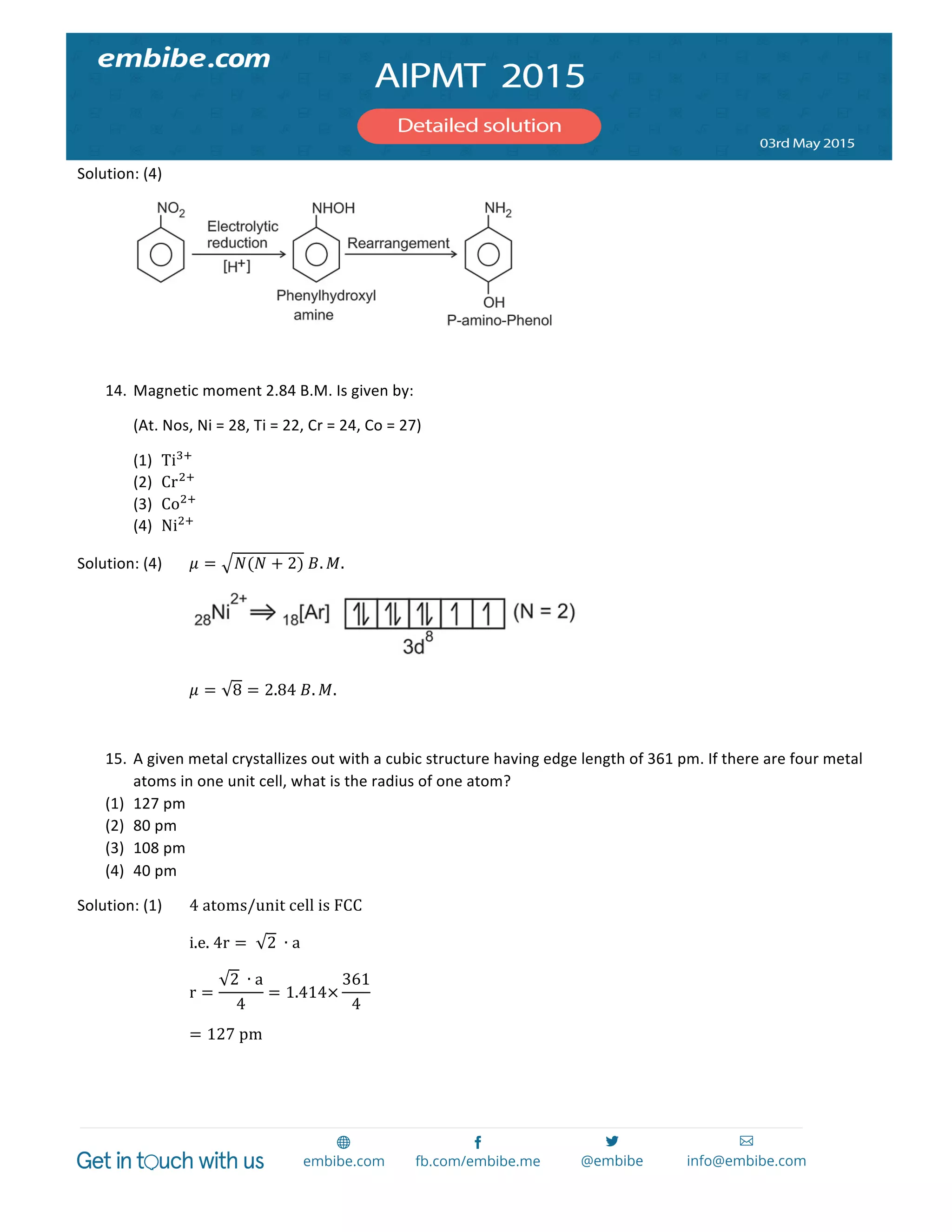
13. The  electrolytic  reduction  of  nitrobenzene  in  strongly  acidic  medium  produces:	
  
(1) Azoxybenzene	
  
(2) Azobenzene	
  
(3) Aniline	
  
(4) p-­‐aminophenol	


Solution:	
  (4)	


14. Magnetic	
  moment	
  2.84	
  B.M.	
  Is	
  given	
  by:	
  
(At.	
  Nos,	
  Ni	
  =	
  28,	
  Ti	
  =	
  22,	
  Cr	
  =	
  24,	
  Co	
  =	
  27)	
  
(1) Ti!!
	
  
(2) Cr!!
	
  
(3) Co!!
	
  
(4) Ni!!
	
  
Solution:	
  (4)	
   𝜇 = 𝑁(𝑁 + 2)  𝐵. 𝑀.	


   𝜇 = 8 = 2.84  𝐵. 𝑀.	


15. A	
  given	
  metal	
  crystallizes	
  out	
  with	
  a	
  cubic	
  structure	
  having	
  edge	
  length	
  of	
  361	
  pm.	
  If	
  there	
  are	
  four	
  metal	
  
atoms	
  in	
  one	
  unit	
  cell,	
  what	
  is	
  the	
  radius	
  of	
  one	
  atom?	
  
(1) 127	
  pm	
  
(2) 80	
  pm	
  
(3) 108	
  pm	
  
(4) 40	
  pm	
  
Solution:	
  (1)	
   4  atoms/unit  cell  is  FCC  
i.e.  4r =    2  ∙ a  
r =
2  ∙ a
4
= 1.414×
361
4
  
= 127  pm	


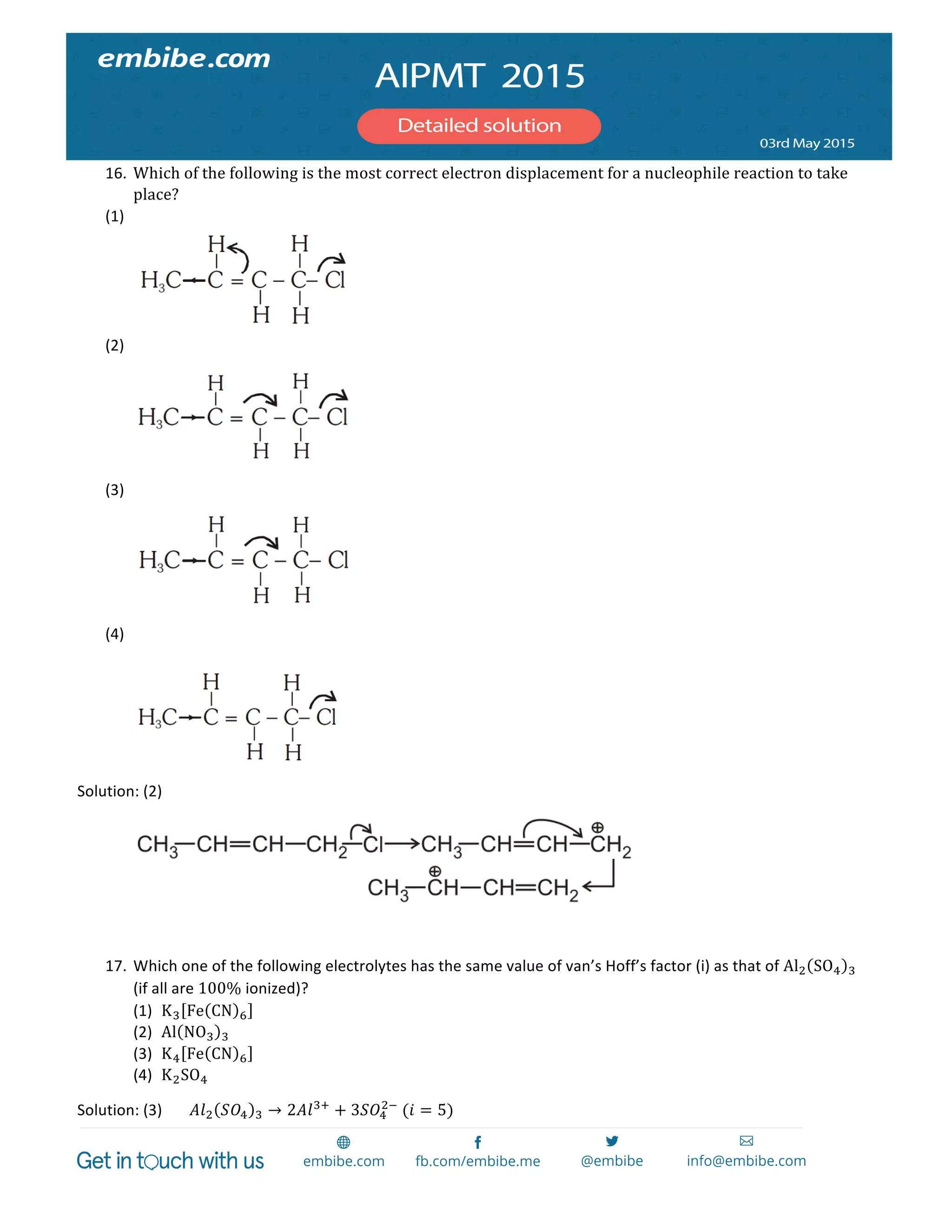
16. Which  of  the  following  is  the  most  correct  electron  displacement  for  a  nucleophile  reaction  to  take  
place?	
  
(1) 	


(2) 	


(3) 	


(4) 	


Solution:	
  (2)	


17. Which	
  one	
  of	
  the	
  following	
  electrolytes	
  has	
  the	
  same	
  value	
  of	
  van’s	
  Hoff’s	
  factor	
  (i)	
  as	
  that	
  of	
  Al! SO! !	
  
(if	
  all	
  are	
  100%	
  ionized)?	
  
(1) K! Fe CN ! 	
  
(2) Al NO! !  	
  
(3) K! Fe CN ! 	
  
(4) K!SO!	
  
Solution:	
  (3)	
   𝐴𝑙! 𝑆𝑂! ! → 2𝐴𝑙!!
+ 3𝑆𝑂!
!!
  (𝑖 = 5)	


   𝐾! 𝑆𝑂! → 2𝐾!
+ 𝑆𝑂!
!!
  (𝑖 = 3)	


   𝐾! 𝐹𝑒 𝐶𝑁 ! → 3𝐾!
+ 𝐹𝑒 𝐶𝑁 !
!!
  (𝑖 = 4)	


   𝐴𝑙 𝑁𝑂! ! → 𝐴𝑙!!
+ 3𝑁𝑂!
!
  (𝑖 = 4)	


   𝐾! 𝐹𝑒 𝐶𝑁 ! → 4𝐾!
+ 𝐹𝑒 𝐶𝑁 !   !!
  (𝑖 = 5)	


18. Nitrogen	
  dioxide	
  and	
  sulphur	
  dioxide	
  have	
  some	
  properties	
  in	
  common.	
  Which	
  property	
  is	
  shown	
  by	
  one	
  
of	
  these	
  compounds,	
  but	
  not	
  by	
  the	
  other?	
  
(1) Is	
  a	
  reducing	
  agent	
  
(2) Is	
  soluble	
  in	
  water	
  
(3) Is	
  used	
  as	
  a	
  food-­‐preservative	
  
(4) Forms	
  ‘acid-­‐rain’	
  
Solution:	
  (3)	
   SO!	
  is	
  used	
  as	
  food	
  preservative	


   NO!	
  is	
  not	
  used	
  as	
  food	
  preservative	


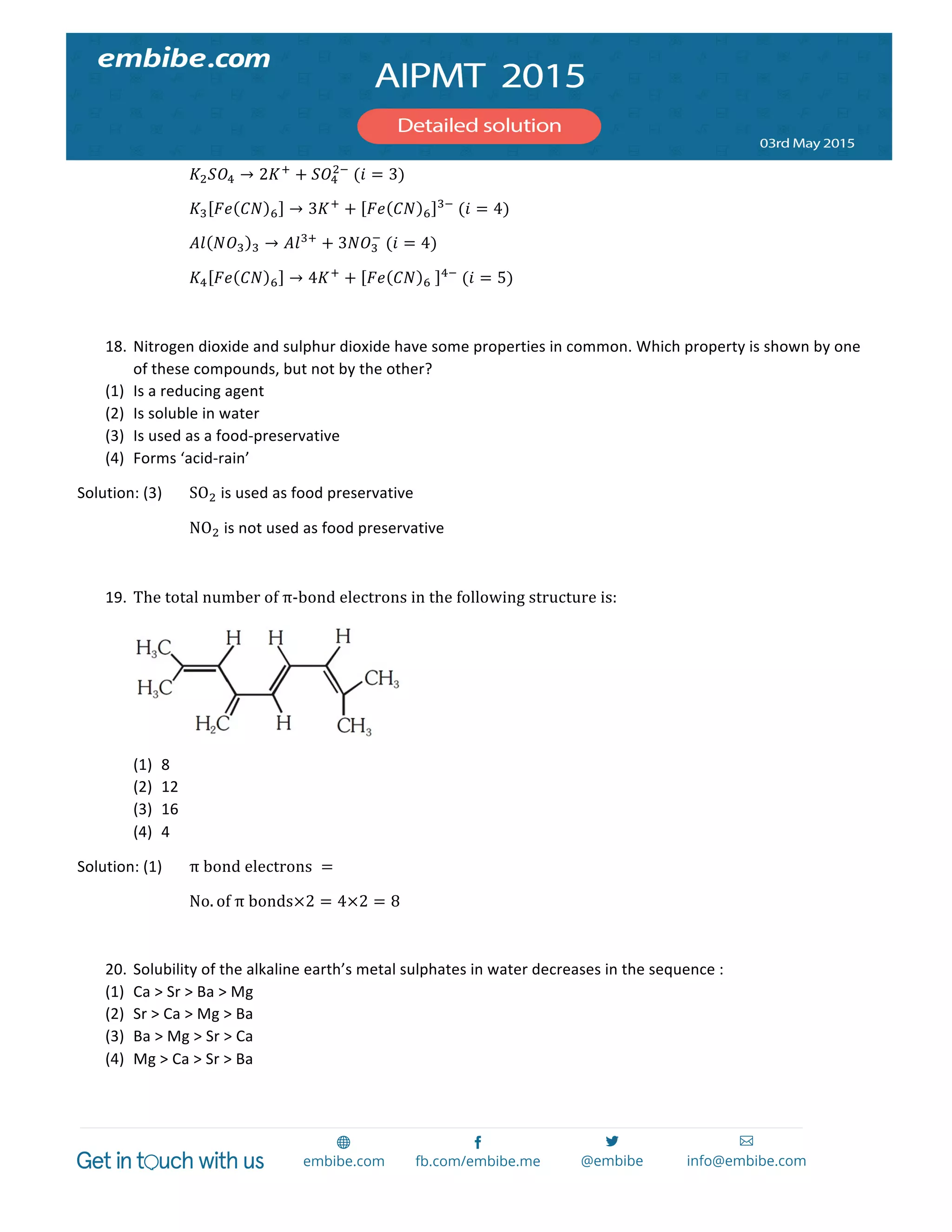
19. The  total  number  of  π-­‐bond  electrons  in  the  following  structure  is:	


(1) 8	
  
(2) 12	
  
(3) 16	
  
(4) 4	
  
Solution:	
  (1)	
   π  bond  electrons   =    
No. of  π  bonds×2 = 4×2 = 8      
  
20. Solubility	
  of	
  the	
  alkaline	
  earth’s	
  metal	
  sulphates	
  in	
  water	
  decreases	
  in	
  the	
  sequence	
  :	
  
(1) Ca	
  >	
  Sr	
  >	
  Ba	
  >	
  Mg	
  
(2) Sr	
  >	
  Ca	
  >	
  Mg	
  >	
  Ba	
  
(3) Ba	
  >	
  Mg	
  >	
  Sr	
  >	
  Ca	
  
(4) Mg	
  >	
  Ca	
  >	
  Sr	
  >	
  Ba	


Solution:	
  (4)	
   Lattice	
  energies	
  of	
  alkaline	
  earth	
  sylphates	
  are	
  almost	
  constant	
  but	
  hydration	
  energy	
  ∝
!
!"#$  !"  !"#$%&
	
  from	
  Mg!!
→ Ca!!
→ Sr!!
→ Ba!!
,	
  cationic	
  size	
  increases,	
  hydration	
  energy	
  decreases	
  i.e.	
  MgSO!	
  is	
  
soluble	
  &	
  BaSO!	
  is	
  a	
  precipitate.	
  
MgSO! > CaSO! > SrSO! > BaSO!	


21. Maximum	
  bond	
  angle	
  at	
  nitrogen	
  is	
  present	
  in	
  which	
  of	
  the	
  following?	
  
(1) NO!
!
	
  
(2) NO!
!
	
  
(3) NO!
!
	
  
(4) NO!	
  
Solution:	
  (2)	
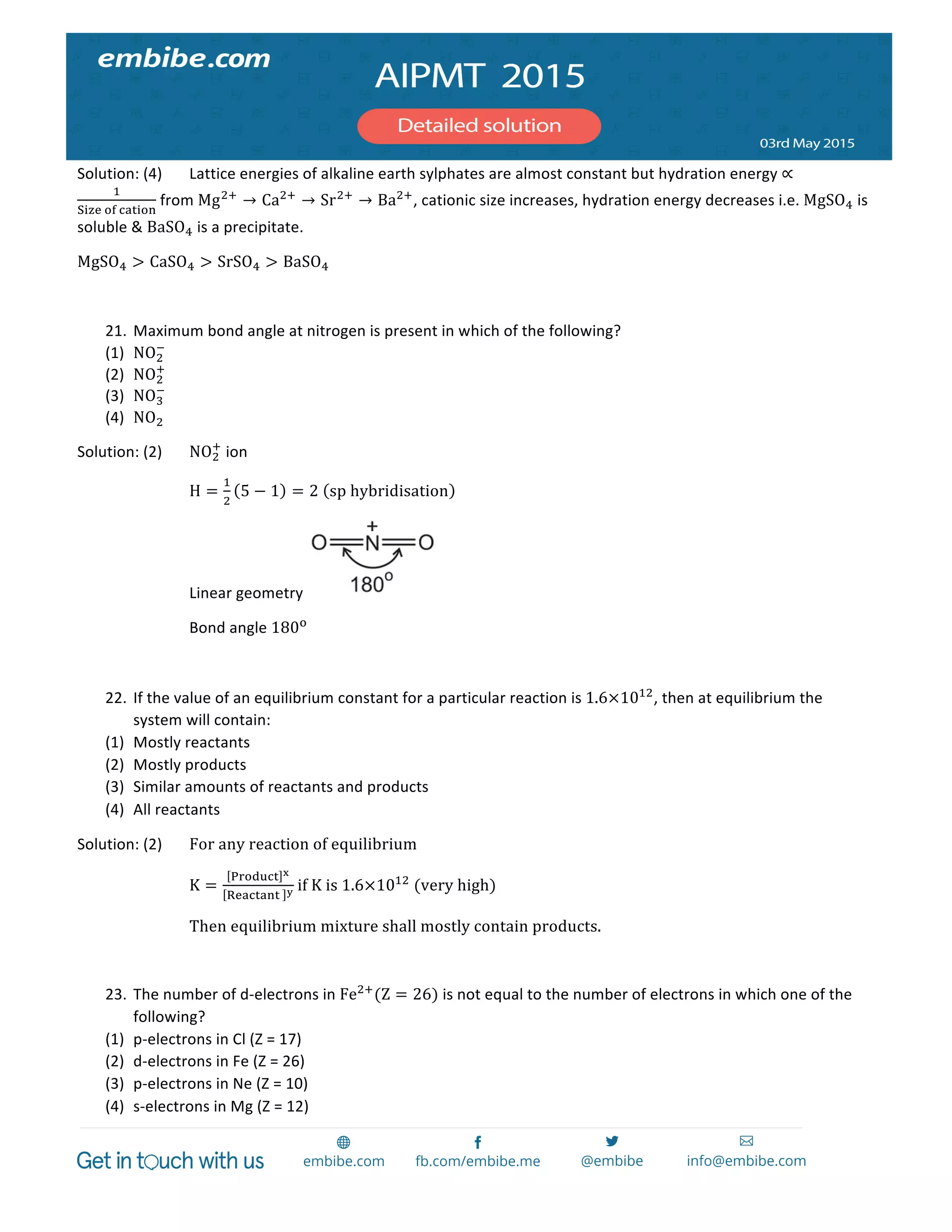
   NO!
!
	
  ion	


   H =
!
!
5 − 1 = 2   sp  hybridisation 	


   Linear	
  geometry	


   Bond	
  angle	
  180!


22. If	
  the	
  value	
  of	
  an	
  equilibrium	
  constant	
  for	
  a	
  particular	
  reaction	
  is	
  1.6×10!"
,	
  then	
  at	
  equilibrium	
  the	
  
system	
  will	
  contain:	
  
(1) Mostly	
  reactants	
  
(2) Mostly	
  products	
  
(3) Similar	
  amounts	
  of	
  reactants	
  and	
  products	
  
(4) All	
  reactants	
  
Solution:	
  (2)	
   For  any  reaction  of  equilibrium  
K =
!"#$%&' !
!"#$%#&%   !  if  K  is  1.6×10!"
  (very  high)  
Then  equilibrium  mixture  shall  mostly  contain  products.  
  
23. The	
  number	
  of	
  d-­‐electrons	
  in	
  Fe!!
(Z = 26)	
  is	
  not	
  equal	
  to	
  the	
  number	
  of	
  electrons	
  in	
  which	
  one	
  of	
  the	
  
following?	
  
(1) p-­‐electrons	
  in	
  Cl	
  (Z	
  =	
  17)	
  
(2) d-­‐electrons	
  in	
  Fe	
  (Z	
  =	
  26)	
  
(3) p-­‐electrons	
  in	
  Ne	
  (Z	
  =	
  10)	
  
(4) s-­‐electrons	
  in	
  Mg	
  (Z	
  =	
  12)	


Solution:	
  (1)	
   !"Fe!!
⇒ !" Ar   3d!
  (d  electrons = 6)	


   !"Cl ⇒ 1s!
  2s!
  2p!
  3s!
  3p!
  (p − electrons = 11)	


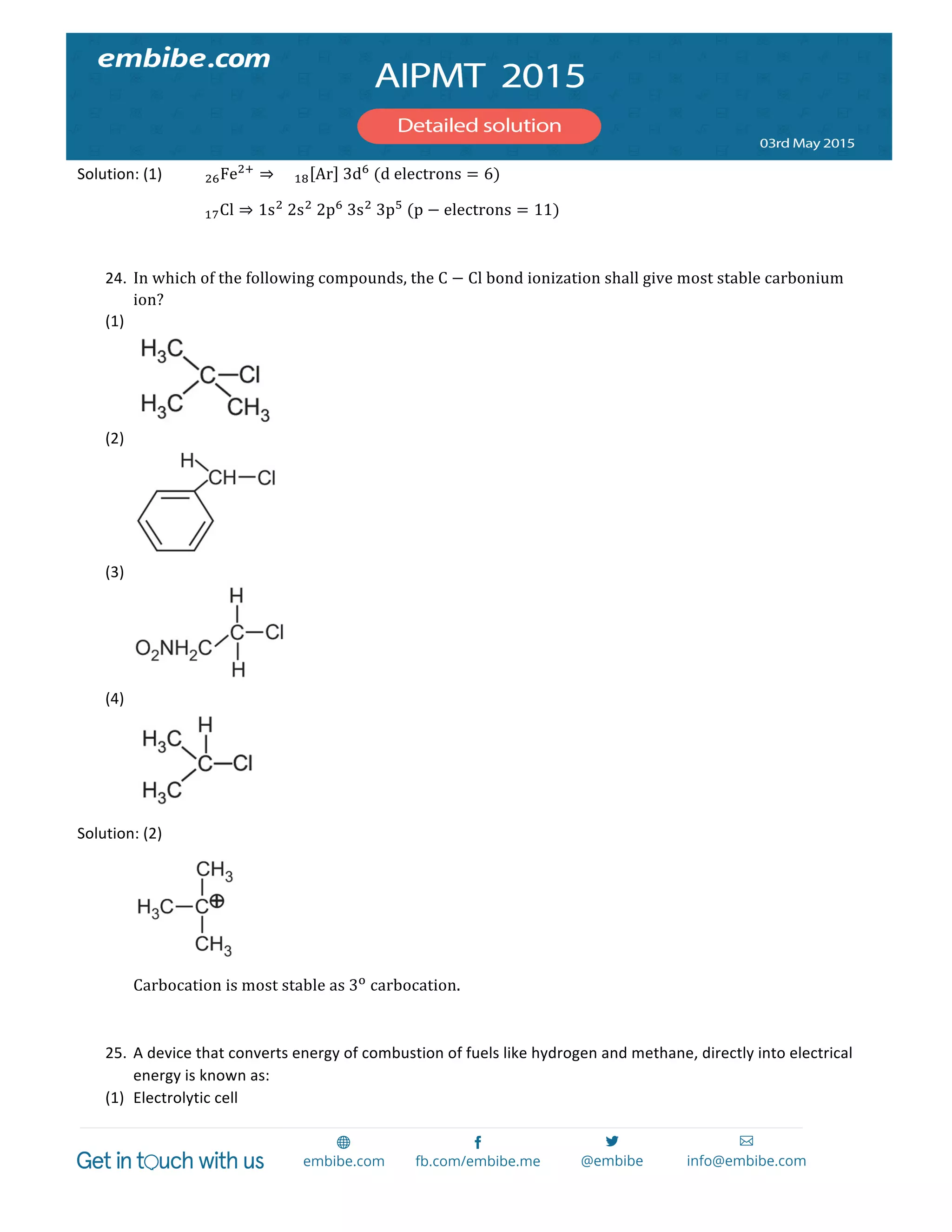
24. In  which  of  the  following  compounds,  the  C − Cl  bond  ionization  shall  give  most  stable  carbonium  
ion?	
  
(1) 	


(2) 	


(3) 	


(4) 	


Solution:	
  (2)	


   Carbocation  is  most  stable  as  3!
  carbocation.  
  
25. A	
  device	
  that	
  converts	
  energy	
  of	
  combustion	
  of	
  fuels	
  like	
  hydrogen	
  and	
  methane,	
  directly	
  into	
  electrical	
  
energy	
  is	
  known	
  as:	
  
(1) Electrolytic	
  cell	


(2) Dynamo	
  
(3) Ni-­‐Cd	
  cell	
  
(4) Fuel	
  cell	
  
Solution:	
  (4)	
   Fuel	
  cell	
  Burns	
  fuels	
  like	
  H!(g)	
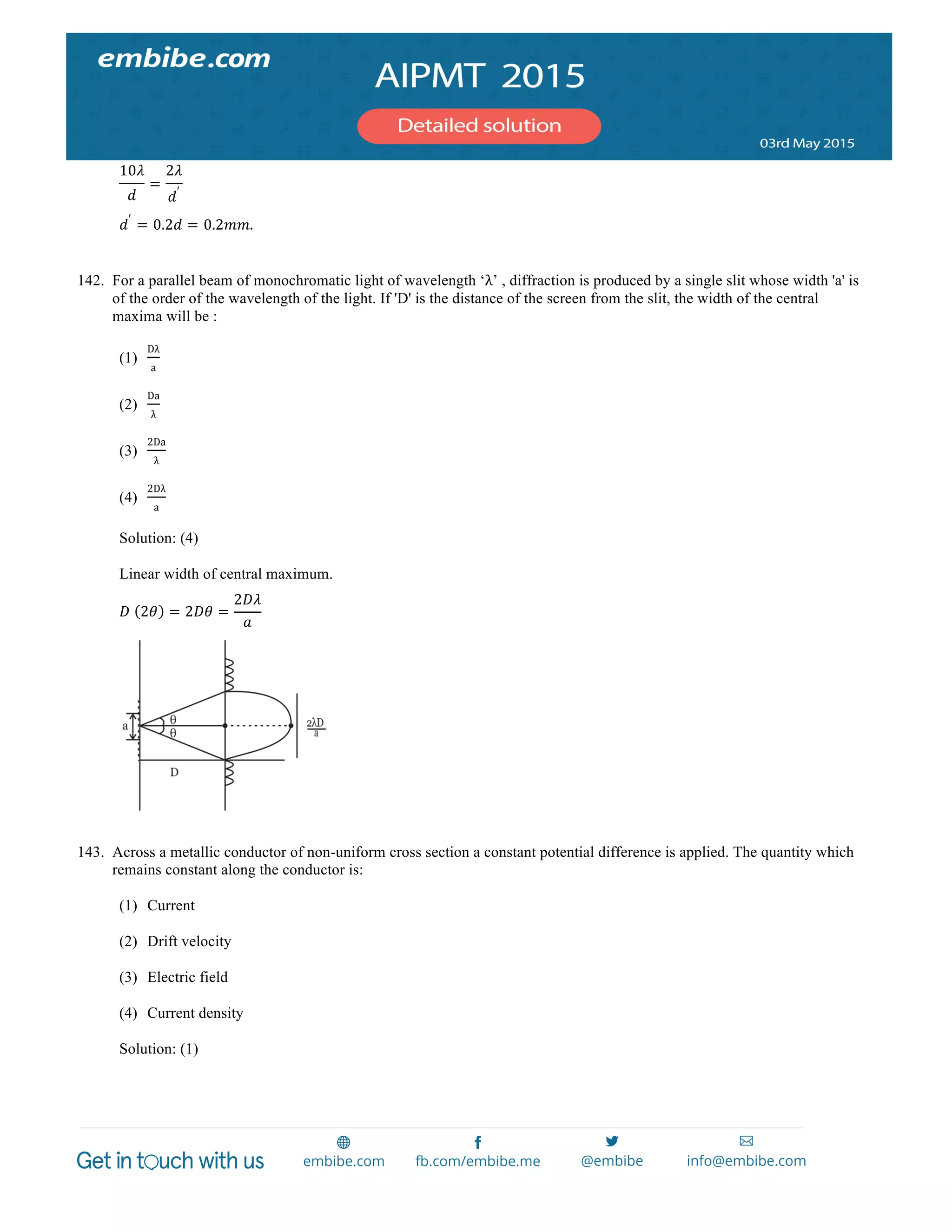
  &	
  CH!(g)	
  &	
  converts	
  chemical	
  energy	
  into	
  electrical	
  energy.	


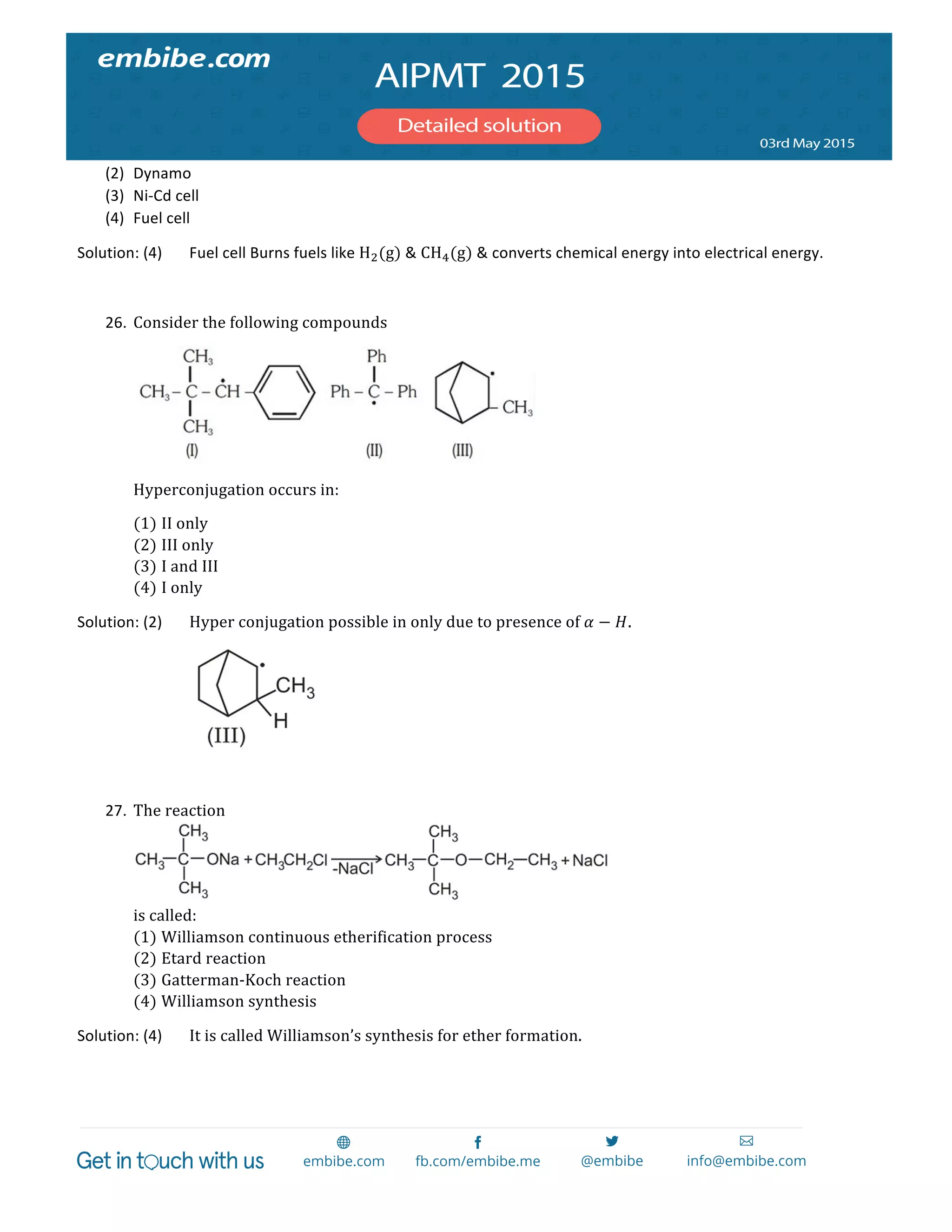
26. Consider  the  following  compounds	


Hyperconjugation  occurs  in:  
(1) II  only	
  
(2) III  only	
  
(3) I  and  III	
  
(4) I  only	
  
Solution:	
  (2)	
   Hyper  conjugation  possible  in  only  due  to  presence  of  𝛼 − 𝐻.	


27. The  reaction	


is  called:  
(1) Williamson  continuous  etherification  process	
  
(2) Etard  reaction	
  
(3) Gatterman-­‐Koch  reaction	
  
(4) Williamson  synthesis	
  
Solution:	
  (4)	
   It  is  called  Williamson’s  synthesis  for  ether  formation.  


28. Cobalt	
  (III)	
  chloride	
  forms	
  several	
  octahedral	
  complexes	
  with	
  ammonia.	
  Which	
  of	
  the	
  following	
  will	
  not	
  
give	
  test	
  for	
  chloride	
  ions	
  with	
  silver	
  nitrate	
  at	
  25!
C?	
  
(1) CoCl! ∙ 4NH!	
  
(2) CoCl! ∙ 5NH!	
  
(3) CoCl! ∙ 6NH!	
  
(4) CoCl! ∙ 3NH!	
  
Solution:	
  (4)	
   In	
  CoCl! ∙ 3NH!	
  the	
  complex	
  can	
  be	
  written	
  as	
  [CoCl! NH! !]	


   With	
  Co!!
	
  oxidation	
  state	
  3,	
  Cl!
	
  ions	
  &	
  3,	
  NH!	
  molecules	
  be	
  with	
  in	
  the	
  co-­‐ordination	
  sphere	
  Co	
  -­‐	
  
Cl	
  bonds	
  in	
  co-­‐ordination	
  sphere	
  not	
  ionisable.	


29. A	
  mixture	
  of	
  gases	
  contains	
  H!	
  and	
  O!	
  gases	
  in	
  the	
  ratio	
  of	
  1	
  :	
  4	
  (w/w).	
  What	
  is	
  the	
  molar	
  ratio	
  of	
  the	
  two	
  
gases	
  in	
  the	
  mixture?	
  
(1) 4	
  :	
  1	
  
(2) 16	
  :	
  1	
  
(3) 2	
  :	
  1	
  
(4) 1	
  :	
  4	
  
Solution:	
  (1)	


30. Which	
  of	
  the	
  following	
  processes	
  does	
  not	
  involve	
  oxidation	
  of	
  iron?	
  
(1) Decolourization	
  of	
  blue	
  CuSO!	
  solution	
  by	
  iron	
  
(2) 	
  Formation	
  of	
  Fe CO !	
  from	
  Fe	
  
(3) Liberation	
  of	
  H!	
  from	
  steam	
  by	
  iron	
  at	
  high	
  temperature	
  
(4) Rusting	
  of	
  iron	
  sheets	
  
Solution:	
  (2)	
   Rusting	
  of	
  iron	
  Fe → Fe!!
(oxidation)	


   Cu!!
+ Fe → Fe!!
+ Cu   oxidation 	


   Fe + H!SO! → FeSO! + H! ↑ g   (oxidation)	


   Fe CO ! ⇒ oxidation  state  of  Fe  is  zero	


31. Because	
  of	
  lanthanoid	
  contraction,	
  which	
  of	
  the	
  following	
  pairs	
  of	
  elements	
  have	
  nearly	
  same	
  atomic	
  
radii?	
  (Number	
  in	
  the	
  parenthesis	
  are	
  atomic	
  numbers).	
  
(1) Zr	
  (40)	
  and	
  Nb	
  (41)	
  
(2) Zr	
  (40)	
  and	
  Hf	
  (72)	
  
(3) Zr	
  (40)	
  and	
  Ta	
  (73)	
  
(4) Ti	
  (22)	
  and	
  Zr	
  (40)	
  
Solution:	
  (2)	
   !"Zr	
  is	
   [Kr]!"   5s!
  4d!


   !"Hf	
  is	
   [Xe]!"   6s!
  4f!"
  5d!


   Both	
  lie	
  in	
  period	
  IV(B)	


   Lanthanide	
  contraction	
  &	
  additional	
  shell	
  introduction	
  cancell	
  size	
  effects	
  &	
  both	
  metals	
  have	
  
same	
  radii.	


32. Which  of  the  following  statements  is  correct  for  a  reversible  process  in  a  state  of  equilibrium?	
  
(1) ΔG =   2.30  RT log K	
  
(2) ΔG!
=   −2.30  RT log K	
  
(3) ΔG!
=   2.30  RT log K	
  
(4) ΔG =   −2.30  RT log K	
  
Solution:	
  (2)	
   For  a  reversible  process  at  equilibrium  
        
ΔG = 0 = ΔG!
+ RT ln K     Q = K   
  i.e.  ΔG!
=   −2.303  RT log K  
  
33. The  angular  momentum  of  electron  ‘d’  orbital  is  equal  to:  
(1) 2  ℏ  
(2) 2 3  ℏ  
(3) 0  ℏ  
(4) 6  ℏ  
Solution:  (4)   For  d-­‐electrons  l = 2  
Angular  orbital  momentum  = l(l + 1)
!
!"
  
= 6
h
2π
= 6  ℏ  


34. The	
  boiling	
  point	
  of	
  0.2  mol  kg!!
	
  solution	
  of	
  X	
  in	
  water	
  is	
  greater	
  than	
  equimolal	
  solution	
  of	
  Y	
  in	
  water.	
  
Which	
  one	
  of	
  the	
  following	
  statements	
  is	
  true	
  in	
  this	
  case?  
(1) Molecular	
  mass	
  of	
  X	
  is	
  greater	
  than	
  the	
  molecular	
  mass	
  of	
  Y.  
(2) Molecular	
  mass	
  of	
  X	
  is	
  less	
  than	
  the	
  molecular	
  mass	
  of	
  Y.  
(3) Y	
  is	
  undergoing	
  dissociation	
  in	
  water	
  while	
  X	
  undergoes	
  no	
  change  
(4) X	
  is	
  undergoing	
  dissociation	
  in	
  water  
Solution:  (4)   ∆T! = i  K!. m	


   K!	
  &	
  m	
  are	
  constant	
  for	
  solutions	
  of	
  X	
  and	
  Y.	
  ∆T!	
  is	
  greater	
  for	
  solution	
  of	
  X	
  implies	
  i(van’t	
  Hoff	
  
factor	
  for	
  X	
  >	
  1)	
  i.e	
  X	
  undergoes	
  dissociation.	


35. The	
  function	
  of	
  “Sodium	
  pump”	
  is	
  a	
  biological	
  process	
  operating	
  in	
  each	
  and	
  every	
  cell	
  of	
  all	
  animals.	
  
Which	
  of	
  the	
  following	
  biologically	
  important	
  ions	
  is	
  also	
  a	
  constituent	
  of	
  this	
  pump?  
(1) Mg!!
  
(2) K!
  
(3) Fe!!
  
(4) Ca!!
  
Solution:  (2)   Memory	
  based	


   K!
	
  ions	
  is	
  constituent	
  of	
  this	
  pump.	


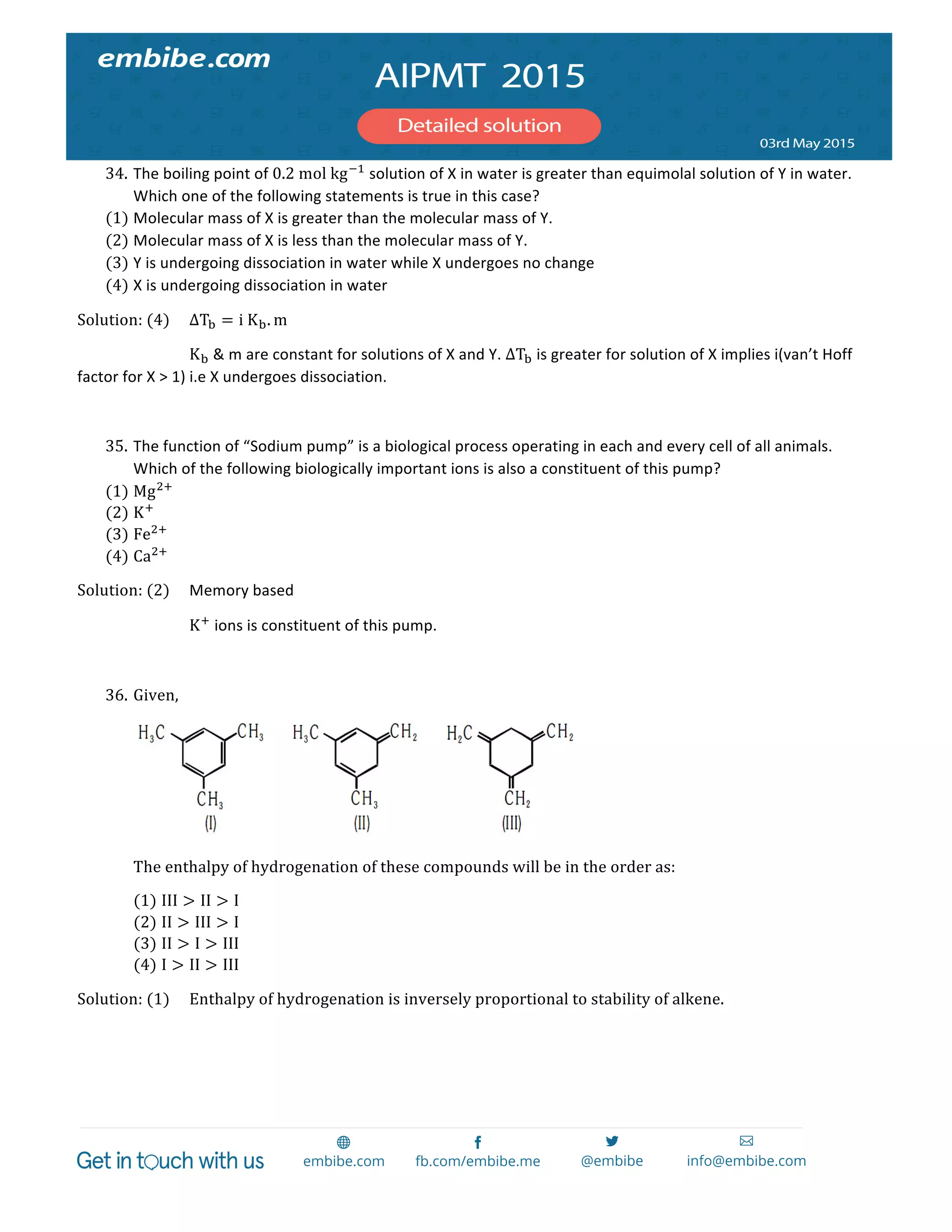
36. Given,  
  
The  enthalpy  of  hydrogenation  of  these  compounds  will  be  in  the  order  as:  
(1) III > II > I  
(2) II > III > I  
(3) II > I > III  
(4) I > II > III  
Solution:  (1)   Enthalpy  of  hydrogenation  is  inversely  proportional  to  stability  of  alkene.  


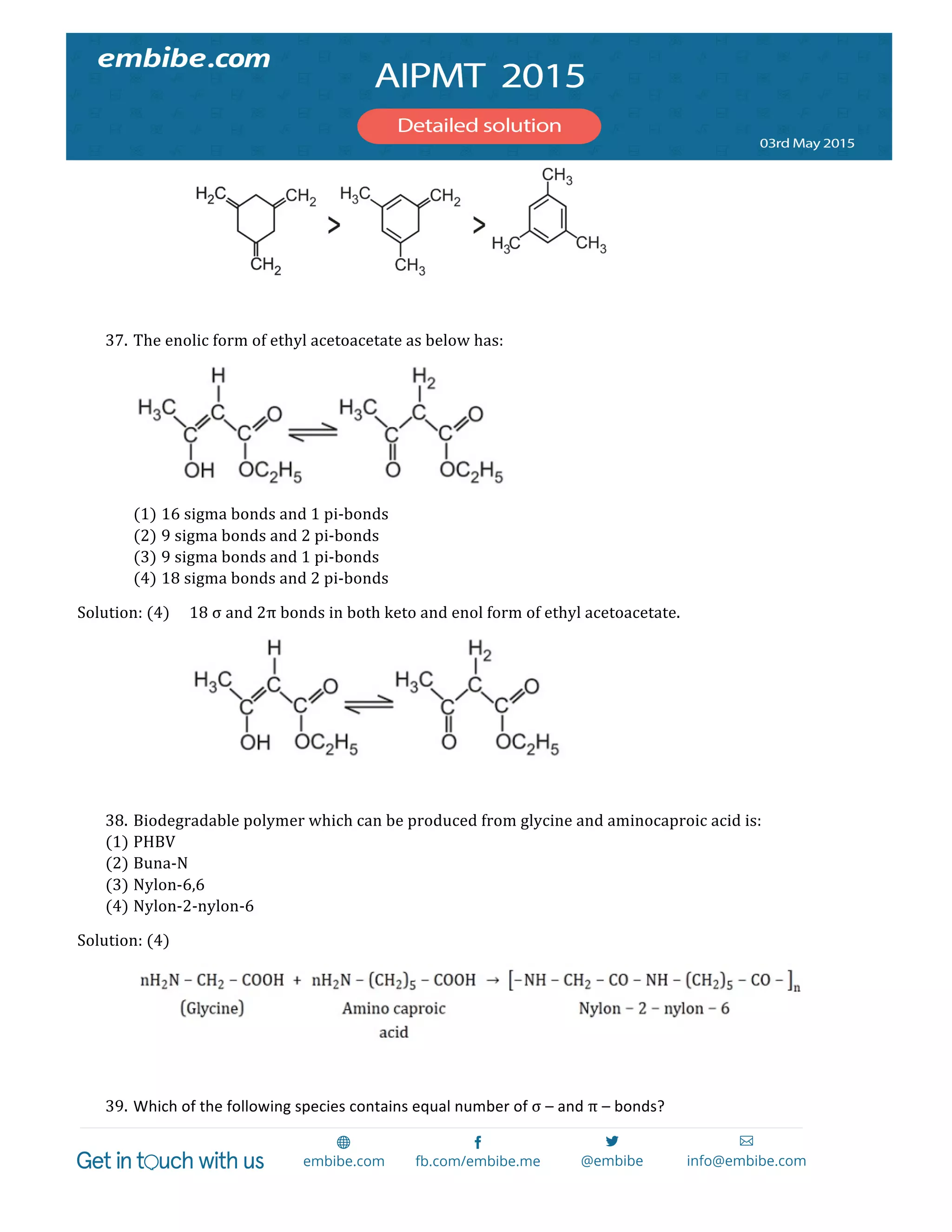
37. The  enolic  form  of  ethyl  acetoacetate  as  below  has:  
  
(1) 16  sigma  bonds  and  1  pi-­‐bonds  
(2) 9  sigma  bonds  and  2  pi-­‐bonds  
(3) 9  sigma  bonds  and  1  pi-­‐bonds  
(4) 18  sigma  bonds  and  2  pi-­‐bonds  
Solution:  (4)   18  σ  and  2π  bonds  in  both  keto  and  enol  form  of  ethyl  acetoacetate.  
        
  
38. Biodegradable  polymer  which  can  be  produced  from  glycine  and  aminocaproic  acid  is:  
(1) PHBV  
(2) Buna-­‐N  
(3) Nylon-­‐6,6  
(4) Nylon-­‐2-­‐nylon-­‐6  
Solution:  (4)  
     
  
39. Which	
  of	
  the	
  following	
  species	
  contains	
  equal	
  number	
  of	
  σ	
  –	
  and	
  π	
  –	
  bonds?  


(1) XeO!  
(2) CN !  
(3) CH! CN !  
(4) HCO!
!
  
Solution:  (1)   XeO! ⇒	
  hybridization	
  of	
  central	
  atom	


   H =
!
!
8 = 4  (sp!
)	


   There	
  are	
  4σ	
  bonds	
  &	
  4π	
  bonds	
  as	
  central	
  Xe	
  atom	
  joined	
  to	
  O	
  atoms	
  at	
  corners	
  of	
  regular	
  
tetrahedron	
  by	
  double	
  bonds.	
  
  
40. Which	
  of	
  these	
  statements	
  about	
   Co CN !
!!
	
  is	
  true?  
(1) Co CN !
!!
	
  has	
  four	
  unpaired	
  electrons	
  and	
  will	
  be	
  in	
  a	
  low-­‐spin	
  configuration.  
(2) Co CN !
!!
	
  has	
  four	
  unpaired	
  electrons	
  and	
  will	
  be	
  in	
  a	
  high-­‐spin	
  configuration.	
  
(3) Co CN !
!!
	
  has	
  no	
  unpaired	
  electrons	
  and	
  will	
  be	
  in	
  a	
  high-­‐spin	
  configuration.  
(4) Co CN !
!!
	
  has	
  no	
  unpaired	
  electrons	
  and	
  will	
  be	
  in	
  a	
  low-­‐spin	
  configuration.  
Solution:  (4)  
     
   Due	
  to	
  strong	
  Ligand	
  field	
  of	
  CN!
	
  ions	
  pairing	
  of	
  electrons	
  takes	
  place	
  in	
  inner	
  3d	
  orbital	
  it	
  is	
  a	
  low	
  spin	
  
complex	
  with	
  no	
  unpaired	
  electrons.	


41. Which	
  one	
  is	
  not	
  equal	
  to	
  zero	
  for	
  an	
  ideal	
  solution?  
(1) ∆S!"#$%&'  
(2) ∆V!"#$%&'  
(3) ∆P = P!"#$%&$' − P!"#$%&  
(4) ∆H!"#$%&'	
  
Solution:	
  (1)	
   ΔS!"#(per  mole) =   −Σx! log x!  
x!  is  mole  fraction  of  i!"
  component  in  solution  ∆S!"#/!"#$  is  +ve  and  not  zero  for  an  ideal  solution.  
  
42. Which  property  of  colloidal  solution  is  independent  of  charge  on  the  colloidal  particles?	
  
(1) Electrophoresis	
  
(2) Electro-­‐osmosis	
  
(3) Tyndall  effect	
  
(4) Coagulation	


Solution:	
  (3)	
   Tyndall  effect  is  related  to  scattering  of  light  by  colloidal  particles  and  not  dependent  on  
charge.  
  
43. Given,	


Which  of  the  given  compounds  can  exhibit  tautomerism?  
(1) I  and  III	
  
(2) II  and  III	
  
(3) I,  II  and  III	
  
(4) I  and  II	
  
Solution:	
  (3)	
   All  compounds  show  tautomerism.  


44. When	
  initial	
  concentration	
  of	
  a	
  reactant	
  is	
  doubled	
  in	
  a	
  reaction,	
  its	
  half-­‐life	
  period	
  is	
  not	
  affected.	
  The	
  
order	
  of	
  the	
  reaction	
  is:	
  
(1) First	


(2) Second	
  
(3) More	
  than	
  zero	
  but	
  less	
  than	
  first	
  
(4) Zero	
  
Solution:	
  (1)	
   t! ! ∝
!
!!
!!!  
t! !  is  independent  of  initial  concentration  i.e.  
t! ! ∝
!
!!
!!!  (is  constant)  
i.e  n  =  1  (order  of  reaction)  
  
45. A  single  compound  of  the  structure  
	
  
is  obtainable  from  ozonolysis  of  which  of  the  following  cyclic  compounds?  
(1) 	


(2) 	


(3) 	


(4) 	


Solution:	
  (4)	


Biology	
  
46.	
  Which	
  of	
  the	
  following	
  endoparasites	
  of	
  humans	
  does	
  show	
  viviparity?	
  
(1) Enterobius	
  vermicularis	
  
(2) Trichinella	
  spiralis	
  
(3) Ascaris	
  lumbricoides	
  
(4) Ancylostoma	
  duodenale	
  
Solution:	
  (2)	
  Viviparity	
  means	
  development	
  of	
  an	
  embryo	
  inside	
  the	
  body	
  of	
  mother	
  rather	
  than	
  laying	
  eggs.	
  Eg:	
  
Trichinella	
  spiralis	
  is	
  an	
  endoparasite	
  of	
  human	
  body	
  that	
  shows	
  viviparity	
  whereas	
  the	
  remaining	
  endoparasites	
  
lay	
  eggs	
  (oviparity).	


47.	
  Cryopreservation	
  of	
  gametes	
  of	
  threatened	
  species	
  in	
  viable	
  and	
  fertile	
  condition	
  can	
  be	
  referred	
  to	
  as:	
  
(1)	
  Advanced	
  ex-­‐situ	
  conservation	
  of	
  biodiversity	
  
(2)	
  In	
  situ	
  conservation	
  by	
  sacred	
  groves	
  
(3)	
  In	
  situ	
  cryo-­‐conservation	
  of	
  biodiversity	
  
(4)	
  In	
  situ	
  conservation	
  of	
  biodiversity	
  
Solution:	
  (1)	
  Cryopreservation of gametes of threatened species in viable and fertile condition can be referred to
as advanced ex-situ conservation of biodiversity because these gametes are stored in liquid nitrogen at a
temperature of about -196
0
C.
	
  
48.	
  Which	
  one	
  of	
  the	
  following	
  matches	
  is	
  correct?	
  
(1)	
  Alternaria	
  –	
  Sexual	
  reproduction	
  absent	
  –	
  Deuteromycetes	
  
(2)	
  Mucor	
  –	
  Reproduction	
  by	
  Conjugation	
  –	
  Ascomycetes	
  
(3) Agaricus	
  –	
  Parasitic	
  fungus	
  –	
  Basidiomycetes	
  
(4) Phytophthora	
  -­‐	
  Aseptate	
  mycelium	
  -­‐	
  Basidiomycetes	


Solution:	
  (1)	
  As	
  Alternaria	
  belongs	
  to	
  Class	
  Deuteromycetes	
  and	
  have	
  asexual	
  reproduction	
  by	
  conidia,	
  thus	
  
sexual	
  reproduction	
  absent.	


49. Minerals	
  known	
  to	
  be	
  required	
  in	
  large	
  amounts	
  for	
  plant	
  growth	
  include:	
  
(1) Calcium,	
  magnesium,	
  manganese,	
  copper	
  
(2) Potassium,	
  phosphorus,	
  selenium,	
  boron	
  
(3) Magnesium,	
  sulphur,	
  iron,	
  zinc	
  
(4) Phosphorus,	
  potassium,	
  sulphur,	
  calcium	
  
Solution:	
  (4)	
  Major/macroelements/macronutrients/meganutrients	
  are	
  required	
  in	
  large	
  amounts	
  which	
  include:-­‐	
  
C,	
  H,	
  O,	
  N,	
  P,	
  K,	
  Ca,	
  S,	
  Mg	
  and	
  Fe.	
  
While	
  minor/micronutrients/trace	
  elements	
  are	
  required	
  in	
  very	
  small	
  amounts,	
  these	
  incude:-­‐	
  Cu,	
  Zn,	
  Mn,	
  B,	
  Mo	
  
and	
  Cl.	
  
Therefore	
  correct	
  option	
  is	
  (1)	
  which	
  includes	
  only	
  major	
  nutrients/megaelements.	


50. Which	
  of	
  the	
  following	
  enhances	
  or	
  induces	
  fusion	
  of	
  protoplasts?	
  
(1) Polyethylene	
  glycol	
  and	
  sodium	
  nitrate	
  
(2) IAA	
  and	
  kinetin	
  
(3) IAA	
  and	
  Gibberellins	
  
(4) Sodium	
  chloride	
  and	
  potassium	
  chloride	
  
Solution:	
  (1)	
  The high molecular weight polymer (1000-6000) of PEG acts as a molecular bridges
connecting the protoplasts. Calcium ions linked the negatively charged PEG and membrane surface.
When PEG elute, the surface potential are disturbed, leading to intramembrane contact and subsequent
fusion due to the strong affinity of PEG for water which may cause local dehydration of the membrane
and increase fluidity, thus inducing fusion.


51. Which	
  of	
  these	
  is	
  not	
  an	
  important	
  component	
  of	
  initiation	
  of	
  parturition	
  in	
  humans?	
  
(1) Synthesis	
  of	
  prostaglandins	
  
(2) Release	
  of	
  oxytocin	
  
(3) Release	
  of	
  prolactin	
  
(4) Increase	
  in	
  estrogen	
  and	
  progesterone	
  ratio	
  
Solution:	
  (3)	
  Prolactin has no role in parturition, it helps in lactation process, (lactogenic hormone),
development of mammary glands (mammotropin) & maintenance of corpus luteum (leutotropin).


52. In	
  which	
  of	
  the	
  following	
  gametophyte	
  is	
  not	
  independent	
  free	
  living?	
  
(1) Marchantia	
  
(2) Pteris	
  
(3) Pinus	
  
(4) Funaria	
  
Solution:	
  (3)	
  In	
  plants	
  (gymnosperms	
  and	
  angiosperms),	
  gametophytes	
  is	
  dependent	
  and	
  develop	
  into	
  
multicellular	
  organisms	
  while	
  still	
  enclosed	
  within	
  the	
  sporangium	
  while	
  in	
  bryophytes	
  (mosses,	
  liverworts,	
  and	
  
hornworts),	
  the	
  gametophyte	
  free	
  living	
  (photosynthetic)	
  eg.	
  Funaria,	
  Marchantia	
  In	
  ferns,	
  gametophytes	
  are	
  
photosynthetic	
  free	
  living	
  organism	
  called	
  a	
  prothallus	
  (Pteris).	


53. Which	
  of	
  the	
  following	
  is	
  not	
  a	
  sexually	
  transmitted	
  disease?	
  
(1) Acquired	
  Immuno	
  Deficiency	
  Syndrome	
  (AIDS)	
  
(2) Trichomobiasis	
  
(3) Encephalitis	
  
(4) Syphilis	
  
Solution:	
  (3)	
  Encephalitis is an acute inflammation (swelling up) of the brain resulting either from a viral
infection or when the body's own immune system mistakenly attacks brain tissue. The most common
cause is a viral infection.


54. Leaves	
  become	
  modified	
  into	
  spines	
  in:	
  
(1) Pea	
  
(2) Onion	
  
(3) Silk	
  Cotton	
  
(4) Opuntia	
  
Solution:	
  (4)	
  Opuntia	
  leaves	
  get	
  modified	
  into	
  spikes	
  to	
  protect	
  them	
  from	
  grazing	
  animals,	
  also	
  reduce	
  area	
  of	
  
transpiration.	
  
Pea	
  leaves	
  are	
  modified	
  into	
  tendrils.	
  
Onion	
  leaves	
  become	
  fleshy	
  since	
  food	
  is	
  stored	
  in	
  it.	
  
Silk	
  cotton	
  get	
  modified	
  from	
  unifoliate	
  leaves	
  to	
  multifoliate	
  leaves.	


55. Which	
  one	
  gives	
  the	
  most	
  valid	
  and	
  recent	
  explanation	
  for	
  stomatal	
  movements?	
  
(1) Potassium	
  influx	
  and	
  efflux	
  
(2) Starch	
  hydrolysis	


(3) Guard	
  cell	
  photosynthesis	
  
(4) Transpiration	
  
Solution:	
  (1)	
  The	
  most	
  recent	
  &	
  valid	
  explanation	
  of	
  stomatal	
  movements	
  is	
  given	
  by	
  potassium	
  influx	
  &	
  
efflux/potassium	
  ion	
  pump	
  theory	
  which	
  is	
  also	
  as	
  the	
  modern	
  theory.	
  The	
  theory	
  was	
  given	
  by	
  Levitt	
  in	
  
1974.	
  This	
  theory	
  states	
  that	
  the	
  accumulation	
  K+	
  ions	
  leads	
  to	
  opening	
  of	
  stomata	
  during	
  the	
  day	
  while	
  
the	
  reverse	
  situation	
  prevails	
  during	
  dark	
  when	
  the	
  stomata	
  is	
  closed.	


56. Which	
  of	
  the	
  following	
  had	
  the	
  smallest	
  brain	
  capacity?	
  
(1) Homo	
  sapiens	
  
(2) Homo	
  neanderthalensis	
  
(3) Homo	
  habilis	
  
(4) Homo	
  erectus	
  
Solution:	
  (3)	
  Homo habilis (Handy man) is considered to be the first human which evolved from
Australopithecus its cranial capacity was smallest (650 – 800cc) among humans.


57. High	
  value	
  of	
  BOD	
  (Biochemical	
  Oxygen	
  Demand)	
  indicates	
  that:	
  
(1) Water	
  is	
  highly	
  polluted	
  
(2) Water	
  is	
  less	
  polluted	
  
(3) Consumption	
  of	
  organic	
  matter	
  in	
  the	
  water	
  is	
  higher	
  by	
  the	
  microbes	
  
(4) Water	
  is	
  pure	
  
Solution:	
  (1)	
  High	
  value	
  of	
  BOD	
  (Biological	
  Oxygen	
  Demand)	
  indicates	
  that	
  water	
  is	
  highly	
  polluted	
  because	
  there	
  
is	
  a	
  high	
  concentration	
  of	
  organic	
  matter	
  which	
  is	
  consequently	
  also	
  increase	
  the	
  number	
  of	
  organisms.	


58. Sliding	
  filament	
  theory	
  can	
  be	
  best	
  explained	
  as:	
  
(1) Actin	
  and	
  Myosin	
  filaments	
  shorten	
  and	
  slide	
  pass	
  each	
  other	
  
(2) Actin	
  and	
  Myosin	
  filaments	
  do	
  not	
  shorten	
  but	
  rather	
  slide	
  pass	
  each	
  other	
  
(3) When	
  myofilaments	
  slide	
  pass	
  each	
  other,	
  Myosin	
  filaments	
  shorten	
  while	
  Actin	
  filaments	
  do	
  not	
  shorten	
  
(4) When	
  myofilaments	
  slide	
  pass	
  each	
  other	
  Actin	
  filaments	
  shorten	
  while	
  Myosin	
  filament	
  do	
  not	
  shorten	
  
Solution:	
  (2)	
  In the sliding filament model, the thick and thin filaments past each other, shortening the
sarcomere, i.e., actin & myosin filaments do not shorten, rather actin filaments slide over myosin
filaments.


59. A	
  gymnast	
  is	
  able	
  to	
  balance	
  his	
  body	
  upside	
  down	
  even	
  in	
  the	
  total	
  darkness	
  because	
  of:	


(1) Vestibular	
  apparatus	
  
(2) Tectorial	
  membrane	
  
(3) Organ	
  of	
  corti	
  
(4) Cochlea	
  
Solution:	
  (1)	
  The vestibular system is the sensory system that provides the sense of balance and spatial
orientation for the purpose of coordinating movement with balance.


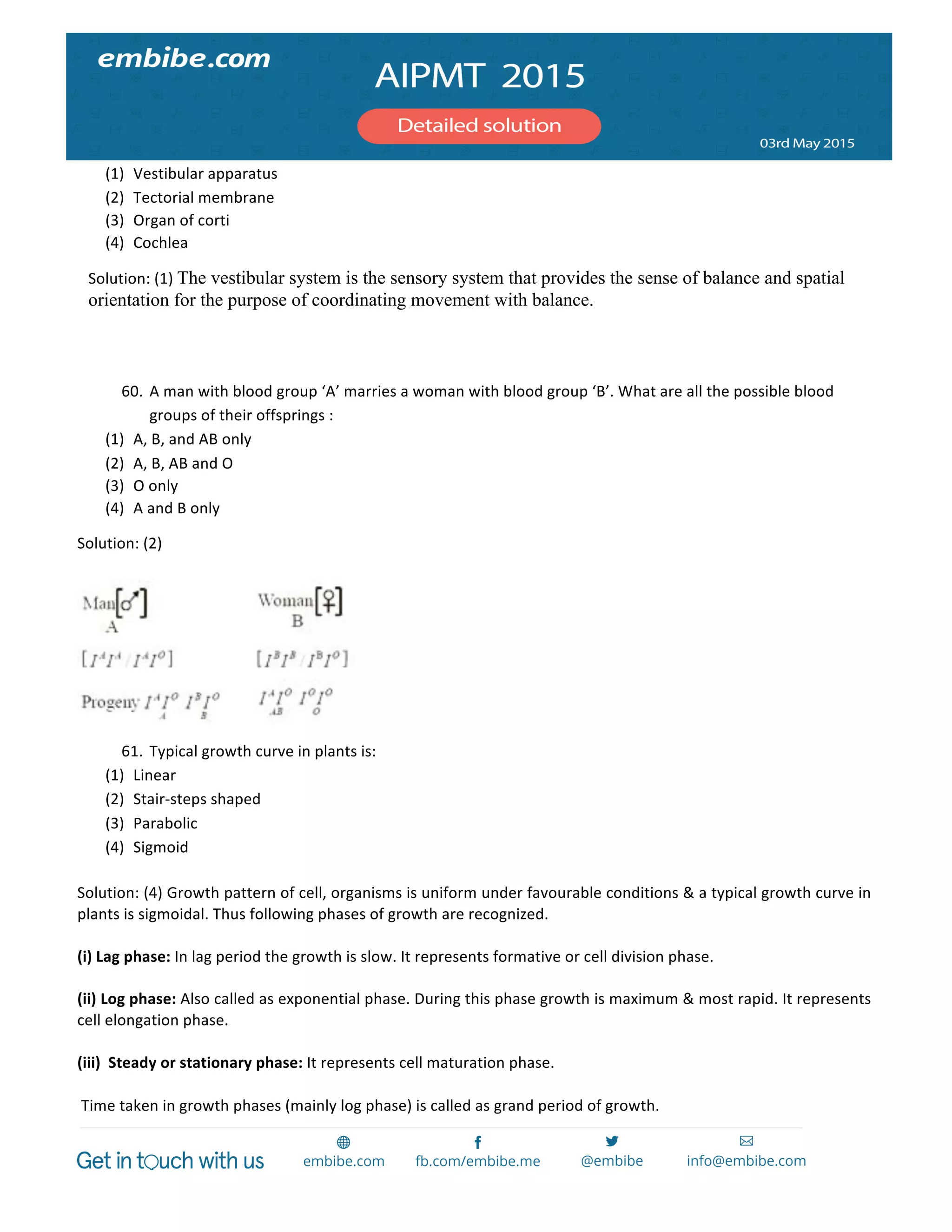
60. A	
  man	
  with	
  blood	
  group	
  ‘A’	
  marries	
  a	
  woman	
  with	
  blood	
  group	
  ‘B’.	
  What	
  are	
  all	
  the	
  possible	
  blood	
  
groups	
  of	
  their	
  offsprings	
  :	
  
(1) A,	
  B,	
  and	
  AB	
  only	
  
(2) A,	
  B,	
  AB	
  and	
  O	
  
(3) O	
  only	
  
(4) A	
  and	
  B	
  only	
  
Solution:	
  (2)	


61. Typical	
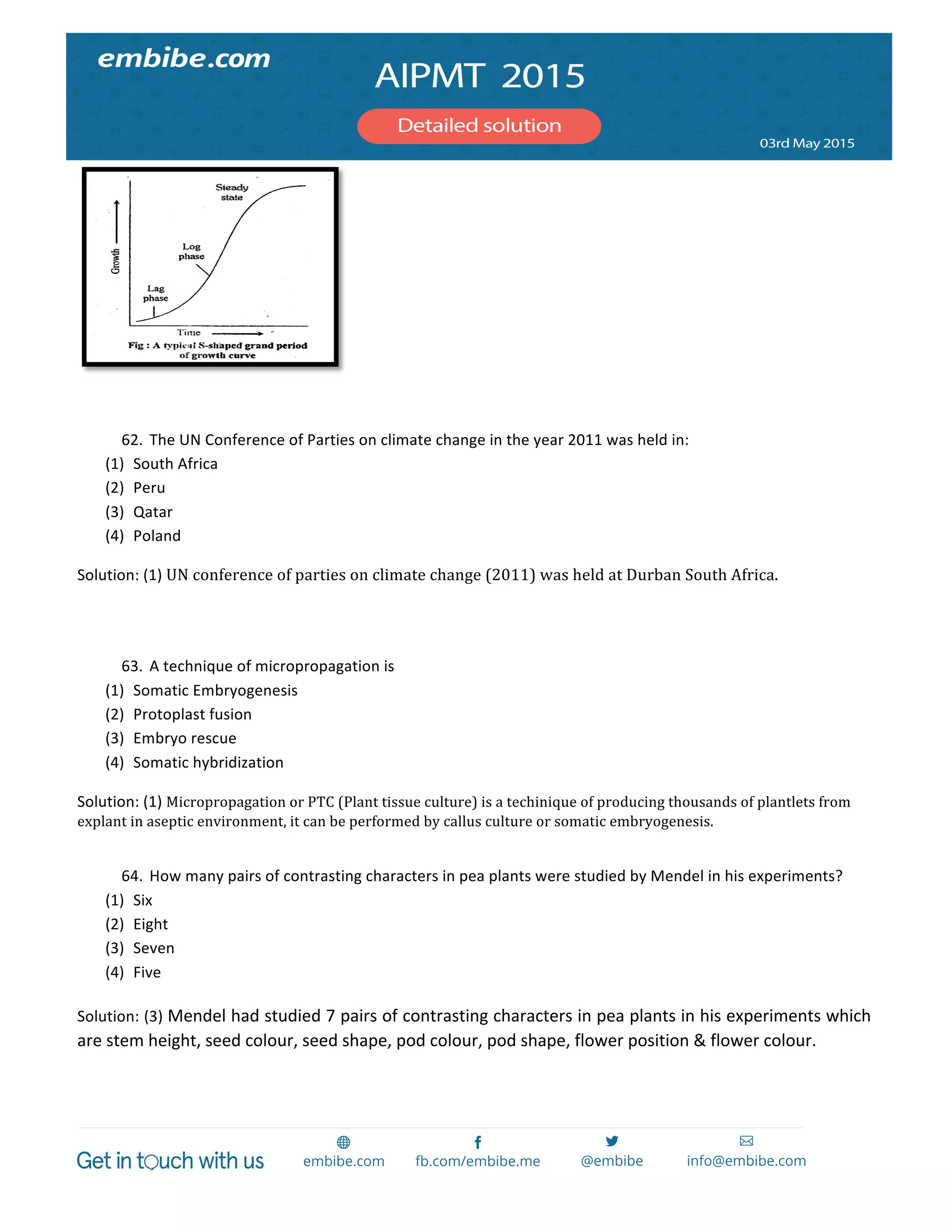
  growth	
  curve	
  in	
  plants	
  is:	
  
(1) Linear	
  
(2) Stair-­‐steps	
  shaped	
  
(3) Parabolic	
  
(4) Sigmoid	
  
Solution:	
  (4)	
  Growth	
  pattern	
  of	
  cell,	
  organisms	
  is	
  uniform	
  under	
  favourable	
  conditions	
  &	
  a	
  typical	
  growth	
  curve	
  in	
  
plants	
  is	
  sigmoidal.	
  Thus	
  following	
  phases	
  of	
  growth	
  are	
  recognized.	
  
(i)	
  Lag	
  phase:	
  In	
  lag	
  period	
  the	
  growth	
  is	
  slow.	
  It	
  represents	
  formative	
  or	
  cell	
  division	
  phase.	
  
(ii)	
  Log	
  phase:	
  Also	
  called	
  as	
  exponential	
  phase.	
  During	
  this	
  phase	
  growth	
  is	
  maximum	
  &	
  most	
  rapid.	
  It	
  represents	
  
cell	
  elongation	
  phase.	
  
(iii)	
  	
  Steady	
  or	
  stationary	
  phase:	
  It	
  represents	
  cell	
  maturation	
  phase.	
  
	
  Time	
  taken	
  in	
  growth	
  phases	
  (mainly	
  log	
  phase)	
  is	
  called	
  as	
  grand	
  period	
  of	
  growth.	


62. The	
  UN	
  Conference	
  of	
  Parties	
  on	
  climate	
  change	
  in	
  the	
  year	
  2011	
  was	
  held	
  in:	
  
(1) South	
  Africa	
  
(2) Peru	
  
(3) Qatar	
  
(4) Poland	
  
Solution:	
  (1)	
  UN	
  conference	
  of	
  parties	
  on	
  climate	
  change	
  (2011)	
  was	
  held	
  at	
  Durban	
  South	
  Africa.	


63. A	
  technique	
  of	
  micropropagation	
  is	
  
(1) Somatic	
  Embryogenesis	
  
(2) Protoplast	
  fusion	
  
(3) Embryo	
  rescue	
  
(4) Somatic	
  hybridization	
  
Solution:	
  (1)	
  Micropropagation	
  or	
  PTC	
  (Plant	
  tissue	
  culture)	
  is	
  a	
  techinique	
  of	
  producing	
  thousands	
  of	
  plantlets	
  from	
  
explant	
  in	
  aseptic	
  environment,	
  it	
  can	
  be	
  performed	
  by	
  callus	
  culture	
  or	
  somatic	
  embryogenesis.	


64. How	
  many	
  pairs	
  of	
  contrasting	
  characters	
  in	
  pea	
  plants	
  were	
  studied	
  by	
  Mendel	
  in	
  his	
  experiments?	
  
(1) Six	
  
(2) Eight	
  
(3) Seven	
  
(4) Five	
  
Solution:	
  (3)	
  Mendel	
  had	
  studied	
  7	
  pairs	
  of	
  contrasting	
  characters	
  in	
  pea	
  plants	
  in	
  his	
  experiments	
  which	
  
are	
  stem	
  height,	
  seed	
  colour,	
  seed	
  shape,	
  pod	
  colour,	
  pod	
  shape,	
  flower	
  position	
  &	
  flower	
  colour.	


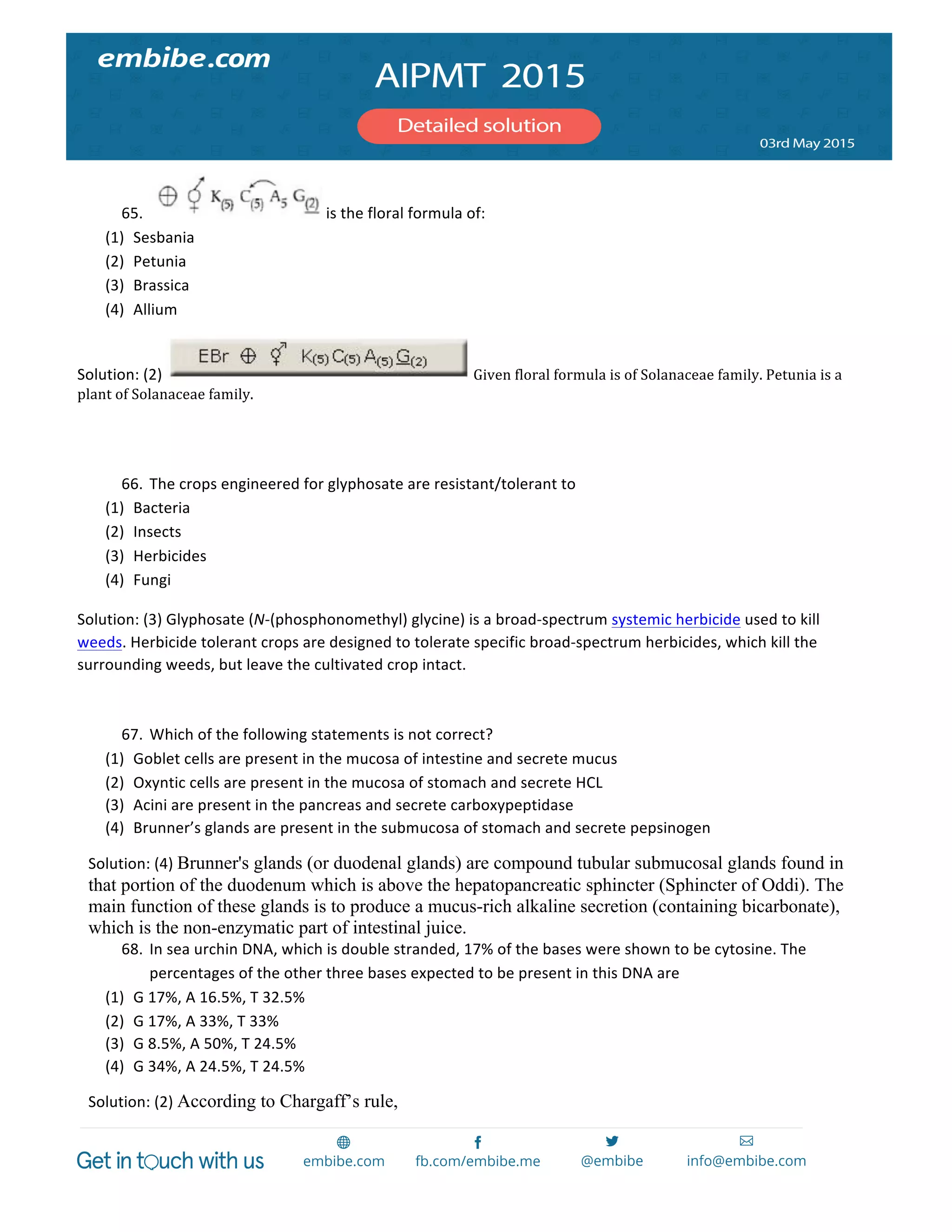
65. 	
  is	
  the	
  floral	
  formula	
  of:	
  
(1) Sesbania	
  
(2) Petunia	
  
(3) Brassica	
  
(4) Allium	
  
Solution:	
  (2)	
   	
  Given	
  floral	
  formula	
  is	
  of	
  Solanaceae	
  family.	
  Petunia	
  is	
  a	
  
plant	
  of	
  Solanaceae	
  family.	


66. The	
  crops	
  engineered	
  for	
  glyphosate	
  are	
  resistant/tolerant	
  to	
  
(1) Bacteria	
  
(2) Insects	
  
(3) Herbicides	
  
(4) Fungi	
  
Solution:	
  (3)	
  Glyphosate	
  (N-­‐(phosphonomethyl)	
  glycine)	
  is	
  a	
  broad-­‐spectrum	
  systemic	
  herbicide	
  used	
  to	
  kill	
  
weeds.	
  Herbicide	
  tolerant	
  crops	
  are	
  designed	
  to	
  tolerate	
  specific	
  broad-­‐spectrum	
  herbicides,	
  which	
  kill	
  the	
  
surrounding	
  weeds,	
  but	
  leave	
  the	
  cultivated	
  crop	
  intact.	


67. Which	
  of	
  the	
  following	
  statements	
  is	
  not	
  correct?	
  
(1) Goblet	
  cells	
  are	
  present	
  in	
  the	
  mucosa	
  of	
  intestine	
  and	
  secrete	
  mucus	
  
(2) Oxyntic	
  cells	
  are	
  present	
  in	
  the	
  mucosa	
  of	
  stomach	
  and	
  secrete	
  HCL	
  
(3) Acini	
  are	
  present	
  in	
  the	
  pancreas	
  and	
  secrete	
  carboxypeptidase	
  
(4) Brunner’s	
  glands	
  are	
  present	
  in	
  the	
  submucosa	
  of	
  stomach	
  and	
  secrete	
  pepsinogen	
  
Solution:	
  (4)	
  Brunner's glands (or duodenal glands) are compound tubular submucosal glands found in
that portion of the duodenum which is above the hepatopancreatic sphincter (Sphincter of Oddi). The
main function of these glands is to produce a mucus-rich alkaline secretion (containing bicarbonate),
which is the non-enzymatic part of intestinal juice.
68. In	
  sea	
  urchin	
  DNA,	
  which	
  is	
  double	
  stranded,	
  17%	
  of	
  the	
  bases	
  were	
  shown	
  to	
  be	
  cytosine.	
  The	
  
percentages	
  of	
  the	
  other	
  three	
  bases	
  expected	
  to	
  be	
  present	
  in	
  this	
  DNA	
  are	
  
(1) G	
  17%,	
  A	
  16.5%,	
  T	
  32.5%	
  
(2) G	
  17%,	
  A	
  33%,	
  T	
  33%	
  
(3) G	
  8.5%,	
  A	
  50%,	
  T	
  24.5%	
  
(4) G	
  34%,	
  A	
  24.5%,	
  T	
  24.5%	
  
Solution:	
  (2)	
  According to Chargaff’s rule,


A = T, G = C
C = 17% So G = 17%
A+G / T+C =1
A + G + C + T = 100
A + 17 + 17 + T = 100
A + T = 100 – 34
So A = 33%, T = 33% = 66


69. In	
  Bt	
  cotton,	
  the	
  Bt	
  toxin	
  present	
  in	
  plant	
  tissue	
  as	
  pro-­‐toxin	
  is	
  converted	
  into	
  active	
  toxin	
  due	
  to:	
  
(1) Acidic	
  pH	
  of	
  the	
  insect	
  gut	
  
(2) Action	
  of	
  gut	
  micro-­‐organisms	
  
(3) Presence	
  of	
  conversion	
  factors	
  in	
  insect	
  gut	
  
(4) Alkaline	
  pH	
  of	
  the	
  insect	
  gut	
  
Solution:	
  (4)	
  Bacillus	
  thurigensis	
  which	
  contain	
  cry	
  protein	
  in	
  inactive	
  form	
  known	
  as	
  pro-­‐toxin.	
  when	
  this	
  is	
  
ingested	
  by	
  insect	
  it	
  get	
  activated	
  by	
  alkaline	
  ph	
  of	
  gut,	
  which	
  solubilise	
  the	
  protein	
  crystal.	
  This	
  activated	
  toxin	
  
bind	
  to	
  the	
  epithelial	
  midgut	
  cell	
  result	
  into	
  lysis	
  of	
  epithelial	
  cell	
  and	
  eventually	
  lead	
  to	
  the	
  death	
  of	
  insect.	


70. Cytochromes	
  are	
  found	
  in:	
  
(1) Outer	
  wall	
  of	
  mitochondria	
  
(2) Cristae	
  of	
  mitochondria	
  
(3) Lysosomes	
  
(4) Matrix	
  of	
  mitochondria	
  
Solution:	
  (2)	
  Cytochromes are the Iron containing electron acceptors, which are present on inner
mitochondrial membrane, called cristae, helpful in ETS.


71. Read	
  the	
  following	
  five	
  statements	
  (A	
  to	
  E)	
  and	
  select	
  the	
  option	
  with	
  all	
  correct	
  statements:	
  
(A) Mosses	
  and	
  Lichens	
  are	
  the	
  first	
  organisms	
  to	
  colonise	
  a	
  bare	
  rock.	
  
(B) Selaginella	
  is	
  a	
  homosporous	
  pteridophyte.	
  
(C) Coralloid	
  roots	
  in	
  Cycas	
  have	
  VAM.	
  
(D) Main	
  plant	
  body	
  in	
  bryophytes	
  is	
  gametophytic,	
  whereas	
  in	
  pteridophytes	
  it	
  is	
  sporophytic.	


(E) In	
  gymnosperms,	
  male	
  and	
  female	
  gametophytes	
  are	
  present	
  with	
  in	
  sporangia	
  located	
  on	
  sporophytes.	
  
(1) (B),	
  (C)	
  and	
  (D)	
  
(2) (A),	
  (D)	
  and	
  (E)	
  
(3) (B),	
  (C)	
  and	
  (E)	
  
(4) (A),	
  (C)	
  and	
  (D)	
  
Solution:	
  (2)	
  Mosses	
  are	
  found	
  in	
  moist,	
  shady	
  places	
  ,moist	
  rocks,	
  damp	
  walls	
  or	
  on	
  tree	
  trunks	
  as	
  well	
  as	
  lichens	
  
grow	
  on	
  rock	
  surfaces	
  &	
  	
  named	
  by	
  Theophrastus	
  are	
  the	
  first	
  organisms	
  to	
  colonise	
  bare	
  rock.	
  
Main	
  plant	
  body	
  in	
  bryophytes	
  is	
  gametophyte	
  because	
  gametophyte	
  is	
  dominant	
  over	
  sporophyte	
  as	
  
gametophyte	
  is	
  branched,	
  haploid,	
  long	
  lived	
  and	
  independent	
  whereas	
  sporophyte	
  is	
  diploid	
  short	
  lived	
  and	
  
dependent	
  upon	
  gametophyte.	
  Main	
  plant	
  body	
  in	
  pteridophyte	
  is	
  sporophyte.	


72. Which	
  one	
  of	
  the	
  following	
  is	
  correct?	
  
(1) Serum	
  =	
  Blood	
  +	
  Fibrinogen	
  
(2) Lymph	
  =	
  Plasma	
  +	
  RBC	
  +	
  WBC	
  
(3) Blood	
  =	
  Plasma	
  +	
  RBC	
  +	
  WBC	
  +	
  Platelets	
  
(4) Plasma	
  =	
  Blood	
  –	
  Lymphocytes	
  
Solution:	
  (3)	
  Blood is a liquid connective tissue which contains plasma, RBCs, WBCs & Platelet. In
animals it delivers necessary substances such as nutrients and oxygen to the cells and transports
metabolic waste products away from those same cells.
73. The	
  movement	
  of	
  a	
  gene	
  from	
  one	
  linkage	
  group	
  to	
  another	
  is	
  called:	
  
(1) Duplication	
  
(2) Translocation	
  
(3) Crossing	
  over	
  
(4) Inversion	
  
Solution:	
  (2)	
  A set of genes at different loci on the same chromosome tend to act as a single pair of genes in meiosis
instead of undergoing independent assortment. Chromosome translocation is a chromosome abnormality caused by
rearrangement of parts between non-homologous chromosomes. Hence in translocation there is movement of gene
from one linkage group to another and lead to change the position of gene.
74. Which	
  body	
  of	
  the	
  Government	
  of	
  India	
  regulates	
  GM	
  research	
  and	
  safety	
  of	
  introducing	
  GM	
  organisms	
  
for	
  public	
  services?	
  
(1) Indian	
  Council	
  of	
  Agricultural	
  Research	
  
(2) Genetic	
  Engineering	
  Approval	
  Committee	
  
(3) Research	
  Committee	
  on	
  Genetic	
  Manipulation	


(4) Bio-­‐safety	
  committee	
  
Solution:	
  (2)	
  Genetic	
  Engineering	
  Approval	
  Committee	
  regulates	
  GM	
  research	
  and	
  safety	
  of	
  introducing	
  GM	
  
organisms	
  for	
  public	
  services.	


75. Rachel	
  Carson’s	
  famous	
  book	
  ‘’Silent	
  Spring’’	
  is	
  related	
  to:	
  
(1) Noise	
  pollution	
  
(2) Population	
  explosion	
  
(3) Ecosystem	
  management	
  
(4) Pesticide	
  pollution	
  
Solution:	
  (4)	
  Rachel Carson’s book “Silent Spring” is related to pesticide pollution which documented	
  the	
  
detrimental	
  effects	
  on	
  the	
  environment	
  particularly	
  on	
  birds	
  by	
  the	
  indiscriminate	
  use	
  of	
  pesticides.	
  Carson	
  
accused	
  the	
  chemical	
  industry	
  of	
  spreading	
  disinformation	
  and	
  public	
  officials	
  of	
  accepting	
  industry	
  claims	
  
unquestioningly.	


76. Gastric	
  juice	
  of	
  infants	
  contains:	
  
(1) Nuclease,	
  pepsinogen,	
  lipase	
  
(2) Pepsinogen,	
  lipase,	
  rennin	
  
(3) Amylase,	
  rennin,	
  pepsinogen	
  
(4) Maltase,	
  pepsinogen,	
  rennin	
  
Solution:	
  (2)	
  Gastric acid is a digestive fluid, formed in the stomach. In infants, it primarily has the ability
to digest milk protein by enzyme rennin, along with small amounts of pepsinogen & lipase.


77. Which	
  of	
  the	
  following	
  is	
  not	
  one	
  of	
  the	
  prime	
  health	
  risks	
  associated	
  with	
  greater	
  UV	
  radiation	
  through	
  
the	
  atmosphere	
  due	
  to	
  depletion	
  of	
  stratospheric	
  ozone?	
  
(1) Reduced	
  Immune	
  System	
  
(2) Damage	
  to	
  eyes	
  
(3) Increased	
  liver	
  cancer	
  
(4) Increased	
  skin	
  cancer	
  
Solution:	
  (3)	
  Due	
  to	
  the	
  depletion	
  of	
  stratospheric	
  ozone	
  there	
  are	
  a	
  few	
  prime	
  health	
  risks	
  associated	
  with	
  the	
  
greater	
  UV	
  radiation	
  through	
  the	
  atmosphere	
  and	
  they	
  are	
  increased	
  risks	
  of	
  skin	
  cancer,	
  reduced	
  immune	
  
system	
  and	
  damage	
  to	
  eyes.	


78. Capacitation	
  refers	
  to	
  changes	
  in	
  the:	
  
(1) Ovum	
  before	
  fertilization	


(2) Ovum	
  after	
  fertilization	
  
(3) Sperm	
  after	
  fertilization	
  
(4) Sperm	
  before	
  fertilization	
  
Solution:	
  (4)	
  Sperm capacitation refers to the physiological changes spermatozoa must undergo in order
to have the ability to penetrate and fertilize an egg. The changes take place via the sperm cell membrane
in which it may be that receptors are made available through the removal of a glycoprotein layer. The
area of the acrosomal cap is also so altered thereby that the acrosome reaction becomes possible.


79. Most	
  animals	
  are	
  tree	
  dwellers	
  in	
  a:	
  
(1) Thorn	
  woodland	
  
(2) Temperate	
  deciduous	
  forest	
  
(3) Tropical	
  rain	
  forest	
  
(4) Coniferous	
  forest	
  
Solution:	
  (3)	
  Most	
  animals	
  are	
  tree	
  dwellers	
  in	
  tropical	
  rain	
  forests	
  because	
  rainforests have a canopy which is
the layer of branches and leaves formed by closely spaced rainforest trees and most of the tree dwellers live in
the canopy.
	
  
80. True	
  nucleus	
  is	
  absent	
  in:	
  
(1) Mucor	
  
(2) Vaucheria	
  
(3) Volvox	
  
(4) Anabaena	
  
Solution:	
  (4)	
  Anabaena	
  cells	
  do	
  not	
  have	
  any	
  organelles	
  so	
  they	
  do	
  not	
  have	
  a	
  nucleus.	
  This	
  is	
  because	
  they	
  can	
  
perform	
  photosynthesis	
  in	
  their	
  own	
  cell	
  membrane.	


81. Glenoid	
  cavity	
  articulates:	
  
(1) Scapula	
  with	
  acromion	
  
(2) Clavicle	
  with	
  scapula	
  
(3) Humerus	
  with	
  scapula	
  
(4) Clavicle	
  with	
  acromion	
  
Solution:	
  (3)	
  The glenoid cavity (or glenoid fossa of scapula) is a part of the shoulder, located on the
lateral angle of the scapula. It is directed laterally and forward and articulates with the head of the
humerus.


82. Transmission	
  tissue	
  is	
  characteristic	
  feature	
  of:	
  
(1) Solid	
  style	
  
(2) Dry	
  stigma	
  
(3) Wet	
  stigma	
  
(4) Hollow	
  style	
  
Solution:	
  (1)	
  Transmission	
  tissue	
  is	
  characteristic	
  feature	
  of	
  solid	
  style.	
  They	
  are	
  located	
  in	
  centre	
  of	
  style	
  
and	
  cytoplasm	
  of	
  these	
  cells	
  are	
  rich	
  in	
  organelles.	
  It	
  is	
  essential	
  for	
  pollen	
  tube	
  growth,	
  because	
  of	
  the	
  
nutrients	
  and	
  guidance.	
  It	
  also	
  regulates	
  GSI	
  (Gametophytic	
  self	
  –	
  Incompatibility)	
  in	
  style.	


83. DNA	
  is	
  not	
  present	
  in:	
  
(1) Ribosomes	
  
(2) Nucleus	
  
(3) Mitochondria	
  
(4) Chloroplast	
  
Solution:	
  (1)	
  The	
  ribosome	
  is	
  a	
  cellular	
  machine	
  which	
  is	
  highly	
  complex	
  and	
  is	
  made	
  up	
  of	
  dozens	
  of	
  distinct	
  
protein	
  as	
  well	
  as	
  a	
  few	
  specialized	
  RNA	
  molecules	
  known	
  as	
  ribosomal	
  RNA	
  (rRNA)	
  and	
  does	
  not	
  contain	
  DNA	


84. Gene	
  regulation	
  governing	
  lactose	
  operon	
  of	
  E.coli	
  that	
  involves	
  the	
  lac	
  I	
  gene	
  product	
  is:	
  
(1) Negative	
  and	
  inducible	
  because	
  repressor	
  protein	
  prevents	
  transcription	
  
(2) Negative	
  and	
  repressible	
  because	
  repressor	
  protein	
  prevents	
  transcription	
  
(3) Feedback	
  inhibition	
  because	
  excess	
  of	
   𝛽-­‐	
  galactosidase	
  can	
  switch	
  off	
  transcription	
  
(4) Positive	
  and	
  inducible	
  because	
  it	
  can	
  be	
  induced	
  by	
  lactose	
  
Solution:	
  (1)	
  In negative regulation, a repressor molecule binds to the operator of an operon and
terminates transcription. The lac operon is a negatively controlled inducible operon, where the inducer
molecule is allolactose.


85. Which	
  of	
  the	
  following	
  does	
  not	
  favour	
  the	
  formation	
  of	
  large	
  quantities	
  of	
  dilute	
  urine?	
  
(1) Caffeine	
  
(2) Renin	
  
(3) Atrial	
  –	
  natriuretic	
  factor	
  
(4) Alcohol	
  
Solution:	
  (2)	
  Renin does not favor for the formation of large quantities of dilute urine as it activates
RAAS (Renin angiotensin activating system) so it causes reabsorption of sodium which leads to
formation of concentrated urine.


86. What	
  causes	
  a	
  green	
  plant	
  exposed	
  to	
  the	
  light	
  on	
  only	
  one	
  side,	
  to	
  bend	
  toward	
  the	
  source	
  of	
  light	
  as	
  
it	
  grows?	
  
(1) Green	
  plants	
  seek	
  light	
  because	
  they	
  are	
  phototropic.	
  
(2) Light	
  stimulates	
  plant	
  cells	
  on	
  the	
  lighted	
  side	
  to	
  grow	
  faster.	
  
(3) Auxin	
  accumulates	
  on	
  the	
  shaded	
  side,	
  stimulating	
  greater	
  cell	
  elongation	
  there.	
  
(4) Green	
  plants	
  need	
  light	
  to	
  perform	
  photosynthesis.	
  
Solution:	
  (3)	
  Auxins	
  accumulates	
  on	
  the	
  shaded	
  side,	
  stimulating	
  grater	
  cell	
  elongation	
  there.	
  Since	
  auxins	
  move	
  
from	
  morphological	
  apex	
  to	
  morphological	
  base	
  therefore	
  gets	
  accumulated	
  on	
  the	
  shaded	
  side.	
  Thus	
  
plants	
  exposed	
  to	
  the	
  light	
  on	
  only	
  one	
  side	
  bends	
  towards	
  the	
  source	
  of	
  light.	
  It	
  is	
  also	
  due	
  to	
  the	
  tropic	
  
movement	
  of	
  auxins	
  which	
  causes	
  phototropism	
  and	
  geotropism	
  in	
  plants.	


87. Nuclear	
  envelope	
  is	
  a	
  derivative	
  of:	
  
(1) Membrane	
  of	
  Golgi	
  complex	
  
(2) Microtubules	
  
(3) Rough	
  endoplasmic	
  reticulum	
  
(4) Smooth	
  endoplasmic	
  reticulum	
  
Solution:	
  (3)	
  Rough endoplasmic reticulum form the nuclear envelop during karyokinesis. The nuclear
membrane (outer) is contiguous with the endoplasmic reticulum.


88. Select	
  the	
  correct	
  option:	
  
	
   I	
   	
   II	
  
(a)	
   Synapsis	
  aligns	
  homologous	
  
chromosomes	
  
(i)	
   Anaphase	
  –	
  II	
  
(b)	
   Synthesis	
  of	
  RNA	
  and	
  protein	
   (ii)	
   Zygotene	
  
(c)	
   Action	
  of	
  enzyme	
  recombinase	
   (iii)	
   𝐺!	
  –	
  phase	
  
(d)	
   Centromeres	
  do	
  not	
  separate	
  but	
  
chromatids	
  move	
  towards	
  opposite	
  
poles	
  
(iv)	
   Anaphase	
  –	
  I	


   (v)	
   Pachytene	


(1)
(𝑎)
(𝑖𝑖)
	
  
(𝑏)
(𝑖𝑖𝑖)
	
  
(𝑐)
(𝑣)
	
  
(𝑑)
(𝑖𝑣)


(2)
𝑎
𝑖
	
  
𝑏
𝑖𝑖
	
  
𝑐
𝑣
	
  
𝑑
𝑖𝑣


(3)
(𝑎)
(𝑖𝑖)
	
  
(𝑏)
(𝑖𝑖𝑖)
	
  
(𝑐)
(𝑖𝑣)
	
  
(𝑑)
(𝑣)


(4)
(𝑎)
(𝑖𝑖)
	
  
(𝑏)
(𝑖)
	
  
(𝑐)
(𝑖𝑖𝑖)
	
  
(𝑑)
(𝑖𝑣)
	
  
Solution:	
  (1)	
  Synapsis of homologous chromosome – Zygotene
Synthesis of RNA & protein – 𝐺! phase
Action of enzyme recombinase – Pachytene
Centromeres do not separate but chromatid move towards opposite pole – Anaphase-I


89. Keel	
  is	
  the	
  characteristic	
  feature	
  of	
  flower	
  of:	
  
(1) Indigofera	
  
(2) Aloe	
  
(3) Tomato	
  
(4) Tulip	
  
Solution:	
  (1)	
  As	
  Indigofera	
  belongs	
  to	
  Family	
  Fabaceae.	
  This	
  family	
  was	
  earlier	
  called	
  Papilionoideae,	
  a	
  sub-­‐family	
  
of	
  family	
  Leguminosae.	
  Keel	
  is	
  a	
  characteristic	
  of	
  Family	
  Fabaecae	
  (enclosing	
  stamens	
  and	
  pistil)	


90. Perigynous	
  flowers	
  are	
  found	
  in:	
  
(1) Cucumber	
  
(2) China	
  rose	
  
(3) Rose	
  
(4) Guava	
  
Solution:	
  (3)	
  Perigynous	
  flower	
  means	
  thalamus	
  is	
  either	
  disc/cup/flasked	
  shaped.	
  Thalamus	
  of	
  rose	
  is	
  cup	
  
shaped,	
  ovary	
  lies	
  in	
  the	
  centre	
  of	
  thalamus,	
  all	
  the	
  whorls	
  arise	
  from	
  periphery	
  and	
  remain	
  at	
  the	
  same	
  level.	
  
Flowers	
  of	
  guava	
  and	
  cucumber	
  are	
  epigynous	
  (i.e.	
  gynoecium	
  is	
  completely	
  inserted	
  within	
  thalamus	


91. A	
  chemical	
  signal	
  that	
  has	
  both	
  endocrine	
  and	
  neural	
  roles	
  is:	
  
(1) Calcitonin	
  
(2) Epinephrine	
  
(3) Cortisol	
  
(4) Melatonin	
  
Solution:	
  (2)	
  Epinephrine (also known as adrenaline) is a hormone and a neurotransmitter.	


92. In	
  which	
  of	
  the	
  following	
  both	
  pairs	
  have	
  correct	
  combination?	
  
(1) In	
  situ	
  conservation:	
  Cryopreservation	


  Ex	
  situ	
  conservation:	
  Wildlife	
  Sanctuary	


(2) In	
  situ	
  conservation:	
  Seed	
  bank	


  Ex	
  situ	
  conservation:	
  National	
  Park	


(3) In	
  situ	
  conservation:	
  Tissue	
  culture	


  Ex	
  situ	
  conservation:	
  Sacred	
  groves	
  
(4) In	
  situ	
  conservation:	
  National	
  Park	


  Ex	
  situ	
  conservation:	
  Botanical	
  Garden	
  
Solution:	
  (4)	
  In	
  situ	
  conservation	
  is	
  the	
  conservation	
  of	
  resources	
  in	
  its	
  natural	
  populations.	
  Ex	
  situ	
  conservation	
  
is	
  the	
  conservation	
  of	
  resources	
  outside	
  its	
  habitat	
  maybe	
  wild	
  area	
  or	
  within	
  human	
  care.	
  Best	
  example	
  is	
  of	
  
botanical	
  gardens.	


93. HIV	
  that	
  causes	
  AIDS,	
  first	
  starts	
  destroying	
  :	
  
(1) Leucocytes	
  
(2) Helper	
  T	
  –	
  Lymphocytes	
  
(3) Thrombocytes	
  
(4) B	
  –Lymphocytes	
  
Solution:	
  (2)	
  HIV	
  that	
  causes	
  AIDS,	
  first	
  starts	
  destroying	
  helper	
  T-­‐lymphocytes	
  which	
  are	
  also	
  called	
  CD!	
  positive	
  
lymphocytes	
  because	
  HIV	
  uses	
  the	
  protein	
  CD!,	
  present	
  on	
  the	
  surface	
  of	
  the	
  cell,	
  to	
  attach	
  itself	
  and	
  pry	
  its	
  way	
  
into	
  the	
  cell.	


94. Hysterectomy	
  is	
  surgical	
  removal	
  of	
  
(1) Prostate	
  gland	
  
(2) Vas-­‐deference	
  
(3) Mammary	
  glands	
  
(4) Uterus	


Solution:	
  (4)	
  Hystero is the term used for uterus. Hysterectomy is the surgical removal of the uterus. It
may also involve removal of the cervix, ovaries, fallopian tubes and other surrounding structures.
95. Removal	
  of	
  proximal	
  convoluted	
  tubule	
  from	
  the	
  nephron	
  will	
  result	
  in:	
  
(1) More	
  concentrated	
  urine	
  
(2) No	
  change	
  in	
  quality	
  and	
  quantity	
  of	
  urine	
  
(3) No	
  urine	
  formation	
  
(4) More	
  diluted	
  urine	
  
Solution:	
  (4)	
  The question is wrongly framed in concept. Hence no appropriate answer which is
absolutely correct, can be found.
Still the least incorrect answer can be (1) because maximum reabsorption of filtrate (70%) occurs from
P.C.T.
Hence removal of PCT will increase the urine volume.


96. A	
  major	
  characteristic	
  of	
  the	
  monocot	
  root	
  is	
  the	
  presence	
  of:	
  
(1) Scattered	
  vascular	
  bundles	
  
(2) Vasculature	
  without	
  cambium	
  
(3) Cambium	
  sandwiched	
  between	
  phloem	
  and	
  xylem	
  along	
  the	
  radius	
  
(4) Open	
  vascular	
  bundles	


Solution:	
  (2)	
  Vascular	
  cambia	
  are	
  found	
  in	
  dicots	
  and	
  gymnosperms	
  but	
  not	
  in	
  monocots	
  because	
  radial	
  vascular	
  
bundle	
  is	
  present	
  in	
  monocot	
  root	
  in	
  which	
  cambium	
  is	
  not	
  present.	


97. Which	
  of	
  the	
  following	
  characteristics	
  is	
  mainly	
  responsible	
  for	
  diversification	
  of	
  insects	
  on	
  land?	
  
(1) Bilateral	
  symmetry	
  
(2) Exoskeleton	
  
(3) Eyes	
  
(4) Segmentation	
  
Solution:	
  (2)	
  Exoskeleton	
  plays	
  a	
  role	
  in	
  defence	
  from	
  the	
  prey	
  and	
  is	
  also	
  an	
  important	
  characteristic	
  in	
  
diversification	
  of	
  many	
  species.	
  E.g.:	
  Insects	
  having	
  chitin	
  as	
  the	
  form	
  of	
  exoskeleton.	


98. Which	
  of	
  the	
  following	
  cells	
  during	
  gametogenesis	
  is	
  normally	
  diploid?	
  
(1) Spermatid	


(2) Spermatogonia	
  
(3) Secondary	
  polar	
  body	
  
(4) Primary	
  polar	
  body	
  
Solution:	
  (2)	
  Spermatogonia or the sperm mother cell is diploid while all other cells are formed in later
steps of spermatogenesis during mitotic cell division.


99. The	
  structures	
  that	
  are	
  formed	
  by	
  stacking	
  of	
  organized	
  flattened	
  membranous	
  sacs	
  in	
  the	
  chloroplasts	
  
are:	
  
(1) Grana	
  
(2) Stroma	
  lamellae	
  
(3) Stroma	
  
(4) Cristae	
  
Solution:	
  (1)	
  Cristae	
  found	
  in	
  mitochondria.	
  
Stroma	
  lamellae,	
  they	
  are	
  thylakoids	
  that	
  cross	
  the	
  stroma	
  of	
  a	
  chloroplast,	
  interconnecting	
  the	
  grana.	
  
Stroma	
  is	
  the	
  matrix	
  of	
  a	
  chloroplast.	


100. The	
  chromosomes	
  in	
  which	
  centromere	
  is	
  situated	
  close	
  to	
  one	
  end	
  are:	
  
(1) Acrocentric	
  
(2) Telocentric	
  
(3) Sub-­‐metacentric	
  
(4) Metacentric	
  
Solution:	
  (1)	
  Metacentric	
  chromosomes	
  has	
  centromere	
  in	
  the	
  middle	
  position.	
  
Telocentric	
  chromosomes	
  has	
  centromere	
  at	
  the	
  terminal	
  position.	
  
Submetacentric	
  chromosomes	
  has	
  centromere	
  near	
  the	
  centre	
  but	
  not	
  in	
  the	
  middle.	


101. In	
  a	
  ring	
  girdled	
  plant:	
  
(1) The	
  root	
  dies	
  first	
  
(2) The	
  shoot	
  and	
  root	
  die	
  together	
  
(3) Neither	
  root	
  nor	
  shoot	
  will	
  die	
  
(4) The	
  shoot	
  dies	
  first	


Solution:	
   (1)	
   In	
   a	
   ring	
   girdled	
   plant	
   the	
   root	
   dies	
   first.	
   Like	
   all	
   vascular	
   plants,	
   trees	
   use	
   two	
   vascular	
  
tissues	
  for	
  transportation	
  of	
  water	
  and	
  nutrients:	
  the	
  xylem	
  (also	
  known	
  as	
  the	
  wood),	
  and	
  the	
  phloem	
  
(the	
  innermost	
  layer	
  of	
  the	
  bark).	
  Girdling	
  results	
  in	
  the	
  removal	
  of	
  the	
  phloem,	
  and	
  death	
  occurs	
  from	
  
the	
  inability	
  of	
  the	
  leaves	
  to	
  transport	
  sugars	
  (primarily	
  sucrose)	
  to	
  the	
  roots.	


102. Vertical	
  distribution	
  of	
  different	
  species	
  occupying	
  different	
  levels	
  in	
  a	
  biotic	
  community	
  is	
  known	
  
as:	
  
(1) Stratification	
  
(2) Zonation	
  
(3) Pyramid	
  
(4) Divergence	
  
Solution:	
  (1)	
  By	
  the	
  definition	
  of	
  stratification,	
  it	
  is	
  the	
  distribution	
  of	
  a	
  community	
  in	
  different	
  levels	
  by	
  various	
  
socioeconomic	
  means.	


103. Multiple	
  alleles	
  are	
  present;	
  
(1) At	
  different	
  loci	
  on	
  the	
  same	
  chromosome	
  
(2) At	
  the	
  same	
  locus	
  of	
  the	
  chromosomes	
  
(3) On	
  non-­‐sister	
  chromatids	
  
(4) On	
  different	
  chromosomes	
  
Solution:	
  (2)	
  Multiple	
  alleles	
  is	
  a	
  type	
  of	
  non-­‐Mendelian	
  inheritance	
  pattern	
  that	
  involves	
  more	
  than	
  just	
  the	
  
typical	
  two	
  alleles	
  that	
  usually	
  code	
  for	
  a	
  certain	
  characteristic	
  in	
  a	
  species.	


104. The	
  mass	
  of	
  living	
  material	
  at	
  a	
  trophic	
  level	
  at	
  a	
  particular	
  time	
  is	
  called:	
  
(1) Standing	
  state	
  
(2) Net	
  primary	
  productivity	
  
(3) Standing	
  crop	
  
(4) Gross	
  primary	
  productivity	
  
Solution:	
  (3)	
  Biomass	
  is	
  the	
  mass	
  of	
  the	
  living	
  material	
  present	
  at	
  a	
  given	
  time	
  at	
  a	
  particular	
  
trophic	
  level,	
  also	
  called	
  as	
  standing	
  crop.	


105. Which	
  of	
  the	
  following	
  animals	
  is	
  not	
  viviparous?	
  
(1) Elephant	
  
(2) Platypus	


(3) Whale	
  
(4) Flying	
  Fox	
  (Bat)	
  
Solution:	
  (2)	
  Platypus	
  is	
  an	
  oviparous	
  mammal	
  i.e.	
  it	
  lays	
  eggs	
  whereas	
  the	
  remaining	
  are	
  viviparous.	


106. In	
  an	
  ecosystem	
  the	
  rate	
  of	
  production	
  of	
  organic	
  matter	
  during	
  photosynthesis	
  is	
  termed	
  as:	
  
(1) Gross	
  primary	
  productivity	
  
(2) Secondary	
  productivity	
  
(3) Net	
  productivity	
  
(4) Net	
  primary	
  productivity	
  
Solution:	
  (1)	
  Gross	
  primary	
  productivity	
  is	
  amount	
  of	
  organic	
  matter	
  produced	
  at	
  given	
  length	
  of	
  time	
  during	
  
photosynthesis.	


107. Erythropoiesis	
  starts	
  in:	
  
(1) Liver	
  
(2) Spleen	
  
(3) Red	
  bone	
  marrow	
  
(4) Kidney	
  
Solution:	
  (3)	
  Erythropoiesis	
  starts	
  in	
  liver	
  and	
  spleen	
  in	
  a	
  foetus	
  whereas	
  in	
  adults	
  it	
  starts	
  in	
  the	
  red	
  bone	
  
marrow.	
  As	
  we	
  cannot	
  opt	
  for	
  two	
  options	
  (spleen	
  and	
  liver)	
  simultaneously	
  which	
  are	
  for	
  foetus,	
  therefore	
  the	
  
answer	
  is	
  red	
  bone	
  marrow	


108. Which	
  is	
  the	
  most	
  common	
  mechanism	
  of	
  genetic	
  variation	
  in	
  the	
  population	
  of	
  sexually-­‐
reproducing	
  organism?	
  
(1) Chromosomal	
  aberrations	
  
(2) Genetic	
  Drift	
  
(3) Recombination	
  
(4) Transduction	
  
Solution:	
  (3)	
  The	
  most	
  common	
  mechanism	
  of	
  genetic	
  variation	
  is	
  recombination.	
  In	
  sexually	
  reproducing	
  
organism	
  during	
  gametogenesis,	
  the	
  homologus	
  chromosomes	
  exchanges	
  genetic	
  material	
  by	
  process	
  of	
  crossing	
  
over.	
  This	
  produces	
  new	
  combination.	
  It	
  is	
  responsible	
  for	
  variation.	


109. Blood	
  pressure	
  in	
  the	
  mammalian	
  aorta	
  is	
  maximum	
  during:	
  
(1) Diastole	
  of	
  the	
  right	
  ventricle	
  
(2) Systole	
  of	
  the	
  left	
  ventricle	
  
(3) Diastole	
  of	
  the	
  right	
  atrium	
  
(4) Systole	
  of	
  the	
  left	
  atrium	
  
Solution:	
  (2)	
  Left ventricular systole drives blood through the aortic valve (AoV) to the body and organs
excluding the lungs. Hence B.P. in Aorta will be maximum when left ventricle pumps the stroke volume
into its lumen during its systole.	


110. When	
  you	
  hold	
  your	
  breath,	
  which	
  of	
  the	
  following	
  gas	
  changes	
  in	
  blood	
  would	
  first	
  lead	
  to	
  the	
  
urge	
  to	
  breathe?	
  
(1) Rising	
  CO!	
  concentration	
  
(2) Falling	
  CO!	
  concentration	
  
(3) Rising	
  CO!	
  and	
  falling	
  O!	
  concentration	
  
(4) Falling	
  O!	
  concentration	
  
Solution:	
  (1)	
  Rise in CO! concentration stimulates chemoreceptors present in aorta and carotid artery which
stimulates respiratory centre. Respiratory centre is not directly sensitive to oxygen concentration & hence
desire to breath is induced by rise in 𝐶𝑂! concentration of blood.
111. Vascular	
  bundles	
  in	
  monocotyledons	
  are	
  considered	
  closed	
  because:	
  
(1) Cambium	
  is	
  absent	
  
(2) There	
  are	
  no	
  vessels	
  with	
  perforations	
  
(3) Xylem	
  is	
  surrounded	
  all	
  around	
  by	
  phloem	
  
(4) A	
  bundle	
  sheath	
  surrounds	
  each	
  bundle	
  
Solution:	
  (1)	
  The	
  vascular	
  bundles	
  of	
  monocotyledonous	
  plants	
  do	
  not	
  contain	
  a	
  layer	
  of	
  meristematic	
  tissue	
  
(cambium)	
  as	
  the	
  dicots	
  do.	
  Thus	
  no	
  new	
  cells	
  can	
  be	
  formed	
  inside	
  the	
  vascular	
  bundles	
  of	
  monocots	
  and	
  their	
  
vascular	
  bundles	
  are	
  termed	
  closed	
  whereas	
  those	
  of	
  dicot	
  plants	
  are	
  open.	


112. Male	
  gametes	
  are	
  flagellated	
  in:	
  
(1) Anabaena	
  
(2) Ectocurpus	
  
(3) Spirogyra	
  
(4) Polysiphonia	


Solution:	
  (2)	
  Ectocarpus	
  gametes	
  and	
  spores	
  are	
  characterized	
  by	
  two	
  flagella	
  .Male	
  and	
  female	
  gametes	
  are	
  
morphologically	
  identical	
  in	
  Ectocarpus	
  but	
  differ	
  with	
  respect	
  to	
  their	
  physiology	
  and	
  their	
  behavior.	
  Female	
  
gametes	
  settle	
  sooner	
  and	
  produce	
  a	
  pheromone	
  whilst	
  male	
  gametes	
  swim	
  for	
  longer	
  and	
  are	
  attracted	
  to	
  the	
  
pheromone	
  produced	
  by	
  the	
  female.	


113. Which	
  one	
  of	
  the	
  following	
  may	
  require	
  pollinators,	
  but	
  is	
  genetically	
  similar	
  to	
  autogamy?	
  
(1) Xenogamy	
  
(2) Apogamy	
  
(3) Cleistogamy	
  
(4) Geitonogamy	
  
Solution:	
  (4)	
  Geitonogamy	
  is	
  functionally	
  cross-­‐pollination	
  involving	
  a	
  pollinating	
  agent,	
  genetically	
  it	
  is	
  
similar	
  to	
  autogamy	
  since	
  the	
  pollen	
  grains	
  come	
  from	
  the	
  same	
  plant.	


114. In	
  ginger	
  vegetative	
  propagation	
  occurs	
  through:	
  
(1) Offsets	
  
(2) Bulbils	
  
(3) Runners	
  
(4) Rhizome	
  
Solution:	
   (4)	
   In	
   Ginger	
   vegetative	
   propagation	
   occurs	
   through	
   rhizome.	
   Rhizome	
   which	
   is	
   a	
   modified	
  
subterranean	
  stem	
  of	
  the	
  plant	
  that	
  is	
  usually	
  found	
  underground.	
  The	
  rhizome	
  retains	
  the	
  ability	
  to	
  
allow	
   new	
   shoots	
   to	
   grow	
   upwards.	
   The	
   plant	
   uses	
   rhizome	
   to	
   store	
   starch	
   &	
   protein.	
   If	
   Rhizome	
   is	
  
separated	
  into	
  pieces	
  each	
  piece	
  may	
  be	
  able	
  to	
  give	
  rise	
  to	
  a	
  new	
  plant.	
  This	
  is	
  called	
  as	
  vegetative	
  
propagation.	


115. Which	
  one	
  of	
  the	
  following	
  is	
  not	
  an	
  inclusion	
  body	
  found	
  in	
  prokaryotes?	
  
(1) Cyanophycean	
  Granule	
  
(2) Glycogen	
  Granule	
  
(3) Polysome	
  
(4) Phosphate	
  Granule	
  
Solution:	
  (3)	
  Polysomes	
  are	
  the	
  cell	
  organelle	
  found	
  in	
  cytoplasm	
  in	
  a	
  free	
  floating	
  form.	


116. A	
  somatic	
  cell	
  that	
  has	
  just	
  completed	
  the	
  S	
  phase	
  of	
  its	
  cell	
  cycle,	
  as	
  compared	
  to	
  gamete	
  of	
  the	
  
same	
  species,	
  has:	
  
(1) Same	
  number	
  of	
  chromosomes	
  but	
  twice	
  the	
  amount	
  of	
  DNA	


(2) Twice	
  the	
  number	
  of	
  chromosomes	
  and	
  four	
  times	
  the	
  amount	
  of	
  DNA	
  
(3) Four	
  times	
  the	
  number	
  of	
  chromosomes	
  and	
  twice	
  the	
  amount	
  of	
  DNA	
  
(4) Twice	
  the	
  number	
  of	
  chromosomes	
  and	
  twice	
  the	
  amount	
  of	
  DNA	
  
Solution:	
  (2)	
  S-phase (synthesis phase) is the part of the cell cycle in which DNA is replicated, but
number of chromosome does not change.
If a cell is diploid then after S phase DNA content in cell will be 4 C and Chromosome in cell will be 2
N.
While in gamete,
DNA content in gamete = C
Chromosome in gamete = N
Hence, Number of chromosome in somatic cell will be twice than gamete while DNA content will be
four times.


117. Alleles	
  are	
  
(1) True	
  breeding	
  homozygotes	
  
(2) Different	
  molecular	
  forms	
  of	
  a	
  gene	
  
(3) Heterozygotes	
  
(4) Different	
  phenotype	
  
Solution:	
  (2)	
  An allele or an allelomorph is one of a number of alternative forms of the same gene or
same genetic locus.


118. Select	
  the	
  correct	
  matching	
  in	
  the	
  following	
  pairs:	
  
(1) Smooth	
  ER	
  -­‐	
  Synthesis	
  of	
  lipids	
  
(2) Rough	
  ER	
  –	
  Synthesis	
  of	
  glycogen	
  
(3) Rough	
  ER	
  –	
  Oxidation	
  of	
  fatty	
  acids	
  
(4) Smooth	
  ER	
  -­‐	
  Oxidation	
  of	
  phospholipids	
  
Solution:	
  (1)	
  Synthesis	
  of	
  lipids	
  is	
  the	
  main	
  function	
  of	
  smooth	
  ER,	
  besides	
  this	
  smooth	
  ER	
  also	
  engaged	
  in	
  
synthesis	
  of	
  glycogen	
  and	
  steroids.	
  Rough	
  ER	
  is	
  responsible	
  for	
  protein	
  synthesis.	
  Oxidation	
  of	
  fatty	
  acids	
  
takes	
  place	
  in	
  microbodies	
  (Glyoxysomes).	


119. The	
  terga,	
  sterna	
  and	
  pleura	
  of	
  cockroach	
  body	
  are	
  joined	
  by	
  :	
  
(1) Muscular	
  tissue	
  
(2) Arthrodial	
  membrane	
  
(3) Cartilage	
  
(4) Cementing	
  glue	


Solution:	
  (2)	
  Tough flexible cuticle between the sclerotized parts (skeletal elements) that allows relative
movement is called as arthrodial membrane. The terga, sterna and pleura are chitinous plates which
covers cockroach body. These three are linked together by thin arthrodial membrane.
	
  
120. Which	
  of	
  the	
  following	
  represents	
  the	
  correct	
  combination	
  without	
  any	
  exception?	
  
(1) 	
  	
  
Characteristics	
   Class	
  
Mouth	
  ventral;	
  gills	
  without	
  operculum;	
  skin	
  
with	
  placoid	
  scales;	
  persistent	
  notochord	
  
Chondrichthyes	


(2) 	
  	
  
Characteristics	
   Class	
  
Sucking	
  and	
  circular	
  mouth;	
  jaws	
  absent,	
  
integument	
  without	
  scales;	
  paired	
  appendages	
  
Cyclostomata	


(3) 	
  	
  
Characteristics	
   Class	
  
Body	
  covered	
  with	
  feathers;	
  skin	
  moist	
  and	
  
glandular;	
  fore	
  –	
  limbs	
  form	
  wings;	
  lungs	
  with	
  air	
  
sacs	
  
Aves	


(4) 	
  	
  
Characteristics	
   Class	
  
Mammary	
  gland;	
  hair	
  on	
  body;	
  pinnae;	
  two	
  pairs	
  
of	
  limbs	
  
Mammalia	


Solution:	
  (1)	
  Mammalia:	
  pinnae	
  absent	
  in	
  whales.	
  
Cyclostomata:	
  paired	
  appendages	
  absent	
  in	
  Agnatha.	
  
Aves:	
  Almost	
  all	
  the	
  aves	
  show	
  presence	
  of	
  nonglandular	
  skin.	


121. Which	
  one	
  of	
  the	
  following	
  statements	
  is	
  incorrect?	
  
(1) In	
  competitive	
  inhibition,	
  the	
  inhibitor	
  molecule	
  is	
  not	
  chemically	
  changed	
  by	
  the	
  enzyme.	
  
(2) The	
  competitive	
  inhibitor	
  does	
  not	
  affect	
  the	
  rate	
  of	
  breakdown	
  of	
  the	
  enzyme-­‐substrate	
  complex.	
  
(3) The	
  presence	
  of	
  the	
  competitive	
  inhibitor	
  decreases	
  the	
  Km	
  of	
  the	
  enzyme	
  for	
  the	
  substrate.	
  
(4) A	
  competitive	
  inhibitor	
  reacts	
  reversibly	
  with	
  the	
  enzyme	
  to	
  form	
  an	
  enzyme-­‐inhibitor	
  complex.	
  
Solution:	
  (3)	
  Competitive inhibition is a form of enzyme inhibition where binding of the inhibitor to the
active site on the enzyme prevents binding of the substrate and vice versa. Presence of competitive
inhibitor, increase the Km constant of enzyme (and not decrease) while does not affects the Vmax as the
competitive inhibitor binds at active site, so decrease the affinity of enzyme for its substrate, so Km
constant increase. If substrate concentration is increased, inhibition over comes and attains normal
Vmax.
	
  
122. Which	
  of	
  the	
  following	
  regions	
  of	
  the	
  brain	
  is	
  incorrectly	
  paired	
  with	
  its	
  function?	
  
(1) Cerebellum	
  –	
  language	
  comprehension	
  
(2) Corpus	
  callosum	
  –	
  communication	
  between	
  the	
  left	
  and	
  right	
  cerebral	
  cortices	
  
(3) Cerebrum	
  –	
  calculation	
  and	
  contemplation	
  
(4) Medulla	
  oblongata	
  –	
  homeostatic	
  control	
  
Solution:	
  (1)	
  The cerebellum is involved in the coordination of voluntary motor movement, balance and
equilibrium and not language comprehension. It is located just above the brain stem and toward the back
of the brain.


123. Which	
  one	
  of	
  the	
  following	
  statements	
  is	
  not	
  true?	
  
(1) Pollen	
  grains	
  of	
  some	
  plants	
  cause	
  severe	
  allergies	
  and	
  bronchial	
  afflictions	
  in	
  some	
  people	
  
(2) The	
  flowers	
  pollinated	
  by	
  files	
  and	
  bats	
  secrete	
  foul	
  odour	
  to	
  attract	
  them	
  
(3) Honey	
  is	
  made	
  by	
  bees	
  by	
  digesting	
  pollen	
  collected	
  from	
  flowers	
  
(4) Pollen	
  grains	
  are	
  rich	
  in	
  nutrients,	
  and	
  they	
  are	
  used	
  in	
  the	
  form	
  of	
  tablets	
  and	
  syrups	
  
Solution:	
  (3)	
  Honey	
  is	
  made	
  by	
  bees	
  by	
  digesting	
  the	
  nectar	
  collected	
  from	
  flowers.	


124. The	
  active	
  form	
  of	
  Entamoeba	
  histolytica	
  feeds	
  upon:	
  
(1) Mucosa	
  and	
  submucosa	
  of	
  colon	
  only	
  
(2) Food	
  in	
  intestine	
  
(3) Blood	
  only	
  
(4) Erythrocytes	
  mucosa	
  and	
  submucosa	
  of	
  colon	


Solution:	
  (4)	
  The	
  active	
  form	
  of	
  Entamoeba	
  Histolytica	
  feeds	
  upon	
  erythrocytes,	
  mucosa	
  and	
  submucosa	
  of	
  
colon	
  as	
  it	
  causes	
  damage	
  by	
  lysis	
  of	
  epithelial	
  cells,	
  neutrophils	
  and	
  also	
  red	
  blood	
  cells.	


125. Which	
  of	
  the	
  following	
  viruses	
  is	
  not	
  transferred	
  through	
  semen	
  of	
  an	
  infected	
  male?	
  
(1) Human	
  immunodeficiency	
  virus	
  
(2) Chikungunya	
  virus	
  
(3) Ebola	
  virus	
  
(4) Hepatitis	
  B	
  virus	
  
Solution:	
  (2)	
  Chikungunya is a viral disease transmitted to humans by infected mosquitoes. It causes fever
and severe joint pain.


126. A	
  population	
  will	
  not	
  exist	
  in	
  Hardy-­‐Weinberg	
  equilibrium	
  if	
  :	
  
(1) There	
  are	
  no	
  mutation	
  
(2) There	
  is	
  no	
  migration	
  
(3) The	
  population	
  is	
  large	
  
(4) Individuals	
  mate	
  selectively	
  
Solution:	
  (4)	
  A	
  population	
  will	
  not	
  exist	
  in	
  Hardy-­‐Weinberg	
  equilibrium	
  if	
  the	
  individuals	
  mate	
  selectively	
  as	
  the	
  
mating	
  has	
  to	
  be	
  random	
  and	
  influences	
  like	
  mutation,	
  natural	
  selection	
  and	
  genetic	
  drift	
  affect	
  the	
  equilibrium.	


127. The	
  guts	
  of	
  cow	
  and	
  buffalo	
  possess:	
  
(1) Chlorella	
  spp.	
  
(2) Methanogens	
  
(3) Cyanobacteria	
  
(4) Fucus	
  spp.	
  
Solution:	
  (2)	
  The	
  Bovine	
  rumen	
  is	
  a	
  niche	
  that	
  has	
  a	
  narrow	
  pH	
  range	
  and	
  is	
  kept	
  fairly	
  stabilized,	
  so	
  that	
  the	
  
bacteria	
  in	
  the	
  rumen	
  as	
  well	
  as	
  the	
  intake	
  sacs	
  for	
  food	
  and	
  water	
  are	
  not	
  too	
  disturbed	
  The	
  organisms	
  
responsible	
  for	
  producing	
  methane	
  through	
  bovine	
  rumen	
  are	
  termed	
  methanogens	
  and	
  do	
  so	
  in	
  order	
  to	
  
reduce	
  the	
  amount	
  of	
  carbon	
  in	
  the	
  rumen	
  system	
  for	
  fermentation.	
  There	
  are	
  two	
  major	
  divisions	
  within	
  the	
  
methanogens	
  found	
  in	
  the	
  bovine	
  rumen.	
  The	
  Methanobrevibacter	
  ruminatium	
  and	
  the	
  Methanosphaera	
  
stadtmanae.	


128. The	
  hilum	
  is	
  a	
  scar	
  on	
  the:	
  
(1) Fruit,	
  where	
  it	
  was	
  attached	
  to	
  pedicel	


(2) Fruit,	
  where	
  style	
  was	
  present	
  
(3) Seed,	
  where	
  micropyle	
  was	
  present	
  
(4) Seed,	
  where	
  funicle	
  was	
  attached	
  
Solution:	
  (4)	
  Hilum	
  is	
  a	
  scar	
  on	
  the	
  surface	
  of	
  a	
  seed	
  marking	
  its	
  point	
  of	
  attachment	
  to	
  the	
  seed	
  stalk	
  
(funicle)	


129. Secondary	
  Succession	
  takes	
  place	
  on/in:	
  
(1) Degraded	
  forest	
  
(2) Newly	
  created	
  pond	
  
(3) Newly	
  cooled	
  lava	
  
(4) Bare	
  rock	
  
Solution:	
  (1)	
  Secondary	
  succession	
  usually	
  occurs	
  on	
  pre-­‐existing	
  soil.	
  This	
  is	
  mainly	
  triggered	
  due	
  to	
  various	
  
mechanisms	
  that	
  cause	
  forest	
  degradation	
  etc.	


130. Which	
  one	
  of	
  the	
  following	
  statements	
  is	
  wrong?	
  
(1) Agar-­‐agar	
  is	
  obtained	
  from	
  Gelidium	
  and	
  Gracilaria	
  
(2) Chlorella	
  and	
  Spirulina	
  and	
  used	
  a	
  space	
  food	
  
(3) Mannitol	
  is	
  stored	
  food	
  in	
  Rhodophyceae	
  
(4) Algin	
  and	
  carrageen	
  are	
  products	
  of	
  algae	
  
Solution:	
  (3)	
  Mannitol	
  is	
  the	
  stored	
  food	
  in	
  Phaeophyceae	
  (brown	
  algae)	
  In	
  RHODOPHYCEAE	
  stored	
  food	
  is	
  
floridean	
  starch.	


131. The	
  following	
  graph	
  depicts	
  changes	
  in	
  two	
  populations	
  (A	
  and	
  B)	
  of	
  herbivores	
  in	
  a	
  grassy	
  field.	
  A	
  
possible	
  reason	
  for	
  these	
  changes	
  is	
  that.	


(1) Population	
  B	
  composed	
  more	
  successfully	
  for	
  food	
  than	
  population	
  A	
  
(2) Population	
  A	
  produced	
  more	
  offspring	
  than	
  population	
  B	
  
(3) Population	
  A	
  consumed	
  the	
  members	
  of	
  population	
  B	
  
(4) Both	
  plant	
  populations	
  in	
  this	
  habitat	
  decreased	
  
Solution:	
  (1)	
  Population B competed more successfully for food than population A and hence due to this success
was able to increase the number of its offsprings.


132. Match	
  each	
  disease	
  with	
  its	
  correct	
  type	
  of	
  vaccine:	
  
(a) 	
   Tuberculosis	
   (i)	
   Harmless	
  virus	
  
(b) 	
   Whooping	
  
cough	
  
(ii)	
   Inactivated	
  toxin	
  
(c) 	
   Diphtheria	
   (iii)	
   Killed	
  bacteria	
  
(d) 	
   Polio	
   (iv)	
   Harmless	
  bacteria	


(1) 	
  	
  
(a)	
   (b)	
   (c)	
   (d)	
  
(iii)	
   (ii)	
   (iv)	
   (i)	


(2) 	
  	
  
(a)	
   (b)	
   (c)	
   (d)	
  
(iv)	
   (iii)	
   (ii)	
   (i)	
  
(3) 	
  	
  
(a)	
   (b)	
   (c)	
   (d)	
  
(i)	
   (ii)	
   (iv)	
   (iii)	


(4) 	
  	
  
(a)	
   (b)	
   (c)	
   (d)	


(ii)	
   (i)	
   (iii)	
   (iv)	


Solution:	
  (2)	
  Tuberculosis	
  –	
  Harmless	
  bacteria	
  –	
  Mycobacterium	
  tuberculosis	


  Whooping	
  cough	
  –	
  Killed	
  Bacteria	
  -­‐	
  Bordetella	
  pertussis	
  bacterium	


  Diptheria	
  –	
  Inactivated	
  Toxin	
  –	
  Corynebacterium	
  diphtheriae	


  Polio	
  –	
  harmless	
  virus	
  –	
  Poliovirus	


133. Which	
  of	
  the	
  following	
  are	
  the	
  important	
  floral	
  rewards	
  to	
  the	
  animal	
  pollinators?	
  
(1) Nectar	
  and	
  pollen	
  grains	
  
(2) Floral	
  fragrance	
  and	
  calcium	
  crystals	
  
(3) Protein	
  pellicle	
  and	
  stigmatic	
  exudates	
  
(4) Colour	
  and	
  large	
  size	
  of	
  flower	
  
Solution:	
   (1)	
   The	
   important	
   floral	
   rewards	
   to	
   the	
   animal	
   pollinators	
   are	
   nectar	
   &	
   pollen	
   grain.	
   Plants	
  
attract	
  pollinators	
  to	
  their	
  flowers	
  by	
  advertising	
  their	
  floral	
  rewards	
  i.e.	
  nectar	
  &	
  pollen	
  grain.	
  They	
  take	
  
the	
  advantage	
  of	
  the	
  fact	
  that	
  the	
  animals	
  can	
  see,	
  smell	
  &	
  taste	
  by	
  evolving	
  different	
  different	
  flower	
  
sizes,	
  shapes,	
  colors	
  and	
  scents	
  to	
  selectively	
  attract	
  pollinators.	


134. An	
  abnormal	
  human	
  baby	
  with	
  ‘XXX’	
  sex	
  chromosomes	
  was	
  born	
  due	
  to:	
  
(1) Formation	
  of	
  abnormal	
  ova	
  in	
  the	
  mother	
  
(2) Fusion	
  of	
  two	
  ova	
  and	
  one	
  sperm	
  
(3) Fusion	
  of	
  two	
  sperms	
  and	
  ovum	
  
(4) Formation	
  of	
  abnormal	
  sperms	
  in	
  the	
  father	
  
Solution:	
  (1)	
  Formation of abnormal ova i.e., 22 + XX in the mother will lead to birth of baby with
‘XXX’ genotype, due to chromosomal non disjunction in ova. Nondisjunction is the failure of the
chromosomes to disjoin and move to opposite poles.


135. Transpiration	
  and	
  root	
  pressure	
  cause	
  water	
  to	
  rise	
  in	
  plants	
  by:	
  
(1) Pulling	
  and	
  pushing	
  it,	
  respectively	
  
(2) Pushing	
  it	
  upward	
  
(3) Pushing	
  and	
  pulling	
  it,	
  respectively	
  
(4) Pulling	
  it	
  upward	


Solution:	
  (1)	
  In	
  transpiration	
  water	
  rises	
  in	
  plant	
  due	
  to	
  strong	
  cohesive	
  force	
  of	
  transpiration	
  pull	
  in	
  which	
  water	
  
is	
  pulled	
  (absorbed)	
  from	
  soil	
  to	
  roots,	
  roots	
  to	
  stem,	
  stem	
  to	
  xylem	
  of	
  leaf	
  and	
  lastly	
  xylem	
  to	
  vein	
  of	
  leaf	
  
which	
  is	
  then	
  evaporated.	
  
Whereas,	
  root	
  pressure	
  causes	
  passive	
  absorption	
  of	
  water	
  resulting	
  in	
  rise	
  of	
  water	
  in	
  plants	
  i.e.	
  it	
  creates	
  
tension	
  in	
  xylem	
  elements	
  which	
  is	
  transmitted	
  downwards	
  up	
  to	
  the	
  root	
  hair,	
  as	
  a	
  result	
  roots	
  are	
  
subjected	
  to	
  tension	
  and	
  suction	
  is	
  set	
  up	
  in	
  xylem;	
  hence	
  water	
  is	
  pulled	
  inside	
  the	
  roots.	


Physics	
  
136. An electron moving in a circular orbit of radius r makes n rotations per second. The magnetic field produced at the center
has magnitude :
(1) Zero
(2)
µμ0n2e
r
(3)
µμ0ne
2r
(4)
µμ0ne
2πr
Solution: (3)
                𝑞 = 𝑒
                𝑖 =
𝑞
𝑇
=
𝑒
𝑇
        𝑔𝑖𝑣𝑒𝑛      𝜔 = 2𝜋𝑛.
⇒           
𝑒
2𝜋
𝜔
=
𝑒𝜔
2𝜋  
=
2𝜋𝑛𝑒
2𝜋
  
          𝑖 = 𝑛𝑒.
      𝐵 =
𝜇! 𝑖
2𝑅
=
𝜇! 𝑛𝑒
2𝑅


137. One mole of an ideal diatomic gas undergoes a transition from A to B along a path AB as shown in the figure,
The change in internal energy of the gas during the transition is:
(1) −20   kJ
(2) 20  J
(3) −12 kJ
(4) 20 kJ
Solution: (1)
ΔU = nC!ΔT
T =
PV
nR
ΔT =
P!V! − P!V!
nR
ΔU =
nR
γ − 1
  
P!V! − P!V!
nR
=
P!V! − P!V!
γ − 1
= −
8×10!
2
5
= −20  kJ
138. When two displacements represented by y1
= a  sin  (ωt) and y2
= b cos ωt are superimposed the motion is:
(1) Simple harmonic with amplitude
a
b
(2) Simple harmonic with amplitude a2 + b2
(3) Simple harmonic with amplitude
a+b
2


(4) Not a simple harmonic
Solution: (2)
y1
= a sin ωt
y2
= b cos ωt = b sin ωt +
π
2
Amplitude A = a! + b! + 2ab cos
!
!
A = a! + b!
Since the frequency for both motion are same, then the resultant motion will be SHM.
139. A	
  particle	
  of	
  unit	
  mass	
  undergoes	
  one-­‐dimensional	
  motion	
  such	
  that	
  its	
  velocity	
  varies	
  according	
  to	
  v x =
βx!!"
,	
  where	
  β	
  and	
  n	
  are	
  constants	
  and	
  x	
  is	
  the	
  position	
  of	
  the	
  particle.	
  The	
  acceleration	
  of	
  the	
  particle	
  as	
  a	
  
function	
  x,	
  is	
  given	
  by:	
  
(1) −2nβ!
  x!!"!!
	
  
(2) −2nβ!
  x!!"!!
	
  
(3) −2nβ!
e!!"!!
	
  
(4) −2nβ!
  x!!"!!
	
  
Solution:	
  (1)	
  
a =
dv
dx
=
d
dx
βx!!"
	
  
= −2nβx!!"!!
×βx!!"
	
  
= −2nβ!
x!!"!!


140. If radius of the Al13
27
nucleus is taken to be RAl then the radius of Te53
125
nucleus is nearly:
(A)   
(B)
3
5
RAl
(C)
13
53
1
3
  RAl


(D)
53
13
1
3
  RAl
Solution: (1)
We	
  know,	
  
Radius	
  of	
  the	
  nucleus	
  is	
  R = R!   mass  Number
!
!	


R = R!A
!
!
RAl
RTe
=
27
725
1
3
=
3
5
RTe =
5
3
RAl
141. In a double slit experiment, the two slits are 1 mm apart and the screen is placed 1 m away. A monochromatic light of
wavelength 500 nm is used. What will be the width of each slit for obtaining ten maxima of double slit within the central
maxima of single slit pattern?
(1) 0.1 mm
(2) 0.5 mm
(3) 0.02 mm
(4) 0.2 mm
Solution: (4)
𝑑   = 1  𝑚𝑚 = 1×10!!
  𝑚
𝐷 = 1  𝑚.          ,        𝜆 = 500×10!!
  𝑚
Width of central maximum = width of maxima
𝛽
𝐷
=   
𝜆𝐷
𝑑
𝐷
=
𝜆
𝑑
Angular width of central maxima in single
Slit experiment =
!!
!!
As per the question


10𝜆
𝑑
=
2𝜆
𝑑′
𝑑′
= 0.2𝑑 = 0.2𝑚𝑚.
142. For a parallel beam of monochromatic light of wavelength ‘λ’ , diffraction is produced by a single slit whose width 'a' is
of the order of the wavelength of the light. If 'D' is the distance of the screen from the slit, the width of the central
maxima will be :
(1)
Dλ
a
(2)
Da
λ
(3)
2Da
λ
(4)
2Dλ
a
Solution: (4)
Linear width of central maximum.
𝐷   2𝜃 = 2𝐷𝜃 =
2𝐷𝜆
𝑎
143. Across a metallic conductor of non-uniform cross section a constant potential difference is applied. The quantity which
remains constant along the conductor is:
(1) Current
(2) Drift velocity
(3) Electric field
(4) Current density
Solution: (1)


Correct flow A cross the metallic conductor remains constant because remains constant because the area of cross
section of conductor is non-uniform is non-uniform so. Current density will be different but the number of flow of electrons
will be same.
144. On observing light from three different stars P,Q and R, it was found that intensity of violet colour is maximum
in the spectrum of P, the intensity of green colour is maximum in the spectrum of R and the intensity of red
colour is maximum in the spectrum of Q. If Tp, TQ and TR are the respective absolute temperatures of P, Q and
R, then it can be concluded from the above observations that :
(1) TP > TR > TQ
(2) TP < TR < TQ
(3) TP < TQ < TR
(4) TP > TQ > TR
Solution: (1)
From Wein’s Displacement law,
λmT = constant   ⇒ λm ∝
1
T
  
From the light spectrum,
λm P < λm R < λm Q
Hence,
TP > TR > TQ
145. A potentiometer wire has length 4 m and resistance 8Ω. The resistance that must be connected in series with the wire and
an accumulator of e.m.f. 2V, so as to get a potential gradient 1 mV per cm on the wire is :
(1) 40  Ω
(2) 44  Ω
(3) 48  Ω
(4) 32  Ω
Solution: (4)
𝑑𝑉
𝑑𝑡
   =   
1𝑚𝑉
𝑐𝑚
For a potentiometer
1  𝑐𝑚 of wire has 1  𝑚𝑉 of voltage


400  𝑐𝑚 has 0.4𝑉.
Given R must be connected in series
Δ𝑉 = 0.4 =
2
8 + 𝑅  
×8
8 + 𝑅 =
16
0.4
=
160
4
= 40
⇒             𝑅 = 32Ω
146. Consider 3rd
orbit of He!
(helium), using non-relativistic approach, the speed of electron in this orbit will be [given
K = 9×10!
constant, Z = 2 and h (Planck’s Constant) = 6.6×10!!"
Js]
(1) 1.46×10!
  m s
(2) 0.73×10!
  m s
(3) 3.0×10!
  m s
(4) 2.92×10!
  m s
Solution: (1)
Energy of electron He!
= −13.6
Z!
n!
ev; Z = 2, n = 3
E3 =    −13.6  
2
3
2
×1.6×10−19  J
In Bohr’s model energy E= - KE
E3 = −KE3
∴ 9.7×10!!"
=
1
2
meV!
v =   
2×9.7×10!!"
9.1×10!!"
Velocity of electron in 3rd
orbit of He!
is 1.46×10!
m/s
147. A wire carrying current I has the shape as shown in adjoining figure. Linear parts of the wire are very long and parallel to
X-axis while semicircular portion of radius R is lying in Y-Z plane. Magnetic field at point O is :


(1) B = −
µμ0
4π
I
R
   πi − 2k
(2) B = −
µμ0
4π
I
R
   πi + 2k
(3) B =
µμ0
4π
I
R
   πi − 2k
(4) B = −
µμ0
4π
I
R
   πi + 2k
Solution: (2)
𝐵 𝑐        =        𝐵1 + 𝐵2 + 𝐵3.
𝐵1      =       
𝜇0
4𝜋𝑅
       sin 90 + 𝑠𝑖𝑛𝜃 − 𝑘
𝐵1      =       
𝜇0
4𝜋𝑅
       −𝑘 = 𝐵3
B due to segment 2
𝐵2    =       
𝜇0  𝐼
4𝜋
×𝜋 − 𝑖 =
𝜇0 𝐼
4𝑅
= 𝑖
So B at center       𝐵! =    𝐵! +   𝐵! + 𝐵!
𝐵 𝑐 =   
−𝜇0 𝐼
4𝑅
   𝑖 +
2𝑘
𝜋
=   
−𝜇0 𝐼
4𝜋𝑅
  (𝜋  𝑖 + 2𝑘)
148. Which of the following figures represent the variation of particle momentum and the associated de-Broglie wavelength?
(1)


(2)
(3)
(4)
Solution: (1)
λ =
h
p
pλ = h
λp = h Same as xy = c
P ∝
!
!
(Rectangles hyperbola)


149. A parallel plate air capacitor of capacitance C is connected to a cell of emf V and then disconnected from it. A
dielectric slab of dielectric constant K, which can just fill the air gap of the capacitor, is now inserted in it.
Which of the following is incorrect?
(1) The energy stored in the capacitor decreases K times
(2) The change in energy stored is
1
2
CV2 1
K
− 1
(3) The charge on the capacitor is not conserved
(4) The potential difference between the plates decreases K times
Solution: (3)
For air 𝑘 = 1
        𝐶1 = 𝐶
            𝑞 = 𝐶! 𝑉                   … (𝑖)
Charge remains constant
𝑈1 =
𝑞2
2𝑐
𝑈2 =
𝑞2
2𝑐𝑘
Change in Energy stored in Capacitor
                            𝑈 = 𝑈! − 𝑈!
    =
!!
!!
  
!
!
− 1       ⇒     
!
!
  𝐶𝑉!
  (
!
!
− 1)
                         𝑉ʹ′ =
!
!"
      ⇒        𝑉ʹ′ =
!
!
  
Here 1- Potential difference between the plates decreases by k times
2- The change in energy stored     𝑈
!
!
  𝐶𝑉!
  
!
!
− 1
3- Charge is conserved
4- The energy stored in capacitor decrease by 𝐾  𝑈! =
!
!
!!
!"
  .
150. The fundamental frequency of a closed organ pipe of length 20 cm is equal to the second overtone of an
organ pipe open at both the ends. The length of organ pipe at both the ends is:
(1) 100 cm


(2) 120 cm
(3) 140 cm
(4) 80 cm
Solution: (2)
For closed organ pipe,
nc =
V
4ℓ𝓁
For open organ pipe,
n0 =
V
2ℓ𝓁′
For the second overtone of open organ pipe,
n′
= 3n0 =
3V
2ℓ𝓁′
nc = n′
V
4ℓ𝓁
=
3V
2ℓ𝓁′
ℓ𝓁′
= 6ℓ𝓁 = 6×20
ℓ𝓁′
= 120  cm
151. The refracting angle of a prism is A, and refractive index of the material of the prism is cot
A
2
. The angle of minimum
deviation is :-
(1) 180o
− 2A
(2) 900
− A
(3) 1800
+ 2A
(4) 180o
− 3A
Solution: (1)
µμ =   
sin
δm + A
2
  
sin
A
2


∵   µμ = cot
A
2


∴ cot
A
2
=  
sin
δm + A
2
sin
A
2


cos
A
2
= sin
δm + A
2


π
2
−
A
2
=   
δm + A
2


δm = π − 2A	


152. Which logic gate is represented by the following combination of logic gates?
(1) NAND
(2) AND
(3) NOR
(4) OR
Solution: (2)
y1
=    A  , y2
= B
y = y! + y! = A + B
Using De-Morgan’s theorem
Truth table:
A B y1
y2
y
0 0 1 1 0
0 1 1 0 0


1 0 0 1 0
1 1 0 0 1
  
153. A Carnot engine, having an efficiency of η =
!
!"
as heat engine, is used as refrigerator. If the work done on the
system is 10 J, the amount of energy absorbed from the reservoir at lower temperature is:  
(1) 99 J
(2) 90 J
(3) 1 J
(4) 100 J
Solution: (2)
For engine and refrigeration operating between two same temperature,
η =
1
1 + β
1
10
=
1
1 + β
⇒ β = 9
From the principle of refrigerator,
Q2
W
= β
Q2
10
= 9
Q2
= 90 Joule.
154. A certain metallic surface is illuminated with monochromatic light of wavelength, λ. The stopping potential for photo-
electric current for this light is 3V!. If the same surface is illuminated with light of wavelength2λ, the stopping potential
is V0. The threshold wavelength for this surface for photoelectric effect is:
(1) 4λ
(2)
λ
4
(3)
λ
6
(4) 6λ
Solution: (1)


eV! = E − ϕ ⇒ V!
Vs =
hc
λe
−
hc
λ0e
3V! =
!"
!!
−
!"
!!!
…(i)
V0 =
hc
2λe
−
hc
λ0e
   …(ii)
by solving i. and ii
0 = −
hc
2λe
+
2hv
λ!e
λ0 = 4λ
155. A radiation of energy ‘E’ falls normally on a perfectly reflecting surface. The momentum transferred to the surface is (C
= Velocity of light) :-
(1)
2E
C
(2)
2E
C2
(3)
E
C2
(4)
E
C
Solution: (1)
𝐸 =
ℎ𝑐
𝜆
𝑃 =
ℎ
𝜆
    ⇒   𝑃 =
𝐸
𝐶
Initial momentum of light when falls on a perfectly reflecting surface.
𝑃𝑖 =
𝐸
𝐶
  
When it is reflected momentum is in opposite direction


𝑃 𝑓 = −
𝐸
𝐶
Net momentum = 𝑃! − 𝑃!
=   −
𝐸
𝐶
−
𝐸
𝐶
= −
2𝐸
𝐶
−  Δ𝑃 =
!!
!
156. A mass m moves in a circle on a smooth horizontal plane with velocity v0 at a radius R0. The mass is attached
to a string which passes through a smooth hole in plane as shown.
The tension in the string is increased gradually and finally m moves in a circle of radius
R0
2
. The final value
of the kinetic energy is:
(1)
1
4
mv0
2
(2) 2  mv!
!
(3)
1
2
mv0
2
(4) mv!
!
Solution: (2)
From conservation of angular momentum.
mv!R! = mv!
R!
2
⇒ v!
= 2v!
Hence, final KE =
!
!
mv!"
=
!
!
m 2v!
!
= 2mv!
!
157. Two identical thin Plano-convex glass lenses (refractive index 1.5) each having radius of curvature of 20 cm are placed
with their convex surfaces in contact at the center. The intervening space is filled with oil of refractive index 1.7. The
focal length of the combination is :-


(1) −25  cm
(2) −50  cm
(3) 50  cm
(4) −20  cm
Solution: (2)
Len’s maker’s formula
1
𝑓
       𝜇 − 1
1
𝑅1
−
1
𝑅2
1
𝑓1
= 𝜇 − 1
1
  20
   ⇒      1.5 − 1   
1
20
=
1
40
  
1
𝑓1
=
1
40
For lens
1
𝑓1
+
1
𝑓2
   =   
1
40
+
1
40
=
1
20
  
For concave
1
𝑓3
= 1.7 − 1   (−
1
𝑅
−
1
𝑅
  )
=   
−0.7×2
𝑅
1
𝑓 𝑒𝑞
=
1
20
+  
−0.7×2
𝑅
=
1
20
  −  
1.4
20
  
𝑓 𝑒𝑞
=    −
20
0.4
   = −50  𝑐𝑚
158. A	
  block	
  A	
  of	
  mass	
  m!	
  rests	
  on	
  a	
  horizontal	
  table.	
  A	
  light	
  string	
  connected	
  to	
  it	
  passes	
  over	
  a	
  frictionless	
  
pulley	
  at	
  the	
  edge	
  of	
  table	
  and	
  from	
  its	
  other	
  end	
  another	
  block	
  B	
  of	
  mass	
  m!	
  is	
  suspended.	
  The	
  coefficient	
  
of	
  kinetic	
  friction	
  between	
  the	
  block	
  and	
  the	
  table	
  is	
  µμ!.	
  When	
  the	
  block	
  A	
  is	
  sliding	
  on	
  the	
  table,	
  the	
  tension	
  
in	
  string	
  is:	


(1)
!!!!!!! !
!!!!!


(2)
!!!! !!!! !
!!!!!


(3)
!!!! !!!! !
!!!!!


(4)
!!!!!!! !
!!!!!
	
  
Solution:	
  	
  (2)	


From	
  the	
  figure,	
  
m!g − T − m!a	
  …(i)	
  
T − µμ!m!g = m!a	
  …(ii)	
  
i   x  m!	
  and	
  (ii)	
  x  m!	
  
m!m!g − Tm! = m!m!a	
  
Tm! − µμ!m!m!g = m!m!a	
  
m!m!g − Tm! = Tm! − µμ!m!m!g	
  
m!m!g 1 + µμ! = T m! + m! 	


159. A particle is executing SHM along a straight line. Its velocities at distances x1 and x2 from the mean position
are V1 and V2 respectively. Its time period is:
(1) 2π
!!
!!!!
!
!!
!!!!
!
(2) 2π
!!
!!!!
!
!!
!!!!
!
(3) 2π
!!
!!!!
!
!!
!!!!
!


(4) 2π
!!
!!!!
!
!!
!!!!
!
Solution: (1)
For particle undergoing SHM,
V = ω A! − x! ⇒ V!
= ω!
   A!
− x!
V1 = ω A2
− x1
2
⇒ V1
2
= ω2
A2
− x1
2
…(i)
V2 = ω A2
− x2
2
   ⇒ V2
2
= ω2
A2
− x2
2
…(ii)
V1
2
− V2
2
= ω2
x2
2
− x1
2
ω =
V!
!
− V!
!
x!
!
− x!
!
T = 2π
x!
!
− x!
!
V!
!
− V!
!
	
  
∴ T =
m!m!g 1 + µμ!
m! + m!


160. A	
  ship	
  A	
  is	
  moving	
  Westwards	
  with	
  a	
  speed	
  of	
  10  kmh!!
	
  and	
  a	
  ship	
  B	
  100	
  km	
  south	
  of	
  A,	
  is	
  moving	
  
Northwards	
  with	
  a	
  speed	
  of	
  10  km  h!!
.	
  The	
  time	
  after	
  which	
  the	
  distance	
  between	
  them	
  becomes	
  shortest,	
  
is:	
  	
  
(1) 5  h	
  
(2) 5 2  h	
  
(3) 10 2  h	
  
(4) 0  h	
  	
  
Solution:	
  (1)	


Relative	
  velocity	
  of	
  ship	
  B	
  is,	


V!" = 10!   + 10! = 10 2  kmph	
  
Let	
  shortest	
  distance	
  between	
  ship	
  A	
  &	
  B	
  is	
  AO,	
  
Distance	
  OB = 100 cos 45!
= 50 2  km	
  
Hence	
  time	
  taken	
  to	
  reach	
  the	
  shortest	
  distance,	
  	
  
t =
50 2
10 2
= 5hrs	


161. A rod of weight W is supported by two parallel knife edges A and B and is in equilibrium in a horizontal
position. The knives are at a distance d from each other. The centre of mass of the rod is at distance x from A.
the normal reaction on A is:
(1)
Wd
x
(2)
W d−x
x
(3)
W d−x
d
(4)
Wx
d
Solution: (3)
Equation for force balance
NA + NB = W …(i)
NB = W − NA
Equation for torque balance about centre of mass of rod.
NAx = NB d − x
NAx = W − NA d − x
NAx = Wd − Wx − NAd + NAx


NAd = W d − x
NA =
W d − x
d
162. The approximate depth of an ocean is 2700 m. The compressibility of water is 45.4×10!!!
  Pa!!
and density of
water is 103 kg
m3
. What fractional compression of water will be obtained at the bottom of the ocean?
(1) 1.0×10!!
(2) 1.2×10!!
(3) 1.4×10!!
(4) 0.8×10!!
Solution: (2)
Pressure at the bottom of ocean
P = ρgd
= 10!
×10×2700
= 27×10!
Pa
∴ Fractional compression = compressibility × pressure
= 45.4×10!!!
Pa!!
×27×10!
Pa
= 1.2×10!!
163. Two particles of masses m1, m2 move with initial velocities u1 and u2 . On collision, one of the particles get
excited to higher level, after absorbing energy ε If final velocities of particles be v1 and v2 then we must have:
(1)
1
2
m1u1
2
+
1
2
m2u2
2
=
1
2
m1v1
2
+
1
2
m2v2
2
− ε
(2)
1
2
m1u1
2
+
1
2
m2u2
2
− ε =
1
2
m1v1
2
+
1
2
m2v2
2
(3)
1
2
m1
2
u1
2
+
1
2
m2
2
u2
2
+ ε =
1
2
m1
2
v1
2
+
1
2
m2
2
v2
2
(4) m1
2
u1 + m2
2
u2 − ε = m1
2
v1 + m2
2
v2
Solution: (2)
From conservation of energy initial total energy
1
2
m1u1
2
+
1
2
m2u2
2


After collision total final energy
1
2
m1v1
2
+
1
2
m2v2
2
+ ε
∴
1
2
m!u!
!
+
1
2
m!u!
!
=
1
2
m!v!
!
+
1
2
m!v!
!
+ ε
1
2
m1u1
2
+
1
2
m2u2
2
− ε =
1
2
m1v1
2
+
1
2
m2v2
2
164. Kepler's third law states that square of period of revolution (T) of a planet around the sun, is proportional to
third power of average distance r between sun and planet i.e., T2
= Kr3
here K is constant. If the masses of sun and planet are M and m respectively then as per Newton's law of
gravitation force of attraction between them is
F =
!"#
!! , here G is gravitational constant
The relation between G and K is described as:
(1) GMK = 4π!
(2) K = G
(3) K =
!
!
(4) GK = 4π!
Solution: (1)
Here gravitational force is equal to centripetal force required for motion of planet.
Hence,
GMm
r2
=
mv2
r
v2
=
GM
r
Time period is given by,
T =
2πr
v
T2
=
4π2
r2
v2
T2
=
4π2
r2
Gm
r
=
4π2
r3
GM


We have given,
T2
= kr3
On comparing,
k =
!!!
!"
⇒ GMk = 4π!
165. A	
  block	
  of	
  mass	
  10	
  kg,	
  moving	
  in	
  x	
  direction	
  with	
  a	
  constant	
  speed	
  of	
  10  ms!!
,	
  is	
  subjected	
  to	
  a	
  retarding	
  
force	
  F = 0.1  x	
  J/m	
  during	
  its	
  travel	
  from	
  x	
  =	
  20	
  m	
  to	
  30m.	
  Its	
  final	
  KE	
  	
  will	
  be:	
  
(1) 450	
  J	
  
(2) 275	
  J	
  
(3) 250	
  J	
  
(4) 475	
  J	
  
Solution:	
  (4)	
  
m = 10  kg, v = 10  ms!!
	
  
Final	
  KE	
  will	
  be	
  given	
  by	
  
KE! = KE! +  ∆W. D	
  
=
1
2
mv!
+ −0.1  xdx
!"
!"
	
  
=
1
2
×10×100 + −0.1   
    x!
2 !"
!"
  	
  
= 500 +
−0.1
2
900 − 400 	
  
KE! = 500 +
−0.1 500
2
	
  
= 475	
  J	


166. A wind with speed 40 m/s blows parallel to the roof of a house. The area of the roof is 250  m!
. Assuming that
the pressure inside the house is atmospheric pressure, the force exerted by the wind on the roof and the
direction of the direction of the force will be : Pair = 1.2
kg
m3
  
(1) N, upwards  
  
(2) N, upwards  


(3) N, downwards  
  
(4) N, downwards  
Solution: (2)
By Bernoulli’s equation,
P +
1
2
PV!
= P! + 0
P0 − P =
1
2
PV2
F =
1
2
PV!
A
=
1
2
×1.2× 40 !
×250
=
1
2
×1.2×1600×250
= 2.4×10!
N, upwards
167. Two spherical bodies of mass M and 5 M and radii R and 2R released in free space with initial separation
between their centres equal to 12 R. If they attract each other due to gravitational force only, then the distance
covered by the smaller body before collision is:
(1) 4.5 R
(2) 7.5 R
(3) 1.5 R
(4) 2.5 R
Solution: (2)
Initial position,
For collision, both bodies have to travel distance = 12R − 3R = 9R
Since the bodies move under the mutual forces, centre of mass will remains stationary,
m1x1 = m2x2


Mx = 5M(9R − x)
x = 45R − 5x
6x = 45R
x =
45
R
R = 7.5R
168. A resistance 'R' draws power 'P' when connected to an AC source. If an inductance is now placed in series with the
resistance, such that the impedance of the circuit becomes 'Z', the power drawn will be:
(1) P
!
!
(2) P
!
!
(3) P
(4) P
!
!
!
Solution: (4)
We know
𝑃 =
!!
!
    ;      𝑃!
=
!.!
!
cos Φ
      𝑉2
= 𝑃𝑅   cos Φ =
𝑅
𝑧
      𝑃!
=
𝑉!
𝑧
  
𝑅
𝑧
      
⇒       
𝑃!
𝑅
𝑧!
  𝑅 = 𝑃!
𝑅!
𝑧!
= 𝑃!
𝑅
𝑧
!


169. The ratio of the specific heats
CP
Cv
=   γ in terms of degrees of freedom (n) is given by:
(1) 1 +
n
3
(2) 1 +
2
n
(3) 1 +
n
2
(4) 1 +
1
n
Solution: (2)
CV =
n
2
R
CP = CV + R =
n
2
R + R =
n
2
+ 1 R  
r =
C!
C!
=
n
2
+ 1 R
n
2
R
=
n
2
+ 1
2
n
  
r = 1 +
2
n
170. Figure below shows two paths that may be taken by a gas to go from a state A to a state C.  
In process AB, 400 J of heat is added to the system and in process BC, 100 J of heat is added to the
system. The heat absorbed by the system in the process AC will be:
(1) 500 J  
(2) 460 J  
(3) 300 J  


(4) 380 J  
Solution: (2)
In cyclic process ABCA,
ΔU!"!#$! = 0
Q!"!#$! = Weight
Q!" + Q!" + Q!" =   Closed loop area
400 + 100 + Q!" =
1
2
×2×10!!
×4×10!
  
500 − Q!" = 40  
Q!" = 460  J  
171. If	
  energy	
  (E),	
  velocity	
  (V)	
  and	
  time	
  (T)	
  are	
  chosen	
  as	
  the	
  fundamental	
  quantities,	
  the	
  dimensional	
  formula	
  of	
  
surface	
  tension	
  will	
  be:	


(1) E  V!!
  T!!
	
  
(2) E  V!!
  T!!


(3) E!!
  V!!
  T!!
	
  
(4) E  V!!
  T!!
	
  
Solution:	
  	
  (2)	
  
ST = M!
L!
T!!
	
  
E = M!
L!
T!!
	
  
V = m!
L!
T!!
	
  
By	
  applying	
  dimensional	
  analysis,	
  
S = E!
V!
T!
	
  
M!
L!
T!!
= M!
L!
T!! !
M!
L!
T!! !
T !
	
  
M!
L!
T!!
= M!
L!"!!
T!!"!!!!
	
  
On	
  comparing,	
  
a = 1	
  
2a + b = 0 ⇒ b =   −2	


−2a − b + c = −2 ⇒ c =   −2	
  
∴ S = E!
V!!
T!!


172.If in a p-n junction, a square input signal of 10 V is applied as shown,
then the output across RL will be:
(1)
(2)
(3)
(4)
Solution: (3)


In the given circuit the P=N junction is acting as a half wave rectifier (as it is forward-bias) output will be +Ve
173. Three	
  blocks	
  A,	
  B	
  and	
  C,	
  of	
  masses	
  4	
  kg,	
  2kg	
  and	
  1	
  kg	
  respectively,	
  are	
  in	
  contact	
  on	
  a	
  frictionless	
  surface,	
  
as	
  shown.	
  If	
  a	
  force	
  of	
  14	
  N	
  is	
  applied	
  on	
  the	
  4	
  kg	
  block,	
  then	
  the	
  contact	
  force	
  between	
  A	
  and	
  B	
  is:	


(1) 6N	


(2) 8N	


(3) 18N	


(4) 2N	
  	
  
Solution:	
  	
  (1)	
  
F = Ma = M! + M! + M! a	
  
14 = 4 + 2 + 1 a = 7a	
  
a = 2	
  	
  
Let	
  F!
	
  be	
  the	
  contact	
  force	
  between	
  A	
  &	
  B,	


F − F!
= 4a	
  
14 − F!
= 4a = 4×2	
  
F!
= 6N	


174. A, B and C are voltmeters of resistance R, 1.5 R and 3R respectively as shown in the figure. When some potential
difference is applied between X and Y, the voltmeter readings are VA, VB and VC respectively. Then:


(1) VA ≠ VB = VC
(2) VA = VB ≠ VC
(3) VA ≠ VB ≠ VC
(4) VA = VB = VC
Solution: (4)
Voltage in parallel is constant
            𝑖! = 𝑖! + 𝑖! 𝑉 𝐵 = 𝑉 𝑐
            
𝑉!
𝑅!
=
𝑉!
𝑅!
+
𝑉!
𝑅!
  
            
!
!!
=
!
!!
+
!
!!
      ⇒     
!
!!
=
!
!!
+
!
!!
  
⇒        𝑅!
= 𝑅
            𝑉!" =    𝑉! = 𝑖𝑅
            𝑉!" = 𝑉! = 𝑉! = 𝑖𝑅
⇒        𝑉! = 𝑉! = 𝑉!
175. Three identical spherical shells, cach of mass m and radius r are placed as shown in figure. Consider an axis
XX!
which is touching to tow shells and passing through diameter of third shell. Moment of inertia of the
system consisting of these three spherical shell about XX!
' axis is :


(1) 3mr!
(2)
16
5
mr2
(3) 4  mr!
(4)
11
5
mr2
Solution: (3)
Total MI of the system,
I = I! + I! + I!
I2 = I3 =
2
3
mr2
+ mr2
=
5mr2
3
I1 =
2
3
mr2
∴ I = 2×5
mr!
3
+
2
3
mr!
=
12mr!
3
= 4mr!
176. The electric field in a certain region is acting radially outward and is given by E = Ar. A charge contained in a
sphere of radius ‘a’ centred at the origin of the filed, will be given by:
(1) A  ϵ!  a!
(2) 4πϵ!  Aa!
(3) ϵ0  Aa3
(4) 4πϵ!Aa!
Solution: (2)


We know
𝐸 𝑆𝑝ℎ𝑒𝑟𝑒 =
1
4𝜋𝜀0
𝑞
𝑟2
  
1
4𝜋𝜀0
𝑞
𝑎2
= 𝐴𝑎.
𝑞 = 4𝜋𝜀!    𝐴𝑎!
177. The two ends of a metal rod are maintained at temperatures 100o
C and 110o
C. The rate of heat flow in the rod
is found to be 4.0 J/s. If the ends are maintained at temperatures 200o
C and 210o
C, the rate of heat flow will
be:
(1) 16.8  
!
!
(2)   
(3)   
(4) 44.0  
!
!
Solution: (3)
In case I, temperature difference between the ends of rod is = 110 − 100 = 10!
C
In case II, temperature difference between the ends of rod is = 210 − 200 = 10!
C
Hence, in both the case temperature difference are same i.e. 10o
C
∴ Rate of heat flow is also 4 J/s in both the cases.
178. Two	
  similar	
  springs	
  P	
  and	
  Q	
  have	
  spring	
  constants	
  K!	
  and	
  K!,	
  such	
  that	
  K! > K!.	
  They	
  are	
  stretched,	
  first	
  
by	
  the	
  same	
  amount	
  (case	
  a),	
  then	
  by	
  the	
  same	
  force	
  (case	
  b).	
  the	
  work	
  done	
  by	
  the	
  springs	
  W!	
  and	
  W!	
  are	
  
related	
  as,	
  in	
  case	
  (a)	
  and	
  case	
  (b),	
  respectively:	


(1) W! = W!; W! = W!	
  
(2) W! > W!; W! > W!	
   	
  
(3) W! < W!; W! < W!	
  
(4) W! = W!; W! > W!	


Solution:	
  (2)	
  	
  
K! > K!	
  
Case	
  (a):	
  Stretched	
  by	
  same	
  amount	
  
W! =
1
2
K!x!
	
  
W! =
!
!
K!x!
	
  	
   ∵ as  x! = x! = x 	
  
∴ W! > W!	
  
Case	
  (b):	
  Stretched	
  by	
  same	
  force,	
  
F = K!x! = K!x!	
  
x! =
F
K!
; x! =
F
K!
	
  
W! =
1
2
K!x!
!
=
1
2
K!
F!
K!
! =
1
2
F!
K!
  	
  
W! =
1
2
K!x!
!
=
1
2
K!
F!
K!
! =
1
2
F!
K!  
	
  
∴ W! < W!	


179. A conducting square frame of side 'a' and a long straight wire carrying current I are located in the same plane as shown in
the figure. The frame moves to the right with a constant velocity 'V'. The e.m.f induced in the frame will be proportional
to :
(1)
1
2x−a 2
(2)
1
2x+a 2
(3)
1
2x−a 2x+a


(4)
1
x2
Solution: (3)
Potential difference across AB is
𝑉 𝐴 − 𝑉 𝐵 = 𝐵1  𝑎. 𝑉.
⇒     
𝜇!
2𝜋   𝑥 −
𝑎
2
  𝑎𝑉
Potential difference across CD is
𝑉 𝐶 − 𝑉 𝐷 = 𝐵2  𝑎. 𝑉
𝐵2 =
𝜇0 𝑖
2𝜋 𝑥+
𝑎
2
𝑉 𝐶 − 𝑉 𝐷 =   
𝜇0
𝑖
2𝜋 𝑥 +
𝑎
2
  𝑎𝑉
Net P.d =
!!  !"
!  !
  
!
!  !  
!
!
−  
!
!  !  
!
!
(𝑉 𝐴
− 𝑉 𝐵) − (𝑉 𝐶
− 𝑉 𝐷) =   
𝜇𝑖𝑎
2𝜋
  
2𝑎
𝑥2 −  
𝑎2
4
∝     
1
4𝑥! − 𝑎!
      ∝       
1
2𝑥 + 𝑎 (2𝑥 − 𝑎)
        
180. A	
  particle	
  of	
  mass	
  m	
  is	
  driven	
  by	
  a	
  machine	
  that	
  delivers	
  a	
  constant	
  power	
  k	
  watts.	
  If	
  the	
  particle	
  starts	
  from	
  
rest	
  the	
  force	
  on	
  the	
  particle	
  at	
  time	
  t	
  is:	


(1) mk  t!
!
!	
  
(2) 2mk  t!
!
!	
  
(3)
!
!
mk  t!
!
!	


(4)
!"
!
  t!
!
!	
  
Solution:	
  (4)	
  
FV = constant = k	
  
mdv
dt
V = k	
  
Vdv =
k
m
dt  	
  
V!
2
=
k
m
t	
  
V =
2k
m
t	
  
F =
mdv
dt
	
  
= m  
2k
m
1
2
t!
!
!  	
  
=
mk
2
  t!
!
!	
  

Aipmt 2015 solution code f

  • 1.
        Set  F   Chemistry       1. The  reaction  of  C!H!CH = CHCH!  with  HBr  produces:     (A)         (B) C!H!CH!CH!CH!Br           (C)       (D)       Solution:  (4)      
  • 2.
        2. In Duma’s  method  for  estimation  of  nitrogen,  0.25  g  of  an  organic  compound  gave  40  mL  of  nitrogen   collected  at  300  K  temperature  and  725  mm  pressure.  If  the  aqueous  tension  at  300  K  is  25  mm,  the   percentage  of  nitrogen  in  the  compound  is:   (1) 18.20   (2) 16.76   (3) 15.76   (4) 17.36   Solution:  (B)   n!! = !" !"   = 725 − 25 40×10!! 760×0.082×300   = 28 760×24.6   = 28×28 760×24.6  g  of  N!   %  N! =   28×28 760×24.6 × 1 0.25 ×100   = 16.77%   3. The  K!"  of  Ag!CrO!, AgCl, AgBr  and  AgI  are  respectively,  1.1×10!!"  , 1.8×10!!"  , 5.0×10!!"  , 8.3× 10!!" .  Which  one  of  the  following  salts  will  precipitate  last  if  AgNO!  solution  is  added  to  the  solution   containing  equal  moles  of  NaCl,  NaI,  NaBr  and  Na!CrO!  ?   (1) AgCl   (2) AgBr   (3) 𝐴𝑔! 𝐶𝑟𝑂!   (4) AgI   Solution:  (3)   Let  the  concentration  of  each   Cl! = Br! = I! = CrO! !! = x M   Then  for  precipitation  concentration  of  [Ag! ]  in  case  of  Ag!CrO!  will  be   Ag! = K!"(Ag!CrO!) x = 1.1×10!!" x   i.e.  maximum  and  therefore  Ag!CrO!  salt  will  precipitate  out  last.     4. Bithional  is  generally  added  to  the  soaps  as  an  additive  to  function  as  a/an:   (1) Dryer   (2) Buffering  agent     (3) Antiseptic  
  • 3.
        (4) Softener  Solution:  (3)  Bithional  is  added  as  antiseptic  to  soaps.     5. “Metals  are  usually  not  found  as  nitrates  in  their  ores”.   Out  of  the  following  two  (a  and  b)  reasons  which  is  or  are  true  for  the  above  observation?     a  –  Metal  nitrates  are  highly  unstable.   b  –  Metal  nitrates  are  highly  soluble  in  water.   (1) a  and  b  are  false   (2) a  is  false  but  b  is  true   (3) a  is  true  but  b  is  false   (4) a  and  b  are  true   Solution:  (2)   Metal  nitrates  are  not  unstable  metal  nitrates  are  highly  soluble.     6. The  correct  bond  order  in  the  following  species  is:   (1) O! !! < O! ! < O! !   (2) O! ! < O! ! < O! !!   (3) O! ! < O! ! < O! !!   (4) O! !! < O! ! < O! !   Solution:  (3)   Bond  order = !!!!! !  as  per  M.O.T   O! ! ⇒ B. O = 10 − 7 2 = 1.5   O! ! ⇒ B. O = 10 − 5 2 = 2.5   O! !! ⇒ B. O = 10 − 4 2 = 3.0   O! ! < O! ! < O! !!     7. The  species  Ar, K!  and  Ca!!  contain  the  same  number  of  electrons.  In  which  order  do  their  radii   increase?   (1) Ca!! < Ar < K!   (2) Ca!! < K! < Ar   (3) K! < Ar < Ca!!   (4) Ar < K! < Cr!!  
  • 4.
        Solution:  (2)   For  isoelectronic  species  as   ! !  ratio  increases  ionic  size  decreases.  e  (Total  no  of  electrons)  =  18     For  Ar ! ! = !" !"     K! ! ! = !" !"     Ca!! ! ! = !" !"   i.e.  Ca!! < K! < Ar       8. The  activation  energy  of  a  reaction  can  be  determined  from  the  slope  of  which  of  the  following  graphs?   (1) !"  ! !  vs. T   (2) In  K  vs. ! !   (3) ! !"  !  vs. ! !   (4) In  K  vs. T   Solution:  (2)   As  per  Arrhenius  equation       𝑘 = 𝐴  𝑒! !" !"       In   𝑘 =  In  𝐴 − !" !"       Plot  of  In   𝑘  𝑣/𝑠   ! !  will  give         Slop  = − !" !       ∴ 𝐸! = −𝑅(𝑠𝑙𝑜𝑝𝑒)     9. Which  of  the  following  pairs  of  iron  are  isoelectronic  and  isostructural?   (1) CIO! ! , CO! !!   (2) SO! !! , NO! !   (3) CIO! ! , SO! !!   (4) CO! !! , SO! !!   Solution:  (3)   Isoelectronic  (same  no  of  electrons)       CIO! !  &  SO! !! ⇒ 17 + 24 + 1 = 42   and  16 + 24 + 2 = 42   Isostructural  (same  type  of  hybridization)  
  • 5.
        CIO! ! ⇒ H= 1 2 7 + 1 = 4   sp!   SO! !! ⇒ H = 1 2 6 + 2 = 4  (sp! )         10. An  organic  compound  ‘X’  having  molecular  formula  C!H!"O  yields  phenyl  hydrazone  and  gives   negative  response  to  the  iodoform  test  and  Tollen’s  test.  It  produces  n-­‐pentane  on  reduction.  ‘X’   could  be:   (1) 2-­‐pentanone   (2) 3-­‐pentanone   (3) n-­‐amyl  alcohol   (4) Pentanal   Solution:  (2)               The  above  ketone  does  not  give  Tollen’s  test  &  iodo  form  test  as  it  does  not  have    ketonic  group.     11. Which  of  the  following  options  represents  the  correct  bond  order?   (1) O! ! < O! < O! !   (2) O! ! > O! < O! !   (3) O! ! < O! > O! !   (4) O! ! > O! > O! !   Solution:  (1)   B. O = !!  !!! !  
  • 6.
        B.O  for  O! ! = 1.5 ⇒ !"  !  ! ! = 1.5   B.O  for  O! = 2.0 ⇒ !"  –  ! ! = 2   B.O  for  O! ! = 2.5 ⇒ !"  !  ! ! = 2.5   As  per  M.O.T  electronic  configurations   O! ! ⇒ σ1s! , σ1∗ s! , σ2s! , σ2∗ s! , σ2pz! , π2px! , π2py! , π2∗ px! , π2∗ py!   O! ⇒ σ1s! , σ1∗ s! , σ2s! , σ2∗ s! , σ2pz! , π2px! , π2py! , π2∗ px! , π2∗ py!   O! ! ⇒ σ1s! , σ1∗ s! , σ2s! , σ2∗ s! , σ2pz! , π2px! , π2py! , π2∗ px! , π2∗ py!   O! ! < O! < O! !     12. Treatment  of  cyclopentanone    with  methyl  lithium  gives  which  of  the  following   species?   (1) Cyclopentanonyl  cation   (2) Cyclopentanonyl  radical   (3) Cyclopentanonyl  biradical   (4) Cyclopentanonyl  anion   Solution:  (4)           13. The  electrolytic  reduction  of  nitrobenzene  in  strongly  acidic  medium  produces:   (1) Azoxybenzene   (2) Azobenzene   (3) Aniline   (4) p-­‐aminophenol  
  • 7.
        Solution:  (4)           14. Magnetic  moment  2.84  B.M.  Is  given  by:   (At.  Nos,  Ni  =  28,  Ti  =  22,  Cr  =  24,  Co  =  27)   (1) Ti!!   (2) Cr!!   (3) Co!!   (4) Ni!!   Solution:  (4)   𝜇 = 𝑁(𝑁 + 2)  𝐵. 𝑀.             𝜇 = 8 = 2.84  𝐵. 𝑀.     15. A  given  metal  crystallizes  out  with  a  cubic  structure  having  edge  length  of  361  pm.  If  there  are  four  metal   atoms  in  one  unit  cell,  what  is  the  radius  of  one  atom?   (1) 127  pm   (2) 80  pm   (3) 108  pm   (4) 40  pm   Solution:  (1)   4  atoms/unit  cell  is  FCC   i.e.  4r =   2  ∙ a   r = 2  ∙ a 4 = 1.414× 361 4   = 127  pm    
  • 8.
        16. Which of  the  following  is  the  most  correct  electron  displacement  for  a  nucleophile  reaction  to  take   place?   (1)     (2)     (3)     (4)       Solution:  (2)           17. Which  one  of  the  following  electrolytes  has  the  same  value  of  van’s  Hoff’s  factor  (i)  as  that  of  Al! SO! !   (if  all  are  100%  ionized)?   (1) K! Fe CN !   (2) Al NO! !     (3) K! Fe CN !   (4) K!SO!   Solution:  (3)   𝐴𝑙! 𝑆𝑂! ! → 2𝐴𝑙!! + 3𝑆𝑂! !!  (𝑖 = 5)  
  • 9.
            𝐾! 𝑆𝑂! → 2𝐾! + 𝑆𝑂! !!  (𝑖 = 3)       𝐾! 𝐹𝑒 𝐶𝑁 ! → 3𝐾! + 𝐹𝑒 𝐶𝑁 ! !!  (𝑖 = 4)       𝐴𝑙 𝑁𝑂! ! → 𝐴𝑙!! + 3𝑁𝑂! !  (𝑖 = 4)       𝐾! 𝐹𝑒 𝐶𝑁 ! → 4𝐾! + 𝐹𝑒 𝐶𝑁 !   !!  (𝑖 = 5)     18. Nitrogen  dioxide  and  sulphur  dioxide  have  some  properties  in  common.  Which  property  is  shown  by  one   of  these  compounds,  but  not  by  the  other?   (1) Is  a  reducing  agent   (2) Is  soluble  in  water   (3) Is  used  as  a  food-­‐preservative   (4) Forms  ‘acid-­‐rain’   Solution:  (3)   SO!  is  used  as  food  preservative       NO!  is  not  used  as  food  preservative     19. The  total  number  of  π-­‐bond  electrons  in  the  following  structure  is:     (1) 8   (2) 12   (3) 16   (4) 4   Solution:  (1)   π  bond  electrons   =     No. of  π  bonds×2 = 4×2 = 8         20. Solubility  of  the  alkaline  earth’s  metal  sulphates  in  water  decreases  in  the  sequence  :   (1) Ca  >  Sr  >  Ba  >  Mg   (2) Sr  >  Ca  >  Mg  >  Ba   (3) Ba  >  Mg  >  Sr  >  Ca   (4) Mg  >  Ca  >  Sr  >  Ba  
  • 10.
        Solution:  (4)   Lattice  energies  of  alkaline  earth  sylphates  are  almost  constant  but  hydration  energy  ∝ ! !"#$  !"  !"#$%&  from  Mg!! → Ca!! → Sr!! → Ba!! ,  cationic  size  increases,  hydration  energy  decreases  i.e.  MgSO!  is   soluble  &  BaSO!  is  a  precipitate.   MgSO! > CaSO! > SrSO! > BaSO!     21. Maximum  bond  angle  at  nitrogen  is  present  in  which  of  the  following?   (1) NO! !   (2) NO! !   (3) NO! !   (4) NO!   Solution:  (2)   NO! !  ion       H = ! ! 5 − 1 = 2   sp  hybridisation       Linear  geometry         Bond  angle  180!     22. If  the  value  of  an  equilibrium  constant  for  a  particular  reaction  is  1.6×10!" ,  then  at  equilibrium  the   system  will  contain:   (1) Mostly  reactants   (2) Mostly  products   (3) Similar  amounts  of  reactants  and  products   (4) All  reactants   Solution:  (2)   For  any  reaction  of  equilibrium   K = !"#$%&' ! !"#$%#&%   !  if  K  is  1.6×10!"  (very  high)   Then  equilibrium  mixture  shall  mostly  contain  products.     23. The  number  of  d-­‐electrons  in  Fe!! (Z = 26)  is  not  equal  to  the  number  of  electrons  in  which  one  of  the   following?   (1) p-­‐electrons  in  Cl  (Z  =  17)   (2) d-­‐electrons  in  Fe  (Z  =  26)   (3) p-­‐electrons  in  Ne  (Z  =  10)   (4) s-­‐electrons  in  Mg  (Z  =  12)  
  • 11.
        Solution:  (1)   !"Fe!! ⇒ !" Ar  3d!  (d  electrons = 6)       !"Cl ⇒ 1s!  2s!  2p!  3s!  3p!  (p − electrons = 11)     24. In  which  of  the  following  compounds,  the  C − Cl  bond  ionization  shall  give  most  stable  carbonium   ion?   (1)     (2)     (3)     (4)     Solution:  (2)           Carbocation  is  most  stable  as  3!  carbocation.     25. A  device  that  converts  energy  of  combustion  of  fuels  like  hydrogen  and  methane,  directly  into  electrical   energy  is  known  as:   (1) Electrolytic  cell  
  • 12.
        (2) Dynamo   (3) Ni-­‐Cd  cell   (4) Fuel  cell   Solution:  (4)   Fuel  cell  Burns  fuels  like  H!(g)  &  CH!(g)  &  converts  chemical  energy  into  electrical  energy.     26. Consider  the  following  compounds     Hyperconjugation  occurs  in:   (1) II  only   (2) III  only   (3) I  and  III   (4) I  only   Solution:  (2)   Hyper  conjugation  possible  in  only  due  to  presence  of  𝛼 − 𝐻.           27. The  reaction     is  called:   (1) Williamson  continuous  etherification  process   (2) Etard  reaction   (3) Gatterman-­‐Koch  reaction   (4) Williamson  synthesis   Solution:  (4)   It  is  called  Williamson’s  synthesis  for  ether  formation.    
  • 13.
        28. Cobalt  (III)  chloride  forms  several  octahedral  complexes  with  ammonia.  Which  of  the  following  will  not   give  test  for  chloride  ions  with  silver  nitrate  at  25! C?   (1) CoCl! ∙ 4NH!   (2) CoCl! ∙ 5NH!   (3) CoCl! ∙ 6NH!   (4) CoCl! ∙ 3NH!   Solution:  (4)   In  CoCl! ∙ 3NH!  the  complex  can  be  written  as  [CoCl! NH! !]       With  Co!!  oxidation  state  3,  Cl!  ions  &  3,  NH!  molecules  be  with  in  the  co-­‐ordination  sphere  Co  -­‐   Cl  bonds  in  co-­‐ordination  sphere  not  ionisable.     29. A  mixture  of  gases  contains  H!  and  O!  gases  in  the  ratio  of  1  :  4  (w/w).  What  is  the  molar  ratio  of  the  two   gases  in  the  mixture?   (1) 4  :  1   (2) 16  :  1   (3) 2  :  1   (4) 1  :  4   Solution:  (1)         30. Which  of  the  following  processes  does  not  involve  oxidation  of  iron?   (1) Decolourization  of  blue  CuSO!  solution  by  iron   (2)  Formation  of  Fe CO !  from  Fe   (3) Liberation  of  H!  from  steam  by  iron  at  high  temperature   (4) Rusting  of  iron  sheets   Solution:  (2)   Rusting  of  iron  Fe → Fe!! (oxidation)       Cu!! + Fe → Fe!! + Cu   oxidation       Fe + H!SO! → FeSO! + H! ↑ g  (oxidation)       Fe CO ! ⇒ oxidation  state  of  Fe  is  zero  
  • 14.
          31.Because  of  lanthanoid  contraction,  which  of  the  following  pairs  of  elements  have  nearly  same  atomic   radii?  (Number  in  the  parenthesis  are  atomic  numbers).   (1) Zr  (40)  and  Nb  (41)   (2) Zr  (40)  and  Hf  (72)   (3) Zr  (40)  and  Ta  (73)   (4) Ti  (22)  and  Zr  (40)   Solution:  (2)   !"Zr  is   [Kr]!"  5s!  4d!       !"Hf  is   [Xe]!"  6s!  4f!"  5d!       Both  lie  in  period  IV(B)       Lanthanide  contraction  &  additional  shell  introduction  cancell  size  effects  &  both  metals  have   same  radii.     32. Which  of  the  following  statements  is  correct  for  a  reversible  process  in  a  state  of  equilibrium?   (1) ΔG =  2.30  RT log K   (2) ΔG! =  −2.30  RT log K   (3) ΔG! =  2.30  RT log K   (4) ΔG =  −2.30  RT log K   Solution:  (2)   For  a  reversible  process  at  equilibrium         ΔG = 0 = ΔG! + RT ln K     Q = K    i.e.  ΔG! =  −2.303  RT log K     33. The  angular  momentum  of  electron  ‘d’  orbital  is  equal  to:   (1) 2  ℏ   (2) 2 3  ℏ   (3) 0  ℏ   (4) 6  ℏ   Solution:  (4)   For  d-­‐electrons  l = 2   Angular  orbital  momentum  = l(l + 1) ! !"   = 6 h 2π = 6  ℏ  
  • 15.
        34. The  boiling  point  of  0.2  mol  kg!!  solution  of  X  in  water  is  greater  than  equimolal  solution  of  Y  in  water.   Which  one  of  the  following  statements  is  true  in  this  case?   (1) Molecular  mass  of  X  is  greater  than  the  molecular  mass  of  Y.   (2) Molecular  mass  of  X  is  less  than  the  molecular  mass  of  Y.   (3) Y  is  undergoing  dissociation  in  water  while  X  undergoes  no  change   (4) X  is  undergoing  dissociation  in  water   Solution:  (4)   ∆T! = i  K!. m       K!  &  m  are  constant  for  solutions  of  X  and  Y.  ∆T!  is  greater  for  solution  of  X  implies  i(van’t  Hoff   factor  for  X  >  1)  i.e  X  undergoes  dissociation.     35. The  function  of  “Sodium  pump”  is  a  biological  process  operating  in  each  and  every  cell  of  all  animals.   Which  of  the  following  biologically  important  ions  is  also  a  constituent  of  this  pump?   (1) Mg!!   (2) K!   (3) Fe!!   (4) Ca!!   Solution:  (2)   Memory  based       K!  ions  is  constituent  of  this  pump.     36. Given,     The  enthalpy  of  hydrogenation  of  these  compounds  will  be  in  the  order  as:   (1) III > II > I   (2) II > III > I   (3) II > I > III   (4) I > II > III   Solution:  (1)   Enthalpy  of  hydrogenation  is  inversely  proportional  to  stability  of  alkene.  
  • 16.
                37. The  enolic  form  of  ethyl  acetoacetate  as  below  has:     (1) 16  sigma  bonds  and  1  pi-­‐bonds   (2) 9  sigma  bonds  and  2  pi-­‐bonds   (3) 9  sigma  bonds  and  1  pi-­‐bonds   (4) 18  sigma  bonds  and  2  pi-­‐bonds   Solution:  (4)   18  σ  and  2π  bonds  in  both  keto  and  enol  form  of  ethyl  acetoacetate.           38. Biodegradable  polymer  which  can  be  produced  from  glycine  and  aminocaproic  acid  is:   (1) PHBV   (2) Buna-­‐N   (3) Nylon-­‐6,6   (4) Nylon-­‐2-­‐nylon-­‐6   Solution:  (4)         39. Which  of  the  following  species  contains  equal  number  of  σ  –  and  π  –  bonds?  
  • 17.
        (1) XeO!  (2) CN !   (3) CH! CN !   (4) HCO! !   Solution:  (1)   XeO! ⇒  hybridization  of  central  atom         H = ! ! 8 = 4  (sp! )       There  are  4σ  bonds  &  4π  bonds  as  central  Xe  atom  joined  to  O  atoms  at  corners  of  regular   tetrahedron  by  double  bonds.     40. Which  of  these  statements  about   Co CN ! !!  is  true?   (1) Co CN ! !!  has  four  unpaired  electrons  and  will  be  in  a  low-­‐spin  configuration.   (2) Co CN ! !!  has  four  unpaired  electrons  and  will  be  in  a  high-­‐spin  configuration.   (3) Co CN ! !!  has  no  unpaired  electrons  and  will  be  in  a  high-­‐spin  configuration.   (4) Co CN ! !!  has  no  unpaired  electrons  and  will  be  in  a  low-­‐spin  configuration.   Solution:  (4)         Due  to  strong  Ligand  field  of  CN!  ions  pairing  of  electrons  takes  place  in  inner  3d  orbital  it  is  a  low  spin   complex  with  no  unpaired  electrons.     41. Which  one  is  not  equal  to  zero  for  an  ideal  solution?   (1) ∆S!"#$%&'   (2) ∆V!"#$%&'   (3) ∆P = P!"#$%&$' − P!"#$%&   (4) ∆H!"#$%&'   Solution:  (1)   ΔS!"#(per  mole) =  −Σx! log x!   x!  is  mole  fraction  of  i!"  component  in  solution  ∆S!"#/!"#$  is  +ve  and  not  zero  for  an  ideal  solution.     42. Which  property  of  colloidal  solution  is  independent  of  charge  on  the  colloidal  particles?   (1) Electrophoresis   (2) Electro-­‐osmosis   (3) Tyndall  effect   (4) Coagulation  
  • 18.
        Solution:  (3)   Tyndall  effect  is  related  to  scattering  of  light  by  colloidal  particles  and  not  dependent  on   charge.     43. Given,     Which  of  the  given  compounds  can  exhibit  tautomerism?   (1) I  and  III   (2) II  and  III   (3) I,  II  and  III   (4) I  and  II   Solution:  (3)   All  compounds  show  tautomerism.                       44. When  initial  concentration  of  a  reactant  is  doubled  in  a  reaction,  its  half-­‐life  period  is  not  affected.  The   order  of  the  reaction  is:   (1) First  
  • 19.
        (2) Second   (3) More  than  zero  but  less  than  first   (4) Zero   Solution:  (1)   t! ! ∝ ! !! !!!   t! !  is  independent  of  initial  concentration  i.e.   t! ! ∝ ! !! !!!  (is  constant)   i.e  n  =  1  (order  of  reaction)     45. A  single  compound  of  the  structure     is  obtainable  from  ozonolysis  of  which  of  the  following  cyclic  compounds?   (1)     (2)     (3)     (4)     Solution:  (4)  
  • 20.
                  Biology   46.  Which  of  the  following  endoparasites  of  humans  does  show  viviparity?   (1) Enterobius  vermicularis   (2) Trichinella  spiralis   (3) Ascaris  lumbricoides   (4) Ancylostoma  duodenale   Solution:  (2)  Viviparity  means  development  of  an  embryo  inside  the  body  of  mother  rather  than  laying  eggs.  Eg:   Trichinella  spiralis  is  an  endoparasite  of  human  body  that  shows  viviparity  whereas  the  remaining  endoparasites   lay  eggs  (oviparity).       47.  Cryopreservation  of  gametes  of  threatened  species  in  viable  and  fertile  condition  can  be  referred  to  as:   (1)  Advanced  ex-­‐situ  conservation  of  biodiversity   (2)  In  situ  conservation  by  sacred  groves   (3)  In  situ  cryo-­‐conservation  of  biodiversity   (4)  In  situ  conservation  of  biodiversity   Solution:  (1)  Cryopreservation of gametes of threatened species in viable and fertile condition can be referred to as advanced ex-situ conservation of biodiversity because these gametes are stored in liquid nitrogen at a temperature of about -196 0 C.   48.  Which  one  of  the  following  matches  is  correct?   (1)  Alternaria  –  Sexual  reproduction  absent  –  Deuteromycetes   (2)  Mucor  –  Reproduction  by  Conjugation  –  Ascomycetes   (3) Agaricus  –  Parasitic  fungus  –  Basidiomycetes   (4) Phytophthora  -­‐  Aseptate  mycelium  -­‐  Basidiomycetes  
  • 21.
        Solution:  (1)  As  Alternaria  belongs  to  Class  Deuteromycetes  and  have  asexual  reproduction  by  conidia,  thus   sexual  reproduction  absent.     49. Minerals  known  to  be  required  in  large  amounts  for  plant  growth  include:   (1) Calcium,  magnesium,  manganese,  copper   (2) Potassium,  phosphorus,  selenium,  boron   (3) Magnesium,  sulphur,  iron,  zinc   (4) Phosphorus,  potassium,  sulphur,  calcium   Solution:  (4)  Major/macroelements/macronutrients/meganutrients  are  required  in  large  amounts  which  include:-­‐   C,  H,  O,  N,  P,  K,  Ca,  S,  Mg  and  Fe.   While  minor/micronutrients/trace  elements  are  required  in  very  small  amounts,  these  incude:-­‐  Cu,  Zn,  Mn,  B,  Mo   and  Cl.   Therefore  correct  option  is  (1)  which  includes  only  major  nutrients/megaelements.     50. Which  of  the  following  enhances  or  induces  fusion  of  protoplasts?   (1) Polyethylene  glycol  and  sodium  nitrate   (2) IAA  and  kinetin   (3) IAA  and  Gibberellins   (4) Sodium  chloride  and  potassium  chloride   Solution:  (1)  The high molecular weight polymer (1000-6000) of PEG acts as a molecular bridges connecting the protoplasts. Calcium ions linked the negatively charged PEG and membrane surface. When PEG elute, the surface potential are disturbed, leading to intramembrane contact and subsequent fusion due to the strong affinity of PEG for water which may cause local dehydration of the membrane and increase fluidity, thus inducing fusion.     51. Which  of  these  is  not  an  important  component  of  initiation  of  parturition  in  humans?   (1) Synthesis  of  prostaglandins   (2) Release  of  oxytocin   (3) Release  of  prolactin   (4) Increase  in  estrogen  and  progesterone  ratio   Solution:  (3)  Prolactin has no role in parturition, it helps in lactation process, (lactogenic hormone), development of mammary glands (mammotropin) & maintenance of corpus luteum (leutotropin).    
  • 22.
        52. In  which  of  the  following  gametophyte  is  not  independent  free  living?   (1) Marchantia   (2) Pteris   (3) Pinus   (4) Funaria   Solution:  (3)  In  plants  (gymnosperms  and  angiosperms),  gametophytes  is  dependent  and  develop  into   multicellular  organisms  while  still  enclosed  within  the  sporangium  while  in  bryophytes  (mosses,  liverworts,  and   hornworts),  the  gametophyte  free  living  (photosynthetic)  eg.  Funaria,  Marchantia  In  ferns,  gametophytes  are   photosynthetic  free  living  organism  called  a  prothallus  (Pteris).     53. Which  of  the  following  is  not  a  sexually  transmitted  disease?   (1) Acquired  Immuno  Deficiency  Syndrome  (AIDS)   (2) Trichomobiasis   (3) Encephalitis   (4) Syphilis   Solution:  (3)  Encephalitis is an acute inflammation (swelling up) of the brain resulting either from a viral infection or when the body's own immune system mistakenly attacks brain tissue. The most common cause is a viral infection.     54. Leaves  become  modified  into  spines  in:   (1) Pea   (2) Onion   (3) Silk  Cotton   (4) Opuntia   Solution:  (4)  Opuntia  leaves  get  modified  into  spikes  to  protect  them  from  grazing  animals,  also  reduce  area  of   transpiration.   Pea  leaves  are  modified  into  tendrils.   Onion  leaves  become  fleshy  since  food  is  stored  in  it.   Silk  cotton  get  modified  from  unifoliate  leaves  to  multifoliate  leaves.     55. Which  one  gives  the  most  valid  and  recent  explanation  for  stomatal  movements?   (1) Potassium  influx  and  efflux   (2) Starch  hydrolysis  
  • 23.
        (3) Guard  cell  photosynthesis   (4) Transpiration   Solution:  (1)  The  most  recent  &  valid  explanation  of  stomatal  movements  is  given  by  potassium  influx  &   efflux/potassium  ion  pump  theory  which  is  also  as  the  modern  theory.  The  theory  was  given  by  Levitt  in   1974.  This  theory  states  that  the  accumulation  K+  ions  leads  to  opening  of  stomata  during  the  day  while   the  reverse  situation  prevails  during  dark  when  the  stomata  is  closed.     56. Which  of  the  following  had  the  smallest  brain  capacity?   (1) Homo  sapiens   (2) Homo  neanderthalensis   (3) Homo  habilis   (4) Homo  erectus   Solution:  (3)  Homo habilis (Handy man) is considered to be the first human which evolved from Australopithecus its cranial capacity was smallest (650 – 800cc) among humans.     57. High  value  of  BOD  (Biochemical  Oxygen  Demand)  indicates  that:   (1) Water  is  highly  polluted   (2) Water  is  less  polluted   (3) Consumption  of  organic  matter  in  the  water  is  higher  by  the  microbes   (4) Water  is  pure   Solution:  (1)  High  value  of  BOD  (Biological  Oxygen  Demand)  indicates  that  water  is  highly  polluted  because  there   is  a  high  concentration  of  organic  matter  which  is  consequently  also  increase  the  number  of  organisms.     58. Sliding  filament  theory  can  be  best  explained  as:   (1) Actin  and  Myosin  filaments  shorten  and  slide  pass  each  other   (2) Actin  and  Myosin  filaments  do  not  shorten  but  rather  slide  pass  each  other   (3) When  myofilaments  slide  pass  each  other,  Myosin  filaments  shorten  while  Actin  filaments  do  not  shorten   (4) When  myofilaments  slide  pass  each  other  Actin  filaments  shorten  while  Myosin  filament  do  not  shorten   Solution:  (2)  In the sliding filament model, the thick and thin filaments past each other, shortening the sarcomere, i.e., actin & myosin filaments do not shorten, rather actin filaments slide over myosin filaments.     59. A  gymnast  is  able  to  balance  his  body  upside  down  even  in  the  total  darkness  because  of:  
  • 24.
        (1) Vestibular  apparatus   (2) Tectorial  membrane   (3) Organ  of  corti   (4) Cochlea   Solution:  (1)  The vestibular system is the sensory system that provides the sense of balance and spatial orientation for the purpose of coordinating movement with balance.     60. A  man  with  blood  group  ‘A’  marries  a  woman  with  blood  group  ‘B’.  What  are  all  the  possible  blood   groups  of  their  offsprings  :   (1) A,  B,  and  AB  only   (2) A,  B,  AB  and  O   (3) O  only   (4) A  and  B  only   Solution:  (2)       61. Typical  growth  curve  in  plants  is:   (1) Linear   (2) Stair-­‐steps  shaped   (3) Parabolic   (4) Sigmoid   Solution:  (4)  Growth  pattern  of  cell,  organisms  is  uniform  under  favourable  conditions  &  a  typical  growth  curve  in   plants  is  sigmoidal.  Thus  following  phases  of  growth  are  recognized.   (i)  Lag  phase:  In  lag  period  the  growth  is  slow.  It  represents  formative  or  cell  division  phase.   (ii)  Log  phase:  Also  called  as  exponential  phase.  During  this  phase  growth  is  maximum  &  most  rapid.  It  represents   cell  elongation  phase.   (iii)    Steady  or  stationary  phase:  It  represents  cell  maturation  phase.    Time  taken  in  growth  phases  (mainly  log  phase)  is  called  as  grand  period  of  growth.  
  • 25.
            62. The  UN  Conference  of  Parties  on  climate  change  in  the  year  2011  was  held  in:   (1) South  Africa   (2) Peru   (3) Qatar   (4) Poland   Solution:  (1)  UN  conference  of  parties  on  climate  change  (2011)  was  held  at  Durban  South  Africa.       63. A  technique  of  micropropagation  is   (1) Somatic  Embryogenesis   (2) Protoplast  fusion   (3) Embryo  rescue   (4) Somatic  hybridization   Solution:  (1)  Micropropagation  or  PTC  (Plant  tissue  culture)  is  a  techinique  of  producing  thousands  of  plantlets  from   explant  in  aseptic  environment,  it  can  be  performed  by  callus  culture  or  somatic  embryogenesis.     64. How  many  pairs  of  contrasting  characters  in  pea  plants  were  studied  by  Mendel  in  his  experiments?   (1) Six   (2) Eight   (3) Seven   (4) Five   Solution:  (3)  Mendel  had  studied  7  pairs  of  contrasting  characters  in  pea  plants  in  his  experiments  which   are  stem  height,  seed  colour,  seed  shape,  pod  colour,  pod  shape,  flower  position  &  flower  colour.    
  • 26.
        65.  is  the  floral  formula  of:   (1) Sesbania   (2) Petunia   (3) Brassica   (4) Allium   Solution:  (2)    Given  floral  formula  is  of  Solanaceae  family.  Petunia  is  a   plant  of  Solanaceae  family.       66. The  crops  engineered  for  glyphosate  are  resistant/tolerant  to   (1) Bacteria   (2) Insects   (3) Herbicides   (4) Fungi   Solution:  (3)  Glyphosate  (N-­‐(phosphonomethyl)  glycine)  is  a  broad-­‐spectrum  systemic  herbicide  used  to  kill   weeds.  Herbicide  tolerant  crops  are  designed  to  tolerate  specific  broad-­‐spectrum  herbicides,  which  kill  the   surrounding  weeds,  but  leave  the  cultivated  crop  intact.     67. Which  of  the  following  statements  is  not  correct?   (1) Goblet  cells  are  present  in  the  mucosa  of  intestine  and  secrete  mucus   (2) Oxyntic  cells  are  present  in  the  mucosa  of  stomach  and  secrete  HCL   (3) Acini  are  present  in  the  pancreas  and  secrete  carboxypeptidase   (4) Brunner’s  glands  are  present  in  the  submucosa  of  stomach  and  secrete  pepsinogen   Solution:  (4)  Brunner's glands (or duodenal glands) are compound tubular submucosal glands found in that portion of the duodenum which is above the hepatopancreatic sphincter (Sphincter of Oddi). The main function of these glands is to produce a mucus-rich alkaline secretion (containing bicarbonate), which is the non-enzymatic part of intestinal juice. 68. In  sea  urchin  DNA,  which  is  double  stranded,  17%  of  the  bases  were  shown  to  be  cytosine.  The   percentages  of  the  other  three  bases  expected  to  be  present  in  this  DNA  are   (1) G  17%,  A  16.5%,  T  32.5%   (2) G  17%,  A  33%,  T  33%   (3) G  8.5%,  A  50%,  T  24.5%   (4) G  34%,  A  24.5%,  T  24.5%   Solution:  (2)  According to Chargaff’s rule,
  • 27.
        A =T, G = C C = 17% So G = 17% A+G / T+C =1 A + G + C + T = 100 A + 17 + 17 + T = 100 A + T = 100 – 34 So A = 33%, T = 33% = 66     69. In  Bt  cotton,  the  Bt  toxin  present  in  plant  tissue  as  pro-­‐toxin  is  converted  into  active  toxin  due  to:   (1) Acidic  pH  of  the  insect  gut   (2) Action  of  gut  micro-­‐organisms   (3) Presence  of  conversion  factors  in  insect  gut   (4) Alkaline  pH  of  the  insect  gut   Solution:  (4)  Bacillus  thurigensis  which  contain  cry  protein  in  inactive  form  known  as  pro-­‐toxin.  when  this  is   ingested  by  insect  it  get  activated  by  alkaline  ph  of  gut,  which  solubilise  the  protein  crystal.  This  activated  toxin   bind  to  the  epithelial  midgut  cell  result  into  lysis  of  epithelial  cell  and  eventually  lead  to  the  death  of  insect.     70. Cytochromes  are  found  in:   (1) Outer  wall  of  mitochondria   (2) Cristae  of  mitochondria   (3) Lysosomes   (4) Matrix  of  mitochondria   Solution:  (2)  Cytochromes are the Iron containing electron acceptors, which are present on inner mitochondrial membrane, called cristae, helpful in ETS.     71. Read  the  following  five  statements  (A  to  E)  and  select  the  option  with  all  correct  statements:   (A) Mosses  and  Lichens  are  the  first  organisms  to  colonise  a  bare  rock.   (B) Selaginella  is  a  homosporous  pteridophyte.   (C) Coralloid  roots  in  Cycas  have  VAM.   (D) Main  plant  body  in  bryophytes  is  gametophytic,  whereas  in  pteridophytes  it  is  sporophytic.  
  • 28.
        (E) In  gymnosperms,  male  and  female  gametophytes  are  present  with  in  sporangia  located  on  sporophytes.   (1) (B),  (C)  and  (D)   (2) (A),  (D)  and  (E)   (3) (B),  (C)  and  (E)   (4) (A),  (C)  and  (D)   Solution:  (2)  Mosses  are  found  in  moist,  shady  places  ,moist  rocks,  damp  walls  or  on  tree  trunks  as  well  as  lichens   grow  on  rock  surfaces  &    named  by  Theophrastus  are  the  first  organisms  to  colonise  bare  rock.   Main  plant  body  in  bryophytes  is  gametophyte  because  gametophyte  is  dominant  over  sporophyte  as   gametophyte  is  branched,  haploid,  long  lived  and  independent  whereas  sporophyte  is  diploid  short  lived  and   dependent  upon  gametophyte.  Main  plant  body  in  pteridophyte  is  sporophyte.     72. Which  one  of  the  following  is  correct?   (1) Serum  =  Blood  +  Fibrinogen   (2) Lymph  =  Plasma  +  RBC  +  WBC   (3) Blood  =  Plasma  +  RBC  +  WBC  +  Platelets   (4) Plasma  =  Blood  –  Lymphocytes   Solution:  (3)  Blood is a liquid connective tissue which contains plasma, RBCs, WBCs & Platelet. In animals it delivers necessary substances such as nutrients and oxygen to the cells and transports metabolic waste products away from those same cells. 73. The  movement  of  a  gene  from  one  linkage  group  to  another  is  called:   (1) Duplication   (2) Translocation   (3) Crossing  over   (4) Inversion   Solution:  (2)  A set of genes at different loci on the same chromosome tend to act as a single pair of genes in meiosis instead of undergoing independent assortment. Chromosome translocation is a chromosome abnormality caused by rearrangement of parts between non-homologous chromosomes. Hence in translocation there is movement of gene from one linkage group to another and lead to change the position of gene. 74. Which  body  of  the  Government  of  India  regulates  GM  research  and  safety  of  introducing  GM  organisms   for  public  services?   (1) Indian  Council  of  Agricultural  Research   (2) Genetic  Engineering  Approval  Committee   (3) Research  Committee  on  Genetic  Manipulation  
  • 29.
        (4) Bio-­‐safety  committee   Solution:  (2)  Genetic  Engineering  Approval  Committee  regulates  GM  research  and  safety  of  introducing  GM   organisms  for  public  services.       75. Rachel  Carson’s  famous  book  ‘’Silent  Spring’’  is  related  to:   (1) Noise  pollution   (2) Population  explosion   (3) Ecosystem  management   (4) Pesticide  pollution   Solution:  (4)  Rachel Carson’s book “Silent Spring” is related to pesticide pollution which documented  the   detrimental  effects  on  the  environment  particularly  on  birds  by  the  indiscriminate  use  of  pesticides.  Carson   accused  the  chemical  industry  of  spreading  disinformation  and  public  officials  of  accepting  industry  claims   unquestioningly.     76. Gastric  juice  of  infants  contains:   (1) Nuclease,  pepsinogen,  lipase   (2) Pepsinogen,  lipase,  rennin   (3) Amylase,  rennin,  pepsinogen   (4) Maltase,  pepsinogen,  rennin   Solution:  (2)  Gastric acid is a digestive fluid, formed in the stomach. In infants, it primarily has the ability to digest milk protein by enzyme rennin, along with small amounts of pepsinogen & lipase.     77. Which  of  the  following  is  not  one  of  the  prime  health  risks  associated  with  greater  UV  radiation  through   the  atmosphere  due  to  depletion  of  stratospheric  ozone?   (1) Reduced  Immune  System   (2) Damage  to  eyes   (3) Increased  liver  cancer   (4) Increased  skin  cancer   Solution:  (3)  Due  to  the  depletion  of  stratospheric  ozone  there  are  a  few  prime  health  risks  associated  with  the   greater  UV  radiation  through  the  atmosphere  and  they  are  increased  risks  of  skin  cancer,  reduced  immune   system  and  damage  to  eyes.     78. Capacitation  refers  to  changes  in  the:   (1) Ovum  before  fertilization  
  • 30.
        (2) Ovum  after  fertilization   (3) Sperm  after  fertilization   (4) Sperm  before  fertilization   Solution:  (4)  Sperm capacitation refers to the physiological changes spermatozoa must undergo in order to have the ability to penetrate and fertilize an egg. The changes take place via the sperm cell membrane in which it may be that receptors are made available through the removal of a glycoprotein layer. The area of the acrosomal cap is also so altered thereby that the acrosome reaction becomes possible.     79. Most  animals  are  tree  dwellers  in  a:   (1) Thorn  woodland   (2) Temperate  deciduous  forest   (3) Tropical  rain  forest   (4) Coniferous  forest   Solution:  (3)  Most  animals  are  tree  dwellers  in  tropical  rain  forests  because  rainforests have a canopy which is the layer of branches and leaves formed by closely spaced rainforest trees and most of the tree dwellers live in the canopy.   80. True  nucleus  is  absent  in:   (1) Mucor   (2) Vaucheria   (3) Volvox   (4) Anabaena   Solution:  (4)  Anabaena  cells  do  not  have  any  organelles  so  they  do  not  have  a  nucleus.  This  is  because  they  can   perform  photosynthesis  in  their  own  cell  membrane.     81. Glenoid  cavity  articulates:   (1) Scapula  with  acromion   (2) Clavicle  with  scapula   (3) Humerus  with  scapula   (4) Clavicle  with  acromion   Solution:  (3)  The glenoid cavity (or glenoid fossa of scapula) is a part of the shoulder, located on the lateral angle of the scapula. It is directed laterally and forward and articulates with the head of the humerus.    
  • 31.
        82. Transmission  tissue  is  characteristic  feature  of:   (1) Solid  style   (2) Dry  stigma   (3) Wet  stigma   (4) Hollow  style   Solution:  (1)  Transmission  tissue  is  characteristic  feature  of  solid  style.  They  are  located  in  centre  of  style   and  cytoplasm  of  these  cells  are  rich  in  organelles.  It  is  essential  for  pollen  tube  growth,  because  of  the   nutrients  and  guidance.  It  also  regulates  GSI  (Gametophytic  self  –  Incompatibility)  in  style.     83. DNA  is  not  present  in:   (1) Ribosomes   (2) Nucleus   (3) Mitochondria   (4) Chloroplast   Solution:  (1)  The  ribosome  is  a  cellular  machine  which  is  highly  complex  and  is  made  up  of  dozens  of  distinct   protein  as  well  as  a  few  specialized  RNA  molecules  known  as  ribosomal  RNA  (rRNA)  and  does  not  contain  DNA     84. Gene  regulation  governing  lactose  operon  of  E.coli  that  involves  the  lac  I  gene  product  is:   (1) Negative  and  inducible  because  repressor  protein  prevents  transcription   (2) Negative  and  repressible  because  repressor  protein  prevents  transcription   (3) Feedback  inhibition  because  excess  of   𝛽-­‐  galactosidase  can  switch  off  transcription   (4) Positive  and  inducible  because  it  can  be  induced  by  lactose   Solution:  (1)  In negative regulation, a repressor molecule binds to the operator of an operon and terminates transcription. The lac operon is a negatively controlled inducible operon, where the inducer molecule is allolactose.     85. Which  of  the  following  does  not  favour  the  formation  of  large  quantities  of  dilute  urine?   (1) Caffeine   (2) Renin   (3) Atrial  –  natriuretic  factor   (4) Alcohol   Solution:  (2)  Renin does not favor for the formation of large quantities of dilute urine as it activates RAAS (Renin angiotensin activating system) so it causes reabsorption of sodium which leads to formation of concentrated urine.
  • 32.
            86. What  causes  a  green  plant  exposed  to  the  light  on  only  one  side,  to  bend  toward  the  source  of  light  as   it  grows?   (1) Green  plants  seek  light  because  they  are  phototropic.   (2) Light  stimulates  plant  cells  on  the  lighted  side  to  grow  faster.   (3) Auxin  accumulates  on  the  shaded  side,  stimulating  greater  cell  elongation  there.   (4) Green  plants  need  light  to  perform  photosynthesis.   Solution:  (3)  Auxins  accumulates  on  the  shaded  side,  stimulating  grater  cell  elongation  there.  Since  auxins  move   from  morphological  apex  to  morphological  base  therefore  gets  accumulated  on  the  shaded  side.  Thus   plants  exposed  to  the  light  on  only  one  side  bends  towards  the  source  of  light.  It  is  also  due  to  the  tropic   movement  of  auxins  which  causes  phototropism  and  geotropism  in  plants.       87. Nuclear  envelope  is  a  derivative  of:   (1) Membrane  of  Golgi  complex   (2) Microtubules   (3) Rough  endoplasmic  reticulum   (4) Smooth  endoplasmic  reticulum   Solution:  (3)  Rough endoplasmic reticulum form the nuclear envelop during karyokinesis. The nuclear membrane (outer) is contiguous with the endoplasmic reticulum.     88. Select  the  correct  option:     I     II   (a)   Synapsis  aligns  homologous   chromosomes   (i)   Anaphase  –  II   (b)   Synthesis  of  RNA  and  protein   (ii)   Zygotene   (c)   Action  of  enzyme  recombinase   (iii)   𝐺!  –  phase   (d)   Centromeres  do  not  separate  but   chromatids  move  towards  opposite   poles   (iv)   Anaphase  –  I       (v)   Pachytene  
  • 33.
          (1) (𝑎) (𝑖𝑖)   (𝑏) (𝑖𝑖𝑖)   (𝑐) (𝑣)   (𝑑) (𝑖𝑣)     (2) 𝑎 𝑖   𝑏 𝑖𝑖   𝑐 𝑣   𝑑 𝑖𝑣     (3) (𝑎) (𝑖𝑖)   (𝑏) (𝑖𝑖𝑖)   (𝑐) (𝑖𝑣)   (𝑑) (𝑣)     (4) (𝑎) (𝑖𝑖)   (𝑏) (𝑖)   (𝑐) (𝑖𝑖𝑖)   (𝑑) (𝑖𝑣)   Solution:  (1)  Synapsis of homologous chromosome – Zygotene Synthesis of RNA & protein – 𝐺! phase Action of enzyme recombinase – Pachytene Centromeres do not separate but chromatid move towards opposite pole – Anaphase-I     89. Keel  is  the  characteristic  feature  of  flower  of:   (1) Indigofera   (2) Aloe   (3) Tomato   (4) Tulip   Solution:  (1)  As  Indigofera  belongs  to  Family  Fabaceae.  This  family  was  earlier  called  Papilionoideae,  a  sub-­‐family   of  family  Leguminosae.  Keel  is  a  characteristic  of  Family  Fabaecae  (enclosing  stamens  and  pistil)     90. Perigynous  flowers  are  found  in:   (1) Cucumber   (2) China  rose   (3) Rose   (4) Guava   Solution:  (3)  Perigynous  flower  means  thalamus  is  either  disc/cup/flasked  shaped.  Thalamus  of  rose  is  cup   shaped,  ovary  lies  in  the  centre  of  thalamus,  all  the  whorls  arise  from  periphery  and  remain  at  the  same  level.   Flowers  of  guava  and  cucumber  are  epigynous  (i.e.  gynoecium  is  completely  inserted  within  thalamus    
  • 34.
        91. A  chemical  signal  that  has  both  endocrine  and  neural  roles  is:   (1) Calcitonin   (2) Epinephrine   (3) Cortisol   (4) Melatonin   Solution:  (2)  Epinephrine (also known as adrenaline) is a hormone and a neurotransmitter.       92. In  which  of  the  following  both  pairs  have  correct  combination?   (1) In  situ  conservation:  Cryopreservation                        Ex  situ  conservation:  Wildlife  Sanctuary     (2) In  situ  conservation:  Seed  bank                      Ex  situ  conservation:  National  Park     (3) In  situ  conservation:  Tissue  culture                      Ex  situ  conservation:  Sacred  groves   (4) In  situ  conservation:  National  Park                      Ex  situ  conservation:  Botanical  Garden   Solution:  (4)  In  situ  conservation  is  the  conservation  of  resources  in  its  natural  populations.  Ex  situ  conservation   is  the  conservation  of  resources  outside  its  habitat  maybe  wild  area  or  within  human  care.  Best  example  is  of   botanical  gardens.       93. HIV  that  causes  AIDS,  first  starts  destroying  :   (1) Leucocytes   (2) Helper  T  –  Lymphocytes   (3) Thrombocytes   (4) B  –Lymphocytes   Solution:  (2)  HIV  that  causes  AIDS,  first  starts  destroying  helper  T-­‐lymphocytes  which  are  also  called  CD!  positive   lymphocytes  because  HIV  uses  the  protein  CD!,  present  on  the  surface  of  the  cell,  to  attach  itself  and  pry  its  way   into  the  cell.     94. Hysterectomy  is  surgical  removal  of   (1) Prostate  gland   (2) Vas-­‐deference   (3) Mammary  glands   (4) Uterus  
  • 35.
        Solution:  (4)  Hystero is the term used for uterus. Hysterectomy is the surgical removal of the uterus. It may also involve removal of the cervix, ovaries, fallopian tubes and other surrounding structures. 95. Removal  of  proximal  convoluted  tubule  from  the  nephron  will  result  in:   (1) More  concentrated  urine   (2) No  change  in  quality  and  quantity  of  urine   (3) No  urine  formation   (4) More  diluted  urine   Solution:  (4)  The question is wrongly framed in concept. Hence no appropriate answer which is absolutely correct, can be found. Still the least incorrect answer can be (1) because maximum reabsorption of filtrate (70%) occurs from P.C.T. Hence removal of PCT will increase the urine volume.     96. A  major  characteristic  of  the  monocot  root  is  the  presence  of:   (1) Scattered  vascular  bundles   (2) Vasculature  without  cambium   (3) Cambium  sandwiched  between  phloem  and  xylem  along  the  radius   (4) Open  vascular  bundles     Solution:  (2)  Vascular  cambia  are  found  in  dicots  and  gymnosperms  but  not  in  monocots  because  radial  vascular   bundle  is  present  in  monocot  root  in  which  cambium  is  not  present.     97. Which  of  the  following  characteristics  is  mainly  responsible  for  diversification  of  insects  on  land?   (1) Bilateral  symmetry   (2) Exoskeleton   (3) Eyes   (4) Segmentation   Solution:  (2)  Exoskeleton  plays  a  role  in  defence  from  the  prey  and  is  also  an  important  characteristic  in   diversification  of  many  species.  E.g.:  Insects  having  chitin  as  the  form  of  exoskeleton.       98. Which  of  the  following  cells  during  gametogenesis  is  normally  diploid?   (1) Spermatid  
  • 36.
        (2) Spermatogonia   (3) Secondary  polar  body   (4) Primary  polar  body   Solution:  (2)  Spermatogonia or the sperm mother cell is diploid while all other cells are formed in later steps of spermatogenesis during mitotic cell division.     99. The  structures  that  are  formed  by  stacking  of  organized  flattened  membranous  sacs  in  the  chloroplasts   are:   (1) Grana   (2) Stroma  lamellae   (3) Stroma   (4) Cristae   Solution:  (1)  Cristae  found  in  mitochondria.   Stroma  lamellae,  they  are  thylakoids  that  cross  the  stroma  of  a  chloroplast,  interconnecting  the  grana.   Stroma  is  the  matrix  of  a  chloroplast.     100. The  chromosomes  in  which  centromere  is  situated  close  to  one  end  are:   (1) Acrocentric   (2) Telocentric   (3) Sub-­‐metacentric   (4) Metacentric   Solution:  (1)  Metacentric  chromosomes  has  centromere  in  the  middle  position.   Telocentric  chromosomes  has  centromere  at  the  terminal  position.   Submetacentric  chromosomes  has  centromere  near  the  centre  but  not  in  the  middle.       101. In  a  ring  girdled  plant:   (1) The  root  dies  first   (2) The  shoot  and  root  die  together   (3) Neither  root  nor  shoot  will  die   (4) The  shoot  dies  first  
  • 37.
        Solution:  (1)   In   a   ring   girdled   plant   the   root   dies   first.   Like   all   vascular   plants,   trees   use   two   vascular   tissues  for  transportation  of  water  and  nutrients:  the  xylem  (also  known  as  the  wood),  and  the  phloem   (the  innermost  layer  of  the  bark).  Girdling  results  in  the  removal  of  the  phloem,  and  death  occurs  from   the  inability  of  the  leaves  to  transport  sugars  (primarily  sucrose)  to  the  roots.     102. Vertical  distribution  of  different  species  occupying  different  levels  in  a  biotic  community  is  known   as:   (1) Stratification   (2) Zonation   (3) Pyramid   (4) Divergence   Solution:  (1)  By  the  definition  of  stratification,  it  is  the  distribution  of  a  community  in  different  levels  by  various   socioeconomic  means.       103. Multiple  alleles  are  present;   (1) At  different  loci  on  the  same  chromosome   (2) At  the  same  locus  of  the  chromosomes   (3) On  non-­‐sister  chromatids   (4) On  different  chromosomes   Solution:  (2)  Multiple  alleles  is  a  type  of  non-­‐Mendelian  inheritance  pattern  that  involves  more  than  just  the   typical  two  alleles  that  usually  code  for  a  certain  characteristic  in  a  species.     104. The  mass  of  living  material  at  a  trophic  level  at  a  particular  time  is  called:   (1) Standing  state   (2) Net  primary  productivity   (3) Standing  crop   (4) Gross  primary  productivity   Solution:  (3)  Biomass  is  the  mass  of  the  living  material  present  at  a  given  time  at  a  particular   trophic  level,  also  called  as  standing  crop.     105. Which  of  the  following  animals  is  not  viviparous?   (1) Elephant   (2) Platypus  
  • 38.
        (3) Whale   (4) Flying  Fox  (Bat)   Solution:  (2)  Platypus  is  an  oviparous  mammal  i.e.  it  lays  eggs  whereas  the  remaining  are  viviparous.       106. In  an  ecosystem  the  rate  of  production  of  organic  matter  during  photosynthesis  is  termed  as:   (1) Gross  primary  productivity   (2) Secondary  productivity   (3) Net  productivity   (4) Net  primary  productivity   Solution:  (1)  Gross  primary  productivity  is  amount  of  organic  matter  produced  at  given  length  of  time  during   photosynthesis.     107. Erythropoiesis  starts  in:   (1) Liver   (2) Spleen   (3) Red  bone  marrow   (4) Kidney   Solution:  (3)  Erythropoiesis  starts  in  liver  and  spleen  in  a  foetus  whereas  in  adults  it  starts  in  the  red  bone   marrow.  As  we  cannot  opt  for  two  options  (spleen  and  liver)  simultaneously  which  are  for  foetus,  therefore  the   answer  is  red  bone  marrow       108. Which  is  the  most  common  mechanism  of  genetic  variation  in  the  population  of  sexually-­‐ reproducing  organism?   (1) Chromosomal  aberrations   (2) Genetic  Drift   (3) Recombination   (4) Transduction   Solution:  (3)  The  most  common  mechanism  of  genetic  variation  is  recombination.  In  sexually  reproducing   organism  during  gametogenesis,  the  homologus  chromosomes  exchanges  genetic  material  by  process  of  crossing   over.  This  produces  new  combination.  It  is  responsible  for  variation.      
  • 39.
        109. Blood  pressure  in  the  mammalian  aorta  is  maximum  during:   (1) Diastole  of  the  right  ventricle   (2) Systole  of  the  left  ventricle   (3) Diastole  of  the  right  atrium   (4) Systole  of  the  left  atrium   Solution:  (2)  Left ventricular systole drives blood through the aortic valve (AoV) to the body and organs excluding the lungs. Hence B.P. in Aorta will be maximum when left ventricle pumps the stroke volume into its lumen during its systole.       110. When  you  hold  your  breath,  which  of  the  following  gas  changes  in  blood  would  first  lead  to  the   urge  to  breathe?   (1) Rising  CO!  concentration   (2) Falling  CO!  concentration   (3) Rising  CO!  and  falling  O!  concentration   (4) Falling  O!  concentration   Solution:  (1)  Rise in CO! concentration stimulates chemoreceptors present in aorta and carotid artery which stimulates respiratory centre. Respiratory centre is not directly sensitive to oxygen concentration & hence desire to breath is induced by rise in 𝐶𝑂! concentration of blood. 111. Vascular  bundles  in  monocotyledons  are  considered  closed  because:   (1) Cambium  is  absent   (2) There  are  no  vessels  with  perforations   (3) Xylem  is  surrounded  all  around  by  phloem   (4) A  bundle  sheath  surrounds  each  bundle   Solution:  (1)  The  vascular  bundles  of  monocotyledonous  plants  do  not  contain  a  layer  of  meristematic  tissue   (cambium)  as  the  dicots  do.  Thus  no  new  cells  can  be  formed  inside  the  vascular  bundles  of  monocots  and  their   vascular  bundles  are  termed  closed  whereas  those  of  dicot  plants  are  open.       112. Male  gametes  are  flagellated  in:   (1) Anabaena   (2) Ectocurpus   (3) Spirogyra   (4) Polysiphonia  
  • 40.
        Solution:  (2)  Ectocarpus  gametes  and  spores  are  characterized  by  two  flagella  .Male  and  female  gametes  are   morphologically  identical  in  Ectocarpus  but  differ  with  respect  to  their  physiology  and  their  behavior.  Female   gametes  settle  sooner  and  produce  a  pheromone  whilst  male  gametes  swim  for  longer  and  are  attracted  to  the   pheromone  produced  by  the  female.     113. Which  one  of  the  following  may  require  pollinators,  but  is  genetically  similar  to  autogamy?   (1) Xenogamy   (2) Apogamy   (3) Cleistogamy   (4) Geitonogamy   Solution:  (4)  Geitonogamy  is  functionally  cross-­‐pollination  involving  a  pollinating  agent,  genetically  it  is   similar  to  autogamy  since  the  pollen  grains  come  from  the  same  plant.     114. In  ginger  vegetative  propagation  occurs  through:   (1) Offsets   (2) Bulbils   (3) Runners   (4) Rhizome   Solution:   (4)   In   Ginger   vegetative   propagation   occurs   through   rhizome.   Rhizome   which   is   a   modified   subterranean  stem  of  the  plant  that  is  usually  found  underground.  The  rhizome  retains  the  ability  to   allow   new   shoots   to   grow   upwards.   The   plant   uses   rhizome   to   store   starch   &   protein.   If   Rhizome   is   separated  into  pieces  each  piece  may  be  able  to  give  rise  to  a  new  plant.  This  is  called  as  vegetative   propagation.     115. Which  one  of  the  following  is  not  an  inclusion  body  found  in  prokaryotes?   (1) Cyanophycean  Granule   (2) Glycogen  Granule   (3) Polysome   (4) Phosphate  Granule   Solution:  (3)  Polysomes  are  the  cell  organelle  found  in  cytoplasm  in  a  free  floating  form.       116. A  somatic  cell  that  has  just  completed  the  S  phase  of  its  cell  cycle,  as  compared  to  gamete  of  the   same  species,  has:   (1) Same  number  of  chromosomes  but  twice  the  amount  of  DNA  
  • 41.
        (2) Twice  the  number  of  chromosomes  and  four  times  the  amount  of  DNA   (3) Four  times  the  number  of  chromosomes  and  twice  the  amount  of  DNA   (4) Twice  the  number  of  chromosomes  and  twice  the  amount  of  DNA   Solution:  (2)  S-phase (synthesis phase) is the part of the cell cycle in which DNA is replicated, but number of chromosome does not change. If a cell is diploid then after S phase DNA content in cell will be 4 C and Chromosome in cell will be 2 N. While in gamete, DNA content in gamete = C Chromosome in gamete = N Hence, Number of chromosome in somatic cell will be twice than gamete while DNA content will be four times.     117. Alleles  are   (1) True  breeding  homozygotes   (2) Different  molecular  forms  of  a  gene   (3) Heterozygotes   (4) Different  phenotype   Solution:  (2)  An allele or an allelomorph is one of a number of alternative forms of the same gene or same genetic locus.     118. Select  the  correct  matching  in  the  following  pairs:   (1) Smooth  ER  -­‐  Synthesis  of  lipids   (2) Rough  ER  –  Synthesis  of  glycogen   (3) Rough  ER  –  Oxidation  of  fatty  acids   (4) Smooth  ER  -­‐  Oxidation  of  phospholipids   Solution:  (1)  Synthesis  of  lipids  is  the  main  function  of  smooth  ER,  besides  this  smooth  ER  also  engaged  in   synthesis  of  glycogen  and  steroids.  Rough  ER  is  responsible  for  protein  synthesis.  Oxidation  of  fatty  acids   takes  place  in  microbodies  (Glyoxysomes).     119. The  terga,  sterna  and  pleura  of  cockroach  body  are  joined  by  :   (1) Muscular  tissue   (2) Arthrodial  membrane   (3) Cartilage   (4) Cementing  glue  
  • 42.
        Solution:  (2)  Tough flexible cuticle between the sclerotized parts (skeletal elements) that allows relative movement is called as arthrodial membrane. The terga, sterna and pleura are chitinous plates which covers cockroach body. These three are linked together by thin arthrodial membrane.   120. Which  of  the  following  represents  the  correct  combination  without  any  exception?   (1)     Characteristics   Class   Mouth  ventral;  gills  without  operculum;  skin   with  placoid  scales;  persistent  notochord   Chondrichthyes     (2)     Characteristics   Class   Sucking  and  circular  mouth;  jaws  absent,   integument  without  scales;  paired  appendages   Cyclostomata     (3)     Characteristics   Class   Body  covered  with  feathers;  skin  moist  and   glandular;  fore  –  limbs  form  wings;  lungs  with  air   sacs   Aves     (4)     Characteristics   Class   Mammary  gland;  hair  on  body;  pinnae;  two  pairs   of  limbs   Mammalia     Solution:  (1)  Mammalia:  pinnae  absent  in  whales.   Cyclostomata:  paired  appendages  absent  in  Agnatha.   Aves:  Almost  all  the  aves  show  presence  of  nonglandular  skin.    
  • 43.
          121.Which  one  of  the  following  statements  is  incorrect?   (1) In  competitive  inhibition,  the  inhibitor  molecule  is  not  chemically  changed  by  the  enzyme.   (2) The  competitive  inhibitor  does  not  affect  the  rate  of  breakdown  of  the  enzyme-­‐substrate  complex.   (3) The  presence  of  the  competitive  inhibitor  decreases  the  Km  of  the  enzyme  for  the  substrate.   (4) A  competitive  inhibitor  reacts  reversibly  with  the  enzyme  to  form  an  enzyme-­‐inhibitor  complex.   Solution:  (3)  Competitive inhibition is a form of enzyme inhibition where binding of the inhibitor to the active site on the enzyme prevents binding of the substrate and vice versa. Presence of competitive inhibitor, increase the Km constant of enzyme (and not decrease) while does not affects the Vmax as the competitive inhibitor binds at active site, so decrease the affinity of enzyme for its substrate, so Km constant increase. If substrate concentration is increased, inhibition over comes and attains normal Vmax.   122. Which  of  the  following  regions  of  the  brain  is  incorrectly  paired  with  its  function?   (1) Cerebellum  –  language  comprehension   (2) Corpus  callosum  –  communication  between  the  left  and  right  cerebral  cortices   (3) Cerebrum  –  calculation  and  contemplation   (4) Medulla  oblongata  –  homeostatic  control   Solution:  (1)  The cerebellum is involved in the coordination of voluntary motor movement, balance and equilibrium and not language comprehension. It is located just above the brain stem and toward the back of the brain.     123. Which  one  of  the  following  statements  is  not  true?   (1) Pollen  grains  of  some  plants  cause  severe  allergies  and  bronchial  afflictions  in  some  people   (2) The  flowers  pollinated  by  files  and  bats  secrete  foul  odour  to  attract  them   (3) Honey  is  made  by  bees  by  digesting  pollen  collected  from  flowers   (4) Pollen  grains  are  rich  in  nutrients,  and  they  are  used  in  the  form  of  tablets  and  syrups   Solution:  (3)  Honey  is  made  by  bees  by  digesting  the  nectar  collected  from  flowers.       124. The  active  form  of  Entamoeba  histolytica  feeds  upon:   (1) Mucosa  and  submucosa  of  colon  only   (2) Food  in  intestine   (3) Blood  only   (4) Erythrocytes  mucosa  and  submucosa  of  colon  
  • 44.
        Solution:  (4)  The  active  form  of  Entamoeba  Histolytica  feeds  upon  erythrocytes,  mucosa  and  submucosa  of   colon  as  it  causes  damage  by  lysis  of  epithelial  cells,  neutrophils  and  also  red  blood  cells.     125. Which  of  the  following  viruses  is  not  transferred  through  semen  of  an  infected  male?   (1) Human  immunodeficiency  virus   (2) Chikungunya  virus   (3) Ebola  virus   (4) Hepatitis  B  virus   Solution:  (2)  Chikungunya is a viral disease transmitted to humans by infected mosquitoes. It causes fever and severe joint pain.     126. A  population  will  not  exist  in  Hardy-­‐Weinberg  equilibrium  if  :   (1) There  are  no  mutation   (2) There  is  no  migration   (3) The  population  is  large   (4) Individuals  mate  selectively   Solution:  (4)  A  population  will  not  exist  in  Hardy-­‐Weinberg  equilibrium  if  the  individuals  mate  selectively  as  the   mating  has  to  be  random  and  influences  like  mutation,  natural  selection  and  genetic  drift  affect  the  equilibrium.     127. The  guts  of  cow  and  buffalo  possess:   (1) Chlorella  spp.   (2) Methanogens   (3) Cyanobacteria   (4) Fucus  spp.   Solution:  (2)  The  Bovine  rumen  is  a  niche  that  has  a  narrow  pH  range  and  is  kept  fairly  stabilized,  so  that  the   bacteria  in  the  rumen  as  well  as  the  intake  sacs  for  food  and  water  are  not  too  disturbed  The  organisms   responsible  for  producing  methane  through  bovine  rumen  are  termed  methanogens  and  do  so  in  order  to   reduce  the  amount  of  carbon  in  the  rumen  system  for  fermentation.  There  are  two  major  divisions  within  the   methanogens  found  in  the  bovine  rumen.  The  Methanobrevibacter  ruminatium  and  the  Methanosphaera   stadtmanae.       128. The  hilum  is  a  scar  on  the:   (1) Fruit,  where  it  was  attached  to  pedicel  
  • 45.
        (2) Fruit,  where  style  was  present   (3) Seed,  where  micropyle  was  present   (4) Seed,  where  funicle  was  attached   Solution:  (4)  Hilum  is  a  scar  on  the  surface  of  a  seed  marking  its  point  of  attachment  to  the  seed  stalk   (funicle)       129. Secondary  Succession  takes  place  on/in:   (1) Degraded  forest   (2) Newly  created  pond   (3) Newly  cooled  lava   (4) Bare  rock   Solution:  (1)  Secondary  succession  usually  occurs  on  pre-­‐existing  soil.  This  is  mainly  triggered  due  to  various   mechanisms  that  cause  forest  degradation  etc.           130. Which  one  of  the  following  statements  is  wrong?   (1) Agar-­‐agar  is  obtained  from  Gelidium  and  Gracilaria   (2) Chlorella  and  Spirulina  and  used  a  space  food   (3) Mannitol  is  stored  food  in  Rhodophyceae   (4) Algin  and  carrageen  are  products  of  algae   Solution:  (3)  Mannitol  is  the  stored  food  in  Phaeophyceae  (brown  algae)  In  RHODOPHYCEAE  stored  food  is   floridean  starch.       131. The  following  graph  depicts  changes  in  two  populations  (A  and  B)  of  herbivores  in  a  grassy  field.  A   possible  reason  for  these  changes  is  that.                                                
  • 46.
        (1) Population  B  composed  more  successfully  for  food  than  population  A   (2) Population  A  produced  more  offspring  than  population  B   (3) Population  A  consumed  the  members  of  population  B   (4) Both  plant  populations  in  this  habitat  decreased   Solution:  (1)  Population B competed more successfully for food than population A and hence due to this success was able to increase the number of its offsprings.     132. Match  each  disease  with  its  correct  type  of  vaccine:   (a)   Tuberculosis   (i)   Harmless  virus   (b)   Whooping   cough   (ii)   Inactivated  toxin   (c)   Diphtheria   (iii)   Killed  bacteria   (d)   Polio   (iv)   Harmless  bacteria     (1)     (a)   (b)   (c)   (d)   (iii)   (ii)   (iv)   (i)     (2)     (a)   (b)   (c)   (d)   (iv)   (iii)   (ii)   (i)   (3)     (a)   (b)   (c)   (d)   (i)   (ii)   (iv)   (iii)     (4)     (a)   (b)   (c)   (d)  
  • 47.
        (ii)  (i)   (iii)   (iv)     Solution:  (2)  Tuberculosis  –  Harmless  bacteria  –  Mycobacterium  tuberculosis                    Whooping  cough  –  Killed  Bacteria  -­‐  Bordetella  pertussis  bacterium                    Diptheria  –  Inactivated  Toxin  –  Corynebacterium  diphtheriae                    Polio  –  harmless  virus  –  Poliovirus     133. Which  of  the  following  are  the  important  floral  rewards  to  the  animal  pollinators?   (1) Nectar  and  pollen  grains   (2) Floral  fragrance  and  calcium  crystals   (3) Protein  pellicle  and  stigmatic  exudates   (4) Colour  and  large  size  of  flower   Solution:   (1)   The   important   floral   rewards   to   the   animal   pollinators   are   nectar   &   pollen   grain.   Plants   attract  pollinators  to  their  flowers  by  advertising  their  floral  rewards  i.e.  nectar  &  pollen  grain.  They  take   the  advantage  of  the  fact  that  the  animals  can  see,  smell  &  taste  by  evolving  different  different  flower   sizes,  shapes,  colors  and  scents  to  selectively  attract  pollinators.       134. An  abnormal  human  baby  with  ‘XXX’  sex  chromosomes  was  born  due  to:   (1) Formation  of  abnormal  ova  in  the  mother   (2) Fusion  of  two  ova  and  one  sperm   (3) Fusion  of  two  sperms  and  ovum   (4) Formation  of  abnormal  sperms  in  the  father   Solution:  (1)  Formation of abnormal ova i.e., 22 + XX in the mother will lead to birth of baby with ‘XXX’ genotype, due to chromosomal non disjunction in ova. Nondisjunction is the failure of the chromosomes to disjoin and move to opposite poles.     135. Transpiration  and  root  pressure  cause  water  to  rise  in  plants  by:   (1) Pulling  and  pushing  it,  respectively   (2) Pushing  it  upward   (3) Pushing  and  pulling  it,  respectively   (4) Pulling  it  upward  
  • 48.
        Solution:  (1)  In  transpiration  water  rises  in  plant  due  to  strong  cohesive  force  of  transpiration  pull  in  which  water   is  pulled  (absorbed)  from  soil  to  roots,  roots  to  stem,  stem  to  xylem  of  leaf  and  lastly  xylem  to  vein  of  leaf   which  is  then  evaporated.   Whereas,  root  pressure  causes  passive  absorption  of  water  resulting  in  rise  of  water  in  plants  i.e.  it  creates   tension  in  xylem  elements  which  is  transmitted  downwards  up  to  the  root  hair,  as  a  result  roots  are   subjected  to  tension  and  suction  is  set  up  in  xylem;  hence  water  is  pulled  inside  the  roots.             Physics   136. An electron moving in a circular orbit of radius r makes n rotations per second. The magnetic field produced at the center has magnitude : (1) Zero (2) µμ0n2e r (3) µμ0ne 2r (4) µμ0ne 2πr Solution: (3)                𝑞 = 𝑒                𝑖 = 𝑞 𝑇 = 𝑒 𝑇        𝑔𝑖𝑣𝑒𝑛      𝜔 = 2𝜋𝑛. ⇒           𝑒 2𝜋 𝜔 = 𝑒𝜔 2𝜋   = 2𝜋𝑛𝑒 2𝜋            𝑖 = 𝑛𝑒.      𝐵 = 𝜇! 𝑖 2𝑅 = 𝜇! 𝑛𝑒 2𝑅  
  • 49.
        137. Onemole of an ideal diatomic gas undergoes a transition from A to B along a path AB as shown in the figure, The change in internal energy of the gas during the transition is: (1) −20   kJ (2) 20  J (3) −12 kJ (4) 20 kJ Solution: (1) ΔU = nC!ΔT T = PV nR ΔT = P!V! − P!V! nR ΔU = nR γ − 1   P!V! − P!V! nR = P!V! − P!V! γ − 1 = − 8×10! 2 5 = −20  kJ 138. When two displacements represented by y1 = a  sin  (ωt) and y2 = b cos ωt are superimposed the motion is: (1) Simple harmonic with amplitude a b (2) Simple harmonic with amplitude a2 + b2 (3) Simple harmonic with amplitude a+b 2
  • 50.
        (4) Nota simple harmonic Solution: (2) y1 = a sin ωt y2 = b cos ωt = b sin ωt + π 2 Amplitude A = a! + b! + 2ab cos ! ! A = a! + b! Since the frequency for both motion are same, then the resultant motion will be SHM. 139. A  particle  of  unit  mass  undergoes  one-­‐dimensional  motion  such  that  its  velocity  varies  according  to  v x = βx!!" ,  where  β  and  n  are  constants  and  x  is  the  position  of  the  particle.  The  acceleration  of  the  particle  as  a   function  x,  is  given  by:   (1) −2nβ!  x!!"!!   (2) −2nβ!  x!!"!!   (3) −2nβ! e!!"!!   (4) −2nβ!  x!!"!!   Solution:  (1)   a = dv dx = d dx βx!!"   = −2nβx!!"!! ×βx!!"   = −2nβ! x!!"!!     140. If radius of the Al13 27 nucleus is taken to be RAl then the radius of Te53 125 nucleus is nearly: (A)   (B) 3 5 RAl (C) 13 53 1 3  RAl
  • 51.
        (D) 53 13 1 3  RAl Solution:(1) We  know,   Radius  of  the  nucleus  is  R = R!   mass  Number ! !     R = R!A ! ! RAl RTe = 27 725 1 3 = 3 5 RTe = 5 3 RAl 141. In a double slit experiment, the two slits are 1 mm apart and the screen is placed 1 m away. A monochromatic light of wavelength 500 nm is used. What will be the width of each slit for obtaining ten maxima of double slit within the central maxima of single slit pattern? (1) 0.1 mm (2) 0.5 mm (3) 0.02 mm (4) 0.2 mm Solution: (4) 𝑑   = 1  𝑚𝑚 = 1×10!!  𝑚 𝐷 = 1  𝑚.          ,        𝜆 = 500×10!!  𝑚 Width of central maximum = width of maxima 𝛽 𝐷 =   𝜆𝐷 𝑑 𝐷 = 𝜆 𝑑 Angular width of central maxima in single Slit experiment = !! !! As per the question
  • 52.
        10𝜆 𝑑 = 2𝜆 𝑑′ 𝑑′ = 0.2𝑑= 0.2𝑚𝑚. 142. For a parallel beam of monochromatic light of wavelength ‘λ’ , diffraction is produced by a single slit whose width 'a' is of the order of the wavelength of the light. If 'D' is the distance of the screen from the slit, the width of the central maxima will be : (1) Dλ a (2) Da λ (3) 2Da λ (4) 2Dλ a Solution: (4) Linear width of central maximum. 𝐷   2𝜃 = 2𝐷𝜃 = 2𝐷𝜆 𝑎 143. Across a metallic conductor of non-uniform cross section a constant potential difference is applied. The quantity which remains constant along the conductor is: (1) Current (2) Drift velocity (3) Electric field (4) Current density Solution: (1)
  • 53.
        Correct flowA cross the metallic conductor remains constant because remains constant because the area of cross section of conductor is non-uniform is non-uniform so. Current density will be different but the number of flow of electrons will be same. 144. On observing light from three different stars P,Q and R, it was found that intensity of violet colour is maximum in the spectrum of P, the intensity of green colour is maximum in the spectrum of R and the intensity of red colour is maximum in the spectrum of Q. If Tp, TQ and TR are the respective absolute temperatures of P, Q and R, then it can be concluded from the above observations that : (1) TP > TR > TQ (2) TP < TR < TQ (3) TP < TQ < TR (4) TP > TQ > TR Solution: (1) From Wein’s Displacement law, λmT = constant   ⇒ λm ∝ 1 T   From the light spectrum, λm P < λm R < λm Q Hence, TP > TR > TQ 145. A potentiometer wire has length 4 m and resistance 8Ω. The resistance that must be connected in series with the wire and an accumulator of e.m.f. 2V, so as to get a potential gradient 1 mV per cm on the wire is : (1) 40  Ω (2) 44  Ω (3) 48  Ω (4) 32  Ω Solution: (4) 𝑑𝑉 𝑑𝑡   =   1𝑚𝑉 𝑐𝑚 For a potentiometer 1  𝑐𝑚 of wire has 1  𝑚𝑉 of voltage
  • 54.
        400  𝑐𝑚has 0.4𝑉. Given R must be connected in series Δ𝑉 = 0.4 = 2 8 + 𝑅   ×8 8 + 𝑅 = 16 0.4 = 160 4 = 40 ⇒            𝑅 = 32Ω 146. Consider 3rd orbit of He! (helium), using non-relativistic approach, the speed of electron in this orbit will be [given K = 9×10! constant, Z = 2 and h (Planck’s Constant) = 6.6×10!!" Js] (1) 1.46×10!  m s (2) 0.73×10!  m s (3) 3.0×10!  m s (4) 2.92×10!  m s Solution: (1) Energy of electron He! = −13.6 Z! n! ev; Z = 2, n = 3 E3 =   −13.6   2 3 2 ×1.6×10−19  J In Bohr’s model energy E= - KE E3 = −KE3 ∴ 9.7×10!!" = 1 2 meV! v =   2×9.7×10!!" 9.1×10!!" Velocity of electron in 3rd orbit of He! is 1.46×10! m/s 147. A wire carrying current I has the shape as shown in adjoining figure. Linear parts of the wire are very long and parallel to X-axis while semicircular portion of radius R is lying in Y-Z plane. Magnetic field at point O is :
  • 55.
        (1) B= − µμ0 4π I R   πi − 2k (2) B = − µμ0 4π I R   πi + 2k (3) B = µμ0 4π I R   πi − 2k (4) B = − µμ0 4π I R   πi + 2k Solution: (2) 𝐵 𝑐       =       𝐵1 + 𝐵2 + 𝐵3. 𝐵1     =       𝜇0 4𝜋𝑅       sin 90 + 𝑠𝑖𝑛𝜃 − 𝑘 𝐵1     =       𝜇0 4𝜋𝑅       −𝑘 = 𝐵3 B due to segment 2 𝐵2   =       𝜇0  𝐼 4𝜋 ×𝜋 − 𝑖 = 𝜇0 𝐼 4𝑅 = 𝑖 So B at center      𝐵! =   𝐵! +   𝐵! + 𝐵! 𝐵 𝑐 =   −𝜇0 𝐼 4𝑅   𝑖 + 2𝑘 𝜋 =   −𝜇0 𝐼 4𝜋𝑅  (𝜋  𝑖 + 2𝑘) 148. Which of the following figures represent the variation of particle momentum and the associated de-Broglie wavelength? (1)
  • 56.
        (2) (3) (4) Solution: (1) λ= h p pλ = h λp = h Same as xy = c P ∝ ! ! (Rectangles hyperbola)
  • 57.
        149. Aparallel plate air capacitor of capacitance C is connected to a cell of emf V and then disconnected from it. A dielectric slab of dielectric constant K, which can just fill the air gap of the capacitor, is now inserted in it. Which of the following is incorrect? (1) The energy stored in the capacitor decreases K times (2) The change in energy stored is 1 2 CV2 1 K − 1 (3) The charge on the capacitor is not conserved (4) The potential difference between the plates decreases K times Solution: (3) For air 𝑘 = 1        𝐶1 = 𝐶            𝑞 = 𝐶! 𝑉                   … (𝑖) Charge remains constant 𝑈1 = 𝑞2 2𝑐 𝑈2 = 𝑞2 2𝑐𝑘 Change in Energy stored in Capacitor                            𝑈 = 𝑈! − 𝑈!    = !! !!   ! ! − 1      ⇒     ! !  𝐶𝑉!  ( ! ! − 1)                         𝑉ʹ′ = ! !"      ⇒       𝑉ʹ′ = ! !   Here 1- Potential difference between the plates decreases by k times 2- The change in energy stored    𝑈 ! !  𝐶𝑉!   ! ! − 1 3- Charge is conserved 4- The energy stored in capacitor decrease by 𝐾  𝑈! = ! ! !! !"  . 150. The fundamental frequency of a closed organ pipe of length 20 cm is equal to the second overtone of an organ pipe open at both the ends. The length of organ pipe at both the ends is: (1) 100 cm
  • 58.
        (2) 120cm (3) 140 cm (4) 80 cm Solution: (2) For closed organ pipe, nc = V 4ℓ𝓁 For open organ pipe, n0 = V 2ℓ𝓁′ For the second overtone of open organ pipe, n′ = 3n0 = 3V 2ℓ𝓁′ nc = n′ V 4ℓ𝓁 = 3V 2ℓ𝓁′ ℓ𝓁′ = 6ℓ𝓁 = 6×20 ℓ𝓁′ = 120  cm 151. The refracting angle of a prism is A, and refractive index of the material of the prism is cot A 2 . The angle of minimum deviation is :- (1) 180o − 2A (2) 900 − A (3) 1800 + 2A (4) 180o − 3A Solution: (1) µμ =   sin δm + A 2   sin A 2  
  • 59.
          ∵  µμ = cot A 2     ∴ cot A 2 =   sin δm + A 2 sin A 2     cos A 2 = sin δm + A 2     π 2 − A 2 =   δm + A 2     δm = π − 2A     152. Which logic gate is represented by the following combination of logic gates? (1) NAND (2) AND (3) NOR (4) OR Solution: (2) y1 =   A  , y2 = B y = y! + y! = A + B Using De-Morgan’s theorem Truth table: A B y1 y2 y 0 0 1 1 0 0 1 1 0 0
  • 60.
        1 00 1 0 1 1 0 0 1   153. A Carnot engine, having an efficiency of η = ! !" as heat engine, is used as refrigerator. If the work done on the system is 10 J, the amount of energy absorbed from the reservoir at lower temperature is:   (1) 99 J (2) 90 J (3) 1 J (4) 100 J Solution: (2) For engine and refrigeration operating between two same temperature, η = 1 1 + β 1 10 = 1 1 + β ⇒ β = 9 From the principle of refrigerator, Q2 W = β Q2 10 = 9 Q2 = 90 Joule. 154. A certain metallic surface is illuminated with monochromatic light of wavelength, λ. The stopping potential for photo- electric current for this light is 3V!. If the same surface is illuminated with light of wavelength2λ, the stopping potential is V0. The threshold wavelength for this surface for photoelectric effect is: (1) 4λ (2) λ 4 (3) λ 6 (4) 6λ Solution: (1)
  • 61.
        eV! =E − ϕ ⇒ V! Vs = hc λe − hc λ0e 3V! = !" !! − !" !!! …(i) V0 = hc 2λe − hc λ0e   …(ii) by solving i. and ii 0 = − hc 2λe + 2hv λ!e λ0 = 4λ 155. A radiation of energy ‘E’ falls normally on a perfectly reflecting surface. The momentum transferred to the surface is (C = Velocity of light) :- (1) 2E C (2) 2E C2 (3) E C2 (4) E C Solution: (1) 𝐸 = ℎ𝑐 𝜆 𝑃 = ℎ 𝜆    ⇒  𝑃 = 𝐸 𝐶 Initial momentum of light when falls on a perfectly reflecting surface. 𝑃𝑖 = 𝐸 𝐶   When it is reflected momentum is in opposite direction
  • 62.
        𝑃 𝑓= − 𝐸 𝐶 Net momentum = 𝑃! − 𝑃! =  − 𝐸 𝐶 − 𝐸 𝐶 = − 2𝐸 𝐶 −  Δ𝑃 = !! ! 156. A mass m moves in a circle on a smooth horizontal plane with velocity v0 at a radius R0. The mass is attached to a string which passes through a smooth hole in plane as shown. The tension in the string is increased gradually and finally m moves in a circle of radius R0 2 . The final value of the kinetic energy is: (1) 1 4 mv0 2 (2) 2  mv! ! (3) 1 2 mv0 2 (4) mv! ! Solution: (2) From conservation of angular momentum. mv!R! = mv! R! 2 ⇒ v! = 2v! Hence, final KE = ! ! mv!" = ! ! m 2v! ! = 2mv! ! 157. Two identical thin Plano-convex glass lenses (refractive index 1.5) each having radius of curvature of 20 cm are placed with their convex surfaces in contact at the center. The intervening space is filled with oil of refractive index 1.7. The focal length of the combination is :-
  • 63.
        (1) −25 cm (2) −50  cm (3) 50  cm (4) −20  cm Solution: (2) Len’s maker’s formula 1 𝑓       𝜇 − 1 1 𝑅1 − 1 𝑅2 1 𝑓1 = 𝜇 − 1 1  20   ⇒     1.5 − 1   1 20 = 1 40   1 𝑓1 = 1 40 For lens 1 𝑓1 + 1 𝑓2   =   1 40 + 1 40 = 1 20   For concave 1 𝑓3 = 1.7 − 1  (− 1 𝑅 − 1 𝑅  ) =   −0.7×2 𝑅 1 𝑓 𝑒𝑞 = 1 20 +   −0.7×2 𝑅 = 1 20  −   1.4 20   𝑓 𝑒𝑞 =   − 20 0.4   = −50  𝑐𝑚 158. A  block  A  of  mass  m!  rests  on  a  horizontal  table.  A  light  string  connected  to  it  passes  over  a  frictionless   pulley  at  the  edge  of  table  and  from  its  other  end  another  block  B  of  mass  m!  is  suspended.  The  coefficient   of  kinetic  friction  between  the  block  and  the  table  is  µμ!.  When  the  block  A  is  sliding  on  the  table,  the  tension   in  string  is:     (1) !!!!!!! ! !!!!!    
  • 64.
        (2) !!!! !!!!! !!!!!       (3) !!!! !!!! ! !!!!!       (4) !!!!!!! ! !!!!!   Solution:    (2)     From  the  figure,   m!g − T − m!a  …(i)   T − µμ!m!g = m!a  …(ii)   i  x  m!  and  (ii)  x  m!   m!m!g − Tm! = m!m!a   Tm! − µμ!m!m!g = m!m!a   m!m!g − Tm! = Tm! − µμ!m!m!g   m!m!g 1 + µμ! = T m! + m!     159. A particle is executing SHM along a straight line. Its velocities at distances x1 and x2 from the mean position are V1 and V2 respectively. Its time period is: (1) 2π !! !!!! ! !! !!!! ! (2) 2π !! !!!! ! !! !!!! ! (3) 2π !! !!!! ! !! !!!! !
  • 65.
        (4) 2π !! !!!! ! !! !!!! ! Solution:(1) For particle undergoing SHM, V = ω A! − x! ⇒ V! = ω!   A! − x! V1 = ω A2 − x1 2 ⇒ V1 2 = ω2 A2 − x1 2 …(i) V2 = ω A2 − x2 2   ⇒ V2 2 = ω2 A2 − x2 2 …(ii) V1 2 − V2 2 = ω2 x2 2 − x1 2 ω = V! ! − V! ! x! ! − x! ! T = 2π x! ! − x! ! V! ! − V! !   ∴ T = m!m!g 1 + µμ! m! + m!     160. A  ship  A  is  moving  Westwards  with  a  speed  of  10  kmh!!  and  a  ship  B  100  km  south  of  A,  is  moving   Northwards  with  a  speed  of  10  km  h!! .  The  time  after  which  the  distance  between  them  becomes  shortest,   is:     (1) 5  h   (2) 5 2  h   (3) 10 2  h   (4) 0  h     Solution:  (1)     Relative  velocity  of  ship  B  is,  
  • 66.
        V!" =10!   + 10! = 10 2  kmph   Let  shortest  distance  between  ship  A  &  B  is  AO,   Distance  OB = 100 cos 45! = 50 2  km   Hence  time  taken  to  reach  the  shortest  distance,     t = 50 2 10 2 = 5hrs     161. A rod of weight W is supported by two parallel knife edges A and B and is in equilibrium in a horizontal position. The knives are at a distance d from each other. The centre of mass of the rod is at distance x from A. the normal reaction on A is: (1) Wd x (2) W d−x x (3) W d−x d (4) Wx d Solution: (3) Equation for force balance NA + NB = W …(i) NB = W − NA Equation for torque balance about centre of mass of rod. NAx = NB d − x NAx = W − NA d − x NAx = Wd − Wx − NAd + NAx
  • 67.
        NAd =W d − x NA = W d − x d 162. The approximate depth of an ocean is 2700 m. The compressibility of water is 45.4×10!!!  Pa!! and density of water is 103 kg m3 . What fractional compression of water will be obtained at the bottom of the ocean? (1) 1.0×10!! (2) 1.2×10!! (3) 1.4×10!! (4) 0.8×10!! Solution: (2) Pressure at the bottom of ocean P = ρgd = 10! ×10×2700 = 27×10! Pa ∴ Fractional compression = compressibility × pressure = 45.4×10!!! Pa!! ×27×10! Pa = 1.2×10!! 163. Two particles of masses m1, m2 move with initial velocities u1 and u2 . On collision, one of the particles get excited to higher level, after absorbing energy ε If final velocities of particles be v1 and v2 then we must have: (1) 1 2 m1u1 2 + 1 2 m2u2 2 = 1 2 m1v1 2 + 1 2 m2v2 2 − ε (2) 1 2 m1u1 2 + 1 2 m2u2 2 − ε = 1 2 m1v1 2 + 1 2 m2v2 2 (3) 1 2 m1 2 u1 2 + 1 2 m2 2 u2 2 + ε = 1 2 m1 2 v1 2 + 1 2 m2 2 v2 2 (4) m1 2 u1 + m2 2 u2 − ε = m1 2 v1 + m2 2 v2 Solution: (2) From conservation of energy initial total energy 1 2 m1u1 2 + 1 2 m2u2 2
  • 68.
        After collisiontotal final energy 1 2 m1v1 2 + 1 2 m2v2 2 + ε ∴ 1 2 m!u! ! + 1 2 m!u! ! = 1 2 m!v! ! + 1 2 m!v! ! + ε 1 2 m1u1 2 + 1 2 m2u2 2 − ε = 1 2 m1v1 2 + 1 2 m2v2 2 164. Kepler's third law states that square of period of revolution (T) of a planet around the sun, is proportional to third power of average distance r between sun and planet i.e., T2 = Kr3 here K is constant. If the masses of sun and planet are M and m respectively then as per Newton's law of gravitation force of attraction between them is F = !"# !! , here G is gravitational constant The relation between G and K is described as: (1) GMK = 4π! (2) K = G (3) K = ! ! (4) GK = 4π! Solution: (1) Here gravitational force is equal to centripetal force required for motion of planet. Hence, GMm r2 = mv2 r v2 = GM r Time period is given by, T = 2πr v T2 = 4π2 r2 v2 T2 = 4π2 r2 Gm r = 4π2 r3 GM
  • 69.
        We havegiven, T2 = kr3 On comparing, k = !!! !" ⇒ GMk = 4π! 165. A  block  of  mass  10  kg,  moving  in  x  direction  with  a  constant  speed  of  10  ms!! ,  is  subjected  to  a  retarding   force  F = 0.1  x  J/m  during  its  travel  from  x  =  20  m  to  30m.  Its  final  KE    will  be:   (1) 450  J   (2) 275  J   (3) 250  J   (4) 475  J   Solution:  (4)   m = 10  kg, v = 10  ms!!   Final  KE  will  be  given  by   KE! = KE! +  ∆W. D   = 1 2 mv! + −0.1  xdx !" !"   = 1 2 ×10×100 + −0.1      x! 2 !" !"     = 500 + −0.1 2 900 − 400   KE! = 500 + −0.1 500 2   = 475  J     166. A wind with speed 40 m/s blows parallel to the roof of a house. The area of the roof is 250  m! . Assuming that the pressure inside the house is atmospheric pressure, the force exerted by the wind on the roof and the direction of the direction of the force will be : Pair = 1.2 kg m3   (1) N, upwards     (2) N, upwards  
  • 70.
          (3)N, downwards     (4) N, downwards   Solution: (2) By Bernoulli’s equation, P + 1 2 PV! = P! + 0 P0 − P = 1 2 PV2 F = 1 2 PV! A = 1 2 ×1.2× 40 ! ×250 = 1 2 ×1.2×1600×250 = 2.4×10! N, upwards 167. Two spherical bodies of mass M and 5 M and radii R and 2R released in free space with initial separation between their centres equal to 12 R. If they attract each other due to gravitational force only, then the distance covered by the smaller body before collision is: (1) 4.5 R (2) 7.5 R (3) 1.5 R (4) 2.5 R Solution: (2) Initial position, For collision, both bodies have to travel distance = 12R − 3R = 9R Since the bodies move under the mutual forces, centre of mass will remains stationary, m1x1 = m2x2
  • 71.
        Mx =5M(9R − x) x = 45R − 5x 6x = 45R x = 45 R R = 7.5R 168. A resistance 'R' draws power 'P' when connected to an AC source. If an inductance is now placed in series with the resistance, such that the impedance of the circuit becomes 'Z', the power drawn will be: (1) P ! ! (2) P ! ! (3) P (4) P ! ! ! Solution: (4) We know 𝑃 = !! !    ;      𝑃! = !.! ! cos Φ      𝑉2 = 𝑃𝑅   cos Φ = 𝑅 𝑧      𝑃! = 𝑉! 𝑧   𝑅 𝑧       ⇒       𝑃! 𝑅 𝑧!  𝑅 = 𝑃! 𝑅! 𝑧! = 𝑃! 𝑅 𝑧 !
  • 72.
        169. Theratio of the specific heats CP Cv =  γ in terms of degrees of freedom (n) is given by: (1) 1 + n 3 (2) 1 + 2 n (3) 1 + n 2 (4) 1 + 1 n Solution: (2) CV = n 2 R CP = CV + R = n 2 R + R = n 2 + 1 R   r = C! C! = n 2 + 1 R n 2 R = n 2 + 1 2 n   r = 1 + 2 n 170. Figure below shows two paths that may be taken by a gas to go from a state A to a state C.   In process AB, 400 J of heat is added to the system and in process BC, 100 J of heat is added to the system. The heat absorbed by the system in the process AC will be: (1) 500 J   (2) 460 J   (3) 300 J  
  • 73.
        (4) 380J   Solution: (2) In cyclic process ABCA, ΔU!"!#$! = 0 Q!"!#$! = Weight Q!" + Q!" + Q!" =   Closed loop area 400 + 100 + Q!" = 1 2 ×2×10!! ×4×10!   500 − Q!" = 40   Q!" = 460  J   171. If  energy  (E),  velocity  (V)  and  time  (T)  are  chosen  as  the  fundamental  quantities,  the  dimensional  formula  of   surface  tension  will  be:     (1) E  V!!  T!!   (2) E  V!!  T!!     (3) E!!  V!!  T!!   (4) E  V!!  T!!   Solution:    (2)   ST = M! L! T!!   E = M! L! T!!   V = m! L! T!!   By  applying  dimensional  analysis,   S = E! V! T!   M! L! T!! = M! L! T!! ! M! L! T!! ! T !   M! L! T!! = M! L!"!! T!!"!!!!   On  comparing,   a = 1   2a + b = 0 ⇒ b =  −2  
  • 74.
        −2a −b + c = −2 ⇒ c =  −2   ∴ S = E! V!! T!!     172.If in a p-n junction, a square input signal of 10 V is applied as shown, then the output across RL will be: (1) (2) (3) (4) Solution: (3)
  • 75.
        In thegiven circuit the P=N junction is acting as a half wave rectifier (as it is forward-bias) output will be +Ve 173. Three  blocks  A,  B  and  C,  of  masses  4  kg,  2kg  and  1  kg  respectively,  are  in  contact  on  a  frictionless  surface,   as  shown.  If  a  force  of  14  N  is  applied  on  the  4  kg  block,  then  the  contact  force  between  A  and  B  is:         (1) 6N     (2) 8N     (3) 18N     (4) 2N     Solution:    (1)   F = Ma = M! + M! + M! a   14 = 4 + 2 + 1 a = 7a   a = 2     Let  F!  be  the  contact  force  between  A  &  B,     F − F! = 4a   14 − F! = 4a = 4×2   F! = 6N     174. A, B and C are voltmeters of resistance R, 1.5 R and 3R respectively as shown in the figure. When some potential difference is applied between X and Y, the voltmeter readings are VA, VB and VC respectively. Then:
  • 76.
        (1) VA≠ VB = VC (2) VA = VB ≠ VC (3) VA ≠ VB ≠ VC (4) VA = VB = VC Solution: (4) Voltage in parallel is constant            𝑖! = 𝑖! + 𝑖! 𝑉 𝐵 = 𝑉 𝑐             𝑉! 𝑅! = 𝑉! 𝑅! + 𝑉! 𝑅!               ! !! = ! !! + ! !!      ⇒     ! !! = ! !! + ! !!   ⇒       𝑅! = 𝑅            𝑉!" =   𝑉! = 𝑖𝑅            𝑉!" = 𝑉! = 𝑉! = 𝑖𝑅 ⇒       𝑉! = 𝑉! = 𝑉! 175. Three identical spherical shells, cach of mass m and radius r are placed as shown in figure. Consider an axis XX! which is touching to tow shells and passing through diameter of third shell. Moment of inertia of the system consisting of these three spherical shell about XX! ' axis is :
  • 77.
        (1) 3mr! (2) 16 5 mr2 (3)4  mr! (4) 11 5 mr2 Solution: (3) Total MI of the system, I = I! + I! + I! I2 = I3 = 2 3 mr2 + mr2 = 5mr2 3 I1 = 2 3 mr2 ∴ I = 2×5 mr! 3 + 2 3 mr! = 12mr! 3 = 4mr! 176. The electric field in a certain region is acting radially outward and is given by E = Ar. A charge contained in a sphere of radius ‘a’ centred at the origin of the filed, will be given by: (1) A  ϵ!  a! (2) 4πϵ!  Aa! (3) ϵ0  Aa3 (4) 4πϵ!Aa! Solution: (2)
  • 78.
        We know 𝐸𝑆𝑝ℎ𝑒𝑟𝑒 = 1 4𝜋𝜀0 𝑞 𝑟2   1 4𝜋𝜀0 𝑞 𝑎2 = 𝐴𝑎. 𝑞 = 4𝜋𝜀!    𝐴𝑎! 177. The two ends of a metal rod are maintained at temperatures 100o C and 110o C. The rate of heat flow in the rod is found to be 4.0 J/s. If the ends are maintained at temperatures 200o C and 210o C, the rate of heat flow will be: (1) 16.8   ! ! (2)   (3)   (4) 44.0   ! ! Solution: (3) In case I, temperature difference between the ends of rod is = 110 − 100 = 10! C In case II, temperature difference between the ends of rod is = 210 − 200 = 10! C Hence, in both the case temperature difference are same i.e. 10o C ∴ Rate of heat flow is also 4 J/s in both the cases. 178. Two  similar  springs  P  and  Q  have  spring  constants  K!  and  K!,  such  that  K! > K!.  They  are  stretched,  first   by  the  same  amount  (case  a),  then  by  the  same  force  (case  b).  the  work  done  by  the  springs  W!  and  W!  are   related  as,  in  case  (a)  and  case  (b),  respectively:     (1) W! = W!; W! = W!   (2) W! > W!; W! > W!     (3) W! < W!; W! < W!   (4) W! = W!; W! > W!  
  • 79.
        Solution:  (2)     K! > K!   Case  (a):  Stretched  by  same  amount   W! = 1 2 K!x!   W! = ! ! K!x!     ∵ as  x! = x! = x   ∴ W! > W!   Case  (b):  Stretched  by  same  force,   F = K!x! = K!x!   x! = F K! ; x! = F K!   W! = 1 2 K!x! ! = 1 2 K! F! K! ! = 1 2 F! K!     W! = 1 2 K!x! ! = 1 2 K! F! K! ! = 1 2 F! K!     ∴ W! < W!     179. A conducting square frame of side 'a' and a long straight wire carrying current I are located in the same plane as shown in the figure. The frame moves to the right with a constant velocity 'V'. The e.m.f induced in the frame will be proportional to : (1) 1 2x−a 2 (2) 1 2x+a 2 (3) 1 2x−a 2x+a
  • 80.
        (4) 1 x2 Solution: (3) Potentialdifference across AB is 𝑉 𝐴 − 𝑉 𝐵 = 𝐵1  𝑎. 𝑉. ⇒     𝜇! 2𝜋   𝑥 − 𝑎 2  𝑎𝑉 Potential difference across CD is 𝑉 𝐶 − 𝑉 𝐷 = 𝐵2  𝑎. 𝑉 𝐵2 = 𝜇0 𝑖 2𝜋 𝑥+ 𝑎 2 𝑉 𝐶 − 𝑉 𝐷 =   𝜇0 𝑖 2𝜋 𝑥 + 𝑎 2  𝑎𝑉 Net P.d = !!  !" !  !   ! !  !   ! ! −   ! !  !   ! ! (𝑉 𝐴 − 𝑉 𝐵) − (𝑉 𝐶 − 𝑉 𝐷) =   𝜇𝑖𝑎 2𝜋   2𝑎 𝑥2 −   𝑎2 4 ∝     1 4𝑥! − 𝑎!      ∝       1 2𝑥 + 𝑎 (2𝑥 − 𝑎)         180. A  particle  of  mass  m  is  driven  by  a  machine  that  delivers  a  constant  power  k  watts.  If  the  particle  starts  from   rest  the  force  on  the  particle  at  time  t  is:     (1) mk  t! ! !   (2) 2mk  t! ! !   (3) ! ! mk  t! ! !  
  • 81.
        (4) !" !  t! ! !   Solution:  (4)   FV = constant = k   mdv dt V = k   Vdv = k m dt     V! 2 = k m t   V = 2k m t   F = mdv dt   = m   2k m 1 2 t! ! !     = mk 2  t! ! !