ANOVA AND SIMILARITY
AND DISSIMILARITY
FACTORS
Presented By-
Hatasha Vaddadi
M.Pharm 1st sem
SoP, Parul University
Guided By-
Bhargavi Mistry
Ass. Professor, Pharmaceutics
SoP, Parul University
Contents
+ Introduction to Anova
+ Types of Anova
+ Principle of Anova
+ One way Anova
+ Two way Anova
+ Applications of anova
+ Similarity and dissimilarty factors
+ Summary
+ References
2 7 - 1 2 - 2 0 2 3 2
Introduction
• ANOVA stands for Analysis of varience.
• It is statistical tool used to observe the variability
found inside a data set into 2 parts- one
parametric variable and one or more
independent variable .
• Discovered by Ronald fisher.
3
2 7 - 1 2 - 2 0 2 3
How ANOVA work ?
• Like other types of statistical tests. ANOVA
compares the means of different groups and
shows you if there are any statistical differences
between the means.
• ANOVA is classified as an omnibus test statistic.
This means that it can't tell you which specific
groups were statistically significantly different
from each other, only that at least two of the
groups were.
2 7 - 1 2 - 2 0 2 3 4
• It's important to remember that the main ANOVA research question is
whether the sample means are from different populations.
• There are two assumptions upon which ANOVA rests:
• First: Whether the technique of data collection, the observations within each
sampled population are normally distributed.
• Second: the sampled population has a common variance (s2).
2 7 - 1 2 - 2 0 2 3
5
Principle Of ANOVA
• The basic principle of Analysis of Variance is to compare
the variance within each group to the variance between
groups.
• If the between-group variance is greater than the within-
group variance, then there is a statistically significant
difference between the means of the groups.
6
2 7 - 1 2 - 2 0 2 3
2 7 - 1 2 - 2 0 2 3 7
Techniques
of Anova
One way anova
Two way anova
Eg Mean output of three
workers
Eg. Mean Based on
working hours and working
conditions
One Way ANOVA
2 7 - 1 2 - 2 0 2 3 8
• Simplest type of anova involving single source of variation or
factor
• Techniques involves as follows-
1. Obtaining mean of each sample i.e.
X1, X2,X3………Xk
2. Finding the mean of sample means
X1+ X2+X3+………+Xk
No. of samples (k)
X=
2 7 - 1 2 - 2 0 2 3 9
3. Calculate the sum of squares for varience between the samples,
5. Calculate the sum of squares for variance within the samples( or within):
4. Calculate mean square (MS) between :
MS Between=SS between/(K-1)
2 7 - 1 2 - 2 0 2 3 1 0
6. Calculate mean square (MS) within:
MS within=SS within/(n-k)
7. Calculate SS for total variance:
• SS for total variance= SS between+ SS within.
• The degrees of freedom for between and within must add up to the
degrees of freedom for total variance i. e,
(n-1)= (k-1)+(n-k)
2 7 - 1 2 - 2 0 2 3 1 1
8. Finally, f ratio may be worked out as under
F ratio=MS between/ MS within
• This ratio is used to judge weather the difference among several
sample means is significant or is just a matter of sampling
flucatuations.
2 7 - 1 2 - 2 0 2 3 1 2
Two Way ANOVA
2 7 - 1 2 - 2 0 2 3 1 3
• Two way ANOVA technique is used when the data are
classified on the basis of two factors.
• A statistical test used to determine the effect of two nominal
predictor variables on a continuous outcome variable.
• Two way ANOVA test analyzes the effect of the independent
variables on the expected outcome along with their relationship
to the outcome itself.
2 7 - 1 2 - 2 0 2 3 1 4
• Two way ANOVA test analyzes the effect of the independent
variables on the expected outcome along with their relationship
to the outcome itself
• Two way ANOVA design may have repeated measurements of
each factor or may not have repeated values.
Types Of Two Way ANOVA
2 7 - 1 2 - 2 0 2 3 1 5
ANOVA technique in context of two
way design when repeated values are
not there-
It includes calculation of residual or
error variation by subtraction, once we
have calculated the sun of squares for
total variance between varieties of the
other treatment.
ANOVA technique in context of two
way design when repeated values are
there. –
we can obtain a separate independent
measure of inherent or smallest
variations. -interaction variation:
Interaction is the measure of inter
relationship among the two different
classifications.
2 7 - 1 2 - 2 0 2 3 1 6
Graphical method for studying interaction in two-way design. –
• For graphs we shall select one of the factors to be used as the x-axis.
• Then we plot the averages for all the samples on the graph and connect
the averages for each variety of other factor by a distinct line.
• If the connecting lines do not cross over each other, then the graph
indicates that there is no interaction.
• But if the lines do cross, they indicate definite interaction or inter-relation
between the two factors.
2 7 - 1 2 - 2 0 2 3 1 7
This graph indicates that there is a significant interaction because the different connecting lines for
groups of people do cross over each other. We find that A and B are affected very similarly,but C is
affected differently.
Applications Of ANOVA Pharmaceutical
Research
2 7 - 1 2 - 2 0 2 3 1 8
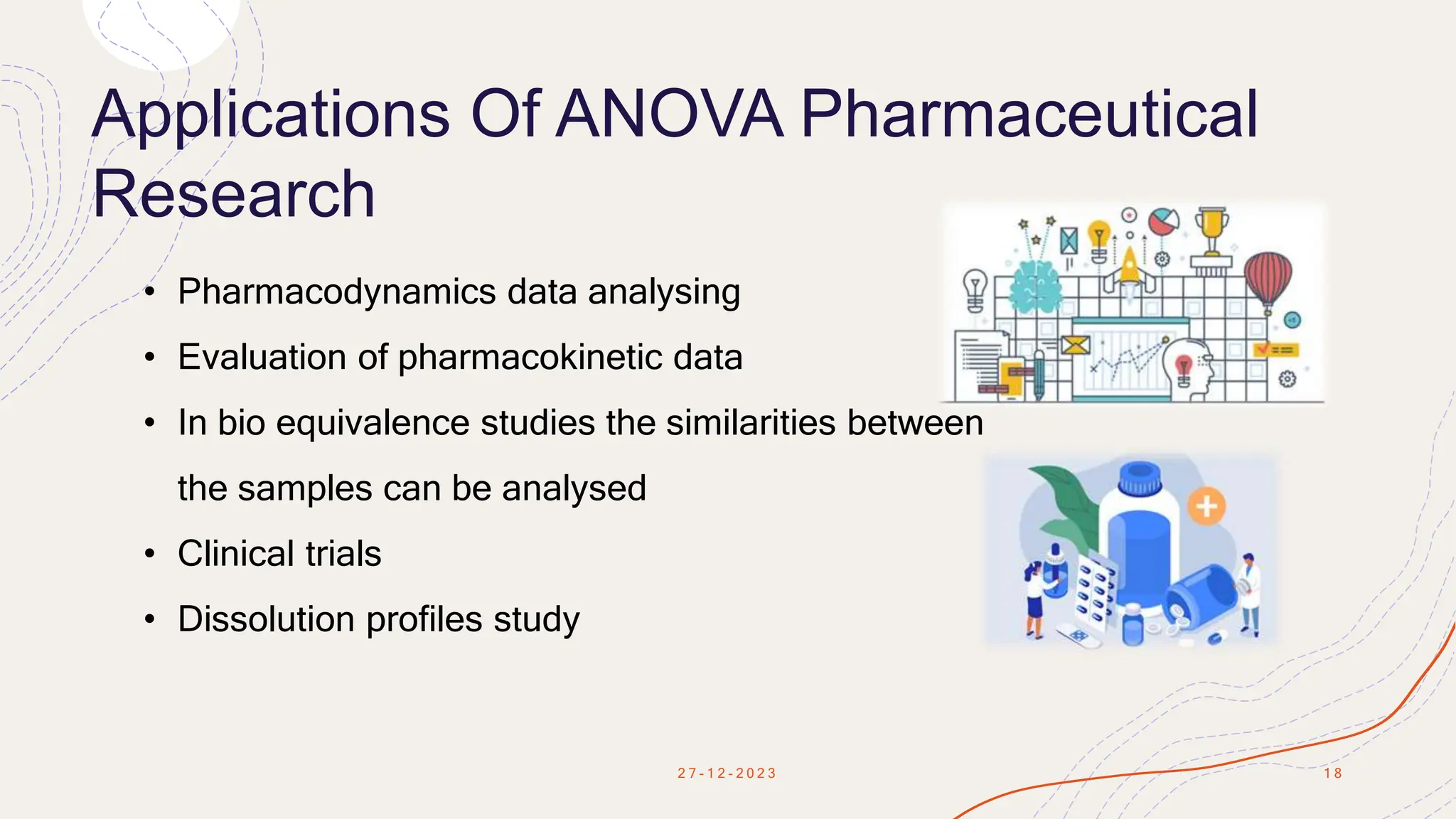
• Pharmacodynamics data analysing
• Evaluation of pharmacokinetic data
• In bio equivalence studies the similarities between
the samples can be analysed
• Clinical trials
• Dissolution profiles study
Similarity And Dissimilarity Factors
2 7 - 1 2 - 2 0 2 3 1 9
• These equations described by Moore and Flanner
• Both equations are endorsed by the FDA as acceptable
method for dissolution profile comparison.
• f1 Value - difference factor
• f2 Value - similarity factor
• They are used to studying the comparison of dissolution
profiles of the two dosage forms.
• It can be calculated using Excel or various readymade
software (E.g- PhEq_ bootstrap)
2 7 - 1 2 - 2 0 2 3 2 0
Difference Factor f1
2 7 - 1 2 - 2 0 2 3 2 1
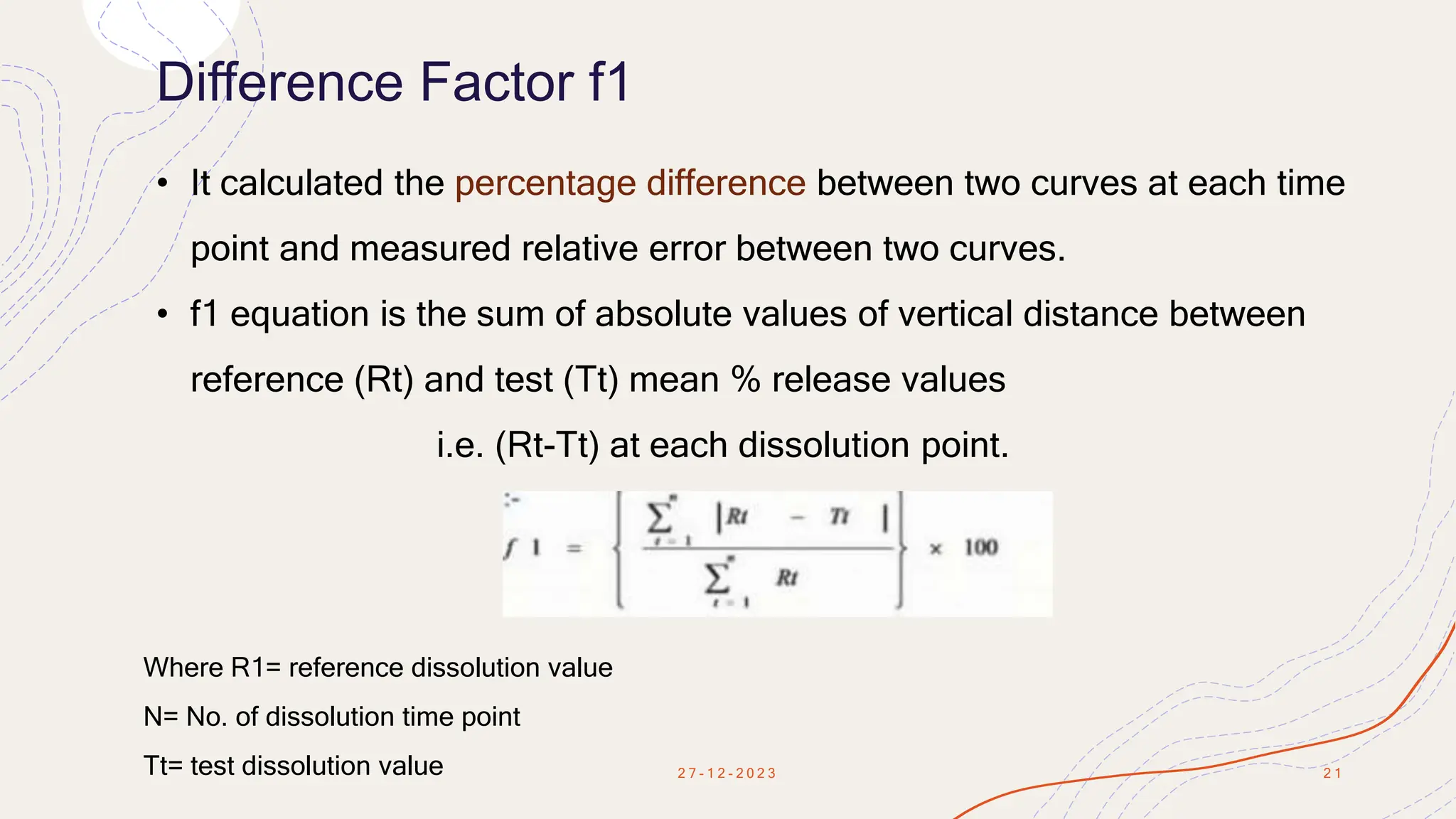
• It calculated the percentage difference between two curves at each time
point and measured relative error between two curves.
• f1 equation is the sum of absolute values of vertical distance between
reference (Rt) and test (Tt) mean % release values
i.e. (Rt-Tt) at each dissolution point.
Where R1= reference dissolution value
N= No. of dissolution time point
Tt= test dissolution value
Similarity Factor f2.
2 7 - 1 2 - 2 0 2 3 2 2
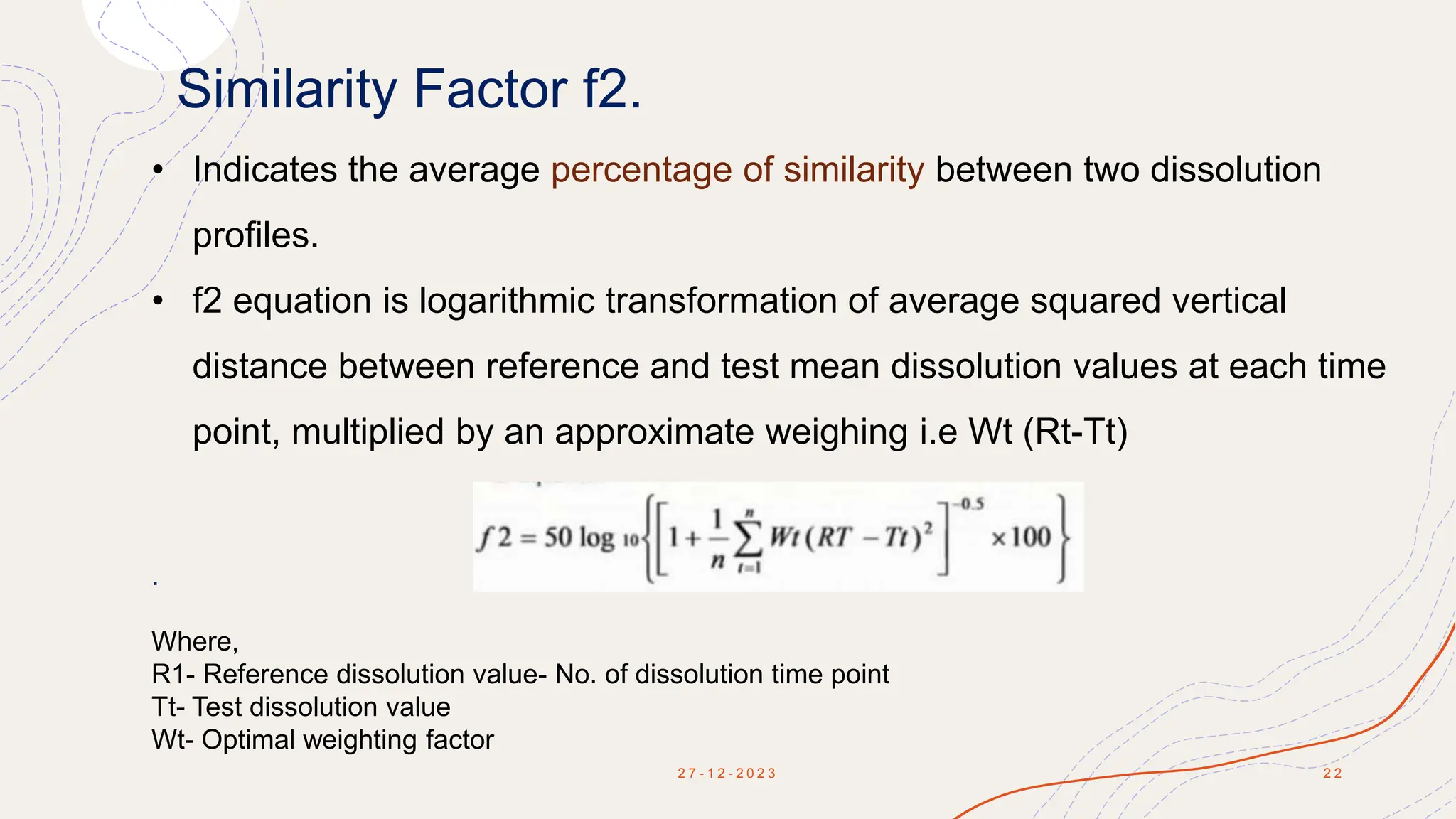
• Indicates the average percentage of similarity between two dissolution
profiles.
• f2 equation is logarithmic transformation of average squared vertical
distance between reference and test mean dissolution values at each time
point, multiplied by an approximate weighing i.e Wt (Rt-Tt)
.
Where,
R1- Reference dissolution value- No. of dissolution time point
Tt- Test dissolution value
Wt- Optimal weighting factor
Summary
2 7 - 1 2 - 2 0 2 3 2 3
• Analysis of variance, or ANOVA, is a
statistical method that separates observed
variance data into different components to
use for additional tests.
• Dissolution studies can be done by both
anova and f1 and f2 factor methods.
References
2 7 - 1 2 - 2 0 2 3 2 4
Pictures -
• https://microbenotes.com/anova/
• https://inspiredwebdev.com/create-dynamic-sticky-table-
of-contents/
• https://www.istockphoto.com/photos/table-of-contents-
book
• https://reviewediting.wordpress.com/2012/07/12/table-of-
contents-front-matter-vs-back-matter/
• https://www.wallstreetprep.com/knowledge/conservatism-
principle/
• https://jhpolice.gov.in/road-safety/mandatory-road-signs
• https://www.computerhope.com/jargon/s/search.htm
Text content-
• St L, Wold S. Analysis of variance (ANOVA). Chemometrics and intelligent
laboratory systems. 1989 Nov 1;6(4):25972.
https://www.sciencedirect.com/science/article/abs/pii/0169743989800954
• Tabachnick BG, Fidell LS. Experimental designs using ANOVA. Belmont,
CA: Thomson/Brooks/Cole; 2007 Dec
6.https://www.researchgate.net/profile/Barbara-
Tabachnick/publication/259465542_Experimental_Designs_Using_ANOV
/links/5e6bb05f92851c6ba70085db/Experimental-Designs-Using-
ANOVA.pdf
• https://brill.com/display/book/9789463510868/BP000006.xml Ross A,
Willson VL. One-way anova. InBasic and advanced statistical tests 2017
Jan 1 (pp. 21-24). Brill.
2 4 - 1 2 - 2 0 2 3 2 5
2 7 - 1 2 - 2 0 2 3 2 6

ANOVA AND F1,F2 SIMILARITY AND DISSIMILARITY FACTORS

  • 1.
    ANOVA AND SIMILARITY ANDDISSIMILARITY FACTORS Presented By- Hatasha Vaddadi M.Pharm 1st sem SoP, Parul University Guided By- Bhargavi Mistry Ass. Professor, Pharmaceutics SoP, Parul University
  • 2.
    Contents + Introduction toAnova + Types of Anova + Principle of Anova + One way Anova + Two way Anova + Applications of anova + Similarity and dissimilarty factors + Summary + References 2 7 - 1 2 - 2 0 2 3 2
  • 3.
    Introduction • ANOVA standsfor Analysis of varience. • It is statistical tool used to observe the variability found inside a data set into 2 parts- one parametric variable and one or more independent variable . • Discovered by Ronald fisher. 3 2 7 - 1 2 - 2 0 2 3
  • 4.
    How ANOVA work? • Like other types of statistical tests. ANOVA compares the means of different groups and shows you if there are any statistical differences between the means. • ANOVA is classified as an omnibus test statistic. This means that it can't tell you which specific groups were statistically significantly different from each other, only that at least two of the groups were. 2 7 - 1 2 - 2 0 2 3 4
  • 5.
    • It's importantto remember that the main ANOVA research question is whether the sample means are from different populations. • There are two assumptions upon which ANOVA rests: • First: Whether the technique of data collection, the observations within each sampled population are normally distributed. • Second: the sampled population has a common variance (s2). 2 7 - 1 2 - 2 0 2 3 5
  • 6.
    Principle Of ANOVA •The basic principle of Analysis of Variance is to compare the variance within each group to the variance between groups. • If the between-group variance is greater than the within- group variance, then there is a statistically significant difference between the means of the groups. 6 2 7 - 1 2 - 2 0 2 3
  • 7.
    2 7 -1 2 - 2 0 2 3 7 Techniques of Anova One way anova Two way anova Eg Mean output of three workers Eg. Mean Based on working hours and working conditions
  • 8.
    One Way ANOVA 27 - 1 2 - 2 0 2 3 8 • Simplest type of anova involving single source of variation or factor • Techniques involves as follows- 1. Obtaining mean of each sample i.e. X1, X2,X3………Xk 2. Finding the mean of sample means X1+ X2+X3+………+Xk No. of samples (k) X=
  • 9.
    2 7 -1 2 - 2 0 2 3 9 3. Calculate the sum of squares for varience between the samples, 5. Calculate the sum of squares for variance within the samples( or within): 4. Calculate mean square (MS) between : MS Between=SS between/(K-1)
  • 10.
    2 7 -1 2 - 2 0 2 3 1 0 6. Calculate mean square (MS) within: MS within=SS within/(n-k) 7. Calculate SS for total variance: • SS for total variance= SS between+ SS within. • The degrees of freedom for between and within must add up to the degrees of freedom for total variance i. e, (n-1)= (k-1)+(n-k)
  • 11.
    2 7 -1 2 - 2 0 2 3 1 1 8. Finally, f ratio may be worked out as under F ratio=MS between/ MS within • This ratio is used to judge weather the difference among several sample means is significant or is just a matter of sampling flucatuations.
  • 12.
    2 7 -1 2 - 2 0 2 3 1 2
  • 13.
    Two Way ANOVA 27 - 1 2 - 2 0 2 3 1 3 • Two way ANOVA technique is used when the data are classified on the basis of two factors. • A statistical test used to determine the effect of two nominal predictor variables on a continuous outcome variable. • Two way ANOVA test analyzes the effect of the independent variables on the expected outcome along with their relationship to the outcome itself.
  • 14.
    2 7 -1 2 - 2 0 2 3 1 4 • Two way ANOVA test analyzes the effect of the independent variables on the expected outcome along with their relationship to the outcome itself • Two way ANOVA design may have repeated measurements of each factor or may not have repeated values.
  • 15.
    Types Of TwoWay ANOVA 2 7 - 1 2 - 2 0 2 3 1 5 ANOVA technique in context of two way design when repeated values are not there- It includes calculation of residual or error variation by subtraction, once we have calculated the sun of squares for total variance between varieties of the other treatment. ANOVA technique in context of two way design when repeated values are there. – we can obtain a separate independent measure of inherent or smallest variations. -interaction variation: Interaction is the measure of inter relationship among the two different classifications.
  • 16.
    2 7 -1 2 - 2 0 2 3 1 6 Graphical method for studying interaction in two-way design. – • For graphs we shall select one of the factors to be used as the x-axis. • Then we plot the averages for all the samples on the graph and connect the averages for each variety of other factor by a distinct line. • If the connecting lines do not cross over each other, then the graph indicates that there is no interaction. • But if the lines do cross, they indicate definite interaction or inter-relation between the two factors.
  • 17.
    2 7 -1 2 - 2 0 2 3 1 7 This graph indicates that there is a significant interaction because the different connecting lines for groups of people do cross over each other. We find that A and B are affected very similarly,but C is affected differently.
  • 18.
    Applications Of ANOVAPharmaceutical Research 2 7 - 1 2 - 2 0 2 3 1 8 • Pharmacodynamics data analysing • Evaluation of pharmacokinetic data • In bio equivalence studies the similarities between the samples can be analysed • Clinical trials • Dissolution profiles study
  • 19.
    Similarity And DissimilarityFactors 2 7 - 1 2 - 2 0 2 3 1 9 • These equations described by Moore and Flanner • Both equations are endorsed by the FDA as acceptable method for dissolution profile comparison. • f1 Value - difference factor • f2 Value - similarity factor • They are used to studying the comparison of dissolution profiles of the two dosage forms. • It can be calculated using Excel or various readymade software (E.g- PhEq_ bootstrap)
  • 20.
    2 7 -1 2 - 2 0 2 3 2 0
  • 21.
    Difference Factor f1 27 - 1 2 - 2 0 2 3 2 1 • It calculated the percentage difference between two curves at each time point and measured relative error between two curves. • f1 equation is the sum of absolute values of vertical distance between reference (Rt) and test (Tt) mean % release values i.e. (Rt-Tt) at each dissolution point. Where R1= reference dissolution value N= No. of dissolution time point Tt= test dissolution value
  • 22.
    Similarity Factor f2. 27 - 1 2 - 2 0 2 3 2 2 • Indicates the average percentage of similarity between two dissolution profiles. • f2 equation is logarithmic transformation of average squared vertical distance between reference and test mean dissolution values at each time point, multiplied by an approximate weighing i.e Wt (Rt-Tt) . Where, R1- Reference dissolution value- No. of dissolution time point Tt- Test dissolution value Wt- Optimal weighting factor
  • 23.
    Summary 2 7 -1 2 - 2 0 2 3 2 3 • Analysis of variance, or ANOVA, is a statistical method that separates observed variance data into different components to use for additional tests. • Dissolution studies can be done by both anova and f1 and f2 factor methods.
  • 24.
    References 2 7 -1 2 - 2 0 2 3 2 4 Pictures - • https://microbenotes.com/anova/ • https://inspiredwebdev.com/create-dynamic-sticky-table- of-contents/ • https://www.istockphoto.com/photos/table-of-contents- book • https://reviewediting.wordpress.com/2012/07/12/table-of- contents-front-matter-vs-back-matter/ • https://www.wallstreetprep.com/knowledge/conservatism- principle/ • https://jhpolice.gov.in/road-safety/mandatory-road-signs • https://www.computerhope.com/jargon/s/search.htm
  • 25.
    Text content- • StL, Wold S. Analysis of variance (ANOVA). Chemometrics and intelligent laboratory systems. 1989 Nov 1;6(4):25972. https://www.sciencedirect.com/science/article/abs/pii/0169743989800954 • Tabachnick BG, Fidell LS. Experimental designs using ANOVA. Belmont, CA: Thomson/Brooks/Cole; 2007 Dec 6.https://www.researchgate.net/profile/Barbara- Tabachnick/publication/259465542_Experimental_Designs_Using_ANOV /links/5e6bb05f92851c6ba70085db/Experimental-Designs-Using- ANOVA.pdf • https://brill.com/display/book/9789463510868/BP000006.xml Ross A, Willson VL. One-way anova. InBasic and advanced statistical tests 2017 Jan 1 (pp. 21-24). Brill. 2 4 - 1 2 - 2 0 2 3 2 5
  • 26.
    2 7 -1 2 - 2 0 2 3 2 6