ANIMATIONS
MUHAMMAD TALHA R AFIQ.
ANIMATIONS?
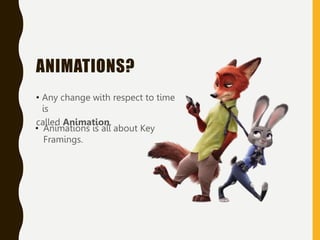
• Any change with respect to time
is
called Animation.
• Animations is all about Key
Framings.
T YPES OF ANIMATIONS
1 . C E L ( C E L L U L O I D ) A N I M AT I O N
2 . 2 D A N I M AT I O N
3 . 3 D A N I M AT I O N
4 . M O T I O N G R A P H I C S
5 . S T O P M O T I O N A N I M AT I O N
CEL
ANIMATION
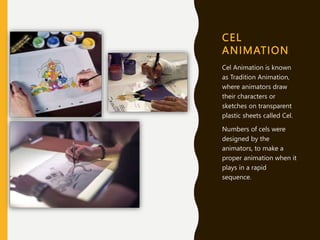
Cel Animation is known
as Tradition Animation,
where animators draw
their characters or
sketches on transparent
plastic sheets called Cel.
Numbers of cels were
designed by the
animators, to make a
proper animation when it
plays in a rapid
sequence.
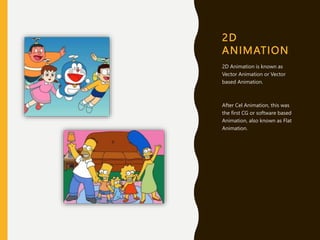
2D
ANIMATION
2D Animation is known as
Vector Animation or Vector
based Animation.
After Cel Animation, this was
the first CG or software based
Animation, also known as Flat
Animation.
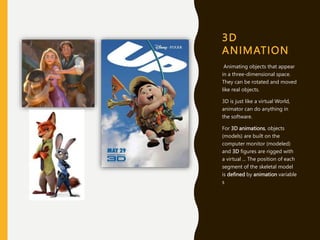
3D
ANIMATION
Animating objects that appear
in a three-dimensional space.
They can be rotated and moved
like real objects.
3D is just like a virtual World,
animator can do anything in
the software.
For 3D animations, objects
(models) are built on the
computer monitor (modeled)
and 3D figures are rigged with
a virtual ... The position of each
segment of the skeletal model
is defined by animation variable
s
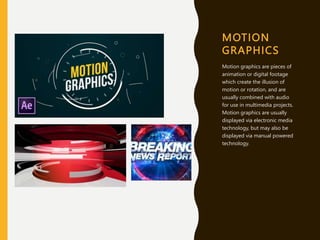
MOTION
GRAPHICS
Motion graphics are pieces of
animation or digital footage
which create the illusion of
motion or rotation, and are
usually combined with audio
for use in multimedia projects.
Motion graphics are usually
displayed via electronic media
technology, but may also be
displayed via manual powered
technology.
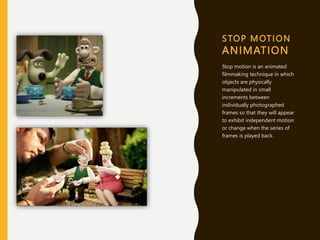
STOP MOTION
ANIMATION
Stop motion is an animated
filmmaking technique in which
objects are physically
manipulated in small
increments between
individually photographed
frames so that they will appear
to exhibit independent motion
or change when the series of
frames is played back.
ANIMATION’S
PRODUCTION PIPELINE
P R O D U C T I O N P I P E L I N E
• Idea & Story
• Script writing & Screenplay
• Concept Art
• Storyboarding
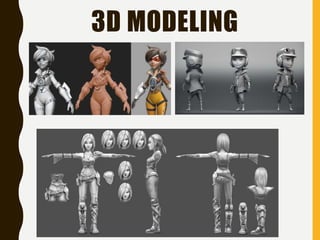
• Modeling
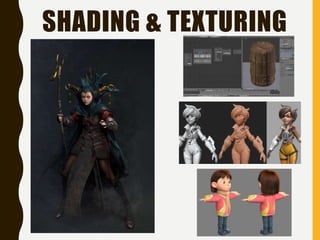
• Shading & Texturing
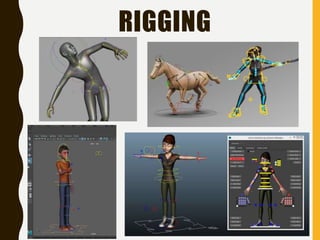
• Rigging
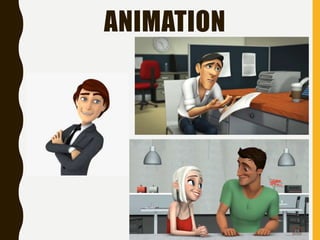
• Animation
• Lighting & Environment
• Rendering
• Compositing & Color grading
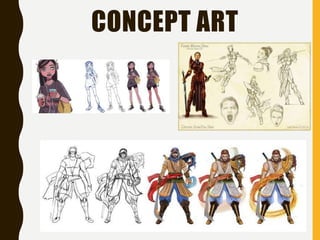
CONCEPT ART
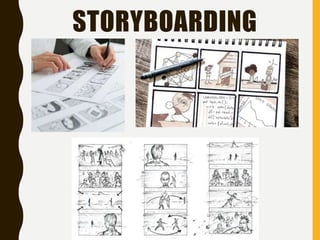
STORYBOARDING
3D MODELING
SHADING & TEXTURING
RIGGING
ANIMATION
THANK YOU

Animation Magic: Crafting Visual Stories

  • 1.
  • 2.
    ANIMATIONS? • Any changewith respect to time is called Animation. • Animations is all about Key Framings.
  • 3.
    T YPES OFANIMATIONS 1 . C E L ( C E L L U L O I D ) A N I M AT I O N 2 . 2 D A N I M AT I O N 3 . 3 D A N I M AT I O N 4 . M O T I O N G R A P H I C S 5 . S T O P M O T I O N A N I M AT I O N
  • 4.
    CEL ANIMATION Cel Animation isknown as Tradition Animation, where animators draw their characters or sketches on transparent plastic sheets called Cel. Numbers of cels were designed by the animators, to make a proper animation when it plays in a rapid sequence.
  • 5.
    2D ANIMATION 2D Animation isknown as Vector Animation or Vector based Animation. After Cel Animation, this was the first CG or software based Animation, also known as Flat Animation.
  • 6.
    3D ANIMATION Animating objects thatappear in a three-dimensional space. They can be rotated and moved like real objects. 3D is just like a virtual World, animator can do anything in the software. For 3D animations, objects (models) are built on the computer monitor (modeled) and 3D figures are rigged with a virtual ... The position of each segment of the skeletal model is defined by animation variable s
  • 7.
    MOTION GRAPHICS Motion graphics arepieces of animation or digital footage which create the illusion of motion or rotation, and are usually combined with audio for use in multimedia projects. Motion graphics are usually displayed via electronic media technology, but may also be displayed via manual powered technology.
  • 8.
    STOP MOTION ANIMATION Stop motionis an animated filmmaking technique in which objects are physically manipulated in small increments between individually photographed frames so that they will appear to exhibit independent motion or change when the series of frames is played back.
  • 9.
  • 10.
    P R OD U C T I O N P I P E L I N E • Idea & Story • Script writing & Screenplay • Concept Art • Storyboarding • Modeling • Shading & Texturing • Rigging • Animation • Lighting & Environment • Rendering • Compositing & Color grading
  • 11.
  • 12.
  • 13.
  • 14.
  • 15.
  • 16.
  • 17.