Animation
Archie Agarwal - 01
ORIGIN
Animation is simply the act of creating the illusion of movement
through still images
History’s first recorded animation is Pygmalion (play) of Greek and
Roman mythology, a sculptor who created a figure of a woman so
perfect that he fell in love with her and begged Venus to bring her to
life
Émile Reynaud’s Pauvre Pierrot (1892) was created by using a longer
image roll for the praxinoscope, allowing for a longer viewing time.
Pauvre Pierrot is often credited as the first animated film because
Reynaud’s picture roll was hand-painted with 500 individual images
(rather than using photographs). However, film historians argue that
Émile Cohl’s Fantasmagorie (1908), is the first instance of a film
produced with traditional animation techniques, making it the first
true animated movie.
The Victorians also figured out how to create moving stills
to trick the eyes into thinking the image was animated
Journey of animated films
● After a number of pioneers began creating animated shorts in the early 20th
century (1914’s Gertie the Dinosaur being a notable example), the very first
feature-length animation created using traditional methods was entitled El Apóstol.
● A few more experimental animation techniques were developed over the next
decade (including methods like rotoscoping), which produced some hit-and-miss
results. It was the opening of a small studio in Los Angeles, however, that changed
the game forever.
● To many, the word “animation” begins and ends with Walt Disney. With more
innovations and notable works over the 20th century (and beyond) than we could
ever hope to list here, Disney’s studio and tumultuous history set a precedent for
the entire animation industry
● As a result, some commenters point to the 1937 release of Snow White and the
Seven Dwarfs as the first feature-length animated film since it was fully hand-
drawn and isn’t classified as a ‘lost movie’.
5 Types Of Animations
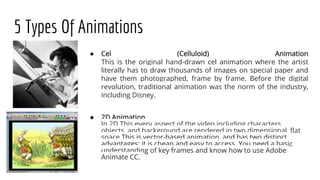
● Cel (Celluloid) Animation
This is the original hand-drawn cel animation where the artist
literally has to draw thousands of images on special paper and
have them photographed, frame by frame. Before the digital
revolution, traditional animation was the norm of the industry,
including Disney.
● 2D Animation
In 2D This every aspect of the video including characters,
objects, and background are rendered in two dimensional, flat
space.This is vector-based animation, and has two distinct
advantages: it is cheap and easy to access. You need a basic
understanding of key frames and know how to use Adobe
Animate CC.
● 3D Animation
3D animation and visual effects are, quite simply, the way of the future.
3D animation operates on different principles, and is more akin to
puppetry than traditional animation. For this, you need to learn how to
digitally model a character, sculpt it perfectly and give it a skeleton that
you can move and manipulate. You’ll have to pose the model at certain
frames, and then let the computer do the rendering.
● Motion Graphics
Motion graphics are pieces of animation or digital footage which create
the illusion of motion or rotation, and are usually combined with audio
for use in multimedia projects. Motion graphics are usually displayed
via electronic media technology, but may also be displayed via manual
powered technology.
● Stop Motion
Stop motion is like traditional animation, except instead of drawing,
you have clay models and a set that you have to carefully manipulate
to produce animation. Stop motion can also be done with puppets, cut-
outs, silhouettes and even action figures. In the past, stop motion was
used as a form of special effects for live-action films, and has largely
been replaced by 3D animation and visual effects work.
Uses Of Animation In Different Feilds
Advertising
● It seems that over the years, brands have cottoned on to the fact that creating a cute, likeable
character can act as a company mascot and that an endearing animated TV advert generates hype.
By personifying a product with an animated character, the brand becomes memorable and the
product seems trustworthy
● It is also used in car and phone advertisements to portray each feature in details and to make the
consumer better understand and to attract them
Virtual Reality
● Virtual reality will not only change the world of gaming but opens up new creative channels, can be
used to benefit education and industry and is also being used in the publishing industry to make
reading more interactive, It adds a sense of interactivity and immediacy to virtual reality, making
them perfectly suited to how we are entertained or educated.
● Is also used in medical arena for educational purposes for better and easier understanding
Gaming
● The computer gaming industry is also pushing the boundaries of what is possible with animation,
leading to the creation of some extremely realistic game footage. Computer game animation has
certainly come a long way from the 2D graphics of early arcade games. Now computer game
animators are able to build environments and objects that react to the player’s actions, for
example buildings being destroyed by explosions. Real-time interaction with light sources and
shadows is also a relatively new feature
Movies and 3D
● Animation has had a major growth spurt in recent years due to the popularity of films such as
‘Finding Nemo’ and ‘Avatar’. Most recently Pixar’s ‘Inside Out’ won the Academy Award for Best
Animated Feature Film
● Ultimately, animation has been making life a little bit more fun, interactive and exciting for some
years now, and it can only get better. While the kids got to have all the fun to begin with, animation
is opening up to become more equally aimed at adults
1. Squash and Stretch:
The squash and stretch
principle provides the
illusion of weight and
volume to a personality
as they move.
2. Anticipation –
Anticipation is used to
realize the audience to
know that a major
action is about to take
place.
3. Staging –
According to this
principle every pose or
action of the character
that he makes should
convey a clear
intention.
12 Principles of Animation
4. Straight Ahead and
Pose to Pose –
According to this
principle which refers
to the techniques by
which animation is
crafted.
5. Follow Through and
Overlapping Action –
According to this
principle when a
character is in action
and stops, nothing
stops all at once.
6. Slow-In and Slow-Out
–
According to this
principle it add realism
to the movement of
characters.
7. Arc –
According to this
principle all actions in
life have a slightly
circular motion.
8. Secondary Action –
According to this
principle an additional
action that reinforces
and adds more
dimension to the main
action.
9. Timing – According to
this principle the timing
helps create the illusion
that an action is abiding
by the laws of physics
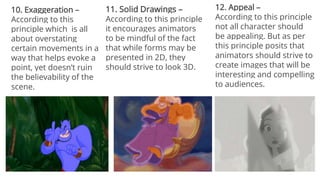
10. Exaggeration –
According to this
principle which is all
about overstating
certain movements in a
way that helps evoke a
point, yet doesn’t ruin
the believability of the
scene.
11. Solid Drawings –
According to this principle
it encourages animators
to be mindful of the fact
that while forms may be
presented in 2D, they
should strive to look 3D.
12. Appeal –
According to this principle
not all character should
be appealing. But as per
this principle posits that
animators should strive to
create images that will be
interesting and compelling
to audiences.
Benefits
● Interactive animation holds the audience’s attention. The use of audio, graphics,
and video interactive animation makes it interesting, engaging.
● Real-life experiments hazardous in nature can be sorted using animation. It
provides flexibility and safety in re-attempting the experiment.
● It helps build practical skills. Animation provides real to life scenarios faced in daily
life during learning. This learning uses methods of learning by viewing, doing and
coaching. This helps in practical skill development and better knowledge retention.
● For cost effective scenarios, a company can elect to keep animation sequences
simple by focusing on dynamic text or simple illustrations. Companies with larger
budgets can have the flexibility to create complex scenarios that take the viewer on
a really unique journey, without having to film anything at all
● Hassle Free of a lengthy production schedule or multiple shoots.Can make
adjustments or tailored videos for different personas can be as simple as changing
a graphic or color scheme – there’s no need to reshoot again
Softwares used for 3D Animations
● 3D Animations :
AutoDesk Maya Blender Cinema 4D
● 2D Animations :
Animate CC After Effects Character Animator
Softwares used for 3D Animations
● Stop Motion :
Dragon Frame Stop Motion Studio
Famous Animators and Their Work
Walt Disney
Walt Disney was an American motion
picture and television producer and
showman, famous as a pioneer of cartoon
films, including Mickey Mouse, and as the
creator of the amusement parks
Disneyland and Disney World.
Disney's most famous movies include:
● Pinocchio (1940)
● Fantasia (1940)
● Dumbo (1941)
● Bambi (1942)
● Cinderella (1950)
● Treasure Island (1950)
● Alice in Wonderland (1951)
● Peter Pan (1953)
● Lady and the Tramp (1955)
● Sleeping Beauty (1959)
● 101 Dalmatians (1961)
Tim Burton
Tim Burton is a director, producer and
screenwriter. After majoring in animation at the
California Institute of Arts, he got his start in
the business by working as a Disney animator.
He quickly struck out on his own and became
known for creating visually striking films that
blend themes of fantasy and horror
Tim’s most famous movies include:
● Batman
● Edward Scissorhands
● The Nightmare Before Christmas
● Mars Attacks
● Sleepy Hollow
● The Corpse Bride
● Charlie And the Chocolate Factory
● Alice In The Wonderland
● Dumbo
● Frankenweenie
Chuck Jones
Chuck Jones was an American animation
director of critically acclaimed cartoon shorts,
primarily the Looney Tunes and Merrie
Melodies film series at Warner Bros. studios.He
wrote, produced, and/or directed many classic
animated cartoon shorts. He was nominated
for eight Academy Awards, winning three times
Tim’s most famous movies include:
● Bugs Bunny
● Daffy Duck
● Wile E. Coyote
● The Road Runner
● One Froggy Evening
● Looney Tunes
● Tom And Jerry Shorts
● The Three Bears
Future
● The future of animation looks to be on an interesting journey as the quality of films is becoming
higher and higher. Most people would now aim for a 4k film, however to achieve this quality in
animation would take twice as long to create. Most animated films are currently 2k and are made
as 24 fps (frames per second), however to create a 4k film you would need at least 48fps or more.
● Animation looks set to continue delighting audiences for many years to come. With animated films
continuing to rise up the blockbuster charts, capturing hearts and imaginations, there is no sign of
this genre coming to an end. Technological advances promise to unlock new doors into the realms
of possibility, with increasing photo-realism providing ever-more lifelike characters and
environments.
● The most growth in 3D gaming will be seen in the mobile sector, and features like Apple's AirPlay
call into question the need for a dedicated gaming machine at all, those hardcore gamers and their
big powerful consoles aren't going away anytime soon though.
Thankyou !

Animation

  • 1.
  • 2.
    ORIGIN Animation is simplythe act of creating the illusion of movement through still images History’s first recorded animation is Pygmalion (play) of Greek and Roman mythology, a sculptor who created a figure of a woman so perfect that he fell in love with her and begged Venus to bring her to life Émile Reynaud’s Pauvre Pierrot (1892) was created by using a longer image roll for the praxinoscope, allowing for a longer viewing time. Pauvre Pierrot is often credited as the first animated film because Reynaud’s picture roll was hand-painted with 500 individual images (rather than using photographs). However, film historians argue that Émile Cohl’s Fantasmagorie (1908), is the first instance of a film produced with traditional animation techniques, making it the first true animated movie. The Victorians also figured out how to create moving stills to trick the eyes into thinking the image was animated
  • 3.
    Journey of animatedfilms ● After a number of pioneers began creating animated shorts in the early 20th century (1914’s Gertie the Dinosaur being a notable example), the very first feature-length animation created using traditional methods was entitled El Apóstol. ● A few more experimental animation techniques were developed over the next decade (including methods like rotoscoping), which produced some hit-and-miss results. It was the opening of a small studio in Los Angeles, however, that changed the game forever. ● To many, the word “animation” begins and ends with Walt Disney. With more innovations and notable works over the 20th century (and beyond) than we could ever hope to list here, Disney’s studio and tumultuous history set a precedent for the entire animation industry ● As a result, some commenters point to the 1937 release of Snow White and the Seven Dwarfs as the first feature-length animated film since it was fully hand- drawn and isn’t classified as a ‘lost movie’.
  • 4.
    5 Types OfAnimations ● Cel (Celluloid) Animation This is the original hand-drawn cel animation where the artist literally has to draw thousands of images on special paper and have them photographed, frame by frame. Before the digital revolution, traditional animation was the norm of the industry, including Disney. ● 2D Animation In 2D This every aspect of the video including characters, objects, and background are rendered in two dimensional, flat space.This is vector-based animation, and has two distinct advantages: it is cheap and easy to access. You need a basic understanding of key frames and know how to use Adobe Animate CC.
  • 5.
    ● 3D Animation 3Danimation and visual effects are, quite simply, the way of the future. 3D animation operates on different principles, and is more akin to puppetry than traditional animation. For this, you need to learn how to digitally model a character, sculpt it perfectly and give it a skeleton that you can move and manipulate. You’ll have to pose the model at certain frames, and then let the computer do the rendering. ● Motion Graphics Motion graphics are pieces of animation or digital footage which create the illusion of motion or rotation, and are usually combined with audio for use in multimedia projects. Motion graphics are usually displayed via electronic media technology, but may also be displayed via manual powered technology. ● Stop Motion Stop motion is like traditional animation, except instead of drawing, you have clay models and a set that you have to carefully manipulate to produce animation. Stop motion can also be done with puppets, cut- outs, silhouettes and even action figures. In the past, stop motion was used as a form of special effects for live-action films, and has largely been replaced by 3D animation and visual effects work.
  • 6.
    Uses Of AnimationIn Different Feilds
  • 7.
    Advertising ● It seemsthat over the years, brands have cottoned on to the fact that creating a cute, likeable character can act as a company mascot and that an endearing animated TV advert generates hype. By personifying a product with an animated character, the brand becomes memorable and the product seems trustworthy ● It is also used in car and phone advertisements to portray each feature in details and to make the consumer better understand and to attract them Virtual Reality ● Virtual reality will not only change the world of gaming but opens up new creative channels, can be used to benefit education and industry and is also being used in the publishing industry to make reading more interactive, It adds a sense of interactivity and immediacy to virtual reality, making them perfectly suited to how we are entertained or educated. ● Is also used in medical arena for educational purposes for better and easier understanding
  • 8.
    Gaming ● The computergaming industry is also pushing the boundaries of what is possible with animation, leading to the creation of some extremely realistic game footage. Computer game animation has certainly come a long way from the 2D graphics of early arcade games. Now computer game animators are able to build environments and objects that react to the player’s actions, for example buildings being destroyed by explosions. Real-time interaction with light sources and shadows is also a relatively new feature Movies and 3D ● Animation has had a major growth spurt in recent years due to the popularity of films such as ‘Finding Nemo’ and ‘Avatar’. Most recently Pixar’s ‘Inside Out’ won the Academy Award for Best Animated Feature Film ● Ultimately, animation has been making life a little bit more fun, interactive and exciting for some years now, and it can only get better. While the kids got to have all the fun to begin with, animation is opening up to become more equally aimed at adults
  • 9.
    1. Squash andStretch: The squash and stretch principle provides the illusion of weight and volume to a personality as they move. 2. Anticipation – Anticipation is used to realize the audience to know that a major action is about to take place. 3. Staging – According to this principle every pose or action of the character that he makes should convey a clear intention. 12 Principles of Animation
  • 10.
    4. Straight Aheadand Pose to Pose – According to this principle which refers to the techniques by which animation is crafted. 5. Follow Through and Overlapping Action – According to this principle when a character is in action and stops, nothing stops all at once. 6. Slow-In and Slow-Out – According to this principle it add realism to the movement of characters.
  • 11.
    7. Arc – Accordingto this principle all actions in life have a slightly circular motion. 8. Secondary Action – According to this principle an additional action that reinforces and adds more dimension to the main action. 9. Timing – According to this principle the timing helps create the illusion that an action is abiding by the laws of physics
  • 12.
    10. Exaggeration – Accordingto this principle which is all about overstating certain movements in a way that helps evoke a point, yet doesn’t ruin the believability of the scene. 11. Solid Drawings – According to this principle it encourages animators to be mindful of the fact that while forms may be presented in 2D, they should strive to look 3D. 12. Appeal – According to this principle not all character should be appealing. But as per this principle posits that animators should strive to create images that will be interesting and compelling to audiences.
  • 13.
    Benefits ● Interactive animationholds the audience’s attention. The use of audio, graphics, and video interactive animation makes it interesting, engaging. ● Real-life experiments hazardous in nature can be sorted using animation. It provides flexibility and safety in re-attempting the experiment. ● It helps build practical skills. Animation provides real to life scenarios faced in daily life during learning. This learning uses methods of learning by viewing, doing and coaching. This helps in practical skill development and better knowledge retention. ● For cost effective scenarios, a company can elect to keep animation sequences simple by focusing on dynamic text or simple illustrations. Companies with larger budgets can have the flexibility to create complex scenarios that take the viewer on a really unique journey, without having to film anything at all ● Hassle Free of a lengthy production schedule or multiple shoots.Can make adjustments or tailored videos for different personas can be as simple as changing a graphic or color scheme – there’s no need to reshoot again
  • 14.
    Softwares used for3D Animations ● 3D Animations : AutoDesk Maya Blender Cinema 4D ● 2D Animations : Animate CC After Effects Character Animator
  • 15.
    Softwares used for3D Animations ● Stop Motion : Dragon Frame Stop Motion Studio
  • 16.
  • 17.
    Walt Disney Walt Disneywas an American motion picture and television producer and showman, famous as a pioneer of cartoon films, including Mickey Mouse, and as the creator of the amusement parks Disneyland and Disney World. Disney's most famous movies include: ● Pinocchio (1940) ● Fantasia (1940) ● Dumbo (1941) ● Bambi (1942) ● Cinderella (1950) ● Treasure Island (1950) ● Alice in Wonderland (1951) ● Peter Pan (1953) ● Lady and the Tramp (1955) ● Sleeping Beauty (1959) ● 101 Dalmatians (1961)
  • 18.
    Tim Burton Tim Burtonis a director, producer and screenwriter. After majoring in animation at the California Institute of Arts, he got his start in the business by working as a Disney animator. He quickly struck out on his own and became known for creating visually striking films that blend themes of fantasy and horror Tim’s most famous movies include: ● Batman ● Edward Scissorhands ● The Nightmare Before Christmas ● Mars Attacks ● Sleepy Hollow ● The Corpse Bride ● Charlie And the Chocolate Factory ● Alice In The Wonderland ● Dumbo ● Frankenweenie
  • 19.
    Chuck Jones Chuck Joneswas an American animation director of critically acclaimed cartoon shorts, primarily the Looney Tunes and Merrie Melodies film series at Warner Bros. studios.He wrote, produced, and/or directed many classic animated cartoon shorts. He was nominated for eight Academy Awards, winning three times Tim’s most famous movies include: ● Bugs Bunny ● Daffy Duck ● Wile E. Coyote ● The Road Runner ● One Froggy Evening ● Looney Tunes ● Tom And Jerry Shorts ● The Three Bears
  • 20.
    Future ● The futureof animation looks to be on an interesting journey as the quality of films is becoming higher and higher. Most people would now aim for a 4k film, however to achieve this quality in animation would take twice as long to create. Most animated films are currently 2k and are made as 24 fps (frames per second), however to create a 4k film you would need at least 48fps or more. ● Animation looks set to continue delighting audiences for many years to come. With animated films continuing to rise up the blockbuster charts, capturing hearts and imaginations, there is no sign of this genre coming to an end. Technological advances promise to unlock new doors into the realms of possibility, with increasing photo-realism providing ever-more lifelike characters and environments. ● The most growth in 3D gaming will be seen in the mobile sector, and features like Apple's AirPlay call into question the need for a dedicated gaming machine at all, those hardcore gamers and their big powerful consoles aren't going away anytime soon though.
  • 21.