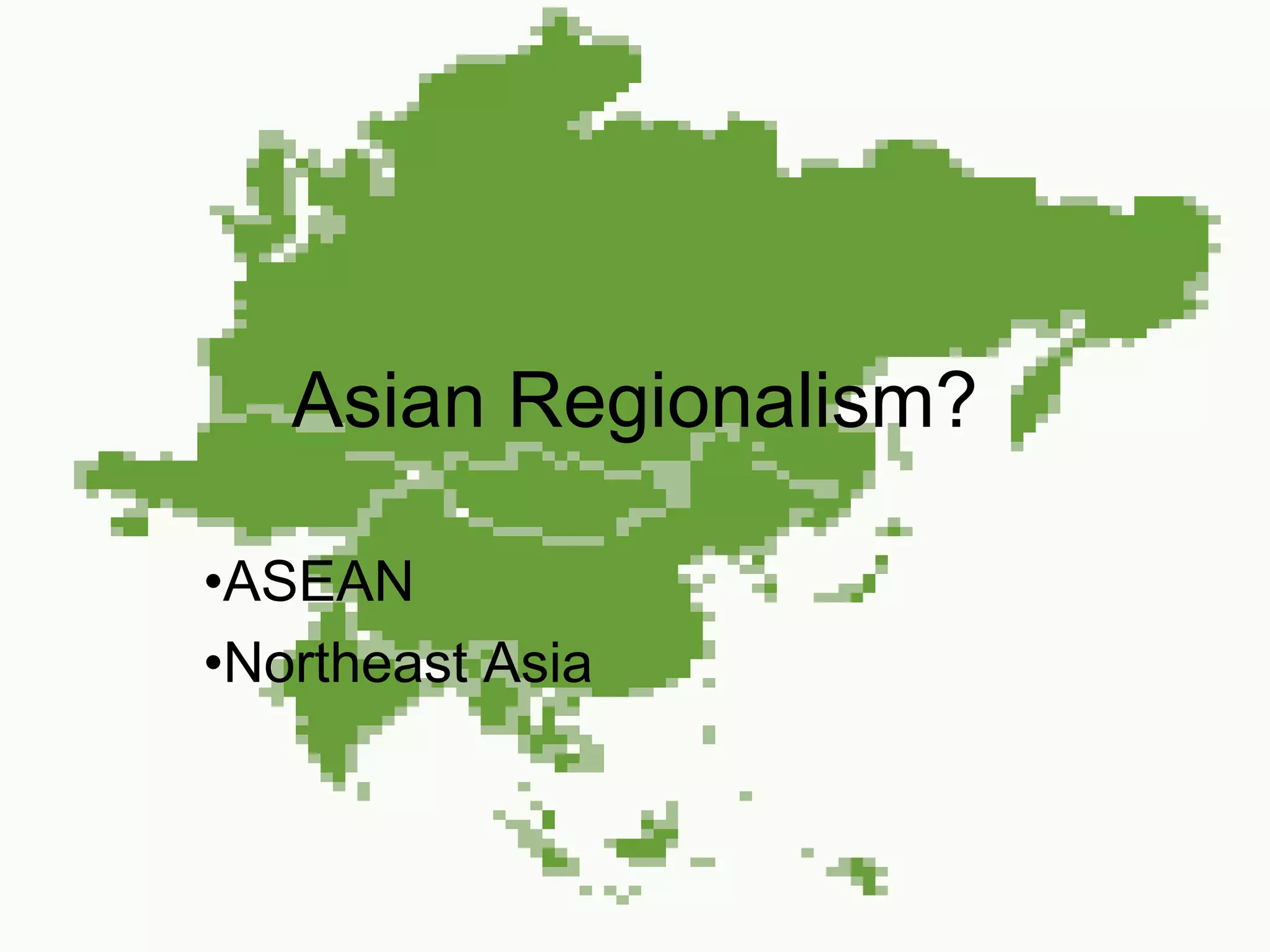
Asian Regionalism?
•ASEAN
•Northeast Asia
Outline
• Economic development
– Flying geese, falling geese
• Economic interdependence
• ASEAN
• Northeast Asia
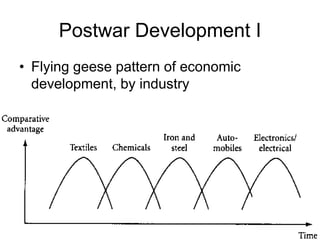
Postwar Development I
• Flying geese pattern of economic
development, by industry
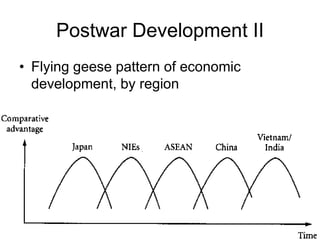
Postwar Development II
• Flying geese pattern of economic
development, by region
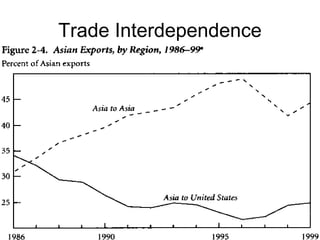
Trade Interdependence
ASEAN: overview
• Association of Southeast Asian Nations
• 10 member states
– Brunei, Cambodia, Indonesia, Laos, Malaysia,
Myanmar, Philippines, Singapore, Thailand, &
Vietnam
• home to 667 million people
• collective GDP of more than US$3 trillion
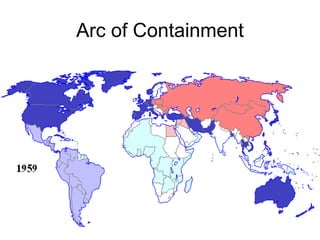
ASEAN: founding (1967)
• 5 founding members:
– Thailand, Malaysia, Singapore, Indonesia,
Philippines
• Bangkok Declaration of 1967:
– accelerate economic growth
– promote regional peace and stability
– contain the spread of communism
Arc of Containment
End of Cold War
• ASEAN Free Trade Area agreement was
signed at ASEAN summit in 1992
• comprehensive program of regional tariff
reduction
• program later broadened and accelerated
• reaffirmed during Asian Financial Crisis of
1997-98
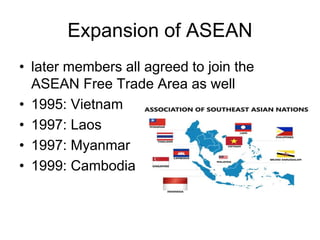
Expansion of ASEAN
• later members all agreed to join the
ASEAN Free Trade Area as well
• 1995: Vietnam
• 1997: Laos
• 1997: Myanmar
• 1999: Cambodia
ASEAN: External Links
• A joint forum with Japan was established
in 1977
• A cooperation agreement with the
European Community was signed in 1980
• ``ASEAN + 3”: regular series of meetings
at the cabinet and head-of-government
levels with Japan, China, and South Korea
since 1997
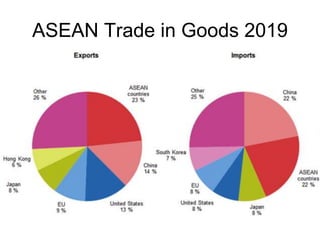
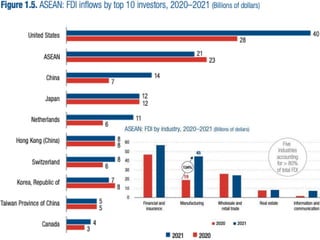
ASEAN Trade in Goods 2019
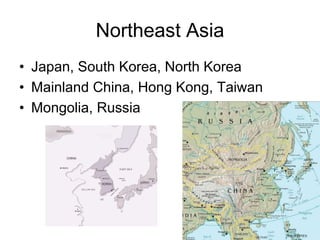
Northeast Asia
• Japan, South Korea, North Korea
• Mainland China, Hong Kong, Taiwan
• Mongolia, Russia
Northeast Asia
• Compared with Southeast Asia and West
Europe, Northeast Asia has lagged behind
– in developing mechanisms or institutions
– of coordination, cooperation, or integration
• especially considering the immense
economic potentials in the region
– natural resources
– human infrastructure
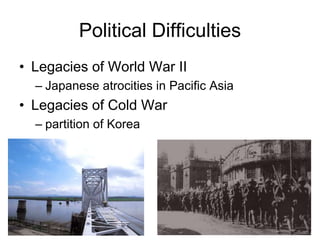
Political Difficulties
• Legacies of World War II
– Japanese atrocities in Pacific Asia
• Legacies of Cold War
– partition of Korea
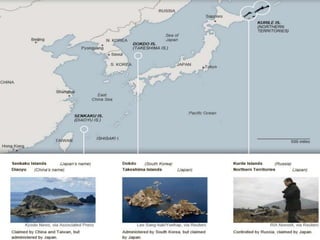
Political difficulties
• Territorial disputes between
– Japan and China
– Japan and South Korea
• “Sea of Japan” or “East Sea”?
– Japan and Russia
• mutually reinforcing suspicions
Current Status
• Washington-Tokyo-Beijing triangle
– PRC & Japan regard relationship with each
other as 2nd in importance to that with US
• Japan plays significant role in integrating
PRC into world economy
• Japan has a vital interest in PRC’s
development and stability
• Economic interdependence
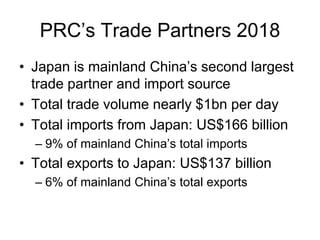
PRC’s Trade Partners 2018
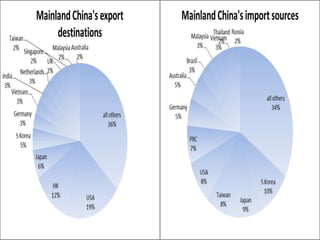
• Japan is mainland China’s second largest
trade partner and import source
• Total trade volume nearly $1bn per day
• Total imports from Japan: US$166 billion
– 9% of mainland China’s total imports
• Total exports to Japan: US$137 billion
– 6% of mainland China’s total exports
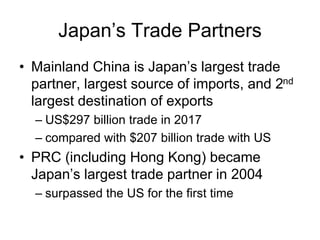
Japan’s Trade Partners
• Mainland China is Japan’s largest trade
partner, largest source of imports, and 2nd
largest destination of exports
– US$297 billion trade in 2017
– compared with $207 billion trade with US
• PRC (including Hong Kong) became
Japan’s largest trade partner in 2004
– surpassed the US for the first time
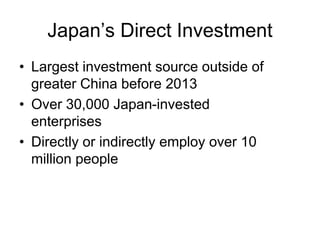
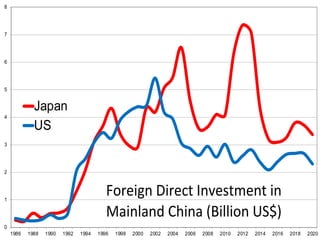
Japan’s Direct Investment
• Largest investment source outside of
greater China before 2013
• Over 30,000 Japan-invested
enterprises
• Directly or indirectly employ over 10
million people
0
1
2
3
4
5
6
7
8
1986 1988 1990 1992 1994 1996 1998 2000 2002 2004 2006 2008 2010 2012 2014 2016 2018 2020
Japan
US
Foreign Direct Investment in
Mainland China (Billion US$)

econinte.ppt

  • 1.
  • 2.
    Outline • Economic development –Flying geese, falling geese • Economic interdependence • ASEAN • Northeast Asia
  • 3.
    Postwar Development I •Flying geese pattern of economic development, by industry
  • 4.
    Postwar Development II •Flying geese pattern of economic development, by region
  • 5.
  • 6.
    ASEAN: overview • Associationof Southeast Asian Nations • 10 member states – Brunei, Cambodia, Indonesia, Laos, Malaysia, Myanmar, Philippines, Singapore, Thailand, & Vietnam • home to 667 million people • collective GDP of more than US$3 trillion
  • 7.
    ASEAN: founding (1967) •5 founding members: – Thailand, Malaysia, Singapore, Indonesia, Philippines • Bangkok Declaration of 1967: – accelerate economic growth – promote regional peace and stability – contain the spread of communism
  • 8.
  • 9.
    End of ColdWar • ASEAN Free Trade Area agreement was signed at ASEAN summit in 1992 • comprehensive program of regional tariff reduction • program later broadened and accelerated • reaffirmed during Asian Financial Crisis of 1997-98
  • 10.
    Expansion of ASEAN •later members all agreed to join the ASEAN Free Trade Area as well • 1995: Vietnam • 1997: Laos • 1997: Myanmar • 1999: Cambodia
  • 11.
    ASEAN: External Links •A joint forum with Japan was established in 1977 • A cooperation agreement with the European Community was signed in 1980 • ``ASEAN + 3”: regular series of meetings at the cabinet and head-of-government levels with Japan, China, and South Korea since 1997
  • 12.
    ASEAN Trade inGoods 2019
  • 14.
    Northeast Asia • Japan,South Korea, North Korea • Mainland China, Hong Kong, Taiwan • Mongolia, Russia
  • 15.
    Northeast Asia • Comparedwith Southeast Asia and West Europe, Northeast Asia has lagged behind – in developing mechanisms or institutions – of coordination, cooperation, or integration • especially considering the immense economic potentials in the region – natural resources – human infrastructure
  • 16.
    Political Difficulties • Legaciesof World War II – Japanese atrocities in Pacific Asia • Legacies of Cold War – partition of Korea
  • 17.
    Political difficulties • Territorialdisputes between – Japan and China – Japan and South Korea • “Sea of Japan” or “East Sea”? – Japan and Russia • mutually reinforcing suspicions
  • 19.
    Current Status • Washington-Tokyo-Beijingtriangle – PRC & Japan regard relationship with each other as 2nd in importance to that with US • Japan plays significant role in integrating PRC into world economy • Japan has a vital interest in PRC’s development and stability • Economic interdependence
  • 20.
    PRC’s Trade Partners2018 • Japan is mainland China’s second largest trade partner and import source • Total trade volume nearly $1bn per day • Total imports from Japan: US$166 billion – 9% of mainland China’s total imports • Total exports to Japan: US$137 billion – 6% of mainland China’s total exports
  • 22.
    Japan’s Trade Partners •Mainland China is Japan’s largest trade partner, largest source of imports, and 2nd largest destination of exports – US$297 billion trade in 2017 – compared with $207 billion trade with US • PRC (including Hong Kong) became Japan’s largest trade partner in 2004 – surpassed the US for the first time
  • 23.
    Japan’s Direct Investment •Largest investment source outside of greater China before 2013 • Over 30,000 Japan-invested enterprises • Directly or indirectly employ over 10 million people
  • 24.
    0 1 2 3 4 5 6 7 8 1986 1988 19901992 1994 1996 1998 2000 2002 2004 2006 2008 2010 2012 2014 2016 2018 2020 Japan US Foreign Direct Investment in Mainland China (Billion US$)