Animal ReproductionAnimal Reproduction
Unit 10Unit 10
ReproductionReproduction
When organism multiply or produceWhen organism multiply or produce
offspringoffspring
Sexual reproduction involves male andSexual reproduction involves male and
femalefemale
Asexual reproduction does not involveAsexual reproduction does not involve
bothboth
The Three Steps of ReproductionThe Three Steps of Reproduction
Copulation is the mating of a male andCopulation is the mating of a male and
femalefemale
The new animal, called the embryo beginsThe new animal, called the embryo begins
to growto grow
Parturition is the giving birthParturition is the giving birth
Male Reproductive SystemMale Reproductive System
ScrotumScrotum contains the testes andcontains the testes and
epididymisepididymis
Maintains temperatureMaintains temperature
Keeps animal fertileKeeps animal fertile
Male Reproductive SystemMale Reproductive System
If testes are held to the body wall theIf testes are held to the body wall the
animal becomes sterileanimal becomes sterile
RidgelingRidgeling oror ridgelridgel has one or bothhas one or both
testes held to the body walltestes held to the body wall
Trait is calledTrait is called cryptrochidismcryptrochidism and is anand is an
inherited traitinherited trait
Male Reproductive SystemMale Reproductive System
TesticlesTesticles produce the sperm cells andproduce the sperm cells and
testosteronetestosterone
Testosterone controls the traits of theTestosterone controls the traits of the
male such as:male such as:
TemperTemper
OdorOdor
Male appearanceMale appearance
Male Reproductive SystemMale Reproductive System
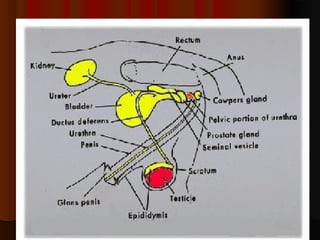
EpididymisEpididymis is a long, coiled tube that isis a long, coiled tube that is
connected to each testicleconnected to each testicle
Vas deferensVas deferens connects the epididymisconnects the epididymis
with the urethrawith the urethra
Vas deferens is inside a protective sheathVas deferens is inside a protective sheath
called thecalled the spermatic cordspermatic cord
UrethraUrethra carries urine from the bladdercarries urine from the bladder
Male Reproductive SystemMale Reproductive System
Three accessory glandsThree accessory glands
Seminal vesiclesSeminal vesicles
Prostate glandProstate gland
Cowper’s glandCowper’s gland
Male Reproductive SystemMale Reproductive System
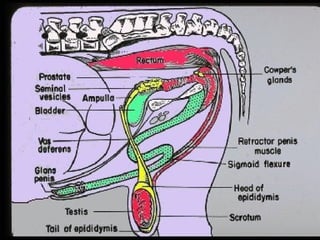
Seminal vesiclesSeminal vesicles produce fluid thatproduce fluid that
protects and transports the spermprotects and transports the sperm
Prostate glandProstate gland produces a fluid that isproduces a fluid that is
mixed with the seminal fluidmixed with the seminal fluid
Cowper’s glandCowper’s gland cleans and neutralizescleans and neutralizes
the urethrathe urethra
Male Reproductive SystemMale Reproductive System
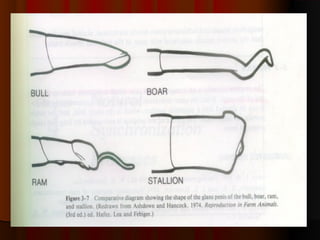
PenisPenis deposits the semen in the femaledeposits the semen in the female
Signoid flexureSignoid flexure and theand the retractorretractor
musclemuscle extend the penis from the sheathextend the penis from the sheath
Male PoultryMale Poultry
TesticlesTesticles produce the sperm andproduce the sperm and
seminal fluidseminal fluid
Vas deferensVas deferens carries the seminal fluidcarries the seminal fluid
and sperm cells the cloacaand sperm cells the cloaca
CloacaCloaca places sperm in the henplaces sperm in the hen
Female Reproductive SystemFemale Reproductive System
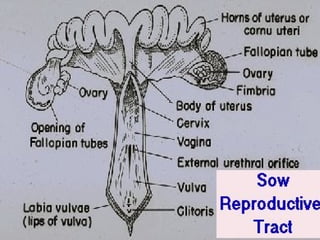
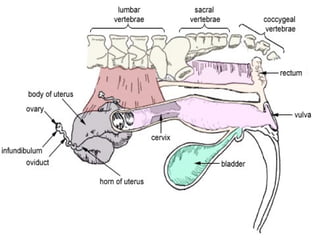
Have twoHave two ovariesovaries that produce eggs andthat produce eggs and
female hormonesfemale hormones estrogenestrogen andand
progesteroneprogesterone
Eggs are produced in theEggs are produced in the folliclesfollicles on theon the
ovariesovaries
Corpus luteumCorpus luteum is formed after the egg isis formed after the egg is
releasedreleased
Female Reproductive SystemFemale Reproductive System
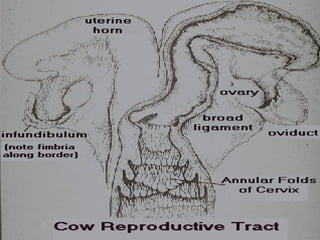
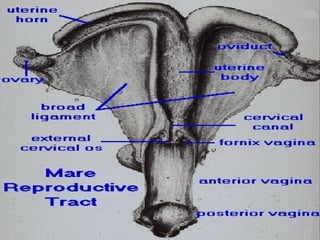
OviductsOviducts oror fallopian tubesfallopian tubes are twoare two
tubes that carry the eggs to the uterustubes that carry the eggs to the uterus
from ovariesfrom ovaries
InfundibulumInfundibulum is the funnel-shaped endis the funnel-shaped end
of the oviductof the oviduct
Female Reproductive SystemFemale Reproductive System
Uterus is where the fetus growUterus is where the fetus grow
Cervix is the neck of the uterusCervix is the neck of the uterus
Vagina is the passage between the cervixVagina is the passage between the cervix
and the vulvaand the vulva
Semen is deposited here in naturalSemen is deposited here in natural
conceptionconception
Female Reproductive SystemFemale Reproductive System
Bladder collects the liquid wasteBladder collects the liquid waste
Vulva is the external openingVulva is the external opening
Clitoris is the sensory and erectile organ ofClitoris is the sensory and erectile organ of
the femalethe female
Female PoultryFemale Poultry
FunnelFunnel receives the yolk from theovaryreceives the yolk from theovary
MagnumMagnum secretes the thick white of thesecretes the thick white of the
eggegg
IsthmusIsthmus develops two shell membranesdevelops two shell membranes
Egg remains in the uterus about 20 hoursEgg remains in the uterus about 20 hours
Takes about 25 to 27 hours for a chick toTakes about 25 to 27 hours for a chick to
produce on eggproduce on egg
Estrus CycleEstrus Cycle
CattleCattle
Standing when mountedStanding when mounted
NervousnessNervousness
Swelling of the vulvaSwelling of the vulva
Inflamed appearance of the vulvaInflamed appearance of the vulva
Mucus dischargeMucus discharge
Try to mount other cattleTry to mount other cattle
Estrus CycleEstrus Cycle
SwineSwine
Mounting other sowsMounting other sows
Restless activityRestless activity
Swelling of the vulvaSwelling of the vulva
Discharge from the vulvaDischarge from the vulva
Frequent urinationFrequent urination
Occasional loud gruntingOccasional loud grunting
Estrus CycleEstrus Cycle
SheepSheep
Do no show any visible signsDo no show any visible signs
Teaser rams maybe neededTeaser rams maybe needed
Come in heat in the fallCome in heat in the fall
Dorset and Tunis breeds come in heat yearDorset and Tunis breeds come in heat year
aroundaround
Estrus CycleEstrus Cycle
GoatsGoats
NervousnessNervousness
Riding or stand to be riddenRiding or stand to be ridden
Frequent urinationFrequent urination
BleatingBleating
Swelling, read appearance of the vulvaSwelling, read appearance of the vulva
Mucus dischargeMucus discharge
Estrus CycleEstrus Cycle
HorsesHorses
Raised tailRaised tail
Relaxation of the vulva (winking)Relaxation of the vulva (winking)
Frequent urinationFrequent urination
Teasing of other maresTeasing of other mares
Desire for other horsesDesire for other horses
Mucus discharge from the vulvaMucus discharge from the vulva
OvulationOvulation
Release of the egg from the ovaryRelease of the egg from the ovary
Egg is contained in the follicleEgg is contained in the follicle
Follicle breaks releasing the eggFollicle breaks releasing the egg
Egg moves into the oviductsEgg moves into the oviducts
If sperm is present, fertilization occurIf sperm is present, fertilization occur
Resource Room - Reproduction Information - AResource Room - Reproduction Information - A
OvulationOvulation
 Corpus luteum forms on the ovary and producesCorpus luteum forms on the ovary and produces
progesteroneprogesterone
 Resource Room - Reproduction Information - AnimatResource Room - Reproduction Information - Animat
LuteolysisLuteolysis
 Progesterone causes:Progesterone causes:
 Implant fertilized egg in the uterusImplant fertilized egg in the uterus
 Other eggs are stopped from formingOther eggs are stopped from forming
 Pregnant condition is maintainedPregnant condition is maintained
 Mammary glands developMammary glands develop
OvulationOvulation
If egg is not fertilizedIf egg is not fertilized
Corpus luteum wastes awayCorpus luteum wastes away
Another follicle growsAnother follicle grows
Another heat occursAnother heat occurs
TwinsTwins
Fraternally related twins occur from twoFraternally related twins occur from two
different eggsdifferent eggs
Identical related twins occur from theIdentical related twins occur from the
splitting of the same eggsplitting of the same egg
FertilizationFertilization
Union of the sperm and eggUnion of the sperm and egg
Sperm cells can only live 24 to 30 hrs afterSperm cells can only live 24 to 30 hrs after
mating occursmating occurs
Egg cell lives about 12 hours after it isEgg cell lives about 12 hours after it is
releases unfertilizedreleases unfertilized
GestationGestation
Time animal is pregnantTime animal is pregnant
Placenta lies along the wall of the uterusPlacenta lies along the wall of the uterus
Food, oxygen, and wastes are exchangedFood, oxygen, and wastes are exchanged
through the umbilical cordthrough the umbilical cord
ParturitionParturition
Giving birthGiving birth
First water bag appearsFirst water bag appears
Second water bag appear containing theSecond water bag appear containing the
fetusfetus
Umbilical cord is brokenUmbilical cord is broken
Animal begins breathingAnimal begins breathing
ParturitionParturition
First milk isFirst milk is colostrumcolostrum which containswhich contains
antibodiesantibodies
AfterbirthAfterbirth is expelledis expelled
Reproduction in PoultryReproduction in Poultry
Young are develop outside the mothersYoung are develop outside the mothers
bodybody
Sperm cells remain in the oviduct for 2 toSperm cells remain in the oviduct for 2 to
3 days3 days
Full fertilization is about 6 daysFull fertilization is about 6 days
Reproductive failureReproductive failure
Physical conditionPhysical condition
InfectionsInfections
Sexual behaviorSexual behavior
CystCyst
CryptorchidismCryptorchidism

Animal reproduction

  • 1.
  • 2.
    ReproductionReproduction When organism multiplyor produceWhen organism multiply or produce offspringoffspring Sexual reproduction involves male andSexual reproduction involves male and femalefemale Asexual reproduction does not involveAsexual reproduction does not involve bothboth
  • 3.
    The Three Stepsof ReproductionThe Three Steps of Reproduction Copulation is the mating of a male andCopulation is the mating of a male and femalefemale The new animal, called the embryo beginsThe new animal, called the embryo begins to growto grow Parturition is the giving birthParturition is the giving birth
  • 4.
    Male Reproductive SystemMaleReproductive System ScrotumScrotum contains the testes andcontains the testes and epididymisepididymis Maintains temperatureMaintains temperature Keeps animal fertileKeeps animal fertile
  • 5.
    Male Reproductive SystemMaleReproductive System If testes are held to the body wall theIf testes are held to the body wall the animal becomes sterileanimal becomes sterile RidgelingRidgeling oror ridgelridgel has one or bothhas one or both testes held to the body walltestes held to the body wall Trait is calledTrait is called cryptrochidismcryptrochidism and is anand is an inherited traitinherited trait
  • 6.
    Male Reproductive SystemMaleReproductive System TesticlesTesticles produce the sperm cells andproduce the sperm cells and testosteronetestosterone Testosterone controls the traits of theTestosterone controls the traits of the male such as:male such as: TemperTemper OdorOdor Male appearanceMale appearance
  • 7.
    Male Reproductive SystemMaleReproductive System EpididymisEpididymis is a long, coiled tube that isis a long, coiled tube that is connected to each testicleconnected to each testicle Vas deferensVas deferens connects the epididymisconnects the epididymis with the urethrawith the urethra Vas deferens is inside a protective sheathVas deferens is inside a protective sheath called thecalled the spermatic cordspermatic cord UrethraUrethra carries urine from the bladdercarries urine from the bladder
  • 8.
    Male Reproductive SystemMaleReproductive System Three accessory glandsThree accessory glands Seminal vesiclesSeminal vesicles Prostate glandProstate gland Cowper’s glandCowper’s gland
  • 9.
    Male Reproductive SystemMaleReproductive System Seminal vesiclesSeminal vesicles produce fluid thatproduce fluid that protects and transports the spermprotects and transports the sperm Prostate glandProstate gland produces a fluid that isproduces a fluid that is mixed with the seminal fluidmixed with the seminal fluid Cowper’s glandCowper’s gland cleans and neutralizescleans and neutralizes the urethrathe urethra
  • 10.
    Male Reproductive SystemMaleReproductive System PenisPenis deposits the semen in the femaledeposits the semen in the female Signoid flexureSignoid flexure and theand the retractorretractor musclemuscle extend the penis from the sheathextend the penis from the sheath
  • 14.
    Male PoultryMale Poultry TesticlesTesticlesproduce the sperm andproduce the sperm and seminal fluidseminal fluid Vas deferensVas deferens carries the seminal fluidcarries the seminal fluid and sperm cells the cloacaand sperm cells the cloaca CloacaCloaca places sperm in the henplaces sperm in the hen
  • 15.
    Female Reproductive SystemFemaleReproductive System Have twoHave two ovariesovaries that produce eggs andthat produce eggs and female hormonesfemale hormones estrogenestrogen andand progesteroneprogesterone Eggs are produced in theEggs are produced in the folliclesfollicles on theon the ovariesovaries Corpus luteumCorpus luteum is formed after the egg isis formed after the egg is releasedreleased
  • 17.
    Female Reproductive SystemFemaleReproductive System OviductsOviducts oror fallopian tubesfallopian tubes are twoare two tubes that carry the eggs to the uterustubes that carry the eggs to the uterus from ovariesfrom ovaries InfundibulumInfundibulum is the funnel-shaped endis the funnel-shaped end of the oviductof the oviduct
  • 19.
    Female Reproductive SystemFemaleReproductive System Uterus is where the fetus growUterus is where the fetus grow Cervix is the neck of the uterusCervix is the neck of the uterus Vagina is the passage between the cervixVagina is the passage between the cervix and the vulvaand the vulva Semen is deposited here in naturalSemen is deposited here in natural conceptionconception
  • 21.
    Female Reproductive SystemFemaleReproductive System Bladder collects the liquid wasteBladder collects the liquid waste Vulva is the external openingVulva is the external opening Clitoris is the sensory and erectile organ ofClitoris is the sensory and erectile organ of the femalethe female
  • 23.
    Female PoultryFemale Poultry FunnelFunnelreceives the yolk from theovaryreceives the yolk from theovary MagnumMagnum secretes the thick white of thesecretes the thick white of the eggegg IsthmusIsthmus develops two shell membranesdevelops two shell membranes Egg remains in the uterus about 20 hoursEgg remains in the uterus about 20 hours Takes about 25 to 27 hours for a chick toTakes about 25 to 27 hours for a chick to produce on eggproduce on egg
  • 24.
    Estrus CycleEstrus Cycle CattleCattle Standingwhen mountedStanding when mounted NervousnessNervousness Swelling of the vulvaSwelling of the vulva Inflamed appearance of the vulvaInflamed appearance of the vulva Mucus dischargeMucus discharge Try to mount other cattleTry to mount other cattle
  • 25.
    Estrus CycleEstrus Cycle SwineSwine Mountingother sowsMounting other sows Restless activityRestless activity Swelling of the vulvaSwelling of the vulva Discharge from the vulvaDischarge from the vulva Frequent urinationFrequent urination Occasional loud gruntingOccasional loud grunting
  • 26.
    Estrus CycleEstrus Cycle SheepSheep Dono show any visible signsDo no show any visible signs Teaser rams maybe neededTeaser rams maybe needed Come in heat in the fallCome in heat in the fall Dorset and Tunis breeds come in heat yearDorset and Tunis breeds come in heat year aroundaround
  • 27.
    Estrus CycleEstrus Cycle GoatsGoats NervousnessNervousness Ridingor stand to be riddenRiding or stand to be ridden Frequent urinationFrequent urination BleatingBleating Swelling, read appearance of the vulvaSwelling, read appearance of the vulva Mucus dischargeMucus discharge
  • 28.
    Estrus CycleEstrus Cycle HorsesHorses RaisedtailRaised tail Relaxation of the vulva (winking)Relaxation of the vulva (winking) Frequent urinationFrequent urination Teasing of other maresTeasing of other mares Desire for other horsesDesire for other horses Mucus discharge from the vulvaMucus discharge from the vulva
  • 29.
    OvulationOvulation Release of theegg from the ovaryRelease of the egg from the ovary Egg is contained in the follicleEgg is contained in the follicle Follicle breaks releasing the eggFollicle breaks releasing the egg Egg moves into the oviductsEgg moves into the oviducts If sperm is present, fertilization occurIf sperm is present, fertilization occur Resource Room - Reproduction Information - AResource Room - Reproduction Information - A
  • 30.
    OvulationOvulation  Corpus luteumforms on the ovary and producesCorpus luteum forms on the ovary and produces progesteroneprogesterone  Resource Room - Reproduction Information - AnimatResource Room - Reproduction Information - Animat LuteolysisLuteolysis  Progesterone causes:Progesterone causes:  Implant fertilized egg in the uterusImplant fertilized egg in the uterus  Other eggs are stopped from formingOther eggs are stopped from forming  Pregnant condition is maintainedPregnant condition is maintained  Mammary glands developMammary glands develop
  • 31.
    OvulationOvulation If egg isnot fertilizedIf egg is not fertilized Corpus luteum wastes awayCorpus luteum wastes away Another follicle growsAnother follicle grows Another heat occursAnother heat occurs
  • 32.
    TwinsTwins Fraternally related twinsoccur from twoFraternally related twins occur from two different eggsdifferent eggs Identical related twins occur from theIdentical related twins occur from the splitting of the same eggsplitting of the same egg
  • 33.
    FertilizationFertilization Union of thesperm and eggUnion of the sperm and egg Sperm cells can only live 24 to 30 hrs afterSperm cells can only live 24 to 30 hrs after mating occursmating occurs Egg cell lives about 12 hours after it isEgg cell lives about 12 hours after it is releases unfertilizedreleases unfertilized
  • 34.
    GestationGestation Time animal ispregnantTime animal is pregnant Placenta lies along the wall of the uterusPlacenta lies along the wall of the uterus Food, oxygen, and wastes are exchangedFood, oxygen, and wastes are exchanged through the umbilical cordthrough the umbilical cord
  • 35.
    ParturitionParturition Giving birthGiving birth Firstwater bag appearsFirst water bag appears Second water bag appear containing theSecond water bag appear containing the fetusfetus Umbilical cord is brokenUmbilical cord is broken Animal begins breathingAnimal begins breathing
  • 36.
    ParturitionParturition First milk isFirstmilk is colostrumcolostrum which containswhich contains antibodiesantibodies AfterbirthAfterbirth is expelledis expelled
  • 37.
    Reproduction in PoultryReproductionin Poultry Young are develop outside the mothersYoung are develop outside the mothers bodybody Sperm cells remain in the oviduct for 2 toSperm cells remain in the oviduct for 2 to 3 days3 days Full fertilization is about 6 daysFull fertilization is about 6 days
  • 38.
    Reproductive failureReproductive failure PhysicalconditionPhysical condition InfectionsInfections Sexual behaviorSexual behavior CystCyst CryptorchidismCryptorchidism