HABITUATION
Dr. Surjya Kumar Saikia
Department of Zoology
Visva-Bharati University
Expected outcomes
• We will be able to know habituation as animal behavior
• We will be able to understand how habituation influences
animal behavior
HABITUATION IS A NON-ASSOCIATIVE LEARNING
Habituation is an extremely simple form of learning, in which
an animal, after a period of exposure to a stimulus, stops
responding.
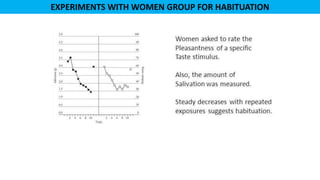
EXPERIMENTS WITH WOMEN GROUP FOR HABITUATION
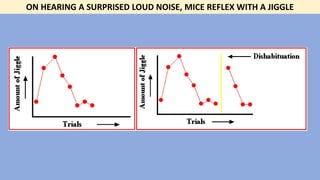
ON HEARING A SURPRISED LOUD NOISE, MICE REFLEX WITH A JIGGLE
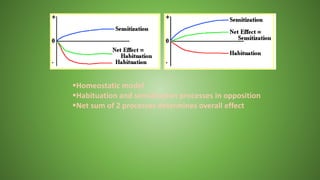
Habituation is the decrease in response strength with repeated exposure to a
particular eliciting stimulus.
Sensitization is the increase in response strength with repeated exposure to a
particular stimulus.
Dual-Process Theory
Homeostatic model
Habituation and sensitization processes in opposition
Net sum of 2 processes determines overall effect
Habituation is important in filtering the large amounts of
information received from the surrounding environment.
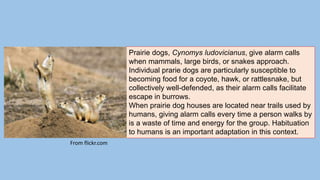
Prairie dogs, Cynomys ludovicianus, give alarm calls
when mammals, large birds, or snakes approach.
Individual prarie dogs are particularly susceptible to
becoming food for a coyote, hawk, or rattlesnake, but
collectively well-defended, as their alarm calls facilitate
escape in burrows.
When prairie dog houses are located near trails used by
humans, giving alarm calls every time a person walks by
is a waste of time and energy for the group. Habituation
to humans is an important adaptation in this context.
From flickr.com
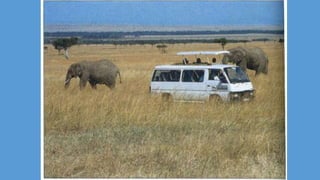
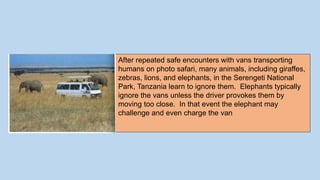
After repeated safe encounters with vans transporting
humans on photo safari, many animals, including giraffes,
zebras, lions, and elephants, in the Serengeti National
Park, Tanzania learn to ignore them. Elephants typically
ignore the vans unless the driver provokes them by
moving too close. In that event the elephant may
challenge and even charge the van

Habituation in Animlas

  • 1.
    HABITUATION Dr. Surjya KumarSaikia Department of Zoology Visva-Bharati University
  • 2.
    Expected outcomes • Wewill be able to know habituation as animal behavior • We will be able to understand how habituation influences animal behavior
  • 3.
    HABITUATION IS ANON-ASSOCIATIVE LEARNING Habituation is an extremely simple form of learning, in which an animal, after a period of exposure to a stimulus, stops responding.
  • 5.
    EXPERIMENTS WITH WOMENGROUP FOR HABITUATION
  • 6.
    ON HEARING ASURPRISED LOUD NOISE, MICE REFLEX WITH A JIGGLE
  • 7.
    Habituation is thedecrease in response strength with repeated exposure to a particular eliciting stimulus. Sensitization is the increase in response strength with repeated exposure to a particular stimulus. Dual-Process Theory
  • 8.
    Homeostatic model Habituation andsensitization processes in opposition Net sum of 2 processes determines overall effect
  • 9.
    Habituation is importantin filtering the large amounts of information received from the surrounding environment.
  • 10.
    Prairie dogs, Cynomysludovicianus, give alarm calls when mammals, large birds, or snakes approach. Individual prarie dogs are particularly susceptible to becoming food for a coyote, hawk, or rattlesnake, but collectively well-defended, as their alarm calls facilitate escape in burrows. When prairie dog houses are located near trails used by humans, giving alarm calls every time a person walks by is a waste of time and energy for the group. Habituation to humans is an important adaptation in this context. From flickr.com
  • 11.
    After repeated safeencounters with vans transporting humans on photo safari, many animals, including giraffes, zebras, lions, and elephants, in the Serengeti National Park, Tanzania learn to ignore them. Elephants typically ignore the vans unless the driver provokes them by moving too close. In that event the elephant may challenge and even charge the van