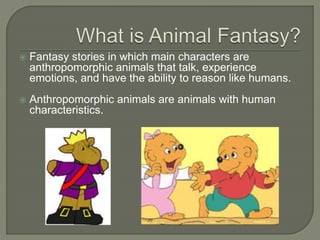
 Fantasy stories in which main characters are 
anthropomorphic animals that talk, experience 
emotions, and have the ability to reason like humans. 
 Anthropomorphic animals are animals with human 
characteristics.
Questions to ask yourself: 
• How believable are the anthropomorphic animals? 
• Does the protagonist possess an appropriate mix of 
both animal and human characteristics? 
• Does the book tell a good story that children will 
enjoy? 
• Is the plot credible?
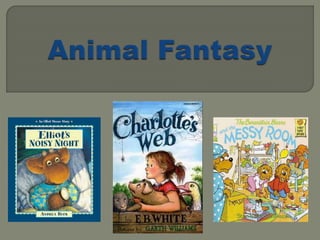
 Includes one or more animals as the focus of the story. 
 Stories appeal to children. 
 Children can relate to the stories because of their pets. 
 Young children may see animals as having human characteristics. 
 Animals in these books have human traits like talking, forming friendships, 
and wearing clothing. 
 Some very popular books focus on animal protagonists – Curious George, 
Peter Rabbit, and Paddington Bear. 
 “Authors use animal characters because they can convey ideas by analogy, 
ideas which have greater impact than if child characters are used.” 
 The most common plots take place in contemporary setting and focus on 
every day issues that mimic human nature. 
 Animal stories are often children’s favorite books.
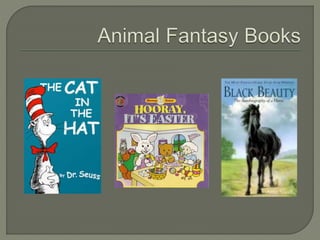
 1877: Black Beauty: The Autobiography of a Horse 
by Anna Sewell 
 First significant animal fantasy story 
 Published in England 
 Not written as a children’s book – written as a protest against the 
cruel treatment of animals 
 1902: The Tale of Peter Rabbit by Beatrix Potter 
 Protype of children’s picture story books 
 Potter privately printed the first edition after 6 publishers turned her 
down 
 Cautionary tale warning children about consequences of not 
minding their parents 
 1908: The Wind in the Willows by Kenneth 
Graham 
 First major animal fantasy novel specifically for children 
 Written in England 
 Different customs and vocabulary make it difficult for children to 
read
 1942: The Pokey Little Puppy by Janette Lowrey 
 Named all-time best-selling children’s picture book in the U.S. by 
Publishers Weekly 
 About 15 million copies were sold in the U.S. in the first 58 years of 
its publication 
 1952: Charlotte’s Web by E.B. White 
 Most-loved animal fantasy novel of the twentieth century 
 The all-time best-selling children’s paper back book in the U.S. 
 More than 11 million copies sold in the U.S. in the first 48 years of 
its publication 
 1957: The Cat in the Hat by Dr. Seuss 
 Protype of easy-to-read picture story books written on a beginning 
reader’s level 
 Dr. Seuss published more than 60 children’s books
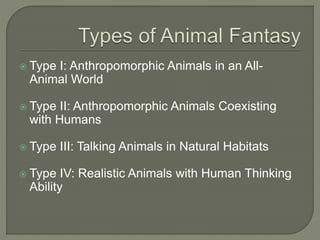
 Type I: Anthropomorphic Animals in an All- 
Animal World 
 Type II: Anthropomorphic Animals Coexisting 
with Humans 
 Type III: Talking Animals in Natural Habitats 
 Type IV: Realistic Animals with Human Thinking 
Ability
The anthropomorphic animals take the 
place of humans and exist in a totally 
animal world. 
Animal characters behave mostly like 
humans – talking, living in house, eating 
human food, wearing clothes. 
Examples: Frog and Toad are Friends 
by Arnold Lobel and Tulip and Lupin 
Forever by Mireille Levert
 Animals coexist with humans, sometimes in a 
human dominated world. 
 May or may not be able to speak and sometimes 
move back and forth from the animal world to the 
human world. 
 Common characters: pets, farm animals, mice, 
and wild animals 
 Examples: Charlotte’s Web by E.B. White and 
Diary of a Worm by Doreen Cronin
 Animals do not wear clothes or live in houses 
and humans are not present. 
 Animals live in natural-type habitats and 
display many animal traits. 
 Animals are able to talk to animals of all 
species, and they portray human emotions and 
thoughts. 
 Examples: The Very Hungry Caterpillar by Eric 
Carle and Into the Wild by Erin Hunter
 It is set in the real world, so animals live in appropriate habitats. 
 Their knowledge of human ways is limited to what they can 
observe and comprehend. 
 They can communicate with animals of the same species only. 
 The author tells the story through the animals point of view and 
assigns some human emotions to the animal characters because 
of this. 
 It is a very small subcategory of Animal Fantasy 
 Plots often show a conflict of some kind. 
 Examples: Black Beauty by Anna Sewell and The Call of the Wild 
by Jack London
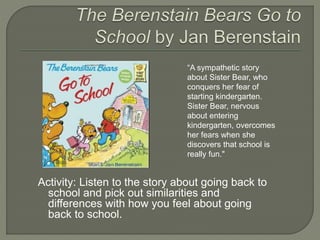
“A sympathetic story 
about Sister Bear, who 
conquers her fear of 
starting kindergarten. 
Sister Bear, nervous 
about entering 
kindergarten, overcomes 
her fears when she 
discovers that school is 
really fun." 
Activity: Listen to the story about going back to 
school and pick out similarities and 
differences with how you feel about going 
back to school.
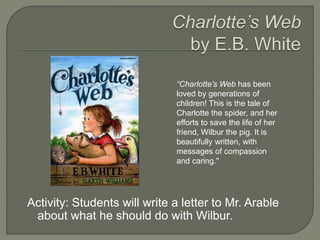
“Charlotte's Web has been 
loved by generations of 
children! This is the tale of 
Charlotte the spider, and her 
efforts to save the life of her 
friend, Wilbur the pig. It is 
beautifully written, with 
messages of compassion 
and caring." 
Activity: Students will write a letter to Mr. Arable 
about what he should do with Wilbur.
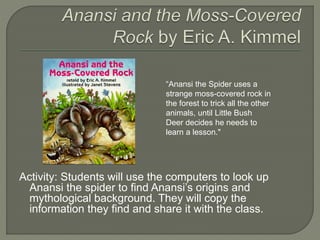
“Anansi the Spider uses a 
strange moss-covered rock in 
the forest to trick all the other 
animals, until Little Bush 
Deer decides he needs to 
learn a lesson." 
Activity: Students will use the computers to look up 
Anansi the spider to find Anansi’s origins and 
mythological background. They will copy the 
information they find and share it with the class.
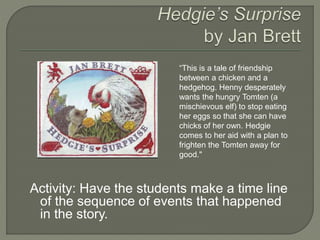
“This is a tale of friendship 
between a chicken and a 
hedgehog. Henny desperately 
wants the hungry Tomten (a 
mischievous elf) to stop eating 
her eggs so that she can have 
chicks of her own. Hedgie 
comes to her aid with a plan to 
frighten the Tomten away for 
good." 
Activity: Have the students make a time line 
of the sequence of events that happened 
in the story.
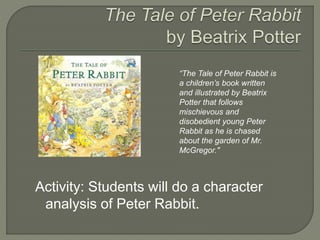
“The Tale of Peter Rabbit is 
a children’s book written 
and illustrated by Beatrix 
Potter that follows 
mischievous and 
disobedient young Peter 
Rabbit as he is chased 
about the garden of Mr. 
McGregor." 
Activity: Students will do a character 
analysis of Peter Rabbit.
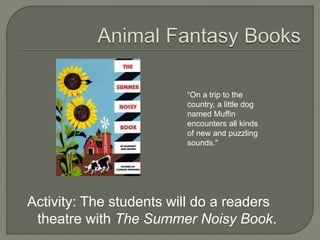
“On a trip to the 
country, a little dog 
named Muffin 
encounters all kinds 
of new and puzzling 
sounds." 
Activity: The students will do a readers 
theatre with The Summer Noisy Book.
 https://people.ucalgary.ca/~dkbrown/wwr/animals.html 
 http://childliterature.net/childlit/animal/ 
 http://www-tc.pbskids.org/berenstainbears/caregiver/BB_Sec_5.pdf 
 http://www.barnesandnoble.com/w/berenstain-bears-go-to-school-stan- 
berenstain/1100192780?ean=9780394837369 
 https://www.teachervision.com/childrens-book/activity/1732.html 
 http://www.goodreads.com/book/show/833229.Anansi_and_the_Mos 
s_Covered_Rock 
 http://www.liveoakmedia.com/client/guides/26754.pdf 
 http://www.scholastic.com/teachers/lesson-plan/hedgies-surprise-lesson- 
plan 
 http://novelsummary.wordpress.com/2012/10/04/the-tale-of-peter-rabbit/ 
 http://www.goodreads.com/book/show/237358.The_Summer_Noisy_ 
Book 
 Elementary Children’s Literature by Nancy A. Anderson