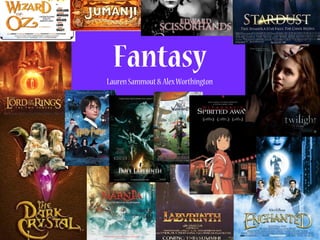
Fantasy
Lauren Sammout & Alex Worthington
What is Fantasy?
•   Fantasy is a genre of fiction it commonly uses magic and other supernatural
    phenomena as a primary element of plot, setting, or theme.
•   Many films within the genre take place in imaginary worlds, creating pure escapism
    from reality.
•   Fantasy is generally distinguished from the genre of sci-fi by the expectation that it
    remains clear of scientific themes.
•   Though there is a great deal of overlap between the two, both of which are sub-genres
    of speculative fiction.
•   In fantasy films, the protagonist(s) often undergo some kind of mystical/heroic
    experience and must require assistance from superhuman forces.
Elements of Fantasy

• Fantasy films usually possess Fantastic elements in a self-coherent
  setting (where inspiration from mythology and folklore remains the
  theme).
• This includes Magic, other worlds, creatures, objects and species.
• These elements, though fictional, remain the norm within fantasy film.
• This allows anything to become possible in the fantasy genre.
CHARACTERS IN THE FANTASY WORLD

  • main characters within the fantasy genre are usually kings/princes or
    queens/princesses, although some fantasies include supernatural beings
    (such as angels, fairies and gods).
  • Gnomes, dwarves and elves are also popular within the genre, alongside evil
    spirits, magicians and sorcerers.
  • in addition to the heroes, villains within the fantasy genre are highly
    important, as their roles often play a key role in the story and plot
    development.
Fantasy Plots

• Fantasy film is a very broad genre, resulting in a wide variety of plots.
• Plots differ depending on the sub-genre.
• In a sense, fantasy remains the theme of the film, and the sub-genre
  creates and drives the plot.
Fantasy Sub-genres
• Bangsian Fantasy
   Bangsian Fantasy is a sub-genre of film that includes a plot that
   revolves around the afterlife. These films explore the concepts of
   Heaven and Hell, through different religious sects.

   Often, Bangsian Fantasy will incorporate Greek themes. Many films in
   this sub-genre base characters off of living beings.


Examples: The Lovely Bones, What Dreams May Come, A Matter of Life
   and Death.
Fantasy Sub-genres
• High Fantasy
    High Fantasy is a sub-genre that emphasises a developed fantasy world.
    These films tend to be more complex than regular fantasy films. The
    complexity shows itself through highly woven story lines and intense
    character development.


    High Fantasy films can be based on novels and therefore have a cult
    following of fans. Many of these films will have sequels and prequels.


Examples: The Chronicles of Narnia, The NeverEnding Story, Eragon.
Fantasy Sub-genres
• Sword and Sorcery
   Unlike High Fantasy film, Sword and Sorcery films tend to be more plot-
   driven. These films rely on heavy action and battle scenes.

   Common themes in Sword and Sorcery films include a rescue mission,
   saving a princess, and battling a fantastical monster.


Examples: Conan the Barbarian, The Sword in the Stone, Legend.
Fantasy Sub-genres
• Fairy Tales and Mythology
  Fairy tales are not just for kids!

  The original versions of many fairy tales and myths were often violent stories set in
  mystical lands, sometimes with strange creatures and sometimes even stranger
  heroes.

  Fairy tails have become one of the most popular fantasy sub-genres.

  examples: most disney/pixar
Fantasy Sub-genres
• Comic Fantasy
  Tales designed specifically as spoofs of other serious fantasies, or containing
  humorous elements to a light-hearted tale.

  examples: Your highness, robin hood: men in tights


• Dark Fantasy
  Encompasses the nastier side to the usual fun of the fantasy genre. Dark fantasy includes the
  nightmarish, dark side of magic, creatures, evil and demons.

  Examples: constantine, pan’s labyrinth
Tips on writing Fantasy
• 1. The Premise:
 This is your big idea! What you are trying to say in a nutshell.

 You are taking a stand. All fantasy is allegorical and so your fantasy story should
 stand for something else.

 Remember this rule:
 If it’s only about what it’s about, it’s not about enough.

 Figure out what your larger story stands for.
 Everything springs from the premise; use it as a map to make all story decisions.
Tips on writing Fantasy
• 2. The Hero:
 It’s not necessary that the Hero of your fantasy story is a prince, princess or the
 ‘chosen one.’

 By going to the fantasy world an ordinary person opens up to a mystical experience.
 The Hero needs to break convention and they need to open their mind and learn to
 see possibilities.


 Let the premise guide you and help you in coming up with characteristics for the
 Hero that will best suit your story.
Tips on writing Fantasy
• 3. The Fantasy World:
 What is this world? A fantasy dream or a fantasy nightmare? You can contrast the fantasy world with
 the real world. (‘Alice in wonderland.’ Above + below the rabbit hole.)

 Is the fantasy world positive or negative? What can the hero learn from this world?

 The fantasy world could be set in a fantastical space or fantastical time, or both.

 Set the rules of the world and don’t break them. Define them. That is the only way to make the world
 come alive - you don’t want a boring fantasy!

 The fantasy world will often have ’The Passage Way’. This is the rabbit hole. Besides the literal use of
 the Passage way it’s a signal to the audience that the rules will now change. We are going to see the
 world in a new perspective and we are going to see a new set of rules.
Tips on writing Fantasy
• 4. The Opponent:
 In many fantasy stories, the main opponent is the ‘King’ who is incapable of positive emotions such as love or
 empathy and is often someone who has simply forgotten how to have fun (or wants to destroy everyone
 else’s!)

 They could be a person or an entity. (In ‘Big’ it’s the corporate executive. In ‘E.T.’ it’s the military and the scientific community.) Occasionally,
 the main opponent is a mother figure. (The Queen in ‘Alice in Wonderland’ and the wicked witch in ‘The Wizard of Oz.’)
 In a movie like ‘Honey I Shrunk the Kids’ instead of one main opponent, there are a series of opponents or
 obstacles.

 Generally, one should distinguish between the main opponent and other opponents that form the
 forces of antagonism. All of this forms the conflict and no story can be complete without conflict but
 a good fantasy story should have a strong, singular, main opponent who is directly in the Hero’s path.
Tips on writing Fantasy
• 5. The Final Battle:
 Every fantasy story has an epic final battle for a climax. This is your Hero’s final test.
 Save the best for last.

 Usually what the hero has learned through their journey is used here to overcome
 the main opponent in the final battle. There is an epiphany moment here for the
 fantasy hero.
 There’s no story after the novelty of the Fantasy world dies.

 A deep conflict is a must; extremely crucial to keep a story going, no matter how
 fantastical your world is. Keep the conflict coming and keep raising the stakes for
 your Hero.
Clips
• Harry Potter and the Goblet of Fire (High/Sorcery)
  http://www.youtube.com/watch?v=W7Ic9rZ9OQw&feature=relmfu

   Pan’s Labyrinth - TRAILER (Dark/Crossover Fantasy)
   http://www.youtube.com/watch?v=fZhKmHPyMJ4

   Lord of the Rings - RIDE FOR RUIN (High fantasy)
   http://www.youtube.com/watch?v=dwT9BEh7qZ0
Thanks for Listening!

Fantasy

  • 1.
    Fantasy Lauren Sammout &Alex Worthington
  • 2.
    What is Fantasy? • Fantasy is a genre of fiction it commonly uses magic and other supernatural phenomena as a primary element of plot, setting, or theme. • Many films within the genre take place in imaginary worlds, creating pure escapism from reality. • Fantasy is generally distinguished from the genre of sci-fi by the expectation that it remains clear of scientific themes. • Though there is a great deal of overlap between the two, both of which are sub-genres of speculative fiction. • In fantasy films, the protagonist(s) often undergo some kind of mystical/heroic experience and must require assistance from superhuman forces.
  • 3.
    Elements of Fantasy •Fantasy films usually possess Fantastic elements in a self-coherent setting (where inspiration from mythology and folklore remains the theme). • This includes Magic, other worlds, creatures, objects and species. • These elements, though fictional, remain the norm within fantasy film. • This allows anything to become possible in the fantasy genre.
  • 4.
    CHARACTERS IN THEFANTASY WORLD • main characters within the fantasy genre are usually kings/princes or queens/princesses, although some fantasies include supernatural beings (such as angels, fairies and gods). • Gnomes, dwarves and elves are also popular within the genre, alongside evil spirits, magicians and sorcerers. • in addition to the heroes, villains within the fantasy genre are highly important, as their roles often play a key role in the story and plot development.
  • 5.
    Fantasy Plots • Fantasyfilm is a very broad genre, resulting in a wide variety of plots. • Plots differ depending on the sub-genre. • In a sense, fantasy remains the theme of the film, and the sub-genre creates and drives the plot.
  • 6.
    Fantasy Sub-genres • BangsianFantasy Bangsian Fantasy is a sub-genre of film that includes a plot that revolves around the afterlife. These films explore the concepts of Heaven and Hell, through different religious sects. Often, Bangsian Fantasy will incorporate Greek themes. Many films in this sub-genre base characters off of living beings. Examples: The Lovely Bones, What Dreams May Come, A Matter of Life and Death.
  • 7.
    Fantasy Sub-genres • HighFantasy High Fantasy is a sub-genre that emphasises a developed fantasy world. These films tend to be more complex than regular fantasy films. The complexity shows itself through highly woven story lines and intense character development. High Fantasy films can be based on novels and therefore have a cult following of fans. Many of these films will have sequels and prequels. Examples: The Chronicles of Narnia, The NeverEnding Story, Eragon.
  • 8.
    Fantasy Sub-genres • Swordand Sorcery Unlike High Fantasy film, Sword and Sorcery films tend to be more plot- driven. These films rely on heavy action and battle scenes. Common themes in Sword and Sorcery films include a rescue mission, saving a princess, and battling a fantastical monster. Examples: Conan the Barbarian, The Sword in the Stone, Legend.
  • 9.
    Fantasy Sub-genres • FairyTales and Mythology Fairy tales are not just for kids! The original versions of many fairy tales and myths were often violent stories set in mystical lands, sometimes with strange creatures and sometimes even stranger heroes. Fairy tails have become one of the most popular fantasy sub-genres. examples: most disney/pixar
  • 10.
    Fantasy Sub-genres • ComicFantasy Tales designed specifically as spoofs of other serious fantasies, or containing humorous elements to a light-hearted tale. examples: Your highness, robin hood: men in tights • Dark Fantasy Encompasses the nastier side to the usual fun of the fantasy genre. Dark fantasy includes the nightmarish, dark side of magic, creatures, evil and demons. Examples: constantine, pan’s labyrinth
  • 11.
    Tips on writingFantasy • 1. The Premise: This is your big idea! What you are trying to say in a nutshell. You are taking a stand. All fantasy is allegorical and so your fantasy story should stand for something else. Remember this rule: If it’s only about what it’s about, it’s not about enough. Figure out what your larger story stands for. Everything springs from the premise; use it as a map to make all story decisions.
  • 12.
    Tips on writingFantasy • 2. The Hero: It’s not necessary that the Hero of your fantasy story is a prince, princess or the ‘chosen one.’ By going to the fantasy world an ordinary person opens up to a mystical experience. The Hero needs to break convention and they need to open their mind and learn to see possibilities. Let the premise guide you and help you in coming up with characteristics for the Hero that will best suit your story.
  • 13.
    Tips on writingFantasy • 3. The Fantasy World: What is this world? A fantasy dream or a fantasy nightmare? You can contrast the fantasy world with the real world. (‘Alice in wonderland.’ Above + below the rabbit hole.) Is the fantasy world positive or negative? What can the hero learn from this world? The fantasy world could be set in a fantastical space or fantastical time, or both. Set the rules of the world and don’t break them. Define them. That is the only way to make the world come alive - you don’t want a boring fantasy! The fantasy world will often have ’The Passage Way’. This is the rabbit hole. Besides the literal use of the Passage way it’s a signal to the audience that the rules will now change. We are going to see the world in a new perspective and we are going to see a new set of rules.
  • 14.
    Tips on writingFantasy • 4. The Opponent: In many fantasy stories, the main opponent is the ‘King’ who is incapable of positive emotions such as love or empathy and is often someone who has simply forgotten how to have fun (or wants to destroy everyone else’s!) They could be a person or an entity. (In ‘Big’ it’s the corporate executive. In ‘E.T.’ it’s the military and the scientific community.) Occasionally, the main opponent is a mother figure. (The Queen in ‘Alice in Wonderland’ and the wicked witch in ‘The Wizard of Oz.’) In a movie like ‘Honey I Shrunk the Kids’ instead of one main opponent, there are a series of opponents or obstacles. Generally, one should distinguish between the main opponent and other opponents that form the forces of antagonism. All of this forms the conflict and no story can be complete without conflict but a good fantasy story should have a strong, singular, main opponent who is directly in the Hero’s path.
  • 15.
    Tips on writingFantasy • 5. The Final Battle: Every fantasy story has an epic final battle for a climax. This is your Hero’s final test. Save the best for last. Usually what the hero has learned through their journey is used here to overcome the main opponent in the final battle. There is an epiphany moment here for the fantasy hero. There’s no story after the novelty of the Fantasy world dies. A deep conflict is a must; extremely crucial to keep a story going, no matter how fantastical your world is. Keep the conflict coming and keep raising the stakes for your Hero.
  • 16.
    Clips • Harry Potterand the Goblet of Fire (High/Sorcery) http://www.youtube.com/watch?v=W7Ic9rZ9OQw&feature=relmfu Pan’s Labyrinth - TRAILER (Dark/Crossover Fantasy) http://www.youtube.com/watch?v=fZhKmHPyMJ4 Lord of the Rings - RIDE FOR RUIN (High fantasy) http://www.youtube.com/watch?v=dwT9BEh7qZ0
  • 17.