Alemanni 
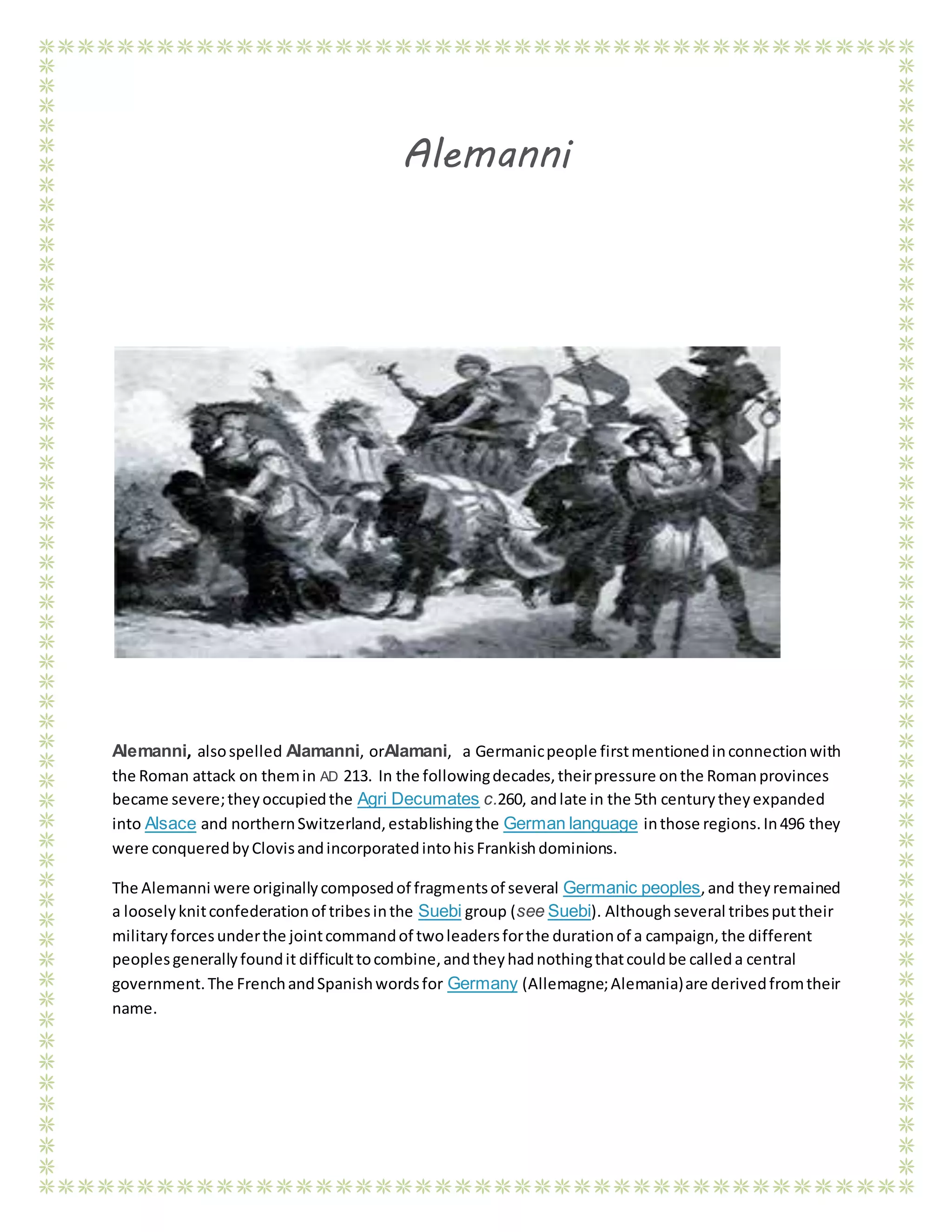
Alemanni, also spelled Alamanni, orAlamani, a Germanic people first mentioned in connection with 
the Roman attack on them in AD 213. In the following decades, their pressure on the Roman provinces 
became severe; they occupied the Agri Decumates c.260, and late in the 5th century they expanded 
into Alsace and northern Switzerland, establishing the German language in those regions. In 496 they 
were conquered by Clovis and incorporated into his Frankish dominions. 
The Alemanni were originally composed of fragments of several Germanic peoples, and they remained 
a loosely knit confederation of tribes in the Suebi group (see Suebi). Although several tribes put their 
military forces under the joint command of two leaders for the duration of a campaign, the different 
peoples generally found it difficult to combine, and they had nothing that could be called a central 
government. The French and Spanish words for Germany (Allemagne; Alemania) are derived from their 
name.
Visigoth 
The Visigoths (UK: /ˈvɪzɪˌɡɒθs/; US: /ˈvɪzɪˌɡɑːθs/, Latin: Visigothi, Wisigothi, Vesi, Visi, 
Wesi, or Wisi) were branches of the nomadic tribes of Germanic peoples referred to 
collectively as the Goths. These tribes flourished and spread during the late Roman 
Empire in Late Antiquity, or the Migration Period. The Visigoths emerged from earlier 
Gothic groups (possibly the Thervingi)[3] who had invaded the Roman Empire beginning 
in 376 and had defeated the Romans at the Battle of Adrianople in 378. The Visigoths 
invaded Italy under Alaric Iand sacked Rome in 410. Their long history of migration led 
the Visigoths to compare themselves to the Biblical Hebrew people who purportedly 
wandered for forty years in the Sinai Desert. After the Visigoths sacked Rome, they 
began settling down, first in southern Gauland eventually in Spain and Portugal, where 
they founded the Kingdom of the Visigoths.
Angles 
The Angles (Latin Anglii) were one of the main Germanic peoples who settled 
in Britain in the post-Roman period. They founded several of the kingdoms of Anglo- 
Saxon England, and their name is the root of the name England. The name comes from 
the district of Angeln, an area located on the Baltic shore of what is now Schleswig- 
Holstein, the most northernstate of Germany.
Lombards
Burgundii
Saxons
7 germanic tribes

7 germanic tribes

  • 1.
    Alemanni Alemanni, alsospelled Alamanni, orAlamani, a Germanic people first mentioned in connection with the Roman attack on them in AD 213. In the following decades, their pressure on the Roman provinces became severe; they occupied the Agri Decumates c.260, and late in the 5th century they expanded into Alsace and northern Switzerland, establishing the German language in those regions. In 496 they were conquered by Clovis and incorporated into his Frankish dominions. The Alemanni were originally composed of fragments of several Germanic peoples, and they remained a loosely knit confederation of tribes in the Suebi group (see Suebi). Although several tribes put their military forces under the joint command of two leaders for the duration of a campaign, the different peoples generally found it difficult to combine, and they had nothing that could be called a central government. The French and Spanish words for Germany (Allemagne; Alemania) are derived from their name.
  • 2.
    Visigoth The Visigoths(UK: /ˈvɪzɪˌɡɒθs/; US: /ˈvɪzɪˌɡɑːθs/, Latin: Visigothi, Wisigothi, Vesi, Visi, Wesi, or Wisi) were branches of the nomadic tribes of Germanic peoples referred to collectively as the Goths. These tribes flourished and spread during the late Roman Empire in Late Antiquity, or the Migration Period. The Visigoths emerged from earlier Gothic groups (possibly the Thervingi)[3] who had invaded the Roman Empire beginning in 376 and had defeated the Romans at the Battle of Adrianople in 378. The Visigoths invaded Italy under Alaric Iand sacked Rome in 410. Their long history of migration led the Visigoths to compare themselves to the Biblical Hebrew people who purportedly wandered for forty years in the Sinai Desert. After the Visigoths sacked Rome, they began settling down, first in southern Gauland eventually in Spain and Portugal, where they founded the Kingdom of the Visigoths.
  • 3.
    Angles The Angles(Latin Anglii) were one of the main Germanic peoples who settled in Britain in the post-Roman period. They founded several of the kingdoms of Anglo- Saxon England, and their name is the root of the name England. The name comes from the district of Angeln, an area located on the Baltic shore of what is now Schleswig- Holstein, the most northernstate of Germany.
  • 4.
  • 5.
  • 6.