OLD ENGLISH
(Anglo-Saxon Periods)
[450-1066]
Presented by: Praddum Namdev 1
 Old English – the earliest form of the English
language
 spoken and written in Anglo-Saxon Britain from
c. 450 CE until c. 1150 (thus it continued to be
used for some decades after the Norman
Conquest of 1066).
 According to Toronto University's Dictionary of
Old English Corpus, the entire surviving body of
Old English material from 600 to 1150 consists of
only 3,037 texts (excluding manuscripts with
minor variants).
2
 English vocabulary has never been purely Anglo-Saxon – not even in
the Anglo-Saxon period. By the time the Anglo-Saxons arrived in
Britain, there had already been four centuries of linguistic interchange
between Germanic and Roman people on the European mainland.
 Latin words might have arrived in English through any of several
possible routes. To begin with, they must have entered the Celtic
speech of the Britons during the Roman occupation (43–c. 410), and
some might have remained in daily use after the Romans finally left
in the early 5th century so that they were picked up by the Anglo-
Saxons in due course.
 Aristocratic Britons may also have continued to use the language as a
medium of upper-class communication. If so, we might expect a
significant number of Latin words to have been in daily use.
 Some Latin words would also have been brought in by the Anglo-
Saxons invaders. And following the arrival of St Augustine in 597, the
influence of the monks must have grown, with Latinisms being
dropped into speech much as they still are today.
3
Middle English Period (1066-1500)
 ‘Middle English’ – a period of roughly 300 years from around 1150
CE to around 1450 – is difficult to identify because it is a time of
transition between two eras that each have stronger definition:
Old English and Modern English.
 Before this period we encounter a language which is chiefly Old
Germanic in its character – in its sounds, spellings, grammar and
vocabulary.
 After this period we have a language which displays a very
different kind of structure, with major changes having taken
place in each of these areas, many deriving from the influence of
French following the Norman Conquest of 1066.
4
Grammatical change in Middle English
 The difference between Old and Middle English is
primarily due to the changes that took place in grammar.
 Old English was a language which contained a great deal
of variation in word endings; Modern English has hardly
any.
 And it is during the Middle English period that we see
the eventual disappearance of most of the earlier
inflections, and the increasing reliance on alternative
means of expression, using word order and prepositional
constructions rather than word endings to express
meaning relationships.
5
Vocabulary and the French influence on Middle
English
 English in the Middle Ages is a consequence of the dominance of French
power in England and of French cultural pre-eminence in mainland Europe in
areas such as law, architecture, estate management, music and literature.
 Vocabulary was especially affected in important fields such as ecclesiastical
architecture, where French architects in England adapted Continental sources
for their cathedral designs.
 The associated terminology needed to express this shift of vision was very large,
covering everything from building tools to aesthetic abstractions.
 Each of the major literary works of the Middle English period provides
evidence of the impact of French.
 By the time we reach The Canterbury Tales (c. 1400), the French lexical content
is a major linguistic feature: eight of the 13 content words in the above
quotation are from French –
April, March, pierced, vain, liquor, virtue, engendered, flower. According to
the Oxford English Dictionary, by the end of the Middle English period around
30 per cent of English vocabulary is French in origin.
6
 The Renaissance Period in English literature is also
called the Elizabethan Period or the Age of
Shakespeare.
 Renaissance means the Revival of Learning, and it
denotes in its broadest sense the gradual enlightenment
of the human mind after the darkness of the Middle
Ages.
 With the fall of Constantinople in 1453 A.D. by the
invasion of the Turks, the Greek scholars who were
residing there, spread all over Europe, and brought with
them invaluable Greek manuscripts.
 The discovery of these classical models resulted in the
Revival of Learning in the fourteenth and fifteenth
centuries.
 The essence of this movement was that “man
discovered himself and the universe”, and that “man, so
long blinded had suddenly opened his eyes and seen”.
7
 The flood of Greek literature which the new art of
printing carried swiftly to every school
in Europe revealed a new world of poetry and
philosophy.
 Along with the Revival of Learning, new discoveries
took place in several other fields. Vasco da Gama
circumnavigated the
earth; Columbus discovered America; Copernicus
discovered the Solar System and prepared the way for
Galileo. Books were printed, and philosophy, science,
and art were systematised.
 The Middle Ages were past, and the old world had
become new. Scholars flocked to the universities, as
adventurers to the new world of America, and there
the old authority received a death blow.
8
 time period associated with the reign of Queen Elizabeth I (1558–1603)
and is often considered to be a golden age in English history.
 age considered to be the height of the English Renaissance, and saw the
full flowering of English literature and English poetry.
 In Elizabethan theater, William Shakespeare, among others, composed
and staged plays in a variety of settings that broke away from
England's past style of plays.
 age of expansion and exploration abroad, while at home the Protestant
Reformation was established and successfully defended against
the Catholic powers of the Continent.
 The Elizabethan Age is viewed so highly because of the contrasts with
the periods before and after.
 It was a brief period of largely internal peace between the English
Reformation, with battles between Protestants and Catholics, and the
battles between parliament and the monarchy that would engulf the
seventeenth century.
 The Protestant Catholic divide was settled, for a time, by the
Elizabethan Religious Settlement and parliament was still not strong
enough to challenge royal absolutism.
9
 This age is named after James I who reigned England from 1603 to
1625.
 The word ‘’Jacobean’’ is derived from ‘’Jacobus’’, the Latin
version of James.
 Some historians like to call the last five years of this age as a part
of another age which they call The Puritan Age (1620-1660).
 They call it so because in between 1620 and 1660 Puritanism
became the driving force in the life and literature of England. The
important elements of this age were:
1. Colonial territories were expanded.
2. Religious conflict that subsided in the Elizabethan age, revived
in this period.
Protestants were divided into three sects:
 1. Anglicans, 2. Presbyterians, 3.Puritans
 3. Renaissance’s influence continued.
 4. Scotland was brought under the rule of the king of England.
10
 Major Writers and Their Major Works:
 1. Shakespeare, who had started in the Elizabethan Period, wrote twelve serious
 plays in this period.
 Those plays are:
 1. Measure for Measure (1604),
 2. Othello(1604),
 3. Macbeth (1605),
 4. King Lear (1605),
 5. Antony and Cleopatra(1606),
 6. Coriolanus (1606),
 7. Timon of Athens (unfinished-1608),
 8. Pericles(in part-1608),
 9. Cymbeline (1609),
 10. The Winter’s Tale (1610),
 11. The Tempest (1611),
 12. Henry VIII (in part-1613).
 Though Shakespeare had written his serious plays in the Jacobean Age, he is
 called an Elizabethan dramatist and never the Jacobean. The period
 (1590-1616) in which he wrote is also called Shakespearean Age.
11
 2. Ben Jonson, who had started in the Elizabethan period, wrote his famous
 plays in this period:
 Volpone (1605),
 The Silent Woman (1609),
 The Alchemist(1610).
 3. Francis Bacon :
 1.Advancement of Learning,
 2.Novum Orgum.
 Some new essays were added to the new edition of
his Essays (1625).
4. King James I, known as the Wisest Fool, instituted the translation of the
Bible
into English in 1611.
 Its language became the standard of English prose.
5. John Webster (1580-1625):
 The White Devil (1612),
 The Duchess of Malfi(1614).
12
 This age is named after the name of Charles I
who reigned over England from 1625 to 1649.
“Caroline” is derived from “Charolus”, the
Latin version of “Charles” .
13
 The important facts which influenced the literature of this period
are:
1. civil war between “Cavaliers” and “Roundheads” . Those who
supported the King were called “Cavalier”. Most of them were Lords
and their dependants. Most of them were Puritans.
 A group of lyric poets associated with the “Cavaliers” are called
“Cavalire poets” . Richard Lovelace , Sir John Suckling, Robert
Herrick and Thomas Carew were the members of this group.
 These poets are also called “Sons of Ben” as they were the admirers
and followings of Ben Jonson.
 Their poems are trivial, gay, witty and often licentious.
2. In 1642 English theatre was officially closed. On 14th June 1642
Licensing Order for printing was passed.
3. The Cavaliers were defeated; King was caught and publicly
beheaded on 30th January, 1649. His death marked the dissolution of
monarchy for the time being
4. English colonies were further expanded.
5. Oliver Cromwell emerged as a Puritan leader and came to power in
1649.
14
 Major Writers of the Period and Their Major
Works:
Donne and Herbert continued writing their
metaphysical poetry. Henry Vaughan (1621-95)
and Andrew Marvell (1621-1678) also wrote
metaphysical poetry.
• John Milton (1608-74)
“Camus” (1634)
“Lycidas” (1637)
“Of Education” (1644)
“Areopagitica” (1644)
15
 Main literary features of the Age:
1. Drama declines significantly
2. Literature reflects revival and moral and intellectual awakening.
3.Elizabethan enthusiasm and national spirit disappear.
4. Literary scenario is overshadowed by gloom and pessimism.
5. Critical and intellectual spirit replaces natural outpouring of
heart.
6. Renaissance 's influence continues.
7. Three types of poetry appear : Puritan Poetry , metaphysical
poetry and Cavalier poetry.
8. Cavalier poets appear and disappear; their straightforward ,
erotic short poems with the motto “carpe diem” disappear with
them.
9. Sermons , pamphlets, history and philosophy are written in
prose.
16
 This period, like the previous two periods,
belonged to the Puritan Age.
 Only in this period there was no monarch in
England.
 After the death of Charles I, Oliver Cromwell , the
Puritan leader , came to power.
 He died in 1658 when his son Richard Cromwell
became the ruler of England.
 He ruled England till 1660. In this period
‘Puritianism’became gradually unpopular.
 The English people realized that monarch was
essential for them.
17
 Major Writers of the Period and Their Major Works:
• John Milton did not write anything important in this
period.
• Thomas Hobbies (1588-1679), a political
philosopher :
“Leviathan” (1651)
• Jeremy Taylor (1613-1667)
“Holly Living” (1650)
“Holly dying” (1651)
• Vaughan (1621-95) and Marvell (1621-78) continue
writing.
The influence of Renaissance and Puritanism diedom
out by the end of this period. The Elizabethan
romantic exuberance ended in this period.
18
 Neoclassical literature was written between 1660 and 1798.
This time period is broken down into three parts:
the Restoration period, the Augustan period, and the Age
of Johnson.
 Writers of the Neoclassical period tried to imitate the style
of the Romans and Greeks.
 Thus the combination of the terms 'neo,' which means 'new,'
and 'classical,' as in the day of the Roman and Greek
classics.
 This was also the era of The Enlightenment, which
emphasized logic and reason.
 It was preceded by The Renaissance and followed by the
Romantic era. In fact, the Neoclassical period ended in 1798
when Wordsworth published the Romantic 'Lyrical Ballads'.
19
 Neoclassical Era
 Understanding the Neoclassical era helps us better understand its
literature.
 This was a time of comfortableness in England.
 It was also the beginning of the British tradition of drinking
afternoon tea.
 And it was the starting point of the middle class, and because of
that, more people were literate.
 People were very interested in appearances, but not necessarily in
being genuine.
 Men and women commonly wore wigs, and being clever and
witty was in vogue.
 Having good manners and doing the right thing, particularly in
public, was essential.
 It was a time, too, of British political upheaval as eight monarchs
took the throne.
20
 Characteristics of Neoclassical Literature
 Neoclassical literature is characterized by order, accuracy, and
structure. In direct opposition to Renaissance attitudes, where
man was seen as basically good, the Neoclassical writers
portrayed man as inherently flawed. They emphasized
restraint, self-control, and common sense. This was a time
when conservatism flourished in both politics and literature.
 Some popular types of literature included:
 Parody
 Essays
 Satire
 Letters
 Fabbles
 Melodrama and
 Rhyming with couplets
21
 The Restoration Period in English Literature
includes the raw, sexually-charged form of
theater, 'restoration comedy,' the emergence of
journalism, and poetry using heroic couplets.
22
 What Was the Restoration Period?
 One of the most important and interesting aspects of literature is
the way that it both responds to and is inevitably shaped by the
political context in which it is written.
 Some of the best examples of this can be found in the Restoration
period, which lasted from 1660 to around 1688.
 The name 'restoration' comes from the crowning of Charles II,
which marks the restoring of the traditional English monarchical
form of government following a short period of rule by a handful
of republican governments.
 At the heart of this literature is the attempt to come to terms with
the political events that had occurred in previous decades.
 The writings of this time are both innovative and varied; the style
and subject matter of the literature produced during the
Restoration period spanned the spectrum from definitively
religious to satirical and risqué.
23
 The eighteenth century in English literature is
roughly called the Augustan Age.
 It is also called the Neo-classical Ages in English
literature. It is further called the Age of Pope and
the Age of Johnson.
 The term ‘Augustan’ was first applied to the
literature of the eighteenth century as a term of
high praise.
 Those who used this term believe that the Age of
Emperor Augustus was the golden age in Latin
literature in the Roman Empire.
24
 A notable feature of eighteenth-century literature is that it is
predominantly intellectual, logical, and rational. It
conspicuously lacks in emotion, imagination, and passion.
 The poetry of this age was one of arguments criticism and
satire on politics and personalities. The satires were social
political and even personal.
 Another important feature of the poetry of this age is that it
largely deals with town life rather than with rural life or
nature.
.
 Lastly, eighteenth-century poetry is almost entirely written
in poetic diction and in closed Heroic couplets. The closed
Heroic couplet best suited this poetic expression on account
of its epigrammatic terseness and satirical suitability.
25
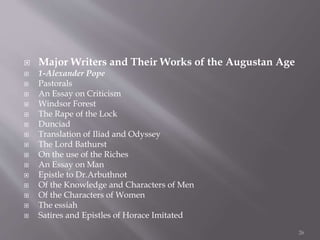
 Major Writers and Their Works of the Augustan Age
 1-Alexander Pope
 Pastorals
 An Essay on Criticism
 Windsor Forest
 The Rape of the Lock
 Dunciad
 Translation of Iliad and Odyssey
 The Lord Bathurst
 On the use of the Riches
 An Essay on Man
 Epistle to Dr.Arbuthnot
 Of the Knowledge and Characters of Men
 Of the Characters of Women
 The essiah
 Satires and Epistles of Horace Imitated
26
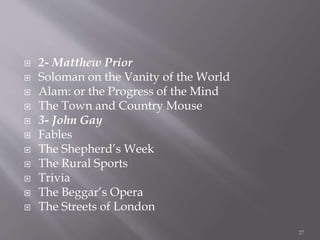
 2- Matthew Prior
 Soloman on the Vanity of the World
 Alam: or the Progress of the Mind
 The Town and Country Mouse
 3- John Gay
 Fables
 The Shepherd’s Week
 The Rural Sports
 Trivia
 The Beggar’s Opera
 The Streets of London
27
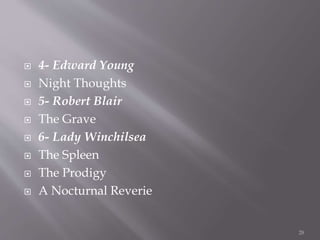
 4- Edward Young
 Night Thoughts
 5- Robert Blair
 The Grave
 6- Lady Winchilsea
 The Spleen
 The Prodigy
 A Nocturnal Reverie
28
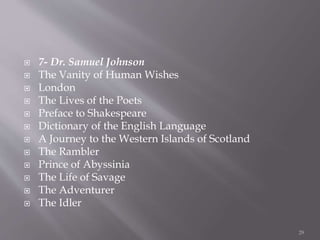
 7- Dr. Samuel Johnson
 The Vanity of Human Wishes
 London
 The Lives of the Poets
 Preface to Shakespeare
 Dictionary of the English Language
 A Journey to the Western Islands of Scotland
 The Rambler
 Prince of Abyssinia
 The Life of Savage
 The Adventurer
 The Idler
29
 The important facts which influenced the Literature
of this period are:
1. James Watt invented stream engine in 1769. In
1733 John Key invented the flying shuttle. In 1769
Hargreaves invented the spinning Jenny . All these
contributed to the Industrial revolution.
2. Industrial towns appeared.
3. There was a revolution in agricultural production.
4. The British Founded it’s empire in India in 1757
and lost its American colony in 1776.
5. France Revolution started in 1789 and continued
till 1799.
 This revolution had a tremendous effect on the life of
the people of England.
30
 6. In 1764 Dr. Johnson founded the famous
literary club known as Johnson's Literary Club;
it’s members were Burke , Pitt, Fox, Gibbon,
Goldsmith and few other great persons of the
time.
7. The development of industry and commerce,
the rise of political parties and democracy
created problems and a change in the social
infrastructure ensued.
8. A literate middle class grew and the range of
reading public widened.
31
 Major Writers of the Period and Their Major Works:
• Samuel Richardson (1689-1761)
*Started writing novels in the previous age and wrote the
following novels in this age.
“Clarissa Marlowe” (1748)
“Sir Charles Grandson” (1754)
• Henry Fielding (1707-54)
*He had started writing in the previous age and wrote the
following novels in this period.
“Tom Jones” (1749)
“Amelia” (1751)
• Dr. Samuel Johnson (1709-84)
“Dictionary” (1755)
“The History of Rasselas, Prince of Abyssinia” (1759)
“Preface to Shakespeare” (1765)
“The Life of the Most Eminent English Poets” (1779-81)
32
 Main literary features of the Age:
1. The Restoration spirit dies away.
2. The age marks a gradual change in poetic taste and
techniques.
3. The heroic couplet and blank verse decline and the
ballad and literary revive.
4. Pinderic Ode appears.
5. Intellectual Prose writing flourished.
6. The novels takes a definite shape and raises to
dominate the literary scene.
7. Poetry shifts it’s focus from intensely social issues to
melancholy, isolation and reflection.
8. Features of Romanticism that flourished in the next
age come into view.
9. Literary criticism found a solid ground.
33
 The romantic period is a term applied to the
literature of approximately the first third of the
nineteenth century.
 During this time, literature began to move in
channels that were not entirely new but were in
strong contrast to the standard literary practice
of the eighteenth century.
34
 Romanticism was a literary movement that began in
the late 18th century, ending around the middle of
the 19th century—although its influence continues to
this day.
 Marked by a focus on the individual (and the unique
perspective of a person, often guided by irrational,
emotional impulses), a respect for nature and the
primitive, and a celebration of the common man,
Romanticism can be seen as a reaction to the huge
changes in society that occurred during this period,
including the revolutions that burned through
countries like France and the United States, ushering
in grand experiments in democracy.
35
 Romanticism Definition
 The term Romanticism does not stem directly from the
concept of love, but rather from the French
word romaunt (a romantic story told in verse).
 Romanticism focused on emotions and the inner life of
the writer, and often used autobiographical material to
inform the work or even provide a template for it,
unlike traditional literature at the time.
 Romanticism celebrated the primitive and elevated
"regular people" as being deserving of celebration,
which was an innovation at the time.
 Romanticism also fixated on nature as a primordial
force and encouraged the concept of isolation as
necessary for spiritual and artistic development.
36
 The Victorian period of literature roughly coincides with the years
that Queen Victoria ruled Great Britain and its Empire (1837-1901).
 During this era, Britain was transformed from a predominantly rural,
agricultural society into an urban, industrial one.
 Although now the period is popularly known as a time of prim,
conservative moral values, the Victorians perceived their world as
rapidly changing.
 Religious faith was splintering into evangelical and even atheist
beliefs. The working class, women, and people of color were agitating
for the right to vote and rule themselves.
 Reformers fought for safe workplaces, sanitary reforms, and universal
education. Victorian literature reflects these values, debates, and
cultural concerns.
 Victorian literature differs from that of the eighteenth century and
Romantic period most significantly because it was not aimed at a
specialist or elite audience; rather, because the steam printing press
made the production of texts much cheaper and because railroads
could distribute texts quickly and easily, the Victorian period was a
time when new genres appealed to newly mass audiences.
37
 Dr Dinah Roe introduces the unique band of
artists, poets and designers known as the Pre-
Raphaelites, charting their formation and
evolution from the 1850s to the late 19th
century.
38
 The Pre-Raphaelites were a loose and baggy collective of
Victorian poets, painters, illustrators and designers whose
tenure lasted from 1848 to roughly the turn of the century.
 Drawing inspiration from visual art and literature, their
work privileged atmosphere and mood over narrative,
focusing on medieval subjects, artistic introspection, female
beauty, sexual yearning and altered states of consciousness.
 In defiant opposition to the utilitarian ethos that formed the
dominant ideology of the mid-century, the Pre-Raphaelites
helped to popularise the notion of ‘art for art’s sake’.
 Generally devoid of the political edge that characterised
much Victorian art and literature, Pre-Raphaelite work
nevertheless incorporated elements of 19th-century realism
in its attention to detail and in its close observation of the
natural world.
39
 Driven by, as Oscar Wilde put it, ‘three things
the English public never forgives: youth, power
and enthusiasm’, Pre-Raphaelitism found itself
paradoxically poised between nostalgia for the
past and excitement about the future.
 19th-century disagreements over whether their
art was forward-thinking or retrogressive set a
precedent for current critical debates about the
extent to which their work should be considered
‘avant-garde’.
40
 The Pre-Raphaelite Brotherhood
 Pre-Raphaelitism began in 1848 when a group of
seven young artists banded together against what
they felt was an artificial and mannered approach
to painting taught at London’s Royal Academy of
Arts.
 They called themselves the ‘Pre-Raphaelite
Brotherhood’ (PRB), a name that alluded to their
preference for late medieval and early Renaissance
art that came ‘before Raphael’.
 The painters were: Dante Gabriel Rossetti,
William Holman Hunt, John Everett Millais,
James Collinson and Frederic George Stephens.
41
 Art for art’s sake’? Aestheticism and
decadence shocked the Victorian
establishment by challenging traditional
values, foregrounding sensuality and
promoting artistic, sexual and political
experimentation.
 Dr Carolyn Burdett explores the key features
of this unconventional artistic period.
42
 Many Victorians passionately believed that literature and art fulfilled
important ethical roles. Literature provided models of correct
behavior: it allowed people to identify with situations in which good
actions were rewarded, or it provoked tender emotions.
 At best, the sympathies stirred by art and literature would spur
people to action in the real world.
 The supporters of aestheticism, however, disagreed, arguing that art
had nothing to do with morality. Instead, art was primarily about the
elevation of taste and the pure pursuit of beauty.
 The famous motto ‘art for art’s sake’ encapsulates this view. It meant
prising the sensual qualities of art and the sheer pleasure they
provide. ‘Art for art’s sake’ became identified with the energy and
creativity of aestheticism – but it also became a shorthand way of
expressing the fears of those who saw this uncoupling of art and
morality as dangerous.
 Aestheticism unsettled and challenged the values of mainstream
Victorian culture. As it percolated more widely into the general
culture, it was relentlessly satirised and condemned.
43
 By the 1890s, another term had become associated with this focus on ‘art
for art’s sake’.
 It has origins in common with aestheticism and the two terms often
overlap and were sometimes used interchangeably.
 ‘Decadence’ was initially used to describe writers of the mid-19th century
in France, especially Baudelaire and Gautier.
 By the century’s end, decadence was in use as an aesthetic term across
Europe. The word literally means a process of ‘falling away’ or decline.
 In relation to art and literature, it signalled a set of interlinked qualities.
 These included the notion of intense refinement; the valuing of
artificiality over nature; a position of ennui or boredom rather than of
moral earnestness or the valuing of hard work; an interest in perversity
and paradox, and in transgressive modes of sexuality.
 One of the most important explicators of decadence was the poet Arthur
Symons, whose essay ‘The Decadent Movement in Literature’ (1893),
described decadence as ‘a new and beautiful and interesting disease’.
44
 The Edwardian Period began in 1901 with
Queen Victoria’s death. King Edward VII took
the throne and reigned until his death in 1910.
The remainder years are pre World War I.
 And aside from the typical idyllic garden
parties seen in period dramas, the Edwardian
Period has a few historic moments in history
that definitely stands out as well.
45
46
47
48
 The Georgian period usually refers to the reign of
George V (1910–1936) but sometimes also includes the
reigns of the four successive Georges from 1714–1830.
 Here, we refer to the former description as it applies
chronologically and covers, for example, the Georgian
poets, such as Ralph Hodgson, John Masefield, W.H.
Davies, and Rupert Brooke.
 Georgian poetry today is typically considered to be the
works of minor poets anthologized by Edward Marsh.
The themes and subject matter tended to be rural or
pastoral in nature, treated delicately and traditionally
rather than with passion (like was found in the
previous periods) or with experimentation (as would
be seen in the upcoming modern period).
49
 The modern period traditionally applies to works written after the start
of World War I.
 Common features include bold experimentation with subject matter,
style, and form, encompassing narrative, verse, and drama. W.B. Yeats’
words, “Things fall apart; the center cannot hold,” are often referred to
when describing the core tenet or “feeling” of modernist concerns.
 Some of the most notable writers of this period include the novelists
James Joyce, Virginia Woolf, Aldous Huxley, D.H. Lawrence, Joseph
Conrad, Dorothy Richardson, Graham Greene, E.M. Forster, and Doris
Lessing; the poets W.B. Yeats, T.S. Eliot, W.H. Auden, Seamus Heaney,
Wilfred Owens, Dylan Thomas, and Robert Graves; and the dramatists
Tom Stoppard, George Bernard Shaw, Samuel Beckett, Frank
McGuinness, Harold Pinter, and Caryl Churchill.
 New Criticism also appeared at this time, led by the likes of Woolf, Eliot,
William Empson, and others, which reinvigorated literary criticism in
general.
 It is difficult to say whether modernism has ended, though we know that
postmodernism has developed after and from it; for now, the genre
remains ongoing.
50
 The postmodern period begins about the time that
World War II ended.
 Many believe it is a direct response to modernism.
Some say the period ended about 1990, but it is likely
too soon to declare this perio closed.
 Poststructuralist literary theory and criticism
developed during this time. Some notable writers of
the period include Samuel Beckett, Joseph Heller,
Anthony Burgess, John Fowles, Penelope M. Lively,
and Iain Banks.
 Many postmodern authors wrote during the modern
period as well.
51
52

Old english periods

  • 1.
  • 2.
     Old English– the earliest form of the English language  spoken and written in Anglo-Saxon Britain from c. 450 CE until c. 1150 (thus it continued to be used for some decades after the Norman Conquest of 1066).  According to Toronto University's Dictionary of Old English Corpus, the entire surviving body of Old English material from 600 to 1150 consists of only 3,037 texts (excluding manuscripts with minor variants). 2
  • 3.
     English vocabularyhas never been purely Anglo-Saxon – not even in the Anglo-Saxon period. By the time the Anglo-Saxons arrived in Britain, there had already been four centuries of linguistic interchange between Germanic and Roman people on the European mainland.  Latin words might have arrived in English through any of several possible routes. To begin with, they must have entered the Celtic speech of the Britons during the Roman occupation (43–c. 410), and some might have remained in daily use after the Romans finally left in the early 5th century so that they were picked up by the Anglo- Saxons in due course.  Aristocratic Britons may also have continued to use the language as a medium of upper-class communication. If so, we might expect a significant number of Latin words to have been in daily use.  Some Latin words would also have been brought in by the Anglo- Saxons invaders. And following the arrival of St Augustine in 597, the influence of the monks must have grown, with Latinisms being dropped into speech much as they still are today. 3
  • 4.
    Middle English Period(1066-1500)  ‘Middle English’ – a period of roughly 300 years from around 1150 CE to around 1450 – is difficult to identify because it is a time of transition between two eras that each have stronger definition: Old English and Modern English.  Before this period we encounter a language which is chiefly Old Germanic in its character – in its sounds, spellings, grammar and vocabulary.  After this period we have a language which displays a very different kind of structure, with major changes having taken place in each of these areas, many deriving from the influence of French following the Norman Conquest of 1066. 4
  • 5.
    Grammatical change inMiddle English  The difference between Old and Middle English is primarily due to the changes that took place in grammar.  Old English was a language which contained a great deal of variation in word endings; Modern English has hardly any.  And it is during the Middle English period that we see the eventual disappearance of most of the earlier inflections, and the increasing reliance on alternative means of expression, using word order and prepositional constructions rather than word endings to express meaning relationships. 5
  • 6.
    Vocabulary and theFrench influence on Middle English  English in the Middle Ages is a consequence of the dominance of French power in England and of French cultural pre-eminence in mainland Europe in areas such as law, architecture, estate management, music and literature.  Vocabulary was especially affected in important fields such as ecclesiastical architecture, where French architects in England adapted Continental sources for their cathedral designs.  The associated terminology needed to express this shift of vision was very large, covering everything from building tools to aesthetic abstractions.  Each of the major literary works of the Middle English period provides evidence of the impact of French.  By the time we reach The Canterbury Tales (c. 1400), the French lexical content is a major linguistic feature: eight of the 13 content words in the above quotation are from French – April, March, pierced, vain, liquor, virtue, engendered, flower. According to the Oxford English Dictionary, by the end of the Middle English period around 30 per cent of English vocabulary is French in origin. 6
  • 7.
     The RenaissancePeriod in English literature is also called the Elizabethan Period or the Age of Shakespeare.  Renaissance means the Revival of Learning, and it denotes in its broadest sense the gradual enlightenment of the human mind after the darkness of the Middle Ages.  With the fall of Constantinople in 1453 A.D. by the invasion of the Turks, the Greek scholars who were residing there, spread all over Europe, and brought with them invaluable Greek manuscripts.  The discovery of these classical models resulted in the Revival of Learning in the fourteenth and fifteenth centuries.  The essence of this movement was that “man discovered himself and the universe”, and that “man, so long blinded had suddenly opened his eyes and seen”. 7
  • 8.
     The floodof Greek literature which the new art of printing carried swiftly to every school in Europe revealed a new world of poetry and philosophy.  Along with the Revival of Learning, new discoveries took place in several other fields. Vasco da Gama circumnavigated the earth; Columbus discovered America; Copernicus discovered the Solar System and prepared the way for Galileo. Books were printed, and philosophy, science, and art were systematised.  The Middle Ages were past, and the old world had become new. Scholars flocked to the universities, as adventurers to the new world of America, and there the old authority received a death blow. 8
  • 9.
     time periodassociated with the reign of Queen Elizabeth I (1558–1603) and is often considered to be a golden age in English history.  age considered to be the height of the English Renaissance, and saw the full flowering of English literature and English poetry.  In Elizabethan theater, William Shakespeare, among others, composed and staged plays in a variety of settings that broke away from England's past style of plays.  age of expansion and exploration abroad, while at home the Protestant Reformation was established and successfully defended against the Catholic powers of the Continent.  The Elizabethan Age is viewed so highly because of the contrasts with the periods before and after.  It was a brief period of largely internal peace between the English Reformation, with battles between Protestants and Catholics, and the battles between parliament and the monarchy that would engulf the seventeenth century.  The Protestant Catholic divide was settled, for a time, by the Elizabethan Religious Settlement and parliament was still not strong enough to challenge royal absolutism. 9
  • 10.
     This ageis named after James I who reigned England from 1603 to 1625.  The word ‘’Jacobean’’ is derived from ‘’Jacobus’’, the Latin version of James.  Some historians like to call the last five years of this age as a part of another age which they call The Puritan Age (1620-1660).  They call it so because in between 1620 and 1660 Puritanism became the driving force in the life and literature of England. The important elements of this age were: 1. Colonial territories were expanded. 2. Religious conflict that subsided in the Elizabethan age, revived in this period. Protestants were divided into three sects:  1. Anglicans, 2. Presbyterians, 3.Puritans  3. Renaissance’s influence continued.  4. Scotland was brought under the rule of the king of England. 10
  • 11.
     Major Writersand Their Major Works:  1. Shakespeare, who had started in the Elizabethan Period, wrote twelve serious  plays in this period.  Those plays are:  1. Measure for Measure (1604),  2. Othello(1604),  3. Macbeth (1605),  4. King Lear (1605),  5. Antony and Cleopatra(1606),  6. Coriolanus (1606),  7. Timon of Athens (unfinished-1608),  8. Pericles(in part-1608),  9. Cymbeline (1609),  10. The Winter’s Tale (1610),  11. The Tempest (1611),  12. Henry VIII (in part-1613).  Though Shakespeare had written his serious plays in the Jacobean Age, he is  called an Elizabethan dramatist and never the Jacobean. The period  (1590-1616) in which he wrote is also called Shakespearean Age. 11
  • 12.
     2. BenJonson, who had started in the Elizabethan period, wrote his famous  plays in this period:  Volpone (1605),  The Silent Woman (1609),  The Alchemist(1610).  3. Francis Bacon :  1.Advancement of Learning,  2.Novum Orgum.  Some new essays were added to the new edition of his Essays (1625). 4. King James I, known as the Wisest Fool, instituted the translation of the Bible into English in 1611.  Its language became the standard of English prose. 5. John Webster (1580-1625):  The White Devil (1612),  The Duchess of Malfi(1614). 12
  • 13.
     This ageis named after the name of Charles I who reigned over England from 1625 to 1649. “Caroline” is derived from “Charolus”, the Latin version of “Charles” . 13
  • 14.
     The importantfacts which influenced the literature of this period are: 1. civil war between “Cavaliers” and “Roundheads” . Those who supported the King were called “Cavalier”. Most of them were Lords and their dependants. Most of them were Puritans.  A group of lyric poets associated with the “Cavaliers” are called “Cavalire poets” . Richard Lovelace , Sir John Suckling, Robert Herrick and Thomas Carew were the members of this group.  These poets are also called “Sons of Ben” as they were the admirers and followings of Ben Jonson.  Their poems are trivial, gay, witty and often licentious. 2. In 1642 English theatre was officially closed. On 14th June 1642 Licensing Order for printing was passed. 3. The Cavaliers were defeated; King was caught and publicly beheaded on 30th January, 1649. His death marked the dissolution of monarchy for the time being 4. English colonies were further expanded. 5. Oliver Cromwell emerged as a Puritan leader and came to power in 1649. 14
  • 15.
     Major Writersof the Period and Their Major Works: Donne and Herbert continued writing their metaphysical poetry. Henry Vaughan (1621-95) and Andrew Marvell (1621-1678) also wrote metaphysical poetry. • John Milton (1608-74) “Camus” (1634) “Lycidas” (1637) “Of Education” (1644) “Areopagitica” (1644) 15
  • 16.
     Main literaryfeatures of the Age: 1. Drama declines significantly 2. Literature reflects revival and moral and intellectual awakening. 3.Elizabethan enthusiasm and national spirit disappear. 4. Literary scenario is overshadowed by gloom and pessimism. 5. Critical and intellectual spirit replaces natural outpouring of heart. 6. Renaissance 's influence continues. 7. Three types of poetry appear : Puritan Poetry , metaphysical poetry and Cavalier poetry. 8. Cavalier poets appear and disappear; their straightforward , erotic short poems with the motto “carpe diem” disappear with them. 9. Sermons , pamphlets, history and philosophy are written in prose. 16
  • 17.
     This period,like the previous two periods, belonged to the Puritan Age.  Only in this period there was no monarch in England.  After the death of Charles I, Oliver Cromwell , the Puritan leader , came to power.  He died in 1658 when his son Richard Cromwell became the ruler of England.  He ruled England till 1660. In this period ‘Puritianism’became gradually unpopular.  The English people realized that monarch was essential for them. 17
  • 18.
     Major Writersof the Period and Their Major Works: • John Milton did not write anything important in this period. • Thomas Hobbies (1588-1679), a political philosopher : “Leviathan” (1651) • Jeremy Taylor (1613-1667) “Holly Living” (1650) “Holly dying” (1651) • Vaughan (1621-95) and Marvell (1621-78) continue writing. The influence of Renaissance and Puritanism diedom out by the end of this period. The Elizabethan romantic exuberance ended in this period. 18
  • 19.
     Neoclassical literaturewas written between 1660 and 1798. This time period is broken down into three parts: the Restoration period, the Augustan period, and the Age of Johnson.  Writers of the Neoclassical period tried to imitate the style of the Romans and Greeks.  Thus the combination of the terms 'neo,' which means 'new,' and 'classical,' as in the day of the Roman and Greek classics.  This was also the era of The Enlightenment, which emphasized logic and reason.  It was preceded by The Renaissance and followed by the Romantic era. In fact, the Neoclassical period ended in 1798 when Wordsworth published the Romantic 'Lyrical Ballads'. 19
  • 20.
     Neoclassical Era Understanding the Neoclassical era helps us better understand its literature.  This was a time of comfortableness in England.  It was also the beginning of the British tradition of drinking afternoon tea.  And it was the starting point of the middle class, and because of that, more people were literate.  People were very interested in appearances, but not necessarily in being genuine.  Men and women commonly wore wigs, and being clever and witty was in vogue.  Having good manners and doing the right thing, particularly in public, was essential.  It was a time, too, of British political upheaval as eight monarchs took the throne. 20
  • 21.
     Characteristics ofNeoclassical Literature  Neoclassical literature is characterized by order, accuracy, and structure. In direct opposition to Renaissance attitudes, where man was seen as basically good, the Neoclassical writers portrayed man as inherently flawed. They emphasized restraint, self-control, and common sense. This was a time when conservatism flourished in both politics and literature.  Some popular types of literature included:  Parody  Essays  Satire  Letters  Fabbles  Melodrama and  Rhyming with couplets 21
  • 22.
     The RestorationPeriod in English Literature includes the raw, sexually-charged form of theater, 'restoration comedy,' the emergence of journalism, and poetry using heroic couplets. 22
  • 23.
     What Wasthe Restoration Period?  One of the most important and interesting aspects of literature is the way that it both responds to and is inevitably shaped by the political context in which it is written.  Some of the best examples of this can be found in the Restoration period, which lasted from 1660 to around 1688.  The name 'restoration' comes from the crowning of Charles II, which marks the restoring of the traditional English monarchical form of government following a short period of rule by a handful of republican governments.  At the heart of this literature is the attempt to come to terms with the political events that had occurred in previous decades.  The writings of this time are both innovative and varied; the style and subject matter of the literature produced during the Restoration period spanned the spectrum from definitively religious to satirical and risqué. 23
  • 24.
     The eighteenthcentury in English literature is roughly called the Augustan Age.  It is also called the Neo-classical Ages in English literature. It is further called the Age of Pope and the Age of Johnson.  The term ‘Augustan’ was first applied to the literature of the eighteenth century as a term of high praise.  Those who used this term believe that the Age of Emperor Augustus was the golden age in Latin literature in the Roman Empire. 24
  • 25.
     A notablefeature of eighteenth-century literature is that it is predominantly intellectual, logical, and rational. It conspicuously lacks in emotion, imagination, and passion.  The poetry of this age was one of arguments criticism and satire on politics and personalities. The satires were social political and even personal.  Another important feature of the poetry of this age is that it largely deals with town life rather than with rural life or nature. .  Lastly, eighteenth-century poetry is almost entirely written in poetic diction and in closed Heroic couplets. The closed Heroic couplet best suited this poetic expression on account of its epigrammatic terseness and satirical suitability. 25
  • 26.
     Major Writersand Their Works of the Augustan Age  1-Alexander Pope  Pastorals  An Essay on Criticism  Windsor Forest  The Rape of the Lock  Dunciad  Translation of Iliad and Odyssey  The Lord Bathurst  On the use of the Riches  An Essay on Man  Epistle to Dr.Arbuthnot  Of the Knowledge and Characters of Men  Of the Characters of Women  The essiah  Satires and Epistles of Horace Imitated 26
  • 27.
     2- MatthewPrior  Soloman on the Vanity of the World  Alam: or the Progress of the Mind  The Town and Country Mouse  3- John Gay  Fables  The Shepherd’s Week  The Rural Sports  Trivia  The Beggar’s Opera  The Streets of London 27
  • 28.
     4- EdwardYoung  Night Thoughts  5- Robert Blair  The Grave  6- Lady Winchilsea  The Spleen  The Prodigy  A Nocturnal Reverie 28
  • 29.
     7- Dr.Samuel Johnson  The Vanity of Human Wishes  London  The Lives of the Poets  Preface to Shakespeare  Dictionary of the English Language  A Journey to the Western Islands of Scotland  The Rambler  Prince of Abyssinia  The Life of Savage  The Adventurer  The Idler 29
  • 30.
     The importantfacts which influenced the Literature of this period are: 1. James Watt invented stream engine in 1769. In 1733 John Key invented the flying shuttle. In 1769 Hargreaves invented the spinning Jenny . All these contributed to the Industrial revolution. 2. Industrial towns appeared. 3. There was a revolution in agricultural production. 4. The British Founded it’s empire in India in 1757 and lost its American colony in 1776. 5. France Revolution started in 1789 and continued till 1799.  This revolution had a tremendous effect on the life of the people of England. 30
  • 31.
     6. In1764 Dr. Johnson founded the famous literary club known as Johnson's Literary Club; it’s members were Burke , Pitt, Fox, Gibbon, Goldsmith and few other great persons of the time. 7. The development of industry and commerce, the rise of political parties and democracy created problems and a change in the social infrastructure ensued. 8. A literate middle class grew and the range of reading public widened. 31
  • 32.
     Major Writersof the Period and Their Major Works: • Samuel Richardson (1689-1761) *Started writing novels in the previous age and wrote the following novels in this age. “Clarissa Marlowe” (1748) “Sir Charles Grandson” (1754) • Henry Fielding (1707-54) *He had started writing in the previous age and wrote the following novels in this period. “Tom Jones” (1749) “Amelia” (1751) • Dr. Samuel Johnson (1709-84) “Dictionary” (1755) “The History of Rasselas, Prince of Abyssinia” (1759) “Preface to Shakespeare” (1765) “The Life of the Most Eminent English Poets” (1779-81) 32
  • 33.
     Main literaryfeatures of the Age: 1. The Restoration spirit dies away. 2. The age marks a gradual change in poetic taste and techniques. 3. The heroic couplet and blank verse decline and the ballad and literary revive. 4. Pinderic Ode appears. 5. Intellectual Prose writing flourished. 6. The novels takes a definite shape and raises to dominate the literary scene. 7. Poetry shifts it’s focus from intensely social issues to melancholy, isolation and reflection. 8. Features of Romanticism that flourished in the next age come into view. 9. Literary criticism found a solid ground. 33
  • 34.
     The romanticperiod is a term applied to the literature of approximately the first third of the nineteenth century.  During this time, literature began to move in channels that were not entirely new but were in strong contrast to the standard literary practice of the eighteenth century. 34
  • 35.
     Romanticism wasa literary movement that began in the late 18th century, ending around the middle of the 19th century—although its influence continues to this day.  Marked by a focus on the individual (and the unique perspective of a person, often guided by irrational, emotional impulses), a respect for nature and the primitive, and a celebration of the common man, Romanticism can be seen as a reaction to the huge changes in society that occurred during this period, including the revolutions that burned through countries like France and the United States, ushering in grand experiments in democracy. 35
  • 36.
     Romanticism Definition The term Romanticism does not stem directly from the concept of love, but rather from the French word romaunt (a romantic story told in verse).  Romanticism focused on emotions and the inner life of the writer, and often used autobiographical material to inform the work or even provide a template for it, unlike traditional literature at the time.  Romanticism celebrated the primitive and elevated "regular people" as being deserving of celebration, which was an innovation at the time.  Romanticism also fixated on nature as a primordial force and encouraged the concept of isolation as necessary for spiritual and artistic development. 36
  • 37.
     The Victorianperiod of literature roughly coincides with the years that Queen Victoria ruled Great Britain and its Empire (1837-1901).  During this era, Britain was transformed from a predominantly rural, agricultural society into an urban, industrial one.  Although now the period is popularly known as a time of prim, conservative moral values, the Victorians perceived their world as rapidly changing.  Religious faith was splintering into evangelical and even atheist beliefs. The working class, women, and people of color were agitating for the right to vote and rule themselves.  Reformers fought for safe workplaces, sanitary reforms, and universal education. Victorian literature reflects these values, debates, and cultural concerns.  Victorian literature differs from that of the eighteenth century and Romantic period most significantly because it was not aimed at a specialist or elite audience; rather, because the steam printing press made the production of texts much cheaper and because railroads could distribute texts quickly and easily, the Victorian period was a time when new genres appealed to newly mass audiences. 37
  • 38.
     Dr DinahRoe introduces the unique band of artists, poets and designers known as the Pre- Raphaelites, charting their formation and evolution from the 1850s to the late 19th century. 38
  • 39.
     The Pre-Raphaeliteswere a loose and baggy collective of Victorian poets, painters, illustrators and designers whose tenure lasted from 1848 to roughly the turn of the century.  Drawing inspiration from visual art and literature, their work privileged atmosphere and mood over narrative, focusing on medieval subjects, artistic introspection, female beauty, sexual yearning and altered states of consciousness.  In defiant opposition to the utilitarian ethos that formed the dominant ideology of the mid-century, the Pre-Raphaelites helped to popularise the notion of ‘art for art’s sake’.  Generally devoid of the political edge that characterised much Victorian art and literature, Pre-Raphaelite work nevertheless incorporated elements of 19th-century realism in its attention to detail and in its close observation of the natural world. 39
  • 40.
     Driven by,as Oscar Wilde put it, ‘three things the English public never forgives: youth, power and enthusiasm’, Pre-Raphaelitism found itself paradoxically poised between nostalgia for the past and excitement about the future.  19th-century disagreements over whether their art was forward-thinking or retrogressive set a precedent for current critical debates about the extent to which their work should be considered ‘avant-garde’. 40
  • 41.
     The Pre-RaphaeliteBrotherhood  Pre-Raphaelitism began in 1848 when a group of seven young artists banded together against what they felt was an artificial and mannered approach to painting taught at London’s Royal Academy of Arts.  They called themselves the ‘Pre-Raphaelite Brotherhood’ (PRB), a name that alluded to their preference for late medieval and early Renaissance art that came ‘before Raphael’.  The painters were: Dante Gabriel Rossetti, William Holman Hunt, John Everett Millais, James Collinson and Frederic George Stephens. 41
  • 42.
     Art forart’s sake’? Aestheticism and decadence shocked the Victorian establishment by challenging traditional values, foregrounding sensuality and promoting artistic, sexual and political experimentation.  Dr Carolyn Burdett explores the key features of this unconventional artistic period. 42
  • 43.
     Many Victorianspassionately believed that literature and art fulfilled important ethical roles. Literature provided models of correct behavior: it allowed people to identify with situations in which good actions were rewarded, or it provoked tender emotions.  At best, the sympathies stirred by art and literature would spur people to action in the real world.  The supporters of aestheticism, however, disagreed, arguing that art had nothing to do with morality. Instead, art was primarily about the elevation of taste and the pure pursuit of beauty.  The famous motto ‘art for art’s sake’ encapsulates this view. It meant prising the sensual qualities of art and the sheer pleasure they provide. ‘Art for art’s sake’ became identified with the energy and creativity of aestheticism – but it also became a shorthand way of expressing the fears of those who saw this uncoupling of art and morality as dangerous.  Aestheticism unsettled and challenged the values of mainstream Victorian culture. As it percolated more widely into the general culture, it was relentlessly satirised and condemned. 43
  • 44.
     By the1890s, another term had become associated with this focus on ‘art for art’s sake’.  It has origins in common with aestheticism and the two terms often overlap and were sometimes used interchangeably.  ‘Decadence’ was initially used to describe writers of the mid-19th century in France, especially Baudelaire and Gautier.  By the century’s end, decadence was in use as an aesthetic term across Europe. The word literally means a process of ‘falling away’ or decline.  In relation to art and literature, it signalled a set of interlinked qualities.  These included the notion of intense refinement; the valuing of artificiality over nature; a position of ennui or boredom rather than of moral earnestness or the valuing of hard work; an interest in perversity and paradox, and in transgressive modes of sexuality.  One of the most important explicators of decadence was the poet Arthur Symons, whose essay ‘The Decadent Movement in Literature’ (1893), described decadence as ‘a new and beautiful and interesting disease’. 44
  • 45.
     The EdwardianPeriod began in 1901 with Queen Victoria’s death. King Edward VII took the throne and reigned until his death in 1910. The remainder years are pre World War I.  And aside from the typical idyllic garden parties seen in period dramas, the Edwardian Period has a few historic moments in history that definitely stands out as well. 45
  • 46.
  • 47.
  • 48.
  • 49.
     The Georgianperiod usually refers to the reign of George V (1910–1936) but sometimes also includes the reigns of the four successive Georges from 1714–1830.  Here, we refer to the former description as it applies chronologically and covers, for example, the Georgian poets, such as Ralph Hodgson, John Masefield, W.H. Davies, and Rupert Brooke.  Georgian poetry today is typically considered to be the works of minor poets anthologized by Edward Marsh. The themes and subject matter tended to be rural or pastoral in nature, treated delicately and traditionally rather than with passion (like was found in the previous periods) or with experimentation (as would be seen in the upcoming modern period). 49
  • 50.
     The modernperiod traditionally applies to works written after the start of World War I.  Common features include bold experimentation with subject matter, style, and form, encompassing narrative, verse, and drama. W.B. Yeats’ words, “Things fall apart; the center cannot hold,” are often referred to when describing the core tenet or “feeling” of modernist concerns.  Some of the most notable writers of this period include the novelists James Joyce, Virginia Woolf, Aldous Huxley, D.H. Lawrence, Joseph Conrad, Dorothy Richardson, Graham Greene, E.M. Forster, and Doris Lessing; the poets W.B. Yeats, T.S. Eliot, W.H. Auden, Seamus Heaney, Wilfred Owens, Dylan Thomas, and Robert Graves; and the dramatists Tom Stoppard, George Bernard Shaw, Samuel Beckett, Frank McGuinness, Harold Pinter, and Caryl Churchill.  New Criticism also appeared at this time, led by the likes of Woolf, Eliot, William Empson, and others, which reinvigorated literary criticism in general.  It is difficult to say whether modernism has ended, though we know that postmodernism has developed after and from it; for now, the genre remains ongoing. 50
  • 51.
     The postmodernperiod begins about the time that World War II ended.  Many believe it is a direct response to modernism. Some say the period ended about 1990, but it is likely too soon to declare this perio closed.  Poststructuralist literary theory and criticism developed during this time. Some notable writers of the period include Samuel Beckett, Joseph Heller, Anthony Burgess, John Fowles, Penelope M. Lively, and Iain Banks.  Many postmodern authors wrote during the modern period as well. 51
  • 52.