The Anglo-Saxon Period
449-1066
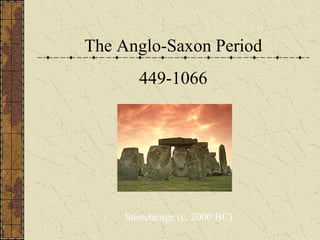
Stonehenge (c. 2000 BC)
The Roman Conquest
In 55 BC and 56 BC, Julius Caesar made hasty
invasions.
True conquest, however, occurred 100 years later
under the Roman emperor Claudius in 43 AD.
Roman rule of Britain lasted for nearly 400
years, ending only when Rome was threatened in
Italy.
The last Roman legions left for Rome in 407
AD.
Roman Rule
Constructed a system of well-paved roads
and founded cities
Erected Hadrian’s Wall to protect from
Picts and Scots
Brought skills in the art of warfare
Introduced Roman law and order
Used Latin
Introduced Christianity (597 AD)
Failed to teach the Britons much about self-
defense
Roman Rule (con’t)
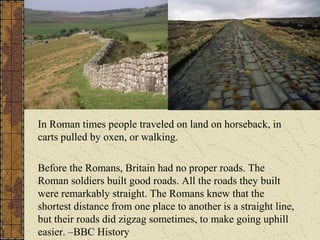
Roman Roads:
5,000 miles of stone roads
Linked tribal capitals and towns
Facilitated trade, the collection of taxes, and
the movement of troops
Hadrian’s Wall:
Linked the North Sea and the Atlantic
Held back the Picts and Scots for 250 years
In Roman times people traveled on land on horseback, in
carts pulled by oxen, or walking.
Before the Romans, Britain had no proper roads. The
Roman soldiers built good roads. All the roads they built
were remarkably straight. The Romans knew that the
shortest distance from one place to another is a straight line,
but their roads did zigzag sometimes, to make going uphill
easier. –BBC History
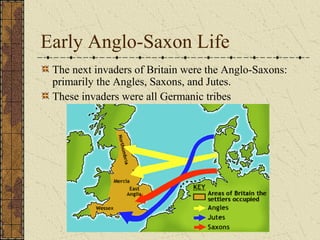
Early Anglo-Saxon Life
The next invaders of Britain were the Anglo-Saxons:
primarily the Angles, Saxons, and Jutes.
These invaders were all Germanic tribes
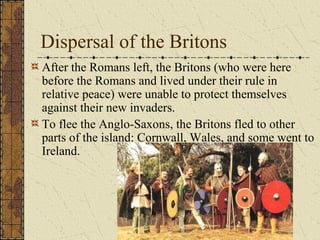
Dispersal of the Britons
After the Romans left, the Britons (who were here
before the Romans and lived under their rule in
relative peace) were unable to protect themselves
against their new invaders.
To flee the Anglo-Saxons, the Britons fled to other
parts of the island: Cornwall, Wales, and some went to
Ireland.
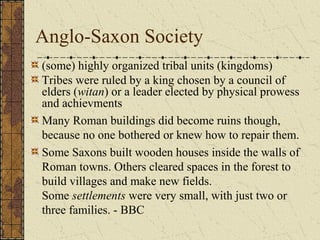
Anglo-Saxon Society
(some) highly organized tribal units (kingdoms)
Tribes were ruled by a king chosen by a council of
elders (witan) or a leader elected by physical prowess
and achievments
Many Roman buildings did become ruins though,
because no one bothered or knew how to repair them.
Some Saxons built wooden houses inside the walls of
Roman towns. Others cleared spaces in the forest to
build villages and make new fields.
Some settlements were very small, with just two or
three families. - BBC
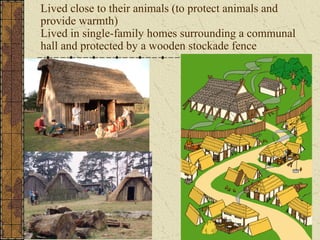
Lived close to their animals (to protect animals and
provide warmth)
Lived in single-family homes surrounding a communal
hall and protected by a wooden stockade fence
Anglo-Saxon Society (con’t)
The Anglo-Saxons farmed, maintained local
governments, and created fine crafts, especially
metalwork.
Eventually, the small kingdoms developed into seven
large ones: Northumbria, Mercia, Wessex, Sussex, Essex,
East Anglia, and Kent. (AD 600)
Once the small settlements became more established and
connected, a more unified language emerged: Old
English or Anglo-Saxon (Germanic Origins)
See YouTube video later in the module for example of
language
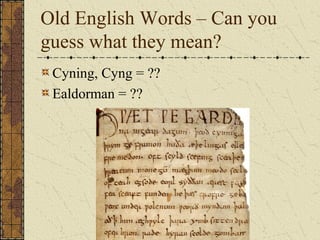
Old English Words – Can you
guess what they mean?
Cyning, Cyng = ??
Ealdorman = ??
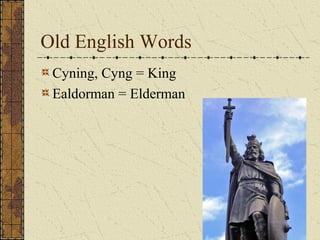
Old English Words
Cyning, Cyng = King
Ealdorman = Elderman
Characteristics of the Anglo-Saxons
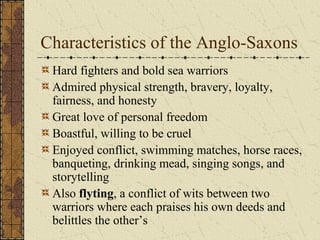
Hard fighters and bold sea warriors
Admired physical strength, bravery, loyalty,
fairness, and honesty
Great love of personal freedom
Boastful, willing to be cruel
Enjoyed conflict, swimming matches, horse races,
banqueting, drinking mead, singing songs, and
storytelling
Also flyting, a conflict of wits between two
warriors where each praises his own deeds and
belittles the other’s
Role of Women
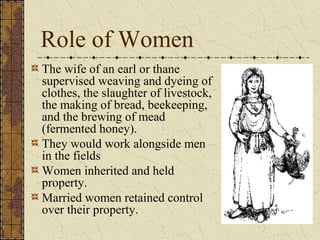
The wife of an earl or thane
supervised weaving and dyeing of
clothes, the slaughter of livestock,
the making of bread, beekeeping,
and the brewing of mead
(fermented honey).
They would work alongside men
in the fields
Women inherited and held
property.
Married women retained control
over their property.
The Scops (pronounced sh(oh)p)
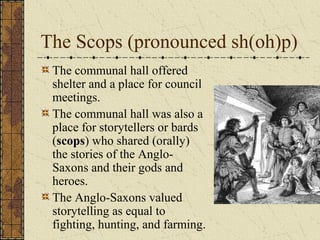
The communal hall offered
shelter and a place for council
meetings.
The communal hall was also a
place for storytellers or bards
(scops) who shared (orally)
the stories of the Anglo-
Saxons and their gods and
heroes.
The Anglo-Saxons valued
storytelling as equal to
fighting, hunting, and farming.
Types of Anglo-Saxon Verse
Scops often recited:
Heroic Poetry: recounts the achievements of
warriors involved in great battles
Elegiac Poetry: sorrowful laments that
mourn the deaths of loved ones and the loss
of the past
Anglo-Saxon Beliefs
Human life in the hands of fate (wyrd (weird)) -
Sharp contrast to the Christian belief in an
individual’s free will
Did not believe in an afterlife
Culture: Valued honor and glory
Honor: People were judged by their actions; To be
respected and remembered was the goal of
everyone’s life
Any injury/death must be avenged by the kinsmen
Wer-gild (man gold): it was acceptable to pay the
family in atonement for death or injury
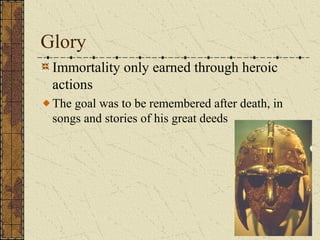
Glory
Immortality only earned through heroic
actions
The goal was to be remembered after death, in
songs and stories of his great deeds
Anglo-Saxon Beliefs (con’t)
Pagan/Polytheistic
The early Anglo-Saxons worshipped ancient Germanic or
Norse gods:
Odin/Woden: chief of the gods, god of death, poetry, and
magic
Fria: Woden’s wife and goddess of the home
Tiu: the god of war and the sky
Thunor/Thor: god of thunder and lightening
Frijz/Frigga: queen of the heavens
The names of these gods survive today in our words Tuesday,
Wednesday, Thursday, and Friday
Weaponry
Anglo-Saxon armies were usually small, with only a
few hundred men.
The soldiers had spears, axes, swords and bows and
arrows. They wore helmets on their heads and carried
wooden shields.
Everyone fought on foot during a battle. It must have
been a bit like a giant rugby scrum, with lots of
pushing and yelling, and nasty wounds. - BBC
Weaponry, Cont’d
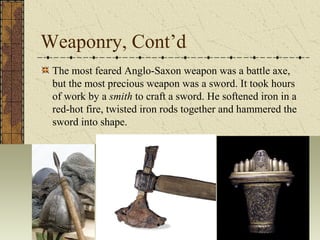
The most feared Anglo-Saxon weapon was a battle axe,
but the most precious weapon was a sword. It took hours
of work by a smith to craft a sword. He softened iron in a
red-hot fire, twisted iron rods together and hammered the
sword into shape.
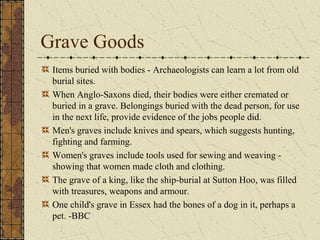
Grave Goods
Items buried with bodies - Archaeologists can learn a lot from old
burial sites.
When Anglo-Saxons died, their bodies were either cremated or
buried in a grave. Belongings buried with the dead person, for use
in the next life, provide evidence of the jobs people did.
Men's graves include knives and spears, which suggests hunting,
fighting and farming.
Women's graves include tools used for sewing and weaving -
showing that women made cloth and clothing.
The grave of a king, like the ship-burial at Sutton Hoo, was filled
with treasures, weapons and armour.
One child's grave in Essex had the bones of a dog in it, perhaps a
pet. -BBC
The Coming of Christianity
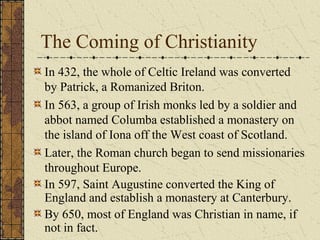
In 432, the whole of Celtic Ireland was converted
by Patrick, a Romanized Briton.
In 563, a group of Irish monks led by a soldier and
abbot named Columba established a monastery on
the island of Iona off the West coast of Scotland.
Later, the Roman church began to send missionaries
throughout Europe.
In 597, Saint Augustine converted the King of
England and establish a monastery at Canterbury.
By 650, most of England was Christian in name, if
not in fact.
Christianity and Literature
The church brought education and written
literature to England.
Monks established churches, monasteries, and
libraries.
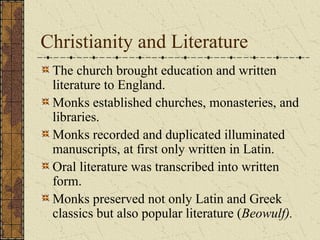
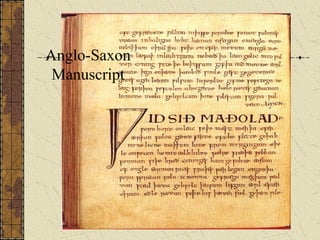
Monks recorded and duplicated illuminated
manuscripts, at first only written in Latin.
Oral literature was transcribed into written
form.
Monks preserved not only Latin and Greek
classics but also popular literature (Beowulf).
The Venerable Bede (673-735)
A monk
Considered the “father of English
history”
Wrote A History of the English Church
and People: the clearest account we
have of Anglo-Saxon times
Anglo-Saxon
Manuscript
The Danish Invasion
Due to rising population and limited
farmland, many Scandinavians (the Norse
and the Danes) took to the seas—the
Vikings.
In 800, Danish raiders attacked Britain.
The Norse settled in Northumbria, Scotland,
Wales, and Ireland.
The Danes targeted eastern and southern
England.
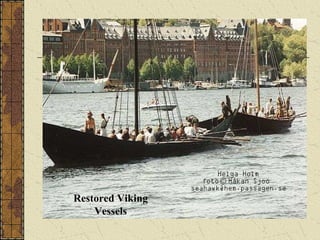
Restored Viking
Vessels
Viking Raids: “From the Fury of the
Northmen, O Lord, Deliver Us”
Sacked and plundered monasteries
Stole sacred religious objects
Burned entire communities
Murdered villagers
Halted the growth of learning
By the middle of the ninth century, most of
England had fallen. The Vikings called
their territory Danelaw.
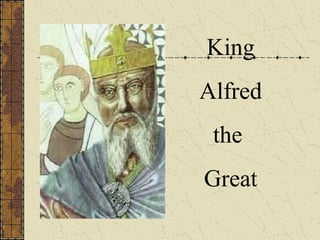
Alfred the Great
Only the Saxon kingdom of Wessex managed to
fight the Danes to a standstill.
In 871, Alfred ascended to the Wessex throne.
Alfred resisted further Danish encroachment.
A 886 truce formally divided England: the Danish
ruled the east and north; the Saxons ruled the south.
Alfred translated the Bede’s History and other
works from Latin into English to make them more
accessible, as well as instituted the Anglo-Saxon
Chronicle, a history of England from the earliest
days through 1154.
King
Alfred
the
Great
Danish Contributions
Built their Danelaw communities as
military fortresses and trading centers
Generated growth of English towns
Expanded English vocabulary as Norse
words crept into the language
For example, law is Danish, and its use
reflects the Danes’ interest in legal
procedures.
The Norman Conquest
Toward the end of the tenth century, the Danes increased
attempts to recapture and widen Danelaw and eventually
forced the witan to select a series of Danish kings.
In 1042, the throne returned to a descendant of Alfred,
King Edward the Confessor, a Christian.
Edward’s association with the Normans weakened
Saxon power.
Upon his death in 1066, Edward was succeeded by
Harold.
William of Normandy challenged Harold’s right to the
throne and defeated Harold in the Battle of Hastings.
William was crowned King on December 25, 1066.
Anglo-Saxon Literary Elements
Alliteration - the repetition of initial sounds
of words
“She sells seashells by the sea shore”
From Beowulf:
839 ferdon folc-togan feorran ond nean
839 chieftains came from far and near
Kenning
A metaphorical phrase or compound word
used to name a person, place, thing, or
event indirectly.
A kenning enhances the literal meaning of
words. A kenning gives the listener an idea
of how the words connect to an idea or
concept that is richer and more emotionally
complex.
Typically gives an image
Examples of kennings from
Beowulf
Gold-shining hall = Herot
Guardian of crime = Grendel
Cave-guard = dragon
Usually two-word poetic - Renaming
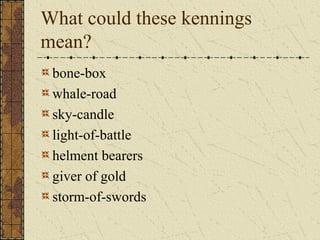
What could these kennings
mean?
bone-box
whale-road
sky-candle
light-of-battle
helment bearers
giver of gold
storm-of-swords
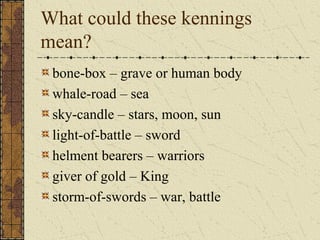
What could these kennings
mean?
bone-box – grave or human body
whale-road – sea
sky-candle – stars, moon, sun
light-of-battle – sword
helment bearers – warriors
giver of gold – King
storm-of-swords – war, battle
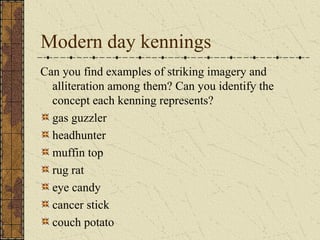
Modern day kennings
Can you find examples of striking imagery and
alliteration among them? Can you identify the
concept each kenning represents?
gas guzzler
headhunter
muffin top
rug rat
eye candy
cancer stick
couch potato

Anglo-Saxons

  • 1.
  • 2.
    The Roman Conquest In55 BC and 56 BC, Julius Caesar made hasty invasions. True conquest, however, occurred 100 years later under the Roman emperor Claudius in 43 AD. Roman rule of Britain lasted for nearly 400 years, ending only when Rome was threatened in Italy. The last Roman legions left for Rome in 407 AD.
  • 3.
    Roman Rule Constructed asystem of well-paved roads and founded cities Erected Hadrian’s Wall to protect from Picts and Scots Brought skills in the art of warfare Introduced Roman law and order Used Latin Introduced Christianity (597 AD) Failed to teach the Britons much about self- defense
  • 4.
    Roman Rule (con’t) RomanRoads: 5,000 miles of stone roads Linked tribal capitals and towns Facilitated trade, the collection of taxes, and the movement of troops Hadrian’s Wall: Linked the North Sea and the Atlantic Held back the Picts and Scots for 250 years
  • 5.
    In Roman timespeople traveled on land on horseback, in carts pulled by oxen, or walking. Before the Romans, Britain had no proper roads. The Roman soldiers built good roads. All the roads they built were remarkably straight. The Romans knew that the shortest distance from one place to another is a straight line, but their roads did zigzag sometimes, to make going uphill easier. –BBC History
  • 6.
    Early Anglo-Saxon Life Thenext invaders of Britain were the Anglo-Saxons: primarily the Angles, Saxons, and Jutes. These invaders were all Germanic tribes
  • 7.
    Dispersal of theBritons After the Romans left, the Britons (who were here before the Romans and lived under their rule in relative peace) were unable to protect themselves against their new invaders. To flee the Anglo-Saxons, the Britons fled to other parts of the island: Cornwall, Wales, and some went to Ireland.
  • 8.
    Anglo-Saxon Society (some) highlyorganized tribal units (kingdoms) Tribes were ruled by a king chosen by a council of elders (witan) or a leader elected by physical prowess and achievments Many Roman buildings did become ruins though, because no one bothered or knew how to repair them. Some Saxons built wooden houses inside the walls of Roman towns. Others cleared spaces in the forest to build villages and make new fields. Some settlements were very small, with just two or three families. - BBC
  • 9.
    Lived close totheir animals (to protect animals and provide warmth) Lived in single-family homes surrounding a communal hall and protected by a wooden stockade fence
  • 10.
    Anglo-Saxon Society (con’t) TheAnglo-Saxons farmed, maintained local governments, and created fine crafts, especially metalwork. Eventually, the small kingdoms developed into seven large ones: Northumbria, Mercia, Wessex, Sussex, Essex, East Anglia, and Kent. (AD 600) Once the small settlements became more established and connected, a more unified language emerged: Old English or Anglo-Saxon (Germanic Origins) See YouTube video later in the module for example of language
  • 11.
    Old English Words– Can you guess what they mean? Cyning, Cyng = ?? Ealdorman = ??
  • 12.
    Old English Words Cyning,Cyng = King Ealdorman = Elderman
  • 13.
    Characteristics of theAnglo-Saxons Hard fighters and bold sea warriors Admired physical strength, bravery, loyalty, fairness, and honesty Great love of personal freedom Boastful, willing to be cruel Enjoyed conflict, swimming matches, horse races, banqueting, drinking mead, singing songs, and storytelling Also flyting, a conflict of wits between two warriors where each praises his own deeds and belittles the other’s
  • 14.
    Role of Women Thewife of an earl or thane supervised weaving and dyeing of clothes, the slaughter of livestock, the making of bread, beekeeping, and the brewing of mead (fermented honey). They would work alongside men in the fields Women inherited and held property. Married women retained control over their property.
  • 15.
    The Scops (pronouncedsh(oh)p) The communal hall offered shelter and a place for council meetings. The communal hall was also a place for storytellers or bards (scops) who shared (orally) the stories of the Anglo- Saxons and their gods and heroes. The Anglo-Saxons valued storytelling as equal to fighting, hunting, and farming.
  • 16.
    Types of Anglo-SaxonVerse Scops often recited: Heroic Poetry: recounts the achievements of warriors involved in great battles Elegiac Poetry: sorrowful laments that mourn the deaths of loved ones and the loss of the past
  • 17.
    Anglo-Saxon Beliefs Human lifein the hands of fate (wyrd (weird)) - Sharp contrast to the Christian belief in an individual’s free will Did not believe in an afterlife Culture: Valued honor and glory Honor: People were judged by their actions; To be respected and remembered was the goal of everyone’s life Any injury/death must be avenged by the kinsmen Wer-gild (man gold): it was acceptable to pay the family in atonement for death or injury
  • 18.
    Glory Immortality only earnedthrough heroic actions The goal was to be remembered after death, in songs and stories of his great deeds
  • 19.
    Anglo-Saxon Beliefs (con’t) Pagan/Polytheistic Theearly Anglo-Saxons worshipped ancient Germanic or Norse gods: Odin/Woden: chief of the gods, god of death, poetry, and magic Fria: Woden’s wife and goddess of the home Tiu: the god of war and the sky Thunor/Thor: god of thunder and lightening Frijz/Frigga: queen of the heavens The names of these gods survive today in our words Tuesday, Wednesday, Thursday, and Friday
  • 20.
    Weaponry Anglo-Saxon armies wereusually small, with only a few hundred men. The soldiers had spears, axes, swords and bows and arrows. They wore helmets on their heads and carried wooden shields. Everyone fought on foot during a battle. It must have been a bit like a giant rugby scrum, with lots of pushing and yelling, and nasty wounds. - BBC
  • 21.
    Weaponry, Cont’d The mostfeared Anglo-Saxon weapon was a battle axe, but the most precious weapon was a sword. It took hours of work by a smith to craft a sword. He softened iron in a red-hot fire, twisted iron rods together and hammered the sword into shape.
  • 22.
    Grave Goods Items buriedwith bodies - Archaeologists can learn a lot from old burial sites. When Anglo-Saxons died, their bodies were either cremated or buried in a grave. Belongings buried with the dead person, for use in the next life, provide evidence of the jobs people did. Men's graves include knives and spears, which suggests hunting, fighting and farming. Women's graves include tools used for sewing and weaving - showing that women made cloth and clothing. The grave of a king, like the ship-burial at Sutton Hoo, was filled with treasures, weapons and armour. One child's grave in Essex had the bones of a dog in it, perhaps a pet. -BBC
  • 23.
    The Coming ofChristianity In 432, the whole of Celtic Ireland was converted by Patrick, a Romanized Briton. In 563, a group of Irish monks led by a soldier and abbot named Columba established a monastery on the island of Iona off the West coast of Scotland. Later, the Roman church began to send missionaries throughout Europe. In 597, Saint Augustine converted the King of England and establish a monastery at Canterbury. By 650, most of England was Christian in name, if not in fact.
  • 24.
    Christianity and Literature Thechurch brought education and written literature to England. Monks established churches, monasteries, and libraries. Monks recorded and duplicated illuminated manuscripts, at first only written in Latin. Oral literature was transcribed into written form. Monks preserved not only Latin and Greek classics but also popular literature (Beowulf).
  • 25.
    The Venerable Bede(673-735) A monk Considered the “father of English history” Wrote A History of the English Church and People: the clearest account we have of Anglo-Saxon times
  • 26.
  • 27.
    The Danish Invasion Dueto rising population and limited farmland, many Scandinavians (the Norse and the Danes) took to the seas—the Vikings. In 800, Danish raiders attacked Britain. The Norse settled in Northumbria, Scotland, Wales, and Ireland. The Danes targeted eastern and southern England.
  • 28.
  • 29.
    Viking Raids: “Fromthe Fury of the Northmen, O Lord, Deliver Us” Sacked and plundered monasteries Stole sacred religious objects Burned entire communities Murdered villagers Halted the growth of learning By the middle of the ninth century, most of England had fallen. The Vikings called their territory Danelaw.
  • 30.
    Alfred the Great Onlythe Saxon kingdom of Wessex managed to fight the Danes to a standstill. In 871, Alfred ascended to the Wessex throne. Alfred resisted further Danish encroachment. A 886 truce formally divided England: the Danish ruled the east and north; the Saxons ruled the south. Alfred translated the Bede’s History and other works from Latin into English to make them more accessible, as well as instituted the Anglo-Saxon Chronicle, a history of England from the earliest days through 1154.
  • 31.
  • 32.
    Danish Contributions Built theirDanelaw communities as military fortresses and trading centers Generated growth of English towns Expanded English vocabulary as Norse words crept into the language For example, law is Danish, and its use reflects the Danes’ interest in legal procedures.
  • 33.
    The Norman Conquest Towardthe end of the tenth century, the Danes increased attempts to recapture and widen Danelaw and eventually forced the witan to select a series of Danish kings. In 1042, the throne returned to a descendant of Alfred, King Edward the Confessor, a Christian. Edward’s association with the Normans weakened Saxon power. Upon his death in 1066, Edward was succeeded by Harold. William of Normandy challenged Harold’s right to the throne and defeated Harold in the Battle of Hastings. William was crowned King on December 25, 1066.
  • 34.
    Anglo-Saxon Literary Elements Alliteration- the repetition of initial sounds of words “She sells seashells by the sea shore” From Beowulf: 839 ferdon folc-togan feorran ond nean 839 chieftains came from far and near
  • 35.
    Kenning A metaphorical phraseor compound word used to name a person, place, thing, or event indirectly. A kenning enhances the literal meaning of words. A kenning gives the listener an idea of how the words connect to an idea or concept that is richer and more emotionally complex. Typically gives an image
  • 36.
    Examples of kenningsfrom Beowulf Gold-shining hall = Herot Guardian of crime = Grendel Cave-guard = dragon Usually two-word poetic - Renaming
  • 37.
    What could thesekennings mean? bone-box whale-road sky-candle light-of-battle helment bearers giver of gold storm-of-swords
  • 38.
    What could thesekennings mean? bone-box – grave or human body whale-road – sea sky-candle – stars, moon, sun light-of-battle – sword helment bearers – warriors giver of gold – King storm-of-swords – war, battle
  • 39.
    Modern day kennings Canyou find examples of striking imagery and alliteration among them? Can you identify the concept each kenning represents? gas guzzler headhunter muffin top rug rat eye candy cancer stick couch potato