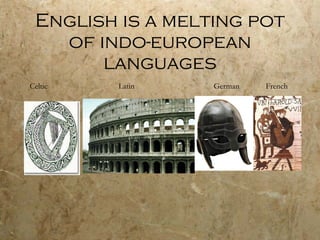
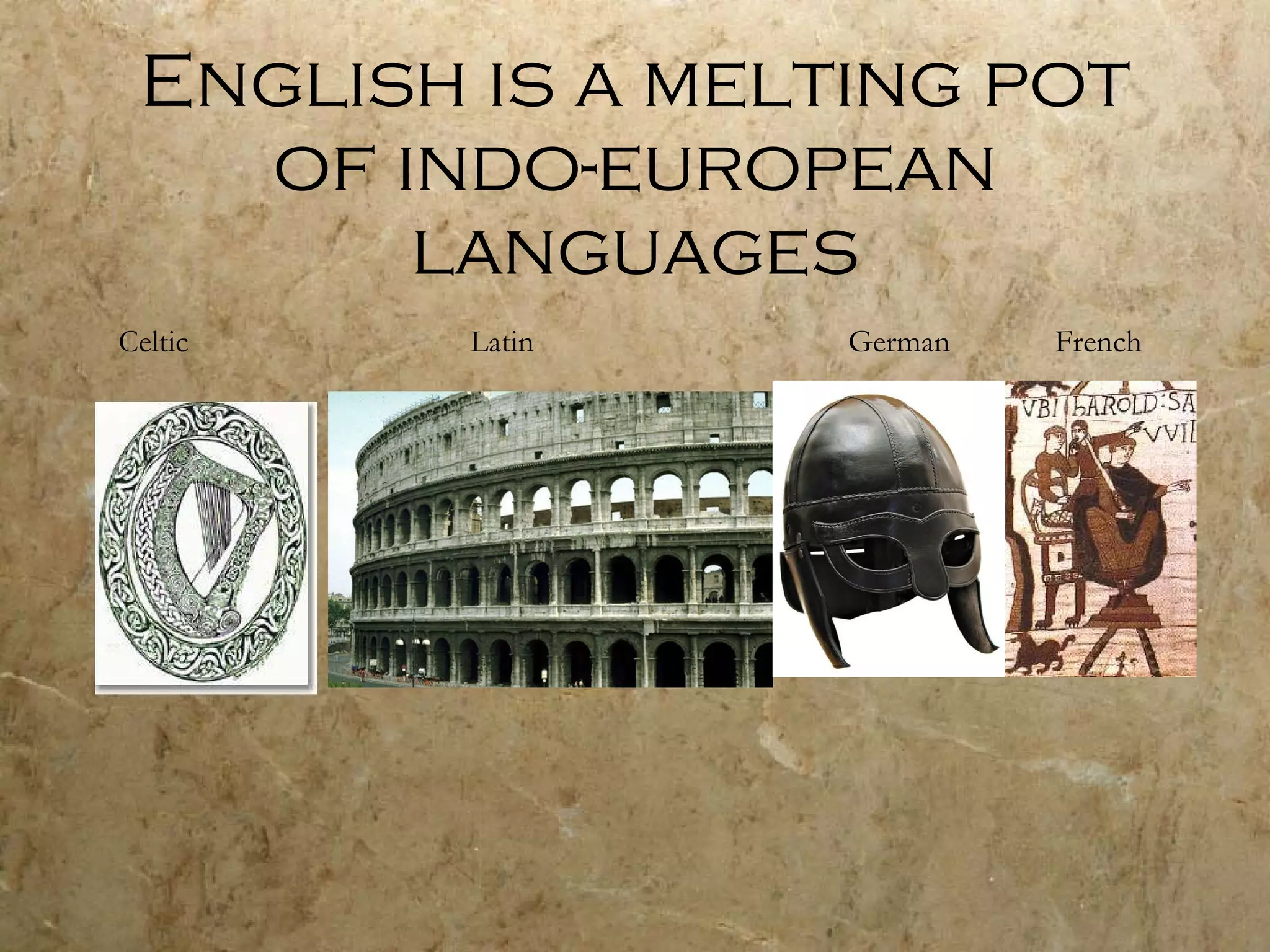
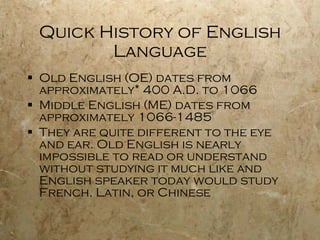
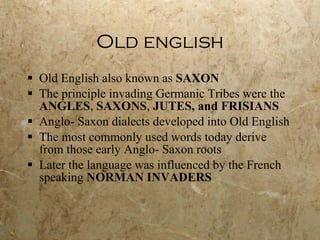
English is a melting pot of indo-european languages Celtic  Latin  German  French
Quick History of English Language Old English (OE) dates from approximately* 400 A.D. to 1066 Middle English (ME) dates from approximately 1066-1485 They are quite different to the eye and ear. Old English is nearly impossible to read or understand without studying it much like and English speaker today would study French, Latin, or Chinese
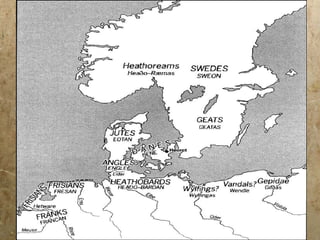
Old english Old English also known as  SAXON   The principle invading Germanic Tribes were the  ANGLES ,  SAXONS ,  JUTES, and FRISIANS Anglo- Saxon dialects developed into Old English The most commonly used words today derive from those early Anglo- Saxon roots Later the language was influenced by the French speaking  NORMAN INVADERS
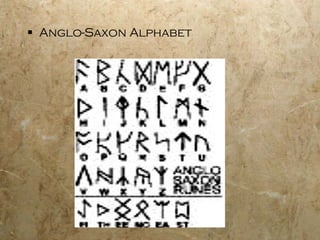
Anglo-Saxon Alphabet
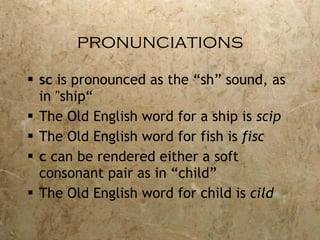
pronunciations sc  is pronounced as the “sh” sound, as in "ship“ The Old English word for a ship is  scip The Old English word for fish is  fisc c  can be rendered either a soft consonant pair as in “child”  The Old English word for child is  cild
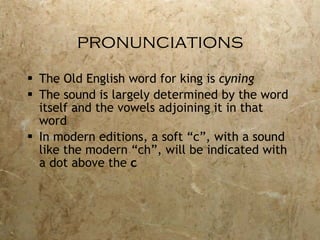
pronunciations The Old English word for king is  cyning The sound is largely determined by the word itself and the vowels adjoining it in that word In modern editions, a soft “c”, with a sound like the modern “ch”, will be indicated with a dot above the  c
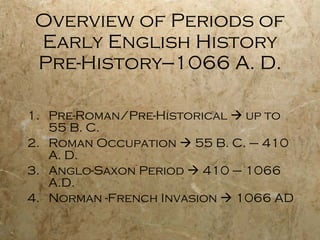
Overview of Periods of Early English History Pre-History—1066 A. D. Pre-Roman/Pre-Historical    up to 55 B. C. Roman Occupation    55 B. C. – 410 A. D. Anglo-Saxon Period    410 – 1066 A.D. Norman -French Invasion    1066 AD
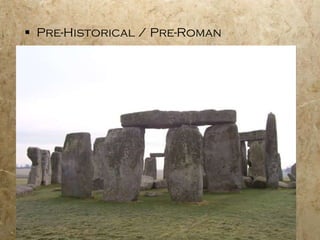
Pre-Historical / Pre-Roman
Theories of first Inhabitants Iberians--came from the Iberian peninsula of portugal and Spain Celts called “Brythons” hence Britain  300’s BC
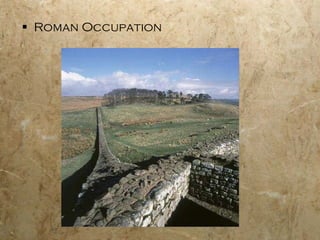
Roman Occupation
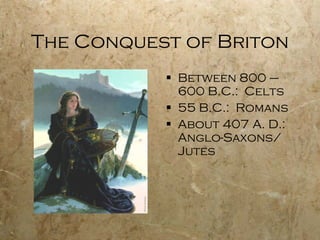
The Conquest of Briton Between 800 – 600 B.C.:  Celts 55 B.C.:  Romans  About 407 A. D.:  Anglo-Saxons/ Jutes
Celts Fourth century b.c. Loved nature Peace loving within their tribes Skilled craftsmen iron Religion - Animism “spirit” in rivers, rocks  War-like Druids - Priests Demanded total dedication Mistletoe (sacred)  and oak Voluntary human sacrifice Use of stones in worship Stone Henge - used in worship, astrology
CELTIC LEGENDS King Arthur- celtic warrior Filled with strong women Tall, fierce, beautiful Bloody magical
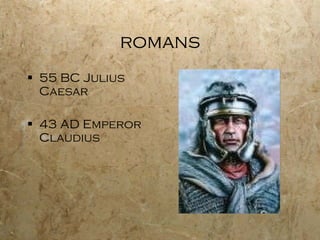
romans 55 BC Julius Caesar 43 AD Emperor Claudius
Picts Painted people Wore blue dye (berry juice) Screeched when they attacked Frightened the Romans according to historians and Julius Ceasar’s description
Celts were pushed to Scotland, Wales , and Ireland by Romans
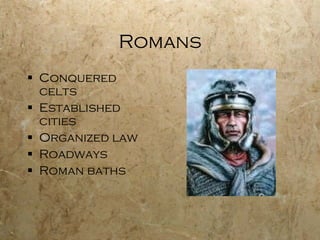
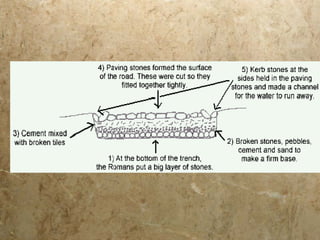
Romans Conquered celts Established cities Organized law Roadways Roman baths
Hadrian’s Wall 73 miles long Wide enough for two people side by side To keep out Celts and Picts Romans Brought Christianity Patrick brought missionaries to Ireland bringing Christianity
 
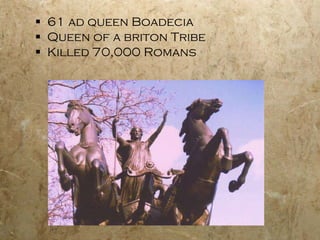
61 ad queen Boadecia Queen of a briton Tribe Killed 70,000 Romans
409 Romans withdrew from Britain leaving no central government
BEDE THE VENERABLE 673-737 A monk and scholar recorded knowledge of England before  the 8th century
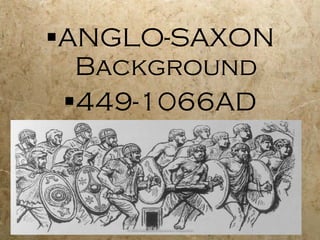
ANGLO-SAXON Background 449-1066AD
 
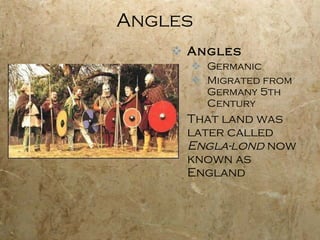
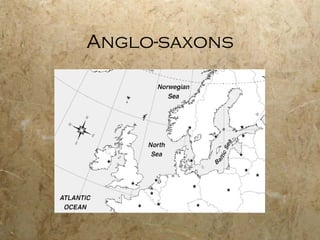
Angles Angles   Germanic Migrated from Germany 5th Century That land was later called  Engla-lond  now known as England
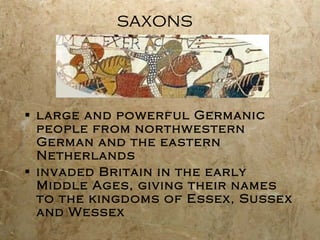
saxons large and powerful Germanic people from northwestern German and the eastern Netherlands invaded Britain in the early Middle Ages, giving their names to the kingdoms of Essex, Sussex and Wessex
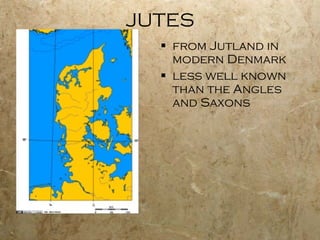
JUTES from Jutland in modern Denmark less well known than the Angles and Saxons
Anglo-saxons
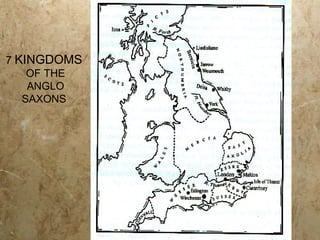
7  KINGDOMS OF THE ANGLO SAXONS
Anglo-Saxons Blond-haired, blue-eyed Fair, sturdy Loved nature and the sea Sense of honor Generous: Love to eat and drink Loved glory of battle braggarts
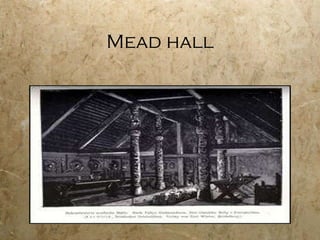
Anglo-Saxon Society King’s home in center of all others Mead hall (communal hall) Mead - potent drink made from honey Women not allowed except for serving Scops told stories/riddles in the halls King received power from gods (Woden) Somewhat democratic Eye for eye justice - immediate Pagan religion / mixed with Christianity later
Mead hall
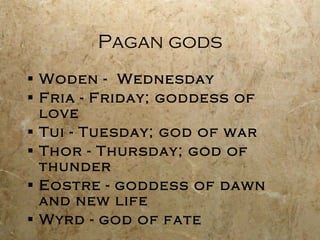
Pagan gods Woden -  Wednesday Fria - Friday; goddess of love Tui - Tuesday; god of war Thor - Thursday; god of thunder Eostre - goddess of dawn and new life Wyrd - god of fate
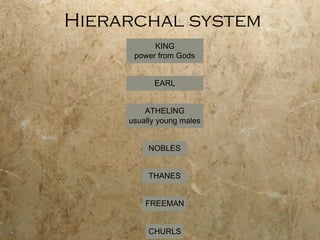
Hierarchal system
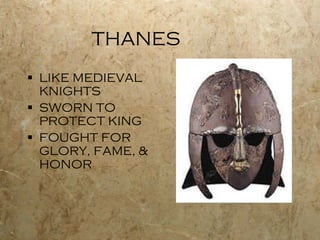
THANES LIKE MEDIEVAL KNIGHTS SWORN TO PROTECT KING FOUGHT FOR GLORY, FAME, & HONOR
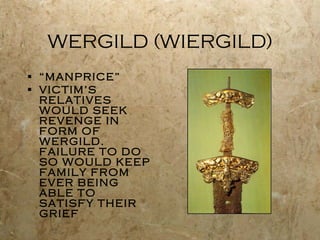
WERGILD (WIERGILD) “ MANPRICE” VICTIM’S RELATIVES WOULD SEEK REVENGE IN FORM OF WERGILD.  FAILURE TO DO SO WOULD KEEP FAMILY FROM EVER BEING ABLE TO SATISFY THEIR GRIEF
wiergild Under the wiergild system, every Anglo-Saxon, in common with other Germanic and Scandinavian peoples, knew the exact value of his life, and that depended on his rank.The life of a churl was worth two hundred shillings; that of a thane ... six times as much, and the price to be paid for injury, like the loss of a hand or a leg, was calculated in proportion."
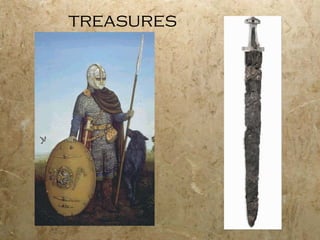
treasures
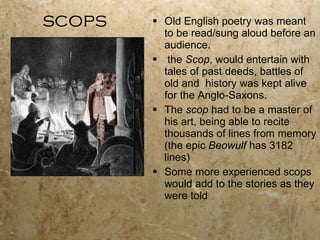
scops Old English poetry was meant to be read/sung aloud before an audience. the  Scop , would entertain with tales of past deeds, battles of old and  history was kept alive for the Anglo-Saxons. The  scop  had to be a master of his art, being able to recite thousands of lines from memory (the epic  Beowulf  has 3182 lines) Some more experienced scops would add to the stories as they were told
Christianity first arrived in Britain in the 6th Century - St. Augustine  gradually converted population until 9th Century when most Britons were Christian Latin introduced to Anglo Saxons who integrated Old English with Latin Vocabulary Centers for learning Preservation of manuscripts
871 alfred the Great unified tribes 1066 norman french invasion King Harold vs william, the conqueror
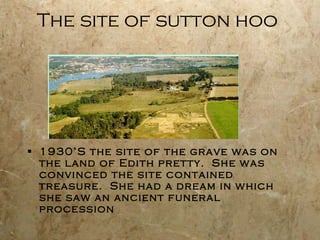
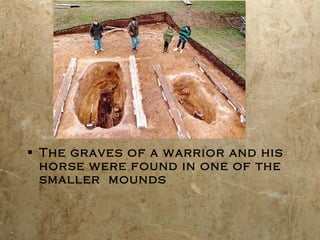
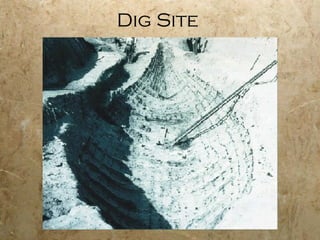
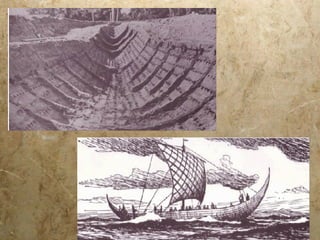
The site of sutton hoo 1930’S the site of the grave was on the land of Edith pretty.  She was convinced the site contained treasure.  She had a dream in which she saw an ancient funeral procession
The graves of a warrior and his horse were found in one of the smaller  mounds
Dig Site
 
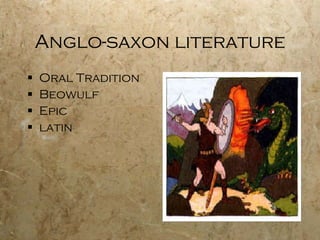
Anglo-saxon literature Oral Tradition Beowulf Epic latin
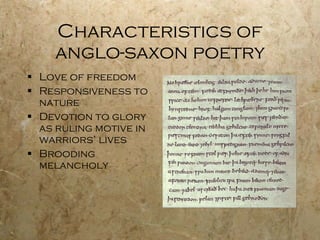
Characteristics of anglo-saxon poetry Love of freedom Responsiveness to nature Devotion to glory as ruling motive in warriors’ lives Brooding melancholy
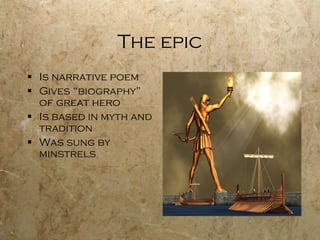
The epic Is narrative poem Gives “biography” of great hero Is based in myth and tradition Was sung by minstrels
epic Long, majestic narrative poem legendary or historical events  ideals of an entire nation at critical point of its history; gratifies national pride
epic ideals of a great cultural or religious movement
epic Supernatural forces Conflict in form of combat Stylistic conventions (invocation to Muse, formal theme statement, long lists of protagonists, set speeches in elevated language)
Epic Characters experience universal emotions Hero is demigod Begins in medias res Contains good vs evil battle Exaggeration and superlatives
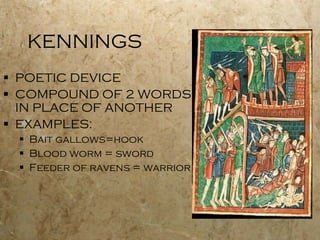
KENNINGS POETIC DEVICE COMPOUND OF 2 WORDS IN PLACE OF ANOTHER EXAMPLES: Bait gallows=hook Blood worm = sword Feeder of ravens = warrior
OTHER TERMS LITOTES:  IRONIC UNDERSTATEMENT EX. “SHE WELCOMED IN HER CLAWS” STICHE:  POETIC VERSE OR LINE HEMI-STICHE:  A HALF LINE COMITATUS - DISPENSING OF TREASURE AS A SYMBOL OF LOYALTY TO KING
Epic hero Represents a whole culture Univeral aspects of human condition Embodies qualities of human greatness Exists for the sake of community and protect community from evil Larger than life Shows proof of victory Boasts of prowess Acclaimed after death
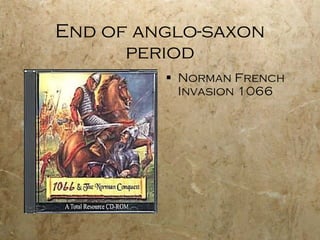
End of anglo-saxon period Norman French Invasion 1066
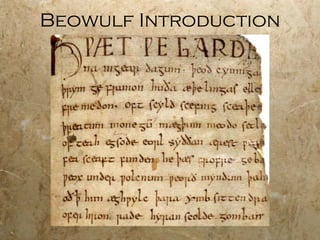
Beowulf Introduction
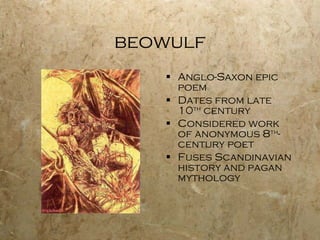
beowulf Anglo-Saxon epic poem Dates from late 10 th  century Considered work of anonymous 8 th -century poet Fuses Scandinavian history and pagan mythology
The basics Who?  What? When? Where? Why?
By whom? By whom was it written? Most Anglo-Saxon poetry was oral at first, meaning it was transmitted or performed by a Bard (Scop) from memory; it wasn’t actually written down,  per se   until . . .  Somewhere between the eighth and ninth centuries A.D., “The  Beowulf -Poet” (his identity is unknown) wrote down the poem which for many years had been sung/spoken.
By whom? The  Beowulf -poet, scholars believe, was an English monk (and therefore,  Christian ) who probably lived in one of the Anglo-Saxon settlements in Western England (Mercia)
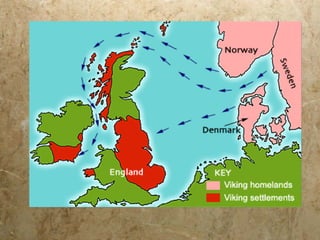
About whom? Even though the poet himself was English and Christian, the poem is about neither Englishmen nor (full-fledged) Christians It is the story of several Scandinavian peoples (tribes, really), mainly the Geats and the Danes, but also the Swedes. Beowulf is a Geat. He goes to the aid of the Danes, whose king is Hrothgar They live in . . .
 
Main characters Beowulf (Geat) Hrothgar (Dane) Unferth (Dane) Wiglaf (Geat) Grendel Grendel’s mother The dragon
Where and when? Where was it written?  It was written down, most likely, in the kingdom of Mercia (East Central Enlgand today). Around 700 AD Where do the events in the poem take place?  The action in the poem takes place in Geatland and Denmark (the island of Zealand and in Southern Sweden) . . . Or more generally, in the Baltic region of Scandinavia Also consider more specific settings: The sea, the meadhall, the swamp, the cliff, the battlefield, etc. In the modern world, it is Denmark and Sweden and the islands in the Baltic between the two countries.
The scary, horror movie where? Beowulf takes place in a “once upon a time world” and that it taps into “three archetypal sites of fear”: The barricaded night house (Grendel) The infested underwater current (Grendel’s mother) Reptile-haunted rocks of a wilderness (dragon) in terms which may mean more to us Our beds on a stormy night when we are alone in the house (where we should feel safe) A murky lake, or the beach where Jaws takes place (Ever been waterskiing and wondered what was nibbling on your toes?). Or, how about a dark forest by yourself? The dark recesses of the earth: a cave, or even better, your own, dark basement

Prewitt anglo saxon

  • 1.
    English is amelting pot of indo-european languages Celtic Latin German French
  • 2.
    Quick History ofEnglish Language Old English (OE) dates from approximately* 400 A.D. to 1066 Middle English (ME) dates from approximately 1066-1485 They are quite different to the eye and ear. Old English is nearly impossible to read or understand without studying it much like and English speaker today would study French, Latin, or Chinese
  • 3.
    Old english OldEnglish also known as SAXON The principle invading Germanic Tribes were the ANGLES , SAXONS , JUTES, and FRISIANS Anglo- Saxon dialects developed into Old English The most commonly used words today derive from those early Anglo- Saxon roots Later the language was influenced by the French speaking NORMAN INVADERS
  • 4.
  • 5.
    pronunciations sc is pronounced as the “sh” sound, as in "ship“ The Old English word for a ship is scip The Old English word for fish is fisc c can be rendered either a soft consonant pair as in “child” The Old English word for child is cild
  • 6.
    pronunciations The OldEnglish word for king is cyning The sound is largely determined by the word itself and the vowels adjoining it in that word In modern editions, a soft “c”, with a sound like the modern “ch”, will be indicated with a dot above the c
  • 7.
    Overview of Periodsof Early English History Pre-History—1066 A. D. Pre-Roman/Pre-Historical  up to 55 B. C. Roman Occupation  55 B. C. – 410 A. D. Anglo-Saxon Period  410 – 1066 A.D. Norman -French Invasion  1066 AD
  • 8.
  • 9.
    Theories of firstInhabitants Iberians--came from the Iberian peninsula of portugal and Spain Celts called “Brythons” hence Britain 300’s BC
  • 10.
  • 11.
    The Conquest ofBriton Between 800 – 600 B.C.: Celts 55 B.C.: Romans About 407 A. D.: Anglo-Saxons/ Jutes
  • 12.
    Celts Fourth centuryb.c. Loved nature Peace loving within their tribes Skilled craftsmen iron Religion - Animism “spirit” in rivers, rocks War-like Druids - Priests Demanded total dedication Mistletoe (sacred) and oak Voluntary human sacrifice Use of stones in worship Stone Henge - used in worship, astrology
  • 13.
    CELTIC LEGENDS KingArthur- celtic warrior Filled with strong women Tall, fierce, beautiful Bloody magical
  • 14.
    romans 55 BCJulius Caesar 43 AD Emperor Claudius
  • 15.
    Picts Painted peopleWore blue dye (berry juice) Screeched when they attacked Frightened the Romans according to historians and Julius Ceasar’s description
  • 16.
    Celts were pushedto Scotland, Wales , and Ireland by Romans
  • 17.
    Romans Conquered celtsEstablished cities Organized law Roadways Roman baths
  • 18.
    Hadrian’s Wall 73miles long Wide enough for two people side by side To keep out Celts and Picts Romans Brought Christianity Patrick brought missionaries to Ireland bringing Christianity
  • 19.
  • 20.
    61 ad queenBoadecia Queen of a briton Tribe Killed 70,000 Romans
  • 21.
    409 Romans withdrewfrom Britain leaving no central government
  • 22.
    BEDE THE VENERABLE673-737 A monk and scholar recorded knowledge of England before the 8th century
  • 23.
  • 24.
  • 25.
    Angles Angles Germanic Migrated from Germany 5th Century That land was later called Engla-lond now known as England
  • 26.
    saxons large andpowerful Germanic people from northwestern German and the eastern Netherlands invaded Britain in the early Middle Ages, giving their names to the kingdoms of Essex, Sussex and Wessex
  • 27.
    JUTES from Jutlandin modern Denmark less well known than the Angles and Saxons
  • 28.
  • 29.
    7 KINGDOMSOF THE ANGLO SAXONS
  • 30.
    Anglo-Saxons Blond-haired, blue-eyedFair, sturdy Loved nature and the sea Sense of honor Generous: Love to eat and drink Loved glory of battle braggarts
  • 31.
    Anglo-Saxon Society King’shome in center of all others Mead hall (communal hall) Mead - potent drink made from honey Women not allowed except for serving Scops told stories/riddles in the halls King received power from gods (Woden) Somewhat democratic Eye for eye justice - immediate Pagan religion / mixed with Christianity later
  • 32.
  • 33.
    Pagan gods Woden- Wednesday Fria - Friday; goddess of love Tui - Tuesday; god of war Thor - Thursday; god of thunder Eostre - goddess of dawn and new life Wyrd - god of fate
  • 34.
  • 35.
    THANES LIKE MEDIEVALKNIGHTS SWORN TO PROTECT KING FOUGHT FOR GLORY, FAME, & HONOR
  • 36.
    WERGILD (WIERGILD) “MANPRICE” VICTIM’S RELATIVES WOULD SEEK REVENGE IN FORM OF WERGILD. FAILURE TO DO SO WOULD KEEP FAMILY FROM EVER BEING ABLE TO SATISFY THEIR GRIEF
  • 37.
    wiergild Under thewiergild system, every Anglo-Saxon, in common with other Germanic and Scandinavian peoples, knew the exact value of his life, and that depended on his rank.The life of a churl was worth two hundred shillings; that of a thane ... six times as much, and the price to be paid for injury, like the loss of a hand or a leg, was calculated in proportion."
  • 38.
  • 39.
    scops Old Englishpoetry was meant to be read/sung aloud before an audience. the Scop , would entertain with tales of past deeds, battles of old and history was kept alive for the Anglo-Saxons. The scop had to be a master of his art, being able to recite thousands of lines from memory (the epic Beowulf has 3182 lines) Some more experienced scops would add to the stories as they were told
  • 40.
    Christianity first arrivedin Britain in the 6th Century - St. Augustine gradually converted population until 9th Century when most Britons were Christian Latin introduced to Anglo Saxons who integrated Old English with Latin Vocabulary Centers for learning Preservation of manuscripts
  • 41.
    871 alfred theGreat unified tribes 1066 norman french invasion King Harold vs william, the conqueror
  • 42.
    The site ofsutton hoo 1930’S the site of the grave was on the land of Edith pretty. She was convinced the site contained treasure. She had a dream in which she saw an ancient funeral procession
  • 43.
    The graves ofa warrior and his horse were found in one of the smaller mounds
  • 44.
  • 45.
  • 46.
    Anglo-saxon literature OralTradition Beowulf Epic latin
  • 47.
    Characteristics of anglo-saxonpoetry Love of freedom Responsiveness to nature Devotion to glory as ruling motive in warriors’ lives Brooding melancholy
  • 48.
    The epic Isnarrative poem Gives “biography” of great hero Is based in myth and tradition Was sung by minstrels
  • 49.
    epic Long, majesticnarrative poem legendary or historical events ideals of an entire nation at critical point of its history; gratifies national pride
  • 50.
    epic ideals ofa great cultural or religious movement
  • 51.
    epic Supernatural forcesConflict in form of combat Stylistic conventions (invocation to Muse, formal theme statement, long lists of protagonists, set speeches in elevated language)
  • 52.
    Epic Characters experienceuniversal emotions Hero is demigod Begins in medias res Contains good vs evil battle Exaggeration and superlatives
  • 53.
    KENNINGS POETIC DEVICECOMPOUND OF 2 WORDS IN PLACE OF ANOTHER EXAMPLES: Bait gallows=hook Blood worm = sword Feeder of ravens = warrior
  • 54.
    OTHER TERMS LITOTES: IRONIC UNDERSTATEMENT EX. “SHE WELCOMED IN HER CLAWS” STICHE: POETIC VERSE OR LINE HEMI-STICHE: A HALF LINE COMITATUS - DISPENSING OF TREASURE AS A SYMBOL OF LOYALTY TO KING
  • 55.
    Epic hero Representsa whole culture Univeral aspects of human condition Embodies qualities of human greatness Exists for the sake of community and protect community from evil Larger than life Shows proof of victory Boasts of prowess Acclaimed after death
  • 56.
    End of anglo-saxonperiod Norman French Invasion 1066
  • 57.
  • 58.
    beowulf Anglo-Saxon epicpoem Dates from late 10 th century Considered work of anonymous 8 th -century poet Fuses Scandinavian history and pagan mythology
  • 59.
    The basics Who? What? When? Where? Why?
  • 60.
    By whom? Bywhom was it written? Most Anglo-Saxon poetry was oral at first, meaning it was transmitted or performed by a Bard (Scop) from memory; it wasn’t actually written down, per se until . . . Somewhere between the eighth and ninth centuries A.D., “The Beowulf -Poet” (his identity is unknown) wrote down the poem which for many years had been sung/spoken.
  • 61.
    By whom? The Beowulf -poet, scholars believe, was an English monk (and therefore, Christian ) who probably lived in one of the Anglo-Saxon settlements in Western England (Mercia)
  • 62.
    About whom? Eventhough the poet himself was English and Christian, the poem is about neither Englishmen nor (full-fledged) Christians It is the story of several Scandinavian peoples (tribes, really), mainly the Geats and the Danes, but also the Swedes. Beowulf is a Geat. He goes to the aid of the Danes, whose king is Hrothgar They live in . . .
  • 63.
  • 64.
    Main characters Beowulf(Geat) Hrothgar (Dane) Unferth (Dane) Wiglaf (Geat) Grendel Grendel’s mother The dragon
  • 65.
    Where and when?Where was it written? It was written down, most likely, in the kingdom of Mercia (East Central Enlgand today). Around 700 AD Where do the events in the poem take place? The action in the poem takes place in Geatland and Denmark (the island of Zealand and in Southern Sweden) . . . Or more generally, in the Baltic region of Scandinavia Also consider more specific settings: The sea, the meadhall, the swamp, the cliff, the battlefield, etc. In the modern world, it is Denmark and Sweden and the islands in the Baltic between the two countries.
  • 66.
    The scary, horrormovie where? Beowulf takes place in a “once upon a time world” and that it taps into “three archetypal sites of fear”: The barricaded night house (Grendel) The infested underwater current (Grendel’s mother) Reptile-haunted rocks of a wilderness (dragon) in terms which may mean more to us Our beds on a stormy night when we are alone in the house (where we should feel safe) A murky lake, or the beach where Jaws takes place (Ever been waterskiing and wondered what was nibbling on your toes?). Or, how about a dark forest by yourself? The dark recesses of the earth: a cave, or even better, your own, dark basement