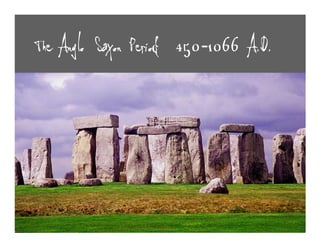
The Anglo Saxon Period 450-1066 A.D.
AKA
& Emergent Period – kingdoms emerging from
Rome’s control
& Old English – before the modern Britain
& the Dark Ages – time of regression from Rome’s
influence, breakdown of society
& This was a time of bloody conflicts,
ignorance, violence and barbarism.
& Life was difficult and the literature
reflected this.
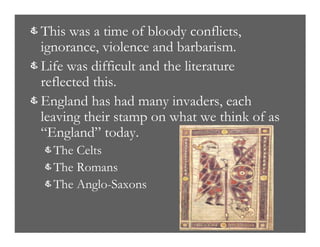
& England has had many invaders, each
leaving their stamp on what we think of as
“England” today.
& The Celts
& The Romans
& The Anglo-Saxons
Let’s step back for a moment . . .
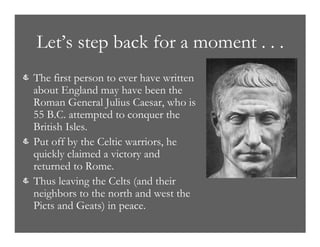
& The first person to ever have written
about England may have been the
Roman General Julius Caesar, who is
55 B.C. attempted to conquer the
British Isles.
& Put off by the Celtic warriors, he
quickly claimed a victory and
returned to Rome.
& Thus leaving the Celts (and their
neighbors to the north and west the
Picts and Geats) in peace.
The Celtic Heroes: A Magical World
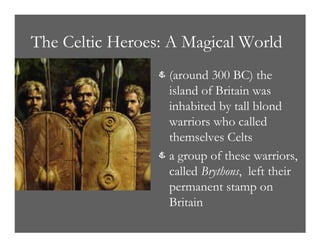
& (around 300 BC) the
island of Britain was
inhabited by tall blond
warriors who called
themselves Celts
& a group of these warriors,
called Brythons, left their
permanent stamp on
Britain
Religion of the Celts
& Animism – the Celts saw spirits everywhere, in
rivers, trees, stones, ponds, fire, and thunder.
These spirits were all around and needed to
satisfied constantly.
& Priests, called Druids, acted as intermediaries
between the gods and the people.
& Ritualistic dances, human sacrifices and religious
rites having to do with the lunar and solar cycles
were performed.
Celtic stories
& Their legends focus on and are full of strong
women (very different from Anglo-Saxon
legends that focus on strong men and women
faded into background).
& Celtic stories leap into sunlight after battle, no
matter how much blood was spilled.
& Full of fantastic animals, passionate love affairs,
and fabulous adventures
The Romans: The
Great Administrators
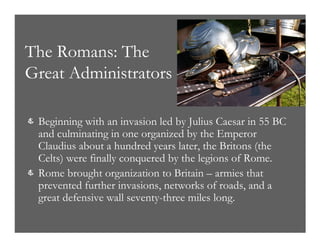
& Beginning with an invasion led by Julius Caesar in 55 BC
and culminating in one organized by the Emperor
Claudius about a hundred years later, the Britons (the
Celts) were finally conquered by the legions of Rome.
& Rome brought organization to Britain – armies that
prevented further invasions, networks of roads, and a
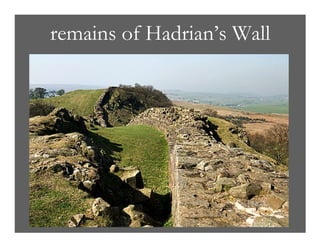
great defensive wall seventy-three miles long.
remains of Hadrian’s Wall
Religion of the Romans
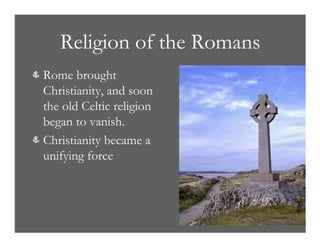
& Rome brought
Christianity, and soon
the old Celtic religion
began to vanish.
& Christianity became a
unifying force
But, Rome pulled out . . .
& The Romans were having trouble in Rome.
& By 409 AD, they had evacuated their troops
from Britain, leaving roads, walls, villas, and
public baths, but no central government.
& Without Roman control, Britain was a country
of separate clans.
& separation led to weakness, weakness led to
vulnerability to other conquering nations
The Anglo-Saxons
Sweep Ashore
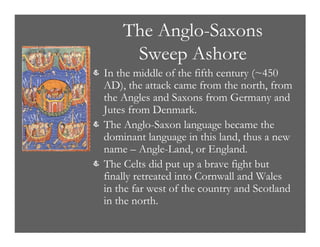
& In the middle of the fifth century (~450
AD), the attack came from the north, from
the Angles and Saxons from Germany and
Jutes from Denmark.
& The Anglo-Saxon language became the
dominant language in this land, thus a new
name – Angle-Land, or England.
& The Celts did put up a brave fight but
finally retreated into Cornwall and Wales
in the far west of the country and Scotland
in the north.
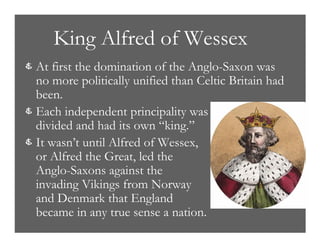
King Alfred of Wessex
& At first the domination of the Anglo-Saxon was
no more politically unified than Celtic Britain had
been.
& Each independent principality was
divided and had its own “king.”
& It wasn’t until Alfred of Wessex,
or Alfred the Great, led the
Anglo-Saxons against the
invading Vikings from Norway
and Denmark that England
became in any true sense a nation.
King Alfred (continued)
& The Viking people of the north were plundering
and destroying everything in their path.
& At first their aim was to hit and run, to get what
they could. Later they realized that England’s
winters were easier than their harsh, icy ones.
& The Danish invaders set up camps and
eventually gained control of parts of the country.
King Alfred (continued)
& But, there was still some instability in England. It is possible that
without the help of Christian monks and missionaries converting
Anglo-Saxon kings, and, thus, their subjects, there would not
have been a unification of England.
& Under King Alfred and Christianity, the Anglo-Saxons fought to
protect their land and way of life from the Danes.
& His children, Ethelfleda, a brilliant military leader and strategist,
and her brother Edward, carried on King Alfred’s fight against
the Danes.
& The battle continued until both the Anglo-Saxons and the Danes
were defeated in 1066 by William, Duke of Normandy, and his
invading force of Normans from northwestern France.
The Norman Conquest
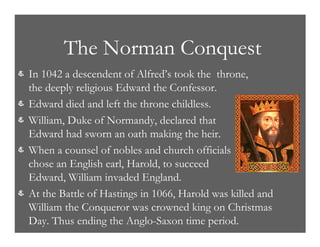
& In 1042 a descendent of Alfred’s took the throne,
the deeply religious Edward the Confessor.
& Edward died and left the throne childless.
& William, Duke of Normandy, declared that
Edward had sworn an oath making the heir.
& When a counsel of nobles and church officials
chose an English earl, Harold, to succeed
Edward, William invaded England.
& At the Battle of Hastings in 1066, Harold was killed and
William the Conqueror was crowned king on Christmas
Day. Thus ending the Anglo-Saxon time period.
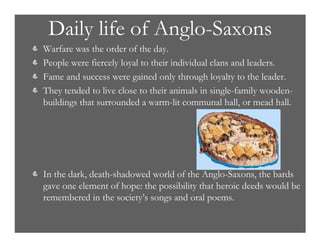
Daily life of Anglo-Saxons
& Warfare was the order of the day.
& People were fiercely loyal to their individual clans and leaders.
& Fame and success were gained only through loyalty to the leader.
& They tended to live close to their animals in single-family wooden-
buildings that surrounded a warm-lit communal hall, or mead hall.
& In the dark, death-shadowed world of the Anglo-Saxons, the bards
gave one element of hope: the possibility that heroic deeds would be
remembered in the society’s songs and oral poems.
Anglo-Saxon Religion
& The Anglo-Saxon religion was very dark, honoring
warrior gods.
& Woden – god of death, poetry and magic
& Thunor – god of thunder and lightning
& Religion focused on the fact that life was hard and the
way to be remembered after death was to fight
gloriously in battle.
& Their religion focused on a strong belief in wyrd, or fate,
and they saved any admiration for heroic warriors
whose fate it was to prevail in battle.
& On the whole the religion was more concerned with
ethics than mysticism. Focused on the earthly virtues
of bravery, loyalty, generosity, and friendship.
Scops or Bards
& In the great mead halls of the lords and nobles,
Anglo-Saxons would gather to celebrate and
listen to the scops, or professional singing poets,
as they brought epic poems to life.
& These poems were more than just simple
entertainment. They were history lessons, moral
sermons, and pep talks all rolled into one.
& With no hope of an afterlife, only an epic poem
could provide a measure of immortality.
& These poems were strictly oral art forms.
Spread of Christianity
& In 597 a Roman missionary named Augustine
arrived in the kingdom of Kent, where he
established a monastery at Canterbury.
& From there Christianity spread, and all of
England was at least nominally Christian (some
still held to the pagan beliefs.
The Christian Monasteries
& Monasteries served as centers of learning.
& They are responsible for preserving the earlier Greek
and Latin works, but also local works and epic poems
like Beowulf.
& In the scriptorium, or writing room, Monks spent their
days hand copying texts. (Printing is still 800 years
away.)
& Latin remained the “serious” language of learning until
the time of King Alfred.
& He instituted the Anglo-Saxon Chronicle, a lengthy
running history of England. Because of these efforts,
English gained respect as language of culture.

The AngloSaxon period.pdfbbbbbbbnbbbbbbbb

  • 1.
    The Anglo SaxonPeriod 450-1066 A.D.
  • 2.
    AKA & Emergent Period– kingdoms emerging from Rome’s control & Old English – before the modern Britain & the Dark Ages – time of regression from Rome’s influence, breakdown of society
  • 3.
    & This wasa time of bloody conflicts, ignorance, violence and barbarism. & Life was difficult and the literature reflected this. & England has had many invaders, each leaving their stamp on what we think of as “England” today. & The Celts & The Romans & The Anglo-Saxons
  • 4.
    Let’s step backfor a moment . . . & The first person to ever have written about England may have been the Roman General Julius Caesar, who is 55 B.C. attempted to conquer the British Isles. & Put off by the Celtic warriors, he quickly claimed a victory and returned to Rome. & Thus leaving the Celts (and their neighbors to the north and west the Picts and Geats) in peace.
  • 5.
    The Celtic Heroes:A Magical World & (around 300 BC) the island of Britain was inhabited by tall blond warriors who called themselves Celts & a group of these warriors, called Brythons, left their permanent stamp on Britain
  • 6.
    Religion of theCelts & Animism – the Celts saw spirits everywhere, in rivers, trees, stones, ponds, fire, and thunder. These spirits were all around and needed to satisfied constantly. & Priests, called Druids, acted as intermediaries between the gods and the people. & Ritualistic dances, human sacrifices and religious rites having to do with the lunar and solar cycles were performed.
  • 7.
    Celtic stories & Theirlegends focus on and are full of strong women (very different from Anglo-Saxon legends that focus on strong men and women faded into background). & Celtic stories leap into sunlight after battle, no matter how much blood was spilled. & Full of fantastic animals, passionate love affairs, and fabulous adventures
  • 8.
    The Romans: The GreatAdministrators & Beginning with an invasion led by Julius Caesar in 55 BC and culminating in one organized by the Emperor Claudius about a hundred years later, the Britons (the Celts) were finally conquered by the legions of Rome. & Rome brought organization to Britain – armies that prevented further invasions, networks of roads, and a great defensive wall seventy-three miles long.
  • 9.
  • 10.
    Religion of theRomans & Rome brought Christianity, and soon the old Celtic religion began to vanish. & Christianity became a unifying force
  • 11.
    But, Rome pulledout . . . & The Romans were having trouble in Rome. & By 409 AD, they had evacuated their troops from Britain, leaving roads, walls, villas, and public baths, but no central government. & Without Roman control, Britain was a country of separate clans. & separation led to weakness, weakness led to vulnerability to other conquering nations
  • 12.
    The Anglo-Saxons Sweep Ashore &In the middle of the fifth century (~450 AD), the attack came from the north, from the Angles and Saxons from Germany and Jutes from Denmark. & The Anglo-Saxon language became the dominant language in this land, thus a new name – Angle-Land, or England. & The Celts did put up a brave fight but finally retreated into Cornwall and Wales in the far west of the country and Scotland in the north.
  • 13.
    King Alfred ofWessex & At first the domination of the Anglo-Saxon was no more politically unified than Celtic Britain had been. & Each independent principality was divided and had its own “king.” & It wasn’t until Alfred of Wessex, or Alfred the Great, led the Anglo-Saxons against the invading Vikings from Norway and Denmark that England became in any true sense a nation.
  • 14.
    King Alfred (continued) &The Viking people of the north were plundering and destroying everything in their path. & At first their aim was to hit and run, to get what they could. Later they realized that England’s winters were easier than their harsh, icy ones. & The Danish invaders set up camps and eventually gained control of parts of the country.
  • 15.
    King Alfred (continued) &But, there was still some instability in England. It is possible that without the help of Christian monks and missionaries converting Anglo-Saxon kings, and, thus, their subjects, there would not have been a unification of England. & Under King Alfred and Christianity, the Anglo-Saxons fought to protect their land and way of life from the Danes. & His children, Ethelfleda, a brilliant military leader and strategist, and her brother Edward, carried on King Alfred’s fight against the Danes. & The battle continued until both the Anglo-Saxons and the Danes were defeated in 1066 by William, Duke of Normandy, and his invading force of Normans from northwestern France.
  • 16.
    The Norman Conquest &In 1042 a descendent of Alfred’s took the throne, the deeply religious Edward the Confessor. & Edward died and left the throne childless. & William, Duke of Normandy, declared that Edward had sworn an oath making the heir. & When a counsel of nobles and church officials chose an English earl, Harold, to succeed Edward, William invaded England. & At the Battle of Hastings in 1066, Harold was killed and William the Conqueror was crowned king on Christmas Day. Thus ending the Anglo-Saxon time period.
  • 17.
    Daily life ofAnglo-Saxons & Warfare was the order of the day. & People were fiercely loyal to their individual clans and leaders. & Fame and success were gained only through loyalty to the leader. & They tended to live close to their animals in single-family wooden- buildings that surrounded a warm-lit communal hall, or mead hall. & In the dark, death-shadowed world of the Anglo-Saxons, the bards gave one element of hope: the possibility that heroic deeds would be remembered in the society’s songs and oral poems.
  • 18.
    Anglo-Saxon Religion & TheAnglo-Saxon religion was very dark, honoring warrior gods. & Woden – god of death, poetry and magic & Thunor – god of thunder and lightning & Religion focused on the fact that life was hard and the way to be remembered after death was to fight gloriously in battle. & Their religion focused on a strong belief in wyrd, or fate, and they saved any admiration for heroic warriors whose fate it was to prevail in battle. & On the whole the religion was more concerned with ethics than mysticism. Focused on the earthly virtues of bravery, loyalty, generosity, and friendship.
  • 19.
    Scops or Bards &In the great mead halls of the lords and nobles, Anglo-Saxons would gather to celebrate and listen to the scops, or professional singing poets, as they brought epic poems to life. & These poems were more than just simple entertainment. They were history lessons, moral sermons, and pep talks all rolled into one. & With no hope of an afterlife, only an epic poem could provide a measure of immortality. & These poems were strictly oral art forms.
  • 20.
    Spread of Christianity &In 597 a Roman missionary named Augustine arrived in the kingdom of Kent, where he established a monastery at Canterbury. & From there Christianity spread, and all of England was at least nominally Christian (some still held to the pagan beliefs.
  • 21.
    The Christian Monasteries &Monasteries served as centers of learning. & They are responsible for preserving the earlier Greek and Latin works, but also local works and epic poems like Beowulf. & In the scriptorium, or writing room, Monks spent their days hand copying texts. (Printing is still 800 years away.) & Latin remained the “serious” language of learning until the time of King Alfred. & He instituted the Anglo-Saxon Chronicle, a lengthy running history of England. Because of these efforts, English gained respect as language of culture.