The Anglo-Saxons: 
449–1066 
Introduction to the 
Literary Period
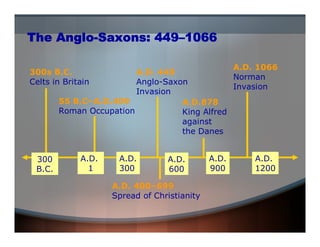
The Anglo-Saxons: 449–1066 
300s B.C. 
Celts in Britain 
55 B.C–A.D.409 
Roman Occupation 
A.D. 449 
Anglo-Saxon 
Invasion 
A.D. 400–699 
Spread of Christianity 
A.D. 1066 
Norman 
Invasion 
A.D.878 
King Alfred 
against 
the Danes 
A.D. 
600 
A.D. 
300 
A.D. 
1 
300 
B.C. 
A.D. 
900 
A.D. 
1200
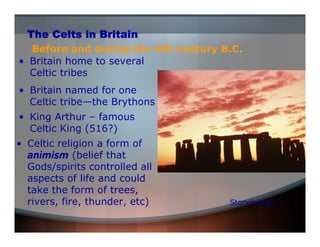
The Celts in Britain 
Before and during the 4th century B.C. 
• Britain home to several 
Celtic tribes 
• Celtic religion a form of 
animism (belief that 
Gods/spirits controlled all 
aspects of life and could 
take the form of trees, 
rivers, fire, thunder, etc) 
Stonehenge 
• Britain named for one 
Celtic tribe—the Brythons 
• King Arthur – famous 
Celtic King (516?)
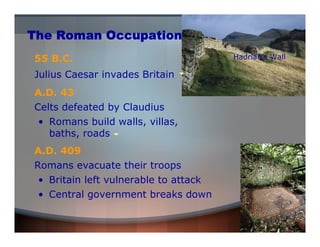
The Roman Occupation 
55 B.C. Hadrian’s Wall 
Julius Caesar invades Britain 
A.D. 43 
Celts defeated by Claudius 
• Romans build walls, villas, 
baths, roads 
A.D. 409 
Romans evacuate their troops 
• Central government breaks down 
Roman ruins 
• Britain left vulnerable to attack
The Anglo-Saxon Invasion 
Jutes 
Angles 
Saxons 
Celts 
A.D. 449 The Anglo-Saxons push the Celts 
into the far west of the country.
The Anglo-Saxon Invasion 
Anglo-Saxon Society 
• Warrior-based society, led by strong warrior chief 
• “Warfare was the order of the day” (between 
clans, tribes, and outside invaders) 
• Anglo-Saxon life was dominated by the need to 
protect the clan and home from enemies. 
• Fame and success were achieved through loyalty 
to a leader, and success was measured by gifts 
received from leaders.
The Anglo-Saxon Invasion 
• Women had many 
rights in Anglo-Saxon 
society. Women 
inherited and held 
property (even when 
married) and were 
offered substantial gifts 
of money and land from 
prospective husbands. 
• English emerged as a 
written language 
The Anglo-Saxon Chronicle
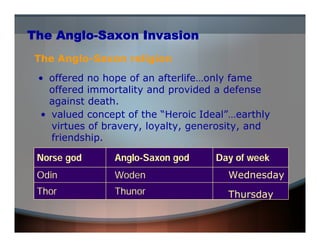
The Anglo-Saxon religion 
• offered no hope of an afterlife…only fame 
offered immortality and provided a defense 
against death. 
• valued concept of the “Heroic Ideal”…earthly 
virtues of bravery, loyalty, generosity, and 
friendship. 
Norse god Anglo-Saxon god Day of week 
Odin Woden 
Thor Thunor 
Wednesday 
Thursday 
The Anglo-Saxon Invasion
The Anglo-Saxon Invasion 
The Anglo-Saxon bards 
• called “scops” 
Why were the scops important? 
• Anglo-Saxons did not believe in 
an afterlife 
• warriors gained immortality 
through songs preserved in the 
collective memory. 
Anglo-Saxon harp 
• skilled storytellers and honored 
members of society. 
• sang of heroic deeds 
• regarded as equals to warriors
King Alfred the Great against the Danes 
8th–9th centuries 
Vikings, called Danes, 
invade Britain 
871 Alfred of Wessex 
becomes king of 
England. 
878 King Alfred unifies 
the Anglo-Saxons 
against the Danes. 
England becomes a 
nation. 
King Sweyn and his Danish troops 
arrive in England, from a 
manuscript (c. 14th century) 
* Alfred was also know for reviving an interest 
in learning and the English language.
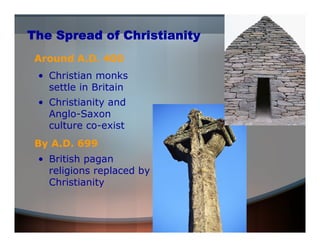
The Spread of Christianity 
Around A.D. 400 
• Christian monks 
settle in Britain 
• Christianity and 
Anglo-Saxon 
culture co-exist 
By A.D. 699 
• British pagan 
religions replaced by 
Christianity
The Norman Invasion 
• William of Normandy crosses the English 
Channel 
• French replaces 
English as the 
language of the 
ruling class 
The Norman Invasion, 
Bayeux Tapestry 
1066 
• William defeats Harold and Anglo-Saxon army
Literature of the Period 
• Leading Genres: Poetry and Riddles 
o Epics (narrative/story-like) 
o Elegiac mood (somber, sorrowful tone) 
o Strong rhythm and no rhyme 
o Lyrical (focuses more on emotion)
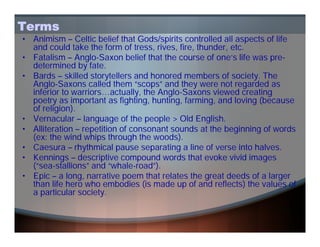
Terms 
• Animism – Celtic belief that Gods/spirits controlled all aspects of life 
and could take the form of tress, rives, fire, thunder, etc. 
• Fatalism – Anglo-Saxon belief that the course of one’s life was pre-determined 
by fate. 
• Bards – skilled storytellers and honored members of society. The 
Anglo-Saxons called them “scops” and they were not regarded as 
inferior to warriors…actually, the Anglo-Saxons viewed creating 
poetry as important as fighting, hunting, farming, and loving (because 
of religion). 
• Vernacular – language of the people > Old English. 
• Alliteration – repetition of consonant sounds at the beginning of words 
(ex: the wind whips through the woods). 
• Caesura – rhythmical pause separating a line of verse into halves. 
• Kennings – descriptive compound words that evoke vivid images 
(“sea-stallions” and “whale-road”). 
• Epic – a long, narrative poem that relates the great deeds of a larger 
than life hero who embodies (is made up of and reflects) the values of 
a particular society.
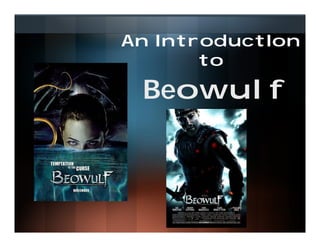
An IntroductIon 
to 
Beowulf
Beowulf 
1st great work of English national literature 
Composed between 700-750, but depicts 
earlier time period…early 6th century. 
An example of “heroic literature” and, as such, 
is composed of many traditionalmotifs and 
recurring elements. 
Beowulf’s name means “Bear”…?? 
The epic is a mythical and literary record of 
the formative stages of English civilization.
Beowulf 
Story handed down orally for 
generations, naturally with changes and 
embellishments. 
3,200 lines long 
Poet unknown…scholars think it was 
originally told by someone of pagan 
religion but recorded by amonk due to 
Christian elements present in the story.
So, why iS Beowulf an important 
work of literature? 
1. It is an expression of Anglo-Saxon values and 
attitudes: 
 Warfare was the order of the day 
 Fatalism 
 Courage, loyalty and honor 
 The battle of Good versus Evil 
 Boasting 
 Storytelling (bards/scops held key to 
immortality)
So, why iS Beowulf an important 
work of literature? 
2. It is an archetypal example of an epic: 
 Long 
 Narrative 
 Adventures of a central hero with 
supernatural powers 
 Worldwide or cosmic setting 
 Major battle scenes 
 Discussion of hero’s weaponry 
 Participation by God (or Gods) in 
action
So, why iS Beowulf an important 
work of literature? 
3. It is an example of Old English poetry: 
 4-beat rhythm 
 No rhyme 
 Alliteration 
 Kennings 
 Caesuras
• Journal Entry! 
– On the last page of your notes, pick one of the 
journal topics and respond to it in the space 
provided. 
– I will collect your notes after the test on Beowulf and 
the Anglo Saxon time period, so make sure you do 
not lose the packet!

Beowulf ppt

  • 1.
    The Anglo-Saxons: 449–1066 Introduction to the Literary Period
  • 2.
    The Anglo-Saxons: 449–1066 300s B.C. Celts in Britain 55 B.C–A.D.409 Roman Occupation A.D. 449 Anglo-Saxon Invasion A.D. 400–699 Spread of Christianity A.D. 1066 Norman Invasion A.D.878 King Alfred against the Danes A.D. 600 A.D. 300 A.D. 1 300 B.C. A.D. 900 A.D. 1200
  • 3.
    The Celts inBritain Before and during the 4th century B.C. • Britain home to several Celtic tribes • Celtic religion a form of animism (belief that Gods/spirits controlled all aspects of life and could take the form of trees, rivers, fire, thunder, etc) Stonehenge • Britain named for one Celtic tribe—the Brythons • King Arthur – famous Celtic King (516?)
  • 4.
    The Roman Occupation 55 B.C. Hadrian’s Wall Julius Caesar invades Britain A.D. 43 Celts defeated by Claudius • Romans build walls, villas, baths, roads A.D. 409 Romans evacuate their troops • Central government breaks down Roman ruins • Britain left vulnerable to attack
  • 5.
    The Anglo-Saxon Invasion Jutes Angles Saxons Celts A.D. 449 The Anglo-Saxons push the Celts into the far west of the country.
  • 6.
    The Anglo-Saxon Invasion Anglo-Saxon Society • Warrior-based society, led by strong warrior chief • “Warfare was the order of the day” (between clans, tribes, and outside invaders) • Anglo-Saxon life was dominated by the need to protect the clan and home from enemies. • Fame and success were achieved through loyalty to a leader, and success was measured by gifts received from leaders.
  • 7.
    The Anglo-Saxon Invasion • Women had many rights in Anglo-Saxon society. Women inherited and held property (even when married) and were offered substantial gifts of money and land from prospective husbands. • English emerged as a written language The Anglo-Saxon Chronicle
  • 8.
    The Anglo-Saxon religion • offered no hope of an afterlife…only fame offered immortality and provided a defense against death. • valued concept of the “Heroic Ideal”…earthly virtues of bravery, loyalty, generosity, and friendship. Norse god Anglo-Saxon god Day of week Odin Woden Thor Thunor Wednesday Thursday The Anglo-Saxon Invasion
  • 9.
    The Anglo-Saxon Invasion The Anglo-Saxon bards • called “scops” Why were the scops important? • Anglo-Saxons did not believe in an afterlife • warriors gained immortality through songs preserved in the collective memory. Anglo-Saxon harp • skilled storytellers and honored members of society. • sang of heroic deeds • regarded as equals to warriors
  • 10.
    King Alfred theGreat against the Danes 8th–9th centuries Vikings, called Danes, invade Britain 871 Alfred of Wessex becomes king of England. 878 King Alfred unifies the Anglo-Saxons against the Danes. England becomes a nation. King Sweyn and his Danish troops arrive in England, from a manuscript (c. 14th century) * Alfred was also know for reviving an interest in learning and the English language.
  • 11.
    The Spread ofChristianity Around A.D. 400 • Christian monks settle in Britain • Christianity and Anglo-Saxon culture co-exist By A.D. 699 • British pagan religions replaced by Christianity
  • 12.
    The Norman Invasion • William of Normandy crosses the English Channel • French replaces English as the language of the ruling class The Norman Invasion, Bayeux Tapestry 1066 • William defeats Harold and Anglo-Saxon army
  • 13.
    Literature of thePeriod • Leading Genres: Poetry and Riddles o Epics (narrative/story-like) o Elegiac mood (somber, sorrowful tone) o Strong rhythm and no rhyme o Lyrical (focuses more on emotion)
  • 14.
    Terms • Animism– Celtic belief that Gods/spirits controlled all aspects of life and could take the form of tress, rives, fire, thunder, etc. • Fatalism – Anglo-Saxon belief that the course of one’s life was pre-determined by fate. • Bards – skilled storytellers and honored members of society. The Anglo-Saxons called them “scops” and they were not regarded as inferior to warriors…actually, the Anglo-Saxons viewed creating poetry as important as fighting, hunting, farming, and loving (because of religion). • Vernacular – language of the people > Old English. • Alliteration – repetition of consonant sounds at the beginning of words (ex: the wind whips through the woods). • Caesura – rhythmical pause separating a line of verse into halves. • Kennings – descriptive compound words that evoke vivid images (“sea-stallions” and “whale-road”). • Epic – a long, narrative poem that relates the great deeds of a larger than life hero who embodies (is made up of and reflects) the values of a particular society.
  • 15.
  • 16.
    Beowulf 1st greatwork of English national literature Composed between 700-750, but depicts earlier time period…early 6th century. An example of “heroic literature” and, as such, is composed of many traditionalmotifs and recurring elements. Beowulf’s name means “Bear”…?? The epic is a mythical and literary record of the formative stages of English civilization.
  • 17.
    Beowulf Story handeddown orally for generations, naturally with changes and embellishments. 3,200 lines long Poet unknown…scholars think it was originally told by someone of pagan religion but recorded by amonk due to Christian elements present in the story.
  • 18.
    So, why iSBeowulf an important work of literature? 1. It is an expression of Anglo-Saxon values and attitudes:  Warfare was the order of the day  Fatalism  Courage, loyalty and honor  The battle of Good versus Evil  Boasting  Storytelling (bards/scops held key to immortality)
  • 19.
    So, why iSBeowulf an important work of literature? 2. It is an archetypal example of an epic:  Long  Narrative  Adventures of a central hero with supernatural powers  Worldwide or cosmic setting  Major battle scenes  Discussion of hero’s weaponry  Participation by God (or Gods) in action
  • 20.
    So, why iSBeowulf an important work of literature? 3. It is an example of Old English poetry:  4-beat rhythm  No rhyme  Alliteration  Kennings  Caesuras
  • 21.
    • Journal Entry! – On the last page of your notes, pick one of the journal topics and respond to it in the space provided. – I will collect your notes after the test on Beowulf and the Anglo Saxon time period, so make sure you do not lose the packet!